


Abstract
The surging popularity of plant-based diets and the growing emphasis on clean-label products have intensified interest in Spirulina within the food industry. As more people adopt vegetarian, vegan, or flexitarian lifestyles, demand for plant-based protein sources has escalated. Spirulina’s high protein content and complete amino acid profile make it an ideal candidate to meet this demand. However, incorporating Spirulina into food products is not without its challenges. Its strong, earthy, or fishy taste can be off-putting to consumers and difficult to mask in food formulations. Furthermore, isolating Spirulina’s bioactive compounds while preserving their integrity is complex, especially considering the heat sensitivity of many of these components. Traditional extraction methods often employ high temperatures, which can degrade these valuable compounds. Consequently, there is a growing preference for non-thermal extraction techniques. This paper provides an overview of recent advancements in Spirulina cultivation, bioactive extraction, and their application in food products.
1. Introduction
The food industry is increasingly oriented toward using Spirulina due to its remarkable nutritional benefits, functional properties, and alignment with contemporary consumer trends emphasizing health, sustainability, and natural ingredients [1,2,3,4]. Spirulina, a blue-green alga, is celebrated as a superfood because it is incredibly nutrient-dense. It comprises about 60–70% protein by dry weight, making it one of the most protein-rich foods available [5,6,7]. Spirulina is a complete protein, containing all essential amino acids, which is particularly beneficial for vegetarians, vegans, and those seeking to increase their protein intake. Additionally, it is a rich source of vitamins and minerals, including B vitamins, iron, calcium, magnesium, and potassium, which are crucial for various bodily functions such as energy production and immune support [8,9,10].
The rise of plant-based diets and the clean-label movement has further fueled the food industry’s interest in Spirulina. As more consumers adopt vegetarian, vegan, or flexitarian lifestyles, there is a growing demand for plant-based protein sources [11,12,13,14]. Spirulina fits this demand perfectly due to its high protein content and complete amino acid profile. Furthermore, its use as a natural colorant aligns with the increasing preference for products free from synthetic additives. The blue-green pigments, particularly phycocyanin, not only enhance the visual appeal of food products but also add nutritional value due to their antioxidant properties [15,16,17]. The environmental sustainability of Spirulina cultivation is another significant driver. Spirulina requires less land, water, and energy compared to traditional livestock farming and generates lower greenhouse gas emissions [18,19]. This makes it a sustainable alternative that can help reduce the ecological footprint of food production, appealing to eco-conscious consumers and companies.
Despite its numerous benefits, incorporating Spirulina into food products presents several challenges and limitations. One of the primary challenges is its strong, distinctive flavor, often described as earthy or fishy, which can be off-putting to some consumers and difficult to mask in food formulations [20,21]. This strong flavor can limit the versatility of Spirulina in various culinary applications. Additionally, the vibrant blue-green color of Spirulina, while appealing in some contexts, may not be suitable for all types of food products, especially those where a natural appearance is desired [22]. Stability is another concern. Some of Spirulina’s bioactive compounds, such as phycocyanin, are sensitive to heat and light, leading to degradation during processing and storage [23]. This degradation can reduce the nutritional and functional benefits of the final product. Ensuring consistent quality and safety of Spirulina can also be challenging due to variations in cultivation and harvesting practices. Compliance with regulatory standards and food safety measures is crucial to prevent contamination and ensure consumer safety [24,25,26,27,28,29]. Isolating bioactive compounds from Spirulina involves several challenges, including maintaining the integrity and functionality of heat-sensitive compounds [30]. Traditional extraction methods often involve high temperatures, which can degrade these sensitive bioactives. Non-thermal extraction techniques are increasingly preferred to address this issue. In this work overview of the latest finding regarding Spirulina spp. cultivation, the extraction of bioactives and implementation of the Spirulina in food products are given.
2. Spirulina spp. Cultivation
Representatives of the genus Arthrospira (Spirulina) cyanobacteriae, such as Spirulina platensis, Spirulina maxima, Spirulina pacifica, and Spirulina fusiformis, are widely used in photobiotechnology as a source of protein, essential amino acids, vitamins (especially B vitamins), β-carotene, and other vital compounds. Spirulina, renowned for its impressive nutritional profile, was cultivated by the Aztecs in the 16th century in the salty waters of Lake Texcoco. They dried the harvested algae and commercialized it as dehydrated cakes, recognizing its value as a nutritious food source [31]. Since the 1960s, Spirulina has been produced in industrial-scale cultivation systems and marketed globally. In 2003, the US Food and Drug Administration (FDA) granted Spirulina “GRAS” (Generally Recognized as Safe) status. Interestingly, a phenomenon known as “spiruliners” has emerged in southern France. Some farmers have transitioned from traditional agricultural practices to producing Spirulina biomass. The French Federation of Spirulina Producers (Fédération des Spiruliniers de France) now has around 150 members (http://www.spiruliniersdefrance.fr, accessed on 15 January 2024). This trend could also be feasible for many African countries, which have a favorable climate for Spirulina cultivation. Moreover, the Food and Agriculture Organization (FAO) recommends Spirulina cultivation as one of the viable solutions during humanitarian crises [32]. The cultivation of Spirulina requires significantly less space than conventional farming, such as poultry and vegetable farms, using around 49 to 132 times less area [33].
Spirulina thrives in alkaline conditions (pH 8.5–11), making its culture resistant to contamination by bacteria and other microalgae. The two most important species of Spirulina are Spirulina maxima and Spirulina platensis. It forms trichomes (helixes) about 0.5 mm in length, which are sufficiently large to allow for simple and cost-effective separation from the culture media through filtration [32]. Spirulina is cultivated in numerous countries, including Israel, the United States, India, China, Japan, Taiwan, Italy, Germany, Thailand, France, and Egypt. The cultivation methods involve open cultivation in artificial ponds, advanced open photobioreactors using sunlight, and closed photobioreactors with artificial lighting and controlled temperatures. The advantages of these cultivation methods include the ease of harvesting and drying the biomass, the efficient extraction of cell contents, and high biological value [34].
Currently, two main technologies are utilized for cultivating Spirulina: closed photobioreactors (PBRs) and open ponds. Both approaches are commercially employed to produce high-value products [35]. Another classification criterion is the source of illumination—artificial or solar. However, for sustainable large-scale microalgae production, only solar cultivation systems are considered feasible. Branyikova and Lucakova [32] reported that the most important requirements for a cultivation system are the following:
- Suitable illumination: Both low and excessive light can limit microalgal growth. The PBR’s geometry and location determine the amount and distribution of light throughout the day and year, affecting the cultivation season length.
- Adequate carbon dioxide supply: Atmospheric CO2 levels are too low for optimal microalgae growth. Depending on the system, CO2 concentrations from 1 to 100% in the aeration gas are used.
- Efficient mixing: This prevents microalgae from settling and biofilm formation, ensuring uniform light distribution and promoting photosynthesis through short light/dark cycles.
- Appropriate construction material: It should prevent biofilm formation, be durable, resistant to solar radiation, and suitable for saline water.
- Effective oxygen release: Excess oxygen from photosynthesis can lower productivity by reducing photosynthetic activity. Managing oxygen levels is crucial.
- Suitable temperature: Overheating from sunlight can damage microalgae. In open systems, water evaporation helps control temperature, while closed systems require thermostatic regulation or surface spraying.
- Ease of cleaning and operation: The PBR should be easy to clean, sanitize, and operate effectively [36].
A significant drawback of Spirulina cultivation is the high cost of chemical-based culture media. Currently, many companies use chemical-based media such as Zarrouk, Conway, and Kosaric for Spirulina cultivation. Zarrouk’s medium has long been recognized as the standard and optimal medium for various Spirulina species. In large-scale industrial production, it remains the sole conventional medium used for Spirulina cultivation [37]. Comprising primarily sodium bicarbonate, along with sodium nitrate, potassium sulfate, magnesium sulfate, calcium chloride, and dipotassium hydrogen phosphate, Zarrouk’s medium supports efficient biomass growth by providing essential nutritional supplements [38]. However, the Zarrouk culture medium is not sustainable in the long run due to its high cost [39]. At approximately USD 0.08 per liter, it represents about 35% of the total cost of algal biomass production [40]. Therefore, the scientific community has been exploring various alternative nutrient sources, such as seawater, vermicompost, and wastewater, to reduce the cost of chemical-based culture media. Among these, wastewater shows promise as an alternative nutrient source [41]. An overview of the current challenges and appropriate solutions in Spirulina spp. cultivation is presented in Table 1.

Table 1.
The challenges and potential solutions in Spirulina spp. cultivation.
3. Nutritional Value of Spirulina (Macronutrients and Micronutrients)
Spirulina (Arthrospira) is the most nutritious and concentrated food known to mankind, rich in antioxidants, phytonutrients, probiotics, and nutraceuticals [49,50,51]. Its impressive nutrient composition makes it a promising solution to various dietary demands and suitable for therapeutic uses. These species have a high content of micro- and macronutrients. Their cell wall is composed of polysaccharides with a digestibility of 86%, making them easily absorbed by the human body. Spirulina is indeed a nutrient-rich source, containing a significant amount of protein (60–70% of its dry weight) and essential amino acids (47% of the total protein weight) which makes them complete proteins [35]. Remarkably, the protein proportion of Spirulina is higher than that of commonly used plant or animal protein sources, such as soybeans (35%), peanuts (25%), cereals (8–14%), meat and fish (15–25%), eggs (12%), milk powder (35%), and whole milk (3%). The protein content of Spirulina can vary by 50–75% depending on the time of harvest, with the highest protein values typically obtained from those harvested at early daylight [51]. In addition to its high protein content, Spirulina is rich in carbohydrates (15–25%), primarily polysaccharides (glucosans and rhamnosans) and mono- or disaccharides (glucose, fructose, and sucrose). It also contains lipids (6–8%), with a significant portion being essential fatty acids (1.3–15%), predominantly palmitic acid, γ-linolenic acid (GLA), linoleic acid, and oleic acid. Spirulina provides all essential minerals (7–13%), including potassium, calcium, chromium, copper, iron, magnesium, manganese, phosphorus, selenium, sodium, and zinc. It is also rich in vitamins, particularly several B vitamins (B1, B2, B3, B6, B9, and B12), as well as provitamin A and vitamins C, D, and E. Additionally, Spirulina contains natural photosynthetic pigments, serving as the main source of phycocyanin (14–20%), along with chlorophylls (1%) and carotenoids (0.5%). The average amounts of the most important groups of nutrients in Spirulina are presented in Figure 1a. Phycocyanin is a blue, water-soluble phycobiliprotein that remains stable at pH levels ranging from 5 to 8 and is found in blue algae. Other significant phycobiliproteins, such as phycoerythrin (red) and allophycocyanin (blue), are also present in microalgae from the Spirulina genus. Chlorophyll is a phytochemical responsible for the green color of this microalgae and plays a crucial role in the photosynthesis process. Flavonoids and phenolic acids are the primary classes of phenolic compounds found in Spirulina [3,35,52,53]. Unlike its protein content, Spirulina contains less fat, which makes it less susceptible to lipid oxidation and rancidity. Generally, Spirulina contains 6–8% lipids by dry weight, but this can reach up to 11%. The fatty acids composition and profile of a particular Spirulina species, which range from 12 to 22 carbons in length, are influenced by various factors such as the composition of the growth medium, aeration rate, temperature, light/dark cycle ratio, and illumination intensity. The antioxidant compounds present in Spirulina include polyunsaturated fatty acids, phycocyanin, phenolics, β-carotene (about 30 times higher than in carrots), other carotenoids, and vitamin E. These components are believed to be responsible for Spirulina’s therapeutic properties. The application of carotenoids in foods includes their use as additives for coloring and flavoring, as well as for vitamin A supplementation [54]. The main carotenoids found in Spirulina are β-carotene, canthaxanthin, astaxanthin, lutein, and zeaxanthin. The extraction of polyunsaturated fatty acids (especially GLA) from Spirulina is costly, making direct consumption of Spirulina as a nutritional supplement the most cost-effective way to obtain GLA [37,55]. It is important to mention that there are differences in nutrient status among the various species of Spirulina, including Spirulina platensis, Spirulina maxima, Spirulina pacifica, and Spirulina fusiformis. While all these species share a similar nutritional profile, there are variations in the concentrations of specific nutrients due to differences in their growth environments, cultivation conditions, and genetic makeup. The comparison of the key nutritional aspects among these species is given in Figure 1b.
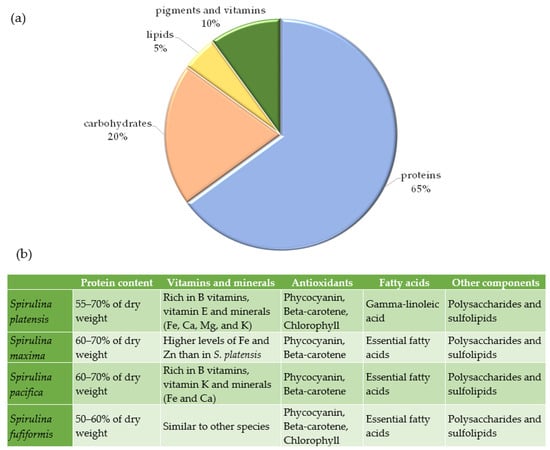
Figure 1.
(a) The average amounts of the most important groups of nutrients in Spirulina. (b) Differences in nutrient status among the various species of Spirulina, including Spirulina platensis, Spirulina maxima, Spirulina pacifica, and Spirulina fusiformis [7,37,56,57,58,59,60,61].
4. Bioactives’ Extraction from Spirulina
The extraction of bioactive compounds from Spirulina is a promising field that enhances the potential health benefits of this microalgae. Traditional extraction methods for Spirulina focus on simplicity and cost-effectiveness, often prioritizing basic mechanical and chemical processes. These methods include the following: (i) Mechanical Disruption: This involves physically breaking down Spirulina cells using grinding, milling, or bead beating. While effective for extracting bulk components like proteins and lipids, this method can result in the loss of sensitive bioactive compounds due to heat and oxidative stress; (ii) Solvent extraction: Organic solvents such as hexane, ethanol, or acetone have traditionally been used to extract lipids, pigments, and other hydrophobic compounds from Spirulina. This method is straightforward but can be less selective, leading to the co-extraction of unwanted materials and potential solvent residues in the final product; and (iii) Alkaline and Acidic Extraction: Proteins and polysaccharides are often extracted using alkaline or acidic conditions to solubilize the components, followed by precipitation and purification [61,62,63,64]. This method can degrade sensitive molecules and reduce the overall bioactivity of the extracts.
Spirulina, particularly species like Spirulina platensis, Spirulina maxima, Spirulina pacifica, and Spirulina fusiformis, is rich in a variety of bioactive compounds including phycocyanin, polysaccharides, phenolic acids, tocopherols, and polyunsaturated fatty acids. The list of key components of Spirulina that contribute to their therapeutic potential, along with their mechanisms of action are given in Table 2.
Table 2.
Key components of Spirulina that contribute to their therapeutic potential, along with their mechanisms of action.
Polysaccharides, a significant group of bioactive compounds in Spirulina, exhibit immunomodulatory and anti-cancer properties. These can be extracted through hot water extraction methods, followed by alcohol precipitation and dialysis [75,87,88] (Table 3). The extracted polysaccharides are used in various health supplements to boost immune function and improve gut health. Phenolic acids and tocopherols, known for their antioxidant activities, can be extracted using organic solvents like ethanol or methanol. These compounds contribute to a reduction in oxidative stress and the prevention of chronic diseases. The solvent extraction method is often followed by techniques such as solid-phase extraction or high-performance liquid chromatography (HPLC) for further purification and quantification. Polyunsaturated fatty acids, including gamma-linolenic acid (GLA), are extracted using supercritical fluid extraction or solvent extraction techniques. These fatty acids are essential for cardiovascular health, inflammation reduction, and overall metabolic function.
Table 3.
Limitations in bioactive extraction form of Spirulina.
Phycocyanin, a vibrant blue pigment with potent antioxidant and anti-inflammatory properties, is one of the most studied bioactive compounds in Spirulina. It can be efficiently extracted using aqueous buffers, often followed by purification steps like ammonium sulfate precipitation and chromatography. This pigment is not only valued for its health benefits but also as a natural colorant in the food industry. Methods for extracting and purifying phycocyanin from Spirulina are being developed in applied research laboratories [107]. Several methods for extracting phycocyanin have been described in the literature, including freeze/thaw, mixing/homogenization, bead milling, ultrasonic, moderate electric field, pulsed electric fields, high-pressure homogenization, microwaves, high-pressure processing, and enzymatic extraction (Figure 2).
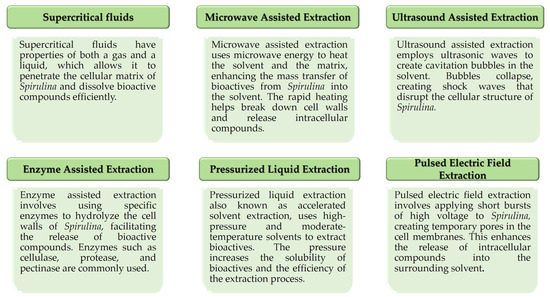
Figure 2.
Advantages of using the most-used non-thermal extraction methods for extracting the bioactive form of Spirulina.
However, only some of these methods provide reliable purity values and have detailed comparisons of optimal conditions and parameters (Table 4). The choice of the best method depends on factors such as time, cost, and yield, as well as the intended amount of phycocyanin, whether the production is small or large scale, and the final application of the product [52]. The extraction of C-phycocyanin (C-PC) is primarily influenced by several physical and chemical variables: temperature, pH, solvent type, biomass-to-solvent ratio, and the form of the biomass (dried or fresh) [16]. C-PC extraction can be carried out at moderate temperatures (up to 50 °C), neutral pH values (6–8), and with precautions to prevent light exposure. At the laboratory scale, Spirulina cells are typically disrupted using freezing and thawing cycles, which often yield relatively high-purity extracts. Despite its common use, this method lacks comprehensive optimization studies. Future research should focus on optimizing parameters such as the number of cycles, duration, temperature, solvent type, and biomass-to-solvent ratio [108]. Mechanical cell disruption methods, such as bead milling and ultrasound, are more amenable to scaling up. However, these methods often produce extracts with lower purity due to the intense cell disruption, necessitating a subsequent purification step after extraction [52,109]. Microwave extraction has the disadvantage of requiring relatively high temperatures, which are not ideal for C-PC extraction [107]. While moderate electric fields (MEFs) offer potential, further research is needed to fully understand their effects on Spirulina cells [16]. Other methods, such as mixing and homogenization, tend to be time-consuming and often result in extracts with lower purity [110]. Regarding high-pressure processing (HPP), further studies are needed to optimize the extraction process and prevent C-phycocyanin degradation [111]. Among the reviewed extraction methods, pulsed electric fields (PEFs) appear to be the most promising technology for C-PC extraction, as they yield highly concentrated extracts with relatively high purity [112]. Enzymatic extraction is increasingly recognized for its potential as a more efficient and eco-friendlier alternative to traditional methods. This technique can be conducted at lower temperatures and pressures, which helps to preserve the stability and quality of phycocyanin. In one study, effective extraction of phycocyanin was achieved using Collupulin protease in combination with the application of a pulsed electric field. This combination of a pulsed electric field with enzymes presents a promising technology for phycocyanin extraction [113].
Table 4.
Overview of some examples of extraction processes of bioactive form of Spirulina spp.
5. Spirulina spp. as Functional Food
Spirulina boasts an excellent nutritional and bioactive composition, making it valuable to both the food and pharmaceutical industries. The bioactive compounds it contains enable its incorporation into various food formulations. Consequently, Spirulina can be highlighted for diverse applications, such as a protein supplement for vegans, a blue dye for infant formulas, a source of pro-vitamin A for the general population, and for creating potentially functional foods [3]. One of the most compelling aspects of Spirulina in functional foods is its potential to combat malnutrition [136]. In regions where protein and micronutrient deficiencies are prevalent, incorporating Spirulina into staple foods could significantly improve the nutritional status of the population [10,85,137]. Its ability to thrive in harsh environmental conditions and its rapid growth rate make it a sustainable and efficient option for large-scale cultivation, offering a reliable source of nutrition in food-insecure areas [59,138,139].
Spirulina’s antioxidant properties, primarily derived from compounds like phycocyanin, chlorophyll, and carotenoids, contribute to its appeal as a functional food ingredient [84,140,141,142]. These antioxidants play a crucial role in neutralizing free radicals, reducing oxidative stress, and preventing chronic diseases such as cardiovascular diseases, diabetes, and cancer. By incorporating Spirulina into everyday foods such as smoothies, energy bars, pasta, and even baked goods, manufacturers can create products that support health and wellness while appealing to health-conscious consumers [3] (Table 5). Currently, due to a greater demand for natural compounds, the large-scale cultivation of Spirulina is focused on the production of high-value proteins, mainly phycocyanin (blue pigment), which, according to its purity grade, can be used in food and other industries [143]. Like any food or dietary supplement, commercialized Spirulina is regulated to ensure its safety and quality. This includes adhering to requirements for the production process to prevent contaminants (such as microcystins, toxic metals, and pathogenic bacteria), as well as regulations for labeling and packaging [52]. Spirulina is an excellent complete nutritional food source, providing protein, beta-carotene, GLA, B vitamins, minerals, chlorophyll, sulfolipids, glycolipids, superoxide dismutase, phycocyanin, enzymes, RNA, and DNA. It supplies many nutrients that are often lacking in most people’s diets. The lipid profile of Spirulina consists of saturated fatty acids (SFAs), monounsaturated fatty acids (MUFAs), and polyunsaturated fatty acids (PUFAs). Notably, the polyunsaturated fatty acids in Spirulina have the potential to be utilized in specialized diets for managing lipid metabolism disorders [144]. Furthermore, Spirulina contains all nine essential amino acids, as well as other amino acids that form the proteins in these microalgae. This nutritional matrix includes essential amino acids like tryptophan, threonine, leucine, lysine, methionine, phenylalanine, histidine, and valine, which the human body cannot produce on its own. Therefore, Spirulina is a valuable source of both essential and non-essential amino acids, with the potential to enhance foods that have low protein content [3]. Spirulina is gaining attention due to its potent antiviral, anti-cancer, hypocholesterolemic, and health-improving properties. Spirulina offers a range of health benefits. It helps athletes maintain long-lasting energy and vitality, supports digestion, assimilation, and elimination, and aids in preventing diabetes [77,145,146,147,148,149]. It also helps reduce stress and depression while contributing to weight loss due to its concentrated nutrients. Additionally, it promotes tissue repair in wounds and burns, possesses anti-infectious properties, decreases cholesterol levels, lowers cardiovascular disease risk, acts as an anti-inflammatory agent, and reduces arthritis inflammation [35].
Table 5.
Examples of Spirulina-enriched food products.
6. Conclusions and Future Perspectives
Spirulina, a nutrient-rich cyanobacterium, has garnered significant attention for its remarkable biological activities and nutritional properties, positioning it as a promising ingredient in the food industry [3]. Known for its high protein content, essential amino acids, vitamins, and minerals, Spirulina is increasingly being utilized in a wide array of food products, supplements, and functional foods. The future applications of Spirulina, particularly in the food sector, are both diverse and expansive, offering substantial benefits for health and nutrition.
One of the most promising uses of Spirulina in the food industry is its incorporation into bakery products. By adding Spirulina to items like bread, cookies, and pasta, manufacturers can significantly boost the nutritional value of these staples [3]. Spirulina not only enriches these products with essential nutrients but also adds a vibrant green hue, appealing to health-conscious consumers seeking natural, nutrient-dense foods. The microalga’s ability to enhance the nutritional profile of everyday foods makes it an ideal ingredient for developing functional foods that support overall health and wellness. Beyond bakery products, Spirulina is also making its mark in the beverage industry. Its inclusion in smoothies, juices, and health drinks provides a natural source of energy, antioxidants, and immune-boosting properties. The versatility of Spirulina allows it to be used in various formulations, catering to the growing demand for plant-based and superfood beverages. Moreover, Spirulina-based supplements, including powders, capsules, and tablets, are increasingly popular in the dietary supplement market. These products are marketed for their potential to support immune function, improve digestion, and enhance overall vitality. In addition to its direct applications in food and beverages, Spirulina’s bioactive components are being explored for innovative uses in active packaging. This type of packaging can extend the shelf life of food products by inhibiting microbial growth, leveraging the natural antimicrobial properties of Spirulina. Furthermore, Spirulina’s antioxidant-rich profile is being utilized in the development of biomedical dressings, which can aid in wound healing and skin regeneration.
The commercial production of Spirulina is dominated by the species Arthrospira platensis, which accounts for an annual production of approximately 10,000 tons, with China leading as the largest producer, contributing to about 66% of the global output [168]. As interest in Spirulina continues to rise, the global market is projected to reach USD 968.6 million by 2028, with a Compound Annual Growth Rate (CAGR) of 13.2% from 2021 to 2028. While North America currently dominates the market, significant growth is expected in the Asia–Pacific region, driven by increasing demand for dietary supplements, efforts to combat malnutrition, favorable climatic conditions, and cost-effective production [169].
To meet the growing demand, producers are focusing on optimizing Spirulina cultivation to improve both economic feasibility and environmental sustainability. Innovations in production processes include the utilization of residual biomass and the recycling of waste resources, aligning with the principles of a circular economy. Even after extracting valuable compounds like phycocyanin, the remaining Spirulina biomass retains high levels of antioxidants, vitamins, and minerals, making it a valuable resource for skincare and cosmetic products. Spirulina’s extensive health benefits and versatile applications make it an invaluable asset in the food industry. As research and technological advancements continue to unlock new possibilities, Spirulina is poised to play a crucial role in shaping the future of nutrition, health, and sustainable food production [52].
Author Contributions
Conceptualization, A.J.T. and B.M.; methodology, A.J.T.; software, M.B. and D.V.; formal analysis, T.S.C. and B.M.; investigation, A.J.T., B.M. and T.J. data curation, T.J.; writing—original draft preparation, B.M. and A.J.T.; writing—review and editing, D.V., M.B., T.J., J.G.K. and A.J.T.; visualization, M.B. and T.S.C. All authors have read and agreed to the published version of the manuscript.
Funding
This research received no external funding.
Data Availability Statement
No new data were created or analyzed in this study.
Conflicts of Interest
The authors declare no conflicts of interest.
References
- AlFadhly, N.K.Z.; Alhelfi, N.; Altemimi, A.B.; Verma, D.K.; Cacciola, F. Tendencies Affecting the growth and cultivation of genus Spirulina: An investigative review on current trends. Plants 2022, 11, 3063. [Google Scholar] [CrossRef]
- Soma, K.; Kals, J.; Opiyo, M.A.; Ndambi, A.; García-Cubero, R.; Barbosa, M.J.; Rurangwa, E.; Vernooij, A. Toward sustainable food systems: Can Spirulina (Arthrospira platensis) become a sustainable source of protein to enhance the nutritional benefits of cultured Nile tilapia (Oreochromis niloticus)? Front. Sustain. Food Syst. 2024, 8, 1283150. [Google Scholar] [CrossRef]
- Bortolini, D.G.; Maciel, G.M.; Fernandes, I.d.A.A.; Pedro, A.C.; Rubio, F.T.V.; Branco, I.G.; Haminiuk, C.W.I. Functional properties of bioactive compounds from Spirulina spp.: Current status and future trends. Food Chem. Mol. Sci. 2022, 5, 100134. [Google Scholar] [CrossRef] [PubMed]
- Istijanto; Arifin, Y.; Nurhayati. Examining costumer satisfaction and purchase intention toward a new product before its lauch: Cookies enricher with spirulina. Cogent. Bus. Manag. 2023, 10, 2257346. [Google Scholar] [CrossRef]
- Saraswathi, K.; Kavitha, C.N. Spirulina: Pharmacological Activities and Health Benefits. J. Young Pharm. 2023, 15, 441–447. [Google Scholar] [CrossRef]
- Seyidoglu, N.; Inan, S.; Aydin, C.; Seyidoglu, N.; Inan, S.; Aydin, C. A Prominent superfood: Spirulina platensis. In Superfood and Functional Food—The Development of Superfoods and Their Roles as Medicine; Shiomi, N., Waisundara, V., Eds.; InTech: London, UK, 2017; pp. 1–28. [Google Scholar]
- Gutiérrez-Salmeán, G.; Fabila-Castillo, L.; Chamorro-Cevallos, G. Revisión Nutritional and toxicological aspects of Spirulina (Arthrospira). Nutr. Hosp. 2015, 32, 34–40. [Google Scholar]
- Mathur, M. Bioactive Molecules of Spirulina: A food supplement. In Bioactive Molecules in Food; Mérillon, J.M., Ramawat, K., Eds.; Reference Series in Phytochemistry; Springer: Cham, Switzerland, 2017. [Google Scholar]
- Sorrenti, V.; Castagna, D.A.; Fortinguerra, S.; Buriani, A.; Scapagnini, G.; Willcox, D.C. Spirulina microalgae and brain Health: A scoping review of experimental and clinical evidence. Mar. Drugs 2021, 19, 293. [Google Scholar] [CrossRef]
- Wu, J.Y.; Tso, R.; Teo, H.S.; Haldar, S. The utility of algae as sources of high value nutritional ingredients, particularly for alternative/complementary proteins to improve human health. Front. Nutr. 2023, 10, 1277343. [Google Scholar] [CrossRef]
- Alcorta, A.; Porta, A.; Tárrega, A.; Alvarez, M.D.; Pilar Vaquero, M. Foods for plant-based diets: Challenges and innovations. Foods 2021, 10, 293. [Google Scholar] [CrossRef]
- Perez-Cueto, F.J.A.; Rini, L.; Faber, I.; Rasmussen, M.A.; Bechtold, K.B.; Schouteten, J.J.; De Steur, H. How barriers towards plant-based food consumption differ according to dietary lifestyle: Findings from a consumer survey in 10 EU countries. Int. J. Gastron. Food Sci. 2022, 29, 100587. [Google Scholar] [CrossRef]
- Fehér, A.; Gazdecki, M.; Véha, M.; Szakály, M.; Szakály, Z. A comprehensive review of the benefits of and the barriers to the switch to a plant-based diet. Sustainability 2020, 12, 4136. [Google Scholar] [CrossRef]
- Sanchez-Sabate, R.; Sabaté, J. Consumer attitudes towards environmental concerns of meat consumption: A systematic review. Int. J. Environ. Res. Public Health 2019, 16, 1220. [Google Scholar] [CrossRef]
- Yuan, B.; Li, Z.; Shan, H.; Dashnyam, B.; Xu, X.; McClements, D.J.; Zhang, B.; Tan, M.; Wang, Z.; Cao, C. A review of recent strategies to improve the physical stability of phycocyanin. Curr. Res. Food Sci. 2022, 5, 2329–2337. [Google Scholar] [CrossRef] [PubMed]
- Pez Jaeschke, D.; Rocha Teixeira, I.; Damasceno Ferreira Marczak, L.; Domeneghini Mercali, G. Phycocyanin from Spirulina: A review of extraction methods and stability. Food Res. Int. 2021, 143, 110314. [Google Scholar] [CrossRef] [PubMed]
- e Silva, A.d.S.; de Magalhães, W.T.; Moreira, L.M.; Rocha, M.V.P.; Bastos, A.K.P. Microwave-assisted extraction of polysaccharides from Arthrospira (Spirulina) platensis using the concept of green chemistry. Algal Res. 2018, 35, 178–184. [Google Scholar] [CrossRef]
- Tzachor, A.; Smidt-Jensen, A.; Ramel, A.; Geirsdóttir, M. Environmental impacts of large-scale Spirulina (Arthrospira platensis) production in Hellisheidi Geothermal Park Iceland: Life Cycle Assessment. Mar. Biotechnol. 2022, 24, 991. [Google Scholar]
- Sabrin, A.; Shukri, M.; Najihah, A.; Nor, M.; Faiz, M.; Amin, M.; Sukhairi, M.; Rasat, M.; Abas, M.A. Greening Spirulina Value Chain Towards Environmental Sustainability in Malaysia. In BIO Web of Conferences; EDP Sciences: Les Ulis, France, 2023; p. 03005. [Google Scholar]
- Koli, D.K.; Rudra, S.G.; Bhowmik, A.; Pabbi, S. Nutritional, functional, textural and sensory evaluation of Spirulina enriched green pasta: A potential dietary and health supplement. Foods 2022, 11, 979. [Google Scholar] [CrossRef]
- Jalili, S.; Aryan, S.; Mousavinezhad, S.A.; Moeini, H.; Dehnad, D. Optimizing Spirulina platensis, Chlorella vulgaris microalgae and curcumin application in functional cheese production and investigating its physicochemical properties and sensory evaluation by RSM. J. Food Meas. Charact. 2023, 18, 1144–1157. [Google Scholar] [CrossRef]
- Herrera, M.; Viera, I.; Roca, M. Study of the authentic composition of the novel green foods: Food colorants and coloring foods. Food Res. Int. 2023, 170, 112974. [Google Scholar] [CrossRef]
- Shkolnikov Lozober, H.; Okun, Z.; Parvari, G.; Shpigelman, A. The Effect of Storage and Pasteurization (Thermal and High-Pressure) Conditions on the Stability of Phycocyanobilin and Phycobiliproteins. Antioxidants 2023, 12, 568. [Google Scholar] [CrossRef]
- Agostoni, C.; Bresson, J.-L.; Fairweather-Tait, S.; Flynn, A.; Golly, I.; Korhonen, H.; Lagiou, P.; Løvik, M.; Marchelli, R.; Martin, A.; et al. Scientific Opinion on Dietary Reference Values for carbohydrates and dietary fibre. EFSA J. 2016, 8, 1462. [Google Scholar]
- Koutsoumanis, K.; Allende, A.; Alvarez-Ordóñez, A.; Bolton, D.; Bover-Cid, S.; Chemaly, M.; Davies, R.; De Cesare, A.; Hilbert, F.; Lindqvist, R.; et al. Scientific Opinion on the update of the list of QPS-recommended biological agents intentionally added to food or feed as notified to EFSA (2017–2019). EFSA J. 2020, 18, e05966. [Google Scholar] [PubMed]
- Araújo, R.; Vázquez Calderón, F.; Sánchez López, J.; Azevedo, I.C.; Bruhn, A.; Fluch, S.; Garcia Tasende, M.; Ghaderiardakani, F.; Ilmjärv, T.; Laurans, M.; et al. Current status of the algae production industry in Europe: An emerging sector of the blue bioeconomy. Front. Mar. Sci. 2021, 7, 626389. [Google Scholar] [CrossRef]
- Cruz, J.D.; Vasconcelos, V. Legal Aspects of microalgae in the European food sector. Foods 2023, 13, 124. [Google Scholar] [CrossRef]
- Zrimec, M.B.; Sforza, E.; Pattaro, L.; Carecci, D.; Ficara, E.; Idà, A.; Ferrer-Ledo, N.; Canziani, S.; Mangini, S.; Lazar, B.; et al. Advances in Spirulina cultivation: Techniques, challenges, and applications. In New Insights Into Cyanobacteria—Fundamentals, Culture Techniques and Biotechnological Uses of Microalgae and Cyanobacteria; Sevaro, I.A.A., Martinez-Burgos, W., Ordonez, J., Eds.; InTech: London, UK, 2024; pp. 1–27. [Google Scholar]
- Pisanello, D.; Caruso, G. EU Regulation on Novel Foods. In Novel Foods in the European Union; Springer: Berlin/Heidelberg, Germany, 2018; pp. 1–29. [Google Scholar]
- Siddhnath; Surasani, V.K.R.; Singh, A.; Singh, S.M.; Hauzoukim; Murthy, L.N.; Baraiya, K.G. Bioactive compounds from micro-algae and its application in foods: A review. Discov. Food 2024, 4, 27. [Google Scholar] [CrossRef]
- Sánchez, A.S.; Nogueira, I.B.R.; Kalid, R.A. Uses of the reject brine from inland desalination for fish farming, Spirulina cultivation, and irrigation of forage shrub and crops. Desalination 2015, 364, 96–107. [Google Scholar] [CrossRef]
- Branyikova, I.; Lucakova, S. Technical and physiological aspects of microalgae cultivation and productivity—Spirulina as a promising and feasible choice. Org. Agric. 2021, 11, 269–276. [Google Scholar] [CrossRef]
- Khoo, K.S.; Chew, K.W.; Yew, G.Y.; Leong, W.H.; Chai, Y.H.; Show, P.L.; Chen, W.H. Recent advances in downstream processing of microalgae lipid recovery for biofuel production. Bioresour. Technol. 2020, 304, 122996. [Google Scholar] [CrossRef]
- Tambiev, A.K.; Vasilieva, S.G.; Lukyanov, A.A. Manifestation of salt tolerance of Spirulina platensis and Spirulina maxima cyanobacteria of the genus Arthrospira (Spirulina). Mosc. Univ. Biol. Sci. Bull. 2011, 66, 133–137. [Google Scholar] [CrossRef]
- Soni, R.A.; Sudhakar, K.; Rana, R.S. Spirulina—From growth to nutritional product: A review. Trends Food Sci. Technol. 2017, 69, 157–171. [Google Scholar] [CrossRef]
- Singh, R.N.; Sharma, S. Development of suitable photobioreactor for algae production—A review. Renew. Sustain. Energy Rev. 2012, 16, 2347–2353. [Google Scholar] [CrossRef]
- Ragaza, J.A.; Hossain, M.S.; Meiler, K.A.; Velasquez, S.F.; Kumar, V. A review on Spirulina: Alternative media for cultivation and nutritive value as an aquafeed. Rev. Aquac. 2020, 12, 2371–2395. [Google Scholar] [CrossRef]
- Pandey, J.; Tiwari, A.; Mishra, R. Evaluation of Biomass Production of Spirulina maxima on Different Reported Media. J. Algal Biomass Utln 2010, 1, 70–81. [Google Scholar]
- Costa, L.R.; Tonoli, G.H.D.; Milagres, F.R.; Hein, P.R.G. Artificial neural network and partial least square regressions for rapid estimation of cellulose pulp dryness based on near infrared spectroscopic data. Carbohydr. Polym. 2019, 224, 115186. [Google Scholar] [CrossRef] [PubMed]
- Yu, J.; Hu, H.; Wu, X.; Wang, C.; Zhou, T.; Liu, Y.; Ruan, R.; Zheng, H. Continuous cultivation of Arthrospira platensis for phycocyanin production in large-scale outdoor raceway ponds using microfiltered culture medium. Bioresour. Technol. 2019, 287, 121420. [Google Scholar] [CrossRef]
- Lim, H.R.; Khoo, K.S.; Chew, K.W.; Chang, C.K.; Munawaroh, H.S.H.; Kumar, P.S.; Huy, N.D.; Show, P.L. Perspective of Spirulina culture with wastewater into a sustainable circular bioeconomy. Environ. Pollut. 2021, 284, 117492. [Google Scholar] [CrossRef]
- Arora Soni, R.; Sudhakar, K.; Rana, R. Influence of temperature and light intensity on the growth performance of Spirulina platensis. Int. J. Emerg. Technol. 2019, 10, 19–22. [Google Scholar]
- Kumari, A.; Pathak, A.K.; Guria, C. Cost-effective cultivation of Spirulina platensis Using NPK Fertilizer. Agric. Res. 2015, 4, 261–271. [Google Scholar] [CrossRef]
- Villaró-Cos, S.; Guzmán Sánchez, J.L.; Acién, G.; Lafarga, T. Research trends and current requirements and challenges in the industrial production of Spirulina as a food source. Trends Food Sci. Technol. 2024, 143, 104280. [Google Scholar] [CrossRef]
- Bumandalai, O.; Bayliss, K.L.; Moheimani, N.R. Innovative processes for combating contaminants in fresh Spirulina. Algal Res. 2024, 78, 103397. [Google Scholar] [CrossRef]
- Girotto, F.; Biasi, V.O.; Mirto, A.; Piazza, L. Challenges for greening Spirulina value chain in terms of freshwater input—A case study. Chem. Eng. Trans. 2021, 87, 355–360. [Google Scholar]
- Costa, J.A.V.; Freitas, B.C.B.; Rosa, G.M.; Moraes, L.; Morais, M.G.; Mitchell, B.G. Operational and economic aspects of Spirulina-based biorefinery. Bioresour. Technol. 2019, 292, 121946. [Google Scholar] [CrossRef] [PubMed]
- The European Market Potential for Chlorella and Spirulina for Health Products|CBI. Available online: https://www.cbi.eu/market-information/natural-ingredients-health-products/chlorella-and-spirulina/market-potential (accessed on 29 July 2024).
- Shah, M.A.R.; Zhu, F.; Cui, Y.; Hu, X.; Chen, H.; Kayani, S.I.; Huo, S. Mechanistic insights into the nutritional and therapeutic potential of Spirulina (Arthrospira) spp.: Challenges and opportunities. Trends Food Sci. Technol. 2024, 151, 104648. [Google Scholar] [CrossRef]
- Citi, V.; Torre, S.; Flori, L.; Usai, L.; Aktay, N.; Dunford, N.T.; Lutzu, G.A.; Nieri, P. Nutraceutical Features of the Phycobiliprotein C-Phycocyanin: Evidence from Arthrospira platensis (Spirulina). Nutrients 2024, 16, 1752. [Google Scholar] [CrossRef] [PubMed]
- Farkha, T.K.J. Fatty Acids, Minerals composition, and antimicrobial activity of the blue-green microalga (Spirulina platensis) isolated from Qilyasan stream, Sulaimani, Kurdistan, Iraq. Egypt J. Aquat. Biol. Fish. 2023, 27, 187–201. [Google Scholar] [CrossRef]
- Fernandes, R.; Campos, J.; Serra, M.; Fidalgo, J.; Almeida, H.; Casas, A.; Toubarro, D.; Barros, A.I.R.N.A. Exploring the benefits of phycocyanin: From Spirulina cultivation to its widespread applications. Pharmaceuticals 2023, 16, 592. [Google Scholar] [CrossRef] [PubMed]
- Ravindran, B.; Gupta, S.K.; Cho, W.M.; Kim, J.K.; Lee, S.R.; Jeong, K.H.; Lee, D.J.; Choi, H.C. Microalgae potential and multiple roles—Current progress and future prospects—An overview. Sustainability 2016, 8, 1215. [Google Scholar] [CrossRef]
- Park, W.S.; Kim, H.J.; Li, M.; Lim, D.H.; Kim, J.; Kwak, S.S.; Kang, C.M.; Ferruzzi, M.G.; Ahn, M.J. Two classes of pigments, carotenoids and c-phycocyanin, in Spirulina powder and their antioxidant activities. Molecules 2018, 23, 2065. [Google Scholar] [CrossRef]
- Halim, R.; Danquah, M.K.; Webley, P.A. Extraction of oil from microalgae for biodiesel production: A review. Biotechnol. Adv. 2012, 30, 709–732. [Google Scholar] [CrossRef]
- Liestianty, D.; Rodianawati, I.; Arfah, R.A.; Assa, A.; Patimah; Sundari; Muliadi. Nutritional analysis of Spirulina sp. to promote as superfood candidate. In IOP Conference Series: Materials Science and Engineering, Proceedings of the 13th Joint Conference on Chemistry (13th JCC), Semarang, Indonesia, 7–8 September 2018; IOP Publishing: Bristol, UK, 2019; Volume 509, p. 012031. [Google Scholar]
- Rahim, A.; Çakir, C.; Ozturk, M.; Şahin, B.; Soulaimani, A.; Sibaoueih, M.; Nasser, B.; Eddoha, R.; Essamadi, A.; El Amiri, B. Chemical characterization and nutritional value of Spirulina platensis cultivated in natural conditions of Chichaoua region (Morocco). S. Afr. J. Bot. 2021, 141, 235–242. [Google Scholar] [CrossRef]
- Hernández-Lepe, M.A.; López-Díaz, J.A.; Juárez-Oropeza, M.A.; Hernández-Torres, R.P.; Wall-Medrano, A.; Ramos-Jiménez, A. Effect of Arthrospira (Spirulina) maxima supplementation and a systematic physical exercise program on the body composition and cardiorespiratory fitness of overweight or obese subjects: A double-blind, randomized, and crossover controlled trial. Mar. Drugs 2018, 16, 364. [Google Scholar] [CrossRef] [PubMed]
- de Sousa, R.; Bragança, L.; da Silva, M.V.; Oliveira, R.S. Challenges and Solutions for sustainable food systems: The potential of home hydroponics. Sustainability 2024, 16, 817. [Google Scholar] [CrossRef]
- Michael, A.; Kyewalyanga, M.S.; Mtolera, M.S.; Lugomela, C.V. Antioxidants activity of the cyanobacterium, Arthrospira (Spirulina) fusiformis cultivated in a low-cost medium. Afr. J. Food Sci. 2018, 12, 188–195. [Google Scholar]
- Yin, C.; Daoust, K.; Young, A.; Tebbs, E.J.; Harper, D.M. Tackling community undernutrition at Lake Bogoria, Kenya: The potential of Spirulina (Arthrospira fusiformis) as a food supplement. Afr. J. Food. 2017, 17, 11603–11615. [Google Scholar] [CrossRef]
- Fernández-Rojas, B.; Hernández-Juárez, J.; Pedraza-Chaverri, J. Nutraceutical properties of phycocyanin. J. Funct. Foods 2014, 11, 375–392. [Google Scholar] [CrossRef]
- Liu, R.; Qin, S.; Li, W. Phycocyanin: Anti-inflammatory effect and mechanism. Biomed. Pharmacother. 2022, 153, 113362. [Google Scholar] [CrossRef]
- Nova, M.; Citterio, S.; Martegani, E.; Colombo, S. Unraveling the anti-aging properties of phycocyanin from the cyanobacterium Spirulina (Arthrospira platensis). Int. J. Mol. Sci. 2024, 25, 4215. [Google Scholar] [CrossRef] [PubMed]
- Santiago-Morales, I.S.; Trujillo-Valle, L.; Márquez-Rocha, F.J.; Hernández, J.F.L. Tocopherols, phycocyanin and superoxide dismutase from microalgae: As potential food antioxidants. Appl. Food Biotechnol. 2018, 5, 19–27. [Google Scholar]
- Choopani, A.; Poorsoltan, M.; Fazilati, M.; Latifi, A.M.; Salavati, H. Spirulina: A source of gamma-linoleic acid and its applications. J. Appl. Biotechnol. Rep. 2016, 3, 483–488. [Google Scholar]
- Jie, X.; Xuan, C.J.; Xi, W.T.; Fan, L.; Jie, X.; Xuan, C.J.; Xi, W.T.; Fan, L. Gamma-linolenic Acid from a Blue-Green alga Spirulina platensis Might Alleviate PM2.5 Induced Damages in A549 Cells. Biomed. Environ. Sci. 2023, 36, 299–303. [Google Scholar]
- Sajilata, M.G.; Singhal, R.S.; Kamat, M.Y. Fractionation of lipids and purification of γ-linolenic acid (GLA) from Spirulina platensis. Food Chem. 2008, 109, 580–586. [Google Scholar] [CrossRef]
- Yang, Y.; Du, L.; Hosokawa, M.; Miyashita, K. Spirulina lipids alleviate oxidative stress and inflammation in mice fed a high-fat and high-sucrose diet. Mar. Drugs 2020, 18, 148. [Google Scholar] [CrossRef] [PubMed]
- Zhang, Y.; Zhang, Y.; Wu, W.; Xu, Y.; Li, X.; Qiu, Q.; Chen, H. Effects on Spirulina supplementation on immune cells’ parameters of elite college athletes. Nutrients 2022, 14, 4346. [Google Scholar] [CrossRef] [PubMed]
- Hirahashi, T.; Matsumoto, M.; Hazeki, K.; Saeki, Y.; Ui, M.; Seya, T. Activation of the human innate immune system by Spirulina: Augmentation of interferon production and NK cytotoxicity by oral administration of hot water extract of Spirulina platensis. Int. Immunopharmacol. 2002, 2, 423–434. [Google Scholar] [CrossRef]
- Wu, X.; Liu, Z.; Liu, Y.; Yang, Y.; Shi, F.; Cheong, K.L.; Teng, B. Immunostimulatory effects of polysaccharides from Spirulina platensis in vivo and vitro and their activation mechanism on RAW246.7 macrophages. Mar. Drugs 2020, 18, 538. [Google Scholar] [CrossRef]
- Cai, B.; Zhao, X.; Luo, L.; Wan, P.; Chen, H.; Pan, J. Structural characterization, and in vitro immunostimulatory and antitumor activity of an acid polysaccharide from Spirulina platensis. Int. J. Biol. Macromol. 2022, 196, 46–53. [Google Scholar] [CrossRef]
- Akao, Y.; Ebihara, T.; Masuda, H.; Saeki, Y.; Akazawa, T.; Hazeki, K.; Hazeki, O.; Matsumoto, M.; Seya, T. Enhancement of antitumor natural killer cell activation by orally administered Spirulina extract in mice. Cancer Sci. 2009, 100, 1494–1501. [Google Scholar] [CrossRef]
- Li, J.; Zhang, Y.; Yang, S.; Lu, Z.; Li, G.; Liu, J.; Zhou, B.; Wu, D.; Wang, L. Isolation, Purification, Characterization, and Immunomodulatory Activity Analysis of α-Glucans from Spirulina platensis. ACS Omega 2021, 6, 21384–21394. [Google Scholar] [CrossRef]
- Murphy, E.J.; Fehrenbach, G.W.; Abidin, I.Z.; Buckley, C.; Montgomery, T.; Pogue, R.; Murray, P.; Major, I.; Rezoagli, E. Polysaccharides—Naturally occurring immune modulators. Polymers 2023, 15, 2373. [Google Scholar] [CrossRef] [PubMed]
- Karkos, P.D.; Leong, S.C.; Karkos, C.D.; Sivaji, N.; Assimakopoulos, D.A. Spirulina in clinical practice: Evidence-based human applications. Evid.-Based Complement. Altern. Med. 2011, 2011, 531053. [Google Scholar] [CrossRef]
- Janda-Milczarek, K.; Szymczykowska, K.; Jakubczyk, K.; Kupnicka, P.; Skonieczna-Żydecka, K.; Pilarczyk, B.; Tomza-Marciniak, A.; Ligenza, A.; Stachowska, E.; Dalewski, B. Spirulina supplements as a source of mineral nutrients in the daily diet. Appl. Sci. 2023, 13, 1011. [Google Scholar] [CrossRef]
- Serban, M.C.; Sahebkar, A.; Dragan, S.; Stoichescu-Hogea, G.; Ursoniu, S.; Andrica, F.; Banach, M. A systematic review and meta-analysis of the impact of Spirulina supplementation on plasma lipid concentrations. Clin. Nutr. 2016, 35, 842–851. [Google Scholar] [CrossRef] [PubMed]
- Jung, F.; Krüger-Genge, A.; Waldeck, P.; Küpper, J.H. Spirulina platensis, a super food? J. Cell. Biotechnol. 2019, 5, 43–54. [Google Scholar] [CrossRef]
- Aouir, A.; Amiali, M.; Bitam, A.; Benchabane, A.; Raghavan, V.G. Comparison of the biochemical composition of different Arthrospira platensis strains from Algeria, Chad and the USA. J. Food Meas. Charact. 2017, 11, 913–923. [Google Scholar] [CrossRef]
- AlFadhly, N.K.Z.; Alhelfi, N.; Altemimi, A.B.; Verma, D.K.; Cacciola, F.; Narayanankutty, A. Trends and technological advancements in the possible food applications of Spirulina and their health benefits: A Review. Molecules 2022, 27, 5584. [Google Scholar] [CrossRef]
- Trotta, T.; Porro, C.; Cianciulli, A.; Panaro, M.A. Beneficial effects of Spirulina consumption on brain health. Nutrients 2022, 14, 676. [Google Scholar] [CrossRef]
- Stunda-Zujeva, A.; Berele, M.; Lece, A.; Šķesters, A. Comparison of antioxidant activity in various spirulina containing products and factors affecting it. Sci. Rep. 2023, 13, 4529. [Google Scholar] [CrossRef]
- Stunda-Zujeva, A.; Berele, M. Algae as a Functional Food: A Case Study on Spirulina. In Value-Added Products from Algae: Phycochemical Production and Applications; Springer International Publishing: Cham, Switzerland, 2024; pp. 563–594. [Google Scholar]
- Alshuniaber, M.A.; Krishnamoorthy, R.; AlQhtani, W.H. Antimicrobial activity of polyphenolic compounds from Spirulina against food-borne bacterial pathogens. Saudi J. Biol. Sci. 2021, 28, 459. [Google Scholar] [CrossRef]
- Dasankoppa, F.S.; Sholapur, H.N.; Byahatti, A.; Abbas, Z.; Komal, S.K.; Subrata, K. Application of Response Surface optimization methodology in designing ordispersible tablets of antdiabetic drug. J. Young Pharm. 2020, 12, 173–177. [Google Scholar] [CrossRef]
- Ai, X.; Yu, P.; Li, X.; Lai, X.; Yang, M.; Liu, F.; Luan, F.; Meng, X. Polysaccharides from Spirulina platensis: Extraction methods, structural features and bioactivities diversity. Int. J. Biol. Macromol. 2023, 231, 123211. [Google Scholar] [CrossRef]
- Kuhnholz, J.; Glockow, T.; Siebecke, V.; Le, A.T.; Tran, L.D.; Noke, A. Comparison of different methods for extraction of phycocyanin from the cyanobacterium Arthrospira maxima (Spirulina). J. Appl. Phycol. 2024, 36, 1725–1735. [Google Scholar] [CrossRef]
- Neag, E.; Stupar, Z.; Varaticeanu, C.; Senila, M.; Roman, C. Optimization of lipid extraction from Spirulina spp. by ultrasound application and mechanical stirring using the Taguchi method of experimental design. Molecules 2022, 27, 6794. [Google Scholar] [CrossRef]
- Fabre, J.-F.; Niangoran, N.U.F.; Gaignard, C.; Buso, D.; Mouloungui, Z.; Valentin, R. Extraction, purification and stability of C-phycocyanin from Arthrospira platensis. Eur. Food Res. Technol. 2022, 248, 1583–1599. [Google Scholar] [CrossRef]
- Nikolova, K.; Petkova, N.; Mihaylova, D.; Gentscheva, G.; Gavrailov, G.; Pehlivanov, I.; Andonova, V. Extraction of phycocyanin and chlorophyll from Spirulina by “Green methods”. Separations 2024, 11, 57. [Google Scholar] [CrossRef]
- Wang, B.; Liu, Q.; Huang, Y.; Yuan, Y.; Ma, Q.; Du, M.; Cai, T.; Cai, Y. Extraction of polysaccharide from Spirulina and evaluation of its activities. Evid. Based Complement. Altern. Med. 2018, 2018, 3425615. [Google Scholar] [CrossRef] [PubMed]
- Nahid, N.; Azam, A.; Ejhieh, N.; Reza, A. Intensified Phycobiliprotein Extraction from Spirulina platensis by Freezing and Ultrasound Methods. Iran. J. Chem. Chem. Eng. 2023, 42, 601–617. [Google Scholar]
- Verdasco-Martín, C.M.; Díaz-Lozano, A.; Otero, C. Advantageous enzyme selective extraction process of essential Spirulina oil. Catal. Today 2020, 346, 121–131. [Google Scholar] [CrossRef]
- Silva, N.C.; Graton, I.S.; Duarte, C.R.; Barrozo, M.A.S. Effects of infrared and microwave radiation on the bioactive compounds of microalga Spirulina platensis after continuous and intermittent drying. Molecules 2023, 28, 5963. [Google Scholar] [CrossRef]
- Colla, L.M.; Bertol, C.D.; Ferreira, D.J.; Bavaresco, J.; Costa, J.A.V.; Bertolin, T.E. Thermal and photo-stability of the antioxidant potential of Spirulina platensis powder. Braz. J. Biol. 2017, 77, 332–339. [Google Scholar] [CrossRef]
- Papalia, T.; Sidari, R.; Panuccio, M.R. Impact of Different Storage Methods on Bioactive Compounds in Arthrospira platensis Biomass. Molecules 2019, 24, 2810. [Google Scholar] [CrossRef]
- Bleakley, S.; Hayes, M. Functional and Bioactive Properties of protein extracts generated from Spirulina platensis and Isochrysis galbana T-Iso. Appl. Sci. 2021, 11, 3964. [Google Scholar] [CrossRef]
- Martí-Quijal, F.J.; Pallarés, N.; Dawidowicz, K.; Ruiz, M.J.; Barba, F.J. Enhancing nutrient recovery and bioactive compound extraction from Spirulina through supercritical fluid extraction: Implications for SH-SY5Y Cell Viability. Foods 2023, 12, 2509. [Google Scholar] [CrossRef]
- Katari, J.K.; Uz Zama Khan, M.R.; Trivedi, V.; Das, D. Extraction, purification, characterization and bioactivity evaluation of high purity C-phycocyanin from Spirulina sp. NCIM 5143. Process. Biochem. 2023, 130, 322–333. [Google Scholar] [CrossRef]
- Lauceri, R.; Cavone, C.; Chini Zittelli, G.; Kamburska, L.; Musazzi, S.; Torzillo, G. High purity grade phycocyanin recovery by decupling cell lysis from the pigment extraction: An innovative approach. Food Bioprocess Technol. 2023, 16, 111–121. [Google Scholar] [CrossRef]
- Khandual, S.; Sanchez, E.O.L.; Andrews, H.E.; de la Rosa, J.D.P. Phycocyanin content and nutritional profile of Arthrospira platensis from Mexico: Efficient extraction process and stability evaluation of phycocyanin. BMC Chem. 2021, 15, 24. [Google Scholar] [CrossRef] [PubMed]
- Papadaki, S.; Kyriakopoulou, K.; Tzovenis, I.; Krokida, M. Environmental impact of phycocyanin recovery from Spirulina platensis cyanobacterium. Innov. Food Sci. Emerg. Technol. 2017, 44, 217–223. [Google Scholar] [CrossRef]
- Muhammad, M.; Mohammad, S.; Ketut, S.I.; Rahmatang. Environmental-friendly extraction methods to produce bioactive compounds in seaweed. Res. J. Chem. Environ. 2023, 27, 114–121. [Google Scholar]
- Cardoso, L.G.; Lombardi, A.T.; de Jesus Silva, J.S.; Lemos, P.V.F.; Costa, J.A.V.; de Souza, C.O.; Druzian, J.I.; Chinalia, F.A. Scaling-up production of Spirulina sp. LEB18 grown in aquaculture wastewater. Aquaculture 2021, 544, 737045. [Google Scholar] [CrossRef]
- İlter, I.; Akyıl, S.; Demirel, Z.; Koç, M.; Conk-Dalay, M.; Kaymak-Ertekin, F. Optimization of phycocyanin extraction from Spirulina platensis using different techniques. J. Food Compos. Anal. 2018, 70, 78–88. [Google Scholar] [CrossRef]
- Tavanandi, H.A.; Mittal, R.; Chandrasekhar, J.; Raghavarao, K.S.M.S. Simple and efficient method for extraction of C-Phycocyanin from dry biomass of Arthospira platensis. Algal Res. 2018, 31, 239–251. [Google Scholar] [CrossRef]
- Günerken, E.; D’Hondt, E.; Eppink, M.H.M.; Garcia-Gonzalez, L.; Elst, K.; Wijffels, R.H. Cell disruption for microalgae biorefineries. Biotechnol. Adv. 2015, 33, 243–260. [Google Scholar] [CrossRef]
- Silveira, S.T.; Burkert, J.F.M.; Costa, J.A.V.; Burkert, C.A.V.; Kalil, S.J. Optimization of phycocyanin extraction from Spirulina platensis using factorial design. Bioresour. Technol. 2007, 98, 1629–1634. [Google Scholar] [CrossRef]
- Li, Y.; Zhang, Z.; Paciulli, M.; Abbaspourrad, A. Extraction of phycocyanin—A natural blue colorant from dried Spirulina biomass: Influence of processing parameters and extraction techniques. J. Food Sci. 2020, 85, 727–735. [Google Scholar] [CrossRef]
- Martínez, J.M.; Luengo, E.; Saldaña, G.; Álvarez, I.; Raso, J. C-phycocyanin extraction assisted by pulsed electric field from Artrosphira platensis. Food Res. Int. 2017, 99, 1042–1047. [Google Scholar] [CrossRef]
- Lee, C.W.; Bae, G.Y.; Bae, S.H.; Suh, H.J.; Jo, K. Increased thermal stability of phycocyanin extracted from Spirulina platensis by cysteine addition during enzyme extraction. Food Sci. Technol. 2021, 42, e15021. [Google Scholar] [CrossRef]
- Benelhadj, S.; Douiri, S.; Ghouilli, A.; Hassen, R.B.; Keshk, S.M.A.S.; El-kott, A.; Attia, H.; Ghorbel, D. Extraction of Arthrospira platensis (Spirulina) proteins via Osborne sequential procedure: Structural and functional characterizations. J. Food Compos. Anal. 2023, 115, 104984. [Google Scholar] [CrossRef]
- Costa, E.; Ribeiro, M.; Filipe-Ribeiro, L.; Cosme, F.; Nunes, F.M. Protein extraction from Arthrospira platensis for use in food processing. Med. Sci. Forum 2024, 23, 8. [Google Scholar] [CrossRef]
- Silva, A.S.; Ghisi, E. Evaluation of capabilities of different global sensitivity analysis techniques for building energy simulation: Experiment on design variables. Ambient. Construído 2021, 21, 89–111. [Google Scholar] [CrossRef]
- Sela, K.; Budhijanto, W.; Budiman, A. Protein Extraction from Spirulina platensis by Using Ultrasound Assisted Extraction: Effect of Solvent Types and Extraction Time. Key Eng. Mater. 2021, 872, 33–37. [Google Scholar] [CrossRef]
- Chi, H.; Nguyen Doan Duy, L.; The Duy, P.; Thi Thanh Hoa, L.; Thi Xuan Quynh, N.; Dang Ninh, N. Protein Extraction from Spirulina platensis with The Cellulase Enzyme Assistance. J. Tech. Educ. Sci. 2022, 17, 25–32. [Google Scholar]
- Purdi, T.S.; Setiowati, A.D.; Ningrum, A. Ultrasound-assisted extraction of Spirulina platensis protein: Physicochemical characteristic and techno-functional properties. J. Food Meas. Charact. 2023, 17, 5474–5486. [Google Scholar] [CrossRef]
- Rajakumar, M.S.; Muthukumar, K. Influence of pre-soaking conditions on ultrasonic extraction of Spirulina platensis proteins and its recovery using aqueous biphasic system. Sep. Sci. Technol. 2018, 53, 2034–2043. [Google Scholar] [CrossRef]
- Parimi, N.S.; Singh, M.; Kastner, J.R.; Das, K.C.; Forsberg, L.S.; Azadi, P. Optimization of protein extraction from Spirulina platensis to generate a potential co-product and a biofuel feedstock with reduced nitrogen content. Front. Energy Res. 2015, 3, 136957. [Google Scholar] [CrossRef]
- Sánchez-Zurano, A.; Morillas-España, A.; González-López, C.V.; Lafarga, T. Optimisation of protein recovery from Arthrospira platensis by ultrasound-assisted isoelectric solubilisation/precipitation. Processes 2020, 8, 1586. [Google Scholar] [CrossRef]
- Chaiklahan, R.; Chirasuwan, N.; Triratana, P.; Loha, V.; Tia, S.; Bunnag, B. Polysaccharide extraction from Spirulina sp. and its antioxidant capacity. Int. J. Biol. Macromol. 2013, 58, 73–78. [Google Scholar] [CrossRef]
- Thi Dong Phuong, N.; Van Anh, L.T.; Thi Dieu Huong, L.; Thi My Yen, P. Extraction of polysaccharide from Spirulina platensis—Advantage of freeze-thaw method. Vietnam J. Biotechnol. 2021, 18, 693–699. [Google Scholar] [CrossRef]
- Al-Badwy, A.H.; Khalil, A.M.; Bashal, A.H.; Kebeish, R. Polysaccharides from Spirulina platensis (PSP): Promising biostimulants for the green synthesis of silver nanoparticles and their potential application in the treatment of cancer tumors. Microb. Cell Factories 2023, 22, 247. [Google Scholar] [CrossRef] [PubMed]
- Kalsum, L.; Dewi, E.; Margarety, E.; Ningsih, A.S. Lipid extraction from microalgae Spirulina platensis for raw materials of Biodiesel. J. Phys. Conf. Ser. 2019, 1167, 012051. [Google Scholar] [CrossRef]
- Pinto, L.F.R.; Ferreira, G.F.; Beatriz, F.P.; Cabral, F.A.; Maciel Filho, R. Lipid and phycocyanin extractions from Spirulina and economic assessment. J. Supercrit. Fluids 2022, 184, 105567. [Google Scholar] [CrossRef]
- Rizwanul Fattah, I.M.; Noraini, M.Y.; Mofijur, M.; Silitonga, A.S.; Badruddin, I.A.; Yunus Khan, T.M.; Ong, H.C.; Mahlia, T.M.I. Lipid Extraction Maximization and Enzymatic Synthesis of Biodiesel from Microalgae. Appl. Sci. 2020, 10, 6103. [Google Scholar] [CrossRef]
- Hadiyanto, H.; Adetya, N.P. Response surface optimization of lipid and protein extractions from Spirulina platensis using ultrasound assisted osmotic shock method. Food Sci. Biotechnol. 2018, 27, 1361–1368. [Google Scholar] [CrossRef] [PubMed]
- Crampon, C.; Nikitine, C.; Zaier, O.; Lépine, O.; Tanzi, C.D.; Vian, A.; Chemat, F.; Badens, E. Oil extraction from enriched Spirulina platensis microalgae usingă supercritical carbon dioxide. J. Supercrit. Fluids 2017, 119, 289–296. [Google Scholar] [CrossRef]
- Alotaiby, S.; Zhao, X.; Boesch, C.; Sergeeva, N.N. Sustainable approach towards isolation of photosynthetic pigments from Spirulina and the assessment of their prooxidant and antioxidant properties. Food Chem. 2024, 436, 137653. [Google Scholar] [CrossRef]
- Martins, R.; Mouro, C.; Pontes, R.; Nunes, J.; Gouveia, I. Natural Deep Eutectic Solvent Extraction of Bioactive Pigments from Spirulina platensis and Electrospinning Ability Assessment. Polymers 2023, 15, 1574. [Google Scholar] [CrossRef] [PubMed]
- Marzorati, S.; Schievano, A.; Idà, A.; Verotta, L. Carotenoids, chlorophylls and phycocyanin from Spirulina: Supercritical CO2 and water extraction methods for added value products cascade. Green Chem. 2020, 22, 187–196. [Google Scholar] [CrossRef]
- Bougatef, H.; Hadrich, F.; Gazbar, M.; Sila, A.; Chamkha, M.; Bougatef, A. Development of a novel method for the extraction of phycocyanin pigment from Spirulina platensis and assessment of its antioxidant, antimicrobial, and anticancer activities. Biomass Convers. Biorefinery 2024, 1–13. [Google Scholar] [CrossRef]
- Julianti, E.; Susanti; Singgih, M.; Neti Mulyani, L. Optimization of extraction method and characterization of phycocyanin pigment from spirulina platensis. J. Math. Fundam. Sci. 2019, 51, 168–176. [Google Scholar] [CrossRef]
- Ahmad, A.M.R.; Intikhab, A.; Zafar, S.; Farooq, U.; Shah, H.B.U.; Akram, S.; Abid, J.; Parveen, Z.; Iqbal, S. Spirulina, an FDA-Approved Functional Food: Worth the Hype? Cell. Mol. Biol. 2023, 69, 137–144. [Google Scholar] [CrossRef] [PubMed]
- Andaregie, A.; Sasaki, S.; Shimura, H.; Chikasada, M.; Sato, S.; Addisu, S.; Astatkie, T.; Takagi, I. Promoting Spirulina-enriched bread for primary school children in Ethiopia: Assessing parental willingness to purchase through information nudging. Appl. Food Res. 2024, 4, 100403. [Google Scholar] [CrossRef]
- Fanzo, J.; Rudie, C.; Sigman, I.; Grinspoon, S.; Benton, T.G.; Brown, M.E.; Covic, N.; Fitch, K.; Golden, C.D.; Grace, D.; et al. Sustainable food systems and nutrition in the 21st century: A report from the 22nd annual Harvard Nutrition Obesity Symposium. Am. J. Clin. Nutr. 2022, 115, 18. [Google Scholar] [CrossRef]
- Çakmakçı, R.; Salık, M.A.; Çakmakçı, S. Assessment and principles of environmentally sustainable food and agriculture systems. Agriculture 2023, 13, 1073. [Google Scholar] [CrossRef]
- Manzoor, M.F.; Afraz, M.T.; Yılmaz, B.B.; Adil, M.; Arshad, N.; Goksen, G.; Ali, M.; Zeng, X.A. Recent progress in natural seaweed pigments: Green extraction, health-promoting activities, techno-functional properties and role in intelligent food packaging. J. Agric. Food Res. 2024, 15, 100991. [Google Scholar] [CrossRef]
- Bürck, M.; Fratelli, C.; de Amarante, M.C.A.; Braga, A.R.C. Unveiling the potential of Spirulina biomass—A Glimpse into the future circular economy using green and blue ingredients. Biomass 2024, 4, 704–719. [Google Scholar] [CrossRef]
- Asghari, A.; Fazilati, M.; Latifi, A.M.; Salavati, H.; Choopani, A. A Review on antioxidant properties of Spirulina. J. Appl. Biotechnol. Rep. Rev. Artic. J. Appl. Biotechnol. Rep. 2016, 3, 345–351. [Google Scholar]
- Ragusa, I.; Nardone, G.N.; Zanatta, S.; Bertin, W.; Amadio, E. Spirulina for skin care: A bright blue future. Cosmetics 2021, 8, 7. [Google Scholar] [CrossRef]
- Li, T.T.; Tong, A.J.; Liu, Y.Y.; Huang, Z.R.; Wan, X.Z.; Pan, Y.Y.; Jia, R.B.; Liu, B.; Chen, X.H.; Zhao, C. Polyunsaturated fatty acids from microalgae Spirulina platensis modulates lipid metabolism disorders and gut microbiota in high-fat diet rats. Food Chem. Toxicol. 2019, 131, 110558. [Google Scholar] [CrossRef]
- Chei, S.; Oh, H.J.; Song, J.H.; Seo, Y.J.; Lee, K.; Kim, K.J.; Lee, B.Y. Spirulina maxima extract prevents activation of the NLRP3 inflammasome by inhibiting ERK signaling. Sci. Rep. 2020, 10, 2075. [Google Scholar] [CrossRef] [PubMed]
- Grover, P.; Bhatnagar, A.; Kumari, N.; Narayan Bhatt, A.; Kumar Nishad, D.; Purkayastha, J. C-Phycocyanin-a novel protein from Spirulina platensis- In vivo toxicity, antioxidant and immunomodulatory studies. Saudi J. Biol. Sci. 2021, 28, 1853–1859. [Google Scholar] [CrossRef]
- Prete, V.; Abate, A.C.; Di Pietro, P.; De Lucia, M.; Vecchione, C.; Carrizzo, A. Beneficial effects of Spirulina supplementation in the management of cardiovascular diseases. Nutrients 2024, 16, 642. [Google Scholar] [CrossRef]
- Deng, R.; Chow, T.J. Hypolipidemic, antioxidant, and antiinflammatory activities of microalgae Spirulina. Cardiovasc. Ther. 2010, 28, e33–e45. [Google Scholar] [CrossRef]
- Chaouachi, M.; Vincent, S.; Groussard, C. A Review of the health-promoting properties of Spirulina with a focus on athletes’ performance and recovery. J. Diet. Suppl. 2024, 21, 210–241. [Google Scholar] [CrossRef] [PubMed]
- Zen, C.K.; Tiepo, C.B.V.; da Silva, R.V.; Reinehr, C.O.; Gutkoski, L.C.; Oro, T.; Colla, L.M. Development of functional pasta with microencapsulated Spirulina: Technological and sensorial effects. J. Sci. Food Agric. 2020, 100, 2018–2026. [Google Scholar] [CrossRef]
- Hernández-López, I.; Alamprese, C.; Cappa, C.; Prieto-Santiago, V.; Abadias, M.; Aguiló-Aguayo, I. Effect of Spirulina in Bread Formulated with Wheat Flours of Different Alveograph Strength. Foods 2023, 12, 3724. [Google Scholar] [CrossRef] [PubMed]
- Lucas, B.F.; de Morais, M.G.; Santos, T.D.; Costa, J.A.V. Effect of spirulina addition on the physicochemical and structural properties of extruded snacks. Food Sci. Technol. 2017, 37, 16–23. [Google Scholar] [CrossRef]
- Lafarga, T.; Acién-Fernández, F.G.; Castellari, M.; Villaró, S.; Bobo, G.; Aguiló-Aguayo, I. Effect of microalgae incorporation on the physicochemical, nutritional, and sensorial properties of an innovative broccoli soup. LWT 2019, 111, 167–174. [Google Scholar] [CrossRef]
- Batista de Oliveira, T.T.; Miranda dos Reis, I.; Bastos de Souza, M.; da Silva Bispo, E.; Fonseca Maciel, L.; Druzian, J.I.; Lordelo Guimarães Tavares, P.P.; de Oliveira Cerqueira, A.; dos Santos Boa Morte, E.; Abreu Glória, M.B.; et al. Microencapsulation of Spirulina sp. LEB-18 and its incorporation in chocolate milk: Properties and functional potential. LWT 2021, 148, 111674. [Google Scholar] [CrossRef]
- Zarzycki, P.; Wirkijowska, A.; Blicharz-Kania, A.; Marzec, A.; Kramarczuk, P.; Kowalska, H.; Kowalska, J. Effect of type of flour and microalgae (Chlorella vulgaris) on the rheological, microstructural, textural, and sensory properties of vegan muffins. Appl. Sci. 2023, 13, 7632. [Google Scholar] [CrossRef]
- Niccolai, A.; Venturi, M.; Galli, V.; Pini, N.; Rodolfi, L.; Biondi, N.; D’Ottavio, M.; Batista, A.P.; Raymundo, A.; Granchi, L.; et al. Development of new microalgae-based sourdough “crostini”: Functional effects of Arthrospira platensis (Spirulina) addition. Sci. Rep. 2019, 9, 19433. [Google Scholar] [CrossRef]
- Oliveira, B.C.C.; Machado, M.; Machado, S.; Costa, A.S.G.; Bessada, S.; Alves, R.C.; Oliveira, M.B.P.P. Algae incorporation and nutritional improvement: The case of a whole-wheat pasta. Foods 2023, 12, 3039. [Google Scholar] [CrossRef]
- Arslan, R.; Aksay, S. Investigation of sensorial and physicochemical properties of yoghurt colored with phycocyanin of Spirulina platensis. J. Food Process. Preserv. 2022, 46, e15941. [Google Scholar] [CrossRef]
- Nourmohammadi, N.; Soleimanian-Zad, S.; Shekarchizadeh, H. Effect of Spirulina (Arthrospira platensis) microencapsulated in alginate and whey protein concentrate addition on physicochemical and organoleptic properties of functional stirred yogurt. J. Sci. Food Agric. 2020, 100, 5260–5268. [Google Scholar] [CrossRef]
- Golmakani, M.T.; Soleimanian-Zad, S.; Alavi, N.; Nazari, E.; Eskandari, M.H. Effect of Spirulina (Arthrospira platensis) powder on probiotic bacteriologically acidified feta-type cheese. J. Appl. Phycol. 2019, 31, 1085–1094. [Google Scholar] [CrossRef]
- Almeida, L.M.R.; da Silva Cruz, L.F.; Machado, B.A.S.; Nunes, I.L.; Costa, J.A.V.; de Souza Ferreira, E.; Lemos, P.V.F.; Druzian, J.I.; de Souza, C.O. Effect of the addition of Spirulina sp. biomass on the development and characterization of functional food. Algal Res. 2021, 58, 102387. [Google Scholar] [CrossRef]
- Saharan, V.; Jood, S. Effect of storage on Spirulina platensis powder supplemented breads. J. Food Sci. Technol. 2021, 58, 978. [Google Scholar] [CrossRef] [PubMed]
- Rodríguez De Marco, E.; Steffolani, M.E.; Martínez, C.S.; León, A.E. Effects of spirulina biomass on the technological and nutritional quality of bread wheat pasta. LWT Food Sci. Technol. 2014, 58, 102–108. [Google Scholar] [CrossRef]
- Montevecchi, G.; Santunione, G.; Licciardello, F.; Köker, Ö.; Masino, F.; Antonelli, A. Enrichment of wheat flour with Spirulina. Evaluation of thermal damage to essential amino acids during bread preparation. Food Res. Int. 2022, 157, 111357. [Google Scholar] [CrossRef]
- Üstün-Aytekin, Ö.; Çoban, I.; Aktaş, B. Nutritional value, sensory properties, and antioxidant activity of a traditional kefir produced with Arthrospira platensis. J. Food Process. Preserv. 2022, 46, e16380. [Google Scholar] [CrossRef]
- Onacik-Gür, S.; Żbikowska, A.; Majewska, B. Effect of Spirulina (Spirulina platensis) addition on textural and quality properties of cookies. Ital. J. Food Sci. 2018, 30, 2018–2020. [Google Scholar]
- Erem, F. Investigation of the effects of corn flour, Spirulina powder, and buffalo yogurt on the quality characteristics of gluten-free muffins. Food Sci. Technol. Int. 2024. [Google Scholar] [CrossRef]
- State of Technology Review-Algae Bioenergy An IEA Bioenergy Inter-Task Strategic Project. 2017. Available online: https://www.ieabioenergy.com/wp-content/uploads/2017/01/IEA-Bioenergy-Algae-report-update-20170114.pdf (accessed on 15 June 2024).
- Spirulina Market by Product Type (Powder, Tablets, Capsules, Flakes, Phycocyanin), Distribution Channel (Business Channel, Consumer Channel), Application (Nutraceuticals, Food & Beverages, Animal Feed, Cosmetics, Agriculture)—Global Forecast to 2030. Available online: https://www.giiresearch.com/report/meti1266319-spirulina-market-by-product-type-powder-tablets.html (accessed on 29 July 2024).
Disclaimer/Publisher’s Note: The statements, opinions and data contained in all publications are solely those of the individual author(s) and contributor(s) and not of MDPI and/or the editor(s). MDPI and/or the editor(s) disclaim responsibility for any injury to people or property resulting from any ideas, methods, instructions or products referred to in the content. |
© 2024 by the authors. Licensee MDPI, Basel, Switzerland. This article is an open access article distributed under the terms and conditions of the Creative Commons Attribution (CC BY) license (https://creativecommons.org/licenses/by/4.0/).