


Abstract
This study characterized, for the first time, the rearing managements (from birth to slaughter) applied throughout the cull cows’ life and observed the effect of these managements on the carcass and meat properties. From the individual data of 371 Charolais cull cows, three rearing managements were defined and characterized with 60 rearing factors. The results showed that the rearing managements had low effects on the carcass and meat properties. For the carcass traits, only the carcass weight, and fat and longissimus (LM) colors at the level of the sixth rib were impacted. Concerning the meat, only the red color intensity, the fat aroma, the flavor intensity and persistence were affected. According to our results, this study confirmed that it is possible to produce carcass or meat with similar properties; consequently, it is difficult to favor a rearing management. However, to manage jointly both carcass and meat qualities, trade-offs are needed.
1. Introduction
In 2020, beef represented 20% of the meat produced in the world after the poultry and swine [1]. The European Union at 27 (EU) was the third producer of beef (10.2% of the world production) with France as the first producer (20.8% of the EU production, FAO, 2021). France also had the most European suckling cows (i.e., 37%), which represented the first category slaughtered in France (i.e., 28.6% of the cattle without calves) in 2021 [2,3]. In 2021, the French people consumed 22.2 kg of beef per capita, including 60% of the beef from cull cows (dairy or suckling herd) [4].
Since few years ago, the consumption trend in the EU and in France has been to reduce the quantity and to increase the quality of the beef consumed [5]. The current challenge of the beef sector was to adapt the carcass and meat productions to new market expectations (e.g., carcass weight carcass size, and meat quality) and to social expectations (e.g., animal welfare, health, and environment). The carcass and meat qualities of cull cows are sensitive to different factors (e.g., breed, stress, muscle, and aging) throughout the farm to fork continuum [6,7,8,9,10]. Many studies showed that the rearing factors could have an effect on the carcass and meat properties, in cull cows [11,12,13]. However, most studies were carried out only during the fattening period, and relatively few published results involving cull cows. In heifers, recent studies displayed the interest in considering the animal’s whole life because the periods before the fattening can have an effect on the carcass and meat qualities [14,15,16]. The aims of this study were to characterize different rearing managements (from birth to slaughter) of cull cows, and to study the effects of these rearing managements simultaneously on the carcass and meat qualities. These results could help the stakeholders of the beef sector to identify the rearing management the most interesting to product carcass and meat qualities corresponding to the target market.
2. Materials and Methods
2.1. Animals and Rearing Factors
The individual data of 371 Charolais cull cows from 39 French commercial farms in the Auvergne-Rhône-Alpes area (the second main area of sulking cattle production in France) were used in this study. The cull cows were born between December 2003 and December 2017 and slaughtered between April 2019 and December 2020.
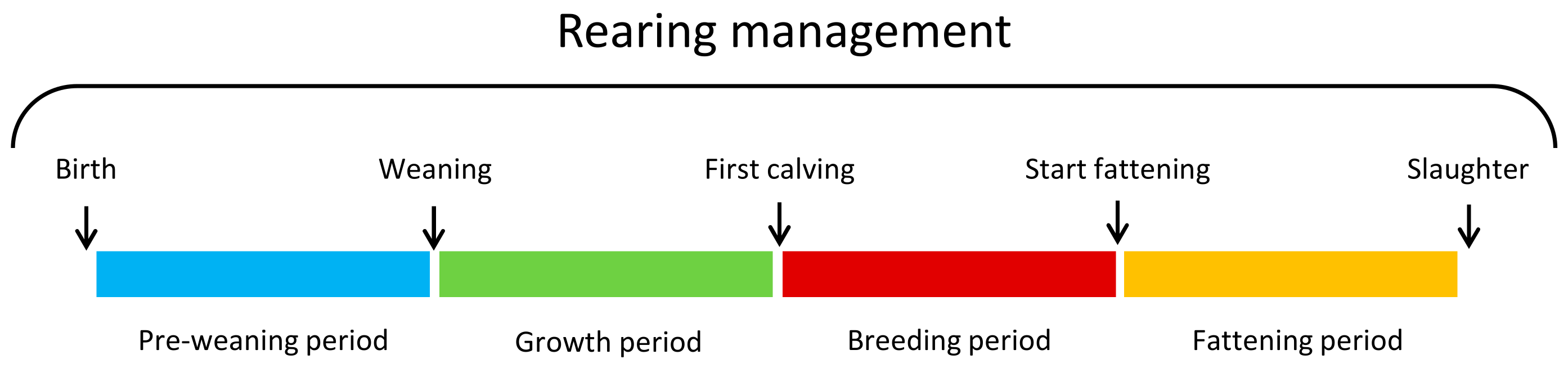
From one face-to-face rearing survey per farm, information on the rearing management (RM) applied throughout the cull cows’ life were collected using questionnaires and establishing batch management practices with each farmer [17]. The cull cows’ life was divided into 4 key periods: pre-weaning period (PWP), growth period (GP), breeding period (BP) and fattening period (FP), as described in Figure 1. In addition to the rearing surveys, the composition and the nutritional values of the different concentrates used in the different diets throughout the cull cow’s life were collected from the manufacture. For the concentrates produced on the farm (e.g., wheat, corn, and barley), the nutritional values of the INRAE system were used [18]. Then, the average concentrate’s crude protein (CP) and net energy (NE) contents were calculated as described by Soulat et al. [19].
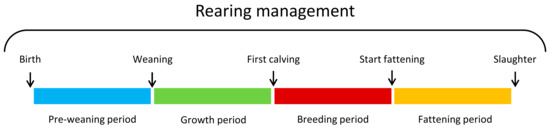
Figure 1.
Description of the four key rearing periods during the cull cows’ whole life.
2.2. Slaughtering, Carcass Traits and Sampling
The cull cows were slaughtered in four French industrial slaughterhouses (SICABA, Bourbon l’Archambault; SICAREV, Roanne; SOCOPA, Villefranche-d’Allier, and Viandes de Bresse, Bourg-en-Bresse) in compliance with European regulation No 1099/2009 on the protection of animals at the time of killing [20].
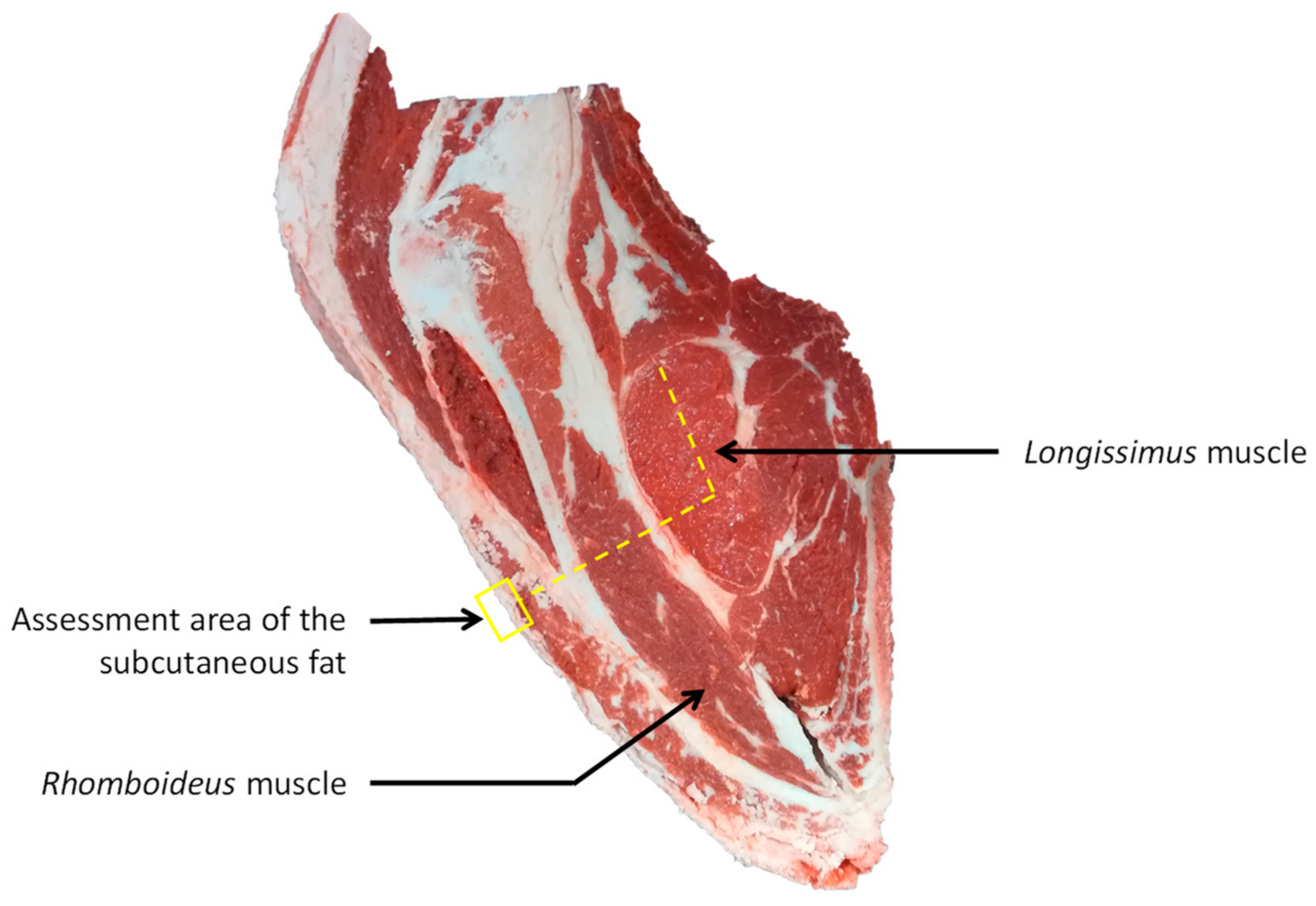
The carcasses were weighted and graded for conformation and fat scores using the EUROP system [21]. Concerning the conformation score, a conversion was performed to obtain a scale (15 levels) where P− = 1 (the lowest muscular development) to E+ = 15 (the highest muscular development). After 24 h post-mortem at 2 °C, the right-hand side of the carcasses were cut at the 6th rib level and the ultimate pH were measured using a pH meter by the slaughterhouse staff in the striploin. At the cut section level, 11 other carcass traits were evaluated by trained slaughterhouse staff and described in Table 1. From a calliper, the subcutaneous fat thickness were assessed in the area presented in Figure 2. Longissimus muscle (LM) seepage, intermuscular fat, nerves, overall meat grain, LM meat grain, and rhomboideus meat grain (Figure 2) were evaluated using a scale from 1 to 5 with a step of 0.5 [22]. Fat and meat colors, and marbling were evaluated on LM using the reference standards [23].

Table 1.
Effects of the three rearing managements (RM) applied during the whole cull cows’ life on carcass traits.
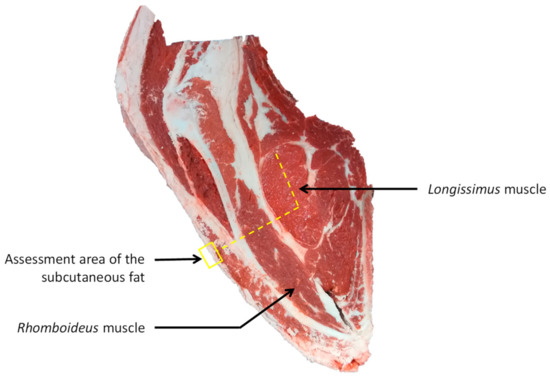
Figure 2.
Localization of the longissimus and rhomboideus muscles on the cut section of the 6th rib and localization of the assessment area of the subcutaneous fat.
On the right-hand side of the carcass, two ribs (5th and 4th ribs) localized in the chuck sale section were collected. The meat samples (2 ribs) were boneless, individually vacuum-packaged and aged 14 days at 4 °C. Then, the meat samples were frozen and stored at −20 °C until the analyses.
2.3. Meat Quality Evaluation
As the rib is compounded of many muscles, the meat analyses were focused on 2 muscles (LM and serratus ventralis muscle, SV) to characterize each meat sample. Color, texture and sensory analyses were carried out on LM, because it is the most muscle studied. Shear force analyses were carried out on SV because it is a specific muscle in the ribs of the chuck sale section [24].
The meat samples were thawed (around 48 h at 4 °C) and dissected to conserve only the LM and the SV by professional butchers (INRAE Unité Expérimentale Herbipôle, Theix, France). Each muscle sample was individually vacuum-packaged. On the dissection day, the LM samples were conserved at 4 °C before the color and sensory analyses, and the SV samples were stored at −20 °C until the shear force analyses.
2.3.1. Color Assessment
Six measurements (randomly distributed) were performed on each LM sample using a spectrophotometer (Konica Minolta CR-400, Osaka, Japan) and the CIE L*a*b* system [25]. The color assessments were carried out three hours before the sensory analyses at room temperature.
2.3.2. Sensory Analysis
In accordance with ISO 8586 [26], 50 persons were trained (six 1-h training sessions) to evaluate 10 sensory descriptors and one hedonic descriptor (Table 2) using a 10-cm unstructured scale (from 0 = no perception to 10 = perception very intense) and a scale anchoring (from 0 = “I don’t like at all” to 10 = “I like very much”), respectively [24]. The sensory descriptors were evaluated by sensory survey using Tastel software® (ABT Informatique, Rouvroy-sur-Marne, France).
Table 2.
Definitions of the sensory and hedonic descriptors.
For each sensory session, 10 trained people monadically assessed 8 LM samples, using a Latin square design. Before the sensory session, 2 or 3 steaks with a 2 cm thickness were cut from each LM sample. The steaks were cooked in an aluminum foil on a plancha at 300 °C to reach an internal temperature of 55 °C. Then, steaks were cut into homogeneous pieces (size 15 × 20 × 20 mm) and kept warm.
Until the texture analyses, the rest of the LM samples were individually vacuum-packaged and frozen at −20 °C.
2.3.3. Texture Profile Analysis
After thawing (around 25 min), the LM samples were cut using a cookie cutter to obtain regular cylinders (1 cm thick × 1 cm in diameter) conserved at +4 °C until the analyses. Then, each meat cylinder underwent 2 cycles of 20% compression at 4 °C using a rheometer (Kinexus pro+, Malvern Instruments, Malvern, UK) and rSpace 1.61 software (Kinexus, Malvern, UK). From the force-deformation curve, six parameters: springiness, hardness, cohesiveness, resilience, gumminess, and chewiness were calculated [27,28]. A texture profile analysis was carried out for a meat sample only when it was possible to perform the measurement on at least two meat cylinders.
2.3.4. Shear Force Measurement
The SV samples were thawed at +4 °C (around 24 h), and for each sample, around 14 meat portions (between 0.9 and 1.1 cm thick × 1 cm wide) were cut in parallel to the fibers. On each raw meat portion, two shear force measurements (cut perpendicular to fibers) were carried out, using the Warner-Braztler method (Instron 5944, Elancourt, France) and Bluehill 2 software (Instron, Elancourt, France).
2.4. Statistical Analyses
Statistical analyses were carried out using R 4.0.5 software [29].
A descriptive analysis of the rearing factors was carried out using graphic distribution and quantile-quantile plots. As described by Soulat et al. (2018b), some quantitative rearing factors were transformed into qualitative rearing factors, according to their distribution to allow the statistical analyses.
The RM applied throughout the cull cows’ life were defined from the 60 rearing factors using the factor analysis for mixed data (FAMD) followed by a hierarchical clustering based on the principal components (HCPC). The HCPC’s dendrogram was used to determine the number of RM considered in this study. Then, the RM were characterized from ANOVA and Khi2 performed on all quantitative and qualitative rearing factors.
The effect of the RM on the carcass and meat traits was evaluated by ANOVA. For the carcass traits, the slaughterhouse and operator effects were tested in the ANOVA. If these effects were significant, a new ANOVA (mixed model) was performed, considering these effects as random effects. If these effects were not significant, they were removed, and a new ANOVA was carried out. For the sensory descriptors, mixed models considering the panelist effect as a random effect were performed. A post-analysis was realized when the effect of the RM effect was significant, using the Tukey’s test.
The “FactoMineR” package was used to realize the FAMD and the HCPC [30]. The ANOVAs were performed using the “agricolae” package [31] and the mixed models followed by Tukey’s tests using the “emmeans”, “multcompView”, and “multcomp” packages [32,33,34,35].
3. Results and Discussion
3.1. Characterisation of the Rearing Managements
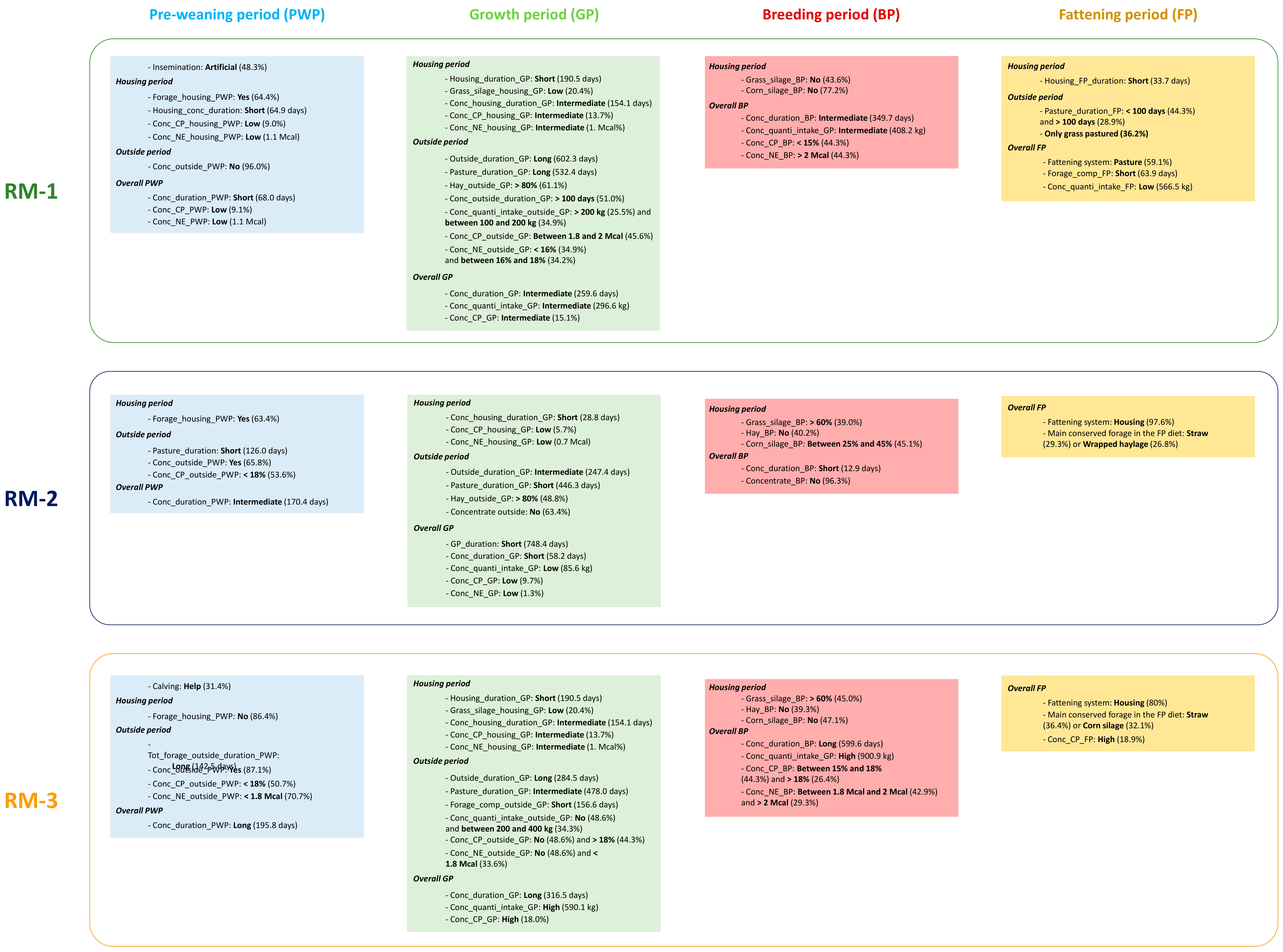
From all rearing factors, the FAMD and HCPC analyses allowed to define three RM applied throughout the cull cows’ life (Table 3, Table 4, Table 5 and Table 6). These RM are summarized in the Figure 3 considering only the rearing factors discriminating the most each RM.
Table 3.
Rearing factors characterizing the pre-weaning period (PWP) of the rearing managements (RM) applied during the cull cows’ whole life.
Table 4.
Rearing factors characterizing the growth period (GP) of the rearing managements (RM) applied during the cull cows’ whole life.
Table 5.
Rearing factors characterizing the breeding period (BP) of the rearing managements (RM) applied during the cull cows’ whole life.
Table 6.
Rearing factors characterizing the fattening period (FP) of the rearing managements (RM) applied during the cull cows’ whole life.
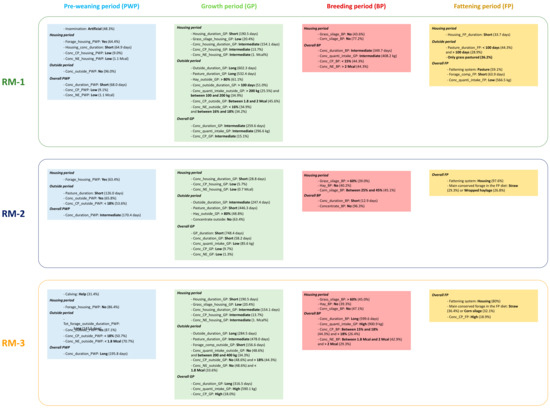
The first rearing management (RM-1) was followed by 149 cull cows. This management had the highest percentage of the calves from artificial insemination (Table 3). The duration of the concentrate distribution was the shortest in housing and the whole PWP. Then, 96% of the calves did not receive concentrate at pasture. During PWP, the average concentrate had the lowest CP and NE values, and the majority of the calves received forage in housing. During GP, the heifers had the shortest period in housing and the longest period outside (Table 4). The duration of the concentrate distribution was intermediate during the housing period of GP and the whole GP. During the outside period, the duration of the concentrate distribution was above 100 days for the majority of the heifers (51.0%), and 34.9% and 25.5% of the heifers ingested between 100 and 200 kg and above 200 kg of concentrate, respectively. During GP, the concentrate quantity ingested and the average concentrate’s CP value were intermediate compared to both other RM. During the outside period of GP, 34.9% and 34.2% of the heifers received an average concentrate with below 16% and between 16% and 18% of CP, respectively. The majority of the heifers (45.6%) received an average concentrate between 1.8 and 2 Mcal of NE. During the outside period of GP, the majority of the heifers (61.1%) were supplemented mainly by hay (above 80%). During the housing period of GP, 32.9% and 26.2% of the heifers ingested between 100 and 200 kg and between 200 and 400 kg of concentrate, respectively. The average concentrate had intermediate CP and NE values. During the housing period of GP, the heifers received the lowest percentage of grass silage in their diet. During BP, the duration of the concentrates distribution was intermediate and the cows ingested an intermediate concentrate quantity (Table 5). In the housing diet, 43.6%and 77.2% of the cows did not receive grass silage and corn silage, respectively. The majority of the cows (44.3%) received an average concentrate that had below 15% of CP and above 2 Mcal of NE. During FP, the cull cows had the shortest housing duration and ingested the lowest concentrate quantity (Table 6). The majority of the cull cows (59.0%) were fattened at pasture, and 36.2% of the cull cows had only the grass as a fiber source in their diet. The fattening duration at pasture was below 100 days and above 100 days for 44.3% and 28.9% of the cull cows, respectively.
The second rearing management (RM-2) was followed by 82 cull cows. In RM-2, the calves had the lowest pasture duration (Table 3). Throughout the PWP, the duration of the concentrate distribution was intermediate, and 65.8% of the calves received concentrate at pasture. At pasture, the average concentrate had below 18% of CP and above 1.8 Mcal of NE for 53.7% and 40.2% of the calves, respectively. In housing, the majority of the calves (63.4%) received forages in their diet. The heifers had the shortest GP duration, with an intermediate duration in housing and the shortest period duration at pasture (Table 4). The duration of the concentrate distribution was the shortest and 63.4% of the heifers did not receive concentrate outside. The heifers ingested the lowest concentrate quantity. During GP, the average concentrate had the lowest CP and NE values. During BP, the duration of the concentrate distribution was the shortest and the cows ingested the lowest concentrate quantity. In fact, the majority of the cows (96.3%) did not receive concentrates (Table 5). In the housing diet, 45.1% and 39.0% of the cows received between 25% and 45% of corn silage and above 60% of grass silage, respectively. Moreover, 40.2% of the cows did not receive hay. The fattening of the cull cows was mainly (97.6%) performed in housing (Table 6). The main forage in the fattening diet was straw and wrapped haylage for 29.3% and 26.8% of the cull cows.
The third rearing management (RM-3) was followed by 140 cull cows. In RM-3, there was the highest proportion of help calving (Table 3). During PWP, the calves had the longest duration with forage supplementation outside and the majority of the calves (86.4%) did not receive forage in housing. The duration of the concentrate distribution was the longest and 87.1% of the calves received concentrate outside. The average concentrate distributed outside had above 18% of CP and below 1.8 Mcal of NE for 50.7% and 70.7% of the calves, respectively. During GP, the heifers had the longest housing period and an intermediate pasture duration (Table 4). The duration of the forage supplementation outside was the shortest, and the duration of the concentrate distribution in housing and during the whole GP were the longest. The concentrate quantity intake was between 200 and 400 kg in housing and between 100 and 200 kg outside for 42.1% and 34.3% of the heifers. Moreover, 22.1% of the heifers ingested above 800 kg in housing, and outside, 48.6% did not receive a concentrate. The average concentrate in housing had the highest CP and NE values. During BP, the duration of the concentrate distribution was the longest and the cows ingested the highest concentrate quantity (Table 5). In RM-3, most cows received concentrates and the average concentrate receiving during BP could have different MAT values. The average concentrate was between 1.8 and 2 Mcal of NE for 42.9% of the cows. In the housing diet, 45.0% of the cows received above 60% of the grass silage. However, 39.3% and 47.1% of the cows did not receive hay and corn silage, respectively. The fattening of the cull cows was mainly (80.0%) performed in housing (Table 6). The main forage in the fattening diet was straw and corn silage for 36.4% and 32.1% of the cull cows. The average concentrate had the highest CP value.
Briefly, the cull cows performing the RM-1 had the longest outside period throughout their life, and they were mainly fattened at pasture. The cull cows performing the RM-2 had the lowest pasture duration throughout their life. They ingested a low concentrate quantity before the fattening, then a high concentrate quantity until the slaughter. In the RM-2, the fattening was carried out in housing with a straw or a wrapped haylage-based based-diet. Finally, the cull cows performing the RM-3 ingested the highest concentrate quantity throughout their life and were fattened in housing with a straw or a corn silage-based diet.
3.2. Effect of the Rearing Managements on the Carcass Traits
According to our results, the RM mainly affected the color traits of the carcass.
The carcasses had a higher ultimate pH value when the cull cows performed the RM-1 than those from both RM (Table 1). However, the differences of the ultimate pH between the three RM were weak.
At the sixth rib level, the cut section had a color more homogeneous when the cull cows performed the RM-3 than those from the RM-1. At 24h post-mortem, the LM color was darker when the cull cows performed the RM-2 than those performing the RM-1. Contrary to the RM-1, the cull cows performing the RM-2 had a shorter pasture duration and were fattening in housing with a high concentrate quantity, and those performing the RM-3 ingested the highest concentrate quantity and were fattened in housing with a straw or corn silage-based diet. According to the meat color chart, the color with a score of 4 or 5 was relatively near. In heifers, Soulat et al. [36] observed that a RM with a fattening at pasture or pasture and housing had not a significant effect on the a* parameter of the LM. These authors did not observe a significant effect of the RM on the a* parameter of the LM when the fattening was performed only in housing or at pasture and housing. For the FP, Sugimoto et al. [37] did not observe an effect of the fattening duration and the fattening diet composition on the redness of the LM, in cull cows. Contrary to our results, Priolo et al. [38] showed that cattle finished at pasture produced darker meat than those finished on the concentrate. Our results showed that the LM meat evaluated at 24 h post-mortem was not explained only by the fattening system (pasture vs. housing) in cull cows.
The carcass’s fat was yellower for the cull cows from the RM-1 compared to those from the others. These three color traits (fat color, color homogeneity, and LM color) of the carcasses were not significantly different between the RM-2 and RM-3. In the RM-1, the cull cows had the longest duration outside, and they were mainly fattened at pasture. According to Dunne et al. [39], the cattle fattened at pasture had a yellower fat than those fattened with forage and concentrate-fed. Our results were in accordance with these results. During FP, other authors did not observe effects of the fattening duration and fattening diet (e.g., concentrate quantity, and nature of forage) on the yellowness (b* parameter) of the fat color, in cull cows [7,37]. However, Holmer et al. [40] observed that the carcass fat from cull cows receiving a fattening diet with more concentrates was yellower than the carcass fat from cull cows receiving more corn silage in their diet.
The cull cows performing the RM-3 produced carcasses significantly heavier and a smoother RH meat grain compared to RM-1. These two carcass traits were not significantly different between the RM-2 and RM-3 or between the RM-1 and RM-2. Our results were in accordance with those of Soulat et al. [36], who showed that fattening at pasture produced lighter carcasses than fattening in housing or outside without grass, in the heifers. Concerning FP, many studies showed that the carcasses were heavier when the fattening duration was longer, in cull cows [37,41,42,43]. In our study, the fattening durations were not significantly different between the three RM. Franco et al. [7] did not show an effect of the fattening duration on the carcass weight. In our defined RM, the composition of the fattening diet was different (e.g., quantity of concentrates, nutritional values of the average concentrate, and nature of forage). Holmer et al. [40] and Hernandez-Calva [44] showed that the fattening diet had an effect on the carcass weight, in the cull cows. However, other studies did not observe an effect of the fattening diet composition on the carcass weight, in cull cows [37,45,46]. Moreover, Jurie et al. [8] and Fiems et al. [47] did not observe an effect of the slaughter age and the parity (after two calvings), respectively, on the carcass weight, in cull cows. As shown in the heifers, these different results showed that the carcass weight could not be explained by only one rearing factor [16]. With regard to RM, it is difficult to compare our results with previously published studies on cull cows investigating only one rearing factor of the fattening period.
To our knowledge, this is the first time that the effect of RM on the meat grain was displayed in cull cows. According to our results, Soulat et al. [24] observed an effect of the RM on the RH meat grain, in the heifers.
The carcasses from the RM-3 tended to have more intermuscular fat. This result was in accordance with Sugimoto et al. [37] and Vestergaard et al. [43], who observed that the fat rib percent was increased when the fattening duration of the cull cows was longer. However, the slaughter age [8] and the parity [47] did not affect the fat percent. The other carcass traits were not significantly different between the three RM (Table 1).
According to our results, it was difficult to favor a RM among the three RM for the carcass quality. Among the carcass traits impacted by the RM, three are related to the color. According to the target market, it will be more interesting to favor the RM-1 to have a yellower fat. The RM-2 and RM-3 allowed to produce carcasses with the same traits. This result confirmed that it is possible to produce carcasses with the same traits from different RM as showed in previous studies on heifers [24,36].
3.3. Effect of the Rearing Managements on the Meat Traits
In this study, due to the large number of samples collected from several slaughterhouses over a long period of time, the samples were frozen after aging until analysis. This step may have an impact on the meat properties [48]. However, as all the samples were under the same conditions, so the results were considered comparable between them.
According to our results, the flavor descriptors were the more sensitive to a modification of the RM in the cull cows, however, the observed differences were low (Table 7).
Table 7.
Effects of the three rearing managements (RM) applied during the whole cull cows’ life on meat traits.
The LM meat had higher overall flavor, fat aroma, and flavor persistence when the cull cows performed the RM-3 than the RM-1. The cull cows performing the RM-3 tended to produce LM meat with more atypical flavor. Contrary to the RM-1, the cull cows performing the RM-3 ingested the highest concentrate quantity and were fattened in housing with a straw or corn silage-based diet. Contrary to Soulat et al. [13] in cull cows, an increase of the concentrate quantity intake during the fattening period induced a decrease of the LM’s flavor intensity. Hernandez-Calva et al. [44] showed a higher flavor intensity of LM meat when the cull cows received a fattening diet with hay compared to those receiving a diet with barley silage. However, a review explained that a similar flavor intensity or acceptable flavor could be obtained when the cattle were fattened at pasture or with a concentrate-based diet [49]. According to Schnell et al. [9], the fattening duration with high-energy concentrate did not affect the flavor intensity and cooked beef fat, in cull cows. Nevertheless, the fattening diet did not seem to have an effect on the atypical flavor of the LM meat, in cull cows [44,50], while the RM applied throughout the heifers’ life had an effect [15].
Concerning the tenderness and the juiciness of LM meat, in accordance with our results, many studies did not observe an effect of the slaughter age, the fattening duration, the parity, and the fattening diet, in cull cows [6,9,41,44,47,50,51]. As the cull cows are mature animals, it was more challenging to modify the physicochemical properties of LM. It was possible that LM is less sensitive to a modification of the rearing management in particular, during the fattening period. Jurie et al. [8] did not observe an effect of the cull cows’ slaughter age on the physicochemical properties of LM. This may be an element to explain that the tenderness and the juiciness were not significantly different between the RM.
According to our results, the RM did not affect the raw LM and SV meat traits (Table 7). In accordance with these results, the RM did not affect the hardness (measured by shear force and/or texture analyses) of the raw LM and SV, in the heifers [24,52]. In cull cows, Franco et al. [7] did not observe a significant effect of the fattening duration on the texture profile of cooking LM meat aging 14 days. The only tendencies were observed for the color descriptors. The LM meat from the RM-1 tended to be less light, redder, and yellower than the LM meat from both others. In accordance with our results, Gatellier et al. [53] observed that the cull cows fattened at pasture compared to those fattened with a mixed diet produced a LM meat with significant lower a* and b* values. However, these authors observed a higher L* value when cull cows were fattened at pasture compared to those fattened with a mixed diet. The fattening diet and the fattening duration did not effect the color of raw LM after aging, in cull cows [7,43,45,50].
After cooking, the LM meat was redder when the cull cows performed the RM-2 than those from the RM-3. To our knowledge, it is the first time that the effect of the RM was studied on the red color of cooking meat.
As observed for the carcass, it is difficult to favor a RM among the three for the meat quality. According to the consumer taste preferences (related to the flavor) targeted, the stakeholders of the beef chain must adapt the RM of the cull cows. If the LM meat targeted must have an intense and long persistence of flavor and a high fat aroma, the RM-3 has to be favored but it is associated with a more intense atypical flavor. According to our results, it was possible to produce LM meat with a similar quality from both RM-1 and RM-2.
With the aim to jointly manage the carcass and the meat qualities, our results did not allow to favor a RM, in the cull cows. In accordance with Soulat et al. [13], a trade-off is needed to manage these qualities in cull cows simultaneously.
4. Conclusions
This work studied, for the first time, the effect of the RM applied throughout the Charolais cull cows’ life on the carcass and meat qualities. Three RM were characterized from 60 rearing factors. The modification of the RM had few effects on the carcass and meat properties. Our results showed that the color (fat and lean) of the carcass and the flavor of the LM meat were the main quality traits affected by the RM. This study confirmed that it is possible to produce carcasses or LM meat with similar properties from RM with different outside durations, intake concentrate quantities or fattening systems (pasture vs. housing). In the cull cows, it was difficult to favor a RM to manage individually and jointly the carcass and meat qualities. From similar carcass and meat properties, it will be interesting to consider also, e.g., the production cost and the system’s durability, to help the beef sector stakeholders identify the RM that allowed the most ecosystem services (e.g., production, environmental, economic, and social).
Author Contributions
V.M. and B.P. conceived and designed the experiment, funding acquisition, and reviewed drafts. J.S. carried out the experiment (farm surveys, drafting of protocols, and collection of samples), the statistical analyses, and wrote the original draft, and prepared the tables and figures. All authors have read and agreed to the published version of the manuscript.
Funding
This research was financed by the Ministry of agriculture and food, the region Auvergne-Rhône-Alpes (Convention Massif central) and the French government IDEX-ISITE initiative 16-IDEX-0001 (CAP 20-25).
Institutional Review Board Statement
Not applicable.
Informed Consent Statement
Informed consent was obtained from all subjects involved in the study.
Data Availability Statement
Data is contained within the article.
Acknowledgments
The authors would first like to thank the farmers who accepted to participate in this study. The authors would also like the staff of the four breeding cooperatives (FEDER, SICABA, SICAGIEB and SICAREV) for helping us to select the surveyed farms, and the staff of the four slaughterhouses (SICABA, SICAREV, SOCOPA, and Viandes de Bresse) for the achievement of measuring the carcasses and the meat sampling. The authors would also like to thank the INRAE staff for the meat samples collection and transport, and for the meat sample preparation and rheological analyses (shear force), and the VetAgro Sup staff for color, sensorial and rheological (texture) analyses. Finally, the authors thank the other partners implicated in the development of the ProBA (produce suckler cattle delivering the goods of the slaughterers in the region Auvergne-Rhône-Alpes) project: ARIA Auvergne-Rhône-Alpes, la Chambre Régionale d’Agriculture Auvergne-Rhône-Alpes, and La Cooperation Agricole Auvergne-Rhône-Alpes.
Conflicts of Interest
The authors declare no conflict of interest.
References
- Food and Agricultural Organization of the United Nations (FAO). FAOSTAT. Available online: https://www.fao.org/faostat/en/#data/QCL/visualize (accessed on 6 June 2022).
- Institut de l’élevage. Marché mondial Viande bovine: Année 2021 - Perspectives 2022. Dossier Economie de l’élevage. Available online: https://idele.fr/detail-article/marche-mondial-viande-bovine-annee-2021-perspectives-2022 (accessed on 6 June 2022).
- Interbev. L’essentiel de La Filière Bovine Française. 2021. Available online: https://www.interbev.fr/interbev/chiffres-cles/ (accessed on 6 June 2022).
- Institut de l’élevage. Les chiffres clés du GEB - Bovins 2021. Productions lait et viande. Available online: https://idele.fr/detail-article/les-chiffres-cles-du-geb-bovins-2021 (accessed on 6 June 2022).
- Ellies-Oury, M.-P.; Lee, A.; Jacob, H.; Hocquette, J.-F. Meat Consumption – What French Consumers Feel about the Quality of Beef? Ital. J. Anim. Sci. 2019, 18, 646–656. [Google Scholar] [CrossRef]
- Dransfield, E.; Martin, J.F.; Bauchart, D.; Abouelkaram, S.; Lepetit, J.; Culioli, J.; Jurie, C.; Picard, B. Meat Quality and Composition of Three Muscles from French Cull Cows and Young Bulls. Anim. Sci. 2003, 76, 387–399. [Google Scholar] [CrossRef]
- Franco, D.; Bispo, E.; González, L.; Vázquez, J.A.; Moreno, T. Effect of Finishing and Ageing Time on Quality Attributes of Loin from the Meat of Holstein–Fresian Cull Cows. Meat Sci. 2009, 83, 484–491. [Google Scholar] [CrossRef]
- Jurie, C.; Martin, J.-F.; Listrat, A.; Jailler, R.; Culioli, J.; Picard, B. Carcass and Muscle Characteristics of Beef Cull Cows between 4 and 9 Years of Age. Anim. Sci. 2006, 82, 415–421. [Google Scholar] [CrossRef]
- Schnell, T.D.; Belk, K.E.; Tatum, J.D.; Miller, R.K.; Smith, G.C. Performance, Carcass, and Palatability Traits for Cull Cows Fed High-Energy Concentrate Diets for 0, 14, 28, 42, or 56 Days. J. Anim. Sci. 1997, 75, 1195–1202. [Google Scholar] [CrossRef]
- Terlouw, E.M.C.; Picard, B.; Deiss, V.; Berri, C.; Hocquette, J.-F.; Lebret, B.; Lefèvre, F.; Hamill, R.; Gagaoua, M. Understanding the Determination of Meat Quality Using Biochemical Characteristics of the Muscle: Stress at Slaughter and Other Missing Keys. Foods 2021, 10, 84. [Google Scholar] [CrossRef] [PubMed]
- Couvreur, S.; Le Bec, G.; Micol, D.; Picard, B. Relationships Between Cull Beef Cow Characteristics, Finishing Practices and Meat Quality Traits of Longissimus Thoracis and Rectus Abdominis. Foods 2019, 8, 141. [Google Scholar] [CrossRef]
- Soulat, J.; Monteils, V.; Léger, S.; Picard, B. Identification of Key Rearing Factors to Manage Cattle Carcass Fatness and Conformation Scores during the Fattening Period. Ital. J. Anim. Sci. 2019, 18, 1192–1204. [Google Scholar] [CrossRef]
- Soulat, J.; Picard, B.; Léger, S.; Monteils, V. Prediction of Beef Carcass and Meat Traits from Rearing Factors in Young Bulls and Cull Cows. J. Anim. Sci. 2016, 94, 1712–1726. [Google Scholar] [CrossRef]
- Monteils, V.; Sibra, C. Rearing Practices in Each Life Period of Beef Heifers Can Be Used to Influence the Carcass Characteristics. Ital. J. Anim. Sci. 2019, 18, 734–745. [Google Scholar] [CrossRef]
- Soulat, J.; Monteils, V.; Picard, B. Effect of the Rearing Managements Applied during Heifers’ Whole Life on Quality Traits of Five Muscles of the Beef Rib. Foods 2019, 8, 157. [Google Scholar] [CrossRef] [PubMed]
- Soulat, J.; Picard, B.; Léger, S.; Ellies-Oury, M.-P.; Monteils, V. Preliminary Study to Determinate the Effect of the Rearing Managements Applied during Heifers’ Whole Life on Carcass and Flank Steak Quality. Foods 2018, 7, 160. [Google Scholar] [CrossRef] [PubMed]
- Ingrand, S.; Dedieu, B. Diversité des formules d’allotement en élevage bovin viande. Le cas d’exploitations du Limousin. Inra Prod. Anim. 1996, 9, 189–199. [Google Scholar] [CrossRef]
- INRA. Alimentation des bovins, ovins et caprins. Besoins des animaux-Valeurs des aliments; Quae: Versailles, France, 2010. [Google Scholar]
- Soulat, J.; Picard, B.; Léger, S.; Monteils, V. Prediction of Beef Carcass and Meat Quality Traits from Factors Characterising the Rearing Management System Applied during the Whole Life of Heifers. Meat Sci. 2018, 140, 88–100. [Google Scholar] [CrossRef]
- EU. Council Regulation (EC) No 1099/2009 of 24 September 2009 on the Protection of Animals at the Time of Killing. Off. J. Eur. Union 2009, 303, 1–30. [Google Scholar]
- EU. Council Regulation (EC) No 1183/2006 of 24 July 2006 Concerning the Community Scale for the Classification of Carcasses of Adult Bovine Animals. Off. J. Eur. Union 2006, 214, 1–6. [Google Scholar]
- Ellies-Oury, M.P.; Durand, Y.; Delamarche, F.; Jouanno, M.; Lambert, J.; Micol, D.; Dumont, R. Relationships between the Assessment of “Grain of Meat” and Meat Tenderness of Charolais Cattle. Meat Sci. 2013, 93, 397–404. [Google Scholar] [CrossRef]
- United Nations Economic Commission for Europ (UNECE) Standard Bovine Meat Carcases and Cuts; UNECE Standard; United Nations Publications: Geneva, Switzerland, 2016.
- Soulat, J.; Picard, B.; Bord, C.; Monteils, V. Characterization of Four Rearing Managements and Their Influence on Carcass and Meat Qualities in Charolais Heifers. Foods 2022, 11, 1262. [Google Scholar] [CrossRef]
- Commission International de l’Eclairage. Commission International de l’Eclairage Colorimetry, 2nd ed.; Commission International de l’Eclairage: Vienna, Austria, 1986. [Google Scholar]
- International Organization of Standardization (ISO). ISO 8586: General Guidelines for the Selection, Training and Monitoring of Selected Assessors and Expert Sensory Assessors. In Sensory Analysis; ISO: Geneva, Switzerland, 2014. [Google Scholar]
- Chinzorig, O.; Hwang, I. Mechanical Texture Profile of Hanwoo Muscles as a Function of Heating Temperatures. J. Anim. Sci. and Tech. 2018, 60, 22. [Google Scholar] [CrossRef]
- Texture technologies. Overview of Texture Profile Analysis. Available online: http://texturetechnologies.com/resources/texture-profile-analysis (accessed on 6 June 2022).
- R core Team, R. A Language and Environment for Statistical Computing; R Foundation for Statistical Computing: Vienna, Austria, 2021. [Google Scholar]
- Le, S.; Josse, J.; Husson, F. FactoMineR: An R Package for Multivariate Analysis. J. Stat. Softw. 2008, 25, 1–18. [Google Scholar] [CrossRef]
- De Mendiburu, F. Agricolae: Statistical Procedures for Agricultural Research. R package version 1.3-3. 2020. Available online: http://CRAN.R-project.org/package=agricolae (accessed on 13 December 2021).
- Graves, S.; Piepho, H.-P.; Selzer, L.; Dorai-Raj, S. MultcompView: Visualizations of Paired Comparisons. R Package Version 0.1-8. 2019. Available online: https://cran.r-project.org/web/packages/multcompView/index.html (accessed on 13 December 2021).
- Hothorn, T.; Bretz, F.; Westfall, P. Simultaneous Inference in General Parametric Models. Biom. J. 2008, 50, 346–363. [Google Scholar] [CrossRef]
- Kuznetsova, A.; Brockhoff, P.B.; Christensen, R.H.B. LmerTest Package: Tests in Linear Mixed Effects Models. J. Stat. Softw. 2017, 82, 1–26. [Google Scholar] [CrossRef]
- Lenth, R.V. Emmeans: Estimated Marginal Means, Aka Least-Squares Means. R package version 1.6.0. 2021. Available online: http://CRAN.R-project.org/package=emmeans (accessed on 13 December 2021).
- Soulat, J.; Picard, B.; Monteils, V. Influence of the Rearing Managements and Carcass Traits on the Sensory Properties of Two Muscles: Longissimus Thoracis and Rectus Abdominis. Meat Sci. 2020, 169, 108204. [Google Scholar] [CrossRef]
- Sugimoto, M.; Saito, W.; Ooi, M.; Oikawa, M. Effects of Days on Feed, Roughage Sources and Inclusion Levels of Grain in Concentrate on Finishing Performance and Carcass Characteristics in Cull Beef Cows. Anim. Sci. J. 2012, 83, 460–468. [Google Scholar] [CrossRef]
- Priolo, A.; Micol, D.; Agabriel, J. Effects of Grass Feeding Systems on Ruminant Meat Colour and Flavour. A Review. Anim. Res. 2001, 50, 185–200. [Google Scholar] [CrossRef]
- Dunne, P.G.; Monahan, F.J.; O’Mara, F.P.; Moloney, A.P. Colour of Bovine Subcutaneous Adipose Tissue: A Review of Contributory Factors, Associations with Carcass and Meat Quality and Its Potential Utility in Authentication of Dietary History. Meat Sci. 2009, 81, 28–45. [Google Scholar] [CrossRef]
- Holmer, S.F.; Homm, J.W.; Berger, L.L.; Brewer, M.S.; Mckeith, F.K.; Killefer, J. Realimentation of Cull Beef Cows. I. Live Performance, Carcass Traits and Muscle Characteristics. J. Muscle Foods 2009, 20, 293–306. [Google Scholar] [CrossRef]
- Hawrysh, Z.; Price, M. The Effect of Grain Feeding on the Eating Quality of Beef from Culled Cows. Can. J. Anim. Sci. 1981, 61, 581–592. [Google Scholar] [CrossRef]
- Matulis, R.J.; McKeith, F.K.; Faulkner, D.B.; Berger, L.L.; George, P. Growth and Carcass Characteristics of Cull Cows after Different Times-on-Feed. J. Anim. Sci. 1987, 65, 669–674. [Google Scholar] [CrossRef]
- Vestergaard, M.; Madsen, N.T.; Bligaard, H.B.; Bredahl, L.; Rasmussen, P.T.; Andersen, H.R. Consequences of Two or Four Months of Finishing Feeding of Culled Dry Dairy Cows on Carcass Characteristics and Technological and Sensory Meat Quality. Meat Sci. 2007, 76, 635–643. [Google Scholar] [CrossRef]
- Hernandez-Calva, L.M.; He, M.; Juarez, M.; Aalhus, J.L.; Dugan, M.E.R.; McAllister, T.A. Effect of Flaxseed and Forage Type on Carcass and Meat Quality of Finishing Cull Cows. Can. J. Anim. Sci. 2011, 91, 613–622. [Google Scholar] [CrossRef]
- Minchin, W.; Buckley, F.; Kenny, D.A.; Monahan, F.J.; Shalloo, L.; O’Donovan, M. Effect of Grass Silage and Concentrate Based Finishing Strategies on Cull Dairy Cow Performance, Carcass and Meat Quality Characteristics. Meat Sci. 2009, 81, 93–101. [Google Scholar] [CrossRef] [PubMed]
- Moreno, T.; Botana, A.; Bispo, E.; Gonzalez, L.; Garcia, C.; Mesas, J. High-Energy Forage Feeding Diets and Body Condition on the Finishing of Cull Dairy Cows. Animal 2012, 6, 1634–1641. [Google Scholar] [CrossRef]
- Fiems, L.O.; De Campeneere, S.; Van Caelenbergh, W.; De Boever, J.L.; Vanacker, J.M. Carcass and Meat Quality in Double-Muscled Belgian Blue Bulls and Cows. Meat Sci. 2003, 63, 345–352. [Google Scholar] [CrossRef]
- Setyabrata, D.; Kim, Y.H.B. Impacts of Aging/Freezing Sequence on Microstructure, Protein Degradation and Physico-Chemical Properties of Beef Muscles. Meat Sci. 2019, 151, 64–74. [Google Scholar] [CrossRef]
- Melton, S.L. Effects of Feeds on Flavor of Red Meat: A Review. J. Anim. Sci. 1990, 68, 4421–4435. [Google Scholar] [CrossRef]
- Holmer, S.F.; Homm, J.W.; Berger, L.L.; Stetzer, A.J.; Brewer, M.S.; Mckeith, F.K.; Killefer, J. Realimentation of Cull Beef Cows. II. Meat Quality of Muscles from the Chuck, Loin and Round in Response to Diet and Enhancement. J. Muscle Foods 2009, 20, 307–324. [Google Scholar] [CrossRef]
- Cabaraux, J.F.; Hornick, J.L.; Dotreppe, O.; Dufrasne, I.; Clinquart, A.; Istasse, L. Effects of the Calving Number on Animal Performance, Carcass and Meat Composition in Finishing Belgian Blue Double-Muscled Culled Females. Livest. Prod. Sci. 2004, 87, 161–169. [Google Scholar] [CrossRef]
- Soulat, J.; Monteils, V.; Ellies-Oury, M.-P.; Papillon, S.; Picard, B. What Is the Impact of the Rearing Management Applied during the Heifers’ Whole Life on the Toughness of Five Raw Rib Muscles in Relation with Carcass Traits? Meat Sci. 2021, 179, 108533. [Google Scholar] [CrossRef]
- Gatellier, P.; Mercier, Y.; Juin, H.; Renerre, M. Effect of Finishing Mode (Pasture- or Mixed-Diet) on Lipid Composition, Colour Stability and Lipid Oxidation in Meat from Charolais Cattle. Meat Sci. 2005, 69, 175–186. [Google Scholar] [CrossRef]
Publisher’s Note: MDPI stays neutral with regard to jurisdictional claims in published maps and institutional affiliations. |
© 2022 by the authors. Licensee MDPI, Basel, Switzerland. This article is an open access article distributed under the terms and conditions of the Creative Commons Attribution (CC BY) license (https://creativecommons.org/licenses/by/4.0/).