


1. Introduction
The management of international logistics networks poses major challenges for companies. Even though international logistics is often seen as the backbone and engine of the global economy, it is regularly put to the test. In a few words, management of international logistics networks describes the planning and design of global value creation systems to fulfill customer orders by efficiently linking goods, information, and financial flows from the procurement of raw materials to delivery to the end customer with the goal of increasing customer satisfaction. Increasing risks and volatility in logistics networks constantly present logistics managers with the challenge of developing innovative solutions for ever-new problems. The importance of logistics has made it one of the most important industries and employers in many regions and countries. To deal with challenges, logistics regularly adapts new technologies and combines them into innovative solutions to better meet customer requirements. Especially in international logistics, the industry often acts as an early adopter of technologies such as machine learning, blockchain, digital supply chain twins, and others. However, the truth is also that logistics, especially international transport, is also one of the major emitters of greenhouse gases, and the industry needs to find answers in the short and medium term on how to reduce the global carbon footprint. In the interplay with the aforementioned technological innovation power of logistics, a huge potential is seen here that has not yet been exhausted. In addition, international logistics can make a decisive contribution to the growth and prosperity of economic regions. Especially in low- and mid-income countries, logistics is an important enabler for economic growth and the integration of those countries into global value creation systems. Supporting these countries, e.g., countries in sub-Saharan Africa, is one of the major challenges of our generation, with it facing society as a whole, and logistics can make a contribution to improving living conditions.
This special issue aims to make a contribution from research to continue the discussion on current trends in international logistics and to make a contribution with solutions that are of great use in industrial practice. To this end, the main trends in international logistics are examined and important sub-topics are analyzed in this context. The following is an introduction to the main trends in international logistics, which form the basis for the articles included in this Special Issue. We will then briefly summarize the articles included in this Special Issue.
2. Main Trends Impacting Future Logistics Networks
Over the past few decades, numerous studies have delved into the question of which economic and social trends influence logistics networks. The landscape of trends that could potentially shape logistics planning and design is extensive, and the specific product and customer base addressed play pivotal roles in determining their relevance. However, in the realm of international logistics, four predominant trends have steadily gained significance over time. While not entirely novel, these trends hold paramount importance in shaping the future design of international logistics networks.
The first of these trends is digitalization, which has been on the rise for the past decade and is set to usher in significant changes in the planning and management of international logistics networks. Rapid technological advances are poised to bring substantial transformations within the current decade. Furthermore, the global trend towards sustainability has emerged as a key driver for future developments in logistics networks. Sustainability has ascended to a prominent position in the global public consciousness, and regulatory interventions in this domain are anticipated. Consequently, logistics networks must adapt and systematically incorporate sustainability considerations into their strategic projects over the next decade. Digitalization and sustainability, two paramount trends, are posing a growing challenge to current approaches in the design of international logistics networks. These trends also interplay with the enduring mega-trend of globalization, which has shaped the landscape of value networks worldwide. While globalization has been a central driver of increased complexity in logistics networks, the current decade raises questions about the role of globalization in international logistics networks, particularly in light of the trends of digitalization and sustainability. To further complicate this intricate web of trends, the world of logistics networks has been characterized by the persisting trend of increasing risks and dynamics. These factors render the study and development of international logistics networks all the more complex. Several research studies have highlighted the growing turbulence in international logistics networks [1,2], a phenomenon that gained even greater prominence with the onset of the COVID-19 pandemic [3,4].
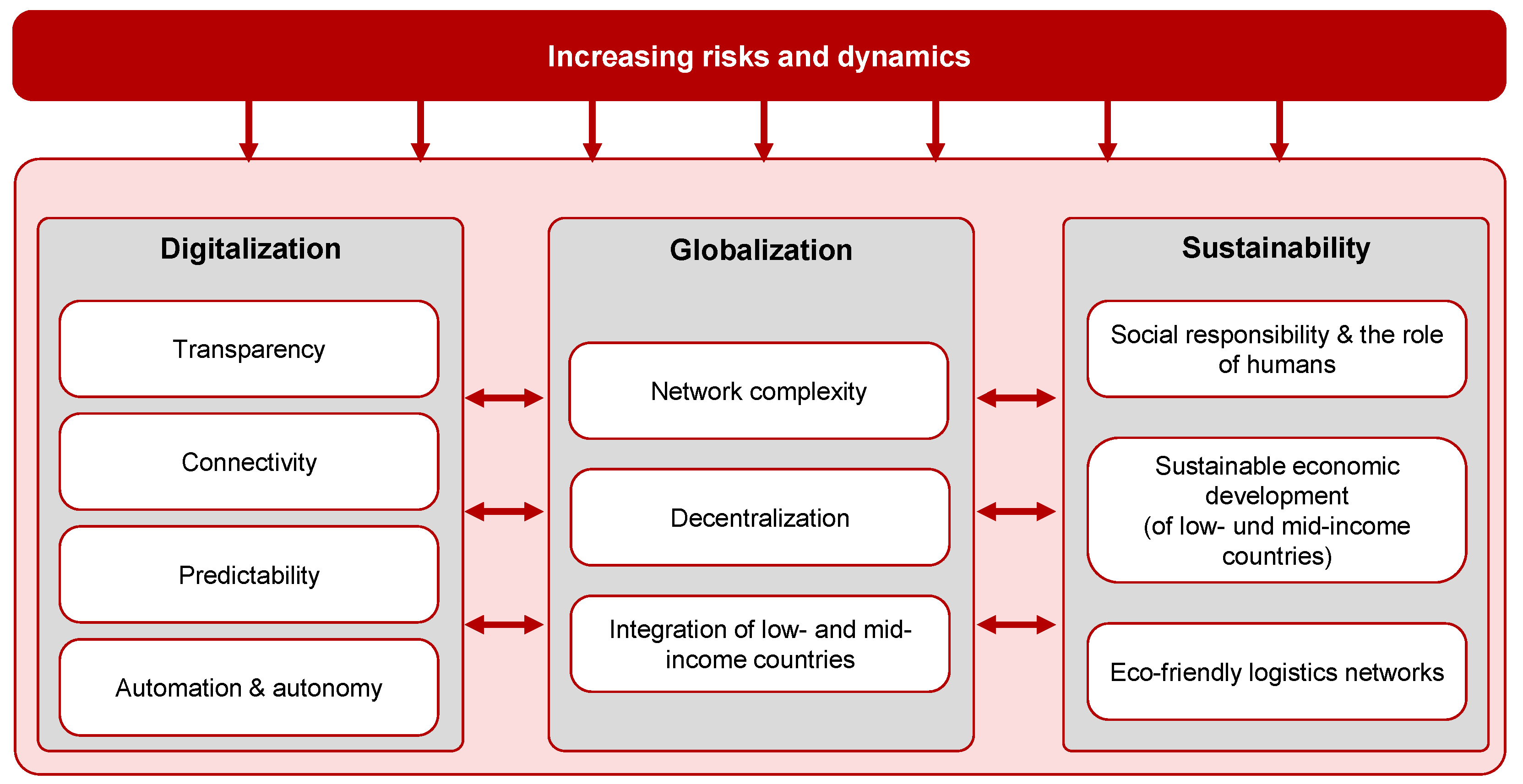
Figure 1 offers an overview of the main trends in international logistics networks, along with their associated sub-trends that exert significant influence on the future design of such networks. The subsequent sections will elaborate on the developments within the main trends of digitalization, sustainability, and globalization, and their implications for the design of future logistics networks.
Figure 1.
Main trends impacting the design of future international logistics networks.
2.1. Digitalization in International Logistics Networks
In recent years, the digitalization of logistics networks has increased significantly, leading to profound consequences for the future planning and management of logistics systems. Under the broad umbrella of digitalization, a myriad of sub-streams, technologies, knowledge areas, and business functions have converged, closely aligned with the burgeoning technologization of logistics networks. Fundamentally, this movement revolves around the strategic question of how to effectively harness the expanding potential made available through advancing computerization and technologization, along with the corresponding acquisition of data, to positively shape the parameters of logistics goals. A key tenet of this approach is to utilize the vast and ever-growing volume of data generated daily and to deploy emerging technologies mindfully, rather than embracing a technology-driven push, thus playing a pivotal role in this landscape.
The potentials of digitalization are diverse, reflecting the multifaceted motives underpinning its promotion in the field of logistics. One of the initial sub-trends is the establishment of connectivity within logistics networks, enabled by the novel possibilities stemming from digitalization. This endeavor seeks to interconnect the various actors in the network, fostering smoother and timelier information exchange. This heightened connectivity lays the foundation for the next sub-trend in the digitalization journey—transparency. Given the increasing complexity of global value creation structures, transparency is an absolute imperative across multiple stages on both the supplier and customer sides of the logistics process. It is essential for the purpose of proactive planning and responsive actions. Creating transparency is, and always has been, a core responsibility of logistics managers. However, the new possibilities facilitated by technologies such as digital supply chain twins [5] and blockchain [6] are anticipated to offer fresh avenues for achieving transparency in a simpler, more comprehensible, near-real-time, and secure manner.
Once connectivity and transparency are firmly established, a wealth of data is at hand, facilitating the pursuit of the third sub-trend of digitalization over the long term—enhancing the predictability of logistics systems. The need for increased predictability is particularly pronounced in the context of international logistics networks. Timely identification of risks within globally distributed value streams is imperative, enabling early or even preemptive countermeasures. This is critical in international logistics, where forecasting arrival times for extensive, intermodal transport chains remains a challenge, often relying solely on historical data. Encouragingly, the remarkable advances in the realms of artificial intelligence and machine learning underscore the potential of digitalization in delivering marked efficiency gains in terms of prediction accuracy within complex logistics networks [7]. Nonetheless, the industry-wide adoption of artificial intelligence algorithms for early risk detection is still lagging behind expectations, highlighting the need for a collective effort to bridge this gap [8].
As a certain level of connectivity and transparency begins to take shape within international logistics networks, the automation of processes within these networks becomes increasingly attainable. Moreover, should a certain level of predictability be established, the prospect of logistics systems operating autonomously in the long term, within the context of digitalized logistics networks, becomes conceivable. The automation of logistics processes stands as one of the most vital trends in the ongoing digitalization of logistics [9,10,11]. The allure of increased efficiency, flexibility, resilience, and reduced dependence on the expertise and decisions of individual logistics decision-makers makes this trend particularly compelling. Automation spans both physical processes, which are already more advanced in certain industries, and informational processes, especially pertinent in the realm of international logistics networks. With the growing degree of automation in these informational processes, accompanied by increasingly intelligent systems, it is conceivable that a significant proportion of these processes may operate autonomously in the evolution of logistics systems. This autonomous operation could include automatic and, at best, intelligent decision-making, e.g., facilitated through intelligent multi-agent systems [12]. Recent studies even propose that the majority of informational processes involved in managing logistics networks may be running autonomously by the end of this decade [13].
It is essential to recognize that while the sub-trends of connectivity, transparency, predictability, and automation and autonomy were presented successively, they need not be pursued sequentially. Instead, these sub-trends offer a directional roadmap for the potential evolution of logistics systems. Projects and developments can run in parallel, with connectivity and transparency often being the initial steps in the development process. They set the foundation for more intricate stages, such as predictability or autonomy, to be addressed subsequently. In this way, the digital transformation of logistics networks can take multiple paths, with the ultimate aim of achieving greater efficiency, resilience, and adaptability in the dynamic landscape of international logistics.
2.2. Sustainability in International Logistics Networks
The significance of the global megatrend of sustainability has grown in recent years. Concerning the ecological dimension of sustainability, the scientific community highlighted several decades ago that the escalating emission of greenhouse gases leads to global warming, with dire consequences for the planet’s ecosystems. In logistics research, ecological sustainability became a topic of intensive discussion as early as the first decade of the 21st century, even though the urgency of these concerns in logistics practice emerged later. While the ecological perspective on sustainability is undeniably crucial, it is important to recognize that the sustainability concept is much broader, adhering to the more widespread “triple bottom line” approach [14]. This approach incorporates not only the ecological dimension but also economic and social dimensions. The economic facet of sustainability is dedicated to fostering economic activities geared toward long-term sustainability rather than prioritizing short-term profits at the expense of future generations. In a societal context, the economic dimension of sustainability encompasses a society striving for long-term economic stability and prosperity while considering the well-being of future generations. The social dimension of sustainability emphasizes the importance of a socially harmonious, ideally conflict-free society that places a strong emphasis on individuals and their living conditions, both at points of consumption and along value chains.
In the realm of social sustainability, a vital sub-trend within international logistics networks centers on social responsibility and the role of humans. In recent years, social sustainability, especially within logistics networks, has been somewhat overshadowed by its ecological counterpart but has grown in prominence. A significant driver for this shift is the evolving societal awareness among end customers who want transparency regarding the production and processing conditions of products, as well as assurances that no individuals, especially children, have been harmed in the process. From a logistics perspective, this presents various challenges in supplier selection and monitoring, particularly in the context of international logistics networks. The role of humans is also gaining increasing importance for another reason. Due to the technological advancements associated with the digitalization trend, processes within international logistics networks are becoming progressively automated and potentially autonomous. This implies that individuals currently engaged in manual logistics processes will need to assume different roles in the near future. This shift is likely to demand new competence profiles and organizational structures in logistics, necessitating corresponding training and education. However, the impact of rationalization and the potential loss of social value associated with tasks should not be underestimated, as this dynamic has the potential to give rise to conflicts.
From the economic sustainability perspective, international logistics networks should facilitate sustainable economic development, especially for emerging and developing countries. International logistics plays a pivotal role in this regard since logistics challenges are consistently identified as significant trade barriers that hinder the sustainable growth of developing nations. The African continent, in particular, stands out as a region with considerable potential, characterized by relatively low economic power yet rapid population growth. It is regarded as one of the most crucial future markets for numerous industries. Nevertheless, sustainable economic growth and prosperity are not guaranteed in these countries alone, given the presence of various trade barriers, especially logistics-related challenges tied to inefficient transportation systems. Companies continue to express reservations, especially concerning sub-Saharan Africa [15].
Finally, the establishment of eco-friendly logistics networks stands as a crucial sub-trend in the domain of ecological sustainability within international logistics networks. Given that most industries feature globally dispersed value creation structures, logistics bears a substantial share of greenhouse gas emissions. Depending on the study and the methodology employed, transportation alone is responsible for roughly 24% of global CO2 emissions [16]. Furthermore, transportation represents only part of logistics functions, indicating that the actual contribution of logistics to global greenhouse gas emissions is likely even higher. This constitutes a pressing issue which will inevitably prompt greater regulatory intervention in the short and medium term. Consequently, logistics must adapt and explore methods for implementing eco-friendly logistics networks. The coming years will serve as a barometer for the extent to which such changes can be implemented. Potential avenues include the redesign of logistics networks, improved planning algorithms, the utilization of new technologies and transport modes, or, at the very least, enhanced integration of existing transport modes into intermodal transport systems.
2.3. Globalization in International Logistics Networks
Globalization has been a driving force behind international logistics networks for decades, playing a pivotal role in fostering economic growth through the increased global division of labor facilitated by highly interconnected logistics systems. This global trend of globalization within international logistics networks comprises three prominent sub-trends. Firstly, network complexity has been steadily rising due to globalization, marked by the expansion of potential suppliers and customer regions. This expansion significantly increases the intricacy of logistics networks that managers need to oversee. This trend aligns closely with another sub-trend: the decentralization of decision-making in international logistics networks and the physical decentralization of production and logistics activities. Decisions are being made in more distributed locations, and the physical structure of production and logistics activities, such as warehouses, are becoming more decentralized. Moreover, the third sub-trend in this globalization paradigm is the integration of low- and mid-income countries into international logistics networks. This is driven by the need for the sustainable development of these developing countries. Integration often begins on the supplier side, gradually expanding to the customer side, with labor cost advantages serving as a primary motivator for manufacturers to incorporate these countries into their logistics networks.
The globalization of the international economy, which has been a dominant trend in recent decades, has yielded various advantages and challenges. However, with the rise of the megatrends of digitalization and sustainability, there is a question of how globalization may evolve. One possible scenario is a reduction in the degree of globalization, motivated by the pursuit of ecological sustainability. International transport is a significant contributor to global greenhouse gas emissions, and localizing logistics networks may help mitigate these emissions. Conversely, the integration and sustainable economic development of developing countries, particularly in sub-Saharan Africa, may drive an increase in globalization. Since more and more potential customers will be located in these regions in the long term, this can also lead to an increase in the decentralization of logistics structures through the addition of further warehouse locations, for example.
The interplay between globalization and sustainability is further complicated by the advent of digitalization. Digitalization, coupled with the technologization of logistics networks, can theoretically lead to highly automated production facilities that can autonomously produce customized products on a large scale with minimal human labor. This could diminish the significance of labor cost advantages in developing countries, potentially prompting a shift of manufacturing back to industrialized nations. Conversely, technology such as digital supply chain twins and blockchain, in conjunction with artificial intelligence, can offer real-time transparency regarding global value chains and predict future states of international logistics networks with intelligent precision. This may facilitate smoother integration of additional suppliers, including those from developing countries, into increasingly complex international logistics networks, ultimately promoting further globalization. These examples underscore the intricate interplay between digitalization, globalization, and sustainability, emphasizing the need to thoroughly assess the potential changes that these focus trends may induce in international logistics networks, both at various levels and in multiple directions.
The interplay of the three trends described above in the context of increasing risks and dynamics makes the discussion about future developments in international logistics both exciting and challenging. Even though industrial practice must find solutions to deal with the challenges described, science can contribute to the solution. This is also the aim of the articles included in this Special Issue, which are located within the interplay of the trends described above and make a contribution to the further development of research in their subfield.
3. Summary of Articles Included in This Special Issue
3.1. The Influence of Technologies in Increasing Transparency in Textile Supply Chains
The international textile industry is a vibrant industry whose logistics networks are constantly reinventing themselves in search of new alternative sources of supply. This reorganization of logistics networks is characterized by two opposing trends. On the one hand, there is the desire for ever more cost-effective production alternatives in developing countries to meet the needs of the fast fashion industry, and on the other hand, there is the customer demand for ever more sustainable logistics networks for textile products, as the industry is considered one of the least sustainable. One of the most important initial levers in the creation of sustainability is the creation of transparency in textile logistics networks. Therefore, the article examines how digital technologies can have an impact on creating more transparency in textile logistics networks and how this can contribute to more sustainability at the same time. A broad range of different technologies is examined on the basis of expert interviews in order to develop a framework that attempts to explain the use of the technologies in the textile industry and their corresponding effect. The article is thus located directly at the interface between digitalization and sustainability of the trend framework in Figure 1 and makes an important contribution to the discussion of future logistics networks.
3.2. Utilization of Free Trade Agreements to Minimize Costs and Carbon Emissions in the Global Supply Chain for Sustainable Logistics
As already mentioned, the pressure on the logistics industry to reduce greenhouse gases is increasing enormously and more and more regulatory interventions will be imposed on the industry to reduce greenhouse gases, for example through carbon tax prices, even if these differ greatly in the regions of the world. This may also lead to companies relocating to take advantage of more favorable carbon taxes. Despite this pressure to reduce, international trade continues to expand and various free trade agreements are being concluded, which, at the very least, risk further increasing greenhouse gas emissions. This article proposes a mathematical model that helps companies set up a cost-optimal logistics network, incorporating carbon taxes and free trade agreements based on suppliers and production locations, quantities of parts and other factors. The resulting logistics networks are also examined and compared with and without the presence of free trade agreements. It is found that free trade agreements do not have a negative impact on greenhouse gas emissions. The article, thus, makes an exciting contribution at the intersection of the trends of globalization and sustainability, especially the creation of eco-friendly logistics networks of the trend framework of Figure 1.
3.3. A Sustainable Two-Echelon Logistics Model with Shipment Consolidation
Even though alternative technologies also play an important role in the context of creating climate-friendly logistics networks, studies repeatedly find that increasing efficiency in logistics in particular can have an enormous impact on reducing greenhouse gases. Logistics networks evolve not always with a view to a cost-optimal and at the same time eco-friendly overall solution, but more as a fast reaction to a volatile market environment. An important lever for increasing efficiency in logistics networks is increasing capacity utilization through shipment consolidation. What sounds logical is often associated with challenges in practice. The article develops a mathematical model that determines an optimal shipment consolidation strategy while reducing costs and emissions. The model is examined and validated on the basis of a case study in the Egyptian dairy industry and it is shown what effects shipment consolidation can achieve. In the example described, costs are reduced by 40% and emissions are significantly reduced due to the significantly lower fuel consumption. the article therefore makes an important contribution in the context of the discussion on eco-friendly in international logistics networks.
3.4. The Impact of Digital Technologies and Sustainable Practices on Circular Supply Chain Management
In the broad and complex field of sustainable logistics, circularity received comparatively little attention in the past. However, the topic of circular supply chains has become increasingly important in recent years, not only in science but also in practice, as it is increasingly realized that limited resources can only be used in the long term if circularity is being created. However, it is also becoming clear that the logistics requirements for such reorganized logistics networks are enormous. This article therefore examines the benefits that companies can derive from the use of digital technologies in the operation of circular supply chains and the extent to which this also has an impact on the sustainability of the logistics network. The study uses a structural equation model based on a survey of 157 companies. The study is located directly at the interface between digitalization and sustainability shown in the trend framework of Figure 1 and makes a significant contribution to research on circular supply chains. Among other things, it can be shown that technologies can make a contribution in the context of circular supply chains, e.g., in identifying the origin of raw materials, in managing complex transport flows within circular supply chains and much more.
3.5. Blockchain Technology and Sustainability in Supply Chains and a Closer Look at Different Industries: A Mixed Method Approach
The discussion about the potential of blockchain technology in the context of international logistics has gained momentum in recent years, and the use of blockchain technology in international logistics networks has become an important field of research, especially in the scientific community. The technology is seen as having particularly high potential for achieving sustainability goals at various levels. This article conducts a content analysis of 185 articles that examine the use of blockchain technology to achieve sustainability goals. The content analysis provides a comprehensive insight into application fields and penetration levels of the technology in diverse industries. Not only is the state of the art in science presented in detail, but above all the industry perspective is highlighted and the advantages and challenges in the use of the technology in industrial practice are explained. The article thus makes an important contribution to the interface between digitalization, sustainability, and globalization.
3.6. Current Trend of Industry 4.0 in Logistics and the Transformation of Logistics Processes Using Digital Technologies: An Empirical Study in the Slovak Republic
When examining the digital transformation of companies and their logistics processes, the concept of Industry 4.0 represents a core element not only in science but above all in industrial practice. Industry 4.0 focuses primarily on the production environment of manufacturing companies, but also goes beyond this with the associated logistics and distribution processes. The article aims on the one hand to classify the concept of Industry 4.0 in the context of logistics, and on the other hand to analyze the extent to which Industry 4.0 technologies have already penetrated Slovakian companies in order to draw conclusions about how to implement digital transformation. The study is based on a survey of 144 Slovakian small-, medium- and large-sized companies. The study of the penetration of Industry 4.0 technologies into production and distribution is informative and makes an important contribution to the field of research on digital transformation in logistics.
3.7. Selecting Partners in Strategic Alliances: An Application of the SBM DEA Model in the Vietnamese Logistics Industry
Managing increasingly complex logistics networks requires strategic alliances between partners to ensure resilience, especially in the context of ever-increasing cost pressures. However, the level of inter-firm relationships in the logistics industry is not strong in all regions of the world, and a high level of competition complicates the situation. The authors of this article argue that while it is highly important to find long-term strategic partners in a logistics network, the level of inter-firm partnerships in Vietnam, among other countries, is comparatively low. In order to contribute to this, the authors develop a model that analyzes logistics service providers in the Vietnamese logistics market and proposes strategic partnerships. The article makes a valuable contribution and proposes a model that helps industrial practice and can certainly be applied beyond Vietnam.
3.8. Analysis of the Activities That Make up the Reverse Logistics Processes and Their Importance for the Future of Logistics Networks: An Exploratory Study Using the TOPSIS Technique
Due to the increasing use of finite raw materials, the topic of reverse logistics or closed-loop supply chains is becoming more and more important in the public perception. Without sensible concepts that organize the return of materials, a sustainable future is hardly conceivable, and logistics has a key role to play here. Using the example of a study of industrial practice in Brazil, this article investigates which processes belong to the subarea of reverse logistics and what their implementation status is in the industry. The article makes an important contribution to the creation of a common understanding of concepts and process responsibilities in the field of reverse logistics, a field of research that will become increasingly important in the future.
3.9. Analyzing the Implementation of Digital Twins in the Agri-Food Supply Chain
Digital supply chain twins are one of the most promising technology concepts for the future management of complex international logistics networks. For this reason, the topic has not only been more thoroughly explored scientifically in recent years but has also been accompanied by industrial practice with prototypes. Many potentials are attributed to digital supply chain twins, especially in creating transparency about possible risks and bottlenecks, increasing efficiency in network management, reducing costs and much more. Especially in agri-food supply chains, the topic of digital twins is strongly accompanied by research and various studies exist. Based on a systematic literature analysis of 50 peer-reviewed articles with a focus on digital supply chain twins in the agri-food industry, the article aims to analyze the status quo of the implementation of digital supply chain twins in the agri-food industry in more detail and to derive its implications. While noting that implementation in practice is still in its infancy, clear research directions are given to overcome current implementation hurdles.
3.10. Warehouse Management Systems for Social and Environmental Sustainability: A Systematic Literature Review and Bibliometric Analysis
Although it has already been explained that international transport accounts for a significant share of global greenhouse gas emissions, it should not go unmentioned that various other logistics-related functions also make a significant contribution, including warehousing in international logistics networks. However, in warehouse management, it is not only the ecological footprint that plays a role, but also social aspects as well. Based on a systematic literature review, the article examines the current state of warehouse management systems in practice and their contribution to achieving environmental and social sustainability goals. Although logistics sites such as warehouses account for a not-so insignificant share of the logistics industry’s total greenhouse gas emissions, the authors note that little research has been performed on how warehouse management systems can contribute to environmental and social sustainability. Based on this, clear recommendations are made as to how warehouse operations can make a more decisive contribution to achieving the goals in the future and what can be carried out on the research side to support this.
Author Contributions
Conceptualization, B.N. and F.S.; writing—review and editing, B.N. and F.S. All authors have read and agreed to the published version of the manuscript.
Conflicts of Interest
The authors declare no conflict of interest.
References
- Christopher, M.; Holweg, M. Supply Chain 2.0 Revisited: A Framework for Managing Volatility-Induced Risk in the Supply Chain. Int. J. Phys. Distrib. Logist. Manag. 2017, 47, 2–17. [Google Scholar] [CrossRef] [Scilit]
- Nitsche, B.; Durach, C.F. Much Discussed, Little Conceptualized: Supply Chain Volatility. Int. J. Phys. Distrib. Logist. Manag. 2018, 48, 866–886. [Google Scholar] [CrossRef] [Scilit]
- Fernandes, N. Economic Effects of Coronavirus Outbreak (COVID-19) on the World Economy. SSRN Electron. J. 2020. [Google Scholar] [CrossRef] [Scilit]
- Belhadi, A.; Kamble, S.; Jabbour, C.J.C.; Gunasekaran, A.; Ndubisi, N.O.; Venkatesh, M. Manufacturing and Service Supply Chain Resilience to the COVID-19 Outbreak: Lessons Learned from the Automobile and Airline Industries. Technol. Forecast. Soc. Chang. 2021, 163, 120447. [Google Scholar] [CrossRef] [Scilit] [PubMed]
- Gerlach, B.; Zarnitz, S.; Nitsche, B.; Straube, F. Digital Supply Chain Twins—Conceptual Clarification, Use Cases and Benefits. Logistics 2021, 5, 86. [Google Scholar] [CrossRef] [Scilit]
- Verhoeven, P.; Sinn, F.; Herden, T. Examples from Blockchain Implementations in Logistics and Supply Chain Management: Exploring the Mindful Use of a New Technology. Logistics 2018, 2, 20. [Google Scholar] [CrossRef] [Scilit]
- Straube, F.; Weinke, M.; Poschmann, P. Hohes Potenzial für Lernende Systeme in Logistischen Entscheidungsprozessen. Logist. Unternehm. 2020. Available online: https://www.ingenieur.de/fachmedien/logistikfuerunternehmen/produktionslogistik/hohes-potenzial-fuer-lernende-systeme-in-logistischen-entscheidungsprozessen/ (accessed on 20 October 2023).
- Nitsche, B.; Straube, F. Defining the “New Normal” in International Logistics Networks: Lessons Learned and Implications of the COVID-19 Pandemic. WiSt Wirtsch. Stud. 2021, 50, 16–25. [Google Scholar] [CrossRef] [Scilit]
- Straube, F.; Nitsche, B. Heading into “The New Normal”: Potential Development Paths of International Logistics Networks in the Wake of the Coronavirus Pandemic. Int. Transp. 2020, 72, 31–35. [Google Scholar]
- Klumpp, M. Automation and Artificial Intelligence in Business Logistics Systems: Human Reactions and Collaboration Requirements. Int. J. Logist. Res. Appl. 2018, 21, 224–242. [Google Scholar] [CrossRef] [Scilit]
- Nitsche, B.; Straube, F.; Wirth, M. Application Areas and Antecedents of Automation in Logistics and Supply Chain Management: A Conceptual Framework. Supply Chain Forum Int. J. 2021, 22, 223–239. [Google Scholar] [CrossRef] [Scilit]
- Nitsche, B.; Brands, J.; Treiblmaier, H.; Gebhardt, J. The Impact of Multiagent Systems on Autonomous Production and Supply Chain Networks: Use Cases, Barriers and Contributions to Logistics Network Resilience. Supply Chain Manag. Int. J. 2023, 28, 894–908. [Google Scholar] [CrossRef] [Scilit]
- Junge, A.L.; Verhoeven, P.; Reipert, J.; Mansfeld, M. Pathway of Digital Transformation in Logistics: Best Practice Concepts and Future Developments; Scientific Series Logistics at the Berlin Institute of Technology; Special Edition; Straube, F., Ed.; Universitätsverlag der TU Berlin: Berlin, Germany, 2019; ISBN 978-3-7983-3094-8. [Google Scholar]
- Elkington, J. Cannibals with Forks: The Triple Bottom Line of 21st Century Business; New Society Publishers: Gabriola Island, BC, USA; Stony Creek, CT, USA, 1998; ISBN 978-1-84112-527-5. [Google Scholar]
- Straube, F.; Nitsche, B.; Coll, A. Challenges and Opportunities of Logistics in African Countries; Technische Universität Berlin: Berlin, Germany, 2022. [Google Scholar]
- Ritchie, H. Cars, Planes, Trains: Where Do CO2 Emissions from Transport Come From? Our World Data 2020. [Google Scholar]
Disclaimer/Publisher’s Note: The statements, opinions and data contained in all publications are solely those of the individual author(s) and contributor(s) and not of MDPI and/or the editor(s). MDPI and/or the editor(s) disclaim responsibility for any injury to people or property resulting from any ideas, methods, instructions or products referred to in the content. |
© 2023 by the authors. Licensee MDPI, Basel, Switzerland. This article is an open access article distributed under the terms and conditions of the Creative Commons Attribution (CC BY) license (https://creativecommons.org/licenses/by/4.0/).