


Abstract
The presence of the white shark (Carcharodon carcharias) in the Mediterranean Sea is well documented, but mainly through historical and opportunistic records. Historically, the Adriatic Sea, particularly its eastern coastline, was considered a hotspot for white sharks, with relatively frequent reports of juvenile specimens suggesting a potential nursery area. However, since the second half of the 20th century, the abundance of white sharks in the Adriatic has experienced a dramatic decline, with the last confirmed sighting recorded in 2011. In this study, we report the recent capture of a young-of-the-year (YOY) white shark off the Croatian coast, previously misidentified as a porbeagle shark (Lamna nasus). In addition, we revisit historical records of white sharks in the Adriatic Sea to assess whether this region can be considered a nursery area. Our findings highlight significant gaps in the understanding of white shark spatial ecology and reproductive biology in the Mediterranean Sea. Furthermore, this study emphasizes the critical role citizen science and public engagement can play in documenting occurrences of these elusive and endangered predators, offering valuable insights for future conservation efforts.
Keywords:
Chondrichthyes; Mediterranean Sea; nursery area; citizen science; social media; threatened species Key Contribution:
This study documents the capture of a juvenile white shark off the Croatian coast, representing the first verifiable record of a young-of-the-year white shark in the Adriatic Sea. It also explores the potential role of the Adriatic Sea as a nursery area for this species.
1. Introduction
The white shark, Carcharodon carcharias (L., 1758), is a large, cosmopolitan apex predator that can reach a total length of up to 6 m [1,2]. This species is known to occupy a wide range of different habitats, from shallow coastal waters to continental shelves and remote islands, with long periods spent in pelagic habitats during mid-ocean migrations [3,4,5]. Despite being highly migratory and known for their offshore and transoceanic migration patterns [6,7], there are several populations within three main lineages of white sharks that exhibit little to no genetic exchange (Ref. [8] and references therein).
The Mediterranean population of white sharks is probably the most threatened among these populations and is classified as critically endangered (CR) by the IUCN Red List of Threatened Species [9]. Mediterranean white sharks show a complex trajectory of population change, marked by an initial historical increase, followed by a sharp decline of 61% since the second half of the 20th century alongside regional declines of 52–96% and a significant contraction in spatial distribution [10]. Although attempts have been made to study the Mediterranean population in the field [11,12,13], these have remained unsuccessful, likely due to the low population density and lack of (known) aggregation sites. Consequently, most of our knowledge of the biology and ecology as well as the population status of Mediterranean white sharks relies exclusively on opportunistic records and meta-analyses that compiled these records [10,14,15,16,17,18].
The Adriatic Sea, an elongated basin located in the Central Mediterranean Sea between the Italian peninsula and the Balkans, has historically been regarded as a hotspot for white sharks [18], particularly along the Eastern Adriatic coast [19,20]. Due to the relatively high occurrence of juvenile white sharks, the region was also considered a potential historical nursery area for the species [18]. However, over the past three generations (~69 years), the abundance of white sharks in the Adriatic Sea has declined dramatically by an estimated 84% [15]. Today, sightings are rare, with the last confirmed record occurring in 2011 when a juvenile white shark of approximately 220 cm total length (TL) was caught off the coast of Bar, Montenegro [18].
In this study, we present data on a recent capture of a young-of-the-year (YOY) white shark off the coast of Croatia, which was previously misidentified as a porbeagle shark, Lamna nasus [20]. Photographic evidence is provided to clearly demonstrate key morphological features that confirm our species identification. Furthermore, we review previous records of white sharks in the Adriatic Sea and discuss whether this region can indeed be considered a historical or current nursery area for white sharks.
2. Materials and Methods
The record reported here was collected through the citizen science initiative “The MECO Project” [21]. This initiative uses a verified citizen science model, where citizen-submitted observations are verified by scientists with taxonomic expertise (see Gardiner et al. [22]). Subsequently, interviews are conducted to confirm the reported data and to obtain further information. The MECO project datasheet includes the following data categories: date, time, location, report type (e.g., fishing, scuba diving, snorkeling, etc.), media (e.g., social media, direct message, newspaper), sex, ontogenetic stage, condition (dead or alive), total length (TL), depth, temperature, coordinates, reporter, and remarks.
In addition, an extensive literature search was conducted to compile an updated list of records of white sharks in the Adriatic Sea using Google Scholar and the Zoological Record (Appendix A; Table S1). Several published and recited sightings, which are based on oral communications alone and are not accompanied by further evidence, are not included in Appendix A as they could not be validated (see Supplementary Materials Table S2). All new records had to be accompanied by photographic evidence to confirm species identification. Species identification was based on the following features: (1) a heavy, long-snouted, spindle-shaped body; (2) a blunt, conical snout; (3) strong keels on the caudal peduncle; (4) the absence of a secondary caudal keel; (5) a large first dorsal fin, very small second dorsal and anal fins; (6) a lunate caudal fin; (7) large, flat, triangular, serrated teeth; (8) long gill slits; (9) small black eyes; (10) a sharp color change from greyish dorsally to white ventrally; and (11) pectoral fins with black tips on the ventral side [5,23,24]. When applicable, the ontogenetic stages were identified based on the total length following Boldrocchi et al. [18]: young-of-the-year (YOY; TL ≤ 1.75 m), juvenile (TL 1.75–3.0 m), subadult (♂TL 3.0–3.6 m; ♀TL 3.0–4.5 m), and adult (♂TL > 3.6 m; ♀TL > 4.5 m).
3. Results and Discussion
On 12 September 2023, a white shark was caught approximately 4 NM southwest of the island of Svilan near Rogoznica (N 43°29′29.037204 E 15°44′25.207208). It was caught between 16:00 and 19:00 with a bottom-set long line at a depth of 100–120 m. The specimen was approximately 1.20–1.30 m in total length and weighed ca. 20 kg, identifying it as a YOY white shark. This is also consistent with the shape of the first dorsal fin, which had a rounded apex, a feature typically observed in embryonic and neonate white sharks up to 1.6–1.7 m [25].
A recent review of white shark occurrence in the eastern Adriatic Sea [20] mentioned this record, but identified it as a porbeagle shark, Lamna nasus. An interview with the fisherman who caught the shark clarified that the date and location reported in newspapers and in Soldo and Bakiu [20] were slightly inaccurate, with the incident actually occurring two days earlier than previously stated. The presence of a conical snout, serrated teeth, and the lack of lateral cusplets, along with distinctive black markings on the ventral side of the pectoral fin and the absence of a secondary caudal keel as well as the lack of a distinctive white free rear tip on the first dorsal fin (Figure 1) unambiguously demonstrate that this shark was indeed a YOY white shark and not a porbeagle shark, which is also known to occur in this area [26,27,28].
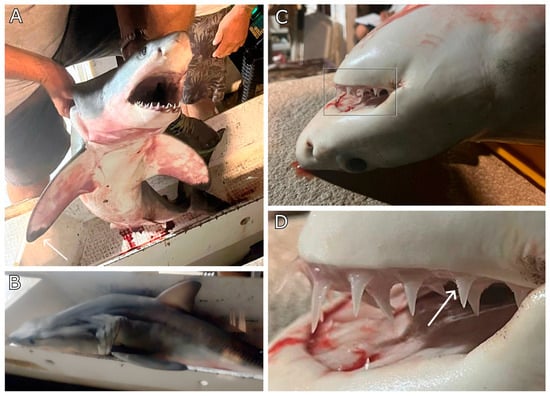
Figure 1.
The young-of-the-year (YOY) white shark (Carcharodon carcharias) caught off Rogoznica, Croatia, on 12. September 2023. (A) The ventral side, showcasing the black tips of the pectoral fins; (B) a lateral view showing the rounded apex of the first dorsal fin, which lacks white markings at the rear edge; and (C) a close-up of the head and (D) jaws, showing triangular teeth with serrations and no cusplets. Figure 1 was reproduced from https://www.morski.hr/kod-rogoznice-ulovljena-velika-bijela-psina-ribari-je-prodali-iako-je-zasticena-vrsta/#google_vignette, with permission from the publisher, 2024 (accessed on 2 August 2024).
Soldo and Bakiu [20] further discuss that this would have been the first record of a juvenile white shark in the Adriatic Sea, which is inconsistent with previously reported records included in their list. In fact, 13 YOY and juvenile white sharks have been reported in the Adriatic Sea since 1868, accounting for approximately 15.5% of all records of white sharks with a known ontogenetic stage (seven YOY, six juveniles, six subadults, 14 subadult/adults, 49 adults, and 14 of an unknown ontogenetic stage; Appendix A). However, the majority of these records are based on historical accounts for which there is no physical or photographic evidence. Only three other records of older juvenile white sharks in the Adriatic Sea (nos. 54, 88, 89; Table S1) are supported by photographic documentation. Therefore, the specimen reported here represents the only unambiguous record of a YOY in the Adriatic Sea.
The white shark caught in Rogoznica is the first record of a white shark in the Adriatic Sea since 2011. The presence of white sharks in the Adriatic Sea, especially along the eastern part of the basin, has previously been associated with the historically high abundance of Atlantic bluefin tuna Thunnus thynnus in this area, which are suggested to be the primary prey for white sharks in the Mediterranean Sea [19]. White sharks are generalist top predators that feed on teleosts [29,30], cephalopods [29,31], elasmobranchs [29,32], and mammals [29,33,34]. However, their nutritional niche breadth increases during ontogeny, with only adult white sharks preying on higher-trophic species, while juveniles primarily feed on lower-trophic teleosts and elasmobranchs [29,30,32]. Therefore, the availability of tuna might explain the presence of adult white sharks, which have been frequently observed in close proximity to tuna fisheries [35,36,37,38,39], but does not account for the occurrence of juvenile white sharks in these waters.
An examination of the collected data reveals that juveniles exhibit a distinct distribution pattern compared to subadult and adult individuals. While adult (and possibly large subadult) white sharks have been recorded throughout the Adriatic Sea, juveniles appear to be restricted to the eastern coast, suggesting specific ecological or environmental factors influencing their distribution (Figure 2; Appendix A). The presence of numerous offshore islands in close proximity to the coast along the eastern Adriatic Sea likely provides a suitable habitat for juvenile white sharks, as has been suggested for other Mediterranean regions [40]. Notably, there is no specific hotspot along the eastern coast where juveniles are more frequently recorded. Instead, sightings are distributed along the entire coastline. This observed pattern cannot be attributed to differences in sampling effort between the eastern and western coasts, as Italy, located on the western Adriatic coast, operates the largest fishing fleet in the region [41].
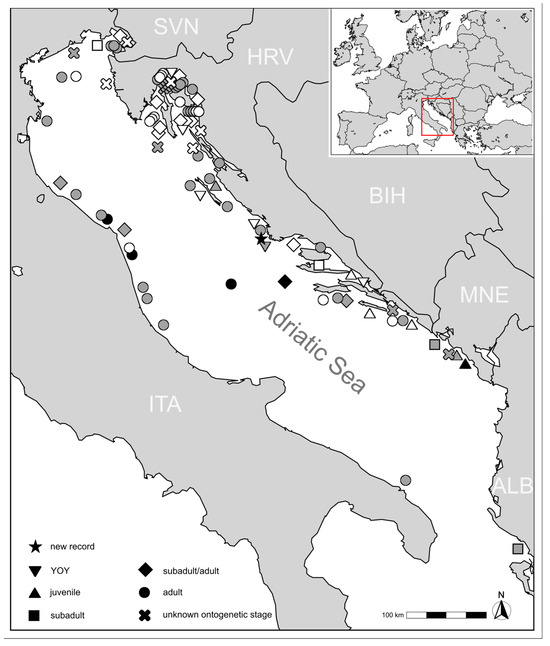
Figure 2.
The spatial distribution of white shark (Carcharodon carcharias) sightings in the Adriatic Sea. Colors indicate the relative age of each record: white, 19th century; grey, 20th century; and black, 21st century. Country abbreviations follow ISO 3166-1 standards.
Previous reports from the western Adriatic coast have suggested the presence of juvenile white sharks also in this area [16,42]. Most of these records date back to the period 1872–1905 when the Imperial Maritime Austrian government issued three circulars offering monetary rewards for captured white sharks [16]. In order to claim the reward, captured specimens had to be presented to the Natural History Museum in Trieste for identification. Unfortunately, white sharks were not the only species that were mentioned in these circulars, and payment records preserved in the State Archive of Trieste do not specify the species for which they were issued [16]. Therefore, the identification of these specimens is uncertain, and we were unable to verify these records (Table S2). A more recent record from Termoli (Italy) mentions the capture of 4–5 female juvenile white sharks, but this record is based on informal communication and lacks supporting evidence [14,16,18]. Consequently, all confirmed records of juvenile white sharks in the Adriatic Sea come from the eastern coast.
The Adriatic Sea has previously been suggested as a potential nursery area for white sharks due to the relatively high occurrence of juvenile specimens in this region [18]. Based on its size and caudal fin morphology, the specimen reported here was identified as a YOY, suggesting that parturition may occur in the Adriatic Sea. This is further supported by a historical record of a gravid female caught near Rijeka [20]. Similarly, several other areas in the Mediterranean Sea have been proposed as potential nursery areas for white sharks, i.e., the Sicilian Channel, Italy [14]; the Gulf of Gabes, Tunisia [14,43,44]; and Edremit Bay, Turkey [45], based on increased juvenile occurrences. However, no discrete nursery areas have been definitively identified in the Mediterranean Sea yet [25]. Furthermore, while white sharks are known to exhibit philopatry [46,47,48], there is evidence that pregnant females are not restricted to a single nursery area but may use widely separated pupping areas [49], and that parturition likely occurs over broader horizontal and vertical spatial scales [7,25]. This was also suggested by previous reports of YOY and juvenile white sharks along the Libyan coast, which were outside their presumed nursery area in the Gulf of Gabes, indicating a wider distribution of these early ontogenetic stages than was previously thought [50]. This indicates that the Mediterranean white shark population exhibits a more complex spatial ecology than previously thought. While the Adriatic Sea remains a plausible candidate for a nursery area, more data on white shark occurrences and broader studies on their spatial ecology in the Mediterranean Sea are needed to confirm this hypothesis.
The record of this YOY white shark in the Adriatic Sea highlights the knowledge gaps that still exist regarding the distribution, spatial ecology, and reproductive biology of Mediterranean white sharks. Citizen science can help to address this data deficiency by providing opportunities to collect new observations that would otherwise go undocumented and should be considered as a complementary approach to studying the biology of these elusive animals in the Mediterranean Sea.
In addition, citizen science also has great potential to promote conservation by raising public awareness of the presence of this species in the Adriatic Sea. The white shark is protected under several international agreements, including the Convention of Migratory Species (Appendix I and II) and the Bern Convention. In addition, white sharks are protected via regional binding decisions (e.g., UNEP MAP SPA/BD Protocol, Decision IG.26/4) and are listed as a prohibited species for EU member states in all waters (Regulation (EU) 2019/1241). Mediterranean countries are required to provide high protection against fishing, ensuring white sharks are released unharmed whenever possible. The retention, transshipment, landing, sale, or display of white sharks is strictly prohibited (GFCM 2018, 2021). Unfortunately, despite these regulations, white sharks and other protected species often go unreported and are illegally sold [51], as was the case with the juvenile white shark from Rogoznica, which was sold to a local restaurant. By leveraging social media and citizen science, we are not only able to collect crucial data about the Mediterranean white shark population, but also educate fishermen and the public, as well as decision makers and control authorities, about the ecological importance of this species, thereby raising awareness and encouraging conservation efforts for this iconic but critically endangered predator in the Mediterranean Sea.
Supplementary Materials
The following supporting information can be downloaded at https://www.mdpi.com/article/10.3390/fishes10010025/s1, Table S1: Verified records of white sharks (Carcharodon carcharias) from the Adriatic Sea; Table S2: Published but unverified records of white sharks (Carcharodon carcharias) from the Adriatic Sea. References [14,16,18,19,20,26,35,37,42,52,53,54,55,56,57,58,59,60,61,62,63,64,65,66,67,68,69,70] are cited in the Supplementary Material.
Author Contributions
Conceptualization, P.L.J. and P.U.; methodology, P.L.J., P.U., M.P., I.Ć. and J.T.; validation, P.L.J., P.U., M.P., I.Ć., S.N., J.K. and J.T.; investigation, P.L.J., P.U., M.P., I.Ć. and J.T.; data curation, P.L.J., P.U., I.Ć. and J.T.; writing—original draft preparation, P.L.J.; writing—review and editing, P.L.J., P.U., M.P., I.Ć., S.N., J.K. and J.T.; visualization, P.L.J. and J.T.; supervision, P.L.J.; funding acquisition, J.K. All authors have read and agreed to the published version of the manuscript.
Funding
This research was funded by the Austrian Science Fund (FWF) [P 33820]. For the purpose of open access, the corresponding author has applied a CC BY public copyright license to any Author Accepted Manuscript version arising from this submission.
Institutional Review Board Statement
Not applicable.
Informed Consent Statement
Not applicable.
Data Availability Statement
All data used by the authors for the analysis are available in the Supplementary Materials.
Acknowledgments
We sincerely thank the fisherman (who wishes to remain anonymous) for generously sharing detailed information about this white shark record from Rogoznica. We are thankful to three anonymous reviewers for their constructive feedback on an earlier version of this manuscript.
Conflicts of Interest
The authors declare no conflicts of interest. The funders had no role in the design of the study; in the collection, analyses, or interpretation of data; in the writing of the manuscript; or in the decision to publish the results.
Appendix A
Verified records of white sharks (Carcharodon carcharias) from the Adriatic Sea, compiled from the literature and the MECO project. Detailed information and sources for each record are provided in Table S1. Unverified or doubtful records that were previously published are listed separately in Table S2.
| Country | Location | Date | Size [cm] | Weight [kg] | Sex | Ontogenetic Stage |
| Albania | Qeparo-Borsh, Himare | 15 April 1964 | 445 | >550 | F | subadult |
| Croatia | Jablanac | 14 September 1868 | - | - | - | - |
| Sv. Juraj | 16 December 1868 | 460 | - | - | adult | |
| Rijeka | 16 April 1872 | 490 | - | - | adult | |
| Opuzen | 12 May 1872 | 95 | - | - | YOY | |
| Mljet | 12 May 1872 | 237 | - | - | juvenile | |
| Rijeka | 8 June 1872 | 131 | - | - | YOY | |
| Dugi Otok | 16 June 1872 | 146 | - | - | YOY | |
| Cavtat | 25 July 1872 | 260 | - | - | juvenile | |
| Rab | 8 August 1872 | 130 | - | - | YOY | |
| Ustrine-Cres | 5 May 1877 | 460 | - | - | adult | |
| Sveta Martin-Cres | 8 May 1877 | 413 | - | - | subadult/adult | |
| Osor-Cres | 17 June 1878 | 371 | - | - | subadult/adult | |
| Poreč | 9 August 1878 | - | - | - | - | |
| Osor | 21 May 1879 | 382 | - | - | subadult/adult | |
| Split | 23 July 1879 | 402–445 | - | - | subadult/adult | |
| Ustrine-Cres | 21 October 1879 | 530 | - | - | adult | |
| Gradac | 5 October 1879 | 250 | - | - | juvenile | |
| Rab | 22 April 1881 | 380 | - | - | subadult/adult | |
| Rab | 16 October 1881 | 405 | - | - | subadult/adult | |
| Sveta Martin-Cres | 13 April 1882 | 529 | - | - | adult | |
| Vrboska-Krk | 13 June 1883 | 300 | - | - | subadult | |
| Rab | 26 September 1883 | 396 | - | - | subadult/adult | |
| Korčula | 3 March 1886 | 560 | - | - | adult | |
| Krk | 2 September 1887 | 470 | - | - | adult | |
| Sv. Juraj | July 1888 | 470 | - | - | adult | |
| Sušak | 23 October 1888 | 500 | 3500 | female | adult | |
| Senj | 26 August 1890 | 440 | - | - | subadult/adult | |
| Bakarac | 15 September 1890 | 384 | - | - | subadult/adult | |
| Pag | 26 April 1891 | - | - | - | - | |
| Bakarac | September 1892 | 450 | - | - | - | |
| Zlarin | 19 February 1893 | 165 | - | male | YOY | |
| Bakar | 29 August 1894 | 470 | - | female | adult | |
| Dubrovnik | 15 July 1901 | 520 | - | - | adult | |
| Senj | 21 May 1903 | 600 | 1200 | adult | ||
| Povile | 30 September 1903 | 450 | - | - | adult | |
| Bakarac | 29 June 1906 | 522 | - | female | adult | |
| Kraljevica | October 1909 | 550 | - | - | adult | |
| Dugi Otok-Kornati | 2 February 1920 | 525 | 1300 | - | adult | |
| Ugljan | March 1926 | 500 | 700 | - | adult | |
| Lumbarda | August 1926 | 400 | 500 | - | subadult/adult | |
| Kraljevica | Summer 1926 | 600 | 1000 | - | adult | |
| Lumbarda | October 1926 | 600 | 1800 | - | adult | |
| Rogoznica | 1931 | 150 | - | female | YOY | |
| Susak Island | 21 August 1934 | - | - | - | - | |
| Kraljevica | 2 September 1934 | 775 | 1100 | - | adult | |
| Mošćenička Draga | 7 September 1934 | 600 | 1000 | - | adult | |
| Lukovo | 20 July 1935 | 600 | 2500 | - | adult | |
| Bakarac | Summer 1946 | - | - | - | - | |
| Primošten | August 1950 | 700–800 | - | - | adult | |
| Pag | 2 October 1954 | 550 | 1500 | - | adult | |
| Senj-Sveti Juraj | 10 December 1955 | 460 | - | female | adult | |
| Opatija | 24 September 1961 | - | - | - | - | |
| Rava | 1968 | 200 | - | - | juvenile | |
| Opatija | 1971 | - | - | - | - | |
| Kornati | 17 August 1972 | 600 | - | - | adult | |
| Luka Šipanska | 26 July 1973 | - | - | - | - | |
| Lokva Rogoznica | 10 August 1974 | 500 | - | - | adult | |
| Vrsi near Nin | 17 June 1976 | 450 | - | male | adult | |
| Island of Jabuka | 24 March 2003 | 570 | 2000–2500 | female | adult | |
| Vis | 6 October 2008 | ~450 | - | - | subadult/adult | |
| Rogoznica | 12 September 2023 | 120–130 | 20 | - | YOY | |
| Italy | Adriatic | 16 September 1823 | 490 | - | F | adult |
| Adriatic | 1827 Spring | - | - | - | - | |
| Civitanova Marche | February 1839 | 580–600 | 1800 | F | adult | |
| Trieste | 1 September 1868 | - | - | - | - | |
| Grado | 19 April 1872 | 300 | - | - | subadult | |
| Gulf of Venezia | Before 1881 | 490 | adult | |||
| Santa Croce di Trieste | 14 September 1885 | 400 | - | - | subadult/adult | |
| Trieste | 1902 | 375 | - | male | adult | |
| Trieste | June 1908 | - | 1400 | - | adult | |
| Pescara | ca. 1945 | 600 | - | - | adult | |
| Riccione | 7 July 1961 | 450 | - | subadult/adult | ||
| Golfo di Venezia | 7 June 1978 | 500 | - | - | adult | |
| Caorle | June 1978 | - | - | - | - | |
| Numana | May 1988 | 450 | - | - | subadult/adult | |
| Porto Barricata | 9 October 1988 | 550 | - | - | adult | |
| Pesaro | September 1989 | 500+ | - | - | adult | |
| Brindisi | 15 September 1996 | 400–500 | - | - | adult | |
| Senigallia | 27 August 1998 | 500–600 | 1200 | - | adult | |
| Giulianova | 26 September 1999 | 600 | - | - | adult | |
| Giulianova | September–October 1999 | 700 | - | - | adult | |
| Falconara | 30 July 2001 | 550–600 | - | - | adult | |
| Porto San Giorgio | 9 September 2002 | 700–800 | adult | |||
| Montenegro | Herceg Novi | June 1926 | 300 | - | - | subadult |
| Budva | August 1955 | - | - | - | - | |
| Budva | 31 January 1998 | 185 | 80 | - | juvenile | |
| Bar | 5 August 2011 | 220 | 150 | male | juvenile | |
| Slovenia | Izola | 22 October 1963 | 490–550 | 1100 | - | adult |
| North Adriatic Sea | Before 1873 | 460 | adult | |||
| Central Adriatic Sea | 1969 | - | - | - | - | |
| Eastern Adriatic Sea | 1901 | 500 | - | - | adult | |
| Eastern Adriatic Sea | May 1947 | 300 | 300 | - | subadult | |
| Adriatic Sea | Before 1919 | 438 | female | subadult | ||
| Adriatic Sea | Before 1969 | 600 | adult |
References
- Randall, J.E. Size of the great white shark (Carcharodon). Science 1973, 181, 169–170. [Google Scholar] [CrossRef] [PubMed]
- Castro, J.J. Chapter 7: A summary of observations on the maximum size attained by the white shark, Carcharodon carcharias. In Global Perspectives on the Biology and Life History of the White Shark; Domeier, M.L., Ed.; CRC Press: Boca Raton, FL, USA, 2012; pp. 85–90. [Google Scholar]
- Compagno, L.J.V. Sharks of the World: Part 1: Hexachiformes to Lamniformes; FAO Species Catalogue; FAO: Rome, Italy, 1984; Volume 4, ISBN 978-92-5-101384-7. [Google Scholar]
- Compagno, L.J.V.; Dando, M.; Fowler, S. Sharks of the World; Princeton University Press: Princeton, NJ, USA, 2005. [Google Scholar]
- Ebert, D.A.; Fowler, S.; Dando, M. Sharks of the World: A Complete Guide; Princeton University Press: Princeton, NJ, USA, 2021; ISBN 978-0-691-20599-1. [Google Scholar]
- Bonfil, R.; Meÿer, M.; Scholl, M.C.; Johnson, R.; O’Brien, S.; Oosthuizen, H.; Swanson, S.; Kotze, D.; Paterson, M. Transoceanic migration, spatial dynamics, and population linkages of white sharks. Science 2005, 310, 100–103. [Google Scholar] [CrossRef] [PubMed]
- Weng, K.C.; Boustany, A.M.; Pyle, P.; Anderson, S.D.; Brown, A.; Block, B.A. Migration and habitat of white sharks (Carcharodon carcharias) in the eastern Pacific Ocean. Mar. Biol. 2007, 152, 877–894. [Google Scholar] [CrossRef]
- Wagner, I.; Smolina, I.; Koop, M.E.L.; Bal, T.; Lizano, A.M.; Choo, L.Q.; Hofreiter, M.; Gennari, E.; De Sabata, E.; Shivji, M.S.; et al. Genome analysis reveals three distinct lineages of the cosmopolitan white shark. Curr. Biol. 2024, 34, 3582–3590.e4. [Google Scholar] [CrossRef]
- Dulvy, N.K.; Allen, D.J.; Ralph, G.M.; Walls, R.H.L. The Conservation Status of Sharks, Rays and Chimaeras in the Mediterranean Sea; IUCN Centre for Mediterranean Cooperation: Malaga, Spain, 2016; p. 14. [Google Scholar]
- Moro, S.; Jona-Lasinio, G.; Block, B.; Micheli, F.; De Leo, G.; Serena, F.; Bottaro, M.; Scacco, U.; Ferretti, F. Abundance and distribution of the white shark in the Mediterranean Sea. Fish Fish. 2020, 21, 338–349. [Google Scholar] [CrossRef]
- Soldo, A.; Peirce, R. Shark chumming in the Eastern Adriatic. Ann. Ser. Hist. Nat. 2005, 15, 203–208. [Google Scholar]
- Micarelli, P.; Reinero, F.R.; Marsella, A.; Vernelli, E.; Vittorini, E.; Monteleone, L.; Vailati, M.; Marsili, L.; Tinti, F.; Sperone, E. Attempts to locate and sample the white shark, Carcharodon carcharias (Lamniformes: Lamnidae), along the Italian coasts in the Mediterranean Sea. Acta Adriat. 2023, 64, 181–186. [Google Scholar] [CrossRef]
- Ferretti, F.; Shea, B.D.; Gambardella, C.; Jenrette, J.F.; Moro, S.; Echwikhi, K.; Schallert, R.J.; Gallagher, A.J.; Block, B.A.; Chapple, T.K. On the tracks of white sharks in the Mediterranean Sea. Front. Mar. Sci. 2024, 11, 1425511. [Google Scholar] [CrossRef]
- Fergusson, I.K. Distribution and autecology of the white shark in the eastern North Atlantic Ocean and the Mediterranean Sea. In Great White Sharks. The Biology of Carcharodon carcharias; Klimley, A.P., Ainley, D., Eds.; Academic Press: San Diego, CA, USA; London, UK, 1996; pp. 321–345. [Google Scholar]
- McPherson, J.M.; Myers, R.A. How to infer population trends in sparse data: Examples with opportunistic sighting records for great white sharks. Divers. Distrib. 2009, 15, 880–890. [Google Scholar] [CrossRef]
- De Maddalena, A.D.; Heim, W. Mediterranean Great White Sharks: A Comprehensive Study Including All Recorded Sightings, Illustrated Edition; McFarland: Jefferson, NC, USA, 2012; ISBN 978-0-7864-5889-9. [Google Scholar]
- Madiraca, F.; Davidov, B.; Udovičić, D. Analyses on the occurrence of pelagic sharks in the Eastern Adriatic Sea. Pluralidade 2015, 5, 1–27. [Google Scholar]
- Boldrocchi, G.; Kiszka, J.; Purkis, S.; Storai, T.; Zinzula, L.; Burkholder, D. Distribution, ecology, and status of the white shark, Carcharodon carcharias, in the Mediterranean Sea. Rev. Fish Biol. Fish. 2017, 27, 515–534. [Google Scholar] [CrossRef]
- Soldo, A.; Jardas, I. Occurrence of great white shark, Carcharodon carcharias (Linnaeus, 1758) and basking shark, Cetorhinus maximus (Gunnerus, 1165) in the Eastern Adriatic and their protection. Period. Biol. 2002, 104, 195–201. [Google Scholar]
- Soldo, A.; Bakiu, R. Additional Historical Records of the Great White Shark, Carcharodon carcharias (Lamniformes: Lamnidae) in the Eastern Adriatic: Updating Regional Occurrence of a Critically Endangered Shark. Ann. Ser. Hist. Nat. 2024, 34, 11–20. [Google Scholar] [CrossRef]
- Barash, A.; Salingré, S.; Grosmark, Y.; Rothman, S.; Stoilas, V.-O.; Maximiadi, M.; Tuncer, S.; Lapinski, M.; Rodriguez, I.; Bakiu, R.; et al. The MECO project (Mediterranean Elasmobranch Citizen Observations): Using social media to create a regional database of elasmobranch observations. In Proceedings of the 22nd European Elasmobranch Association Annual Conference, Peniche, Portugal, 12–14 October 2018. [Google Scholar]
- Gardiner, M.M.; Allee, L.L.; Brown, P.M.; Losey, J.E.; Roy, H.E.; Smyth, R.R. Lessons from lady beetles: Accuracy of monitoring data from US and UK citizen-science programs. Front. Ecol. Environ. 2012, 10, 471–476. [Google Scholar] [CrossRef]
- Compagno, L.J.V. Sharks of the World. An Annotated and Illustrated Catalogue of Shark Species Known to Date. Volume 2. Bullhead, Mackerel and Carpet Sharks (Heterodontiformes, Lamniformes and Orectolobiformes); FAO Species Catalogue for Fishery Purposes; FAO: Rome, Italy, 2002; 269p. [Google Scholar]
- Serena, F. Field Identification Guide to the Sharks and Rays of The Mediterranean and Black Sea; FAO: Rome, Italy, 2005; ISBN 978-92-5-105291-4. [Google Scholar]
- O’Connell, C.P.; Dodd, J.F.; Crews, J.; Gressle, J.; Racicot, B.; Sitzer, S.; Lis, T.; Skomal, G.B. A global review of white shark (Carcharodon carcharias) parturition. Rev. Fish Biol. Fish. 2024, 34, 869–893. [Google Scholar] [CrossRef]
- Balàka, P.F.; Ugarković, P.; Türtscher, J.; Kriwet, J.; Niedermüller, S.; Krstinić, P.; Jambura, P.L. Updated Checklist of Chondrichthyan Species in Croatia (Central Mediterranean Sea). Biology 2023, 12, 952. [Google Scholar] [CrossRef] [PubMed]
- Bernardi, J.; De Maddalena, A. On a porbeagle, Lamna nasus (Bonnaterre, 1788), observed near Brač, Croatia. Boll. Mus. Stor. Nat. Venezia 2023, 74, 19–23. [Google Scholar]
- Keramidas, I.; Ugarković, P.; De Maddalena, A.; Giovos, I. An additional record of Lamna nasus (Bonnaterre, 1788) from Croatia, Adriatic Sea. J. Black Sea Mediterr. Environ. 2019, 25, 87–92. [Google Scholar]
- Hussey, N.E.; McCann, H.M.; Cliff, G.; Dudley, S.F.J.; Wintner, S.P.; Fisk, A.T. Chapter 3: Size-based analysis of diet and trophic position of the white shark (Carcharodon carcharias) in South African waters. In Global Perspectives on the Biology and Life History of the White Shark; Domeier, M.L., Ed.; CRC Press: Boca Raton, FL, USA, 2012; pp. 27–45. [Google Scholar]
- Clark, Z.S.R.; Fish, J.J.; Butcher, P.A.; Holland, O.J.; Sherman, C.D.H.; Rizzari, J.; Weeks, A.R.; Miller, A.D. Insights into the diet and trophic ecology of white sharks (Carcharodon carcharias) gained through DNA metabarcoding analyses of cloacal swabs. Environ. DNA 2023, 5, 1362–1377. [Google Scholar] [CrossRef]
- Smale, M.J.; Cliff, G. Chapter 4: White sharks and cephalopod prey: Indicators of habitat use? In Global Perspectives on the Biology and Life History of the White Shark; CRC Press: Boca Raton, FL, USA, 2012; pp. 51–58. [Google Scholar]
- Grainger, R.; Peddemors, V.M.; Raubenheimer, D.; Machovsky-Capuska, G.E. Diet Composition and Nutritional Niche Breadth Variability in Juvenile White Sharks (Carcharodon carcharias). Front. Mar. Sci. 2020, 7, 422. [Google Scholar] [CrossRef]
- Long, D.J.; Jones, R.E. White shark predation and scavenging on cetaceans in the eastern North Pacific Ocean. In Great White Sharks: The Biology of Carcharodon carcharias; Academic Press: Cambridge, MA, USA, 1996; pp. 293–307. [Google Scholar]
- Martin, R.A.; Hammerschlag, N.; Collier, R.S.; Fallows, C. Predatory behaviour of white sharks (Carcharodon carcharias) at Seal Island, South Africa. J. Mar. Biol. Assoc. U. K. 2005, 85, 1121–1135. [Google Scholar] [CrossRef]
- Morey, G.; Martínez, M.; Massutí, E.; Moranta, J. The Occurrence of White Sharks, Carcharodon carcharias, Around the Balearic Islands (Western Mediterranean Sea). Environ. Biol. Fishes 2003, 68, 425–432. [Google Scholar] [CrossRef]
- Galaz, T.; De Maddalena, A. On a great white shark, Carcharodon carcharias (Linnaeus, 1758), trapped in a tuna cage off Libya, Mediterranean Sea. Ann. Ser. Hist. Nat. 2004, 14, 159–164. [Google Scholar]
- Soldo, A.; Dulčić, J. New record of a great white shark, Carcharodon carcharias (Lamnidae) from the eastern Adriatic Sea. Cybium 2005, 29, 89–90. [Google Scholar]
- Storai, T.; Vanni, S.; Zuffa, M.; Blagi, V. Presenza di Carcharodon carcharias (Linnaeus, 1758) nelle acque toscane (Mar Ligure meridionale e Mar Tirreno settentrionale; Mediterraneo): Analisi e revisione delle segnalazioni (1839–2004). Atti Della Soc. Toscana Di Sci. Nat. Resid. Pisa Mem. Ser. B 2005, 112, 153–166. [Google Scholar]
- Salinas-de-León, P.; Zanchi, S.; Moya-Serrano, A.V.; Suarez-Moncada, J.; Hoyos-Padilla, M. First record of a white shark (Carcharodon carcharias) in Ecuadorian waters coinciding with the 2021 La Niña ENSO event. Environ. Biol. Fishes 2024, 107, 1291–1296. [Google Scholar] [CrossRef]
- Kabasakal, H.; Yamaz, A.; Gedikoglu, S.O. Two juvenile Great White sharks, Carcharodon carcharias (LINNAEUS, 1758) (Chondrichthyes; Lamnidae), caught in the northeastern Aegean Sea. Ann. Ser. Hist. Nat. 2009, 19, 127–134. [Google Scholar]
- Russo, E.; Monti, M.A.; Mangano, M.C.; Raffaetà, A.; Sarà, G.; Silvestri, C.; Pranovi, F. Temporal and spatial patterns of trawl fishing activities in the Adriatic Sea (Central Mediterranean Sea, GSA17). Ocean Coast. Manag. 2020, 192, 105231. [Google Scholar] [CrossRef]
- De Maddalena, A. Historical and contemporary presence of the Great White Shark, Carcharodon carcharias (Linnaeus, 1758), in the northern and central Adriatic Sea. Ann. Ser. Hist. Nat. 2000, 10, 3–16. [Google Scholar]
- Saïdi, B.; Bradaï, M.N.; Bouaïn, A.; Guélorget, O.; Capapé, C. Capture of a pregnant female white shark, Carcharodon carcharias (Lamnidae) in the Gulf of Gabès (southern Tunisia, central Mediterranean) with comments on oophagy in sharks. Cybium 2005, 29, 303–307. [Google Scholar]
- Bradai, M.N.; Saidi, B. On the occurence of the great white shark (Carcharodon carcharias) in Tunisian coasts. Rapp. Comm. Int. Mer Médit. 2013, 40, 489. [Google Scholar]
- Kabasakal, H. Exploring a possible nursery ground of white shark (Carcharodon carcharias) in Edremit Bay (northeastern Aegean Sea, Turkey). J. Black Sea Mediterr. Environ. 2020, 26, 176–189. [Google Scholar]
- Jorgensen, S.J.; Reeb, C.A.; Chapple, T.K.; Anderson, S.; Perle, C.; Van Sommeran, S.R.; Fritz-Cope, C.; Brown, A.C.; Klimley, A.P.; Block, B.A. Philopatry and migration of Pacific white sharks. Proc. R. Soc. B Biol. Sci. 2010, 277, 679–688. [Google Scholar] [CrossRef] [PubMed]
- Blower, D.; Pandolfi, J.; Bruce, B.; Gomez Cabrera, K.-L.; Ovenden, J. Population genetics of Australian white sharks reveals fine-scale spatial structure, transoceanic dispersal events and low effective population sizes. Mar. Ecol. Prog. Ser. 2012, 455, 229–244. [Google Scholar] [CrossRef]
- Andreotti, S.; Rutzen, M.; Van Der Walt, S.; Von Der Heyden, S.; Henriques, R.; Meer, M.; Oosthuizen, H.; Matthee, C.A. An integrated mark-recapture and genetic approach to estimate the population size of white sharks in South Africa. Mar. Ecol. Prog. Ser. 2016, 552, 241–253. [Google Scholar] [CrossRef]
- Domeier, M.L.; Nasby-Lucas, N. Two-year migration of adult female white sharks (Carcharodon carcharias) reveals widely separated nursery areas and conservation concerns. Anim. Biotelemetry 2013, 1, 2. [Google Scholar] [CrossRef]
- Jambura, P.L.; Türtscher, J.; De Maddalena, A.; Giovos, I.; Kriwet, J.; Rizgalla, J.; Al Mabruk, S.A.A. Using citizen science to detect rare and endangered species: New records of the great white shark Carcharodon carcharias off the Libyan coast. Ann. Ser. Hist. Nat. 2021, 31, 51–60. [Google Scholar] [CrossRef]
- WWF. Sharks and Rays: A Deadly Harvest—Widespread Evidence of Illegal, Unreported and Unregulated Fishing in the Mediterranean; WWF: Rome, Italy, 2020; p. 4. Available online: https://wwfeu.awsassets.panda.org/downloads/wwf_iuu_sharks_and_rays_briefing_2020_v6__1_.pdf (accessed on 2 December 2024).
- Brusina, S. Morski psi Sredozemnoga i Crljenog mora. Glas. Hrvat. Naravosl. Druž. 1888, 3, 167–230. [Google Scholar]
- Hirtz, M. Morski psi. Priroda 1932, 22, 213–221. [Google Scholar]
- Perugia, A. Appunti sopra alcuni pesci sud-americani conservan nel Musco Cívico di Storia Naturale di Genova. Ann. Mus. Civ. Stor. Nat. Genova 1891, 10, 605–657. [Google Scholar]
- Ninni, E. Catalogo dei Pesci del Mare Adriatico; Bertotti: Venezia, Italy, 1912. [Google Scholar]
- Mojetta, A.; Storai, T.; Zuffa, M. Segnalazioni di squalo bianco (Carcharodon carcharias) in acque italiane. Quad. Civ. Stn. Idrobiol. 1997, 22, 23–38. [Google Scholar]
- Tortonese, E. Fauna D’italia. Leptocardia, Ciclostomata, Selachii; Calderini: Bologna, Italy, 1956; Volume 2. [Google Scholar]
- Carus, J.V. Prodromus Faunae Mediterraneae II: Plagiostomi—Selachoidei; Schweizerbarfsche Verlagshandlung: Stuttgart, Germany, 1893. [Google Scholar]
- Faber, G.L. Fisheries of the Adriatic and the Fish of Thereof; Bernard Quaritch: London, UK, 1883. [Google Scholar]
- Storai, T.; Mojetta, A.; Zuffa, M.; Giuliani, S. Nuove segnalazioni di Carcharodon carcharias (L.) nel Mediterraneo centrale. Atti Soc. Toscana Sci. Nat. Resid. Pisa Mem. Ser. B 2000, 107, 139–142. [Google Scholar]
- Mušin, D. Ichthyological collection (Cyclostomata, Selachii, Osteichthyes) of the Natural History Museum of the Biological Institute, Dubrovnik. Matice Srp. Za Prir. Nauke 1989, 76, 137–168. [Google Scholar]
- Langhoffer, A. Popis riba. G.H.N.D. 1905, 16, 148–169. [Google Scholar]
- Kovačić, M. Ichthyological collection (Cyclostomata, Selachii, Osteichthyes) of the Natural History Museum Rijeka. In Arko–Pijevac; Kovačić, M., Crnković, D., Eds.; Natural History Library: Rijeka, Croatia, 1998; pp. 685–698. [Google Scholar]
- Morović, D. Prilog Bibliografiji Jadranskog Ribarstva; Institut Oceanografiju i Ribarstvo u Split: Split, Croatia, 1950. [Google Scholar]
- Morović, D. Rijetke ribe u Jadranu. Pomor. Zb. 1973, 2, 367–383. [Google Scholar]
- Giudici, A.; Fino, F. Squali del Mediterraneo; Atlantis: Roma, Italy, 1989. [Google Scholar]
- Bonaparte, C. Iconografia della Fauna Italica per le Quattro Classi Degli Animali Vertebrati. Tomo III, Pesci; Tipografia Salviucci: Rome, Italy, 1839. [Google Scholar]
- Mizzan, L. I Leptocardi, Ciclostomi e Selaci delle collezioni del Museo Civico di Storia Naturale di Venezia—1) Leptocardia, Agnatha, Gnathostomata—Chondrichthyes (esclusi Rajiformes). Boll. Mus. Civ. Stor. Nat. Venezia 1994, 45, 123–137. [Google Scholar]
- Cugini, G.; De Maddalena, A. Sharks captured off Pescara (Italy, western Adriatic Sea). Ann. Ser. Hist. Nat. 2003, 13, 201–208. [Google Scholar]
- Regner, S. Joksimović Velika bela ajkula na crnogorskom primorju. Bionet Glas. 1998, 7, 3–4. [Google Scholar]
Disclaimer/Publisher’s Note: The statements, opinions and data contained in all publications are solely those of the individual author(s) and contributor(s) and not of MDPI and/or the editor(s). MDPI and/or the editor(s) disclaim responsibility for any injury to people or property resulting from any ideas, methods, instructions or products referred to in the content. |
© 2025 by the authors. Licensee MDPI, Basel, Switzerland. This article is an open access article distributed under the terms and conditions of the Creative Commons Attribution (CC BY) license (https://creativecommons.org/licenses/by/4.0/).