


Abstract
Due to major global urbanisation, a careful evaluation of plans (town planning and mobility) and projects (industrial and development) is required in order to measure their impact on health and environmental matrices. In Italy, Legislative Decree No 152/06 introduced two procedures: the EIA (Environmental Impact Assessment) and SIA (Strategic Impact Assessment). Their focus, however, does not consider human health. Recently, the Integrated Environmental and Health Impact Assessment (IEHIA) was introduced; this defines the parameters necessary to provide an EIA that includes human health as a factor. This systematic review was conducted, including both the population impacted by new facilities and the method used to define their impact. Our database search produced 724 articles, of which 33 were eligible. Studies included landfill plans, manufacturing industries, mobility policies, energy production, and the environmental health of an area. All studies show how an approach encompassing multiple parameters can analyse the impact of a new facility in a comprehensive manner. This review shows that the use of health-related environmental impact parameters is essential for the integration of a project into a community, and can allow a wider understanding of the possible impacts on human health, both direct and indirect.
1. Introduction
Increasing globalisation, industrialisation, and the development of transport systems and the trade sector are having a massive impact on the world’s ecosystem, and, consequently, on the health of the global population. The large rise in the negative impact of these large-scale anthropogenic projects is alarming as it causes irreversible damage to the ecological balance of the ecosystem. In order to mitigate the various negative effects, the One Health Model approach provides several tools that can be used in upcoming projects; such as the Environmental Impact Assessment (EIA), which can be used in the design phase, and the Strategic Environmental Assessment (SEA), which can be used in the territorial planning phase. These tools allow the evaluation of different aspects of the long-term effects of a project on the surrounding environment [1,2,3].
The EIA first emerged in the US in 1969, with its National Environmental Policy Act (NEPA). Between 1973 and 1974, Australia, Canada, and New Zealand followed the NEPA statement by implementing it in their legislation and administrative procedures. In Europe, it was introduced with the “Council Directive 85/337/EEC of 27 June 1985” and amended with Directive 2011/92/EU and Directive 2014/52/EU [4,5,6]. Directive 2014/52/EU also includes “population” and “human health”. The Directive does not, however, specify parameters on how health effects can be assessed. The EIA is widely used in many countries around the world today. As of 2017, most of these countries implemented the EIA in their national legislations in various sectors, such as agriculture, tourism, mining, and so forth. Various parameters are measured, including soil, water, and air pollution, waste production, noise pollution, and loss of biodiversity.
In 2016, the World Health Organisation (WHO) tried to estimate environmental exposures and the effects of these on the burden of diseases afflicting humanity around the world. It has been found that the environment contributed up to 24% of deaths globally [7]. This shows how one of the most important social determinants of health, from an “equitable” point of view, is the physical environment in which one lives [8]. The living environment can by itself determine the probability of contracting or developing a disease [9]. Many studies have shown that low-income countries are more susceptible to climate change relative to high-income countries. Low-income countries are primarily affected with reference to health, food, water, and ambient pollution [10].
The Netherlands Environmental Assessment Commission and the United Nations Environment Programme (UNEP) state that the EIA is considered a legal requirement in 186 countries of the 193 nations recognised by the UN. The SEA, on the other hand, introduced in the EU in 2001 with Directive 2001/42/EC, is used in only about 60 UN countries [11,12]. With regard to Italy, the EIA was introduced in 1988, as the “Valutazione Impatto Ambientale (VIA)” (Environmental Impact Assessment), and is used mainly for projects and production facilities [13]. The SEA (“Valutazione Ambientale Strategica (VAS)”) was introduced in 2008, and is now used in mobility and urbanisation planning. Today, the Italian Legislative Decree 152/06 is used nationally, though it is not considered binding and is used instead as a guideline. This Decree tends to have a very specific flaw as it focuses on the environment and, therefore, the health impact is not easily measured [14]. In Italy, the term “Valutazione Impatto Sanitario” (VIS) (Health Impact Assessment) is not yet mandatory, although there is a great push in trying to enhance the role of the Health Impact Assessment within Environmental Impact Assessments at a national level [15]. Project VIIAS, “Valutazione Integrata dell’Impatto Ambientale e Sanitario” (Integrated Environmental and Health Impact Assessment—IEHIA), a national project financed by the Ministry of Health, was recently introduced in Italy [16]. The IEHIA is analogous to the Health Impact Assessment (HIA), used internationally for the impact assessment of policies, plans, and projects. This work resulted from a desire to define the parameters necessary to provide an EIA that thoroughly includes human health, promoting a One Health Model approach, addressing the needs of the most vulnerable populations, animals, and the environment.
Unfortunately, the EIA and SEA cannot qualify for a full assessment of the environmental impact as they have a very limited scope in measuring the health impact on humans. Therefore, there have been different attempts to introduce the HIA in order to have a much more comprehensive view [17]. The HIA can be used in policy making as it uses an evidence-based medicine approach. The WHO, with its 1999 Consensus Paper, outlined methods that could be used to implement the HIA at an international level [18]. Nowadays, the HIA method is used in many countries, usually on a voluntary basis, as it is not incorporated in national legislation. In spite of this, it is now widely disseminated in many countries with the objective to reach the Sustainable Development Goals (SDGs), introduced by the UN in order to reach “equity” by 2030 [19]. Gulis et al. (2022) describes how the inclusion of SDGs indicators in EIA, SIA, and HIA are important in reaching the target of a much more sustainable world [20,21]. Since 2022, the One Health Model approach has been the next step in tackling the different threats caused by climate change and environmental impacts on health [22]. Again, the Health Impact is not easily estimated as many parameters are not considered. There is a wide range of tools available to be integrated into a single, more complete tool. Therefore, this means that a much more comprehensive and inclusive approach is needed from a public health perspective.
2. Materials and Methods
2.1. Selection Protocol and Search Strategy
The current systematic review was carried out according to the Preferred Reporting Items for Systematic Reviews and Meta-Analyses (PRISMA) Methodology [23]. The associated protocol was registered in PROSPERO with the following ID: CRD42024509337.
Research in the literature was performed using three different databases: PubMed, Scopus, and Web of Science. All articles were searched, from the beginning to the 5 February 2024 using the following search string: (“environmental impact assessment” OR “strategic environmental assessment”) AND (“population health” OR “public health”) AND (indicators OR method OR guidelines).
2.2. Inclusion Criteria for the Study
All articles found were first screened by title and abstract and secondly by the full text. Screening was conducted independently by all authors (L.C., M.S., E.D.R., C.C., L.P.). The same authors (L.C., M.S., E.D.R., C.C., L.P.) read the full texts independently. All doubts and disagreements were then discussed, and disagreements were solved by reaching consensus between the authors.
Any research that provided information regarding a specific example of a framework and an assessment of its influence on human health was considered acceptable. Reviews, meta-analyses, case studies, symposia, editorials, and other kinds of studies were not accepted. Only those articles presenting original data were admissible. All references of the included articles were examined; this was performed in order to identify the articles that were included in those references. Only articles published in Italian or English were included.
2.3. Data Extraction and Quality Assessment
Information regarding author, year, country, methods, and parameters used were collected from all studies. Furthermore, the data were organised to define the parameters that were important for the assessment of the environmental impact on human health.
A quality assessment was conducted by the use of the Newcastle–Ottawa Quality Assessment Scale (NOS).
3. Results
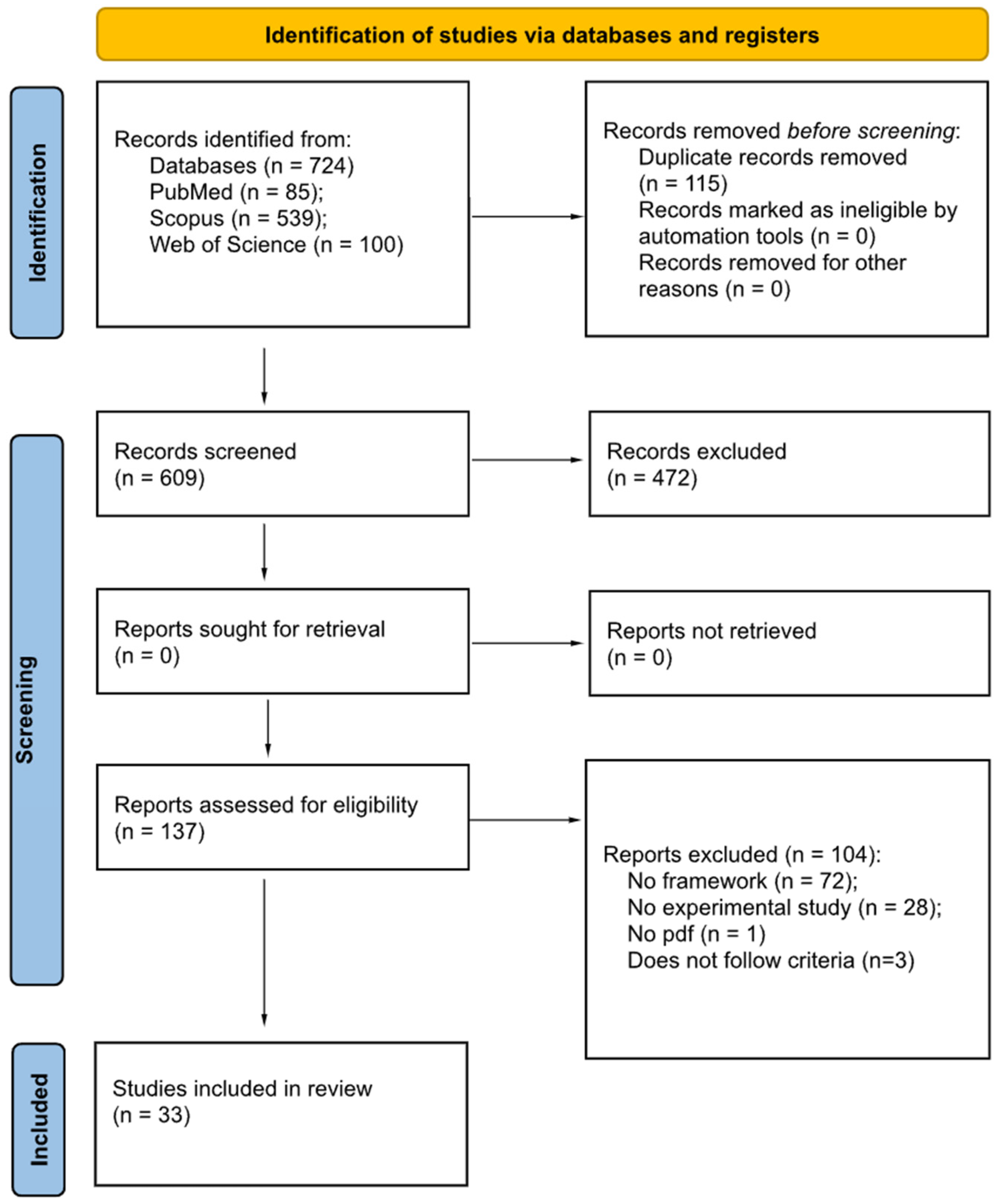
A total of 724 studies were retrieved from the following databases: PubMed, Web of Science, and Scopus. Of these, 115 duplicates were removed and 609 were screened according to title and abstract. In this step, 472 articles were excluded as they did not meet the inclusion criteria chosen by all the authors (L.C., M.S., E.D.R., C.C., L.P.). The remaining 137 articles were then screened by the full text.
After reviewing the remaining 137 full texts, 101 articles were excluded for the following reasons: 72 did not have a clear framework, 28 were not experimental studies, and, for 1, we could not find the complete full text.
In the end, we included only those 33 articles that met the inclusion criteria (Figure 1).
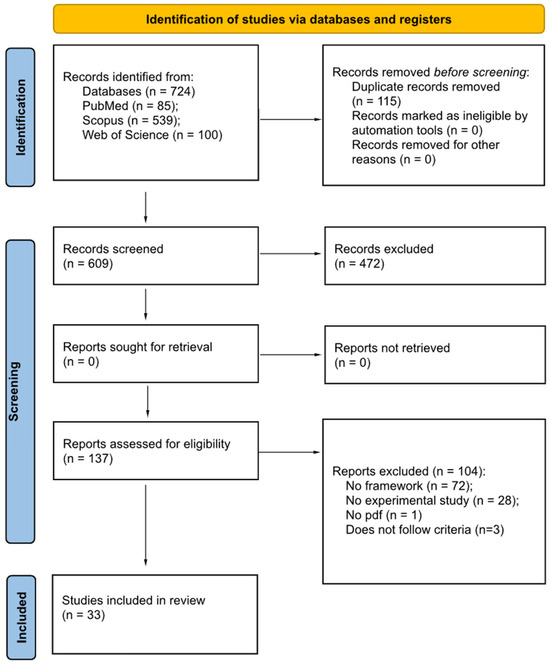
Figure 1.
PRISMA flowchart for search strategy.
The quality was then measured using the NOS. The NOS for observational studies evaluates the quality of the study following a set of questions, in which each study can be assigned up to nine points based on three domains. The first domain, “SELECTION” (4 points), considers the selection of the study groups, the sample size, information about the responders, and whether there was a clear ascertainment of the risk factor. The second domain, “COMPARABILITY” (2 points), consists of the comparability of the different outcome groups and if the confounding factors are controlled. The last domain, “OUTCOME” (3 points), studies whether the ascertainment of the exposure and the outcome are clearly assessed, or whether the statistical test, if used, is appropriate or not.
The points were then added up and the quality was “Good” if the final sum was higher than 7, “Fair” when the points assigned were between 5 and 7, or “Poor” if the final result was lower than 5.
The findings from each of those studies included are summarised in Table 1.

Table 1.
Included studies and their characteristics.
The articles included were published between the years 1993 [24] and 2023 [54,55,56]. Studies were conducted in Canada [24,35], the USA [25,27,33,40], the UK [26,46], Denmark [28], Germany [29,43], Iran [30,31,42,49,50,54], Italy [32,36], China [34,37,45,47,56], Australia [38,48], Republic of Korea [39,52], Ghana [41], Spain [44], Greece [51], Thailand [53], and Egypt [55].
The included studies covered a variety of contexts, considering from landfill plans [24,28,32,37,41,42,46,51,55], manufacturing factories [29,31,39,49,50,53], mobility actions [26,38,44,48,52], energy productions [30,33,36,40,43,47,54,56], and the environmental health of an area [25,27,34,35,45].
Each article describes a different method for the impact assessment. The HIA method is one of those used by the authors [26,27,33,38,48]. Another method is the EIA [30,31,37,42,49,54]. Several authors have assessed the possible impact of the process throughout the entire procedure, using the Life Cycle Assessment method [36,39,41,43,47,51,53,56] and a Life Cycle Cost method [47].
Another technique that was also equally represented is one that involves the use of mathematical simulators and a multi-criteria decision analysis [24,25,26,27,29,30,31,32,33,34,35,37,40,42,44,45,46,49,50,52,54,55]. This method can also be combined with the information extracted from the Geographical Information System (GIS) [31,34,55]. Only a study carries out an SEA [28] and a Specific Health Impact Assessment [48].
Determinants of health are assessed as parameters with a focus on human health and safety [26,27,28,29,32,33,35,40,42,43,44,47,48,49,54,56], environmental impact [24,25,26,27,28,29,30,31,32,33,34,35,36,37,38,39,40,41,42,43,45,46,47,49,50,51,52,54,55,56], the contribution to global warming [28,29,32,39,51,56], eco-toxic effects [28,29,30,31,32,35,47,50,52,53,56], human toxicity [28,29,35,40,47,53,56], life cycle cost [27,35,41,47], and socioeconomical [26,27,35,38,42,49,50,54], cultural [26,27,38,42,43,49,50,54], archaeological and historical resources [27], and programmatic assumptions [27,35,41,47]. Biomonitoring of blood and urine samples can also be used to assess human health [25]. All studies show how an approach which takes into account many parameters can help analyse the impact of a new facility in a much more comprehensive and thorough manner.
Regarding the quality assessment, only 3 studies were considered “Fair”, while 30 were considered “Good”.
4. Discussion
The results of this review showed the importance of using EIA tools in order to minimise the effect of anthropogenic activities. The advantage of using these tools in the preliminary stages of study (subjectivity verification, screening, etc.) is to enable decision makers to choose between various alternatives with respect to the future consequences of the choices that are to be implemented [57].
As highlighted in the literature, it is essential, in the context of Impact Assessment Processes, whether environment- or health-related, to evaluate both direct impact factors: for instance, those concerning emissions (even during the processing phase) and indirect impact factors, such as those related to the socioeconomic status of the population. In this regard, it is useful to remember that there is a growing interest in the literature in defining the so-called “double exposure” [58], i.e., environmental and social factors. Moreover, within the studies on the social determinants of health, these are characterised as being, on the one hand, directly correlated with the health status of the population, but also as proxies of the effect of environmental exposures. Given the same level of exposure, a socioeconomically disadvantaged population will have worse health outcomes than one with a higher socioeconomic status [59]. At this point—and this is one of the main limitations of the HIA methodology, at least for the literature included in the study—the field becomes less defined; it shifts from a deterministic concept of health to one related to vulnerability. This is a debated theme and is difficult to define with the tools of classical epidemiology. In this sense, it is therefore useful to specify how, in all phases of the impact assessment processes, interdisciplinarity plays a fundamental role in understanding health dynamics in light of the population’s life trajectories [60]. This also addresses more complex themes, where causal links blur in qualitative assessment, and where the work of health professionals becomes indispensable and cannot be replaced only by “remote” evaluations [61].
In this context, it is important to distinguish the roles between social determinants of health, which, as described above, have an epidemiological value as effect modifiers, from incident factors, such as pollution. The former are evaluated, as it emerges from the review, in terms of “indirect factors”; therefore, they only marginally fall within the strictly environmental assessment; the latter are, in all the studies included, the true focus of the procedure. The purpose of this review is solely to evaluate which elements are internationally included in EIA procedures, not to explore the causal links and possible mediations between incident factors and population health. This latter area is the subject of more quantitative research that requires robust statistical tools and extensive data sources.
Additional elements to consider, particularly with regard to the assessments in the context of procedures related to plans, concern various factors and how they interact, starting from a regional or metropolitan scale level of planning. For example, on the theme of mobility, urban architectural factors affecting active cycling and walking mobility, and how these influence the propensity to use one mode of transportation over another [62].
In this sense, it would be appropriate to delve deeper, within the context of impact assessment procedures, into the theme of environmental, social, and therefore health co-benefits of interventions related to mobility or new urban developments [63], and determine how these fit into contexts; this is particularly the case in light of the available evidence on the relationship. For example, the relationship between green areas and health [64], as it is mediated by socioeconomic factors like the real estate market [65].
Returning instead to the procedure itself, the decision can be facilitated if the initial impact assessment is as wide as possible and examines as many of the analysable parameters as feasible. The elements investigated should be as varied as possible. This is in order to analyse all aspects of the life of the community involved, and also to reach a more equitable and sustainable decision. When evaluating a newly developed anthropogenic activity, it is advisable to consider the surrounding environment, including GIS studies, in order to define a location that has the lowest impact on the social, territorial, and environmental context. It is also important to consider the historical, archaeological, and cultural context of the area, as well as the impact that the facility may have on the current economic reality and infrastructure. In every production process, even the simple transport of raw materials, molecules are generated at every stage of the cycle, whose effect on the environment and ecology can be minimised if they are studied, analysed, and researched. It is therefore necessary to know their chemical and physical properties, which also include stability and reactivity, toxicological and ecological information, as well as normal disposal and transportation procedures. In addition to all of this information, it would be appropriate to add that of the population, on which the new anthropogenic activity will have a real impact. For example, it is useful to know the average age, health status, lifestyles, living and working conditions, social and community networks, and the socioeconomic situation of the community, and to make a forecast of how these factors could change, enhancing the use of instruments like longitudinal studies [66].
This prospective study, essential in order to allow decision makers to choose alternatives, should also be followed by an epidemiological, environmental, socioeconomic, and cultural assessment some duration of time after the construction of a plant, in order to be able to intervene and, possibly, implement corrective procedures.
Finally, it is useful to specify how the regulatory framework varies from country to country, and how this is decisive in defining the perimeter within which the authority responsible for prevention (or otherwise expressing opinions within the context of impact assessment processes) can or cannot act. In this sense, it would be useful to be able to define—and this could concern further future studies—the relationship between existing regulations, the competencies assigned to authorities, and the possibility of influencing the proceedings in order to balance the needs of production and economic development with those of environmental sustainability and public health.
This review has some limitations. First, we could not perform a meta-analysis due to the high heterogeneity of the studies examined. This is due the characteristics of the anthropogenic activities evaluated and, in particular, the variety of methodologies and the parameters employed. Another limitation is the legislative variability between the different countries that carried out the studies, which does not allow a direct comparison between these studies. This highlights the importance of integrating methodologies as much as possible in order to expand the number of parameters used and to better define the needs for global health.
5. Conclusions
The EIA is a regulated tool of fundamental importance to Public Health. The more parameters are analysed, the clearer the choice with the least social and environmental impact is. The inclusion of a HIA, which considers all determinants of health, and not just environmental determinants, in the process of development, is of major importance. Putting community wellbeing before the economic aspects at the planning stage can minimise the impact of the new anthropogenic activity.
Author Contributions
Conceptualization, L.C., M.S. and L.P.; methodology, L.C.; software, L.C., M.S. and L.P.; validation, L.C., M.S., E.D.R., C.C. and L.P.; formal analysis, L.C.; investigation, L.C., M.S., E.D.R., C.C. and L.P.; resources, L.C. and M.S.; data curation, L.C.; writing—original draft preparation, L.C. and M.S.; writing—review and editing, L.C., M.S., E.D.R., C.C. and L.P.; visualization, L.C., M.S., E.D.R., C.C. and L.P.; supervision, E.D.R. and L.P. All authors have read and agreed to the published version of the manuscript.
Funding
This research received no external funding.
Data Availability Statement
All data presented in this study are available on request from the corresponding author.
Conflicts of Interest
The authors declare no conflicts of interest.
References
- Environmental Impact Assessment. Available online: https://environment.ec.europa.eu/law-and-governance/environmental-assessments/environmental-impact-assessment_en (accessed on 12 March 2024).
- Environmental Impact Assessment (EIA). Available online: https://europa.eu/!BGWHJw (accessed on 12 February 2024).
- Assessment of the Certain Effects of Plans and Programmes on the Environment (SEA)|EUR-Le…. Available online: https://eur-lex.europa.eu/EN/legal-content/summary/assessment-of-the-certain-effects-of-plans-and-programmes-on-the-environment-sea.html (accessed on 12 February 2024).
- Council Directive 85/337/EEC of 27 June 1985. Directive-85/337-EN-EUR-Lex. Available online: https://eur-lex.europa.eu/legal-content/EN/TXT/?uri=CELEX:31985L0337 (accessed on 8 February 2024).
- Directive 2011/92/EU. Directive-2011/92-EN-EIA-EUR-Lex. Available online: https://eur-lex.europa.eu/legal-content/EN/TXT/?uri=CELEX:32011L0092 (accessed on 9 February 2024).
- Directive 2014/52/EU. Directive-2014/52-EN-EIA-EUR-Lex. Available online: https://eur-lex.europa.eu/legal-content/EN/TXT/?uri=celex:32014L0052 (accessed on 9 February 2024).
- Preventing Disease through Healthy Environments: A Global Assessment of the Burden of Disease from Environmental Risks; Updated 2016 Data Tables; World Health Organization: Geneva, Switzerland, 2016; Available online: https://www.who.int/publications/i/item/9789241565196 (accessed on 12 February 2024).
- WHO Climate Change. Available online: https://www.who.int/news-room/fact-sheets/detail/climate-change-and-health (accessed on 12 April 2024).
- Salgado, M.; Madureira, J.; Mendes, A.S.; Torres, A.; Teixeira, J.P.; Oliveira, M.D. Environmental determinants of population health in urban settings. A systematic review. BMC Public Health 2020, 20, 853. [Google Scholar] [CrossRef] [PubMed]
- Taconet, N.; Méjean, A.; Guivarch, C. Influence of climate change impacts and mitigation costs on inequality between countries. Clim. Chang. 2020, 160, 15–34. [Google Scholar] [CrossRef]
- Netherlands Environmental Assessment Commission. 2022. World Map of EIA/SEA Legislation. Available online: https://www.eia.nl/en/topics/esia-sea/introduction2 (accessed on 15 February 2024).
- Environmental Impact Assessment and Strategic Environmental Assessment. Available online: https://www.unep.org/resources/report/environmental-impact-assessment-and-strategic-environmental-assessment-towards (accessed on 12 February 2024).
- Valutazione di Impatto Ambientale. Available online: https://www.isprambiente.gov.it/it/attivita/autorizzazioni-e-valutazioni-ambientali/valutazione-di-impatto-ambientale-via (accessed on 28 March 2024).
- Valutazione Ambientale Strategica. Available online: https://www.isprambiente.gov.it/it/attivita/autorizzazioni-e-valutazioni-ambientali/valutazione-ambientale-strategica-vas (accessed on 28 March 2024).
- Linee Guida sulla Valutazione Impatto Sanitario. Available online: https://www.iss.it/linee-guida1/-/asset_publisher/9wEEqxOZ8wPT/content/le-linee-guida-sulla-valutazione-d-impatto-sulla-salute-vis- (accessed on 28 March 2024).
- Il Progetto VIIAS-VIIAS Project-Materials, Methods, and Development Methods of the VIIAS Phases. Available online: https://www.viias.it/pagine/il-progetto-viias (accessed on 27 March 2024).
- Health Impact Assessment (HIA) Tools and Methods. Available online: https://www.who.int/tools/health-impact-assessments (accessed on 12 February 2024).
- Europe, W. Gothenburg Consensus Paper: Health Impact Assessment, Main Concepts and Suggested Approach. 1999. Available online: https://ec.europa.eu/health/ph_projects/2001/monitoring/fp_monitoring_2001_frep_11_en.pdf (accessed on 12 February 2024).
- SDGs. Available online: https://sdgs.un.org/goals (accessed on 12 February 2024).
- Gulis, G.; Krishnankutty, N.; Boess, E.R.; Lyhne, I.; Kørnøv, L. Environmental Impact Assessment, Human Health and the Sustainable Development Goals. Int. J. Public Health 2022, 67, 1604420. [Google Scholar] [CrossRef] [PubMed] [PubMed Central]
- Meeting of the Parties to the Espoo Convention, 9th Session and Meeting of the Parties to the Protocol on SEA, 5th Session. Available online: https://unece.org/circular-economy/press/meetings-parties-unece-treaties-stress-role-environmental-assessment-boost (accessed on 9 February 2024).
- One Health Approach. Available online: https://www.unep.org/topics/chemicals-and-pollution-action/pollution-and-health/unep-one-health (accessed on 12 February 2024).
- Page, M.J.; Moher, D.; Bossuyt, P.M.; Mulrow, C.D.; Tetzlaff, J.M.; Chou, R.; Hróbjartsson, A.; Li, T.; McDonald, S.; Stewart, L.A.; et al. PRISMA 2020 explanation and elaboration: Updated guidance and exemplars for reporting systematic reviews. BMJ 2021, 372, n160. [Google Scholar] [CrossRef] [PubMed] [PubMed Central]
- Zeiss, C.; Atwater, J. A case study of nuisance impact screening for municipal waste landfill planning. Environ. Technol. 1993, 14, 1101–1115. [Google Scholar] [CrossRef]
- Akland, G.G.; Schwab, M.; Zenick, H.; Pahl, D. An interagency partnership applied to the study of environmental health in the Lower Rio Grande Valley of Texas. Environ. Int. Vol. 1997, 23, 595–609. [Google Scholar] [CrossRef]
- Fleeman, N.; Scott-Samuel, A. A prospective health impact assessment of the Merseyside Integrated Transport Strategy (MerITS). J. Public Health Med. 2000, 22, 268–274. [Google Scholar] [CrossRef] [PubMed][Green Version]
- Bonano, E.J.; Apostolakis, G.E.; Salter, P.F.; Ghassemi, A.; Jennings, S. Application of risk assessment and decision analysis to the evaluation, ranking and selection of environmental remediation alternatives. J. Hazard. Mater. 2000, 71, 35–57. [Google Scholar] [CrossRef] [PubMed]
- Poulsen, T.G.; Hansen, J.A. Strategic environmental assessment of alternative sewage sludge management scenarios. Waste Manag. Res. 2003, 21, 19–28. [Google Scholar] [CrossRef] [PubMed]
- Biwer, A.; Heinzle, E. Environmental assessment in early process development. J. Chem. Technol. Biotechonol. 2004, 79, 597–609. [Google Scholar] [CrossRef]
- Monjezi, M.; Shahriar, K.; Dehghani, H.; Samimi Namin, M. Environmental impact assessment of open pit mining in Iran. Environ. Geol. 2009, 58, 205–216. [Google Scholar] [CrossRef]
- Ghasemian, M.; Poursafa, P.; Amin, M.M.; Ziarati, M.; Ghoddousi, H.; Momeni, S.A.; Rezaei, A.H. Environmental impact assessment of the industrial estate development plan with the geographical information system and matrix methods. J. Environ. Public Health 2012, 2012, 407162. [Google Scholar] [CrossRef] [PubMed] [PubMed Central]
- Cordioli, M.; Vincenzi, S.; De Leo, G.A. Effects of heat recovery for district heating on waste incineration health impact: A simulation study in Northern Italy. Sci. Total Environ. 2013, 444, 369–380. [Google Scholar] [CrossRef] [PubMed]
- McKenzie, L.M.; Witter, R.Z.; Newman, L.S.; Adgate, J.L. Human health risk assessment of air emissions from development of unconventional natural gas resources. Sci. Total Environ. 2012, 424, 79–87. [Google Scholar] [CrossRef] [PubMed]
- Ni, H.; Rui, Y.; Wang, J.; Cheng, L. A synthetic method for atmospheric diffusion simulation and environmental impact assessment of accidental pollution in the chemical industry in a WEBGIS context. Int. J. Environ. Res. Public Health 2014, 11, 9238–9255. [Google Scholar] [CrossRef] [PubMed] [PubMed Central]
- Lam, S.; Leffley, A.; Cole, D.C. Applying an Ecohealth perspective in a state of the environment report: Experiences of a local public health unit in Canada. Int. J. Environ. Res. Public Health 2014, 12, 16–31. [Google Scholar] [CrossRef] [PubMed] [PubMed Central]
- Palmieri, N.; Bonaventura Forleo, M.; Suardi, A.; Coaloa, D.; Pari, L. Rapeseed for energy production: Environmental impacts and cultivation methods. Biomass Bioenergy 2014, 69, 1–11. [Google Scholar] [CrossRef]
- Hu, H.; Li, X.; Nguyen, A.D.; Kavan, P. A Critical Evaluation of Waste Incineration Plants in Wuhan (China) Based on Site Selection, Environmental Influence, Public Health and Public Participation. Int. J. Environ. Res. Public Health 2015, 12, 7593–7614. [Google Scholar] [CrossRef] [PubMed] [PubMed Central]
- Baum, F.E.; Sanders, D.M.; Fisher, M.; Anaf, J.; Freudenberg, N.; Friel, S.; Labonté, R.; London, L.; Monteiro, C.; Scott-Samuel, A.; et al. Assessing the health impact of transnational corporations: Its importance and a framework. Glob. Health 2016, 12, 27. [Google Scholar] [CrossRef] [PubMed] [PubMed Central]
- Kim, T.H.; Tae, S.H. Proposal of Environmental Impact Assessment Method for Concrete in South Korea: An Application in LCA (Life Cycle Assessment). Int. J. Environ. Res. Public Health 2016, 13, 1074. [Google Scholar] [CrossRef] [PubMed] [PubMed Central]
- Yost, E.E.; Stanek, J.; Burgoon, L.D. A decision analysis framework for estimating the potential hazards for drinking water resources of chemicals used in hydraulic fracturing fluids. Sci. Total Environ. 2017, 574, 1544–1558. [Google Scholar] [CrossRef] [PubMed] [PubMed Central]
- Oduro-Appiah, K.; Scheinberg, A.; Mensah, A.; Afful, A.; Boadu, H.K.; de Vries, N. Assessment of the municipal solid waste management system in Accra, Ghana: A ‘Wasteaware’ benchmark indicator approach. Waste Manag. Res. 2017, 35, 1149–1158. [Google Scholar] [CrossRef] [PubMed]
- Sajjadi, S.A.; Aliakbari, Z.; Matlabi, M.; Biglari, H.; Rasouli, S.S. Environmental impact assessment of Gonabad municipal waste landfill site using Leopold Matrix. Electron. Physician 2017, 9, 3714–3719. [Google Scholar] [CrossRef] [PubMed] [PubMed Central]
- Lohse, C. Environmental impact by hydrogeothermal energy generation in low-enthalpy regions. Renew. Energy 2018, 128 Pt B, 509–519. [Google Scholar] [CrossRef]
- Mueller, N.; Rojas-Rueda, D.; Basagaña, X.; Cirach, M.; Cole-Hunter, T.; Dadvand, P.; Donaire-Gonzalez, D.; Foraster, M.; Gascon, M.; Martinez, D.; et al. Health impacts related to urban and transport planning: A burden of disease assessment. Environ. Int. 2017, 107, 243–257. [Google Scholar] [CrossRef] [PubMed]
- Chen, L.; Li, L.; Yang, X.; Zhang, Y.; Chen, L.; Ma, X. Assessing the Impact of Land-Use Planning on the Atmospheric Environment through Predicting the Spatial Variability of Airborne Pollutants. Int. J. Environ. Res. Public Health 2019, 16, 172. [Google Scholar] [CrossRef] [PubMed] [PubMed Central]
- Masum, S.A.; Islam, M.S. A Case Study On Predicting The Environmental Impacts Of Untreated Effluent Generated From Tannery Industrial Estate In Dhaka, Bangladesh. Geogr. Environ. Sustain. 2020, 13, 22–31. [Google Scholar] [CrossRef]
- Li, Y.; Yuan, X.; Tang, Y.; Wang, Q.; Ma, Q.; Mu, R.; Fu, J.; Hong, J.; Kellett, J.; Zuo, J. Integrated assessment of the environmental and economic effects of “coal-to-gas conversion” project in rural areas of northern China. Environ. Sci. Pollut. Res. Int. 2020, 27, 14503–14514. [Google Scholar] [CrossRef] [PubMed]
- Haigh, F.; Fletcher-Lartey, S.; Jaques, K.; Millen, E.; Calalang, C.; de Leeuw, E.; Mahimbo, A.; Hirono, K. The health impacts of transformative infrastructure change: Process matters as much as outcomes. Environ. Impact Assess. Rev. 2020, 85, 106437. [Google Scholar] [CrossRef]
- Arani, M.H.; Mohammadzadeh, M.; Kalantary, R.R.; Rad, S.H.; Moslemzadeh, M.; Jaafarzadeh, N. Environmental impact assessment of a steel industry development plan using combined method involving Leopold matrix and RIAM. J. Environ. Health Sci. Eng. 2021, 19, 1997–2011, Erratum in J. Environ. Health Sci. Eng. 2021, 20, 599. [Google Scholar] [CrossRef] [PubMed] [PubMed Central]
- Dawoudian, J.; Bahamin, S.; Tantoh, H.B. Environmental impact assessment of cement industries using mathematical matrix method: Case of Ghayen cement, South Khorasan, Iran. Environ. Sci. Pollut. Res. Int. 2021, 28, 22348–22358. [Google Scholar] [CrossRef] [PubMed]
- Sarigiannis, D.A.; Handakas, E.J.; Karakitsios, S.P.; Gotti, A. Life cycle assessment of municipal waste management options. Environ. Res. 2021, 193, 110307. [Google Scholar] [CrossRef] [PubMed]
- Kim, M.K.; Park, D.; Kim, D.Y. Quantification of the Ecological Value of Railroad Development Areas Using Logistic Regression Analysis. Int. J. Environ. Res. Public Health 2021, 18, 11764. [Google Scholar] [CrossRef] [PubMed] [PubMed Central]
- Ponghiran, W.; Charoensaeng, A.; Khaodhiar, S. The environmental impact assessment of gold extraction processes for discarded computer RAM: A comparative study of two leaching chemicals. J. Mater. Cycles Waste Manag. 2021, 23, 1412–1422. [Google Scholar] [CrossRef]
- Tianliang, W.; Aghalari, Z.; Mubanga, R.; Sosa-Hernandez, J.E.; Martínez-Ruiz, M.; Parra-Saldívar, R. Assessing environmental health impacts of coal mining exploitation in Iran: A Rapid Impact Assessment Matrix (RIAM) approach for environmental protection. PLoS ONE 2023, 18, e0293973. [Google Scholar] [CrossRef] [PubMed] [PubMed Central]
- Armanuos, A.M.; Elgaafary, K.A.; Gado, T.A. Landfill site selection using MCDM methods and GIS in the central part of the Nile Delta, Egypt. Environ. Monit. Assess. 2023, 195, 1407. [Google Scholar] [CrossRef] [PubMed] [PubMed Central]
- Tao, M.; Lu, D.; Shi, Y.; Liu, K.; Yan, D.; Memon, M.B. Life cycle assessment of coal mines of diverse scales over time in China. Sci. Total Environ. 2024, 912, 169236. [Google Scholar] [CrossRef] [PubMed]
- Lerer, L.B. Health Impact Assessment. Health Policy Plan. 1999, 14, 198–203. [Google Scholar] [CrossRef] [PubMed]
- Badaloni, C.; De Sario, M.; Caranci, N.; De’ Donato, F.; Bolignano, A.; Davoli, M.; Leccese, L.; Michelozzi, P.; Leone, M. A spatial indicator of environmental and climatic vulnerability in Rome. Environ. Int. 2023, 176, 107970. [Google Scholar] [CrossRef] [PubMed]
- Diderichsen, F.; Andersen, I.; Manuel, C.; Working Group of Danish Review on Social Determinants of Health; Andersen, A.M.; Bach, E.; Baadsgaard, M.; Brønnum-Hansen, H.; Hansen, F.K.; Jeune, B.; et al. Health inequality—Determinants and policies. Scand. J. Public Health 2012, 40 (Suppl. S8), 12–105. [Google Scholar] [CrossRef] [PubMed]
- Vineis, P.; Kelly-Irving, M. Biography and biological capital. Eur. J. Epidemiol. 2019, 34, 979–982. [Google Scholar] [CrossRef] [PubMed]
- Krieger, N. Theories for social epidemiology in the 21st century: An ecosocial perspective. Int. J. Epidemiol. 2001, 30, 668–677. [Google Scholar] [CrossRef] [PubMed]
- Paglione, L.; Gigliola, G.; Marrero Cabrera, M.C.; Scalingi, S.; Montesi, A.; Bonfini Petraccone, J.; Fanti, A.; Aucone, R.; Brandimarte, M.A.; Di Rosa, E.; et al. A Walkable Urban Environment to Prevent Chronic Diseases and Improve Wellbeing, an Experience of Urban Health in the Local Health Unit Roma 1. In Equity in Health and Health Promotion in Urban Areas. Green Energy and Technology; Battisti, A., Marceca, M., Ricotta, G., Iorio, S., Eds.; Springer: Cham, Switzerland, 2023. [Google Scholar] [CrossRef]
- Vineis, P.; Romanello, M.; Michelozzi, P.; Martuzzi, M. Health co-benefits of climate change action in Italy. Lancet Planet Health 2022, 6, e293–e294. [Google Scholar] [CrossRef] [PubMed]
- Plans-Beriso, E.; Gullon, P.; Fontan-Vela, M.; Franco, M.; Perez-Gomez, B.; Pollan, M.; Cura-Gonzalez, I.; Bilal, U. Modifying effect of urban parks on socioeconomic inequalities in diabetes prevalence: A cross-sectional population study of Madrid City, Spain. J. Epidemiol. Community Health 2024, 78, 360–366. [Google Scholar] [CrossRef] [PubMed]
- Cesaroni, G.; Venturini, G.; Paglione, L.; Angelici, L.; Sorge, C.; Marino, C.; Davoli, M.; Agabiti, N. Mortality inequalities in Rome: The role of individual education and neighbourhood real estate market. Epidemiol. Prev. 2020, 44 (Suppl. S1), 31–37. (In Italian) [Google Scholar] [CrossRef] [PubMed]
- Caranci, N.; Di Girolamo, C.; Giorgi Rossi, P.; Spadea, T.; Pacelli, B.; Broccoli, S.; Ballotari, P.; Costa, G.; Zengarini, N.; Agabiti, N.; et al. Cohort profile: The Italian Network of Longitudinal Metropolitan Studies (IN-LiMeS), a multicentre cohort for socioeconomic inequalities in health monitoring. BMJ Open 2018, 8, e020572. [Google Scholar] [CrossRef] [PubMed] [PubMed Central]
Disclaimer/Publisher’s Note: The statements, opinions and data contained in all publications are solely those of the individual author(s) and contributor(s) and not of MDPI and/or the editor(s). MDPI and/or the editor(s) disclaim responsibility for any injury to people or property resulting from any ideas, methods, instructions or products referred to in the content. |
© 2024 by the authors. Licensee MDPI, Basel, Switzerland. This article is an open access article distributed under the terms and conditions of the Creative Commons Attribution (CC BY) license (https://creativecommons.org/licenses/by/4.0/).