


Abstract
In this paper, nonlinear nonautonomous equations with the generalized proportional Caputo fractional derivative (GPFD) are considered. Some stability properties are studied by the help of the Lyapunov functions and their GPFDs. A scalar nonlinear fractional differential equation with the GPFD is considered as a comparison equation, and some comparison results are proven. Sufficient conditions for stability and asymptotic stability were obtained. Examples illustrating the results and ideas in this paper are also provided.
Keywords:
generalized proportional Caputo fractional derivative; fractional differential equations; stability; asymptotic stability; Lyapunov functions MSC:
34A08; 34A34; 34D20
1. Introduction
The stability properties of solutions are an important branch in the qualitative theory of differential equations. One of the most effective and applicable methods for investigation of the stability properties of solutions is the Lyapunov approach [1]. Various types of stability for Caputo fractional differential equations by the Caputo fractional derivative of Lyapunov functions have been presented and discussed (see, for example, [2,3,4,5,6,7]). Recently, in 2017 [8], the generalized proportional Caputo fractional derivative (GPFD) was introduced and applied to various problems. This derivative is a generalization of the Caputo fractional derivative. Note that the GPFE is similar to the so-called tempered fractional derivative. For some results concerning the GPFR and the differential equations with the GPFD, as well as its applications, we refer the reader to [9,10,11,12,13]. However, the study of the stability properties of the solutions of fractional differential equations with the GPFD is at its initial stage (see, for example, [14]). Note that, in contrast to ordinary derivatives, fractional derivatives depend significantly on the initial time point , which is equal to the lower limit of the derivative ([15,16,17,18,19,20]). Therefore, any change of the initial time leads to a change of the fractional derivative and the corresponding fractional differential differential equation. For this reason, we study only stability and asymptotic stability instead of the uniform ones.
In this paper, we used appropriate Lyapunov functions and their GPFD among the solutions of the appropriate equation. Comparison results with the scalar fractional differential equations with the GPFD and Lyapunov functions were obtained. Several sufficient conditions for stability and asymptotic stability are presented. Some examples illustrate the ideas and results in this paper.
2. Notes on Fractional Calculus
Let (if , then the interval is half-open). The generalized proportional fractional integral is defined by (as long as all integrals are well defined; see [10]):
and the generalized Caputo proportional fractional derivative (GPFD) is defined by (as long as all integrals are well defined; see [10]):
where .
Remark 1.
Note that in the case , the GPFE is reduced to the Caputo fractional derivative: .
Remark 2.
The GPFE given by (2) could be generalized for any function via a componentwise approach.
Lemma 1
(Theorem 5.3 [10]). For and , we have:
Lemma 2.
(Theorem 5.2 [10]). For and , we have:
Remark 3.
If , then , where c is a nonzero constant.
Remark 4.
The relation:
is known from [10], Remark 3.2.
We used the result given in Example 5.7 of [10] (with necessary slight corrections).
Consider the initial-value problem for the scalar linear fractional differential equation with the GPFD:
with .
Lemma 3.
Lemma 4
([14]). Let the function and be two reals. Then,
3. Statement of the Problem
Consider the following nonlinear system of fractional differential equations with the GPFE:
with the initial condition:
where , , .
In our paper, we assumed that , so the zero is a solution of (9).
We denote the solution of (9), (10) by . We assumed in the paper the initial-value problem (9), (10) has a solution defined for for any initial value . Some existence results were given in [21,22].
Definition 1.
The zero solution of (9) is:
- Stable if for every , there exist such that for any , the inequality implies for ;
- Attractive if there exists such that for any with and for every , there exists such that for ;
- Asymptotically stable if the zero solution is stable and attractive.
Define the following set:
Consider the comparison scalar fractional differential equation with the GPFE:
where , . We assumed there exists a small enough number such that the equation with has a solution where .
Example 1.
Let us consider the scalar fractional differential equation:
where , .
According to Lemma 3, the solution of (12) is:
From (13) and the inequality , we obtain:
We define a class of Lyapunov functions.
Definition 2.
Let be locally Lipschitzian with respect to its second argument and , where . Then, we say .
We used the generalized proportional Caputo fractional derivative of the Lyapunov function for any solution of the system of fractional equations. Note that in the case of Caputo fractional derivatives, some authors [3,6,7] have used a similar approach.
4. Comparison Results
Lemma 5.
Let , and there exists a point , such that and for . Then, if the generalized proportional Caputo fractional derivative of u exists at , then the inequality holds.
Proof.
From the definition of the GPFD and integration by parts, we obtain:
Using for , for , and L’Hôpital’s rule applied to:
we obtain:
□
We now obtain a comparison result.
Lemma 6.
(Comparison result). Assume:
- 1.
- The function is a solution of (9) defined on , where , and is a given constant, ;
- 2.
- The function ;
- 3.
- The function ; the generalized proportional Caputo fractional derivative exists for any point , and the inequality:holds;
- 4.
- The function is the maximal solution of (11) on .Then, the inequality implies for
Proof.
Consider:
where , as described after (11).
Take the generalized proportional integral operator on both sides of Equation (17), apply Lemma 2 with and Lemma 1, and obtain for the solution: of (17):
Consider the function defined by We prove that:
The inequality (19) holds for because . Assume that Inequality (19) is not true. Then, there exists a point such that . Now, Lemma 6 (applied to ) yields , i.e.,
From Condition 3 with , the inequality holds. The obtained contradiction proves (19).
We now show that if , then:
Inequality (21) holds for . Assume that Inequality (21) is not true. Then, there exists a point and for . From Lemma 6 (applied to ), we obtain . However:
The obtained contradiction proves Inequality (21).
From (19) and (21), it follows that the family of solutions of (17) is uniformly bounded, i.e, there exists with for . Denote .
Let and . Then, for , we obtain:
Now, for from (23), we have:
and thus, as .
Therefore, the family of functions is equicontinuous on . According to the Arzela–Ascoli theorem, there exists a subsequence and a with for . Taking the limit in (23) as , we obtain that the function satisfies:
Corollary 1.
Let Condition 1 of Lemma 6 be satisfied and be such that the generalized proportional Caputo fractional derivative exists for any point , and the inequality:
holds.
Then, for .
Proof.
The proof follows from Remark 4 , i.e., the solution of (11) with and initial condition is . □
Corollary 2.
Let Condition 1 of Lemma 6 be satisfied and the function be such that the generalized proportional Caputo fractional derivative exists for any point , and the inequality:
holds where .
Then:
Proof.
The proof follows from Lemma 3 about the solution of (11) with and initial condition . □
Remark 5.
The results of Lemma 6, Corollaries 1 and 2 are true for .
5. Main Result
We study the stability properties of the nonlinear generalized proportional Caputo fractional differential Equation (9).
Theorem 1 (Stability).
Assume:
Proof.
Corollary 3.
Assume , such that:
The stability property is also satisfied if the conditions for the Lyapunov functions are satisfied on a ball:
Theorem 2 (Stability).
Assume:
Proof.
Let . Then, there exists such that the inequality implies:
where is any solution of (11).
Let .
Since , there exists such that if , then . Let .
We prove:
Assume this is false. Then, there exists a point such that , and , i.e., .
Let . Then , and Inequality (31) holds for the solution of the scalar FrDE (11). Then, from Lemma 6, we have:
here, is the maximal solution of (11). Then, from Condition 2(ii), we obtain:
The obtained contradiction proves Inequality (32). □
Theorem 3 (Asymptotic stability).
Let and:
Proof.
According to Theorem 2, the zero solution of (9) is stable. Thus, there exists a constant such that the inequality implies:
where is a solution of (9) and (10).
Let , and choose . Consider the solution of (9) with initial condition . Then, , i.e., , and therefore, .
According to Corollary 2, we obtain:
Choose an arbitrary number . Consider the function , which is decreasing. Thus, there exists a number such that for . Thus,
6. Applications
Example 2.
Consider the following system of fractional differential equations with the GPFD:
with initial condition:
where , , and is an arbitrary function.
Note that for .
Consider for .
For any , apply Lemma 4, and obtain:
Case 1. Let (Caputo fractional differential equation). From (36), we obtain the inequality , and according to Corollary 3, the zero solution of (35) is stable.
Case 2. Let , and from (36), according to Theorem 3, the zero solution of (35) is asymptotically stable.
Therefore, the stability properties depend on the parameter ρ of the generalized proportional fractional derivative.
Consider the corresponding to (35) system with ordinary derivatives:
Case 3. Let . Then, the solutions are not stable (see Figure 1) (compare with Case 1).
Case 4. Let . The zero solution is asymptotically stable (see Figure 2 with and ).
Therefore, the type of the derivative (ordinary derivative, or Caputo fractional derivative, or the GPFD) in the differential equation has a significant influence on the behavior of the solutions.
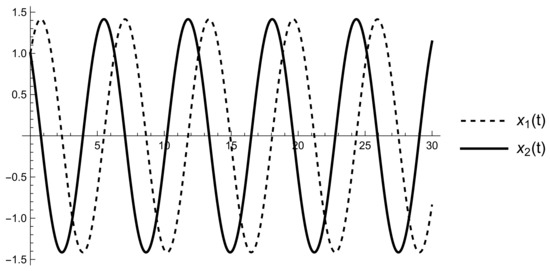
Figure 1.
Graph of the solutions (37) for , .
Figure 1.
Graph of the solutions (37) for , .
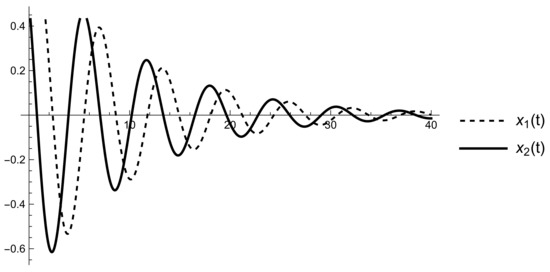
Figure 2.
Graph of the solutions (37) for , .
Figure 2.
Graph of the solutions (37) for , .
Example 3.
Consider the following system of nonlinear fractional differential equations with the GPFD:
with initial condition,
where , is an arbitrary function and .
Consider for .
For any , apply Lemma 4, and obtain:
Consider the scalar fractional Equation (11) with , the solution of which according to Lemma 3 with is given by According to Theorem 1.2 [23], for every , the function, is completely monotonic and Therefore, and
7. Conclusions
A system of nonlinear equations with the GPFD was considered. The stability properties of the zero solution were studied using Lyapunov functions and their GPFDs. First, some comparison results with scalar nonlinear fractional differential equations with the GPFD and Lyapunov functions were established and several sufficient conditions for stability and asymptotic stability were obtained and illustrated with examples. In the future, we hope to study other types of stability for nonlinear fractional differential equations with the GPFD and apply them to some new models.
Author Contributions
Conceptualization, R.A., S.H. and D.O.; methodology, R.A., S.H. and D.O.; validation, R.A., S.H. and D.O.; formal analysis, R.A., S.H. and D.O.; writing—original draft preparation, R.A., S.H. and D.O.; writing—review and editing, R.A., S.H. and D.O.; funding acquisition, S.H. All authors have read and agreed to the published version of the manuscript.
Funding
This work is partially supported by the Bulgarian National Science Fund under Project KP-06-N32/7.
Institutional Review Board Statement
Not applicable.
Informed Consent Statement
Not applicable.
Data Availability Statement
Not applicable.
Conflicts of Interest
The authors declare no conflict of interest.
References
- Trigeassou, J.C.; Maamri, N.; Sabatier, J.; Oustaloup, A. A Lyapunov approach to the stability of fractional differential equations. Signal Process. 2011, 91, 437–445. [Google Scholar] [CrossRef]
- Aguila-Camacho, N.; Duarte-Mermoud, M.A.; Gallegos, J.A. Lyapunov functions for fractional order systems. Comm. Nonlinear Sci. Numer. Simul. 2014, 19, 2951–2957. [Google Scholar] [CrossRef]
- Burton, T.A. Fractional Differential equations and Lyapunov functionals. Nonlinear Anal. Theory Methods Appl. 2011, 74, 5648–5662. [Google Scholar] [CrossRef]
- Duarte-Mermoud, M.A.; Aguila-Camacho, N.; Gallegos, J.A.; Castro-Linares, R. Using general quadratic Lyapunov functions to prove Lyapunov uniform stability for fractional order systems. Commun. Nonlinear Sci. Numer. Simul. 2015, 22, 650–659. [Google Scholar] [CrossRef]
- Hu, J.B.; Lu, G.P.; Zhang, S.B.; Zhao, L.-D. Lyapunov stability theorem about fractional system without and with delay. Commun. Nonlinear Sci. Numer. Simulat. 2015, 20, 905–913. [Google Scholar] [CrossRef]
- Li, Y.; Chen, Y.; Podlubny, I. Stability of fractional-order nonlinear dynamic systems: Lyapunov direct method and generalized Mittag–Leffler stability. Comput. Math. Appl. 2010, 59, 1810–1821. [Google Scholar] [CrossRef] [Green Version]
- Li, C.P.; Zhang, F.R. A survey on the stability of fractional differential equations. Eur. Phys. J. Spec. Top. 2011, 193, 27–47. [Google Scholar] [CrossRef]
- Jarad, F.; Abdeljawad, T.; Alzabut, J. Generalized fractional derivatives generated by a class of local proportional derivatives. Eur. Phys. J. Spec. Top. 2017, 226, 3457–3471. [Google Scholar] [CrossRef]
- Abbas, M.I.; Ragusa, M.A. On the hybrid fractional differential equations with fractional proportional derivatives of a function with respect to a certain function. Symmetry 2021, 13, 264. [Google Scholar] [CrossRef]
- Alzabut, J.; Abdeljawad, T.; Jarad, F.; Sudsutad, W. A Gronwall inequality via the generalized proportional fractional derivative with applications. J. Ineq. Appl. 2019, 2019, 101. [Google Scholar] [CrossRef] [Green Version]
- Hristova, S.; Abbas, M.I. Explicit solutions of initial-value problems for fractional generalized proportional differential equations with and without impulses. Symmetry 2021, 13, 996. [Google Scholar] [CrossRef]
- Jarad, F.; Abdeljawad, T. Generalized fractional derivatives and Laplace transform. Discret. Contin. Dyn. Syst.-S 2020, 13, 709–722. [Google Scholar] [CrossRef] [Green Version]
- Laadjal, Z.; Abdeljawad, T.; Jarad, F. On existence-uniqueness results for proportional fractional differential equations and incomplete gamma functions. Adv. Differ. Equ. 2020, 2020, 641. [Google Scholar] [CrossRef]
- Almeida, R.; Agarwal, R.P.; Hristova, S.; O’Regan, D. Quadratic Lyapunov functions for stability of generalized proportional fractional differential equations with applications to neural networks. Axioms 2021, 10, 322. [Google Scholar] [CrossRef]
- Li, C.; Qian, D.; Chen, Y. On Riemann-Liouville and Caputo Derivatives. Discret. Dyn. Nat. Soc. 2011, 2011, 562494. [Google Scholar] [CrossRef] [Green Version]
- Baleanu, D.; Mustafa, O.G. On the global existence of solutions to a class of fractional differential equations. Comput. Math. Appl. 2010, 59, 1835–1841. [Google Scholar] [CrossRef] [Green Version]
- Das, S. Functional Fractional Calculus; Springer: Berlin/Heidelberg, Germany, 2011. [Google Scholar]
- Diethelm, K. The Analysis of Fractional Differential Equations; Springer: Berlin/Heidelberg, Germany, 2010. [Google Scholar]
- Podlubny, I. Fractional Differential Equations; Academic Press: San Diego, CA, USA, 1999. [Google Scholar]
- Samko, G.; Kilbas, A.A.; Marichev, O.I. Fractional Integrals and Derivatives: Theory and Applications; Gordon and Breach: Philadelphia, PA, USA, 1993. [Google Scholar]
- Abbas, M.I.; Hristova, S. Existence results of nonlinear generalized proportional fractional differential inclusions via the diagonalization technique. AIMS Math. 2021, 6, 12832–12844. [Google Scholar] [CrossRef]
- Abbas, M.I.; Hristova, S. On the Initial Value Problems for Caputo-Type Generalized Proportional Vector-Order Fractional Differential Equations. Mathematics 2021, 9, 2720. [Google Scholar] [CrossRef]
- Simon, T. Mittag–Leffler functions and complete monotonicity. Integral Transf. Spec. 2015, 26, 36–50. [Google Scholar] [CrossRef]
Publisher’s Note: MDPI stays neutral with regard to jurisdictional claims in published maps and institutional affiliations. |
© 2022 by the authors. Licensee MDPI, Basel, Switzerland. This article is an open access article distributed under the terms and conditions of the Creative Commons Attribution (CC BY) license (https://creativecommons.org/licenses/by/4.0/).