


Abstract
The theory of integral inequality has gained considerable attention due to its influential impact on several fields of mathematics and applied sciences. Over the years, numerous refinements, generalizations, and extensions of convexity have been explored to achieve more precise variants of already established results. The principal idea of this article is to establish some interval-valued integral inequalities of the Hermite–Hadamard type in the fractional domain. First, we propose the idea of generalized interval-valued convexity with respect to the continuous monotonic functions ⋎, bifunction , and based on the containment ordering relation, which is termed as pre-invex functions. This class is innovative due to its generic characteristics. We generate numerous known and new classes of convexity by considering various values for ⋎ and . Moreover, we use the notion of -pre-invexity and Atangana–Baleanu (AB) fractional operators to develop some fresh fractional variants of the Hermite–Hadamard (HH), Pachpatte, and Hermite–Hadamard–Fejer (HHF) types of inequalities. The outcomes obtained here are the most unified forms of existing results. We provide several specific cases, as well as a numerical and graphical study, to show the significance of the major results.
MSC:
26A33; 26A51; 26D07; 26D10; 26D15; 26D20
1. Introduction and Preliminaries
Convex analysis is regarded as the most fundamental branch of mathematical analysis. It has gained effective attention due to its major role in the development of both pure and applied mathematics. Convexity and its consequences provide both a geometrical and analytical approach to solving a problem. The role of convexity is unforgettable in linear algebra, topology, and functional analysis, especially separation axioms, fixed point theory, engineering, and economics as well. Firstly, in 1905, Jensen made the theory function much more interesting by introducing the concept of convex mappings on the basis of a convex set. One would like to characterize it by functions and their derivatives, as a positive second derivative indicates the convexity of functions. It is closely related to the theory of optimization, especially in linear programming. Convex mappings are often utilized to derive a feasible solution, and they provide unique minima.
The theory of inequalities is a broad discipline of research in mathematical analysis, and it has several applications in numerous areas of mathematics, physics, and engineering. Strong linkages between this theory and other disciplines, including functional analysis, approximation theory, probability theory, and information theory, have been found. As a consequence of its influence on applied mathematics, this field’s prominence will rise in the future. Theory convex functions have played a significant role in the development of the theory of inequalities. Many inequalities can be obtained directly by utilizing the notion of convexity such as Jensen’s inequality, HH inequality, Young’s inequality, etc. In this regard, we recall the well-known inequality due to Hermite and Hadamard separately. Let be a convex function with , then
Through the utilization of the above inequality, one can check the concavity of the different mappings. For more detail about this, see [1,2].
Recently, the concept of convexity has been refined and extended by using novel and innovative ideas, especially by making use of weighted means, for example, harmonic, geometric, and P convexity based on weighted harmonic mean, weighted geometric mean, and generalized weighted p mean, respectively. In 2019, Wu et al. [3] explored the new class of convexity by utilizing the quasi-arithmetic mean, which is described as:
Definition 1.
Let be a strictly continuous function. Then, is said to be ⋎-convex set with respect to ⋎ if:
Now, we revisit the class ⋎-convex function, which is studied in [3].
Definition 2.
A function is said to be a ⋎-convex function with respect to a strictly monotonic continuous function ⋎ if
In 2021, Kashuri et al. [4] discuss the ⋎ invex set and exponential preinvex functions, which are given by:
Definition 3.
Let be a bifunction and ⋎ be a strictly monotonic continuous function. Then, k is said to be K⋎-invex set, if
Next, we have an exponential ⋎-exponential preinvex function.
Definition 4
([4]). Let be a bifunction, ⋎ be a strictly monotonic continuous function, and β be non-positive. Then, is said to be ⋎-exponential preinvex function if
Now, we present Condition C.
Let be an invex set with respect to a bifunction . Then, satisfies the condition c for any and if
- 1.
- 2.
In set-valued analysis, we deal with multi-valued functions, and I.V. analysis is a sub-discipline of this subject. Initially, interval analysis was used to calculate the error estimates of finite machines. As in daily life processes, if we assign a single value to any variable, then the chance of error increases; to overcome this deficiency, a numerical single number is replaced by interval numbers. Moore wrote some interesting books on interval analysis, which revealed new directions in executing this theory, and proposed some applications for computer programming and error analysis. After remarkable and applicable work due to Moore, many authors have shown their interest in the field and used it in different directions. I.V. techniques are used to investigate dynamic systems of differential equations, fluid mechanics, combinatorics, neural networking, and inequalities (see [5]). In the continuation, Breckner [6] purported the idea of convexity from the perspective of set-valued mappings, which are given as:
Definition 5.
Let , which is said to be an I.V. convex function if
The space of intervals is denoted by . Sadowska was the first who examined the classical HH-type inequality through convex set-valued mappings. This is stated as:
Let be an interval-valued convex mapping defined over the interval and together with .
If is set of all partitions of and is the set of all points P such that , then is called an interval Riemann integrable on if there exist and for each there exists such that
where is the Riemann sum of with respect to . Relation (1) shows that K is the -integral of and given by
Definition 6.
Let , which is said to be a generalized invex set with respect to mapping , and ⋎ be a monotonically continuous function if
Theorem 1.
Let be an I.V. function such that if and only if and
Next, we give the I.V. analog of AB-fractional operators.
Definition 7.
The fractional integral concerned with the new fractional derivative with the nonlocal kernel of a mapping is described as:
Similarly, the right-sided AB-operator is stated as:
Here, is the gamma function. is called the normalization function.
For more detail about fractional calculus see [7].
Assume that is an I.V. mapping. Now, we revisit I.V. fractional -operators, which are defined as:
Definition 8.
, and both mappings and are Riemann integrable defined on the interval . Then,
and
with and as the normalization function. We clearly see that
and
Recently, several inequalities have been extended and refined by implementing the I.V. mappings and ordering relations defined over interval numbers. In this regard, Chalco-Cano et al. [8,9] computed the familiar Ostrowski’s integral inequality via I.V. mappings and Hukuhara derivatives and concluded the applicable utility of the main outcomes in a numerical analysis, respectively. In 2017, Costa et al. [10] explored the novel integral inequalities by applying the mappings defined over fuzzy numbers. In the continuation, Flores et al. [11] computed the new variants of integral inequalities associated with I.V. mappings. In [12], the authors investigated the integral inequalities of HH involving preinvex I.V. mappings. Zhao et al. [13,14] established the Jensen’s and HH-type containment involving a general class of I.V. convexity, which is referred to as -I.V. mapping and Chebyshev-type inequalities, respectively. Fractional calculus has contributed extraordinary impacts on the growth of integral inequalities. In 2012, Sarikaya et al. [15] made the first successful attempt to establish fractional counterparts of HH-type inequalities, essentially considering integral fractional operators. After this, several inequalities have been improved by using fractional tools, and this is still a very active field of research. In [16,17], Mohammad et al. examined the new tempered Hermite-Hadmard-like inequalities and presented some applications as well as fractional mid-point-like inequalities in the frame of fractional calculus. In [18], Akdemir et al. analyzed the Chebyshev-like inequalities through unified fractional operators. Set et al. [19] concluded with the inequalities involving AB-fractional integral operators and differentiability of convex mappings. In 2020, Budak et al. [20] studied the interval-valued fractional operators to explore the HH-type inequalities. Kara et al. [21] used the conception of interval-valued coordinated convexity and new double fractional operators to prove some HH-type inequalities. Recently, Bin-Mohsin et al. [22] introduced the notion of interval-valued coordinated harmonically convex mappings and double fractional operators involving the generalized Mittag-Leffler function introduced by Raina as a kernel to extract some novel fractional versions of HH-type inequalities. Zhou et al. [23] explored the trigonometric convex functions with exponential weight to formulate some new variants of HH-like inequalities. In [24], they discussed trigonometric convexity and related integral containment, implementing the fuzzy ordered relation. In [25], Kalsoom et al. used the idea of I.V. convexity and calculus to establish some new refinements of existing results. In [26], the authors introduced the concept of the fuzzy interval-valued bi-convex function to obtain some HH-like inequalities. In [27,28], the authors obtained fractional variants of Hermite–Hadamard-type inequalities for interval-coordinated convex functions and product inequalities of Hermite–Hadamard-type inequalities, respectively. In [29], they concluded with new Hermite–Hadamard-type inequalities involving interval-valued convexity and generalized quantum calculus. For more detail and recent developments see [30,31,32,33,34].
The main focus of the proceeding study is to obtain new generic inclusion relations of the HH-type by invoking AB-fractional concepts. First of all, we develop a novel class of convexity based on the bi-function and monotonically continuous function ⋎ in interval analysis. The novelty of this study is that by applying different values of and , several existing and new fractional counterparts can be deduced. Additionally, we validated our theoretical outcomes via numerical simulations. To the best of our knowledge, these results are more beneficial for acquiring variants of I.V. HH-type inequalities for several classes of convexity. The structure of the paper consists of two sections: in the first segment of the study, we recall some facts relative to convexity and fractional calculus, and some history of the problem is explained. In the second section, we introduce the newly proposed class of convexity, and its consequences and applications in integral inequalities are provided. Later on, concluding remarks are added.
2. Main Results
Now, we define I.V. pre-invex mappings.
Definition 9.
Let be a non-negative mapping with , then is called I.V. pre-invex mappings, satisfying the condition if
and .
Now, we discuss some special cases of Definition 2.
- Choosing , we acquire a fresh class ⋎ I.V. pre-invex function:
- Choosing and , we then obtain a class of I.V. harmonically pre-invexity:
- Choosing and , we then obtain a class of I.V. P pre-invex functions:
- Choosing and , we then obtain a class of I.V. log-exponential pre-invex functions:
Remark 1.
Choosing , we then obtain the definition of classical I.V. pre-invex functions.
Definition 10.
Choosing in Definition 2, we acquire a fresh class I.V. -pre-invex function
Now, we investigate some special cases of Definition 10.
- Setting , we then obtain I.V. harmonically s pre-invex functions, which follow as
- Setting , , we then obtain I.V. pre-invex functions, which follow as
- Choosing and , we then obtain a class of I.V. log-exponential s pre-invex functions:
Definition 11.
Choosing , we acquire a fresh class of the I.V. Godunova–Levin-type pre-invex function
By taking different values of , we obtain some new and previously known classes of pre-invex functions.
For our convenience, we specify that the space of I.V. preinvex mappings, interval-valued pre-concave functions, preinvex mappings, and pre-concave functions are denoted by , , , and , respectively.
Theorem 2.
Suppose is an interval-valued mapping such that with . Then, and .
Proof.
Assume that , , and , then
This implies that
From (3), we have
Additionally,
Conversely, suppose that and , then
Additionally,
From the fact that ,
In this way, we acquire our required result. □
Now, we aim to conclude a new fractional variant of the HH inequality when .
Theorem 3.
Let be a I.V. pre-invex function with and be a continuous function; then, we have
Proof.
Since is a I.V. pre-invex function, then
Substituting and + in the above inequality, multiplying both sides by and using Condition C, and then integrating with respect to over
Now,
Additionally,
We obtain
Multiplying both sides by and then adding both sides , we obtain
Combining (9)–(11), we obtain the right-sided inclusion. To prove the second part, we use the I.V. convexity of ,
Adding (12) and (13), and multiplying the resulting inequality by and integrating with respect to on , then we have
Multiplying both sides by and then adding to both sides, we obtain the second part of our required result. □
Now, we provide various consequences of Theorem 3.
- Choosing in Theorem 3, we obtain
- Choosing and in Theorem 3, we obtain
- Choosing , in Theorem 3, we obtain
- Choosing , and in Theorem 3, we obtainwhere .
- Choosing and in Theorem 3, we obtainwhere .
Example 1.
Assume that all the assumptions of Theorem 3 are fulfilled; we take with , and with , we have
For graphical visualization, we vary (see Figure 1).
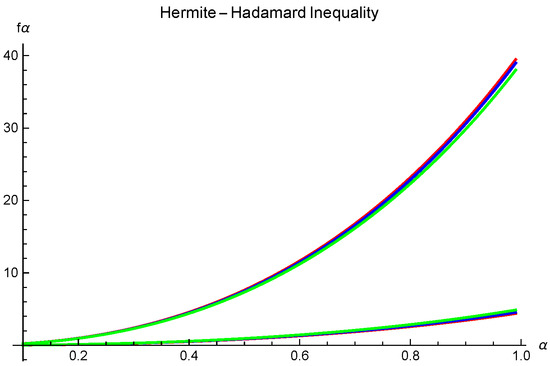
Figure 1.
This figure describes the lower and upper bounds of the mean value integral, which is proved in Theorem 3. Here, red, blue, and green colours represent the left-, middle-, and right-hand sides of Theorem 3.
Now, we provide the generalized fractional version of the Fejer-type HH’s-type inequality.
Theorem 4.
Let be a I.V. pre-invex function with and be a continuous function; then, we have
and .
Proof.
Since is a I.V. pre-invex function, for , we have
Substituting and in the above inequality, multiplying both sides by , we have
Now, we use fact that =
Multiplying both sides by and then adding + to both sides, we obtain
Now,
Multiplying both sides by and then adding to both sides, we acquire
To prove our second inequality, we add (12) and (13), multiplying both sides by and integrating with respect to on ; then, we have
Multiplying both sides by and then adding + to both sides, we obtain our required second inclusion. □
Now, we deliver several consequences of Theorem 4.
- If we choose in Theorem 4, we havewhere and .
- If we choose and in Theorem 4, thenwhere and .
- If we choose in Theorem 4, thenwhere and .
- If we choose and in Theorem 4, thenwhere and .
- If we choose and in Theorem 4, thenwhere , and .
Example 2.

Assume that all the assumptions of Theorem 4 are fulfilled. If we take , where with , , and and symmetric function with respect to such that and are defined as:
For a graphical visualization, we vary (see Figure 2).
Figure 2.
This figure provides the validation of the HHF inequality derived in Theorem 4. Here, red, blue, and green colors represent the left-, middle-, and right-hand sides of Theorem 4, respectively.
Theorem 5.
Let be I.V. pre-invex functions with and be a continuous function; then,
where
and , .
Proof.
Similarly, we have
By adding (21) and (22), multiplying both sides by and integrating with respect to on , then we have
Multiplying both sides by and then adding + to both sides, we obtain
This completes the proof. □
Now, we extract a few important inclusions from Theorem 5 for the product of different kinds of convex functions.
- If we choose in Theorem 5, then
- If we choose and in Theorem 5, then
- If we choose in Theorem 5, then
- If we choose and in Theorem 5, then
- If we choose and in Theorem 5, thenwhere .
Example 3.
Assume that all the assumptions of Theorem 5 are fulfilled. If we take where and with , and , then
For visualization, please see Figure 3.

Figure 3.
This figure describes the validation of right Pachpatte’s-type inclusions, which is derived in Theorem 5. Here, red and blue colors represent the left- and right-hand sides of the inequality proved in Theorem 5.
Theorem 6.
Proof.
Since and are I.V. pre-invex functions, then we have
Multiplying the proceeding inequality by and integrating with respect to on , we have
Applying the definition of interval-valued convexity, we acquire
Additionally,
Adding to both sides, we obtain
Additionally,
Now, we extract a few important inclusions from Theorem 6, for the product of different kinds of convex functions.
- If we choose and in Theorem 6, thenwhere and are given by (17) and , respectively.
Example 4.
Assume that all the assumptions of Theorem 6 are fulfilled. If we take where and with , and , then
For visualization, please see Figure 4.

Figure 4.
This figure depicts the validation of left Pachpatte’s-type containment, which is derived in Theorem 6. Here, red and blue colors represent the left- and right-hand sides of the inequality obtained in Theorem 6.
3. Conclusions
The theory of inequalities is investigated from various aspects in different domains. One of the rigorous perspectives is to establish new unified and refined forms of already-known results. In the current proceeding, we have introduced a new generalized notion of convex mappings, and some consequences of the proposed notion are discussed. Moreover, we have explored the HH, HH–Fejer, and Pachpatte’s-type containments, essentially implementing the newly established notion of convexity together with AB-fractional integral operators. The reliability of the findings is verified through examples and simulations. The advantage of this class is that it consolidates several other known classes of convexity. Consequently, the outcomes derived from this class also unify classical results. To the best of our knowledge, the results have no limitations, except ⋎ should be monotonically continuous functions. In the future, we will try to conclude fuzzy and quantum variants of these kinds of inequalities. Additionally, based on the idea of quasi-mean, numerous other classes such as and , , -polynomial convex functions and stronger versions of convexity can also be introduced in a classical and fuzzy sense as well. Moreover, based on other ordering relations, several new forms of convexity can also be established. Utilizing these classes, several other inequalities can be explored in quantum calculus and time scale calculus. We hope that the ideas and methodology of the current study will inspire interested readers.
Author Contributions
Investigation, B.B.-M., M.Z.J., M.U.A. and A.K. All authors have read and agreed to the published version of the manuscript.
Funding
This research received no external funding.
Data Availability Statement
Not applicable.
Acknowledgments
The authors are thankful to the editor and anonymous reviewers for their valuable comments and suggestions. The authors extend their appreciation to the Deputyship for Research & Innovation, Ministry of Education in Saudi Arabia for funding this research work through the project no. (IFKSUOR3–340-3).
Conflicts of Interest
The authors declare no conflict of interest.
References
- Dragomir, S.S.; Pearce, C.E.M. Selected topics on Hermite–Hadamard inequalities and applications. In RGMIA; Victoria University: Melbourne, VIC, Australia, 2000. [Google Scholar]
- Peajcariaac, J.E.; Tong, Y.L. Convex Functions, Partial Orderings, and Statistical Applications; Academic Press: Cambridge, MA, USA, 1992. [Google Scholar]
- Wu, S.; Awan, M.U.; Noor, M.A.; Noor, K.I.; Iftikhar, S. On a new class of convex functions and integral inequalities. J. Inequalities Appl. 2019, 2019, 1–14. [Google Scholar] [CrossRef]
- Kashuri, A.; Awan, M.U.; Talib, S.; Noor, M.A.; Noor, K.I. On Exponetially ϱ-Preinvex Functions and Associated Trapezium Like Inequalities. Appl. Anal. Discret. Math. 2021, 15, 317–336. [Google Scholar] [CrossRef]
- Moore, R.E. Interval Analysis; Prentice-Hall: Englewood Cliffs, NJ, USA, 1966; Volume 4, pp. 8–13. [Google Scholar]
- Breckner, W.W. Continuity of generalized convex and generalized concave set-valued functions. Rev. D’Anal. Numer. Theor. L’Approx. 1993, 22, 39–51. [Google Scholar]
- Kilbas, A.A.; Srivastava, H.M.; Trujillo, J.J. Theory and Applications of Fractional Differential Equations; Elsevier: Amsterdam, The Netherlands, 2006; Volume 204. [Google Scholar]
- Chalco-Cano, Y.; Flores-Franulic, A.; Roman-Flores, H. Ostrowski type inequalities for interval-valued functions using generalized Hukuhara derivative. Comput. Appl. Math. 2012, 31, 457–472. [Google Scholar]
- Chalco-Cano, Y.; Lodwick, W.A.; Condori-Equice, W. Ostrowski type inequalities and applications in numerical integration for interval-valued functions. Soft Comput. 2015, 19, 3293–3300. [Google Scholar] [CrossRef]
- Costa, T.M.; Román-Flores, H. Some integral inequalities for fuzzy-interval-valued functions. Inf. Sci. 2017, 420, 110–125. [Google Scholar] [CrossRef]
- Roman-Flores, H.; Chalco-Cano, Y.; Lodwick, W. Some integral inequalities for interval-valued functions. Comput. Appl. Math. 2018, 37, 1306–1318. [Google Scholar] [CrossRef]
- Sharma, N.; Singh, S.K.; Mishra, S.K.; Hamdi, A. Hermite-Hadamard-type inequalities for interval-valued preinvex functions via Riemann-Liouville fractional integrals. J. Inequalities Appl. 2021, 2021, 1–15. [Google Scholar] [CrossRef]
- Zhao, D.; An, T.; Ye, G.; Liu, W. New Jensen and Hermite-Hadamard type inequalities for H-convex interval-valued functions. J. Inequalities Appl. 2018, 2018, 1–14. [Google Scholar] [CrossRef]
- Zhao, D.; An, T.; Ye, G.; Liu, W. Chebyshev type inequalities for interval-valued functions. Fuzzy Sets Syst. 2020, 396, 82–101. [Google Scholar] [CrossRef]
- Sarikaya, M.Z.; Set, E.; Yaldiz, H.; Basak, N. Hermite-Hadamard’s inequalities for fractional integrals and related fractional inequalities. Math. Comput. Model. 2013, 57, 2403–2407. [Google Scholar] [CrossRef]
- Mohammed, P.O.; Sarikaya, M.Z.; Baleanu, D. On the generalized Hermite-Hadamard inequalities via the tempered fractional integrals. Symmetry 2020, 12, 595. [Google Scholar] [CrossRef]
- Mohammed, P.O.; Brevik, I. A new version of the Hermite-Hadamard inequality for Riemann-Liouville fractional integrals. Symmetry 2020, 12, 610. [Google Scholar] [CrossRef]
- Akdemir, A.O.; Butt, S.I.; Nadeem, M.; Ragusa, M.A. New general variants of Chebyshev type inequalities via generalized fractional integral operators. Mathematics 2021, 9, 122. [Google Scholar] [CrossRef]
- Set, E.; Butt, S.I.; Akdemir, A.O.; Karaoglan, A.; Abdeljawad, T. New integral inequalities for differentiable convex functions via Atangana-Baleanu fractional integral operators. Chaos Solitons Fractals 2021, 143, 110554. [Google Scholar] [CrossRef]
- Budak, H.; Tunc, T.; Sarikaya, M. Fractional Hermite-Hadamard-type inequalities for interval-valued functions. Proc. Am. Math. Soc. 2020, 148, 705–718. [Google Scholar] [CrossRef]
- Kara, H.; Ali, M.A.; Budak, H. Hermite-Hadamard-type inequalities for interval-valued coordinated convex functions involving generalized fractional integrals. Math. Methods Appl. Sci. 2021, 44, 104–123. [Google Scholar] [CrossRef]
- Mohsin, B.B.; Awan, M.U.; Javed, M.Z.; Budak, H.; Khan, A.G.; Noor, M.A. Inclusions Involving Interval-Valued Harmonically Co-Ordinated Convex Functions and Raina’s Fractional Double Integrals. J. Math. 2022, 2022, 1–21. [Google Scholar] [CrossRef]
- Zhou, T.; Du, T. Certain Fractional Integral Inclusions Pertaining to Interval-Valued Exponential Trigonometric Convex, doi.org/10.7153/jmi-2023-17-20Functions. J. Math. Inequalities 2023, 2023, 17. [Google Scholar]
- Khan, M.B.; Catas, A.; Aloraini, N.; Soliman, M.S. Some New Versions of Fractional Inequalities for Exponential Trigonometric Convex Mappings via Ordered Relation on Interval-Valued Settings. Fractal Fract. 2023, 7, 223. [Google Scholar] [CrossRef]
- Kalsoom, H.; Ali, M.A.; Idrees, M.; Agarwal, P.; Arif, M. New post quantum analogues of Hermite-Hadamard type inequalities for interval-valued convex functions. Math. Probl. Eng. 2021, 2021, 1–17. [Google Scholar] [CrossRef]
- Bin-Mohsin, B.; Rafique, S.; Cesarano, C.; Javed, M.Z.; Awan, M.U.; Kashuri, A.; Noor, M.A. Some General Fractional Integral Inequalities Involving LR-Bi-Convex Fuzzy Interval-Valued Functions. Fractal Fract. 2022, 6, 565. [Google Scholar] [CrossRef]
- Kara, H.; Budak, H.; Ali, M.A.; Sarikaya, M.Z.; Chu, Y.M. Weighted Hermite-Hadamard type inclusions for products of co-ordinated convex interval-valued functions. Adv. Differ. Eqs. 2021, 2021, 1–16. [Google Scholar] [CrossRef]
- Budak, H.; Kara, H.; Ali, M.A.; Khan, S.; Chu, Y. Fractional Hermite-Hadamard-type inequalities for interval-valued co-ordinated convex functions. Open Math. 2021, 19, 1081–1097. [Google Scholar] [CrossRef]
- Ali, M.A.; Budak, H.; Murtaza, G.; Chu, Y.M. Post-quantum Hermite-Hadamard type inequalities for interval-valued convex functions. J. Inequalities Appl. 2021, 2021, 84. [Google Scholar] [CrossRef]
- Du, T.; Zhou, T. On the fractional double integral inclusion relations having exponential kernels via interval-valued co-ordinated convex mappings. Chaos Solitons Fractals 2022, 156, 111846. [Google Scholar] [CrossRef]
- Abdeljawad, T.; Rashid, S.; Khan, H.; Chu, Y.M. On new fractional integral inequalities for p-convexity within interval-valued functions. Adv. Differ. Eqs. 2020, 2020, 1–17. [Google Scholar] [CrossRef]
- Khan, M.B.; Mohammed, P.O.; Noor, M.A.; Abualnaja, K.M. Fuzzy integral inequalities on coordinates of convex fuzzy interval-valued functions. Math. Biosci. Eng. 2021, 18, 6552–6580. [Google Scholar] [CrossRef]
- Bin-Mohsin, B.; Awan, M.U.; Javed, M.Z.; Khan, A.G.; Budak, H.; Mihai, M.V.; Noor, M.A. Generalized AB-Fractional Operator Inclusions of Hermite-Hadamard’s Type via Fractional Integration. Symmetry 2023, 15, 1012. [Google Scholar] [CrossRef]
- Vivas-Cortez, M.; Ramzan, S.; Awan, M.U.; Javed, M.Z.; Khan, A.G.; Noor, M.A. IV-CR-γ-Convex Functions and Their Application in Fractional Hermite-Hadamard Inequalities. Symmetry 2023, 15, 1405. [Google Scholar] [CrossRef]


Disclaimer/Publisher’s Note: The statements, opinions and data contained in all publications are solely those of the individual author(s) and contributor(s) and not of MDPI and/or the editor(s). MDPI and/or the editor(s) disclaim responsibility for any injury to people or property resulting from any ideas, methods, instructions or products referred to in the content. |
© 2023 by the authors. Licensee MDPI, Basel, Switzerland. This article is an open access article distributed under the terms and conditions of the Creative Commons Attribution (CC BY) license (https://creativecommons.org/licenses/by/4.0/).