


Abstract
In this paper, we investigate the optimal control problems for a class of neutral stochastic integrodifferential equations (NSIDEs) with infinite delay driven by Poisson jumps and the Rosenblat process in Hilbert space involving concrete-fading memory-phase space, in which we define the advanced phase space for infinite delay for the stochastic process. First, we introduce conditions that ensure the existence and uniqueness of mild solutions using stochastic analysis theory, successive approximation, and Grimmer’s resolvent operator theory. Next, we prove exponential stability, which includes mean square exponential stability, and this especially includes the exponential stability of solutions and their maps. Following that, we discuss the existence requirements of an optimal pair of systems governed by stochastic partial integrodifferential equations with infinite delay. Then, we explore examples that illustrate the potential of the main result, mainly in the heat equation, filter system, traffic signal light systems, and the biological processes in the human body. We conclude with a numerical simulation of the system studied. This work is a unique combination of the theory with practical examples and a numerical simulation.
Keywords:
stochastic systems; stability; phase space; infinite delay; Poisson jumps; Rosenblatt process MSC:
34A37; 60H10; 34K50; 37L55
1. Introduction
Since arbitrary fluctuations and noise are common and predictable in both natural and artificial systems, stochastic models should be studied rather than deterministic ones. Stochastic differential equations incorporate uncertainty into the mathematical representation of a specific occurrence of stochastic differential equations (SDEs). Due to their use in modeling numerous phenomena in physics, population dynamics, ecology, medicine, biology, engineering, and other areas of research, SDEs in both infinite and finite dimensions have garnered a lot of attention in recent years. For excellent information for learning about stochastic differential equations and their applications, see [1,2,3,4,5].
Since SDEs with delay are suitable for simulating physical systems with delay, such as those found in medicine, economics, epidemiology, biology, and chemistry, research on SDEs with delay has attracted a lot of attention over the past few decades; see [1,6,7,8] for a brief overview. Numerous writers have looked at the existence, uniqueness, controllability, and stability of the qualitative and quantitative characteristics of SDEs with delay solutions (see [9,10,11,12,13,14] and references therein). Researchers have been examining the existence and asymptotic behavior of some mild solutions to SDEs in Hilbert spaces using a semigroup approach [11], comparison theorem [15], Razumikhin-type theorem [16], analytic technique [17], Banach fixed point principle [18], etc.
In the literature, neutral stochastic partial differential equations (SPDEs) have been used to simulate a variety of dynamical systems [13,19,20]. Some of these equations have delayed state derivatives, which are different from SPDEs with delays that rely on the past and the present states. We merely recommend to see more information on this theory and its applications [14,21,22]. Recently, SIDEs have drawn a lot of interest with an emphasis on qualitative characteristics like optimality conditions, regularity, control issues, periodicity, and stability; we refer readers to [10,12,18]. Instead of using the continuous semigroup operators, the resolvent operator theory has been implemented as the system contains an integral term (see [23] for further details). However, the majority of academics that study exponential stability have focused only on infinite delays; see [9,18]. The solutions that are continuously dependent on the initial value have been the focus of this study. Authors in [21,22,24] discussed asymptotic and exponential stability of stochastic systems with infinite delay using the phase space given by Hale and Kato [25]. Notable is the paucity of research on the subject of defining the stochastic time delay systems involving exponential stability ([13,14,20,26]).
On the other hand, we consider the stationary Gaussian sequence with variance and mean zero whose correlation function is , with . Let f be a Hermite polynomial with rank k Let L be a slowly varying function at infinity. Also, if f admits the following expansion in Hermite polynomials
where and represent the Hermite polynomial of degree j defined as , then by virtue of the Non-Central Limit Theorem, this series converges in the form of distribution in finite-dimension as
Here, is a positive normalization constant that depends on and and the multiple integral in Equation (1) is of Wiener–It-type integral of order with respect to the standard Brownian motion . For , this process is called the Hermite process and is self-similar to the and it has stationary increments [27].
When , the Hermite process (1) is the fractional Brownian motion (fBm) with Hurst parameter [28]. If , then the process (1) is called the Rosenblatt process, which occurs from the Non-Central Limit Theorem (see [29,30] and references therein). Self-similar processes with long-range dependence are important in practice and are employed in many areas, including finance, turbulence, internal traffic, hydrology, and econometrics, to mention a few [31,32]. The self-similar Rosenblatt process, which has stationary increments, seems to be the upper bound for long-range dependent stationary series, which is not a Gaussian process. Due to its significance in numerous fields of science and engineering, the fBm is undoubtedly the Hermite process in the class that has received the most research [12,33,34]. However, one can apply the Rosenblatt process in actual circumstances when the model’s assumption of Gaussianity is implausible. However, in contrast to the fBm, the study of the Rosenblatt process has received little attention due to its non-Gaussianity trait and complexity of its dependence structures. The study of SDEs using the Rosenblatt technique looks interesting. Because a subset of the class of self-decomposition distributions following the multivariate Rosenblatt distribution belongs to the Thorin class, it is possible to take advantage of this characteristic. Maejima and Tudor [27] showed that further properties of the Rosenblatt distribution can be discovered. Ramkumar et al. [35] recently used semigroup theory and the successive approximation method to study higher-order neutral SDEs driven by the Rosenblatt process in Hilbert space and Poisson jumps. One might consult the papers [12,14,34,36] and their references for more information on the Rosenblatt procedure. In system engineering, the optimal control issues arise frequently. The primary objective of optimum control is to identify the ideal values of the control variables for the dynamic system that maximize or minimize a specified performance index in an open-loop control. Because dynamic systems are nonlinear, finding the optimal control is a challenging and open-ended endeavor. In biomedicine, optimal control is frequently used to simulate cancer chemotherapy, and it has also recently been used in medicine and epidemiological models [37,38]. Rajivganthi and Muthukumar [39] examined the properties of Poisson jumps with fractional stochastic evolution equations and virtually automorphic solutions, as well as their optimal control. Wang et al. [40] studied the best possible control that is achieved for delayed SDEs powered by fBms. Very recently, Ramkumar et al. [41] investigated the existence of mild solutions and optimal controls for a class of fractional neutral SDEs driven by fBm and Poisson jumps in Hilbert spaces. Only a few authors have studied the optimal control results of stochastic differential/integrodifferential equations in infinite dimensional spaces (see [42,43] and references therein). Section 7 is devoted to the practical applications. We discuss the stochastic heat equation, the filter system, the traffic signal light systems, and the biological reaction on a human body to justify the practical applications of the theory studied.
More precisely, Boufoussi et al. [44] studied the global existence and uniqueness result of the mild solution for stochastic functional differential equations in Hilbert space driven by a fractional Brownian motion of the form
Next, Hajji et al. [45] extended the study of [44] and concerned themselves with the existence and uniqueness of mild solutions for a class of neutral functional stochastic differential equations described in the form
We extended the system studied by Hajji et al. [45] with numerous applications. Also, previous authors have not discussed the numerical simulation to justify their theory.
Considering the following neutral SIDEs with infinite delay driven by Poisson jumps and the Rosenblatt process given on the entire probability space is motivated by the explanation above:
where is -measurable, and the next section provides more information on the concrete fading memory-phase space . is given as a closed linear operator. Also, a closed linear operator is defined on a separable Hilbert space such that . Assume that is another real separable Hilbert space. , , are appropriate functions; we see that function , such that takes the value from the phase space . Let be the complete probability space. Assume that the Poisson counting measure induced by the Poisson point process in the measurable space . is the compensated martingale measure. is a -valued Rosenblatt process with parameter . The space of all continuous functions is endowed with the norm given as
We present the abstract phase space . Assume that is a continuous function with . Assume the fading memory for , defined as : , is a bounded and measurable function on for any and exists in .
This space () represents a Banach space with the norm
The following lemma of phase spaces is essential for the infinite delay system.
Lemma 1.
Suppose , then , . Moreover,
where .
Proof.
It is simple to see that is bounded and measurable on for for any ,
Since , then ,
The proof is complete. □
The phase space defined above satisfies all the conditions of phase space given by Hall and Kato [25].
According to the author’s understanding, this research is the first to examine neutral SIDEs with infinite latency driven by Poisson jumps and the Rosenblatt process, as well as their existence and exponential stability. This paper’s key contribution is to identify prerequisites that guarantee:
- (i)
- The existence, uniqueness, and exponential stability of the solutions and their maps of system 2, including mean square exponential stability and nearly certain exponential stability, are explored.
- (ii)
- We demonstrate the outcome via stochastic methods and Grimmer’s [23] resolvent operator theory. It is important to note that system 2 was explored with a finite delay by Diop et al. [18]. They studied the existence of mild solutions with exponential stability. Due to this, our method can be viewed as an extension of the conclusion of [18] for the case of infinite delay.
- (iii)
- The literature does not address the best controls for neutral SIDEs with infinite delay of system (35), and this fact drives us to create the current work on this subject by both extending the existing controls and creating new ones.
- (iv)
- Lastly, to demonstrate the established idea, we came up with three alternative cases.
This manuscript is organized as follows: In Section 2 There are some notations and preliminary remarks. Section 3 represents the existence and uniqueness of mild solutions for neutral SIDEs with infinite delay. Section 4 ensures the conditions assuring mean square moment exponential stability of the solution and almost surely exponential stability of the solution is studied in Section 5. Section 6 displays the outcomes for optimal pairs of systems governed by the stochastic control system (35). Section 7 contains four examples to illustrate the theory. To illustrate the efficiency of the theoretical result, we study the numerical simulation in Section 8.
2. Preliminary Remarks
Let and be two real separable Hilbert spaces and represent the norm operator in , . The space from to consists of bounded linear operators endowed with , and system 2 is attired with a normal filtration .
Rosenblatt Process: The basic properties of the Rosenblatt process and Wiener integral are given below. Let be a one-dimensional Rosenblatt process with parameter on , with being an arbitrary fixed horizon representing the following equation [30]:
with given by
where , when , is a standard Brownian motion, and is a normalizing constant and is the Beta function. The covariance function of the Rosenblatt process is
The Wiener integral can be constructed with respect to the Rosenblatt process due to its covariance structure. For more background information for this section, the reader is referred to [29,30].
Poisson Process: For , is a -valued, -finite stationary, and the -adapted Poisson point process has values in measurable space and an intensity measure of -finite . We define as the Poisson counting measure. induces the Poisson counting measure and the compensatory martingale is provided by
Definition 1.
A resolvent operator , is a bounded linear operator-valued function for Equation (2) if attains the following:
- (i)
- , , , .For , is exponentially stable.
- (ii)
- The function is strongly continuous for each and for , in , and satisfies
The existence of solutions for Equation (3) is ensured by the following two criteria, which are adopted from Grimmer [23].
- (A1)
- The operator is an infinitesimal generator of a -semigroup on .
- (A2)
- For all , denotes a closed, continuous linear operator from to , and belongs to . For any , the map is bounded, differentiable, and its derivative is bounded and uniformly continuous on .
Remark 1.
The existence and uniqueness of is guaranteed by (A1) and (A2).
Consider the following deterministic integrodifferential equation:
and is a continuous function.
Lemma 2.
Let assumptions (A1) and (A2) hold good. If is a strict solution of (3), i.e., , then
Lemma 3.
If satisfies then system (1) is well defined as an -valued random variable, and
Definition 2.
A mild solution of Equation (2) is an -valued process satisfying the following:
- (i)
- is -adapted and almost surely.
- (ii)
- is continuous for and satisfies
with .
The following presumptions are useful to accomplish the main objective.
- (H1)
- is exponentially stable; that is, there exist two constants and ∋
- (H2)
- ∃ a real number ∋
- (H3)
- ∃ a real number , such that
Obviously, .
3. Existence and Uniqueness
First, we ensure sufficiency for the existence and uniqueness of the solution for (2). The sequential approximation method and numerous stochastic analytic methods are used to accomplish this. However, in order to deal with infinite delay, we must create some novel strategies. In the sections that follow, we replace for the Hilbert space in (A1) and (A2). We now offer the primary finding listed below.
Theorem 1.
Let assumptions (A1), (A2), (H2), and (H3) hold good with . Then, system (2) has a unique mild solution.
Proof.
We use the successive approximation technique to Equation (5).
For , and for ,
and
Let
i.e., is uniformly bounded.
The proof now follows the steps below:
Step 1: , is bounded.
Then, for any , we have,
From assumption (H2), we obtain
and
Next, combining (H3) and Hölder’s inequality yields
Now, using Lemma 2, and (H3), we obtain
Finally, with (H3), Lemma 2, and Hölder’s inequality, we obtain
Substituting (8) and (9) into (7), we obtain
where .
By using the definition of the norm , we can write
where .
Therefore,
where . Besides that, we have
It follows that
where .
Using Gronwall’s inequality,
Since k is arbitrary, we have
which completes the proof.
Step 2: is a Cauchy sequence.
The successive approximations are constructed to have on for . So we now establish
Therefore from (3.1), we have
By using (H2), we obtain
and
Next, using (H3) and Hölder’s inequality, we obtain
From Lemma 2, we have
In a similar way, using (H3), we obtain
Substituting (17)–(21) into (16), we obtain
where
This yields
Next, we can deduce
Similarly,
Therefore,
where .
Sequentially, we can prove that
Using the successive iteration scheme, ,
Therefore,
This argument proves that is a Cauchy sequence in .
Step 3: Existence and uniqueness of Equation (2).
We have in as . For all , the Borel–Cantelli lemma shows that converge to uniformly as , for . We prove the next inequality using (H2) and (H3).
Next,
Similarly, we have
and
Taking the limit as yields,
Gronwall’s lemma assures the assertion which completes the proof. □
Remark 3.
The existence and uniqueness of the local solution is defined on , and that leads us to the global solution on .
4. Exponential Stability
Definition 3.
For any initial value , the mild solution of 2 is said to be mean square mment exponentially stable if it is -measurable and ∃ two positive real numbers and such that
The following theorem contains the major finding of this work.
Theorem 2.
Let us assume that for all conditions of Theorem 1, the following inequalities hold:
Proof.
The mean square moment exponential stability of : Combining Lemma 3 and (H1)–(H3), we can write
Note that
and
By Hölder’s inequality,
Using Lemma 3 and (H3), we obtain
Finally, using (H1) and (H3), we obtain
Substituting (24)–(28) into (23), and using Definition 3, we obtain
where .
Multiplying both sides of (29) by yields
For , we have
From Appendix A, pp. 12 of [46], we have the following estimation:
Recall that and ; hence,
where
By virtue of Gronwall’s lemma,
which implies that
The result of the square moment exponential stability of solution is therefore satisfied given the criterion in (22). For any , we have
multiplying both sides by ,
From (30), we have
where and . Thus, we have
The inequality in (31) ensures that the square moment of the solution map is exponentially stable.
□
5. Almost Surely Exponential Stability
Definition 4.
If the following inequality is almost certainly guaranteed, the mild solution of (2) is said to be exponentially stable if
Theorem 3.
Suppose that in Theorem 2 the prerequisites are all true.
- (i)
- almost surely,
- (ii)
- almost surely,
which means that and are almost surely exponentially stable for any .
Proof.
Theorem 1 guarantees condition (i) of Theorem 3 .
For any . Let be the interval .
Since and , by using the Markov inequality, we have
In Equation (33), the right-hand-side term is bounded by
Therefore, the Borel–Cantelli lemma guarantees that ∃ an integer such that ,
Thus,
yields,
which shows that Theorem 3 (i) is satisfied. The argument that proves Theorem 3 (ii) follows an analogous reasoning. To be specific, we can use the assumption that solution map is square moment exponentially stable and reach the same conclusion by using the same logic as before. The details are left out. □
6. Optimal Control
Let control be associated with the mild solution of (2). Let be the reflexive Banach space where the values of control are taken. represents the set of operator valued functions that are uniformly bounded in J and measurable in the strong operator topology. Let be the closed subspace of containing all measurable and -adapted, -valued stochastic processes satisfying the condition and endowed with the norm
A nonempty closed bounded convex set is a subset of .
Define . We preemptively believe the following:
- (H4)
- .
Using Bolza problem (see [39]), we can find an optimal pair , such that , where the cost functional
- (H5)
- We introduce the following hypotheses:
(1) The functional is Borel measurable.
(2) For almost all , is sequentially lower semi-continuous on .
(3) For almost all , is convex on for each .
(4) For , is non-negative, ∋.
where are constants.
Consider the optimal control for neutral SIDEs with infinite delay driven by Poisson jumps and the Rosenblatt process:
Theorem 4.
If (H1)–(H5) are satisfied, then there exists a unique mild solution of the system (35) for every of the form
Proof.
This theorem’s proof is comparable to that of Theorem 1, and since the successive approximation approach can be used to demonstrate the solution to system (35), it is removed. □
Theorem 5.
Assume that (H1)–(H5) are fulfilled. Also, Theorems 1 and 4 hold good. Then, the stochastic control problem (35) admits at least one optimal pair.
Proof.
If , then there is nothing to prove. Assume that . Using , we have . By definition of infimum, ∃ a minimizing sequence feasible pair is a mild solution of system (35) corresponding to such that as . Since , is bounded, ∃ and a subsequence is extracted from such that in . Since is closed and convex, the Mazur lemma forces us to conclude that . Suppose that and are the mild solutions of (35) corresponding to and , respectively; i.e.,
Similarly, corresponding to , ∃ a mild solution of (35); that is,
Using (H1)–(H5) and the Hölder inequality for , we have
By Lemma 4.2 in [41], is strongly continuous. Also, by Lebesgue’s dominated convergence theorem, we have
For each , , , we have
So, let us infer that as . Finally using Balder’s theorem [41] and (H5), we obtain
Hence, the result is followed that l attains its minimum at . □
Remark 4.
The main idea of the proof here is similar to that of [41].
7. Applications
Example 1: Consider the following neutral SIDEs driven by Poisson jumps and the Rosenblatt process with infinite delay:
Here, denotes a Q-Rosenblatt process, and , are continuous functions, and .
Let with the norm . Define by with domain . Obviously, generates a strongly continuous semigroup on . So, (A1) is guaranteed. The operator is .
The resolvent operator decays exponentially; i.e.,
Let us assume the following:
- (i)
- ; , .
- (ii)
- There exist real numbers , ∋
- (iii)
- ∃ an integrable function such that
For , ,
which involve a variable delay term and the following equation contains a distributed delay term:
Using condition (ii) with the norm yields
using condition (iii) with Hölder’s inequality,
Thus, (37) follows the presumptions of Theorem 1 with and . Theorems 2 and 3 assure the mild solution of (37) with mean square surely and almost surely exponentially stable operators with the following conditions:
Let us consider the cost functional as
Here, . Now,
where . Consequently, it may be said that is a bounded linear operator in . Additionally, if Theorem 4’s presumptions are met, at least one optimal pair of exists.
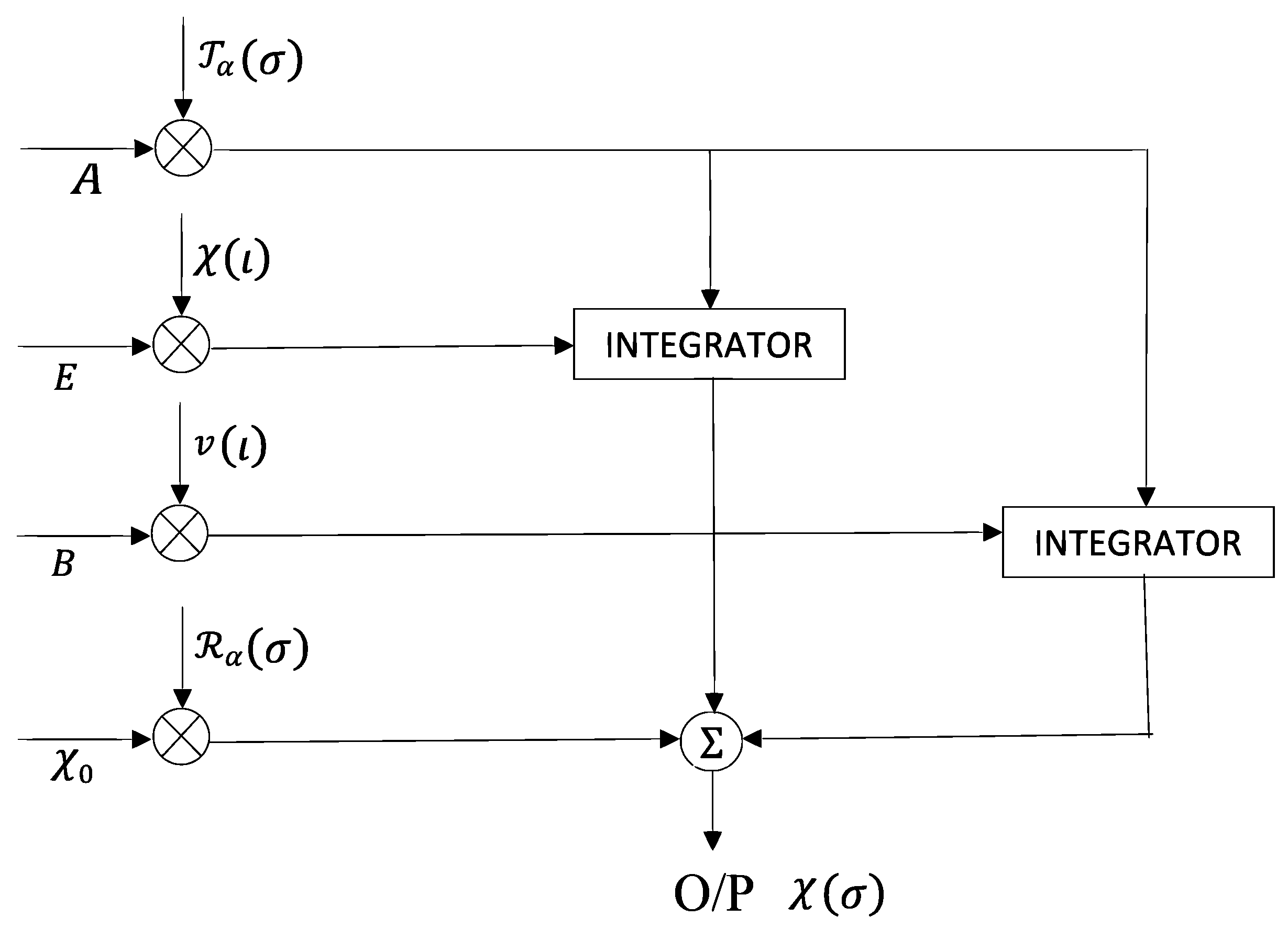
Example 2: Filter System. An advanced filter is a system that applies mathematical operations to a digitized sign that has been examined in order to tone down or enhance some of the prepared signal’s highlights. We represented a filter design for our framework, which is depicted in Figure 1 driven by the strategies studied in [47]. A simple block diagram pattern is shown in Figure 1 to help improve the feasibility of an arrangement with the fewest input sources available.
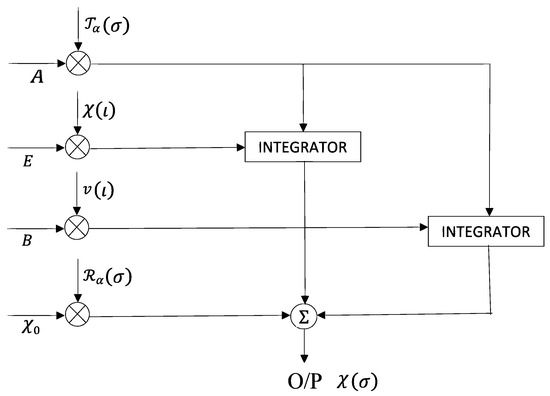
Figure 1.
Filter System:block diagram: the feasibility with the minimum input source arrangement. All letters in the figure correspond to the Definition 2.
- Modulator Product (MP)-1 acquires the input A, , which represents the output as .
- (MP)-2 acquires , E, and represents .
- (MP)-3 acquires , B, and represents .
- (MP)-4 acquires and at time , and represents .
- The integral of is executed by integrators over .
- Inputs and E are multiplied and come together with an integrator output over .
- and B are multiplied and come together over .
Finally, all integrator signals are sent to a digital network which attains the output .
Example 3: Traffic Signal Light System. If are complete probability space, then are natural filters that meet the usual requirement (i.e., they are right continuous and contains all -null sets). The family of piecewise right continuous functions is defined as : with respect to , for . Let denote the family for all -measurable, valued random variables satisfying . Let denote the corresponding expectation operator with respect to the probability measure Assume that is an m-dimensional Brownian motion that is specified on the complete probability space. Let be a right continuous fBm on the probability space taking values in a finite state space with the generator given by
where . Here, is the transition rate from to if , while Define and From fBm theory, we know that is an fBm. Its transition probability is . Here, we assume that Rossenblatt process is independent of the Brownian motion and the fBm.
Electronic Control System: If the volume of the traffic on the route reaches A, the red light is turned on. The green light is on if the vehicle flows below A. With the generator, we define a two-state Rosenblatt chain .
{the vehicle flow exceeds A} = {the red light on} =
{the vehicle flow does not exceed A} = {the green light on} =
The electronic control system will receive either the red light or the green light signal. However, the sign transport latency varies depending on the sign brightness. In addition, noise will disturb the electrical control system, making impulsive signals (such as a quick voltage change) inevitable. The electronic control system can be characterized by the following two systems, depending on whether the red light (or the green light) is on:
where Although the movement of the vehicle is unpredictable, the Rosenblatt chain governs the random switching of the electronic control system during the aforementioned two systems.
Example 4: Biological impact of an infinite delay on the human body: After overnight fasting, a patient is called to the hospital for the routine yearly body check-up to measure blood sugar and other diseases caused due to the age factor. Last year, he was diagnozed with the normal lab results, but this time he detected diabetes. The patient was curious to know when exactly the diabetes entered the body with the particular month and date, but the doctor showed insufficiency in answering his question. There is no medical instrument which gives us this information so far. This is the practical example of an infinite time delay problem which we have studied in system (2). During this time, the patient took sweets in his diet very frequently and that resulted in boosting up sugar levels, which is a study of stochastic process.
Remark 5.
Ramkumar et al. [48] studied the river-dam-contamination problem as one of the applications of the stochastic delay system with optimal control. By taking , system (35) is converted to [48]. Thus, our system is in the more generalized form.
8. Numerical Simulation
In this section, we provide numerical simulations of the application of Equation (38). This example includes several interesting and tricky parts that relate to approximating a numerical solution. If it merely contained a parabolic partial differential equation (PDE), we could solve it using a variety of software packages and the techniques detailed in the cited [38,39] sources. If there was merely a neutral delay term, we could apply the techniques in [40]. All of these elements are represented in this equation along with an integral term.
Now we can write
When and then by using [49], we have
and we know that
Since (37) with infinite delay and mixed fBm does not yet have an established software suite that can handle all of these components, we created the one using Matlab. The code contains all of the details of the simulation; however, the following are the main methods. The time derivative was made apparent by using a forward finite difference. Each spatial derivative was approximated by a centered difference. The integral term was approximated at each discretization point using the trapezoid rule, which is implemented by the Matlab function trapz.m. Difference derivatives on the mesh were also used to roughly estimate the delayed derivative terms.
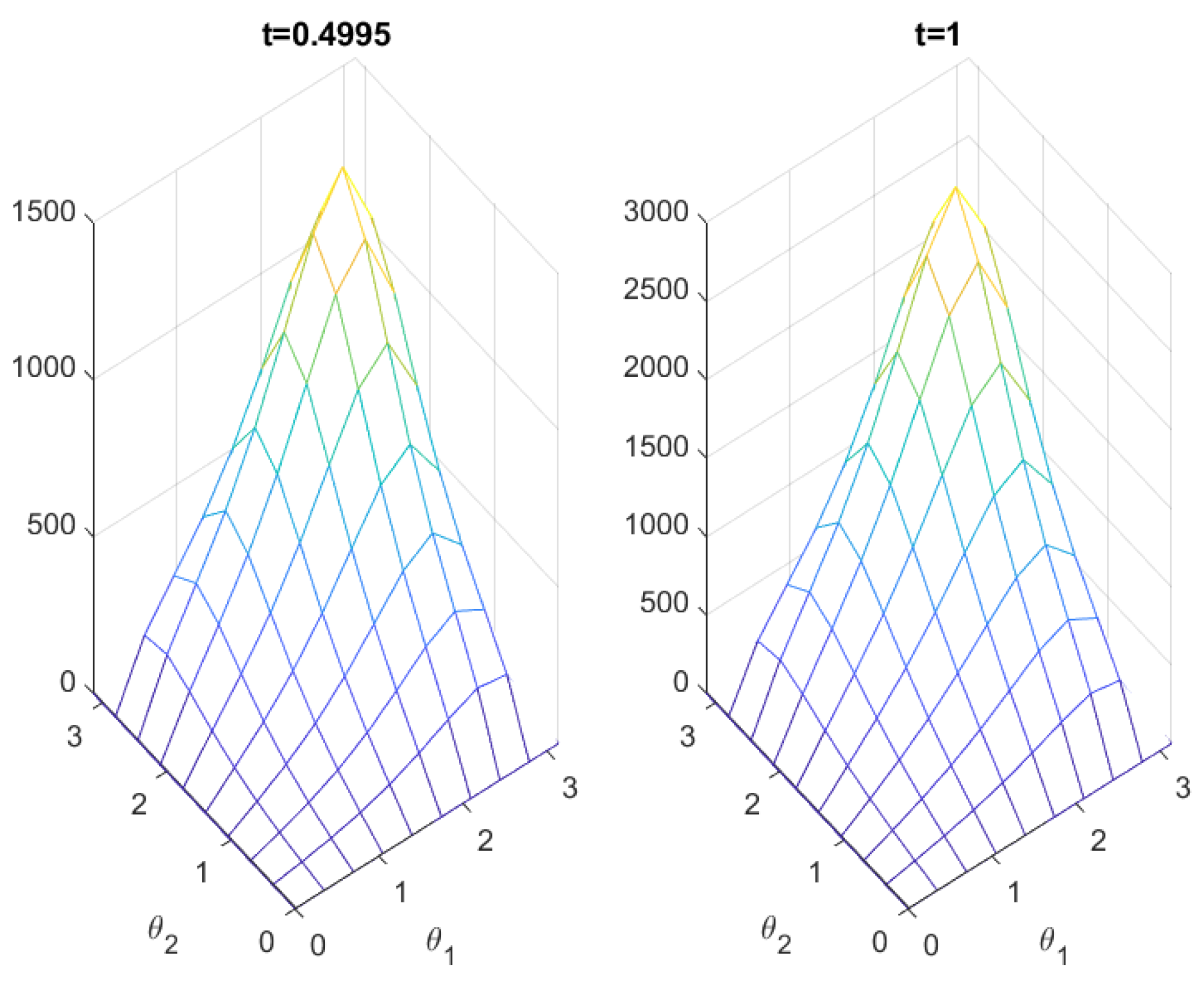
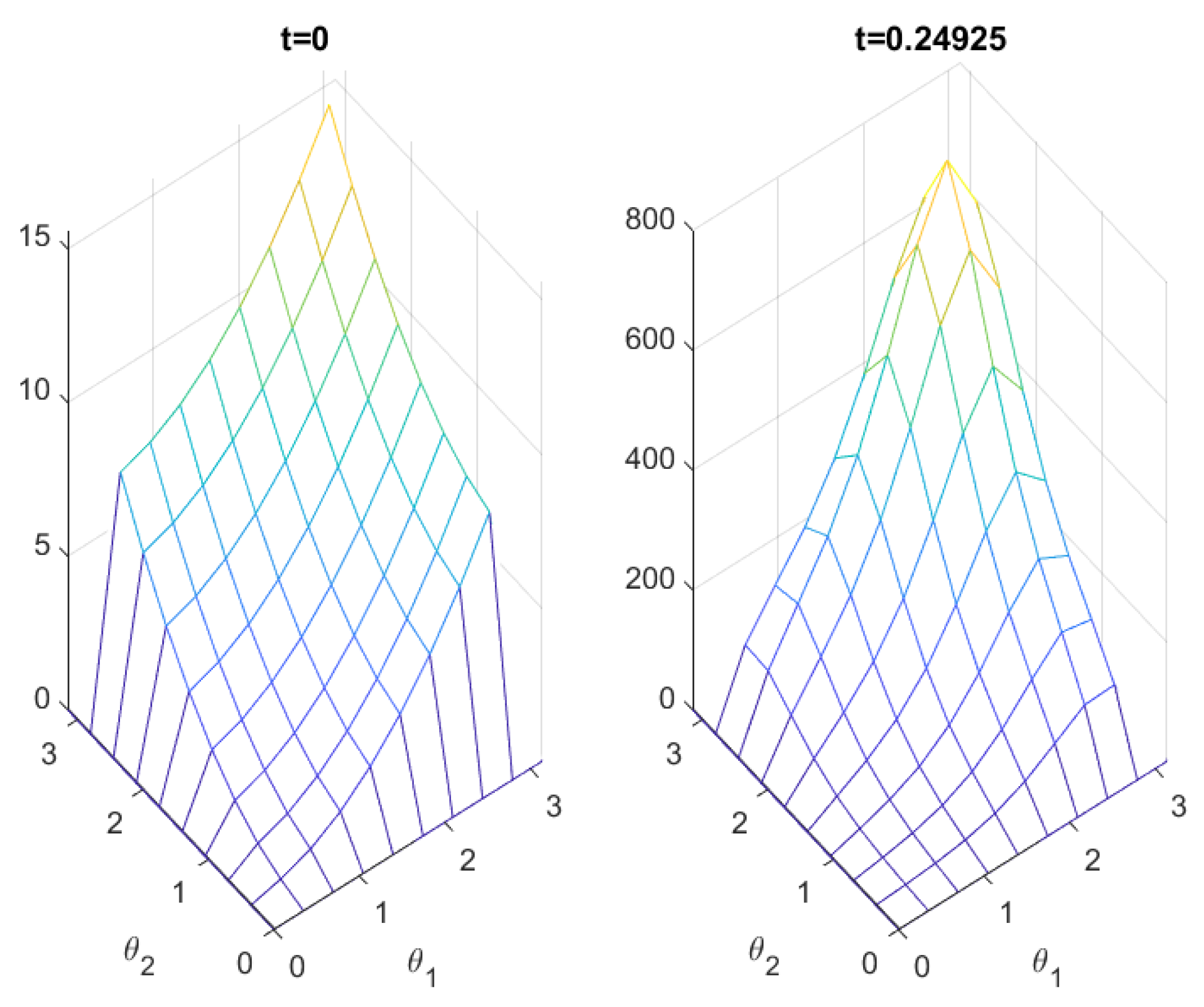
The simulations provided (Figure 1 and Figure 2) used the following functions and settings. For each timestep, we used and a total of 400 spatial points, with 20 points in each spatial dimension. We used 5000 timesteps, so . The fBm parameter . The functions are , , and . Figure 2 shows the function at the beginning, when , and halfway through the experiment. At about the halfway point of the experiment and at the end, Figure 3 shows the simulation.
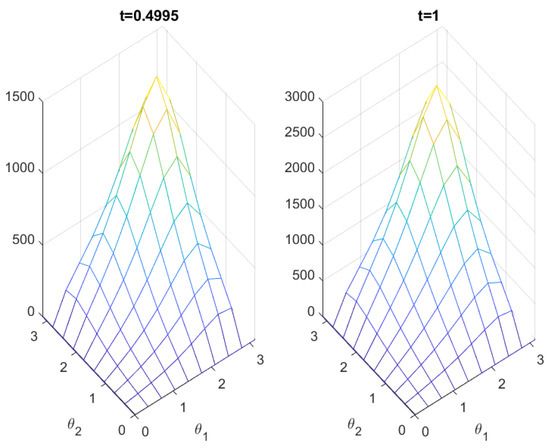
Figure 2.
Graph of and . Function at the start of the simulation, when , and a third of the way through. Blue indicates lower values of , yellow indicates higher values of .
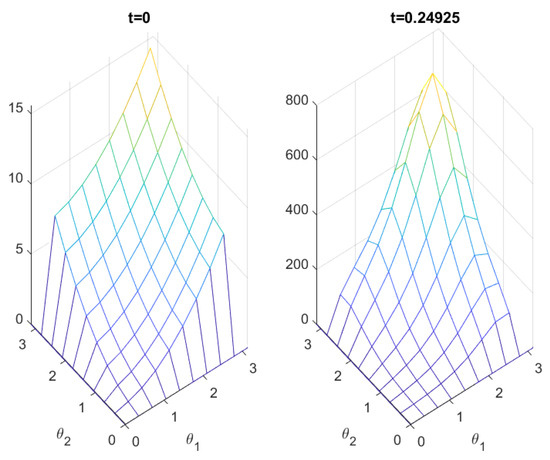
Figure 3.
and . Simulation at approximately the two-thirds point of the simulation. Blue indicates lower values of , yellow indicates higher values of .
9. Conclusions
For a class of neutral SIDEs driven by Poisson jumps and Rosenblatt processes utilizing concrete-fading memory-phase space defined for the stochastic process, we looked into the optimal control difficulties. Grimmer’s resolvent operator theory, successive approximation, and stochastic analysis theory have all been used to examine the existence and uniqueness of mild solutions. The exponential stability, including mean square exponential stability, is then demonstrated. The best-performing pair of systems demonstrates the solution of exponential stability and their maps and is most likely controlled by stochastic partial integrodifferential equations with infinite delay. In order to support the hypothesis, we created a numerical framework. The code includes all of the simulation information for the Matlab finite difference approach. In this study, theoretical proof and numerical estimates are combined in an original way. The following are the research’s potential future applications:
- The same concept can be expanded utilizing Riemann–Liouville (R-L) and Caputo derivatives for the fractional order/hybrid fractional order system with deviating inputs. Consider the Hilfer fractional system with non-instantaneous impulses and state-dependent delay.
- The new work with the numerical simulation will be the system’s trajectory controllability.
- The Measure of Noncompactness method can be used in place of the technique employed in this paper. Additionally, the same system and several types of fractional order SIDEs can be studied using monotone operator theory.
- The approach of "Integral Contractor with Regularity" can be used to weaken Lipschitz continuity in the nonlinear operators.
Author Contributions
Methodology: D.C. and R.K. (Ramkumar Kasinathan); software: D.C. and R.K. (Ravikumar Kasinathan); validation, R.K. (Ramkumar Kasinathan) and R.K. (Ravikumar Kasinathan); formal analysis: R.K. (Ramkumar Kasinathan) and R.K. (Ravikumar Kasinathan); investigation: D.C.; resources, R.K. (Ramkumar Kasinathan) and R.K. (Ravikumar Kasinathan); data accuration, D.C., R.K. (Ramkumar Kasinathan) and R.K. (Ravikumar Kasinathan); writing—R.K. (Ravikumar Kasinathan); original draft preparation, R.K. (Ramkumar Kasinathan); writing—review and editing; D.C.; visualization, R.K. (Ramkumar Kasinathan) and R.K. (Ravikumar Kasinathan); supervision, D.C.; project administration, R.K. (Ramkumar Kasinathan). All authors have read and agreed to the published version of the manuscript.
Funding
This research received no external funding.
Institutional Review Board Statement
No animal or human body was involved in conducting this research.
Data Availability Statement
The authors did not use any scientific data yet to be determined for this research.
Acknowledgments
The authors would like to thank the referees and the editor for their careful comments and valuable suggestions to improve this manuscript.
Conflicts of Interest
The authors declare no conflict of interest.
References
- Mao, X. Stochastic Differential Equations and Applications; Horwood Publishing Limited: Chichester, UK, 2007. [Google Scholar]
- Oksendal, B. Stochastic differential equations. In Stochastic Differential Equations; Springer: Berlin/Heidelberg, Germany, 2003; pp. 65–84. [Google Scholar]
- Prato, D.G.; Zabczyk, J. Stochastic Equations in Infinite Dimensions; Cambridge University Press: Cambridge, UK, 2014. [Google Scholar]
- Evans, L.C. An Introduction to Stochastic Differential Equations; University of California: Berkeley, CA, USA, 2013. [Google Scholar]
- Ravikumar, K.; Ramkumar, K.; Chalishajar, D. Existence and Stability Results for Second-Order Neutral Stochastic Differential Equations With Random Impulses and Poisson Jumps. Eur. J. Math. Anal. 2021, 1, 1–18. [Google Scholar] [CrossRef]
- Helge, H.; Ksendal, B.; Ube, J.; Zhang, T. Stochastic partial differential equations. In Stochastic Partial Differential Equations; Birkhäuser: Boston, MA, USA, 1996; pp. 141–191. [Google Scholar]
- Kostikov, Y.A.; Romanenkov, A.M. Approximation of the multidimensional optimal control problem for the heat equation (applicable to computational fluid dynamics (CFD)). Civ. Eng. J. 2020, 6, 743–768. [Google Scholar] [CrossRef]
- Trung, T.T. Smart city and modelling of its unorganized flows using cell machines. Civ. Eng. J. 2020, 6, 954–960. [Google Scholar] [CrossRef]
- Dieye, M.; Diop, M.A.; Ezzinbi, K. On exponential stability of mild solutions for some stochastic partial integrodifferential equations. Stat. Probab. Lett. 2017, 123, 61–76. [Google Scholar] [CrossRef]
- Dieye, M.; Diop, M.A.; Ezzinbi, K. Almost sure asymptotic stability for some stochastic partial functional integrodifferential equations on Hilbert spaces. Cogent Math. Stat. 2019, 6, 1602928. [Google Scholar] [CrossRef]
- Taniguchi, T.; Liu, K.; Truman, A. Existence, uniqueness, and asymptotic behavior of mild solutions to stochastic functional differential equations in Hilbert spaces. J. Differ. Equ. 2002, 181, 72–91. [Google Scholar] [CrossRef]
- Ramkumar, K.; Ravikumar, K.; Anguraj, A. Existence and Exponential Stability for Neutral Impulsive Stochastic Integrodifferential Equations with Fractional Brownian Motion Driven by Poisson Jumps. J. Vib. Test. Syst. Dyn. 2020, 4, 311–324. [Google Scholar] [CrossRef]
- Anguraj, A.; Ravikumar, K. Existence and stability results of impulsive stochastic partial neutral functional differential equations with infinite delays and Poisson jumps. Discontinuity Nonlinearity Complex. 2020, 9, 245–255. [Google Scholar] [CrossRef]
- Anguraj, A.; Ramkumar, K.; Elsayed, E.M. Existence, uniqueness and stability of impulsive stochastic partial neutral functional differential equations with infinite delays driven by a fractional Brownian motion. Discontinuity Nonlinearity Complex. 2020, 9, 327–337. [Google Scholar] [CrossRef]
- Govindan, T.E. Stability of mild solutions of stochastic evolution equations with variable delay. Stochastics Anal. Appl. 2003, 5, 1059–1077. [Google Scholar] [CrossRef]
- Kai, L.; Shi, Y. Razumikhin-type theorems of infinite dimensional stochastic functional differential equations. In Proceedings of the IFIP Conference on System Modeling and Optimization, Turin, Italy, 18–22 July 2005; pp. 237–247. [Google Scholar]
- Taniguchi, T. Almost sure exponential stability for stochastic partial functional differential equations. Stoch. Anal. Appl. 1998, 16, 965–975. [Google Scholar] [CrossRef]
- Diop, M.A.; Ezzinbi, K.; Lo, M. Exponential stability for some stochastic neutral partial functional integrodifferential equations with delays and Poisson jumps. Semigroup Forum 2014, 88, 595–609. [Google Scholar] [CrossRef]
- Chen, H.; Zhu, C.; Zhang, Y. A note on exponential stability for impulsive neutral stochastic partial functional differential equations. Appl. Math. Comput. 2014, 227, 139–147. [Google Scholar] [CrossRef]
- Cui, J.; Yan, L. Successive approximation of neutral stochastic evolution equations with infinite delay and Poisson jumps. Appl. Math. Comput. 2012, 218, 6776–6784. [Google Scholar] [CrossRef]
- Mao, W.; Hu, L.; Mao, X. Neutral stochastic functional differential equations with Lévy jumps under the local Lipschitz condition. Adv. Differ. Equ. 2017, 2017, 1–24. [Google Scholar] [CrossRef]
- Yue, C. Neutral stochastic functional differential equations with infinite delay and Poisson jumps in the Cg space. Appl. Math. Comput. 2014, 237, 595–604. [Google Scholar] [CrossRef]
- Grimmer, R.C. Resolvent operators for integral equations in a Banach space. Trans. Am. Math. Soc. 1982, 273, 333–349. [Google Scholar] [CrossRef]
- Ren, Y.; Xia, N. Existence, uniqueness and stability of the solutions to neutral stochastic functional differential equations with infinite delay. Appl. Math. Comput. 2009, 210, 72–79. [Google Scholar] [CrossRef]
- Hale, K.J.; Kato, J. Phase space for retarded equations with infinite delay. Funck. Ekvacioj 1978, 21, 11–41. [Google Scholar]
- Wu, F.; Yin, G.; Mei, H. Stochastic functional differential equations with infinite delay: Existence and uniqueness of solutions, solution maps, Markov properties, and ergodicity. J. Differ. Equ. 2017, 262, 1226–1252. [Google Scholar] [CrossRef]
- Maejima, M.; Tudor, C.A. Self-similar processes with stationary increments in the second Wiener chaos. Probab. Math. Stat. 2012, 32, 167–186. [Google Scholar]
- Pipiras, V.; Taqqu, M.S. Regularization and integral representations of Hermite processes. Stat. Probab. Lett. 2010, 80, 2014–2023. [Google Scholar] [CrossRef]
- Taqqu, M. Weak convergence to fractional Brownian motion and to the Rosenblatt process. Adv. Appl. Probab. 1975, 7, 249. [Google Scholar] [CrossRef]
- Tudor, C.A. Analysis of the Rosenblatt process. ESAIM Probab. Stat. 2008, 12, 230–257. [Google Scholar] [CrossRef]
- Abry, P.; Pipiras, V. Wavelet-based synthesis of the Rosenblatt process. Signal Process. 2006, 86, 2326–2339. [Google Scholar] [CrossRef]
- Leonenko, N.N.; Anh, V.V. Rate of convergence to the Rosenblatt distribution for additive functionals of stochastic processes with long-range dependence. J. Appl. Math. Stoch. Anal. 2001, 14, 27–46. [Google Scholar] [CrossRef]
- Boufoussi, B.; Hajji, S. Neutral stochastic functional differential equations driven by a fractional Brownian motion in a Hilbert space. Stat. Probab. Lett. 2012, 82, 1549–1558. [Google Scholar] [CrossRef]
- Caraballo, T.; Diop, M.A. Neutral stochastic delay partial functional integro-differential equations driven by a fractional Brownian motion. Front. Math. China 2013, 8, 745–760. [Google Scholar] [CrossRef]
- Ramkumar, K.; Ravikumar, K.; Anguraj, A.; Hamdy, M. Ahmed, Well-posedness results for higher-order neutral stochastic differential equations driven by Poisson jumps and Rosenblatt process. Filomat 2021, 35, 353–365. [Google Scholar] [CrossRef]
- Caraballo, T.; Garrido-Atienza, M.J.; Taniguchi, T. The existence and exponential behavior of solutions to stochastic delay evolution equations with a fractional Brownian motion. Nonlin. Anal. Theory Methods Appl. 2011, 74, 3671–3684. [Google Scholar] [CrossRef]
- Urszula, L.; Schättler, H. Antiangiogenic therapy in cancer treatment as an optimal control problem. SIAM J. Control. Optim. 2007, 46, 1052–1079. [Google Scholar]
- Area, I.; Ndairou, F.; Nieto, J.J.; Silva, C.J.; Torres, D.F. Ebola model and optimal control with vaccination constraints. J. Ind Manag Optim. 2018, 14, 427–446. [Google Scholar] [CrossRef]
- Rajivganthi, C.; Muthukumar, P. Almost automorphic solutions for fractional stochastic differential equations and its optimal control. Optim. Control. Appl. Methods 2016, 37, 663–681. [Google Scholar] [CrossRef]
- Wang, Q.; Chen, F.; Huang, F. Maximum principle for optimal control problem of stochastic delay differential equations driven by fractional Brownian motions. Optim. Control Appl. Methods 2016, 37, 90–107. [Google Scholar] [CrossRef]
- Ramkumar, K.; Ravikumar, K.; Varshini, S. Fractional neutral stochastic differential equations with Caputo fractional derivative: Fractional Brownian motion, Poisson jumps, and optimal control. Stoch. Anal. Appl. 2021, 39, 157–176. [Google Scholar] [CrossRef]
- Diop, M.A.; Ezzinbi, K.; Guindo, P.D.A. Optimal controls problems for some impulsive stochastic integro-differential equations with state-dependent delay. Stochastics 2022, 94, 1–35. [Google Scholar] [CrossRef]
- Diop, M.A.; Guindo, P.D.A.; Fall, M.; Diakhby, A. Optimal controls for stochastic functional integrodifferential equations. Electron. J. Math. Anal. Appl. 2021, 9, 241–261. [Google Scholar]
- Hajji, S.; Lakhel, E. Existence and uniqueness of mild solutions to neutral SFDE driven by a fractional Brownian motion with non-Lipschitz coefficients. arXiv 2013, arXiv:1312.6147. [Google Scholar]
- Boufoussi, B.; Hajji, S.; Lakhel, E.H. Functional differential equations in Hilbert spaces driven by a fractional Brownian motion. Afr. Mat. 2012, 23, 173–194. [Google Scholar] [CrossRef]
- Zouine, A.; Bouzahir, H.; Vargas, A.N. Stability for stochastic neutral integro-differential equations with infinite delay and Poisson jumps. RMS Res. Math. Stat. 2021, 8, 1979733. [Google Scholar] [CrossRef]
- Zahoor, S.; Naseem, S. Design and implementation of an efficient FIR digital filter. Cogent Eng. 2017, 4, 1323373. [Google Scholar] [CrossRef]
- Ramkumar, K.; Ravikumar, K.; Chalishajar, D. Existence trajectory and optimal control of Clarke subdifferential stochastic integrodifferential inclusions suffered by non-instantaneous impulses and deviated arguments. Result Control. Optim. 2023, 13, 100295. [Google Scholar] [CrossRef]
- Mattuvarkuzhali, C.; Balasubramaniam, P. pth Moment stability of fractional stochastic differential inclusions via resolvent operators driven by the Rosenblatt process and Poisson jumps with impulses. Stochastics 2019, 92, 1157–1174. [Google Scholar] [CrossRef]
Disclaimer/Publisher’s Note: The statements, opinions and data contained in all publications are solely those of the individual author(s) and contributor(s) and not of MDPI and/or the editor(s). MDPI and/or the editor(s) disclaim responsibility for any injury to people or property resulting from any ideas, methods, instructions or products referred to in the content. |
© 2023 by the authors. Licensee MDPI, Basel, Switzerland. This article is an open access article distributed under the terms and conditions of the Creative Commons Attribution (CC BY) license (https://creativecommons.org/licenses/by/4.0/).