1. Introduction
Dynamical systems are commonly modeled using differential equations, which describe the system’s behavior in terms of its states and their respective time derivatives. These derivatives are typically of an integer order; for example, the first derivative is of order 1, the second derivative is of order 2, and so forth.
An extension of the concept of derivatives and integrals allows for the consideration of orders that are not necessarily integer values. This extension involves fractional-order derivatives and integrals, which are studied within the field of fractional calculus. These extensions are known as fractional-order derivatives and integrals. When applied to the modeling of dynamical systems, they enhance the precision of the model by offering the flexibility to adjust the derivative order freely.
Fractional calculus has attracted interest due to the numerous potential applications in many disciplines such as finance [
1], physics [
2], medicine [
3], biology [
4], and control [
5]. By applying fractional derivatives to known models and control laws, the model can better match the real-world dynamics of the system, whereas the fractional-order controller can find added benefits, similar to the Fractional Order Proportional Integral Derivative control (FOPID), which obtains two new values that can be adjusted for a better system response [
6].
There have been recent advances on the control for fractional-order non-linear systems with non-linear control inputs: in [
7], a sliding-mode control scheme with a fractional-order sliding surface is presented; in [
8], a neural network controller for a fractional-order system with a non-linear control input is given, and in [
9], a fractional-order control system is employed for a non-linear control input.
Fractional-order control applied to temperature regulation via thermoelectric modules (TEM) remains an area with limited exploration. In [
10], a heating process is characterized by a fractional-order transfer function and subsequently regulated employing a fractional-order PID (FOPID) controller. Ref. [
11] introduces an auto-tuning algorithm for FOPID controllers, based on particle swarm optimization techniques, and its performance is demonstrated through testing on a thermoelectric module. In a similar vein, ref. [
12] tests the performance of a FOPID controller on a thermoelectric module, taking into consideration the process time delay. Meanwhile, ref. [
13] advances the field by modeling an array of Peltier cells as a group of fractional-order transfer functions, where control is achieved using a set of PI controllers. Ref. [
14] offers a similar approach, presenting a thermoelectric module modeled with an integer-order transfer function of the first order with a time delay and demonstrates a successful control implementation via the discrete approximation of a FOPID controller.
In addition to temperature regulation, thermoelectric modules find extensive application as thermoelectric generators. In this context, control is not directly applied on the thermoelectric module itself, but rather on the DC-DC power converter responsible for supplying energy to an energy storage device. The purpose of the controller is the optimization of the energy extraction process, a popular approach concerning the utilization of a Maximum Power Point Tracking (MPPT). Notably, a number of studies have explored the use of fractional-order controllers within the MPPT, with noteworthy contributions from works such as those presented in [
15,
16,
17,
18].
Thermoelectric modules have the capability of both heating and cooling, depending on the supplied current. This characteristic lends itself to various industrial applications, including thermal cycling in biomedical settings. In optics-based telecommunications, thermoelectric modules are employed for the cooling of lasers and other optical elements. Additionally, in spectroscopy, thermoelectric modules play a crucial role in the temperature regulation of deep-cooling CCD cameras. Thermoelectric generation stands as another important application of these modules. Moreover, certain consumer electronics rely on thermoelectric modules for cooling; for example, there exists a wide range of solutions based on these modules for cooling computer processors and graphics cards.
Given this diverse array of applications, the control of thermoelectric modules holds significant importance in engineering applications. Fractional-order models offer a superior adjustment for representing the dynamic behavior of real-world thermoelectric modules, allowing for the design of controllers with a more comprehensive understanding of the system and, consequently, yielding improved results. Despite the wide range of applications, there is a shortage of existing literature providing control methodologies beyond FOPID for fractional-order models of thermoelectric modules. This paper introduces a novel observer-based control strategy for commensurate fractional-order non-linear systems featuring non-linear polynomial control inputs. The proposed control law uses a state observer to mitigate the influence of the non-linear control inputs, thus inducing the desired response in the output of the TEM. By doing so, this new approach addresses a gap in current research and showcases its potential for enhancing the control performance of the fractional-order TEM model.
The rest of the paper is organized as follows: In
Section 2, preliminaries about fractional calculus are given;
Section 3 presents the observer-based control law;
Section 4 is about the thermoelectric module;
Section 5 contains numerical simulations; and
Section 5 gives some concluding remarks.
3. Uncertainty Estimation Observer and Controller
The proposed control law employs a sliding-mode uncertainty observer to estimate the desired part of the system dynamics. This estimate is then employed via a sliding-mode controller to counteract the effects of the non-linear control input and to provide robustness to the closed-loop system.
Consider the fractional-order non-linear system with polynomial non-affine control inputs
with
. The system can be separated in its power stage given by
:
having
and the process with states containing the non-linear polynomial control inputs:
where
and
, notice that the input of the non-linear function is one of the states of the power stage. The system can then be written as:
where
,
,
,
and
are matrices of the appropriate dimension,
,
gives the non-linear dynamic of the system, and
are the coefficients of the non-linear polynomial control input. The output is the state to be controlled
with the fractional-order derivative
where
are the parts corresponding to the output of the system dynamics. The fractional-order derivative of
can be expressed as a two-state system by making the change in variable
In the interest of simplicity
then
with
. The following sliding-mode state observer produces an estimate of the fractional-order derivative of the state
:
The synchronization error and its derivative of order
are then:
The following assumptions are needed for the proof of convergence for the observer.
Assumption 1. There is a solution for a to the linear matrix inequality
Assumption 2. The unknown dynamic is Lipschitz with ,
Assumption 3. For a number , , the norm of the solution of the Lyapunov equation fulfills the inequality
Assumption 4. There is a solution with to the Lyapunov equation
Assumption 5. The states of the linear driving system are bounded via a real non-negative number
The observer equation is rewritten to match (13)
where
and
. The error dynamic is
Consider the Lyapunov candidate function
From Lemma 2 and based on the Caputo derivative, the
th order derivative of the Lyapunov candidate function has the upper bound
By substituting the error dynamic into the fractional-order derivative of the Lyapunov candidate function
The terms of the derivative are rearranged
Using the Rayleigh–Ritz inequality
, then
Knowing that
To fulfill Lemma 1,
K has to satisfy the inequality
, so
and the observer error is Mittag-Leffler stable. In order to estimate the desired part of the system dynamic, the state of the observer is extended by the equation
With
r being a trajectory with the bounded
th-order Caputo derivative
. The tracking error and its
order derivative are
Let a Lyapunov candidate function for the error be
From Lemma 2, the
th-order derivative is bounded
Since the derivative of the reference is bounded
having
makes the derivative of the Lyapunov candidate function be
; therefore, the additional observer satisfies Lemma 1, and thus, the additional state converges to the desired reference
r. Choosing
leads to
The value converges to the uncertain part of the dynamic containing the state and the non-linear part of the input ; thus, the extended dynamic for the observer is .
A strategy similar to active disturbance rejection is proposed by using to mitigate the effects of the non-linear control input, of which the input for the non-lineal system is , where denotes the desired system-output dynamics. These dynamic are necessary to counteract the effects of any possible estimation errors by introducing a robust control law.
In order to attain the desired trajectory for
, the linear part of the system is then expressed as
Let a differentiable desired reference signal for the linear system
with the bounded derivative
and its tracking error
, with the fractional-order derivative, be
Choosing
as both the control input and a Lyapunov candidate function for the linear system
According to Lemma 1
from Assumption 4
by Assumption 5
making
so that
leads to
; therefore, the input state for the non-linear states converges to the desired control law
, making the overall system Mittag-Leffler stable with
.
4. The Thermoelectric Module and Numerical Results
Thermoelectric Modules (TEM) are solid-state temperature control devices composed of n- and p-type semiconductors linked to ceramic plates. Depending on the direction of the current provided to the semi-conductor elements of the module, heat is transferred from one of its ceramic plates to the other. The TEM is a non-linear system with a non-linear control input. An equivalent circuit model of the TEM is introduced in [
21,
22], which is especially practical for this application. In [
23], an integer-order mathematical model for the TEM is obtained from the results of Lineykin. If the TEM is powered via a DC/DC Buck converter, the equations describing the TEM’s state trajectories driven by the buck converter are similar to those in (9). Then, a fractional-order mathematical model for this system is given by
where the output voltage is
, the electrical resistance parameter is
R, the input PWM signal is
u, the current of the converter is
, and the capacitance and inductance are denoted by
C and
L, respectively. The temperature in the cold side is
and the temperature in the hot plate is
;
is the Seebeck coefficient;
is the thermal conductivity;
is the electric resistance; and
is the temperature difference between the hot and cold plates;
and
are the thermal capacitance for the hot and cold plate, respectively;
is the thermal paste’s thermal resistance; and
is the thermal resistance of the system.
The linear part of the system is formed by the first two states and the remaining two are the non-linear dynamics of the TEM. The non-linear polynomial input for the TEM is the output voltage
. This input forms a second-degree polynomial with coefficients dependent on the parameters of the Buck and TEM, but it also depends on the TEM state. The order of the derivative
is obtained via system identification: first, the system parameters are identified using an integer-order mathematical model, and then a second parametric identification is conducted to estimate the value of the fractional derivative. The control law is tested in a TEC-12706 thermoelectric module; to make parameter identification easier, Equation (
9) is simplified via a change in the variable:
The parameter identification process yields the following results (
Table 1):
The observer-based proposed controller is then implemented using the CRONE approximation of the fractional-order integral
the gains for the controller are
,
,
,
,
,
, and
, with
being a desired temperature in
C.
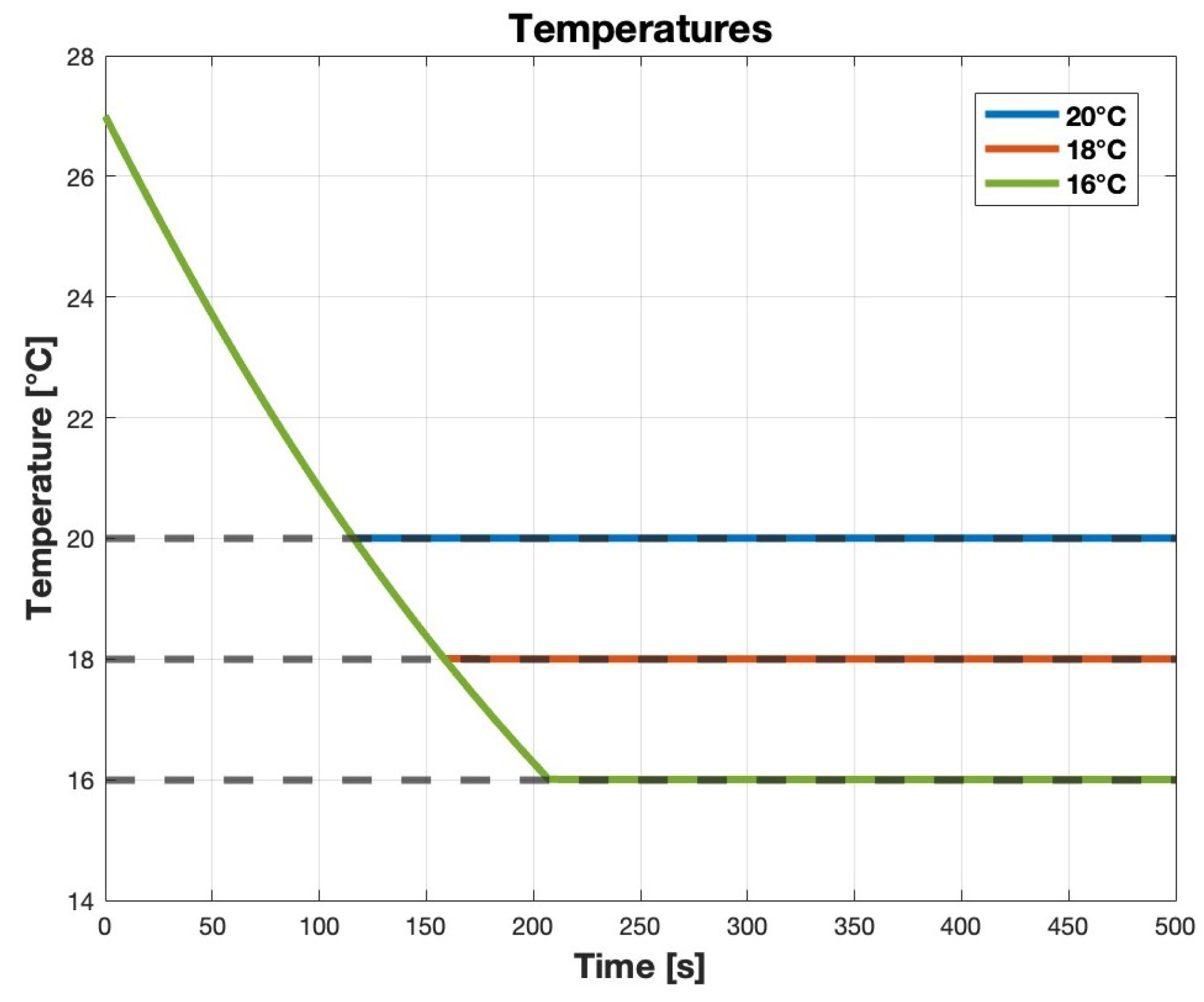
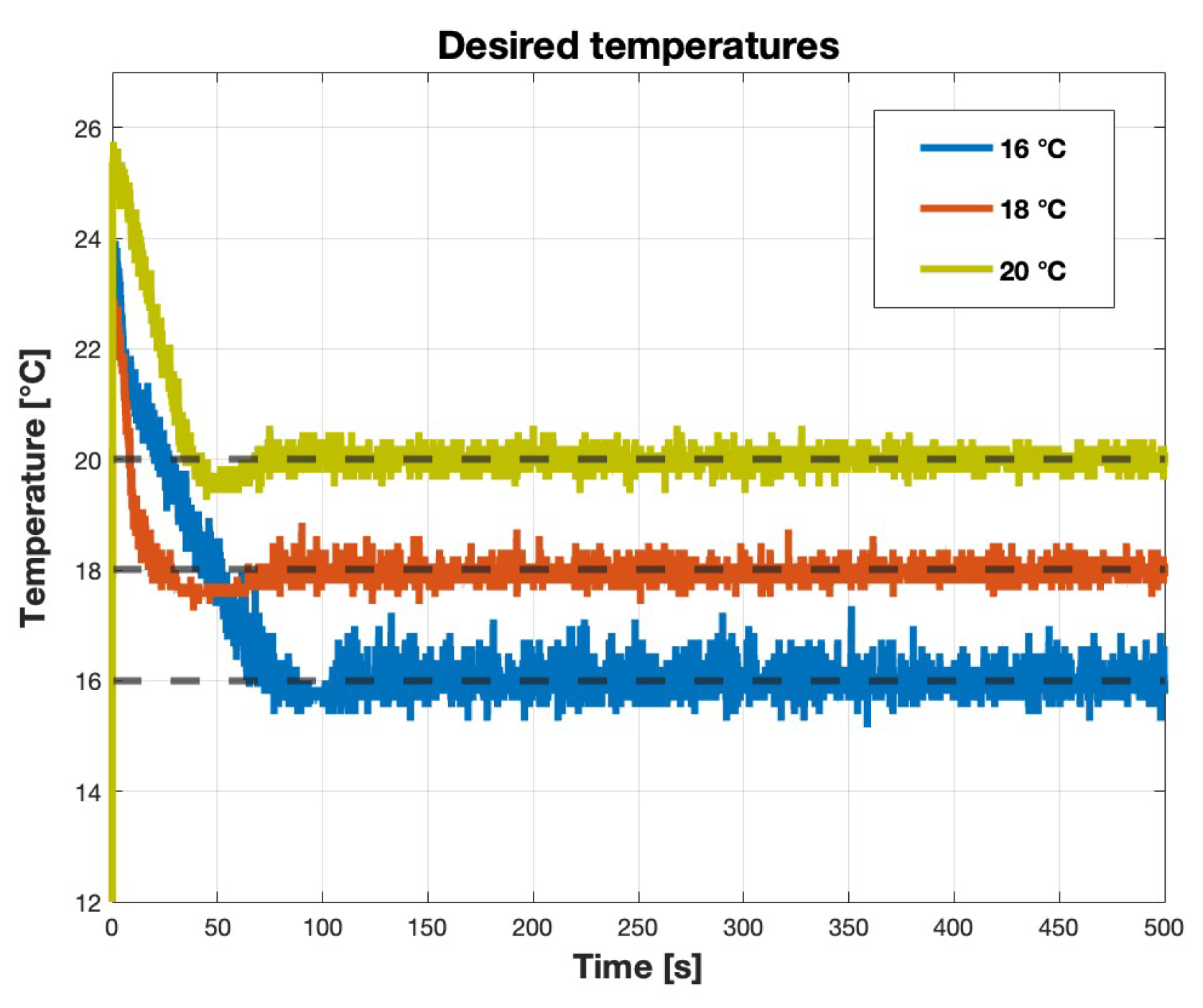
Figure 1 shows the time evolution of the temperature on the cold side of the TEM at the desired temperatures of 20
C,
C, and
C.
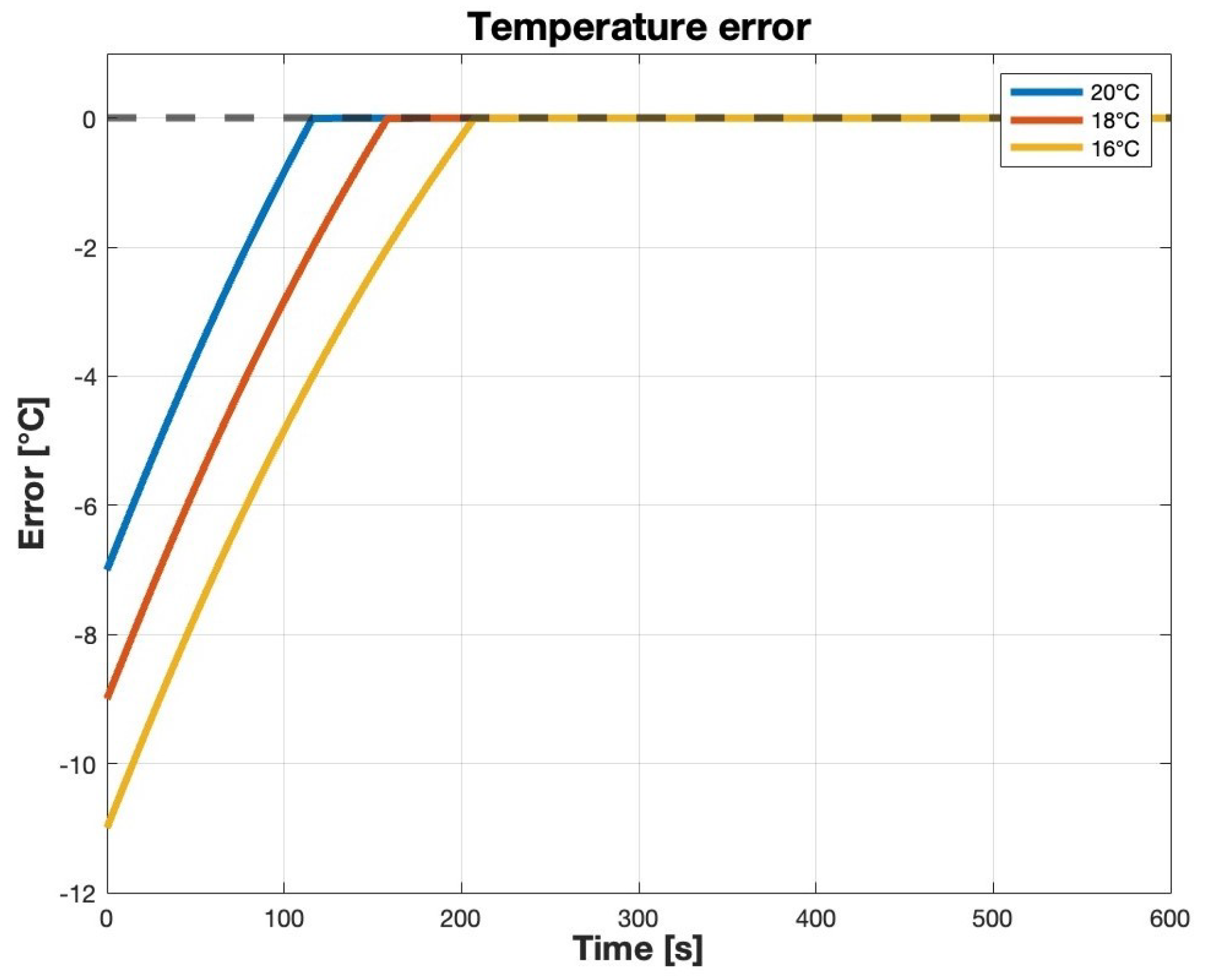
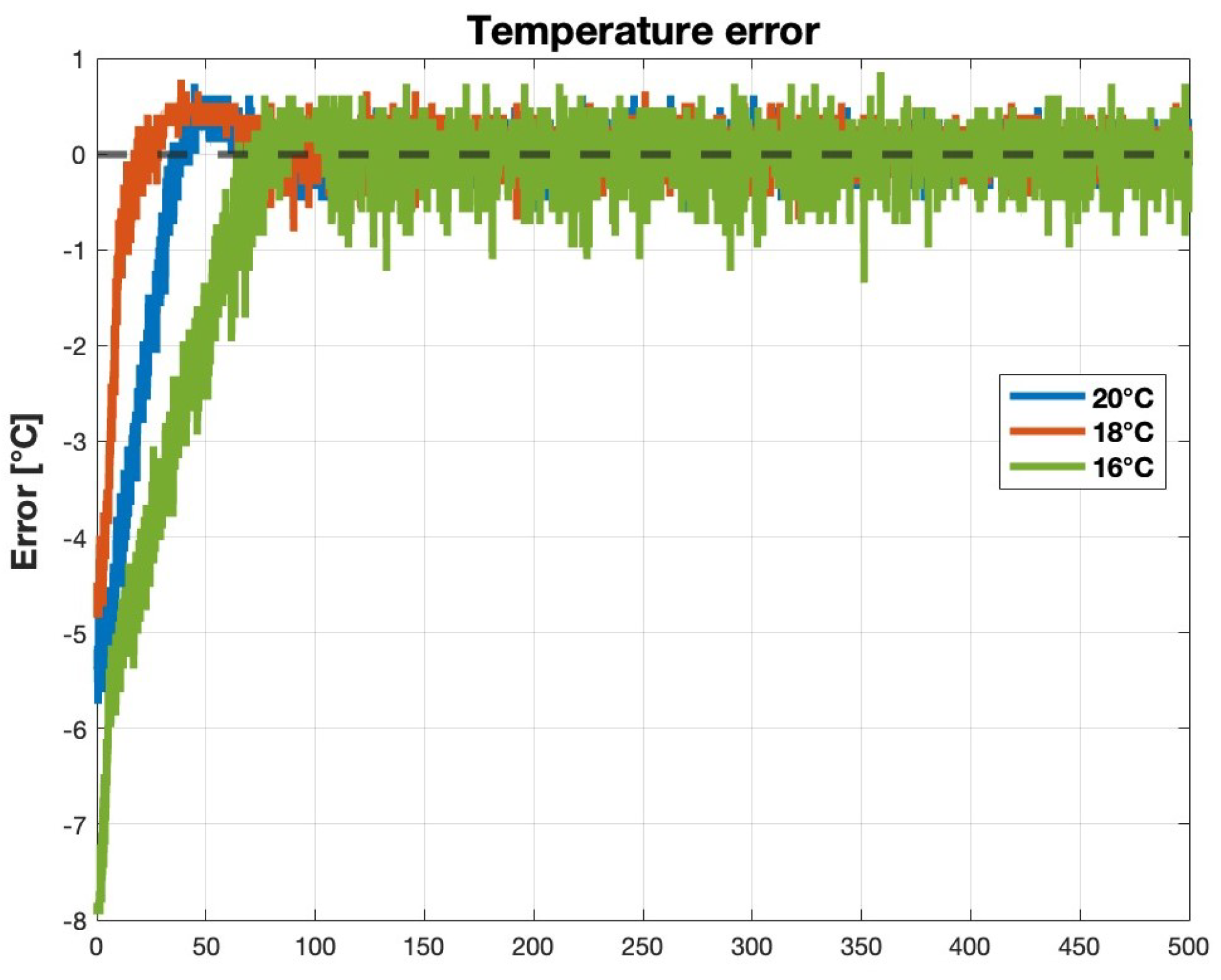
Figure 2 shows the error signals for these desired temperatures,
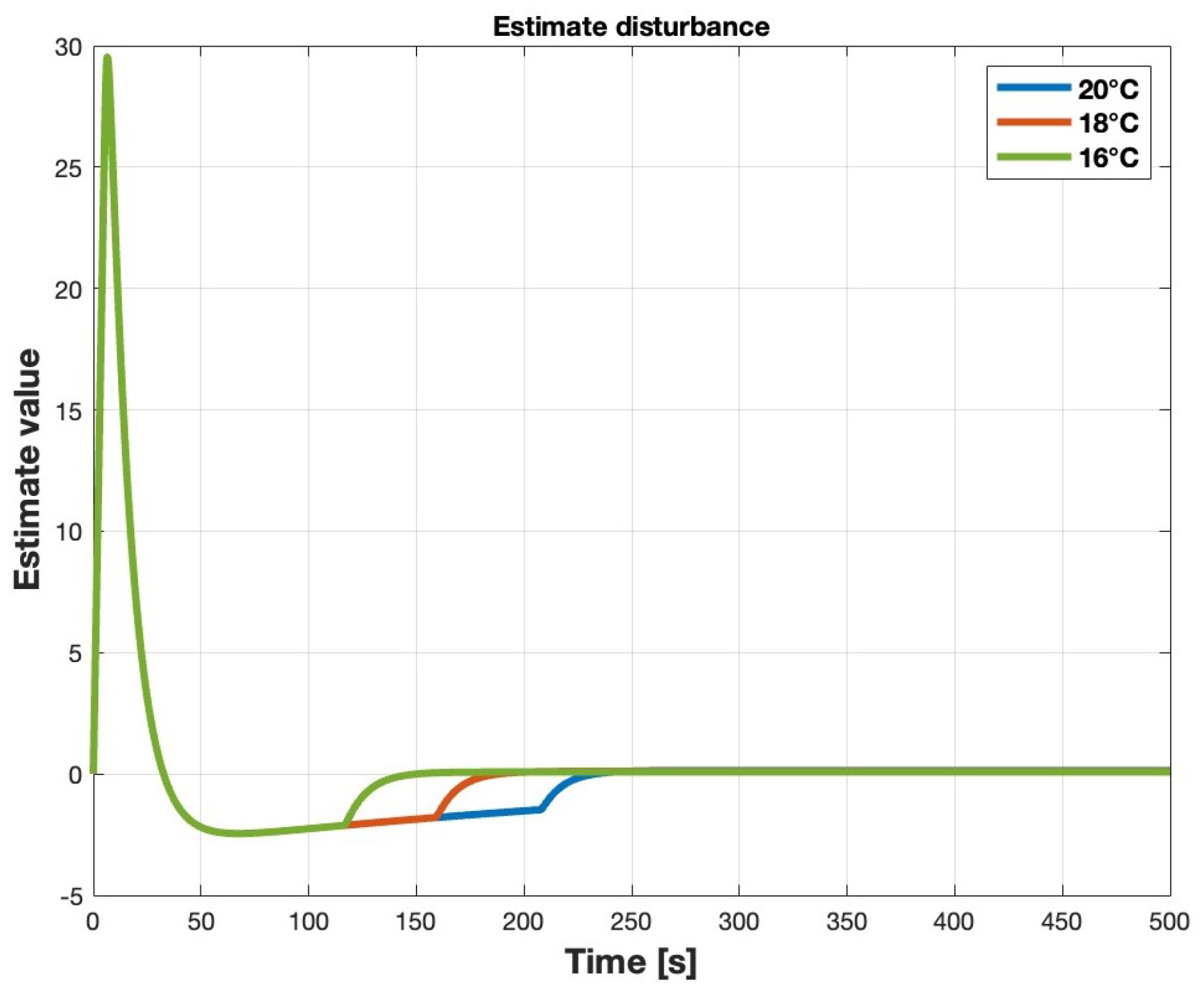
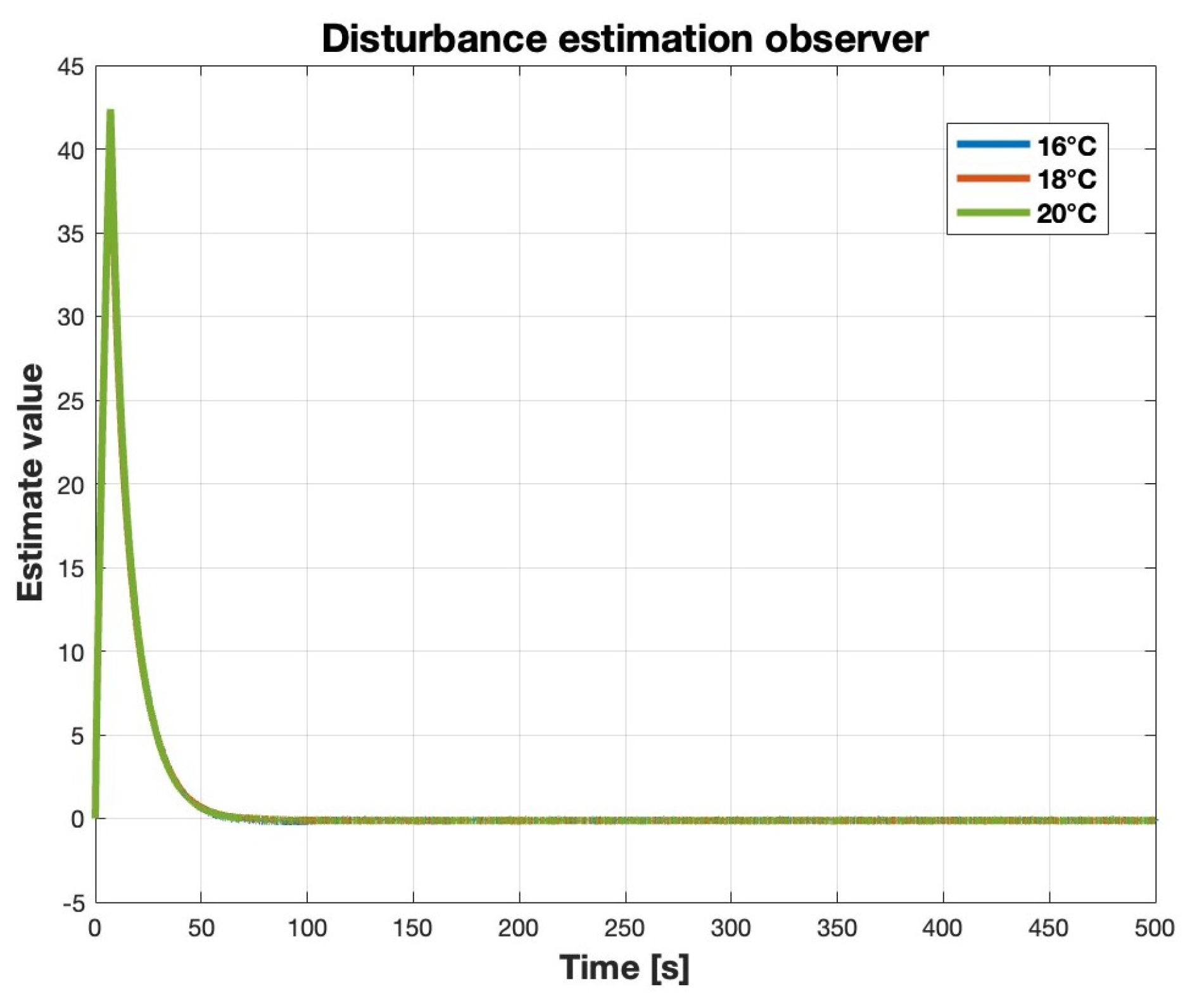
Figure 3 shows the behavior of the perturbation estimation, and
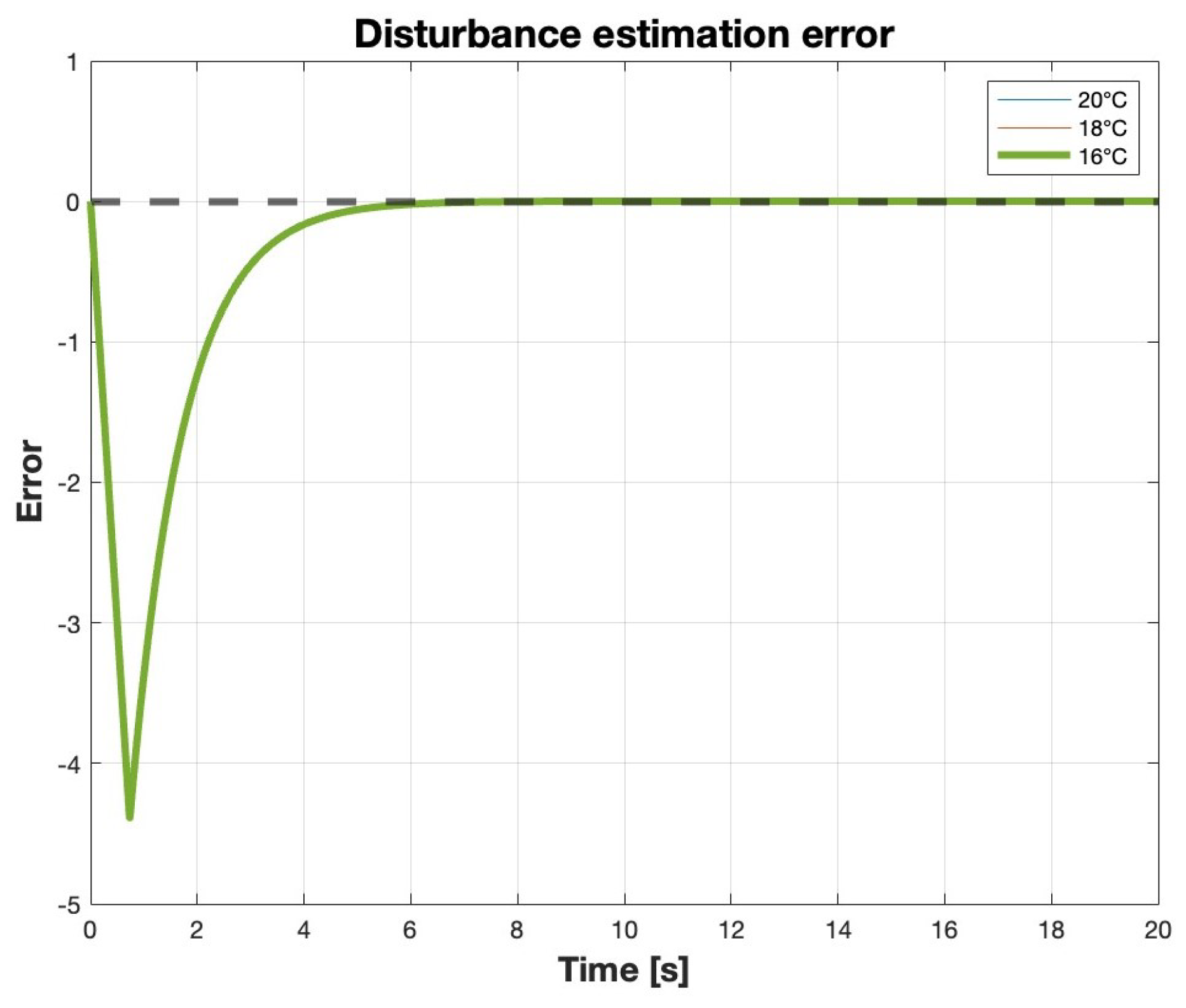
Figure 4 shows the perturbation estimation error.
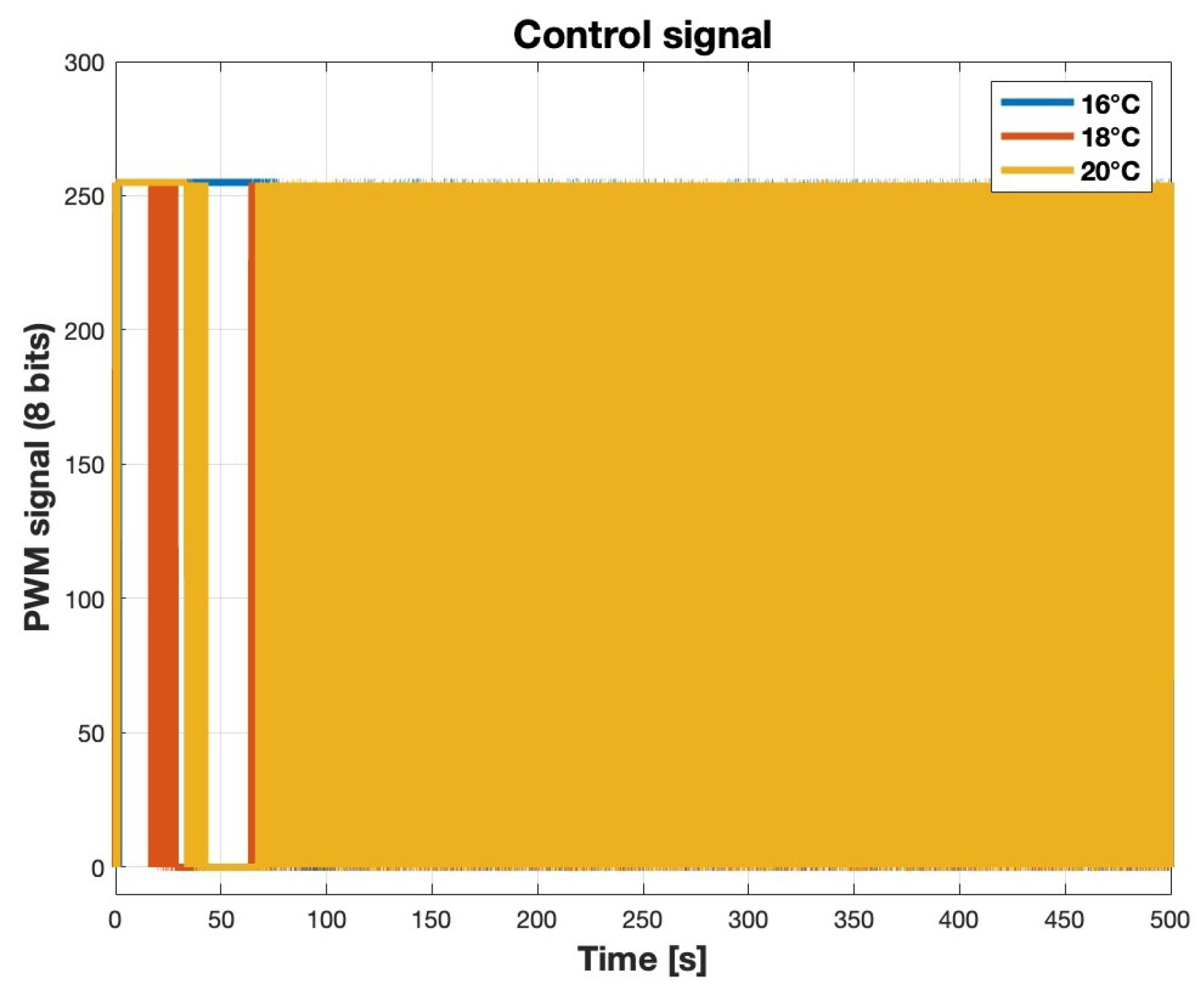
As shown in the figures, the simulation results obtained for the performance of the proposed controller were satisfactory. It is necessary to clarify that care must be taken in the way in which the gains are chosen so that the linear system obtains achievable values. It is important to note that the observer is compatible with other control techniques, such as FOPID and its variants.
Notice the observer consistently generates identical error trajectories across all experiments; as depicted in
Figure 4, each trajectory is consistently replicated. To confirm the validity of the simulation, the experiments were conducted on an experimental platform. The control law is implemented using an Arduino board for control and data acquisition. The next figures (
Figure 5,
Figure 6,
Figure 7 and
Figure 8) show the results of the experiment.
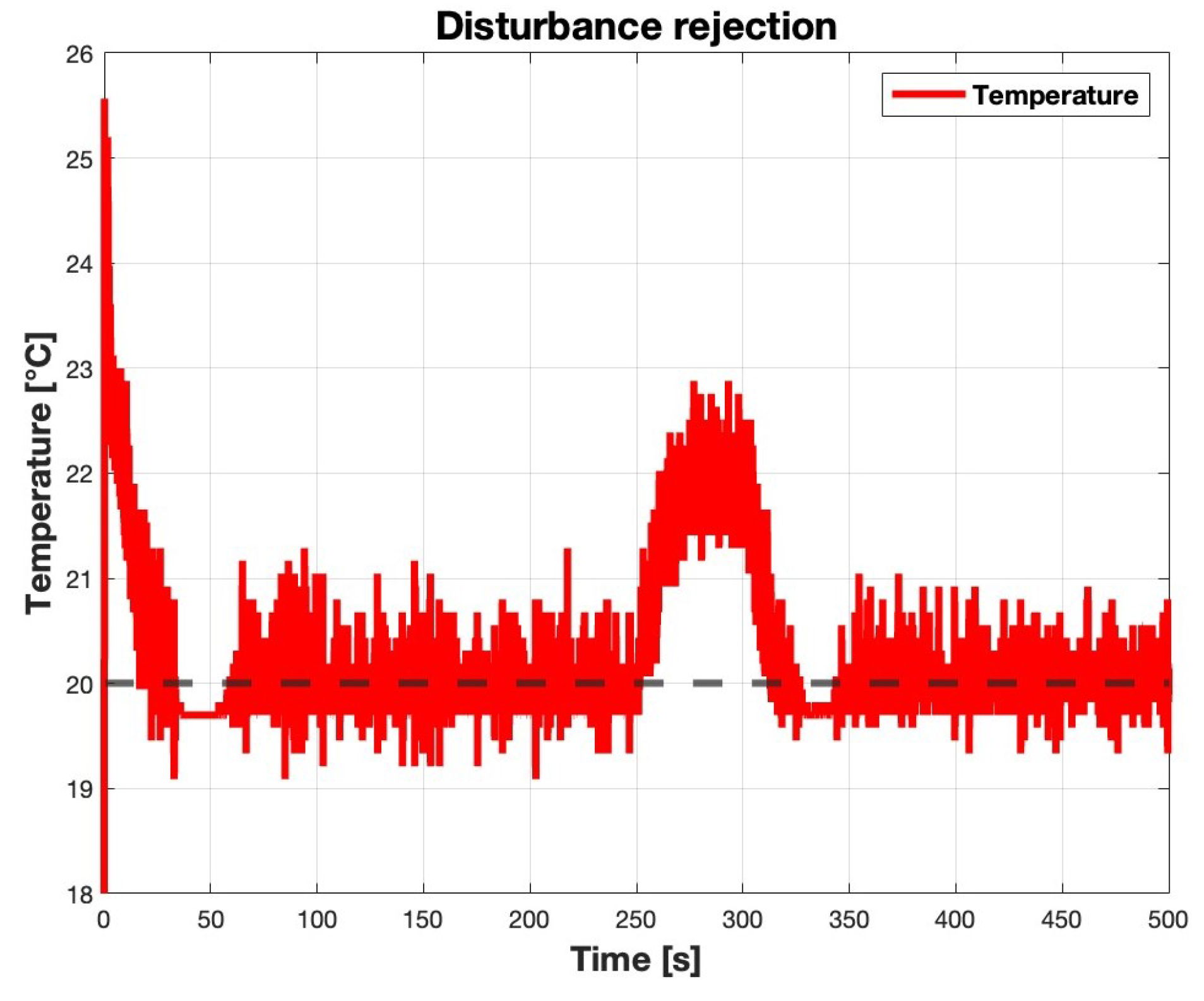
The experiment shows that the control law is effective in a real-life scenario and behaves very similarly to the simulation results. It is worth mentioning that the initial conditions cannot be the same for each experiment because they were conducted at different times of the day or even on different days; thus, room temperature is different, making each initial condition different. To make the experiment have the same initial condition each time would require equipment to accurately regulate room temperature, and the authors have no access to said equipment. Next, an experiment to test disturbance rejection is made in which a fan is used to raise the temperature of the TEM (
Figure 9):
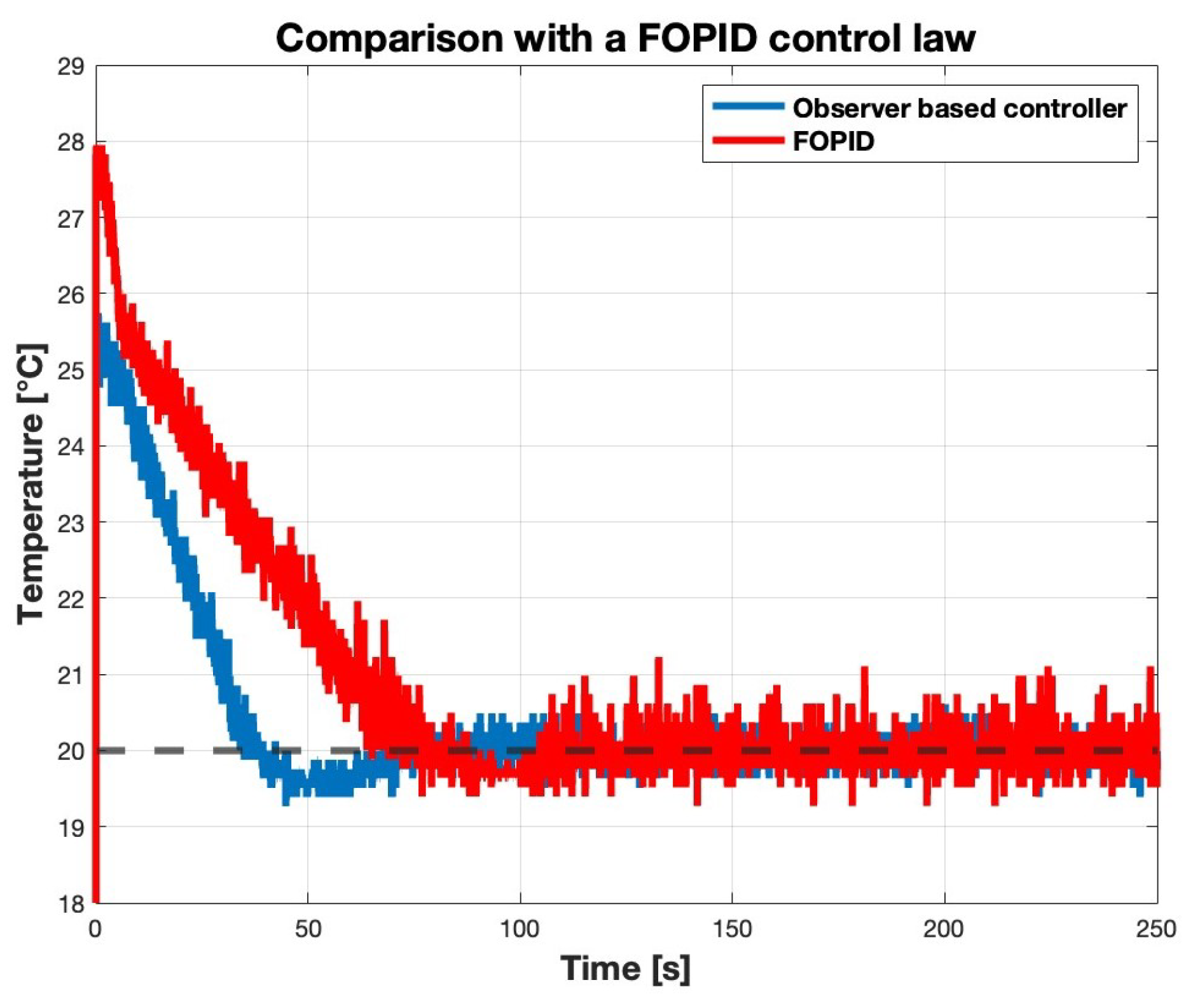
The controller effectively corrects the offset in temperature caused by the air stream, showing its capability to reject disturbances. Finally, it is compared to a FOPID controller similar to the one proposed on [
24], of which the desired temperature is 20 °C (
Figure 9 and
Figure 10):
The observer-based controller exhibits a notably shorter settling time when contrasted with the FOPID controller. Furthermore, the FOPID controller displays a minor steady-state error, caused by its tendency to overreact to the sluggish response of the thermal system when the temperature error becomes positive. Additionally, it is worth mentioning that the implementation of the FOPID controller poses an increased computational cost on the microcontroller. This arises from the distinct orders of the integral and derivative gains.
5. Conclusions
In this paper, a fractional-order, observer-based, sliding-mode control law is proposed to regulate a non-linear system with non-linear control inputs. The control law is validated through testing on a Thermoelectric Module powered via a buck converter, a system known for its non-linear control inputs. The simulation results validate that the control law can guide the system to a desired value. The uncertainty observer achieves its purpose of making an estimate of the desired part of the state and, consequently, this estimate can be used to mitigate the effects of the non-linear control input and give the system output the desired dynamic. The simulation results are corroborated via implementation in an experimental platform, which gives similar results.
As highlighted in the introduction, there is a scarcity of research focusing on TEM control utilizing diverse fractional-order control laws. In future work, the authors intend to expand on the applications for the temperature-based control of the TEM by employing consensus control to synchronize an array of thermoelectric modules for cooling applications. In this setting, it is also desirable to introduce optimal control techniques for lowering the power consumption and make the cooling system more cost effective; as it is widely known, TEM are not efficient cooling devices. This next work also intends on applying other definitions of the fractional-order derivative, such as Caputo–Fabrizio and Atangana–Baleanu.





 ,
,