


Abstract
In the paper, the authors find a sufficient and necessary condition for the power-exponential function to be a Bernstein function, derive closed-form formulas for the nth derivatives of the power-exponential functions and , and present a closed-form formula of the partial Bell polynomials for , where for are completely monotonic on .
Keywords:
Bernstein function; sufficient and necessary condition; power-exponential function; completely monotonic function; partial Bell polynomial; derivative; closed-form formula; Descartes’ rule of signs; zero of polynomial MSC:
Primary 44A10; Secondary 11B73; 11B83; 26A06; 26A09; 26A48; 26A51; 33B10
1. Motivations
Let be a finite or infinite interval. Recall from [1] (Chapter XIII) and [2] (Chapter IV) that a real-valued function defined on is said to be completely monotonic on I if and only if is valid for all and . The interval is called the completely monotonic interval of . A non-negative-valued function on an interval I is called (see the paper [3]) (Chapter 3) a Bernstein function if its first derivative is completely monotonic on I.
In the paper [4], the authors reviewed, discussed, and presented closed-form formulas for the nth derivative of the power-exponential function for . One of the main results in the paper [4] is Theorem 1, in which the formula
was established, where denotes the Stirling numbers of the first kind, which can be analytically generated [5] (p. 20, (1.30)) by
see also the monographs [6,7]. For more information on the nth derivative of the function , please refer to [8] (pp. 139–140, Example), [9] (p. 8), and the papers [10,11,12].
In this paper, for alternatively demonstrating that, if and only if , the function
is a Bernstein function on , see the papers [13,14,15,16], we will compute the nth derivative of the power-exponential function using several approaches.
Why do we consider the power-exponential function and determine the largest number such that is a Bernstein function on for ? What applications of this necessary and sufficient condition has? Ones can find explicit answers to these two questions in the papers [13,14,15,17,18] and closely related references therein.
Another reason why we will consider the function is that writing out the general formula for the nth derivatives of power-exponential functions, such as , , and is, although elementary, also difficult.
2. Preliminaries
In [19] (p. 412, Definition 11.2) and [8] (p. 134, Theorem A), the partial Bell polynomials in the variables of degree k are defined for by
In particular, the special values and for are useful. The famous Faà di Bruno formula can be described in terms of the partial Bell polynomials by
The partial Bell polynomials satisfy the identities
and
These three identities can be found in [19] (pp. 412, 420) and [8] (pp. 135–137).
In [20] (Theorem 1.1), the closed-form formula
for was presented. Since
for , Formula (7) is equivalent to
for . Formula (8) can be found in [8] (p. 136), while Formula (9) can be found in [20] (Theorem 1.1).
In [4] (Lemma 1), it was established that
for . In [8] (p. 135, Theorem B) and [20] (Theorem 1.1), we can find the identity
for , where is called the Lah numbers in combinatorial number theory (see [6,21] (pp. 43–44)).
A family of polynomials of degree is said to be of binomial type if it satisfies the binomial identity
Let
Then the family of polynomials of degree is of binomial type, that is,
and
These results can be found in [22,23] (p. 83).
3. A Sufficient and Necessary Condition
In this section, we discuss the nth derivative of the power-exponential function and present a sufficient and necessary condition for to be a Bernstein function on the infinite interval .
Theorem 1.
For and , the nth derivative of the power-exponential function can be computed using
where is an integer and the functions
are completely monotonic on .
Proof.
Let . Then direct computation gives
and
for , where we used the integral representation
in [24] (p. 230, 5.1.32) and the formula
in [24] (p. 255, Entry 6.1.1).
Remark 1.
It is clear that
Since the functions for are completely monotonic on , the product of finitely many completely monotonic functions is a completely monotonic function on the intersection of their completely monotonic intervals, considering definition (2), we conclude that the functions
are completely monotonic on .
Theorem 2.
For and , the derivatives of the power-exponential function satisfy the identity
In other words, the nth derivative for is of binomial type.
Proof.
Theorem 3.
There exists a positive constant such that, if and only if , the power-exponential function is a Bernstein function on .
Proof.
It is easy to see that for is positive on . Hence, to prove that is a Bernstein function on , it is sufficient to show
for . Therefore, it is sufficient to demonstrate
on for all and a part of .
Descartes’ rule of signs [25] (p. 22) states that:
- If the nonzero terms of a single-variable polynomial with real coefficients are ordered by descending variable exponent, then the number of positive zeros of the polynomial is either equal to the number of sign changes between consecutive (nonzero) coefficients or is less than it by an even number. A zero of multiplicity k is counted as k zeros.
- The number of negative zeros is the number of sign changes after multiplying the coefficients of odd-power terms by , or fewer than it by an even number.
Applying this rule to the polynomials
of the variable for and reveals that,
- when , the polynomial has no any zero;
- when , the polynomial has no any negative zero;
- when , the polynomial has at most n positive zeros or has positive zeros of an even number less than n, or has no positive zero.
For convenience, we denote the set of all positive zeros of the polynomial for by in . It is clear that in . Since
has a positive zero , the set in . Since
if for some positive integer n the set in , then the polynomial is positive for all , and then is valid for all ; if for some positive integer n the set in , then the polynomial is positive for those numbers , which are located on the open interval between 0 and the smallest element in in , and then is valid in for those numbers which locate on the open interval between 0 and the smallest element in in .
Denote
Then the union set in has at least one element. Accordingly, the number
is defined and significant. From the complete monotonicity of the function on and the positivity of in (19), we conclude that the number is positive. Consequently, if and only if , the inequalities are valid in for all integers , and the power-exponential function is a Bernstein function on . □
Remark 2.
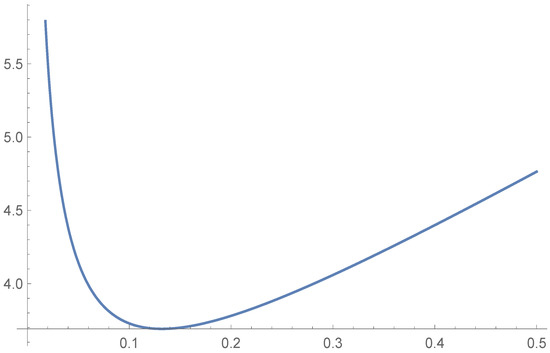
When , the inequality (17) is equivalent to
which can be rewritten as
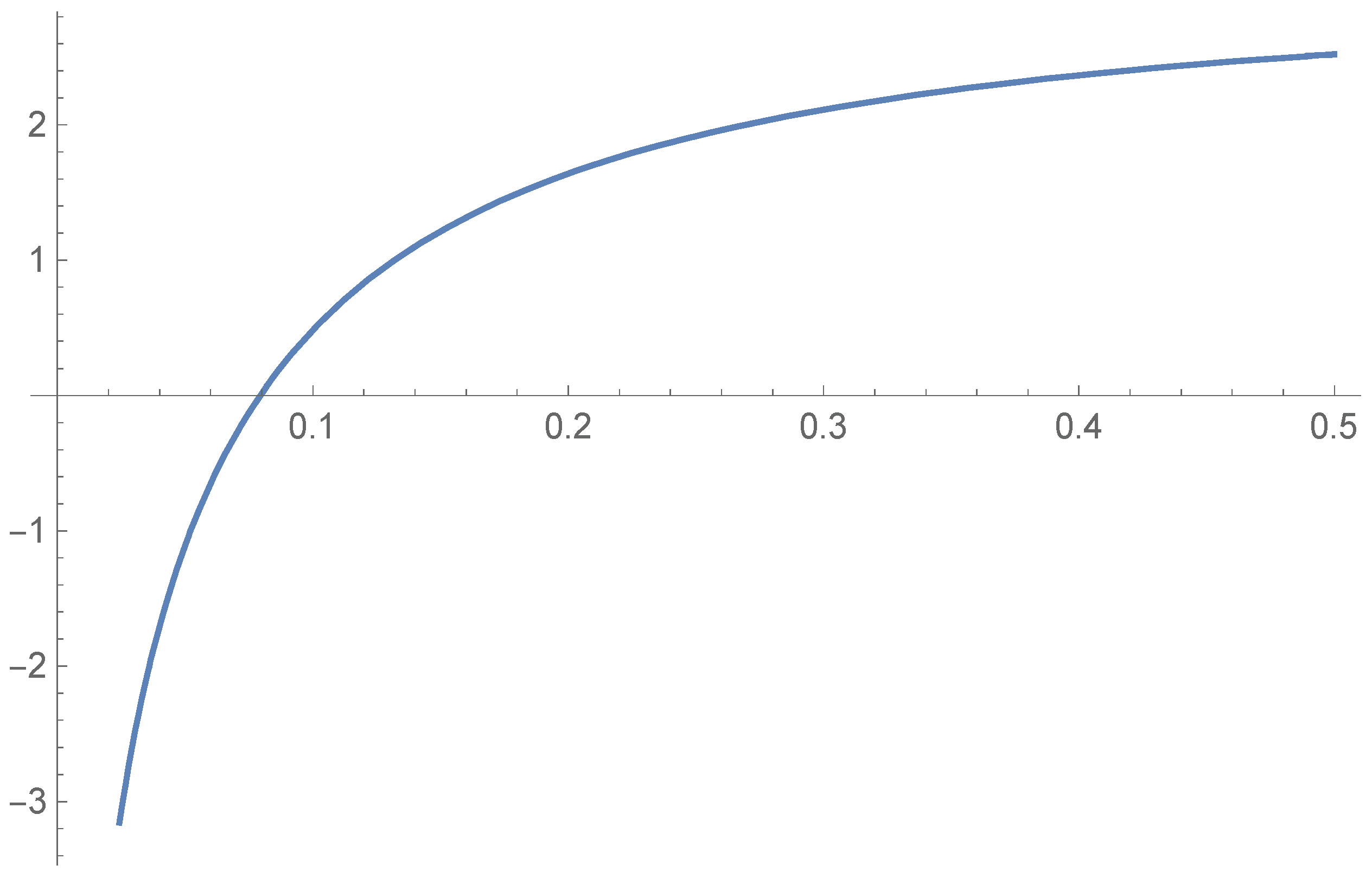
for . Using the softwareWolfram Mathematica 12, we can plot the graph of the function for . The graph is shown in Figure 1. This implies that
Figure 1.
The graph of the function for .
Remark 3.
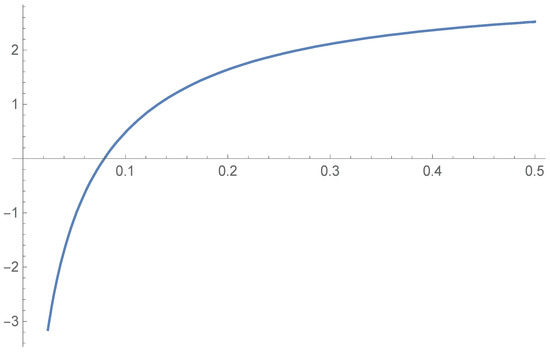
When , the inequality (17) can be rearranged as
whose discriminant is
The graph of , plotted using the softwareWolfram Mathematica 12, on the interval is shown in Figure 2. This means the function has a zero . When , the polynomial has no positive zero, that is, the positivity is valid for all and for ; when , the polynomial of the variable α has two positive zeros
Consequently, we take
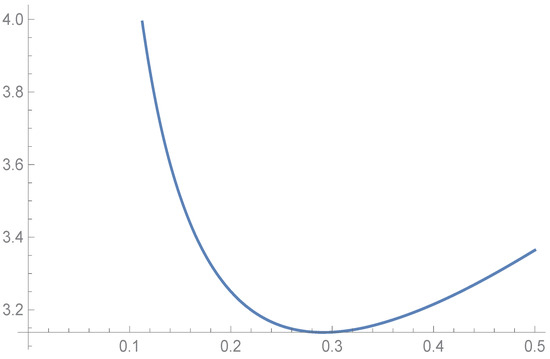
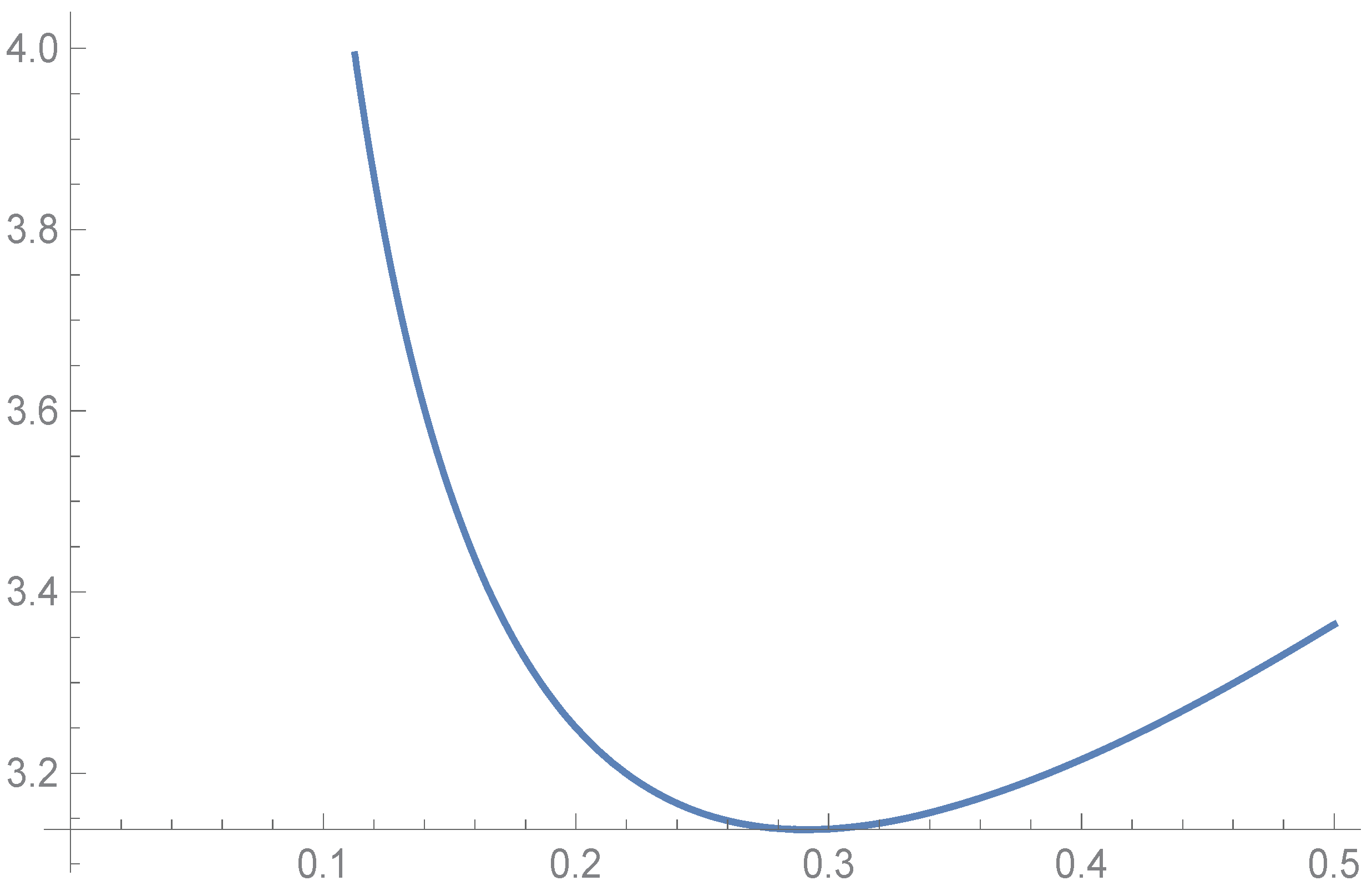
in . The graph of the function
plotted using the software Wolfram Mathematica 12, on the interval is shown in Figure 3. This implies that
Figure 2.
The graph of the function for .
Figure 3.
The graph of the function for .
Remark 4.
When , the inequality (17) can be concretely written as
for . This implies that the polynomial of the variable α has at least one positive zero; that is, the set in is not empty.
Remark 5.
For given , if in is not empty, then all the positive zeros of the polynomial are bounded using
In particular,
for , which coincides with the result in (20).
Remark 6.
In [16], it was established numerically that See also the paper [14].
4. A Closed-Form Formula of the nth Derivative of
In this section, we present an alternative formula for the nth derivative of the power-exponential function .
Theorem 4.
For , the nth derivative of the function for can be computed using
where denotes the Stirling numbers of the first kind and
stands for the falling factorial of the number .
Proof.
The function in (1) can be rewritten as
In [4] (Theorem 3), it was obtained that
Replacing with x in (22) yields
See also [8] (pp. 139–140, Example), [9] (p. 8), and the papers [10,11,12]. Therefore, making use of Formulas (22) and (23), we obtain
and
Consequently, we arrive at
The proof of Theorem 4 is, thus, complete. □
Remark 7.
Remark 8.
Remark 9.
Making use of the formula
listed in [8] (p. 133) yields
Taking
results in
This is an alternative possibility to derive a closed-form formula of partial Bell polynomials for and .
5. A Closed-Form Formula of
In this section, we present a closed-form and explicit formula of the partial Bell polynomials for .
Theorem 5.
For and , we have
where
6. A Closed-Form Formula of the nth Derivative of
Combining Formula (26) in Theorem 5 with Formula (13) in Theorem 1, we can easily deduce an alternative closed-form and explicit formula of the power-exponential function .
Corollary 1.
For and , the nth derivative of the power-exponential function can be computed using
where is an integer and is defined using (27).
Finally, we derive a closed-form formula of the nth derivative of for , , and .
Theorem 6.
7. Conclusions
In this paper, via Formula (13) for the nth derivative of the power-exponential function , we discovered the relation (16) for the nth derivative of the power-exponential function , found a sufficient and necessary condition in Theorem 3 for the power-exponential function to be a Bernstein function, and derived a closed-form formula (21) for the nth derivative of the power-exponential function .
Author Contributions
Writing—original draft, J.C., B.-N.G., W.-S.D. and F.Q.; writing—review and editing, J.C., B.-N.G., W.-S.D. and F.Q. All authors have read and agreed to the published version of the manuscript.
Funding
Jian Cao was partially supported by the Zhejiang Provincial Natural Science Foundation of China (Grant No. LY21A010019). Wei-Shih Du was partially supported by the National Science and Technology Council of the Republic of China (Grant No. MOST 111-2115-M-017-002).
Data Availability Statement
Data sharing does not apply to this article as no new data were created or analyzed in this study.
Acknowledgments
The authors express their hearty thanks to the anonymous referees for their valuable suggestions and helpful comments on the original version of this paper.
Conflicts of Interest
The authors declare no conflict of interest.
References
- Mitrinović, D.S.; Pečarić, J.E.; Fink, A.M. Classical and New Inequalities in Analysis; Kluwer Academic Publishers: Dordrecht, The Netherlands; Boston, MA, USA; London, UK, 1993. [Google Scholar] [CrossRef]
- Widder, D.V. The Laplace Transform; Princeton University Press: Princeton, NJ, USA, 1946. [Google Scholar]
- Schilling, R.L.; Song, R.; Vondraček, Z. Bernstein Functions, 2nd ed.; De Gruyter Studies in Mathematics 37; Walter de Gruyter: Berlin, Germany, 2012. [Google Scholar] [CrossRef]
- Cao, J.; Qi, F.; Du, W.-S. Closed-form formulas for the nth derivative of the power-exponential function xx. Symmetry 2023, 15, 323. [Google Scholar] [CrossRef]
- Temme, N.M. Special Functions: An Introduction to Classical Functions of Mathematical Physics; A Wiley-Interscience Publication; John Wiley & Sons, Inc.: New York, NY, USA, 1996. [Google Scholar] [CrossRef]
- Mansour, T.; Schork, M. Commutation Relations, Normal Ordering, and Stirling Numbers; Discrete Mathematics and its Applications; CRC Press: Boca Raton, FL, USA, 2016. [Google Scholar]
- Quaintance, J.; Gould, H.W. Combinatorial Identities for Stirling Numbers; The Unpublished Notes of H. W. Gould, with a Foreword by George E. Andrews; World Scientific Publishing Co. Pte. Ltd.: Singapore, 2016. [Google Scholar]
- Comtet, L. Advanced Combinatorics: The Art of Finite and Infinite Expansions; Revised and Enlarged Edition; D. Reidel Publishing Co.: Dordrecht, The Netherlands, 1974. [Google Scholar] [CrossRef]
- Kruchinin, V. Derivation of Bell polynomials of the second kind. arXiv 2011. [Google Scholar]
- Kulkarni, S.B. Solution to Problem 3977. Sch. Sci. Math. 1984, 84, 629–630. [Google Scholar] [CrossRef]
- Lehmer, D.H. Numbers associated with Stirling numbers and xx. Rocky Mt. J. Math. 1985, 15, 461–479. [Google Scholar] [CrossRef]
- Renfro, D.L. Derivatives of generalized power functions. Math. Teach. 2010, 103, 630–631. Available online: https://www.jstor.org/stable/20876724 (accessed on 13 March 2023).
- Berg, C. Problem 1. Bernstein functions. J. Comput. Appl. Math. 2005, 178, 525–526. [Google Scholar] [CrossRef]
- Berg, C.; Massa, E.; Peron, A.P. A family of entire functions connecting the Bessel function J1 and the Lambert W function. Constr. Approx. 2021, 53, 121–154. [Google Scholar] [CrossRef]
- Qi, F.; Wan, A. A closed-form expression of a remarkable sequence of polynomials originating from a family of entire functions connecting the Bessel and Lambert functions. São Paulo J. Math. Sci. 2022, 16, 1238–1248. [Google Scholar] [CrossRef]
- Shemyakova, E.; Khashin, S.I.; Jeffrey, D.J. A conjecture concerning a completely monotonic function. Comput. Math. Appl. 2010, 60, 1360–1363. [Google Scholar] [CrossRef]
- Alzer, H.; Berg, C. Some classes of completely monotonic functions. Ann. Acad. Sci. Fenn. Math. 2002, 27, 445–460. [Google Scholar] [CrossRef]
- Guo, B.-N.; Qi, F. A property of logarithmically absolutely monotonic functions and the logarithmically complete monotonicity of a power-exponential function. Politehn. Univ. Bucharest Sci. Bull. Ser. A Appl. Math. Phys. 2010, 72, 21–30. [Google Scholar]
- Charalambides, C.A. Enumerative Combinatorics; CRC Press Series on Discrete Mathematics and its Applications; Chapman & Hall/CRC: Boca Raton, FL, USA, 2002. [Google Scholar]
- Qi, F. Diagonal recurrence relations for the Stirling numbers of the first kind. Contrib. Discrete Math. 2016, 11, 22–30. [Google Scholar] [CrossRef]
- Riordan, J. An Introduction to Combinatorial Analysis; Reprint of the 1958 Original; J Wiley & Sons Ltd.; Dover Publications, Inc.: Mineola, NY, USA, 2002. [Google Scholar]
- Mihoubi, M. Bell polynomials and binomial type sequences. Discrete Math. 2008, 308, 2450–2459. [Google Scholar] [CrossRef]
- Roman, S. An Introduction to Catalan Numbers; Compact Textbook in Mathematics; Springer: Cham, Switzerland, 2015. [Google Scholar] [CrossRef]
- Abramowitz, M.; Stegun, I.A. (Eds.) Handbook of Mathematical Functions with Formulas, Graphs, and Mathematical Tables; National Bureau of Standards, Applied Mathematics Series 55; Reprint of the 1972 ed.; Dover Publications, Inc.: New York, NY, USA, 1992. [Google Scholar]
- Olver, F.W.J.; Lozier, D.W.; Boisvert, R.F.; Clark, C.W. (Eds.). NIST Handbook of Mathematical Functions; Cambridge University Press: New York, NY, USA, 2010. [Google Scholar]
Disclaimer/Publisher’s Note: The statements, opinions and data contained in all publications are solely those of the individual author(s) and contributor(s) and not of MDPI and/or the editor(s). MDPI and/or the editor(s) disclaim responsibility for any injury to people or property resulting from any ideas, methods, instructions or products referred to in the content. |
© 2023 by the authors. Licensee MDPI, Basel, Switzerland. This article is an open access article distributed under the terms and conditions of the Creative Commons Attribution (CC BY) license (https://creativecommons.org/licenses/by/4.0/).