


Abstract
In this paper, we provide sufficient conditions for the existence, uniqueness and global behavior of a positive continuous solution to some nonlinear Riemann-Liouville fractional boundary value problems. The nonlinearity is allowed to be singular at the boundary. The proofs are based on perturbation techniques after reducing the considered problem to the equivalent Fredholm integral equation of the second kind. Some examples are given to illustrate our main results.
MSC:
34B16; 34B18; 34B27
1. Introduction
Nonlinear fractional differential equations have been of great interest for the past three decades. This is due to the intensive development of the theory of fractional calculus and its applications. Apart from diverse areas of pure mathematics, fractional differential equations can be used in the modeling of various fields of science and engineering, including wave and fluid dynamics, mathematical biology, financial systems, structural dynamics, artificial intelligence, etc. (see, for instance [1,2,3,4,5,6] and references therein). A significant characteristic of a fractional order differential operator which distinguishes it from the integer-order differential operator is that it is nonlocal in nature, that is, the future state of a dynamical system or process involving fractional derivative depends on its current state as well as its past states. Therefore, fractional models have become relevant when dealing with phenomena with memory effects instead of relying on ordinary or partial differential equations. The study of fractional differential equations has received a great amount of attention from researchers.
In [7], the authors considered the fractional differential problem:
where a and is the Riemann-Liouville differential operator of order defined by (see, for example [2,4,5]),
where for ,
They have proved that, when g satisfies certain growth conditions, problem (1) has at least three positive solutions. The proof is based on the well-known fixed point theorem.
By some fixed-point techniques, the authors [8] established some existence results of positive solutions for:
where and is continuous satisfying some adequate conditions.
In [9], Cui et al obtained a new uniqueness result for the problem:
where and is satisfying some convenient Lipschitz conditions. They have used some fixed-point theorems.
In [10], the authors consider the second-order noncanonical advanced differential equation
where with (i.e., noncanonical form) and for all
By transforming the noncanonical differential Equation (4) to an equivalent one in canonical form and applying some known results to the obtained equation in canonical form, the authors established oscillation for the Equation (4) in noncanonical form.
In [11], by using a perturbation argument, some existence results are established for:
where and with and g satisfying:
- (P1)
- .
- (P2)
- There exists a function satisfying some integrable conditions such that for each is nondecreasing onwhere for
- (P3)
- For each is nondecreasing on
For further related results, we refer the reader to [12,13,14,15,16,17,18,19,20,21] and the references therein.
Motivated by the approach used in [11], we consider the problem:
where and which could be singular at both and and satisfying some adequate conditions regarding to the class (see, (7) below). Using a perturbation approach, we establish that problem (6) has a unique positive continuous solution and we describe its global behavior.
Notations:
- (i)
- (ii)
- .
- (iii)
- with
- (iv)
- For
- (v)
- For ,where for is the Green’s function of the operator withNote that (see, Proposition 4) if then .
- (vi)
- For and we letbe the unique solution ofObserve that for all
To study problem (6), for a given and we assume that satisfies:
- (C1)
- with for all .
- (C2)
- There exists with such that, for each is nondecreasing on .
- (C3)
- For each , whenever
Remark 1.
Conditions (C1)–(C3) are verified in the particular case where λ is a small positive parameter and is a nondecreasing function with satisfying: there exists a constant such that
Indeed, in this case (C1), (C3) are obviously verified and (C2) holds with and
As examples of such function we quote:
with (the superlinear case).
with
Remark 2.
It is important to observe that conditions of the form (C1)–(C3) are weaker then conditions of the form (P1)–(P3) adopted in [11].
We establish the following main result.
Theorem 1.
Let (C1)–(C3) hold. Then problem (6) possess a unique solution with the following global behavior
Corollary 1.
Let be a nondecreasing function with and There exist such that for , the problem
possess a unique solution with
where
In Section 2, some interesting inequalities on are provided. In Section 3, we first show that if satisfying then the following fractional boundary value problem:
has a nonnegative solution provided that That is problem (15) admits a nonnegative Green’s function Next, we establish some pertinent properties on which allow us to prove our main results.
2. Background Materials and Preliminaries
Lemma 1
([2,4,5]). Let and . We have
For and .
if and only if where .
In the next Lemma, we recall the expression of
Lemma 2
([7]). Let and then the unique solution of
is given by
where for
with .
To obtain an immediate idea of the global behavior of in Figure 1, we have obtained its representation with the contours and some projections for . In particular, one can see from figure that is singular at
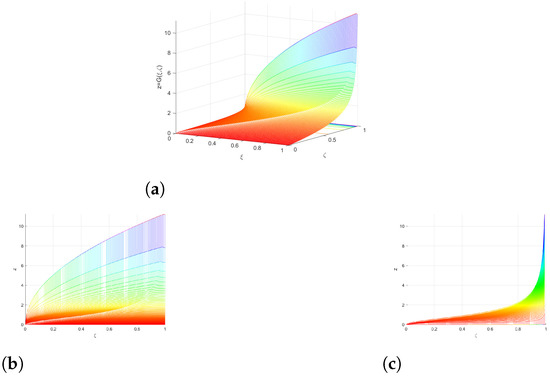
Figure 1.
for . (a) and contours. (b) Projection on z. (c) Projection on z.
Proposition 1.
Let be fixed. Then
- (i)
- Forwhere .
- (ii)
- For
Proof.
- (i)
- From (18), for we haveUsing this fact and that for andwe deduce the required result with and .
- (ii)
- The results follows from the previous estimates and the fact that
□
For we let
The next Corollary follows immediately from (18) and Proposition 1 (ii).
Corollary 2.
Let with Then belongs to
The next Proposition is important in the rest of the paper. It improves Lemma 2.
Proposition 2.
Let and f Assume that the function belongs to , then is the unique solution in of (16).
Proof.
Since by Corollary 2, belongs to then becomes finite on Hence
with .
By simple computation, we obtain
Thus
Differentiate twice (24), we obtain
Hence, we deduce by the Lebesgue dominated convergence theorem, that .
Finally, by Lemma 1, we obtain the uniqueness. □
Proposition 3.
For each
Proof.
Due to Proposition 1 (i), for each ,
Hence, we obtain inequality (25) by observing that
□
Proposition 4.
Let and then
- (i)
- (ii)
- where V is given in (23).
3. Proofs of the Existence Results
3.1. Properties of
Our first goal is to show that if satisfying the operator subjected to admits a nonnegative Green’s function . Next, we will study properties of the kernel defined by
This will allow us to prove our main results.
For and set and
Define on by
Lemma 3.
Consider with . For all and
- (i)
- Hence, is well defined in
- (ii)
- whereand
- (iii)
- (iv)
Proof.
Inequality (32) holds by induction and Proposition 1 (ii).
- (iii)
- The assertion is valid for . Assume thatTherefore, by using (29) and Fubini-Tonelli’s theorem, we deduce that
- (iv)
- Let and From part (i), we getSo, the series converges.Hence, we deduce by the dominated convergence theorem and Lemma 3 (iii), that□
Proposition 5.
Let with The function is in .
Proof.
Let be fixed. We claim that the function
To this end, we need first to prove that the function for all .
We proceed by induction. It is clear that
Assume that for some
Hence from (29), (34) and the dominated convergence theorem, we conclude that the function belongs to
On the other hand, since for all
the series becomes uniformly convergent on
Hence, is continuous on □
Lemma 4.
Consider with Then
In particular,
Proof.
From Lemma 3 (i), we obtain
Namely,
From (36) and Lemma 3 (i), we derive that
Therefore, by (38),
Corollary 3.
Consider with Let satisfying Then
where is given in (28).
Proof.
Let be fixed. Since the function and by Lemma 4 and Proposition 1
we deduce by the dominated convergence theorem that is a continuous function on □
Lemma 5.
Consider with Let then the following resolvent equation hold:
Furthermore, if , then and we have
where and are the operators defined on by
and
Proof.
Let then by (38),
Therefore
Hence by Lemma 3 (iv), we obtain
Namely,
from which, we obtain
Furthermore, if , then from (39), we deduce that and
Similarly, we obtain
□
Proposition 6.
Let belonging to such that For any such that the function is the unique nonnegative continuous solution to problem (15) satisfying
Proof.
From Corollary 3, it is clear that the function is in
By using (39) and Proposition 1 (iii), there exists such that
This implies that
Due to Proposition 2, the function belongs to and verify
That is is a solution to problem (15).
Next, to establish the uniqueness, we consider be another solution to problem (15) satisfying
Therefore, by Proposition 2, satisfies
So
from which, we deduce that
where and
Since , we conclude by Proposition 1 (ii) that
Hence, from (40), we obtain that □
3.2. Proofs of the Existence of Solutions
Proof of Theorem 1.
Let be fixed and set By (C2), there exists a function with such that, for each
In particular, from (C1), we obtain
Let
Since, for all we deduce from (46), that
Define the operator T on by
That is
From (45), we derive that T is a nondecreasing operator on
Let defined by and for
Since and T is nondecreasing, we obtain
Hence by the dominated convergence theorem and (C1)–(C2), the sequence converges to a function satisfying
So
This implies that
Hence, by Corollary 2, belongs to and from (53), becomes in .
Remark 3.
Assume that (C1)–(C2) hold. Let Λ be the nonempty, closed, bounded and convex set given by
where is as in the proof of Theorem 1. Define the operator T on Λ by (48), then T is a compact operator mapping Λ to itself.
Indeed, following the proof of Theorem 1, one can see that the family is equicontinuous in In particular, for all and Moreover, the family is uniformly bounded in It follows by Ascoli’s theorem that is relatively compact in To prove the continuity of T in we consider a sequence in Λ which converges uniformly to a function Then from (35) we have
Now from (47), we have
So we deduce from (C1)–(C2), (20) and the dominated convergence theorem that
Since is relatively compact in we have the uniform convergence, namely
Proof of Corollary 1.
Let with and as in Corollary 1.
Assumptions (C1) and (C3) are trivially satisfied.
Let and set Then, for hypotheses (C2) is satisfied with
Hence by applying Theorem 1, we deduce the result. □
Example 1.
Let and be fixed. Let and Put where is the Beta function.
Then for the singular problem
possess a unique solution satisfying
where
Indeed, we may apply Corollary 1 with (which could be singular at both and ) and
In this case, we have and from (25), we obtain Therefore,
Example 2.
Let and . Consider and put where
Then for the problem
possess a unique solution satisfying
Indeed, we may again apply Corollary 1 with and
In this case, we have and from (25), we obtain Therefore,
4. Conclusions
Under mild assumptions, the existence and uniqueness of a positive continuous solution to the nonlinear fractional boundary value problem (6) has been studied. Sharp estimates on the solution are obtained. The proofs are based on perturbation techniques, which consist, for a convenient function , at the construction of the Green’s function of the operator subject to the boundary condition . This allows us to prove the resolvent Equation (39) which plays an important role for the existence. It will be interesting to investigate, by using this approach, fractional boundary value problems for higher dimensions.
Author Contributions
Investigation, E.A.; supervision, I.B. All authors have read and agreed to the published version of the manuscript.
Funding
The author Imed Bachar would like to extend their sincere appreciation to the Deanship of Scientific Research at King Saud University for its funding this Research group NO (RG-1435-043).
Institutional Review Board Statement
Not applicable.
Informed Consent Statement
Not applicable.
Data Availability Statement
Not applicable.
Acknowledgments
The authors would like to thank the anonymous referees for their careful reading of the paper and useful suggestions.
Conflicts of Interest
The authors declare no conflict of interest.
References
- Hilfer, R. Applications of Fractional Calculus in Physics; World Scientific: Singapore, 2000. [Google Scholar]
- Kilbas, A.; Srivastava, H.; Trujillo, J. Theory and Applications of Fractional Differential Equations. In North-Holland Mathematics Sudies; Elsevier: Amsterdam, The Netherlands, 2006; Volume 204. [Google Scholar]
- Miller, K.; Ross, B. An introduction to the Fractional Calculus and Fractional Differential Equations; Wiley: New York, NY, USA, 1993. [Google Scholar]
- Podlubny, I. Fractional Differential Equations. In Mathematics in Sciences and Engineering; Academic Press: San Diego, CA, USA, 1999; Volume 198. [Google Scholar]
- Samko, S.; Kilbas, A.; Marichev, O. Fractional Integrals and Derivative; Theory and applications; Gordon and Breach: Yverdon, Switzerland, 1993. [Google Scholar]
- Tarasov, V. Fractional Dynamics: Applications of Fractional Calculus to Dynamics of Particles, Fields and Media; Springer: New York, NY, USA, 2011. [Google Scholar]
- Kaufmann, E.R.; Mboumi, E. Positive solutions of a boundary value problem for a nonlinear fractional differential equation. Electron. J. Qual. Theory Differ. Equ. 2008, 3, 1–11. [Google Scholar] [CrossRef]
- Bai, Z.; Lü, H. Positive solutions for boundary value problem of nonlinear fractional differential equation. J. Math. Anal. Appl. 2005, 311, 495–505. [Google Scholar] [CrossRef]
- Cui, Y.; Ma, W.; Sun, Q.; Su, X. New uniqueness results for boundary value problem of fractional differential equation. Nonlinear Anal. Model. Control. 2018, 23, 31–39. [Google Scholar] [CrossRef]
- Bohner, M.; Vidhyaa, K.S.; Thandapani, E. Oscillation of NoncanonicalSecond-order Advanced Differential Equations via Canonical Transform. Constr. Math. Anal. 2022, 5, 7–13. [Google Scholar]
- Bachar, I.; Mâagli, H. Positive solutions for superlinear fractional boundary value problems. Adv. Differ. Equ. 2014, 2014, 1–16. [Google Scholar] [CrossRef]
- Agarwal, R.P.; O’Regan, D.; Stanĕk, S. Positive solutions for Dirichlet problems of singular nonlinear fractional differential equations. J. Math. Anal. Appl. 2010, 371, 57–68. [Google Scholar] [CrossRef]
- Bilgici, S.S.; San, M. Existence and uniqueness results for a nonlinear singular fractional differential equation of order σ∈(1,2). AIMS Math. 2021, 6, 13041–13056. [Google Scholar] [CrossRef]
- Caballero Mena, J.; Harjani, J.; Sadarangani, K. Existence and uniqueness of positive and nondecreasing solutions for a class of singular fractional boundary value problems. Bound. Value Probl. 2009, 421310. [Google Scholar] [CrossRef]
- Liang, S.; Zhang, J. Positive solutions for boundary value problems of nonlinear fractional differential equation. Nonlinear Anal. 2009, 71, 5545–5550. [Google Scholar] [CrossRef]
- Mâagli, H.; Mhadhebi, N.; Zeddini, N. Existence and Estimates of Positive Solutions for Some Singular Fractional Boundary Value Problems. Abstr. Appl. Anal. 2014, 2014, 120781. [Google Scholar] [CrossRef]
- Senasukh, J.; Saejung, S. A Note on the Stability of Some Functional Equations on Certain Groupoids. Constr. Math. Anal. 2020, 3, 96–103. [Google Scholar] [CrossRef]
- Thakur, A.; Ali, J.; Rodríguez-López, R. Existence of Solutions to a Class of Nonlinear Arbitrary Order Differential Equations Subject to Integral Boundary Conditions. Fractal Fract. 2021, 5, 220. [Google Scholar] [CrossRef]
- Xiangkui, Z.; Chengwen, C.; Weigao, G. Existence and nonexistence results for a class of fractional boundary value problems. J. Appl. Math Comput. 2013, 41, 17–31. [Google Scholar]
- Zhai, C.; Yan, W.; Yang, C. A sum operator method for the existence and uniqueness of positive solutions to Riemann-Liouville fractional differential equation boundary value problems. Commun. Nonlinear Sci. Numer. Simul. 2013, 18, 858–866. [Google Scholar] [CrossRef]
- Zhao, Y.; Sun, S.; Ha, Z.; Li, Q. The existence of multiple positive solutions for boundary value problems of nonlinear fractional differential equations. Commun. Nonlinear Sci. Numer. Simul. 2011, 16, 2086–2097. [Google Scholar] [CrossRef]
Disclaimer/Publisher’s Note: The statements, opinions and data contained in all publications are solely those of the individual author(s) and contributor(s) and not of MDPI and/or the editor(s). MDPI and/or the editor(s) disclaim responsibility for any injury to people or property resulting from any ideas, methods, instructions or products referred to in the content. |
© 2023 by the authors. Licensee MDPI, Basel, Switzerland. This article is an open access article distributed under the terms and conditions of the Creative Commons Attribution (CC BY) license (https://creativecommons.org/licenses/by/4.0/).