Abstract
In this paper, we consider constructions of first derivative approximations using the generating function. The weights of the approximations contain the powers of a parameter whose modulus is less than one. The values of the initial weights are determined, and the convergence and order of the approximations are proved. The paper discusses applications of approximations of the first derivative for the numerical solution of ordinary and partial differential equations and proposes an algorithm for fast computation of the numerical solution. Proofs of the convergence and accuracy of the numerical solutions are presented and the performance of the numerical methods considered is compared with the Euler method. The main goal of constructing approximations for integer-order derivatives of this type is their application in deriving high-order approximations for fractional derivatives, whose weights have specific properties. The paper proposes the construction of an approximation for the fractional derivative and its application for numerically solving fractional differential equations. The theoretical results for the accuracy and order of the numerical methods are confirmed by the experimental results presented in the paper.
1. Introduction
The fractional derivatives are a generalization of the integer-order derivatives and provide powerful tools for analyzing functions and systems. Many of the methods for studying integer-order derivatives also apply to fractional derivatives. The Caputo fractional derivative of order , where , is defined as
Fractional calculus is an active research area and has been used to describe phenomena that cannot be adequately explained by integer-order derivatives. Fractional differential equations have found applications in various fields, including physics, engineering, chemistry and biology [1,2,3,4,5,6]. Numerical methods are used to analyze models that involve fractional differential equations. The finite difference schemes for solving numerically fractional differential equations use approximations of the fractional derivative. Consider the interval and a uniform grid with a step size of , where N is a positive integer. Denote and . The approximations of fractional derivative have the form , where are the weights of the approximation and . The generating function of an approximation of the fractional derivative is defined as . Two important approximations of the fractional derivative are the Grünwald difference approximation and the L1 approximation. The Grünwald difference approximation of the fractional derivative of order has a first-order accuracy and a generating function . The Grünwald approximation is a second-order shifted approximation of the fractional derivative with a shift parameter . L1 approximation has an order and a generating function . Their weights satisfy
The properties of the weights of an approximation of the fractional derivative (1) allow for an effective analysis of the convergence of numerical schemes for fractional differential equations [7,8,9,10]. The construction of approximations for the fractional derivative and schemes for numerically solving fractional differential equations is an area of ongoing research. Second-order approximations of the fractional derivative are constructed by Arshad et al. [11], Nasir and Nafa [12]. Approximations of order are constructed by Alikhanov [13], Gao et al. [14], Xing and Yan [15]. High-order approximations and numerical schemes for fractional differential equations are studied in [16,17,18,19,20]. Implicit ADI schemes for fractional differential equations are constructed by Nasrollahzadeh and Hosseini [21], Wang et al. [22]. Denote . In [23], we obtain an approximation of the fractional derivative and its asymptotic formula
where
Approximation (2) has an order and a generating function . The main class of approximations of integer-order derivatives is the finite-difference approximations, which have first-order accuracy and second order at the midpoint. Finite-difference approximations are local numerical differentiation methods and are a special case of the Grünwald difference approximation, where the order is an integer. Methods for global numerical differentiation are studied in [24,25]. The methods for constructing approximations of fractional derivatives using a generating function also apply to the construction of integer-order derivative approximations. In [26,27], we construct approximations of the first and second derivatives whose generating functions are transformations of the exponential and logarithmic functions. In [26,28], we construct second-order approximations of the fractional derivative using the asymptotic formula of the L1 approximation and second derivative approximations. In this paper, we apply the method from [26,27] for constructing an approximation of the first derivative and its second-order asymptotic formula
where the coefficient has a value . Approximation (3) has a generating function and is a global approximation of the first derivative. The structure of the paper is as follows. In Section 2, we construct approximation (3) and the following first-order approximation:
The weights of approximations (3) and (4) satisfy conditions (1). We consider the application of these approximations for numerically solving an ordinary differential equation and propose an algorithm that computes the numerical solutions using arithmetic operations. The computational time and accuracy of the numerical methods are compared with Euler’s method. In Section 3, we derive estimates for the errors of approximations (3) and (4) and the corresponding numerical solutions. In Section 4, we construct numerical solutions for first-order ODEs which use approximation (3) of the first derivative. We determine the values of the parameter a such that the numerical methods achieve an arbitrary order of accuracy in the interval . In Section 5, we construct a finite difference scheme for the heat diffusion equation which uses approximation (3) for the first partial derivative. The stability and convergence of the scheme are analyzed. In Section 6, we consider an application of approximation (3) for constructing an approximation of the Caputo fractional derivative. By applying approximation (3) with the parameter value to the first derivative in the asymptotic Formula (2), we obtain the following approximation of a fractional derivative of order .
where
We prove that the weights of approximation (5) satisfy properties (1). The numerical experiments presented in the paper validate the theoretical results on the accuracy and error of the numerical methods. The main contributions of the paper are the constructions of approximations (3) and (5). The examples in the paper demonstrate that these approximations can be used to construct efficient methods for the numerical solution of differential and fractional differential equations. The method for deriving an approximation (3) can be used to derive approximations of the second derivative and higher-order derivatives [26]. A question for future work is to apply these approximations to the construction of high-order approximations of the fractional derivative that have properties (1) of the weights.
2. Asymptotic Formula
In this section, we use the method from [26,27] to construct an approximation for the first derivative and its asymptotic formula by specifying the generating function of the approximation. Let
where . The generating function has properties . Denote
The functions and have Maclaurin series
Consider a uniform grid on the interval with step size of where N is a positive integer and let . From (6) and (7), we obtain
where the function and satisfies the condition . Now, we extend asymptotic Formula (8) to all functions in the class . Let
where satisfies the condition .
The coefficient has a value and
Asymptotic Formula (9) holds for all functions . When the parameter a is zero, is a first-order backward difference approximation of the first derivative. We will consider an application of Formula (9) for the numerical solution of an ordinary differential equation and compare the performance of the method with the Euler method.
Example 1.
Consider the following first-order ordinary differential equation
By approximating the first derivative at the point using a first-order backward difference approximation, we obtain
The numerical solution of Equation (10) satisfies and
The value of is computed with one addition and one multiplication, assuming that the values of the function F at the nodes of the grid are known. The total number of arithmetic operations of the Euler method is . Note that in many cases, the computational time required to evaluate the values of exceeds the time needed to compute the numerical solution (11). Now, we construct the numerical solution of Equation (10), which uses asymptotic Formula (9). By substituting with , we find
The numerical solution obtained from (12) by truncating the error term satisfies
The sequence has initial conditions and satisfies
Numerical solution (11) is a special case of (13) when the parameter a is zero, . Direct computation of numerical solution (13) using the above formula requires operations. The weights of consist of powers of the parameter a, which allows us to compute (13) with operations. The sequence satisfies
where
The sequence satisfies
Both sequences and are computed with operations. The pseudocode for calculating the numerical solution (13) is given below.
The algorithm uses four operations in Step 1 and five operations for calculating each value of the sequence for in Step 2. The total number of operations for computation of the numerical solution (13) is . Consider the ordinary differential equation
where . The numerical results for the error and order of numerical solutions (11) and (13) of Equation (14) are given in Table 1. The abbreviation NS for numerical solution is used. The calculation of the numerical solutions was performed using Mathematica 13 software. Although Formula (9) holds asymptotically, the experimental results in Table 1 suggest that numerical method (11) has first-order accuracy. This fact is proven in the next section. The time for computation of the values of is greater than the computational time of the numerical solutions. We observed a small difference in the computational time of the numerical solutions in Table 1, which is a fraction of a second. The finite geometric series satisfies
By differentiating (15) twice, we find
Now, we construct an approximation of the first derivative in the form
which satisfies the conditions and . The values of the coefficients and are determined from the two conditions.
The numbers and satisfy
Using Formulas (15) and (16), we obtain
Then,
From (18) and (19), we find
Approximation has the form
and holds for every value of n, where . Now, we construct the numerical solution of Equation (10), which uses approximation for the first derivative. By replacing the first derivative with , we obtain
Numerical solution (21) has initial conditions . The algorithm and pseudocode for computing the numerical solution (21) are given below:
where
The sequence satisfies
The sequences and are calculated in time with the following pseudocode.
The algorithm uses ten operations in Step 1 and five operations for calculating each value of the sequence in Step 2 for . The total number of operations for calculating numerical solution (21) is .
From (8), approximation has a second-order asymptotic expansion formula
where . Approximation has second-order accuracy, when the coefficient is equal to zero, or .
Approximation is second-order accurate when and . Consider the following ordinary differential equation:
Equation (23) has a solution . The experimental results of numerical solution (21) for Equation (23) and values of the parameter and are given in Table 2.
3. Error Estimates and Convergence
In this section, we derive estimates for the errors of approximations and of the first derivative and the errors of numerical solutions (13) and (21) of Equation (10). Denote
Lemma 1.
Let . Then,
where the coefficient satisfies the estimate
Proof.
From the Taylor theorem,
for and . By substituting with (26) in Formula (27) for , we obtain
where
From (16) and (17), we obtain
□
Denote Now, we prove that (9) holds for .
Corollary 1.
Let and . Then,
where the coefficient satisfies the estimate
Proof.
In the next lemma, we prove that approximation (20) holds for all functions in .From (27), it follows that . Then,
because . □
Lemma 2.
Let . Then,
where the coefficient satisfies the estimate
Proof.
Approximation is written in the form
where the coefficients and satisfy
□
The estimate for the coefficients and derived in Lemmas 1 and 2 depends on the step size h, and approximations and can be defined for any interval . Formula is a first-order approximation of the first derivative for , while is an approximation of the first derivative for all . The sum of the coefficients of the second derivative in the formula for is
Therefore, (3) holds for . Now, we use the bound for the errors of approximations and to prove the convergence of numerical methods (13) and (21). Let be the error of numerical solution (21) at the point for . First, we estimate the errors and . From the Taylor Theorem, the solution of Equation (10) satisfies
Then,
In Theorems 1 and 2, we derive bounds for the errors of numerical solutions (13) and (21) of Equation (10). The theorems are proved by induction.
Theorem 1.
The errors of numerical solution (21) satisfy
Proof.
The estimate (30) for the error of numerical method (21) holds for and . Suppose that (30) holds for . The solution of Equation (10) and the error of (21) satisfy
where for . The error is expressed with as
By applying (31) successively times, we obtain
Denote
The error satisfies the estimate.
□
Theorem 2.
The error of numerical solution (13) satisfies
4. Numerical Solutions of First-Order ODEs
In this section, we construct the numerical methods for first-order ODEs which use approximation of the first derivative and we obtain recursive formulas for computation of the numerical solution. The performance of the numerical methods is compared with the performance of the corresponding Euler methods. We show that the numerical methods can achieve an arbitrary order in the interval by using appropriate choices of the parameter of approximation .
Example 2.
Consider the first-order linear ODE with constant coefficients
By approximating with first-order backward difference approximation, we obtain
The numerical solution is computed as and
By approximating with approximation , we obtain
Denote . The solution of Equation (34) satisfies
The numerical solution of Equation (34) is computed as
The numerical solution (36) is calculated with arithmetic operations using an algorithm that is similar to the algorithms for calculating (13) and (21). From Formula (36), the value of is expressed in terms of as follows.
The numerical solution of Equation (34) using the approximation for the first derivative is computed recursively as and
Consider the following first-order linear ODE:
Experimental results for the error and order of numerical solutions (35) and (37) of Equation (38) and positive values of L are given in Table 3. Now, we prove the convergence of numerical method (37) when the value of L is positive. Denote by the error of (37) at the point . First, we estimate the errors and . The solution of Equation (34) satisfies
From the Taylor theorem, the truncation error satisfies
Hence,
In a similar way, we show that . The errors and satisfy the estimates
We will prove the convergence of the numerical method (37) of Equation (38) for positive values of the parameter L and derive an estimate for the error of the method. Denote
Theorem 3.
Let . Then,
Proof.
We will compare the performance of numerical methods (35) and (37) and negative values of the parameter L of Equation (38). Experimental results for the error and order of numerical solutions (35) and (37) and are given in Table 4, Table 5 and Table 6. The results of the numerical experiments presented in this section refer to ODSs that are defined in the interval . The numerical results in Table 4 show that method (35) has a first-order accuracy and its error can be very large for small values of the step size h of the method. In Table 5, the values of the parameter a are fixed numbers close to one. In Table 6, the parameter and numerical solution (37) has an order . Although the order of (37) in Table 5 and Table 6 is smaller than one, the errors of the method are significantly smaller than the corresponding errors of numerical solution (35) in Table 4.
Example 3.
Consider the first-order linear ODE
The numerical solutions (43) and (45) for Equation (42), which use backward difference approximation and approximation for first derivative, are computed as
In a similar way as in Example 2, a recursive formula for calculating the numerical solution of an Equation (42) is derived from (44)
The first-order liner ODE
has a solution . The experimental results of numerical solutions (43) and (45) of Equation (46) are given in Table 7.
Numerical solution (45) depends on a parameter a. The method can have any order in the interval with a suitable choice of the parameter. The coefficient in an asymptotic Formula (3) has a value . The order of NS7 is when the coefficient is equal to .
When , the coefficient and (45) has an order . When , the coefficient satisfies
Numerical solution (45) has an order . A summary of these results is given below.
- • Numerical method (45) has an order when and ,
- • (45) has an order , when and ,
When , numerical solution (45) has a second-order accuracy. The experimental results for and are given in Table 10.
The logistic equation is a first-order nonlinear ordinary differential equation used for modeling population dynamics [29,30,31].
The explicit schemes of Equation (50) which use first-order backward difference and approximation of the first derivative satisfy
Numerical method (52) has initial conditions and is computed recursively as
Experimental results for the error and order of numerical solutions (51) and (53) of Equation (50) are given in Table 11.
Example 4.
Equation (50) has a solution
Consider the logistic equation
5. Numerical Solution of Heat Equation
The heat equation is a partial differential equation that models the distribution of temperature in a one-dimensional object. Heat conduction a classical problem in physics and engineering that can be generalized to higher dimensions and has a wide range of applications. The analytical and numerical solutions of the heat equation are extensively studied in [32,33,34,35,36]. In this section, we construct a finite difference scheme for the heat equation which uses approximation for the partial derivative in time and second-order difference approximation for the partial derivative in space. The stability and convergence of the method are proved, and experimental results for the error and order of the method are presented.
Denote .
The coefficient satisfies . From Lemma 2 the coefficient satisfies the estimate , where
Formula (55) is written in the form
From Formulas (55) and (56), we obtain
The solution of heat Equation (54) satisfies
where . The numerical solution of heat Equation (54) on row m of the grid , which corresponds to (57), satisfies
The system of linear Equation (58) is written in matrix form as
where and are vectors of dimension which have entries and for and . The matrix is the tridiagonal matrix of dimension with main diagonal entries equal to 2 and entries above and below the main diagonal equal to . Numerical solution (59) is computed with operations because is a tridiagonal M-matrix [37,38].
Example 5.
where D is the thermal diffusivity of the material and . Denote , where M and N are positive integers, and , the values of the solution at the nodes of a rectangular grid on . Now, we construct the finite difference scheme of Equation (54), which uses approximation for the partial derivative in time and central difference approximation for the partial derivative in space. The solution of heat Equation (54) satisfies
Consider the following heat equation:
A Crank–Nicolson scheme for the heat equation has second-order accuracy [39,40]. The convergence of finite difference schemes for the heat equation are studied in [41,42]. Now, we derive a bound for the error of finite difference scheme (59). Let be the error of (59) at the point and be the vector with the errors on row m of the grid , where . The infinity norm of a vector is the maximum absolute value of its components and the infinity norm of a matrix is the maximum of the absolute row sums. In Lemma 3, we estimate the errors of difference scheme (59) on the first row of the grid .
Lemma 3.
Let . Then,
Proof.
The solution of Equation (54) on the first row of the grid satisfies
The first-order difference approximation satisfies
where for . Then,
where for . The error satisfies
Hence,
for and . The errors of numerical method (59) on the first row of the grid satisfy
The elements of are equal to zero, , and the vector with the errors of (59) on the first row of the grid satisfies
where is the vector with elements . From (61), the infinity norm of satisfies
The matrix is a diagonally dominant M-matrix and its infinity norm satisfies [43,44]
Therefore,
□
The vector with the errors of difference scheme (59) on row m of the grid satisfies
where is the vector with entries . The infinity norm of satisfies
where
The matrix has eigenvalues [45]
and eigenvectors for , which have components , where . Denote by P and Q the following matrices:
The sequence of vectors satisfies
The matrix P has eigenvalues for . The spectral radius of the matrix P is smaller than one, , and its powers converge to zero. Therefore, . Denote
In Theorem 4, we prove that finite difference scheme (59) is unconditionally stable and has an accuracy .
Theorem 4.
Let . Then,
where and all .
Proof.
By applying (64) successively times, we obtain
Then,
From Lemma 3, the norm of the vector satisfies . Hence,
□
Consider the following heat equation
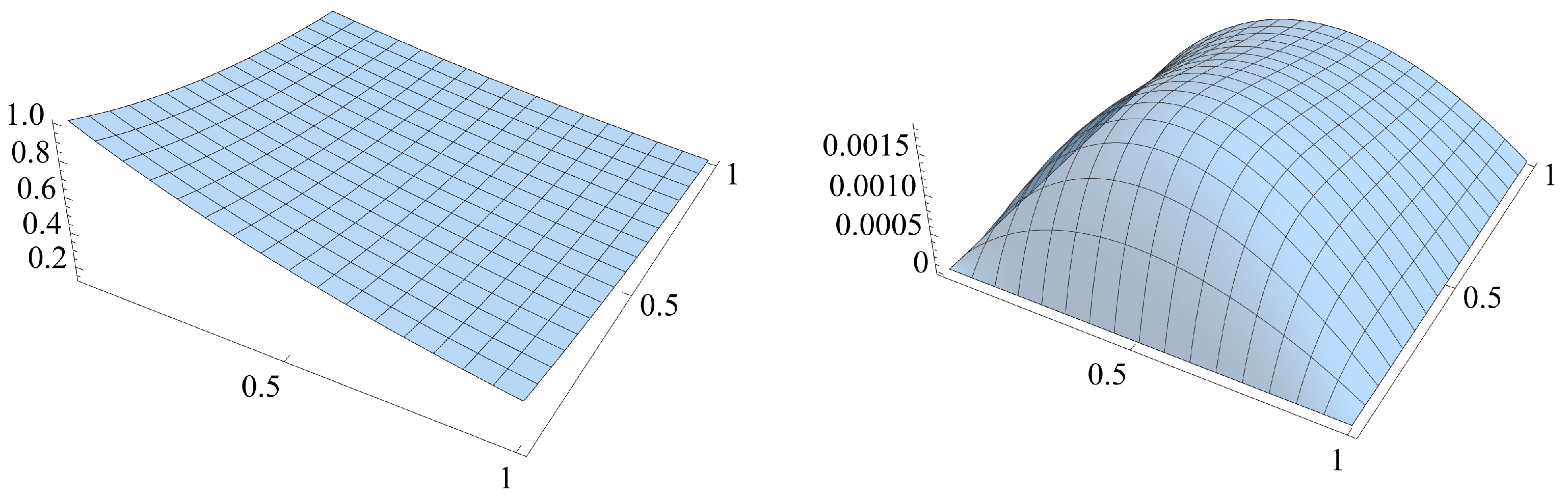
where . Equation (65) has a solution . The graphs of numerical solution (59) and its error for are shown in Figure 1. Numerical method (59) has an accuracy for . When the parameter , numerical method (59) has a second-order accuracy . Experimental results for the error and order of the numerical solution (59) of Equation (65) with and are given in Table 12 and Table 13.
Figure 1.
Graphs of numerical solution (59) (left) and its error (right) for .
Table 12.
Error and order of numerical solution (59) and .
Table 13.
Error and order of numerical solution (59) and .
The order of the numerical method (59) in time is obtained by fixing and varying the value of M using the formula . Similarly, the order in space is computed as with the parameter kept fixed.
6. Approximations of the Fractional Derivative
In this section, we discuss the construction of an approximation (5) for the fractional derivative, using the asymptotic Formula (2) and the approximation for the first derivative. Two approximations of the fractional derivative of order whose weights satisfy (1) are given below. Let . The L1 approximation of the Caputo fractional derivative has the form
where ,
The L1 approximation and approximation (5) have an order and and their weights satisfy (1). In [7,46], we use the properties of the weights (1) of approximations of the fractional derivative for analyzing the convergence and order of the numerical solutions of two-term ordinary fractional differential equation and the time-fractional Black–Scholes equation. In [26,28], we construct second-order approximations of the Caputo derivative using the asymptotic formula of the L1 approximation. In [23], we obtain an approximation of the Caputo fractional derivative of order by substituting the first derivative in (2) with a first-order backward difference approximation.
where ,
and . Now, we apply approximation for constructing an approximation of the Caputo derivative. By substituting the first derivative in Formula (2) with , we obtain an approximation of order .
where ,
The value of zeta function is negative when and the parameter b of approximation has a modulus smaller than one, . Therefore, and for . In Lemma 4, we show that the coefficient of approximation (68) is negative when the parameter b has a value .
Lemma 4.
Let . Then,
Proof.
Inequality (69) holds when
Taking the logarithm of both sides, we obtain
Let . The function f satisfies and has first derivative
It is sufficient to prove that is positive. The zeta function and its derivative have Laurent series expansions
where are Stieltjes constants
Hence,
The derivative of the function f satisfies
Denote
The function g has first-, second- and third-order derivatives
The values of the function g and its derivatives at zero are positive:
The third derivative is positive on the interval because
Therefore, the functions are positive and increasing and . The function f is increasing and positive because . □
Approximation (5) of the fractional derivative is obtained from (68) and value of the parameter . The two-term and multi-term ordinary fractional differential equations are an important class of equations in fractional calculus which generalize the linear ordinary differential equations with constant coefficients. Their analytical and numerical solutions are studied in [47,48,49,50,51]. In the following examples, we will consider an application of approximation (68) for the construction of numerical schemes for the two-term ordinary fractional differential equation and the fractional subdiffusion equation.
Example 6.
Consider the following two-term equation:
The numerical solution of Equation (70), which uses the L1 approximation (66) of the fractional derivative, is computed as
The numerical solution of Equation (70), which uses approximations (67) and (68) of the fractional derivative , satisfies
and has initial conditions
The initial conditions (6) are obtained with the approximation of the fractional derivative
Consider the two-term equation
Equation (75) has a solution , where is the Mittag–Leffler function
The experimental results of numerical solutions (71) and (72) of Equation (75) on the interval are given in Table 14 and Table 15. The second column of Table 14 pertains to (72) using approximation (67), while the results in the third column relate to (72) using approximation (68) with a parameter . The numerical results in Table 15 were obtained using approximation (5) for the fractional derivative. The sequence and the coefficients and of approximations (67) and (68) for are computed recursively in arithmetic operations. The (71) and (72) methods have similar computational time and accuracy. The approximation (67) is obtained from Formula (2) by replacing the first derivative with a first-order difference approximation. Replacing the second derivative and derivatives of higher order with finite difference approximations in the asymptotic formulas leads to approximations whose weights do not satisfy (1). The method of constructing approximation (5) using the approximation of the first derivative has the advantage that it can be generalized to constructions of high-order fractional derivative approximations, which have properties (1).
The time-fractional subdiffusion equation is a generalization of the heat diffusion equation using a time-fractional derivative of order with . The analytical and numerical solutions of fractional subdiffusion equations are studied in [52,53,54,55,56].
Denote . The numerical solution satisfies the system of linear equations
and has initial conditions for and boundary conditions for . The numerical solution on row m of the grid , where , which uses approximation (5) of the fractional derivative, satisfies
Denote . The numerical solution on row m satisfies the tridiagonal system of linear equations
Consider the fractional subdiffusion equation
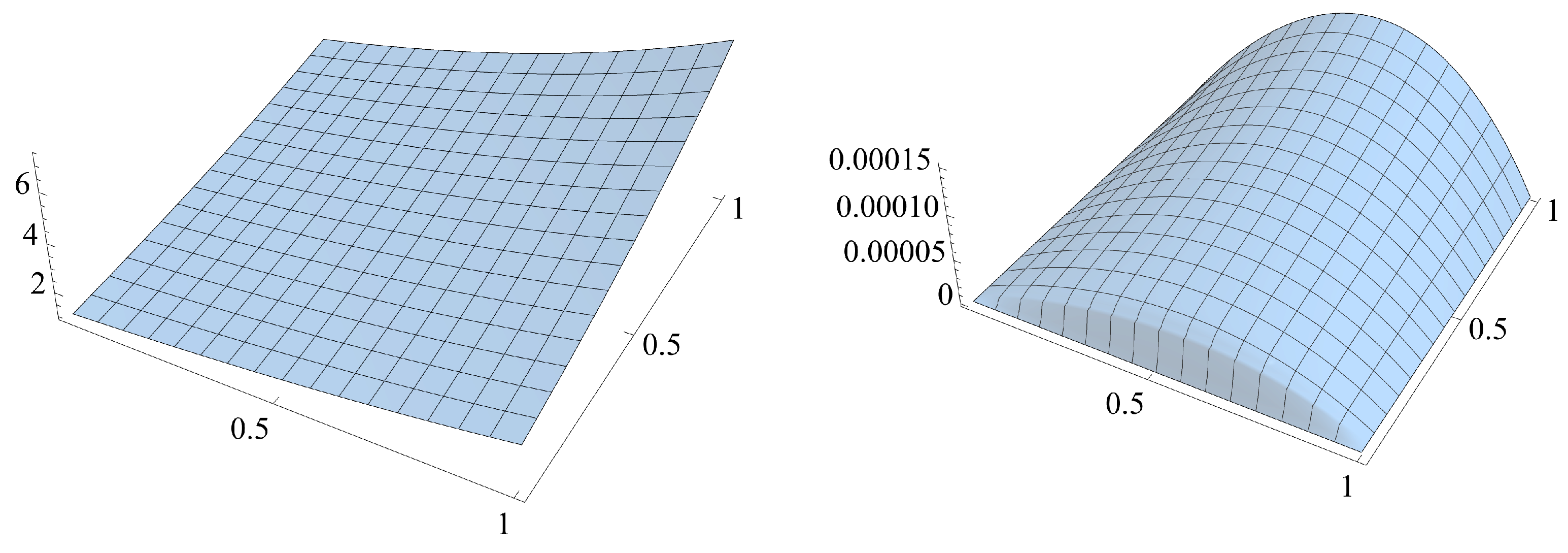
Equation (78) has a solution . The graphs of numerical solution (77) of Equation (78) and its error for are shown in Figure 2. Experimental results for the error and order of numerical solution (77) of fractional subdiffusion Equation (78) and are given in Table 16 and Table 17.
Example 7.
where and denotes the Caputo derivative of the solution in time. Let and , where M and N are positive integers, and let be a rectangular grid with nodes . The numerical solution on the first three rows of is computed with the approximation (74) of the partial fractional derivative and second-order central difference approximation of the partial derivative in space
Consider the following fractional subdiffusion equation:
Figure 2.
Graphs of numerical solution (77) (left) and its error (right) for .
Table 16.
Error and order of numerical solution (77) and .
Table 17.
Error and order of numerical solution (77) and .
7. Conclusions
In this paper, we construct approximations of the first derivative whose weights contain powers of a parameter a, where . The approximations are applied to the numerical solution of ordinary differential equations and the heat equation. The properties of the weights allow the computation of the numerical solution of ordinary differential equations with operations. The numerical solutions of partial differential equations are computed with operations, where M is the number of nodes in time and N is the number of nodes in space. The numerical methods are compared with the Euler method using a first-order backward approximation of the first derivative. In the examples given in the paper, we observe similar computational time and accuracy for the numerical methods, with the time difference being less than a second. The numerical methods for ODEs and PDEs using approximation (3) of the first derivative can achieve an arbitrary order in using values of the parameter (47), (48), and (49). The numerical methods constructed in the paper are easy to implement and perform better compared to the Euler method for Equation (38) with negative values of L and values of the parameter a close to one, as shown in Table 4, Table 5 and Table 6. The main goal of constructing the first derivative approximations (3) and (4) is to use them in constructing fractional derivative approximations, whose weights have property (1). An example of a construction of an approximation of the fractional derivative of order which uses asymptotic Formula (2) and approximation (3) of the first derivative is given in Section 6. The method for constructing the approximation (5) can be generalized to develop high-order approximations of the fractional derivative. In future work, we plan to extend the results presented in this paper. We will present proofs of the convergence of the numerical methods discussed in the paper and apply the method to construct approximations for the second-order and higher-order derivatives. We aim to study the construction of high-order approximations of the fractional derivative with weights that satisfy (1), as well as to investigate the properties and convergence of finite difference schemes for fractional differential equations.
Author Contributions
Conceptualization, Y.D. and S.G.; data curation, V.T.; formal analysis, Y.D. and V.T.; funding acquisition, S.G.; investigation, Y.D.; methodology, V.T. and S.G.; project administration, Y.D. and V.T.; resources, S.G.; software, S.G.; supervision, Y.D.; validation, V.T.; visualization, S.G.; writing—original draft, Y.D. and S.G.; writing—review and editing, Y.D. and V.T. All authors have read and agreed to the published version of the manuscript.
Funding
This study is supported by the Bulgarian National Science Fund under Project KP-06-M62/1 “Numerical deterministic, stochastic, machine and deep learning methods with applications in computational, quantitative, algorithmic finance, biomathematics, ecology and algebra” from 2022.
Data Availability Statement
The data presented in this study are available on request from the corresponding author.
Conflicts of Interest
The authors declare no conflicts of interest.
References
- Akgül, A.; Conejero, J.A. Fractal fractional derivative models for simulating chemical degradation in a bioreactor. Axioms 2024, 13, 151. [Google Scholar] [CrossRef]
- Akgül, A.; Khoshnaw, S.H.A. Application of fractional derivative on non-linear biochemical reaction models. Int. J. Intell. Netw. 2020, 1, 2–58. [Google Scholar] [CrossRef]
- Baba, I.A.; Rihan, F.A. A fractional–order model with different strains of COVID-19. Phys. A Stat. Mech. Appl. 2022, 603, 127813. [Google Scholar] [CrossRef] [PubMed]
- Gu, Y.; Yu, Z.; Lan, P.; Lu, N. fractional derivative viscosity of ANCF cable element. Actuators 2023, 12, 64. [Google Scholar] [CrossRef]
- Hilfer, R. Applications of Fractional Calculus in Physics; World Scientific: Singapore, 2003. [Google Scholar]
- Kumar, D.; Singh, J. Fractional Calculus in Medical and Health Science; CRC Press: Boca Raton, FL, USA, 2020. [Google Scholar]
- Dimitrov, Y.; Georgiev, S.; Miryanov, R.; Todorov, V. Convergence of the L1 two-term equation scheme. J. Phys. Conf. Ser. 2023, 2675, 012027. [Google Scholar] [CrossRef]
- Jin, B.; Lazarov, R.; Zhou, Z. An analysis of the L1 scheme for the subdiffusion equation with nonsmooth data. IMA J. Numer. Anal. 2016, 36, 197–221. [Google Scholar] [CrossRef]
- Li, B.; Xie, X.; Yan, Y. L1 scheme for solving an inverse problem subject to a fractional diffusion equation. Comput. Math. Appl. 2023, 134, 112–123. [Google Scholar] [CrossRef]
- Scherer, R.; Kalla, S.L.; Tang, Y.; Huang, J. The Grünwald—Letnikov method for fractional differential equations. Comput. Math. Appl. 2011, 62, 902–917. [Google Scholar] [CrossRef]
- Arshad, S.; Defterli, O.; Baleanu, D. A second order accurate approximation for fractional derivatives with singular and non-singular kernel applied to a HIV model. Appl. Math Comput. 2020, 374, 125061. [Google Scholar] [CrossRef]
- Nasir, H.M.; Nafa, K. A new second order approximation for fractional derivatives with applications. Sultan Qaboos Univ. J. Sci. 2018, 23, 43–55. [Google Scholar] [CrossRef]
- Alikhanov, A.A. A new difference scheme for the time fractional diffusion equation. J. Comput. Phys. 2015, 280, 424–438. [Google Scholar] [CrossRef]
- Gao, G.-H.; Sun, Z.-Z.; Zhang, H.-W. A new fractional numerical differentiation formula to approximate the Caputo fractional derivative and its applications. J. Comput. Phys. 2014, 259, 33–50. [Google Scholar] [CrossRef]
- Xing, Y.; Yan, Y. A higher order numerical method for time fractional partial differential equations with nonsmooth data. J. Comput. Phys. 2018, 357, 305–323. [Google Scholar] [CrossRef]
- Chen, M.H.; Deng, W.H. Fourth order accurate scheme for the space fractional diffusion equations. SIAM J. Numer. Anal. 2014, 52, 1418–1438. [Google Scholar] [CrossRef]
- Gunarathna, W.A.; Nasir, H.M.; Daundasekera, W.B. An explicit form for higher order approximations of fractional derivatives. Appl. Numer. Math. 2019, 143, 51–60. [Google Scholar] [CrossRef]
- Hao, Z.-P.; Sun, Z.-Z.; Cao, W.-R. A fourth-order approximation of fractional derivatives with its applications. J. Comput. Phys. 2015, 281, 787–805. [Google Scholar] [CrossRef]
- Li, L.; Zhao, D.; She, M.; Chen, X. On high order numerical schemes for fractional differential equations by block-by-block approach. Appl. Math. Comput. 2022, 425, 127098. [Google Scholar] [CrossRef]
- Lubich, C. Discretized fractional calculus. SIAM J. Math. Anal. 1986, 17, 704–719. [Google Scholar] [CrossRef]
- Nasrollahzadeh, F.; Hosseini, S.M. An implicit difference ADI method for two-dimensional space-time fractional diffusion equation. Iran. J. Math. Sci. Inform. 2016, 11, 71–86. [Google Scholar] [CrossRef]
- Wang, Z.; Liang, Y.; Mo, Y. A novel high order compact ADI scheme for two dimensional fractional integro-differential equations. Appl. Numer. Math. 2021, 167, 257–272. [Google Scholar] [CrossRef]
- Dimitrov, Y. Approximations for the Caputo derivative (I). J. Fract. Calc. Appl. 2018, 9, 15–44. [Google Scholar]
- Ahnert, K.; Abel, M. Numerical differentiation of experimental data: Local versus global methods. J. Comput. Phys. Commun. 2005, 177, 764–774. [Google Scholar] [CrossRef]
- Hanke, M.; Scherzer, O. Inverse problems light: Numerical differentiation. Am. Math. Mon. 2001, 108, 512–521. [Google Scholar] [CrossRef]
- Apostolov, S.; Dimitrov, Y.; Todorov, V. Constructions of second order approximations of the Caputo fractional derivative. In Lecture Notes in Computer Science; Lirkov, I., Margenov, S., Eds.; Large-Scale Scientific Computing. LSSC 2021; Springer: Berlin/Heidelberg, Germany, 2022; p. 13127. [Google Scholar]
- Todorov, V.; Dimitrov, Y.; Dimov, I. Second order shifted approximations for the first derivative. In Studies in Computational Intelligence; Dimov, I., Fidanova, S., Eds.; Advances in High Performance Computing. HPC 2019; Springer: Cham, Switzerland, 2011; p. 902. [Google Scholar]
- Dimitrov, Y. A second order approximation for the Caputo fractional derivative. J. Fract. Calc. Appl. 2016, 7, 175–195. [Google Scholar]
- Al-Bar, R. On the approximate solution of fractional logistic differential equation using operational matrices of Bernstein polynomials. Appl. Math. 2015, 6, 2096–2103. [Google Scholar] [CrossRef]
- Iannelli, M.; Pugliese, A. An Introduction to Mathematical Population Dynamics: Along the Trail of Volterra and Lotka, 4th ed.; Springer: Berlin/Heidelberg, Germany, 2014. [Google Scholar]
- Kot, M. Elements of Mathematical Ecology; Cambridge University Press: Cambridge, UK, 2001. [Google Scholar]
- Hahn, D.W.; Özişik, M.N. Heat Conduction, 3rd ed.; John Wiley & Sons: Hoboken, NJ, USA, 2012. [Google Scholar]
- Incorpera, F.P.; DeWitt, D.P.; Bergman, T.L.; Lavine, A.S. Fundamentals of Heat and Mass Transfer, 6th ed.; John Wiley: New York, NY, USA, 2006. [Google Scholar]
- Majumdar, P. Computational Methods for Heat and Mass Transfer; CRC Press: Boca Raton, FL, USA, 2006. [Google Scholar]
- Morton, K.W.; Mayers, D.F. Numerical Solution of Partial Differential Equations: An Introduction, 2nd ed.; Cambridge University Press: Cambridge, UK, 2005. [Google Scholar]
- Zhao, S. A matched alternating direction implicit (ADI) method for solving the heat equation with interfaces. J. Sci. Comput. 2015, 63, 118–137. [Google Scholar] [CrossRef]
- Press, W.H.; Teukolsky, S.A.; Vetterling, W.T.; Flannery, B.P. Numerical Recipes: The Art of Scientific Computing; Cambridge University Press: Cambridge, UK, 2007. [Google Scholar]
- Datta, B.N. Numerical Linear Algebra and Applications, 2nd ed.; Society for Industrial and Applied Mathematics: Philadelphia, PA, USA, 2010. [Google Scholar]
- Suárez-Carreño, F.; Rosales-Romero, L. Convergency and stability of explicit and implicit schemes in the simulation of the heat equation. Appl. Sci. 2021, 11, 4468. [Google Scholar] [CrossRef]
- Sundaram, A. Numerical solution for the heat equation using Crank-Nicolson difference method. Int. J. Res. Appl. Sci. Eng. Technol. 2023, 11, 158–164. [Google Scholar] [CrossRef]
- Ames, W. Numerical Methods for Partial Differential Equations; Academic Press: Boston, MA, USA, 1992. [Google Scholar]
- Smith, G.D. Numerical Solution of Partial Differential Equations: Finite Difference Method; Oxford University Press: Oxford, UK, 1992. [Google Scholar]
- Kolotilina, L.Y. Bounds for the infinity norm of the inverse for certain M- and H-matrices. Linear Algebra Appl. 2009, 430, 692–702. [Google Scholar] [CrossRef]
- Varah, J.M. A lower bound for the smallest singular value of a matrix. Linear Algebra Appl. 1975, 11, 3–5. [Google Scholar] [CrossRef]
- Kulkarni, D.; Schmidt, D.; Tsui, S.-K. Eigenvalues of tridiagonal pseudo-Toeplitz matrices. Linear Algebra Appl. 1999, 297, 63–80. [Google Scholar] [CrossRef]
- Dimitrov, Y.; Georgiev, S.; Todorov, V. Approximation of Caputo fractional derivative and numerical solutions of fractional differential equations. Fractal Fract. 2023, 7, 750. [Google Scholar] [CrossRef]
- Li, C.; Zeng, F. Numerical Methods for Fractional Calculus; Chapman and Hall/CRC: Boca Raton, FL, USA, 2015. [Google Scholar]
- Avcı, İ.; Mahmudov, N.I. Numerical solutions for multi-term fractional order differential equations with fractional Taylor operational matrix of fractional integration. Mathematics 2020, 8, 96. [Google Scholar] [CrossRef]
- Diethelm, K.; Ford, N.J. Analysis of fractional differential equations. J. Math. Anal. Appl. 2002, 265, 229–248. [Google Scholar] [CrossRef]
- Edwards, J.T.; Ford, N.J.; Simpson, A.C. The numerical solution of linear multi-term fractional differential equations: Systems of equations. J. Comput. Appl. Math. 2002, 148, 401–418. [Google Scholar] [CrossRef]
- El-Mesiry, A.E.M.; El-Sayed, A.M.A.; El-Saka, H.A.A. Numerical methods for multi-term fractional (arbitrary) orders differential equations. Appl. Math. Comput. 2005, 160, 683–699. [Google Scholar] [CrossRef]
- Ali, U.; Sohail, M.; Abdullah, F.A. An efficient numerical scheme for variable-order fractional sub-diffusion equation. Symmetry 2020, 12, 1437. [Google Scholar] [CrossRef]
- Ashurov, R.; Umarov, S. Determination of the order of fractional derivative for subdiffusion equations. Fract. Calc. Appl. Anal. 2020, 23, 1647–1662. [Google Scholar] [CrossRef]
- Langlands, T.A.M.; Henry, B.I. The accuracy and stability of an implicit solution method for the fractional diffusion equation. J. Comput. Phys. 2005, 205, 719–736. [Google Scholar] [CrossRef]
- Mainardi, F.; Mura, A.; Pagnini, G.; Gorenflo, R. Sub-diffusion equations of fractional order and their fundamental solutions. In Mathematical Methods in Engineering; Taş, K., Tenreiro Machado, J.A., Baleanu, D., Eds.; Springer: Berlin/Heidelberg, Germany, 2007; pp. 23–55. [Google Scholar]
- Podlubny, I. Fractional Differential Equations; Academic Press: Cambridge, MA, USA, 1999. [Google Scholar]
Disclaimer/Publisher’s Note: The statements, opinions and data contained in all publications are solely those of the individual author(s) and contributor(s) and not of MDPI and/or the editor(s). MDPI and/or the editor(s) disclaim responsibility for any injury to people or property resulting from any ideas, methods, instructions or products referred to in the content. |
© 2024 by the authors. Licensee MDPI, Basel, Switzerland. This article is an open access article distributed under the terms and conditions of the Creative Commons Attribution (CC BY) license (https://creativecommons.org/licenses/by/4.0/).