


Abstract
In this paper, we will introduce a compact alternating direction implicit (ADI) difference scheme for solving the two-dimensional (2D) time fractional nonlinear Schrödinger equation. The difference scheme is constructed by using the
formula to approximate the Caputo fractional derivative in time and the fourth-order compact difference scheme is adopted in the space direction. The proposed difference scheme with a convergence accuracy of
is obtained by adding a small term, where
,
,
are the temporal and spatial step sizes, respectively. The convergence and unconditional stability of the difference scheme are obtained. Moreover, numerical experiments are given to verify the accuracy and efficiency of the difference scheme.
1. Introduction
The Schrödinger equation, as a basic equation in quantum mechanics, is widely used in plasma physics, nonlinear photonics, water waves, bimolecular dynamics, and other fields. Models with fractional derivatives are better at describing the motion of things in real situations. In 2004, the time fractional Schrödinger equation is proposed in [1], which is considered by changing the first-order derivative to a Caputo fractional derivative. Various nonlinear development equations are discussed in [2], and finite difference schemes are used to solve these equations. This approach is also applied to the nonlinear Schrödinger equation.
In this paper, we will discuss the following 2D time fractional nonlinear Shrödinger equation (TFNSE) [3] with the Caputo fractional derivative:
here,
are the given smooth functions,
,
represents the domin and
is the boundary. The
-order Caputo fractional derivative [4] is defined by
with
.
For Equation (2), this paper will apply the time-fractional Schrödinger equation, which is classified as an integral-differential equation. Due to the challenges in obtaining an analytical solution, the use of numerical methods to address the time-fractional Schrödinger equation has emerged as a widely debated and significant topic. The
formula is proposed in [5] for approximating the
-order Caputo fractional derivative for solving time-fractional sub-diffusion equation. The
formula is proposed in [6,7] for the time-fractional reaction sub-diffusion equation. Further, the
formula is proposed for Caputo-type time-fractional sub-diffusion equations in [8]. The paper [9] focused on a conservative implicit difference scheme for one dimensional nonlinear Schrödinger equation by presupposing a higher-order difference scheme, and proving its stability and convergence with second-order accuracy in time and fourth-order accuracy in space.
In order to obtain high-order accuracy and reduce the cost of computation, this article will discuss a compact ADI scheme in the space direction for Equation (1). A compact ADI scheme is proposed in [10] for the 2D fractional sub-diffusion equation, and the error of the compact scheme is discussed. Based on previous papers, a new ADI scheme is introduced in [11] for solving three-dimensional parabolic equations. And a compact difference scheme for solving the nonlinear time-space fractional Schrödinger equation is discussed in [12], it is also proved that the scheme has second-order accuracy in time and space directions. And a new high order ADI numerical difference formula is discussed in [13] for a time-fractional convection–diffusion equation. In [14], several high-order compact finite difference schemes are presented and analyzed for the numerical solution of one and two-dimensional linear time fractional Schrödinger equations. The time Caputo fractional derivative is approximated using the
and
formula. Spatial discretization employs a fourth-order compact finite difference method. Furthermore, the unconditional stability of the proposed scheme is examined using Fourier analysis.
The following sections of this paper are organized as follows. Section 2 is devoted to some notations and useful lemmas. In Section 3, the derivation of the compact ADI difference scheme is discussed for Equation (1). The convergence and stability are analyzed seriously in Section 4. In Section 5, some numerical experiments are given to illustrate the efficiency of the scheme which introduced in this work. Finally, the paper ends with a conclusion section.
2. Preliminaries
We first introduce some notations used in this paper.
,
, and N are the spatial and temporal partition parameters, respectively, and are the positive integers. We set the spatial step size as
,
and the time step size as
. Denote
,
,
,
. Suppose
is a grid function on
, and
is a conjugate function of
, for any
, given the discrete notation as follows:
Definition 1
(Formula
[15]). Assume that
,
, then
when
,
. When
,
When
,
and when
,
where
Lemma 1
([16]). When
, we have
Lemma 2
([16]). For
, we have
Lemma 3
([17]). Let
and
be the nonnegative sequence, and
, then for
, if
then, we have the following inequality
Lemma 4
([3]). For
, we obtain
Lemma 5
([18]). For
, we can obtain
Lemma 6
([19]). For
, we have
Lemma 7
([20]). For
, we have
Lemma 8
([21]). For
, we can obtain
Lemma 9
([21]). Let
, for any
, when
, which satisfies the following conditions
Lemma 10
([22]). For
, we obtain
Lemma 11
([22]). For
, we have
Theorem 1
([13]). Let
when
we have
where
3. Derivation of the Compact ADI Difference Scheme
For Equatoion (1), in the time direction, we use the
formula, then, we can obtain the following equation:
where
. The truncation error, denoted as
, pertains to the temporal domain. And in space, we use the fourth-order compact difference scheme, and use H on both sides of the equation, and we obtain
where
Utilizing Lemma 9, we have
where
Using Lemma 9, Theorem 1, and the Taylor expansion, we can learn about
then, we have
Multiply both sides by
and add
to the left-hand side of Equation (7); thus, we obtain
It can easily to be seen that,
then, Equation (8) can be written as follows:
For Equation (10), by omitting the error and replacing
with
, we can obtain the following difference scheme:
The above equation can be written as follows:
So we derive the following compact ADI scheme for problem (1):
4. Stability and Convergence Analysis
Theorem 2.
The compact ADI scheme (13) is unconditionally stable.
Proof.
Consider the real parts of (15)
when
, using Lemma 8, Lemma 10, Lemma 11, and Cauchy–Schwarz inequality
Using the Lemma 6 and Lemma 7, we can obtain
then, we have
where
.
Where
, using Lemma 8, Lemma 10, and Lemma 11 and Cauchy–Schwarz inequality
Using Lemma 6 and Lemma 7, we have
therefore,
where
. For any
, we have
where
,
.
By using Lemma 1 and Lemma 3, we can obtain
choose
, then
When
and
, using Lemma 8, Lemma 10, Lemma 11, and Cauchy–Schwarz inequality
Using Lemma 6 and Lemma 7, we have
therefore,
where
. For any
, we have
where
,
,
.
From Lemma 1 and Lemma 3, we have
choose
, then
When
and
, using Lemma 8, Lemma 10, Lemma 11, and Cauchy–Schwarz inequality
Using Lemma 6 and Lemma 7, we can obtain
then,
which
.
For any
, we have
which
,
,
,
, using Lemma 1 and Lemma 3, have
choose
, we have
Therefore, for any
, using Lemma 5, we have
□
Theorem 3.
Define
, then for positive integers
, we have
Proof.
Associate Equation (6) with Equation (9), then the truncation errors
satisfy the following conditions:
Take the inner product of Equation (17) with
and extract its real part
Using the partial integration method, for any
, we have
thus, Equation (18) can be written as follows:
Uisng Cauchy–Schwarz inequality, Equation (19) can be written as follows:
When
,
we get
Using Cauchy–Schwarz inequality, Equation (19) can be written as follows:
When
, Using Cauchy–Schwarz inequality, Equation (19) can be written as follows:
Using Lemma 8 and Equation (20), we have
Using Lemma 1 and Lemma 3, we have
thus,
When
, Using Cauchy–Schwarz inequality, Equation (19) can be written as follows:
Using Lemma 8 and Equation (20), we can obtain
with
, using the Lemma 1 and Lemma 3, we have
thus,
therefore, for any
, we have
□
5. Numerical Experiments
In this section, we will present two numerical experiments to illustrate the theoretical analysis results. All of our experiments were conducted in MATLAB R2019b.
Example 1.
In the first example, we consider the following 2D time fractional Schrödinger equation:
and the initial and boundary conditions are given by the following exact solution:
Table 1 displays the
-error and the convergence rate in the spatial domain for Example 1, examining
values of 0.1, 0.5, and 0.9. This evaluation is performed by halving the spatial step size from h to
and the time step size from
to
. The findings confirm that the compact difference scheme
achieves a fourth-order precision in spatial discretization.

Table 1.
Example 1: when
, computational errors and orders of convergence.
Table 2 shows the infinite norm error and the convergence order in the temporal direction for Example 1 with
and various
values of
, and 0.75 at distinct time steps. The data reveal that the temporal convergence accuracy of the compact difference scheme (13) is
.
Table 2.
Example 1: when
, computational errors and orders of convergence.
Figure 1 depicts a comparison of the numerical errors for
values of 0.2, 0.4, 0.6, and 0.8 when
.
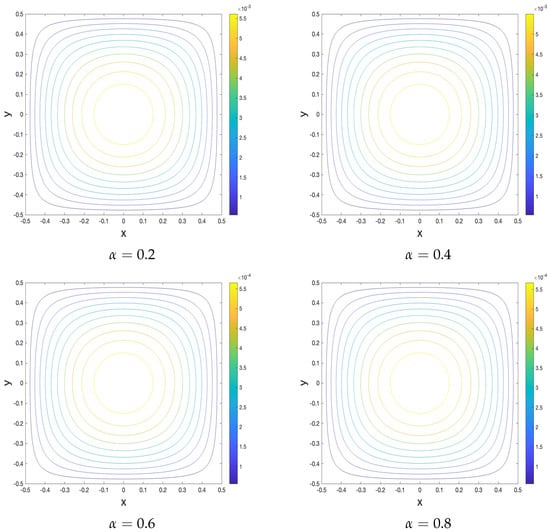
Figure 1.
Contour plots of the numerical errors when
for different values of
.
Example 2.
In this example, we consider the following 2D time-fractional nonlinear Schrödinger equation:
The initial and boundary values of the equation are given by the following exact solution:
Table 3 shows the
-error and the convergence order in space, when h is reduced from h to
and
is reduced from
to
, respectively. The result shows that the difference scheme
has fourth-order accuracy in a spatial direction for Example 2.
Table 3.
Example 2: when
, computational errors and orders of convergence.
From Table 4, it can be observed that the difference scheme (13) has
convergence accuracy in time, which shows the
-error and the convergence order in time with different values of
when
for Example 2.
Table 4.
Example 2: when
, computational errors and orders of convergence.
Figure 2 displays contour plots of the numerical errors for
with different values
, and 0.8 when
.
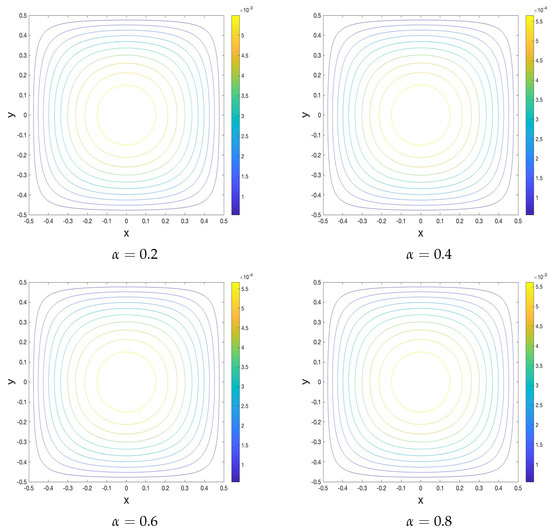
Figure 2.
Contour plots of the numerical errors when
for different values of
.
6. Conclusions
In this article, we applied the
formula and the fourth-order compact difference formula to construct a linearized high-order compact difference scheme for the 2D time-fractional nonlinear Schrödinger equation with the well-known Caputo time-fractional derivative of order
, the difference scheme (13) with convergence order
. Similarity, we have proved that the unconditional stability and convergence of the compact difference scheme, and provide examples to illustrate the effectiveness of the difference scheme.
This paper provides two numerical experiments and compares the present compact ADI scheme with a difference scheme in [14]. The results of the numerical examples show that the difference scheme proposed in this paper is very effective at solving the two-dimensional time fractional nonlinear Schrödinger equation. In the future, we will consider some high-order exponential difference schemes [23] to improve the computational efficiency in time.
Author Contributions
Conceptualization, Z.A. and R.E.; review and editing, Z.A. and R.E.; software, and writing—original draft preparation, Z.A. and R.E.; formal analysis, Z.A., R.E. and M.S.; investigation, R.E.; methodology, R.E. and P.H.; funding acquisition, P.H. All authors have read and agreed to the published version of the manuscript.
Funding
This work is supported by the Natural Science Foundation of Xinjiang Uygur Autonomous Region (Grant No 2023D14014) and the Basic Research Program of Tianshan Talent Plan of Xinjiang, China (Grant No 2022TSYCJU0005).
Institutional Review Board Statement
Not applicable.
Informed Consent Statement
Not applicable.
Data Availability Statement
All data reported are obtained by the numerical schemes designed in this paper.
Conflicts of Interest
The authors declare no conflicts of interest.
Abbreviations
| TFNSE | Time-fractional nonlinear Schrödinger equation |
| ADI | Alternating direction implicit |
| 2D | Two-dimensional |
References
- Naber, M. Time fractional Schrödinger equation. J. Math. Phys. 2004, 45, 3339–3352. [Google Scholar] [CrossRef]
- Sun, Z.Z.; Zhang, Q.; Gao, G. Finite Difference Methods for Nonlinear Evolution Equations; Walter de Gruyter GmbH & Co. KG: Berlin, Germany, 2023. [Google Scholar]
- Gao, Z.; Xie, S. Fourth-order alternating direction implicit compact finite difference schemes for two-dimensional Schrödinger equations. Appl. Numer. Math. 2011, 61, 593–614. [Google Scholar] [CrossRef]
- Podlubny, I. Fractional Differential Equations; Academic Press: Cambridge, MA, USA, 1999. [Google Scholar]
- Gao, G.H.; Sun, Z.Z.; Zhang, H.W. A new fractional numerical differentiation formula to approximate the Caputo fractional derivative and its applications. J. Comput. Phys. 2014, 259, 33–50. [Google Scholar] [CrossRef]
- Alikhanov, A.A. A New Difference Scheme for the Time Fractional Diffusion Equation; Academic Press Professional, Inc.: Cambridge, MA, USA, 2015. [Google Scholar]
- Roul, P.; Rohil, V. A novel high-order numerical scheme and its analysis for the two-dimensional time-fractional reaction-subdiffusion equation. Numer. Algorithms 2022, 90, 1357–1387. [Google Scholar] [CrossRef]
- Wang, Y.M.; Ren, L. A high-order L2-compact difference method for Caputo-type time-fractional sub-diffusion equations with variable coefficients. Appl. Math. Comput. 2019, 342, 71–93. [Google Scholar] [CrossRef]
- Jin, C.; Zhizhong, S.; Hongwei, W. A high accurate and conservative difference scheme for the solution of nonlinear Schrödinger eqaution. Numer. Math. J. Chin. Univ. 2015, 37, 31–52. [Google Scholar]
- Rezamokhtari, G. Stability and Convergence Analyses of the FDM Based on Some L-Type Formulae for Solving the Subdiffusion Equation. Numer. Math. Theory Methods Appl. 2021, 14, 945. [Google Scholar]
- Dai, W.; Nassar, R. A New ADI Scheme for Solving Three-Dimensional Parabolic Equations with First-Order Derivatives and Variable Coefficients. J. Comput. Anal. Appl. 2000, 2, 293–308. [Google Scholar]
- Fei, M.; Wang, N.; Huang, C.; Ma, X. A second-order implicit difference scheme for the nonlinear time-space fractional Schrödinger equation. Appl. Numer. Math. 2020, 153, 399–411. [Google Scholar] [CrossRef]
- Wu, L.; Zhai, S. A new high order ADI numerical difference formula for time-fractional convection-diffusion equation. Appl. Math. Comput. 2019, 387, 124564. [Google Scholar] [CrossRef]
- Eskar, R.; Feng, X.; Kasim, E. On high-order compact schemes for the multidimensional time-fractional Schrödinger equation. Adv. Differ. Equ. 2020, 2020, 492. [Google Scholar] [CrossRef]
- Mokhtari, R.; Mostajeran, F. A high order formula to approximate the Caputo fractional derivative. Appl. Math. Comput. 2020, 2, 29. [Google Scholar] [CrossRef]
- Lin, Y.; Xu, C. Finite difference/spectral approximations for the time-fractional diffusion equation. J. Comput. Phys. 2007, 225, 1533–1552. [Google Scholar] [CrossRef]
- Holte, J.M. Discrete Gronwall lemma and applications. In Proceedings of the MAA-NCS Meeting at the University of North Dakota, Collegeville, MN, USA, 19–24 July 2009; Sciene Press: Beijing, China, 2021; 24, pp. 1–7. [Google Scholar]
- Zhang, Y.N.; Sun, Z.Z. Error Analysis of a Compact ADI Scheme for the 2D Fractional Subdiffusion Equation. J. Sci. Comput. 2014, 59, 104–128. [Google Scholar] [CrossRef]
- Wang, Y.M. Error and extrapolation of a compact LOD method for parabolic differential equations. J. Comput. Appl. Math. 2011, 235, 1367–1382. [Google Scholar] [CrossRef]
- Sun, Z.Z. Numerical Solution of Partial Differential Equations; Science Press: Beijing, China, 2005. [Google Scholar]
- Atouani, N.; Omrani, K. On the convergence of conservative difference schemes for the 2D generalized Rosenau–Korteweg de Vries equation. Appl. Math. Comput. 2015, 250, 832–847. [Google Scholar] [CrossRef]
- Liao, H.L.; Sun, Z.Z. Maximum norm error bounds of ADI and compact ADI methods for solving parabolic equations. Numer. Methods Partial Differ. Equ. 2010, 26, 37–60. [Google Scholar] [CrossRef]
- Bhatt, H.P.; Khaliq, A.Q.M. Higher order exponential time differencing scheme for system of coupled nonlinear Schrdinger equations. Appl. Math. Comput. 2014, 228, 271–291. [Google Scholar]
Disclaimer/Publisher’s Note: The statements, opinions and data contained in all publications are solely those of the individual author(s) and contributor(s) and not of MDPI and/or the editor(s). MDPI and/or the editor(s) disclaim responsibility for any injury to people or property resulting from any ideas, methods, instructions or products referred to in the content. |
© 2024 by the authors. Licensee MDPI, Basel, Switzerland. This article is an open access article distributed under the terms and conditions of the Creative Commons Attribution (CC BY) license (https://creativecommons.org/licenses/by/4.0/).