


Abstract
We prove the inequalities of the weighted Hermite–Hadamard type the and Hermite–Hadamard–Mercer type for an extremely rich class of geometrically arithmetically-h-convex functions (GA-h-CFs) via generalized Hadamard–Fractional integral operators (HFIOs). The two generalized fractional integral operators (FIOs) are Hadamard proportional fractional integral operators (HPFIOs) and Hadamard k-fractional integral operators (HKFIOs). Moreover, we also present the results for subclasses of GA-h-CFs and show that the inequalities proved in this paper unify the results from the recent related literature. Furthermore, we compare the two generalizations in view of the fractional operator parameters that contribute to the generalizations of the results and assess the better approximation via graphical tools. Finally, we present applications of the new inequalities via HPFIOs and HKFIOs by establishing interpolation relations between arithmetic mean and geometric mean and by proving the new upper bounds for the Tsallis relative operator entropy.
1. Introduction
Fractional integral and differential operators expand classical calculus by moving from integer orders to fractional ones and have important applications in real-world problems. Fractional operators are highly applicable because they model events with great accuracy. For example, Section 1.3 of [1] highlights their importance in studying materials ranging from liquids to viscoelastic materials. Recently, its applications have expanded to include diverse fields such as science, medicine, and engineering [2,3]. In the class of fractional integral operators (FIOs), the Riemann–Liouville fractional integral operator (RLFIO) is foundational due to its natural generalization [1]. Another operator gaining recent attention in research [4], the Hadamard–Fractional integral operator (HFIO), exhibits isometric properties with the RLFIO [5]. HFIOs have been studied from various perspectives, including mathematical inequalities [6,7], generalized proportional Hadamard fractional integral operators [8], modifications and generalizations like the Caputo [9], and Hadamard k-fractional integrals [10], as well as their relationship with entropy [11].
Mathematical inequalities are one of the most extensively investigated topics in mathematics due to their wide applicability in analyzing key aspects of both classical and modern phenomena. Recently, these inequalities have been utilized to explore system reliability, prediction, and feedback control [12]. The well-known inequalities, including Jensen’s, Hölder’s, Grön-wall’s, and Bihari’s, are crucial for analyzing the controllability of differential equations [13], while Chebyshev’s inequality is used to find certain parameters in data points [14]. Thus, the broad applicability has led to the investigation of mathematical inequalities across diverse domains. Recently, several variants of classical inequalities have been established, including Jensen’s inequality (JI), Jensen–Mercer inequality (JMI), Ostrowski and Fejér-type inequalities [15,16], Hermite–Hadamard inequality (HHI) [17,18], and Young, Heinz and Polya-Szegő-type inequalities [19,20].
Among the numerous mathematical notions involved in investigations of well-known inequalities, the family of convex functions (CFs) [21] stand out as particularly significant. Properties like continuity, differentiability (almost everywhere), and the monotonicity of their derivatives make CFs an important mathematical notion, which has led to their extensive study over time. As a result, various types of CFs, including h-CFs and its subclasses such as s-CFs, P-CFs, Q-CFs, have been introduced and analyzed, with several inequalities developed for these classes. For more details on CFs, generalized CFs, their characteristics, and associated inequalities, see [6,22] and references therein. It is known that the class of h-CFs contains all the above-mentioned classes, thus attaining the most attention in investigations of inequalities [23,24]. In [25], Niculescu introduced the concept of hybrid convexity, referred to as GA-CFs. Similar to how convexity notions have been extended, GA-CFs have also been generalized and modified, leading to different variants of familiar inequalities for GA-CFs and their generalizations [6,7,26,27]. A recent generalization of GA-CFs, referred to as GA-Cr-h-CFs, has been introduced [28] and inequalities known for GA-CFs have been studied for this generalized family of interval-valued functions (IVFs). The recent related studies on Hermite–Hadamard-type, Fejer-type and Mercer-type inequalities for IVFs have also been presented in [16,29]. Several variants of HHI have been proved for different families of functions [30]. For CFs via fractional integrals [31], generalized harmonic CFs on fractal sets [32], the HHI, and related inequalities have been proven. HHI and Jensen-type inequalities have also been investigated in view of the operators, for example, for h-CFs on fractal sets and FIOs [33,34]. Certain inequalities involving variants of CFs, including HH-type inequalities, have been proven for generalized RLFIOs, including multiplicative RLFIOs [35,36]. In recent years, GA-CFs have also received special attention in the context of mathematical inequalities, particular HHI and related ones [6,7,26,28]. However, several inequalities have not yet been investigated for different FIOs and GA-h-CFs and related families, such as [6,28].
In this paper, we prove the inequalities from the [6,7,37,38] by means of two generalized HFIOs, including HPFIO and HKFIO. We prove inequalities involving these operators, which unify the results from [6,7,37,38]. Furthermore, we compare the two generalizations in view of the parameters that contribute to the generalization of the results and assess the approximation via graphical tools. Finally, we present applications of the new inequalities via HPFIOs and HKFIOs by establishing interpolation relations between the arithmetic mean and the geometric mean and by proving the new upper bounds for the Tsallis-relative operator entropy.
2. Basic Notions and Known Results
In this section, we include the necessary definitions and results. For notions not recalled here, we refer [39] to the readers. We use ℜ, 𝚥,
,
and h to denote the set of real numbers, an interval in ℜ, a set of integrable functions on
, and a function
. We start by recalling the notion of different types of CFs.
Definition 1
([21]). A function
is called a convex function (CF) if for all
and
, the inequality
holds.
Definition 2
([40]). Let function
and
be two functions; we say that f is h-CF if
holds for all
and
.
Definition 3
([25]). A function
is called GA-CF if
holds for any
and
.
Definition 4
([6]). A function
is said to be
- •
- GA-s-CF if
- •
- GA-Q-CF if ,
- •
- GA-P-CF if
holds ∀
(
for GA-Q-CF),
and
.
Definition 5
([6]). Let
and
. The function f is known as GA-h-CF if
holds for any
and
.
Remark 1
([6]). If
(1,
or
), the inequality necessary for GA-CFs (GA-P-CF, GA-s-CF or GA-Q-CF) holds. Thus GA-h-CF contains all families, including GA-P-CFs, GA-s-CF, GA-P-CFs, and GA-Q-CFs.
Now, we recall the definition of HFIOs.
Definition 6
([5]). Let
,
be a integrable function, with
and x,
. Then,
the left side HHIO of order
is defined as
The right side HFIO of order
defined as
The generalization of HFI known as generalized Hadamard proportional fractional integral operator (GHPFIO) is
Definition 7
([8]). Let
,
be a integrable function, with
and x,
also
; then
The left and right side HPFIO of the order
are defined by
and
Another generalization of HFIO, known as HKFIO, is defined as
Definition 8
([10]). Let
,
with
and x,
and
.
The left and right side HKFIO of order
are defined by
and
where
Note that, if
in HPFIO and HKFIO, then we obtain HFIO.
Now, we recall the main results involving HFIs from [6]. Throughout this manuscript, we assume that
Theorem 1.
For a GA-h-CF f on
and an integrable function ϕ on
, the inequalities
hold for all
, where
.
Theorem 2.
For a GA-h-CF f on
and an integrable function ϕ on
, the inequalities
hold for all
and
.
3. Results
In this section, we prove Hermite–Hadamard–Mercer and weighted Hermite– Hadamard-type inequalities for GA-h-CFs in terms of HPFIOs. We extract several consequences from the main results. Moreover, the inequalities involving HPFIOs for special cases GA-CFs, GA-s-CFs, GA-P-CFs and GA--CFs have also been obtained. In the end, by using the special cases for the HPFIO, we re-capture the main results of several recent contributions in the area of mathematical inequalities.
In order to prove the main results, we introduce the following: For any
with
and
, the functions
and a function
, we define
Under the assumption that if f is GA-h-CF f on
, then Theorem 1 implies that
.
Now, we are ready to prove the following main result.
Theorem 3.
For a GA-h-CF f on
,
and
, the inequalities
hold for all
, where
.
Proof.
To prove the first inequality, we substitute
in Equation (3); we have
Since f is GA-h-CF,
0. So
The above inequality produces the following inequality:
for all
and
. Thus, we obtain the first inequality. The other inequalities directly follow by substituting
in Theorem 1, which completes the proof. □
By replacing
in Theorem 3, we obtain the following results:
Corollary 1.
for a GA-CF f on
,
and
, the inequalities
for all
.
By replacing
and
in Theorem 3, we obtain the following results:
Corollary 2.
For a GA-h-CF f on
,
and
, the inequalities
hold, where
By replacing
in Corollary 2, we obtain the following results
Corollary 3.
For a GA-CF f on
,
and
, the inequalities
hold.
If we put
or
in Theorem 2, we obtain the following inequalities.
Theorem 4.
For a GA-h-CF f on
,
and
, the inequalities
hold for all
, where
.
By replacing
in Theorem 4, we obtain the following result for GA-CFs through GHPFI.
Corollary 4.
For a GA-CF f on
,
and
, the inequalities
hold for all
and
.
By replacing
and
in Theorem 4, we obtain the following result:
Corollary 5.
For a GA-h-CF f on
,
and
, the inequalities
hold, where
.
By replacing
in Corollary 5, we obtain the result that coincides with the Corollary 3.
Now, we prove wHHMI for GA-h-CFs via GPHFIOs.
Theorem 5
(wHHMI for GA-h-CFs via GPHFIOs). For a GA-h-CF f and a non-negative function w on
,
and
, the wHHMI inequalities
hold for all
with
.
Proof.
By replacing
and
in Theorem 1, we obtain
and
for all
with
,
and
.
An immediate consequence of Theorem 5 is as follows; by replacing
in (5), we have the inequality shown below.
Corollary 6.
For a GA-CF f and a non-negative function w on
,
and
, the inequalities
hold for all
.
By replacing
and
in (5), we obtain the following results.
Corollary 7.
For a GA-h-CF f and a non-negative function w on
,
and
, the inequalities
hold, where
.
By replacing
in (9), the result is the inequality shown below,
Corollary 8.
For a GA-CF f and a non-negative function w on
,
and
, the inequalities
hold ∀
and
.
Remark 2.
We further obtain special cases of the main results by replacing
(
,
) in Theorem 3 and Corollary 3 (as well as Theorem 4) to obtain corresponding inequalities for GA-s-CFs (GA-Q-CFs and GA-P-CFs). Similar implications can be obtained for the other results of this section and recapture the results from [6].
Remark 3.
- For the special case when in Theorem 3 (and Theorem 4), we obtain Theorem 13 in [6] (Theorem 14 in [6]).
- If we take in Corollary 1, we re-capture Corollary of [7].
- If we take in Corollary 2, we obtain Corollary 12 from [6].
- If we take in Corollary 3, then we reproduce Theorem from [37].
- Similarly to the case when in Remark 2, we obtain corresponding results for HFIO from [6].
- On the other hand, the consequence of Corollary 5 for yields the special case for HFIOs from [6].
- By replacing in (5), we obtain Theorem 15 in [6].
- By replacing in (8) and Corollary 8, we obtain Corollary from [7] and Theorem from [38], respectively.
4. Hermite–Hadamard-Mercer Inequalities for GA-h-CFs via Hadamard k-Fractional Integrals
In this section, we utilize another generalization of the HFIO, known as the Hadamard k-Fractional Integral operator to prove a generalization of HHMIs and related results for the class of GA-h-CFs. Moreover, we present the special cases of the results from different perspectives and establish the significance of the proven results by demonstrating connections with the recent literature. We start by proving the following theorem.
Theorem 6.
For a GA-h-CF f on
and
, the inequalities
hold for all
, where
.
Proof.
To prove the first inequality, put
in the Equation (3):
Now, let
Since f is GA-h-CF therefore
0. So,
which gives the first inequality. The other inequalities follow directly from Theorem 1 by replacing
, which completes the proof. □
By taking
in (10), we obtain the following HHI for GA-CF through HKFI.
Corollary 9.
For a GA-CF f on
and
, the inequalities
hold for all
.
By replacing
in (10), we obtain
Corollary 10.
For a GA-h-CF f on
and
, the inequalities
hold, where
.
By replacing
in (11), we obtain
Corollary 11.
For a GA-CF f on
and
, the inequalities
hold.
By replacing
or
in Theorem 2, we obtain the following result:
Theorem 7.
For a GA-h-CF f on
and
, the inequalities
hold for all
where
.
By replacing
in (12), then we obtain results for GA-CFs through HKFI as follows:
Corollary 12.
For a GA-CF f on
and
, the inequalities
hold for all
.
By replacing
in (12), we obtain
Corollary 13.
For a GA-h-CF f on
and
, the inequalities
hold, where
.
By replacing
in Corollary 13, we obtain the results that coincides with Corollary 11.
Now, we prove wHHMI inequalities for GA-h-CFs via HKFIO.
Theorem 8
(wHHMI inequalities via HKFIO). For a GA-h-CF f and a non-negative function w on
and
, the wHHMI inequalities
hold for all
, where
.
By substituting
in (14), we obtain the following inequality for GA–convex function through HKFIO.
Corollary 14.
For a GA-CF f and a non-negative function w on
and
, the wHHMI inequalities
hold for all
.
By substituting
and
in (14), the following inequality is obtained:
Corollary 15.
For a GA-h-CF f and a non-negative function w on
and
, the wHHMI inequalities
hold, where
.
By substituting
in Corollary (15), the following inequality is obtained for GA-convex function through HKFI.
Corollary 16.
For a GA-CF f and a non-negative function w on
and
, the wHHMI inequalities
hold.
Remark 4.
We further obtain special cases of the main results by replacing
(
,
) in Theorem 6 and Corollary 10 (as well as Theorem 12) to obtain corresponding inequalities for GA-s-CFs (GA-Q-CFs and GA-P-CFs). Similar implications can be obtained for the other results of this section and recapture the results from [6].
Remark 5.
- For the special case when in Theorem 6 (and Theorem 7), we obtain Theorem 13 (and Theorem 14) in [6].
- If we replace in Corollary 9, we reproduce Corollary of [7].
- If we take in Corollary 10, we obtain Corollary 12 from [6].
- If we take in Corollary 11, then we reproduce Theorem from [37].
- Similarly to the case when in Remark 4, we obtain corresponding results for HFIO from [6].
- On the other hand, the consequence of Corollary 13 for yields the special case for HFIOs from [6].
- By replacing in (14), we obtain Theorem 15 in [6].
- By replacing in Corollary 14 and Corollary 16, we obtain Corollary from [7] and Theorem from [38], respectively.
5. Comparison Between the Generalizations of Hermite–Hadamard–Mercer-Type Inequalities via GA-CFs via HPFIOs and HKFIOs
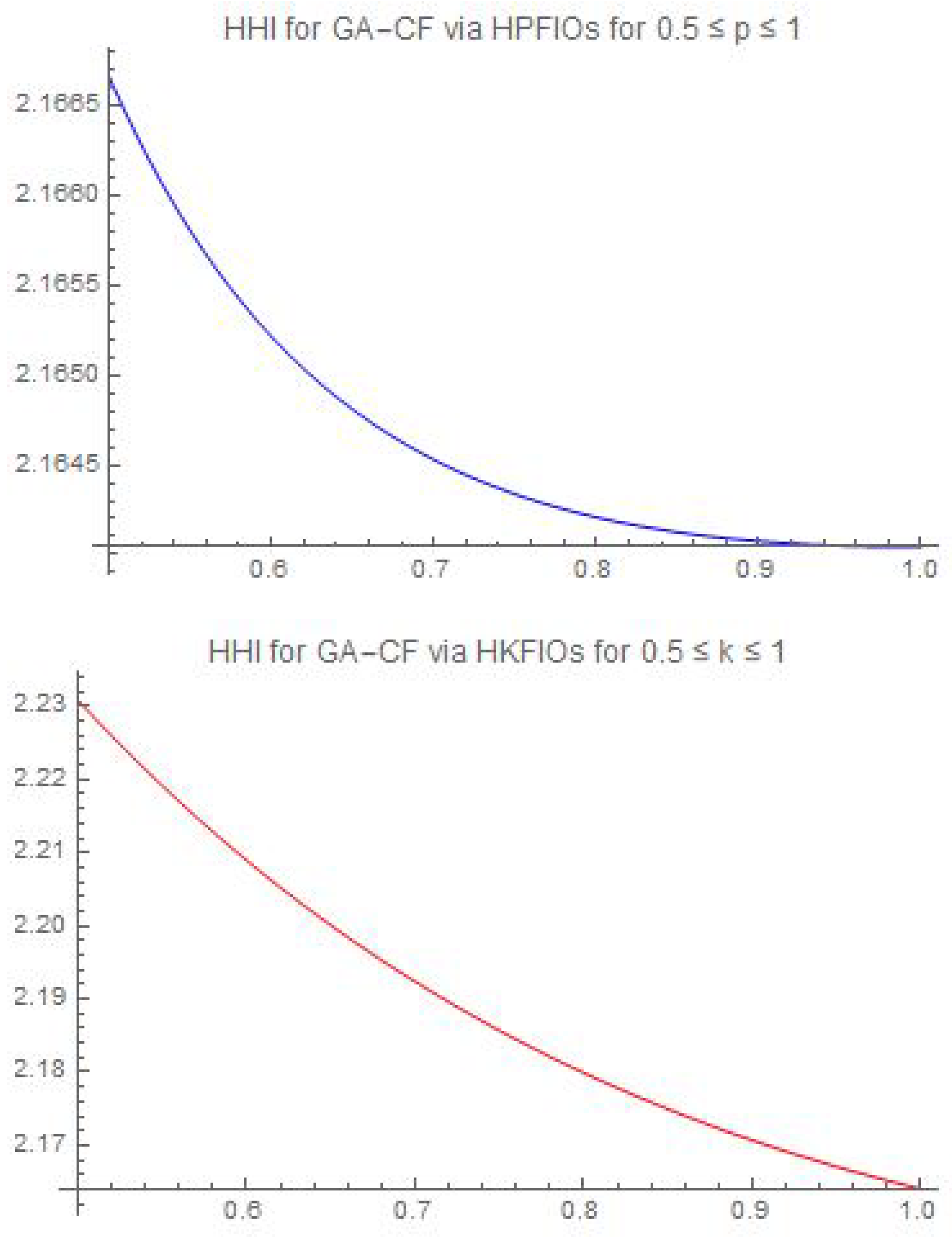
In this section, we compare two generalizations of the HHMI obtained via HPFIOs and HKFIOs. Note that the parameters contributing to generalizing the existing results are p and k in Section 3 and Section 4, respectively. So, in this section, we draw a comparison between generalizations by means of the obtained inequalities for different values of the parameter p and k. More specifically, we compare Corollary
and Corollary
by substituting a GA-CF and draw comparisons for p and k with
.
Example 1.
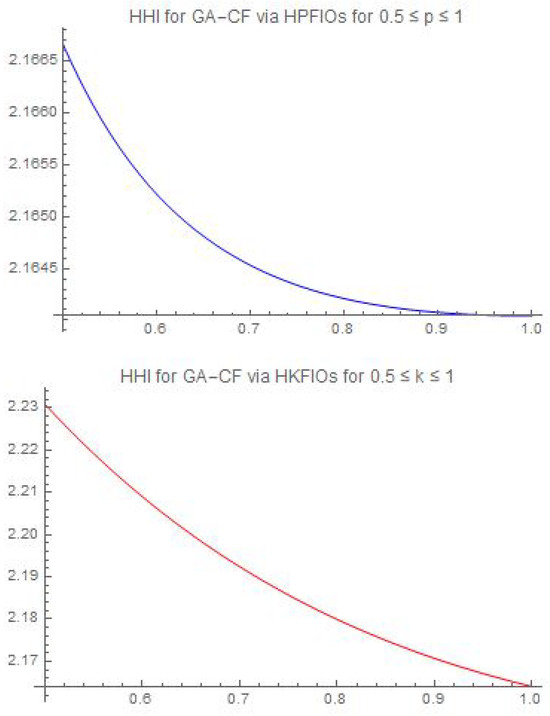


For any GA-CF f,
,
the inequalities corresponding to the parameter p and k, obtained from Corollary
and Corollary
are
and
Now, if we take
, for
. By page 156 of [25], the other meaning of GA convexity shows that a function f is GA-CF if
, the function f is GA-CF. Therefore, by using (16) and (17), we construct the graphical comparisons for
corresponding to
, as shown in Figure 1.
Figure 1.
HHI for
bounded below by 2 and above by
with respect to the parameters p and k.
In addition, Figure 2 shows the difference between the expressions obtained via HPFIO and HKFIO. The result shows that the estimation obtained via HPFIOs is less than the HKFIOs.
Figure 2.
Difference between the HHI obtained via HPFIOs and HKFIOs.
Finally, both values coincide at
, as shown in Figure 3.
Figure 3.
HPFIOs and HKFIOs coincide.
6. Applications
In this section, we present applications of the HHIs for GA-CFs obtained via HPFIOs and HKFIOs by establishing interpolation relations between the arithmetic mean and the geometric mean (AM-GM). Furthermore, we give a brief review of operator entropies and, by using Corollary
and Corollary
, obtain upper bounds for the Tsallis relative operator entropy.
We use the notation for the generalized logarithmic function
, which uniformly converges to the usual logarithmic function
as
. In the following theorem, we present applications of Corollary
proved by using HPFIOs with the parameter
.
Theorem 9.
Let
and
.
- (i)
- If , then
- (ii)
Proof.
From Corollary 3.4 with
, we obtain
for a GA–CF function and
. Since
we confirm the equalities in the above inequalities when
.
If we take
, then
so that we obtain from (19) the relation (18). It is easy to see that
are symmetric by the simple calculations
and
. Thus the relation (18) holds for all
.
Finally, we have (ii) by taking
with the limit
.
□
Remark 6.
- (i)
- The inequalities (18) give the improved inequality for the arithmetic–geometric mean inequality. Letting above, we also obtain the known relation among the arithmetic mean, the geometric mean, and the logarithmic mean:where the arithmetic mean , the geometric mean and the logarithmic mean with , since we have . Thus, the inequalities (18) give the new interpolation relation between the arithmetic mean and the geometric mean.
- (ii)
- We easily find thatIt is known thatwhere is called the harmonic mean and . Then, in Theorem 9 showsAlthough the second inequality is trivial, the first inequality is not trivial.
We give a brief review of relative operator entropies. A self–adjoint operator A acting on a Hilbert space
is called positive, and it is denoted by
if
for any vector
. A self-adjoint operator A is called strictly positive and it is denoted by
if A is positive and invertible. The order
for two self–adjoint operators
means
. For two positive operators
, we denote
If
, then
is called the operator geometric mean. For two positive operators
, the relative operator entropy
[41] and the Tsallis relative operator entropy
[42] are defined by
Note that
by
. See Section 7.3 of [43] and the references therein for recent results on the relative operator entropies. Applying the inequalities (19), we give upper bounds for the Tsallis relative operator entropy.
Theorem 10.
Let
, and let
be positive operators such that
. Then,
- (i)
- If , then
- (ii)
Proof.
Putting
and
in the inequalities (19), we obtain
which implies
Putting
with the standard functional calculus and multiplying
from both sides, we obtain (i).
If we take the limit
in (21), we have
since
. Thus, we obtain (ii) in a similar way to the above. □
If we take
in Theorem 10, then we have the upper bound of the relative operator entropy
for
.
Now, we present the applications of Corollary
obtained via HKFIOs with the parameter
. If we take
and
in Corollary
, then for
,
which also gives a new interpolational relation on the generalized logarithmic mean between the arithmetic mean and the geometric mean. We easily find that the above relation recovers (20) when
. Here, the Gamma k-function
[10] for
is defined as
However the calculations of the integrals in (22) are quite complicated. By using the computer software Mathematica version 8 [44], we obtain
where
We take
in Corollary 4.4. Then,
which gives
when
since
and
. (See [10].) Since
, the above relation is rewritten as
However, the above inequalities do not hold in general since
.
7. Conclusions
Motivated by the applicability of fractional calculus, mathematical inequalities, derived families of convex functions, and information sciences, we have investigated these topics together. The findings of this paper cover (i) generalizations in terms of multiple aspects and the unification of main results from [6,7,37,38], (ii) the comparison between new generalizations, and (iii), most importantly, applications to information sciences and interpolating means. Unlike the common development in mathematical inequalities, the current results not only cover the theoretical aspects but also provide comparisons between inequalities and applications. The applications of newly proved HHIs for GA-CFs obtained via HPFIOs and HKFIOs in determining interpolation relations between AM-GM and upper bounds for the Tsallis relative operator entropy is a distinct feature of this study.
Author Contributions
Conceptualization, Y.W. and A.F.; methodology, A.F., Z.A. and S.F.; software, Z.A.; validation, S.I.B., Y.W., A. and A.F.; investigation, A.F. and Z.A.; writing—original A.F., Z.A. and S.F.; draft preparation, A.F.; writing—review and editing, Y.W. and S.I.B.; supervision, Y.W.; project administration, Y.W.; funding acquisition, Y.W. All authors have read and agreed to the published version of the manuscript.
Funding
This work was partially supported by the National Natural Science Foundation of China under Grant 12171435, and the Postdoctoral Fellowship at Zhejiang Normal University, China, Grant No. YS304023966.
Institutional Review Board Statement
Not applicable.
Informed Consent Statement
Not applicable.
Data Availability Statement
No new data were created or analyzed in this study. Data sharing is not applicable to this article.
Acknowledgments
All the authors are thankful to their respective institutes.
Conflicts of Interest
The authors declare no conflicts of interest.
References
- Kai, D. The analysis of fractional differential equations: An application-oriented exposition using differential operators of Caputo type. In Lecture Notes in Mathematics; Springer: Berlin/Heidelberg, Germany, 2004. [Google Scholar]
- Alshammari, S.; Alshammari, M.; Alabedalhadi, M.; Al-Sawalha, M.M.; Al-Smadi, M. Numerical investigation of a fractional model of a tumor-immune surveillance via Caputo operator. Alex. Eng. J. 2024, 86, 525–536. [Google Scholar] [CrossRef]
- Ferrari, A.L.; Gomes, M.C.S.; Aranha, A.C.R.; Paschoal, S.M.; de Souza, M.G.; de Matos, J.L.M.; Defendi, R.O. Mathematical modeling by fractional calculus applied to separation processes. Sep. Purif. Technol. 2024, 337, 126310. [Google Scholar] [CrossRef]
- Set, E.; Kashuri, A.; Mumcu, I. Chebyshev type inequalities by using generalized proportional Hadamard fractional integrals via Polya–Szegö inequality with applications. Chaos Solitons Fractals 2021, 146, 110860. [Google Scholar] [CrossRef]
- Kilbas, A.A.; Srivastava, H.M.; Trujillo, J.J. Theory and Applications of Fractional Differential Equations; Elsevier: Amsterdam, The Netherlands, 2006; Volume 204. [Google Scholar]
- Fahad, A.; Ayesha; Wang, Y.; Butt, S.I. Jensen–Mercer and Hermite–Hadamard–Mercer Type Inequalities for GA-h-Convex Functions and Its Subclasses with Applications. Mathematics 2023, 11, 278. [Google Scholar] [CrossRef]
- Iscan, I. Jensen—Mercer inequality for GA-convex functions and some related inequalities. J. Inequalities Appl. 2020, 212, 212. [Google Scholar] [CrossRef]
- Rahman, G.; Abdeljawad, T.; Jarad, F.; Khan, A.; Nisar, K.S. Certain inequalities via generalized proportional Hadamard fractional integral operators. Adv. Differ. Equ. 2019, 2019, 454. [Google Scholar] [CrossRef]
- Gambo, Y.Y.; Jarad, F.; Baleanu, D.; Abdeljawad, T. On Caputo modification of the Hadamard fractional derivatives. Adv. Differ. Equ. 2014, 2014, 10. [Google Scholar] [CrossRef]
- Iqbal, S.; Mubeen, S.; Tomar, M. On Hadamard k-fractional integrals. J. Fract. Calc. Appl. 2018, 9, 255–267. [Google Scholar]
- Tarasov, V.E. Entropy interpretation of Hadamard type fractional operators: Fractional cumulative entropy. Entropy 2022, 24, 1852. [Google Scholar] [CrossRef]
- Todinov, M. Reverse Engineering of Algebraic Inequalities for System Reliability Predictions and Enhancing Processes in Engineering. IEEE Trans. Reliab. 2023, 73, 902–911. [Google Scholar] [CrossRef]
- Huang, J.; Luo, D. Relatively exact controllability for higher-order fractional stochastic delay differential equations. Inf. Sci. 2023, 648, 119631. [Google Scholar] [CrossRef]
- Aydin, F. Boundary-aware local Density-based outlier detection. Inf. Sci. 2023, 647, 119520. [Google Scholar] [CrossRef]
- Akhtar, N.; Awan, M.U.; Javed, M.Z.; Rassias, M.T.; Mihai, M.V.; Noor, M.A.; Noor, K.I. Ostrowski type inequalities involving harmonically convex functions and applications. Symmetry 2021, 13, 201. [Google Scholar] [CrossRef]
- Khan, Z.A.; Afzal, W.; Nazeer, W.; Asamoah, J.K.K. Some New Variants of Hermite–Hadamard and Fejér-Type Inequalities for Godunova–Levin Preinvex Class of Interval-Valued Functions. J. Math. 2024, 2024, 8814585. [Google Scholar] [CrossRef]
- Mohammed, P.O.; Abdeljawad, T.; Alqudah, M.A.; Jarad, F. New discrete inequalities of Hermite–Hadamard type for convex functions. Adv. Differ. Equ. 2021, 2021, 122. [Google Scholar] [CrossRef]
- Srivastava, H.M.; Sahoo, S.K.; Mohammed, P.O.; Baleanu, D.; Kodamasingh, B. Hermite–Hadamard type inequalities for interval-valued preinvex functions via fractional integral operators. Int. J. Comput. Intell. Syst. 2022, 15, 8. [Google Scholar] [CrossRef]
- Huy, D.Q.; Van, D.T.T. Some inequalities for convex functions and applications to operator inequalities. Asian-Eur. J. Math. 2023, 16, 2350216. [Google Scholar] [CrossRef]
- Yang, W. Certain new weighted Young and Polya Szego-type inequalities for unified fractional inegral operators via an extended generalized Mittag-Leffler function with applications. Fractals 2022, 30, 2250106. [Google Scholar] [CrossRef]
- Beckenbach, E.F. Convex functions. Bull. Am. Math. Soc. 1948, 54, 439–460. [Google Scholar] [CrossRef]
- Noor, M.A.; Noor, K.I.; Rassias, M.T. Characterizations of higher order strongly generalized convex functions. Nonlinear Anal. Differ. Equ. Appl. 2021, 341–364. [Google Scholar]
- Luo, C.; Wang, H.; Du, T. Fejér—Hermite—Hadamard type inequalities involving generalized h-convexity on fractal sets and their applications. Chaos Solitons Fractals 2020, 131, 109547. [Google Scholar] [CrossRef]
- Mihai, M.V.; Noor, M.A.; Noor, K.I.; Awan, M.U. Some integral inequalities for harmonic h-convex functions involving hypergeometric functions. Appl. Math. Comput. 2015, 252, 257–262. [Google Scholar] [CrossRef]
- Niculescu, C.P. Convexity according to the geometric mean. Math. Inequal. Appl. 2000, 3, 155–167. [Google Scholar] [CrossRef]
- Latif, M.A.; Dragomir, S.S.; Momoniat, E. Some Fejér type integral inequalities for geometrically-arithmetically-convex functions with applications. Filomat 2018, 32, 2193–2206. [Google Scholar] [CrossRef]
- Noor, M.A.; Noor, K.I.; Awan, M.U. Some inequalities for geometricallyarithmetically h-convex functions. Creat. Math. Inform 2014, 23, 91–98. [Google Scholar] [CrossRef]
- Fahad, A.; Wang, Y.; Ali, Z.; Hussain, R.; Furuichi, S. Exploring properties and inequalities for geometrically arithmetically-Cr-convex functions with Cr-order relative entropy. Inf. Sci. 2024, 662, 120219. [Google Scholar] [CrossRef]
- Fahad, A.; Ali, Z.; Furuichi, S.; Wang, Y. Novel fractional integral inequalities for GA-Cr-convex functions and connections with information systems. Alex. Eng. J. 2025, 113, 509–515. [Google Scholar] [CrossRef]
- Dragomir, S.S.; Pearce, C. Selected Topics on Hermite–Hadamard Inequalities and Applications. Science Direct Working Paper No S1574-0358(04)70845-X. Available online: https://ssrn.com/abstract=3158351 (accessed on 14 October 2024).
- Ozdemir, M.E.; Ragomir, S.S.; Yildiz, C. The Hadamard inequality for convex function via fractional integrals. Acta Math. Sci. 2013, 33, 1293–1299. [Google Scholar] [CrossRef]
- Sun, W.; Liu, Q. Hadamard type local fractional integral inequalities for generalized harmonically convex functions and applications. Math. Methods Appl. Sci. 2020, 43, 5776–5787. [Google Scholar] [CrossRef]
- Sun, W. Some new inequalities for generalized h-convex functions involving local fractional integral operators with Mittag-Leffler kernel. Math. Methods Appl. Sci. 2021, 44, 4985–4998. [Google Scholar] [CrossRef]
- Vivas, M.; Hernández, J.; Merentes, N. New Hermite–Hadamard and Jensen type inequalities for h-convex functions on fractal sets. Rev. Colomb. MatemáTicas 2016, 50, 145–164. [Google Scholar] [CrossRef]
- Chen, J.; Luo, C. Certain generalized Riemann–Liouville fractional integrals inequalities based on exponentially (h, m)-preinvexity. J. Math. Anal. Appl. 2024, 530, 127731. [Google Scholar] [CrossRef]
- Du, T.; Peng, Y. Hermite–Hadamard type inequalities for multiplicative Riemann–Liouville fractional integrals. J. Comput. Appl. Math. 2024, 440, 115582. [Google Scholar] [CrossRef]
- Iscan, I. New general integral inequalities for quasi-geometrically convex functions via fractional integrals. J. Inequal. Appl. 2013, 491. [Google Scholar] [CrossRef]
- Kunt, M.; Iscan, I. Fractional Hermite–Hadamard–Fejér type inequalities for GA-convex functions. Turk. J. Inequal. 2018, 2, 1–20. [Google Scholar]
- Pachpatte, B.G. Integral and Finite Difference Inequalities and Applications; Elsevier: Amsterdam, The Netherlands, 2006. [Google Scholar]
- Varosanec, S. On h-convexity. J. Math. Anal. Appl. 2007, 326, 303–311. [Google Scholar] [CrossRef]
- Fujii, J.I. Relative operator entropy in noncommutative information theory. Math. Jpn. 1990, 35, 387–396. [Google Scholar]
- Yanagi, K.; Kuriyama, K.; Furuichi, S. Generalized Shannon inequalities based on Tsallis relative operator entropy. Linear Algebra Its Appl. 2005, 394, 109–118. [Google Scholar] [CrossRef]
- Furuichi, S. Advances in Mathematical Inequalities; Walter de Gruyter GmbH Co KG: Berlin, Germany, 2020. [Google Scholar]
- A Scientific and Technical Computing System Developed by Wolfram Research. Available online: https://www.wolfram.com/mathematica (accessed on 14 October 2024).


Disclaimer/Publisher’s Note: The statements, opinions and data contained in all publications are solely those of the individual author(s) and contributor(s) and not of MDPI and/or the editor(s). MDPI and/or the editor(s) disclaim responsibility for any injury to people or property resulting from any ideas, methods, instructions or products referred to in the content. |
© 2024 by the authors. Licensee MDPI, Basel, Switzerland. This article is an open access article distributed under the terms and conditions of the Creative Commons Attribution (CC BY) license (https://creativecommons.org/licenses/by/4.0/).