


Abstract
This research proposes a method for reducing the dimension of the coefficient vector for Crank–Nicolson mixed finite element (CNMFE) solutions to solve the fourth-order variable coefficient parabolic equation. Initially, the CNMFE schemes and corresponding matrix schemes for the equation are established, followed by a thorough discussion of the uniqueness, stability, and error estimates for the CNMFE solutions. Next, a matrix-form reduced-dimension CNMFE (RDCNMFE) method is developed utilizing proper orthogonal decomposition (POD) technology, with an in-depth discussion of the uniqueness, stability, and error estimates of the RDCNMFE solutions. The reduced-dimension method employs identical basis functions, unlike standard CNMFE methods. It significantly reduces the number of unknowns in the computations, thereby effectively decreasing computational time, while there is no loss of accuracy. Finally, numerical experiments are performed for both fourth-order and time-fractional fourth-order parabolic equations. The proposed method demonstrates its effectiveness not only for the fourth-order parabolic equations but also for time-fractional fourth-order parabolic equations, which further validate the universal applicability of the POD-based RDCNMFE method. Under a spatial discretization grid
, the traditional CNMFE method requires
degrees of freedom at each time step, while the RDCNMFE method reduces the degrees of freedom to
through POD technology. The numerical results show that the RDCNMFE method is nearly 10 times faster than the traditional method. This clearly demonstrates the significant advantage of the RDCNMFE method in saving computational resources.
1. Introduction
This research focuses on exploring the fourth-order variable coefficient parabolic equation with the initial-boundary value
is a bounded convex polygonal domain.
is a boundary of
.
.
is a known initial function.
,
satisfying
for some positive constants,
,
,
,
, and
.
is a positive constant.
satisfies the following properties
For simplicity, we assume that
in the following theoretical analysis.
The fourth-order parabolic equations are commonly used to describe higher-order physical behaviors, such as considering the internal damping or viscoelastic properties of materials. Within the category of fourth-order parabolic equations, models such as the Cahn—Hilliard equation [1,2], the fourth-order reaction–diffusion equation [3,4], and the Swift–Hohenberg equation [5] are included. Due to the inclusion of higher-order derivatives, solving and analyzing these kinds of equations is usually more complex and often requires the use of numerical methods. Currently, a range of numerical methods are applied to address fourth-order parabolic equations, for example, the finite element (FE) method [1,6,7], mixed finite element method (MFE) [3,8,9,10], discontinuous space–time MFE method [11,12], two-grid MFE method [13,14], weak Galerkin FE method [2,15], finite difference method [16], implicit compact difference method [17,18,19,20], cubic spline method [21], blow-up method [22,23,24,25], and so on. In this paper, the MFE method is employed to study the fourth-order variable coefficient parabolic equation for spatial analysis. The Crank–Nicolson (CN) scheme is used for time discretization.
A prevalent challenge in addressing high-order partial differential equations (PDEs) through the MFE method is the rapid escalation of unknown dimensions when dealing with coupled equations, often resulting in a doubling of the data volume processed. Such significantly elevated dimensions not only heighten memory requirements but also substantially escalate computational costs. In practical scenarios, this increased computational burden can pose a significant barrier to solving complex PDE problems. An effective strategy for mitigating these challenges involves the implementation of order reduction techniques. The primary objective of these techniques is to minimize the number of variables considered during the solution process using mathematical methods, thereby alleviating computational demands while preserving as much as possible a good approximation quality. Currently, several effective numerical reduced-order methods have gained widespread application, including the POD method [26,27], the spectral element method [28], the sparse grid method [29], and the balanced truncation method [30].
Certainly, integrating POD technology with diverse numerical methods can effectively address a range of PDEs. It is the most widely utilized method for dimensionality reduction, and it has been attracting increasing attention. Refs [31,32] combined the compact difference method and POD technique to study the fourth-order parabolic equation. Zhao and Piao [33] studied the KDV-RLW-Rosenau equation using the POD method in conjunction with B-spline Galerkin FE formulations. In [34], the heat equation was addressed using the POD reduced-order methods and the two-step backward differentiation formula (BDF2). Janes and Singler [35] solved the damped wave equation through the POD method and second difference quotients (DDQs). He et al. [36] employed a space-time FE method that integrates a POD-based extrapolation with DG time stepping to analyze the parabolic equation. Lu et al. [37] merged the POD method with a collocation approach using local radial basis functions (RBFs) to address time-dependent nonlocal diffusion problems.
For the POD-based FE and MFE reduced-dimension models, there are two existing methods. The first involves establishing optimized models that reduce the dimensions of the FE or the MFE subspaces. For further references, please consult [38,39,40,41,42,43,44]. The second, introduced by Luo et al. in 2020, presents an innovative strategy for the dimension reduction in CNFE [45,46] and CNMFE [47,48,49,50,51] solution coefficient vectors. To our understanding, no existing literature has documented simplifying the solution coefficient vectors of CNMFE scheme using POD technology in solving fourth-order variable coefficient parabolic equations. This paper’s primary objective is to present a rapid algorithm capable of solving fourth-order variable coefficient parabolic equations. Since the proposed methods prove to be computationally effective for both fourth-order and time-fractional fourth-order parabolic equations, we naturally extend their application to time-fractional fourth-order parabolic equations. For the time-fractional derivative term
, we employ the Caputo derivative, defined as
This research is organized as follows: Section 2 discusses the CNMFE scheme, detailing its uniqueness, stability, and convergence. Section 3 is dedicated to constructing a POD-based RDCNMFE matrix model while also analyzing its uniqueness, stability, and error estimates. In Section 4, we perform numerical simulations on 2D fourth-order and time-fractional fourth-order variable coefficient parabolic equations, respectively. Finally, Section 5 summarizes the key results and conclusions of the research.
2. The CNMFE Method for the Fourth-Order Variable Coefficient Parabolic Equation
2.1. The CNMFE Scheme
In this paper, the Sobolev spaces and the associated norms adhere to the conventional definitions commonly found in the existing literature [52]. To construct the CNMFE scheme for the fourth-order variable coefficient parabolic Equation (1), we begin by introducing a diffusion term defined as
. This introduces a pair of lower-order equations
Utilizing Green’s integration formula in the variational framework leads to the weak mixed formulation of (5), which is explicitly constructed below.
Problem 1.
Find
:
, such that
Given a quasi-uniform triangulation,
on
, the finite element subspace
is spanned by the following orthonormal basis
where
is a polynomial space of
degree, M is the dimension of the space
, and
satisfies
For a positive integer, N, define
,
,
, and
. Hence, Problem 1 can be reformulated at time
as follows.
The equivalent equation is that
where
When
, we define the CNMFE approximations of
as
. Therefore, we can formulate the CNMFE scheme of Problem 1 using the form below.
Problem 2.
For
, find
, such that
Remark 1
[50] [Formula (12)]. When the linearized term
is used, it is evident that Equation (13) is structured in a linear format.
2.2. The Uniqueness, Stability, and Error Estimates of the CNMFE Solutions
Utilizing the orthonormal basis of the finite element space
, the CNMFE approximations
to Problem 2 can be expressed as
in which
is the orthonormal basis function vector.
and
represent the unknown CNMFE solution coefficient vectors. With the solutions
defined in (15), we obtain the following matrix form for Problem 2.
Problem 3.
For
, find
and
that satisfy
where
and
Theorem 1.
Given that
is small enough, the uniqueness of the CNMFE solutions
is guaranteed for Problem 3.
Proof of Theorem 1.
Problem 3 can alternatively be expressed as
where
denotes the
identity matrix, and
stands for a zero-column vector of
.
Due to
where
represents the
zero matrix, because
is small enough,
is invertible. Hence, the coefficient matrix of (17) is invertible; then, there exists the unique solutions
for Problem 3. □
It is necessary to discuss the characteristics of
and
in Problem 3 to analyze the stability.
Lemma 1
([53] [Lemma 1.19]). Matrices
and
are positively definite, and they satisfy
Theorem 2.
The CNMFE solutions
have unconditional stability.
Proof of Theorem 2.
We reformulate (16) as
Inserting the second Equation of (20) into the first, and considering that
is positive definite, we obtain
Letting
, and performing the inner product of (21) with
, we derive
Then, two sides of (22) are as follows:
and
Combining Lemma 1, we obtain
From (3), we get
so
Combining (23), (24) and (28), we have
Multiplying (29) by
, summating from 2 to n, and noting that
, we have
We apply the Gronwall inequality to (30) to obtain
And because
from (31) and (32), we get
Given that
, it easily follows that
As indicated by (33) and (34), the CNMFE solution coefficient vectors
are bounded, implying that the CNMFE solutions
retain unconditional stability. □
It is essential to define the projection operators
and
in order to analyze the convergence of the CNMFE solutions.
Lemma 2.
The projection
is defined by
with the following estimates:
Lemma 3.
The projection
is defined by
with the following estimates
Errors can be divided to simplify theoretical analyses as follows:
When subtracting (13) from (9) and using (35) and (38) at
, the error equations are derived as
The following lemma is presented to derive error estimates. The lemma can be straightforwardly obtained through Taylor expansion.
Lemma 4
([54]). and
hold the error estimates as follows:
Based on Lemmas 2–4, we can establish the theorems that concern the fully discrete error estimates for the Crank–Nicolson method.
Theorem 3.
Given that the solutions to (6) adhere to regularity conditions with
,
,
, a positive constant, C, can be found, that is independent of h and
, satisfying
in which
.
Proof of Theorem 3.
Setting
and
in (43) and (44), respectively, we obtain
Subtracting (49) from (48), we have
Multiplying (50) by
, summating from
, and considering that
and
, we obtain
For the nonlinear term
, from reference [50], we have
Substituting (52) into (51), and using the Gronwall inequality and
, we get
We note that
Substituting (54) and (55) into (53) and combining Lemma 4, we obtain
The proof of (47) is effectively completed, combining Lemmas 2, 3, (56), and the triangle inequality. □
Theorem 4.
With
and
, given that the solutions to (6) adhere to regularity conditions with
,
,
, it follows that a positive constant, C, exists, independent of h and
, satisfying
Proof of Theorem 4.
From (44), we can get
Taking
and
in (43) and (58), respectively, we obtain
From (59), we have
so
Substituting (62) into (60) yields
Multiplying (63) by
, summating from
, and employing (54) and (55), we get
Utilizing the Gronwall inequality and (52), we derive
Substituting (56) and Lemma 4 into (65), we get
By combining the results from Lemmas 2 and 3 with (66), and employing the triangle inequality, the complete proof is established. □
3. The POD-Based RDCNMFE Method for the Fourth-Order Variable Coefficient Parabolic Equation
3.1. Structure of POD Bases
Initially, by computing the first
-step coefficient vectors
via Problem 3, the snapshot matrices
and
are generated. Next, we compute the eigenvalues and eigenvectors of matrices
. We organize the eigenvalues as
. The eigenvectors form the eigenmatrix
. Lastly, the initial d vectors of
are selected as the POD bases
, such that
in which
and
for vector
. For
, it can be concluded that
denote standard unit vectors, satisfying
. Consequently,
represent the optimal sets of POD bases.
Remark 2.
Here,
,
, where
. However, their positive eigenvalues are the same, and we can compute the first d eigenvalues,
, and eigenvectors,
, of the matrices
. Then, we can derive the eigenvectors for
through the relationships
. This approach facilitates the creation of POD bases
.
.
3.2. The RDCNMFE Scheme
Initially, we let
and
, and we define the RDCNMFE solution coefficient vectors as follows:
and
. Next, the first
RDCNMFE solution coefficient vectors are promptly derived using
and
, for
, as outlined in Section 3.1. Finally, for the subsequent time steps
, we employ
and
, replacing the original CNMFE solution vectors
in Problem 3. This allows us to develop the following RDCNMFE matrix scheme.
Problem 4.
Find
and
, such that
Here,
denotes the first
solution vectors of Problem 3. The definitions of matrix
,
, and vector
, along with the FE basis vectors
, are detailed in Section 2.2.
3.3. The Uniqueness, Stability, and Error Estimate of the RDCNMFE Solutions
Theorem 5.
With the assumptions laid out in Theorems 3 and 4, we consider
as the solutions of Problem 1 and
as reduced-dimension solutions to Problem 4. Then, the RDCNMFE solutions are both unique and unconditionally stable for
, and they have the error estimate as follows.
Proof of Theorem 5.
- (1)
- Demonstrate the uniqueness.(i) When .The uniqueness of the solutions for Problem 3 is guaranteed through Theorem 1.Consequently, the corresponding solutions, , derived from the first and fourth expressions of Problem 4, also have uniqueness.(ii) When .Through the application of and , the last three equations of Problem 4 are reformulated asFor , the uniqueness of the solutions for Problem 3 is guaranteed. (72)–(74) adhere to the identical structure, as presented in Problem 3. Thus, the solutions for (72)–(74) have uniqueness.
- (2)
- Analyze the stability.(i) When .When applying Theorem 2 and considering the orthonormality of the vectors in and , it follows that(ii) When .From the positive definite symmetry of matrix , (72) can be reformulated asSubstituting (73) into (76), and since is positive definite, we obtainLetting , and taking the inner product of (77) and , we haveThen, two sides of (78) are such thatandSimilar to (25), we obtainCombining (79), (80), and (81), we haveMultiplying (82) by and summating from 2 to n, it follows thatNoting thatputting (84) into (83), we haveUsing the Gronwall inequality for (85),AndSo, we getBecause of , we getBased on (75) and (89), the solutions exhibit unconditional stability.
- (3)
- Discuss the error estimates. (i) For .According to (68) and (69), and considering , we obtain(ii) For .Defining and , and combining (20), (76), and (73), we obtainPutting (92) into (91), and since is positively definite, we haveLetting , we obtainTaking the inner product of (94) and ,Then, two sides of (95) are such thatandUsing Lemma 1, (31), and (86), we can estimate the first term of (97) as follows:Combining (96), (97), and (98), we haveMultiplying (99) by and summating from to , we deriveNoting thatPutting (101) into (100), from (68) and (69), we haveWhen applying the Gronwall’s inequality for (102),Andthus, we getBecause of , we haveCombining Theorems 3 and 4 and formula (90) and (106), and utilizing the triangle inequality, we derive
□
4. The Numerical Experiments for the Fourth-Order Parabolic Equations
For the purpose of assessing the effectiveness of the proposed methods, numerical experiments were conducted. A detailed comparison between the reduced-dimension model and the standard CNMFE model is provided, focusing on the
error, convergence orders, and runtime.
4.1. The Fourth-Order Variable Coefficient Parabolic Equation
For analysis, we conducted experiments on the specified fourth-order parabolic equation.
Solving Problem 3 yields the standard CNMFE solutions
. In order to get the RDCNMFE solutions
, the four steps are as follows.
- Step 1:
- In order to generate the snapshot matrices and , the initial CNMFE solution vectors are calculated via Problem 3.
- Step 2:
- Calculate the eigenvalues and the corresponding eigenvectors of the matrix . Sort the eigenvalues in descending order.
- Step 3:
- Through calculation, it is observed that . From the matrix , the first 6 eigenvectors can be selected. Applying the formula , we construct the POD bases .
- Step 4:
- Inserting the result into Problem 4 and calculating the RDCNMFE solutions.
Example 1.
We explore the model (108) in
with the analytical solution
. Choosing
,
, the source term is
Since
, the analytical solution of q is
.
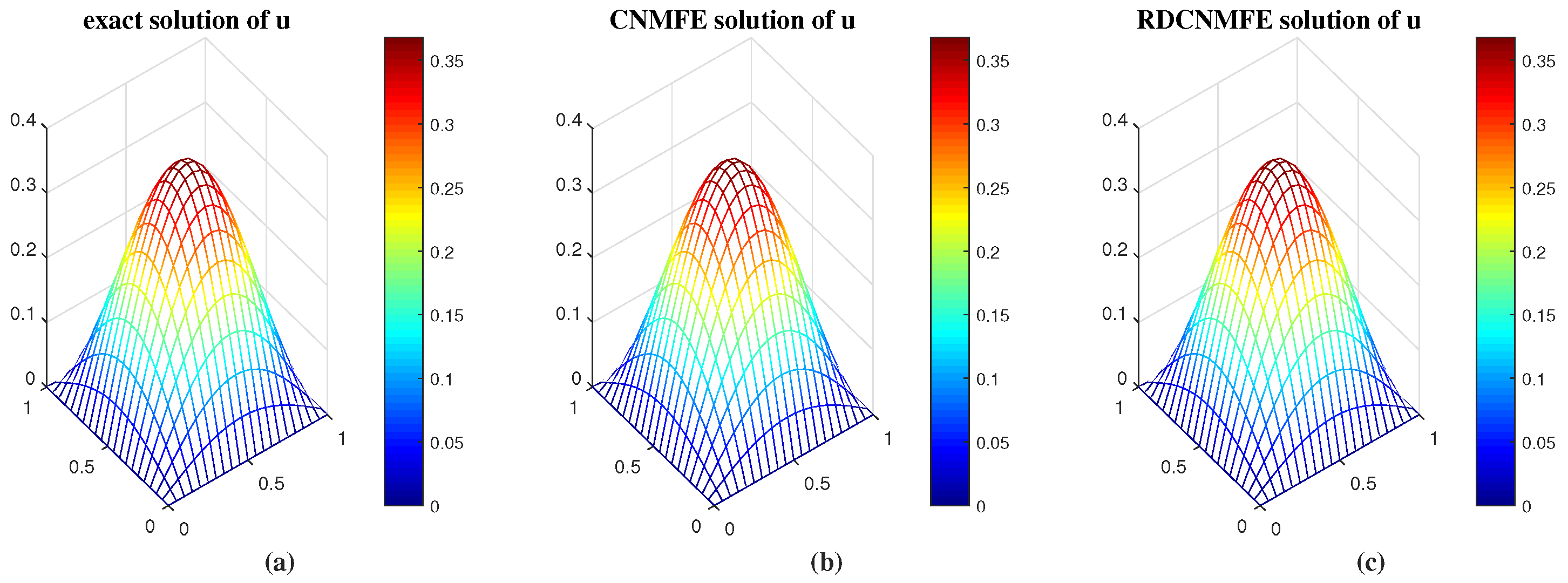
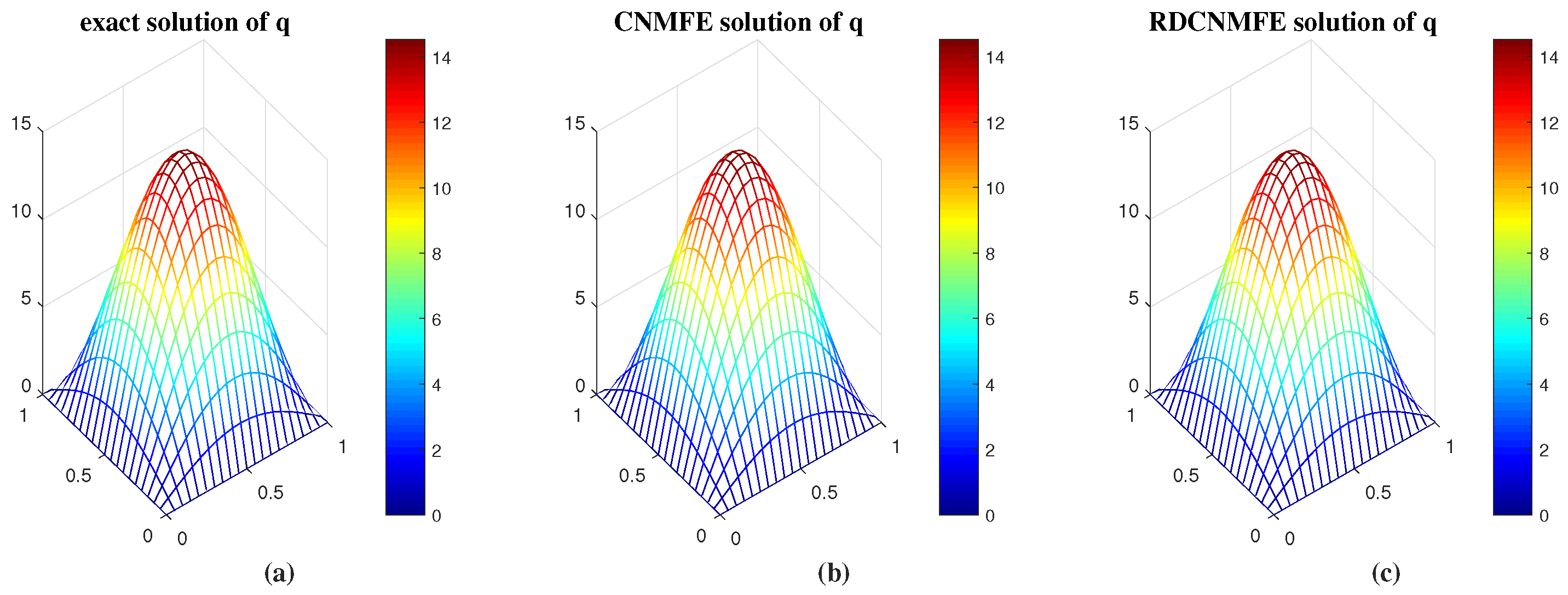
When
, with
and
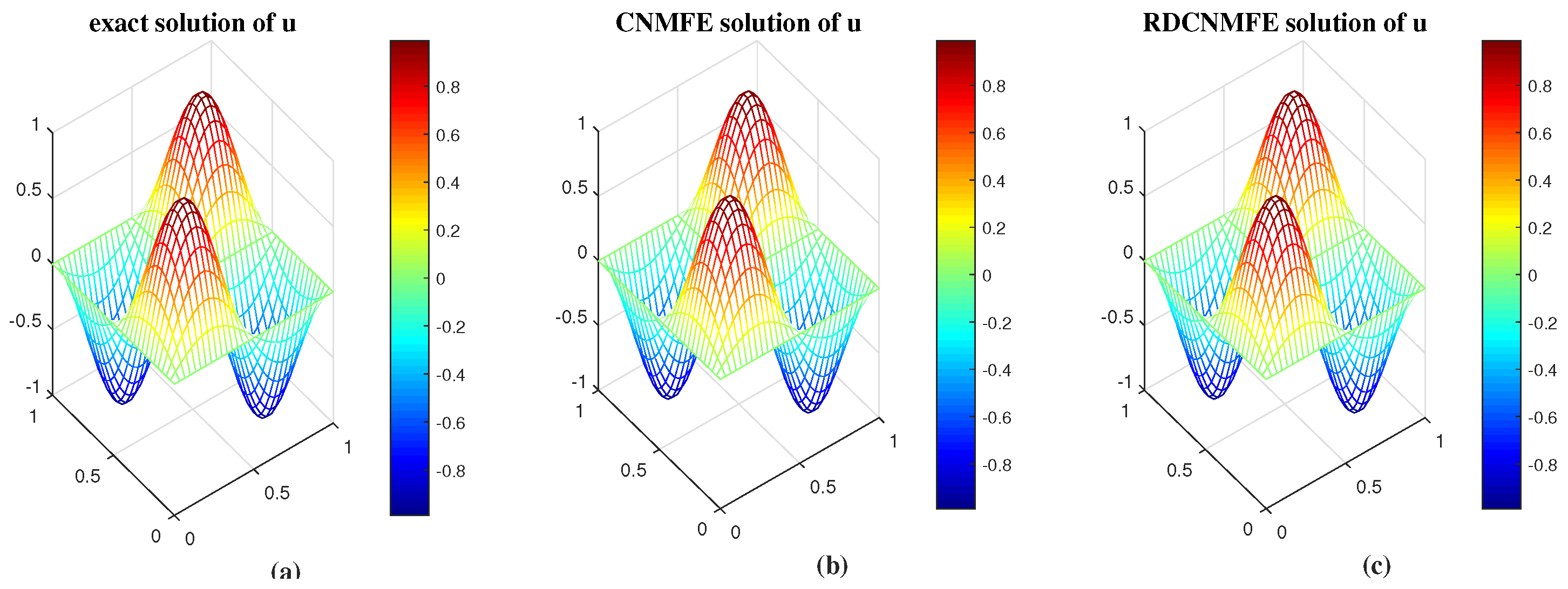
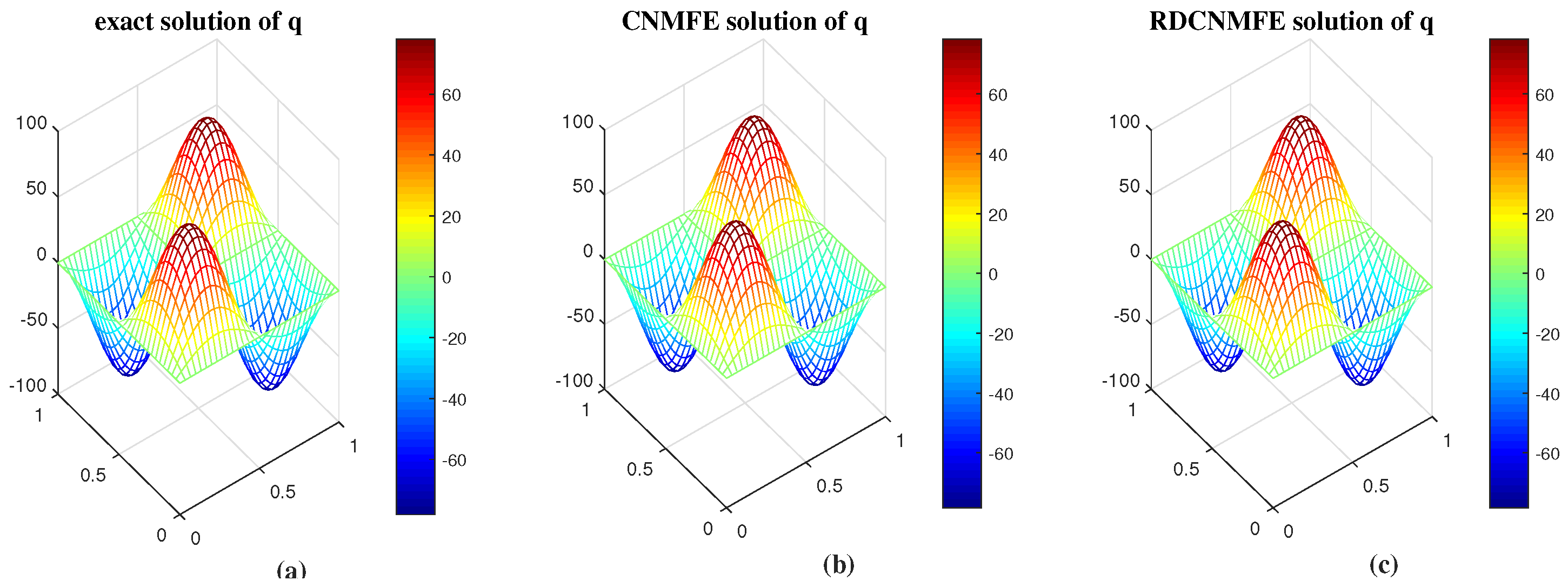
, we get the standard CNMFE solutions and RDCNMFE solutions. They are compared with the exact solutions, as shown in Figure 1 and Figure 2. Obviously, both methods simulate the exact solutions very well.
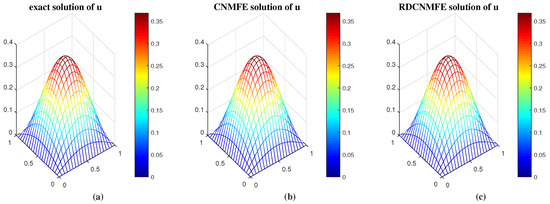
Figure 1.
(a) The exact solution
. (b) The CNMFE solution
. (c) The RDCNMFE solution
.
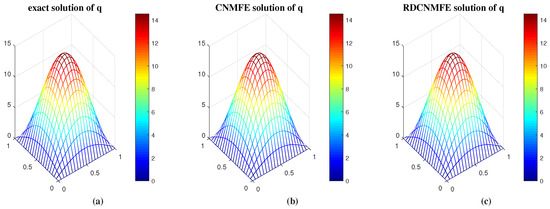
Figure 2.
(a) The exact solution
. (b) The CNMFE solution
. (c) The RDCNMFE solution
.
When
and
, so as to enable an easier comparison, we use both methods to calculate the
errors and convergence rates of
, as shown in Table 1 and Table 2.

Table 1.
errors and convergence orders between the analytical, CNMFE, and RDCNMFE solutions of u.
Table 2.
errors and convergence orders between the analytical, CNMFE, and RDCNMFE solutions of q.
When
, with
and
, we record the
error obtained and the CPU runtime required using both methods to further examine the efficacy of the POD-based RDCNMFE method, as shown in Table 3. The data indicate that both methods obtain the same
errors. With each incremental second, the conventional CNMFE method increases by approximately 260 s, whereas the RDCNMFE method only increases by just over 10 s.
Table 3.
Comparison of
errors and CPU runtime of CNMFE and RDCNMFE solutions.
Example 2.
We explore the model (108) in
with the analytical solution
. With
,
, the source term is
The analytical solution of q is
.
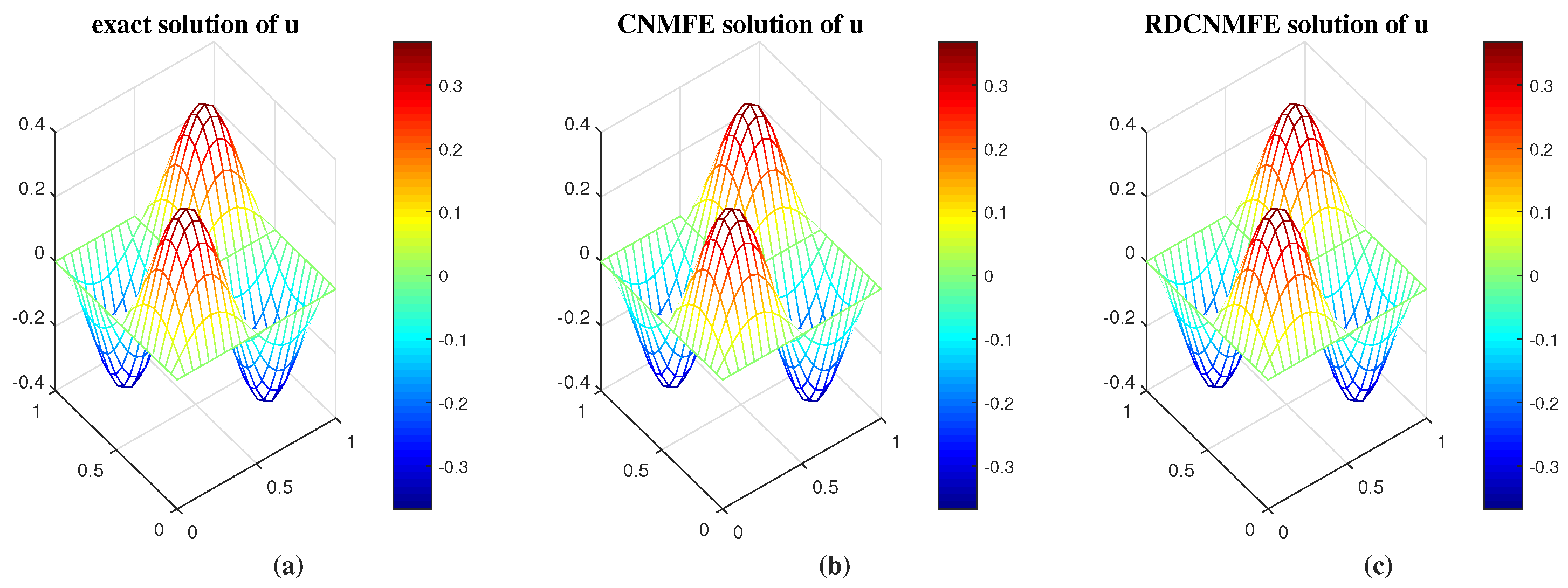
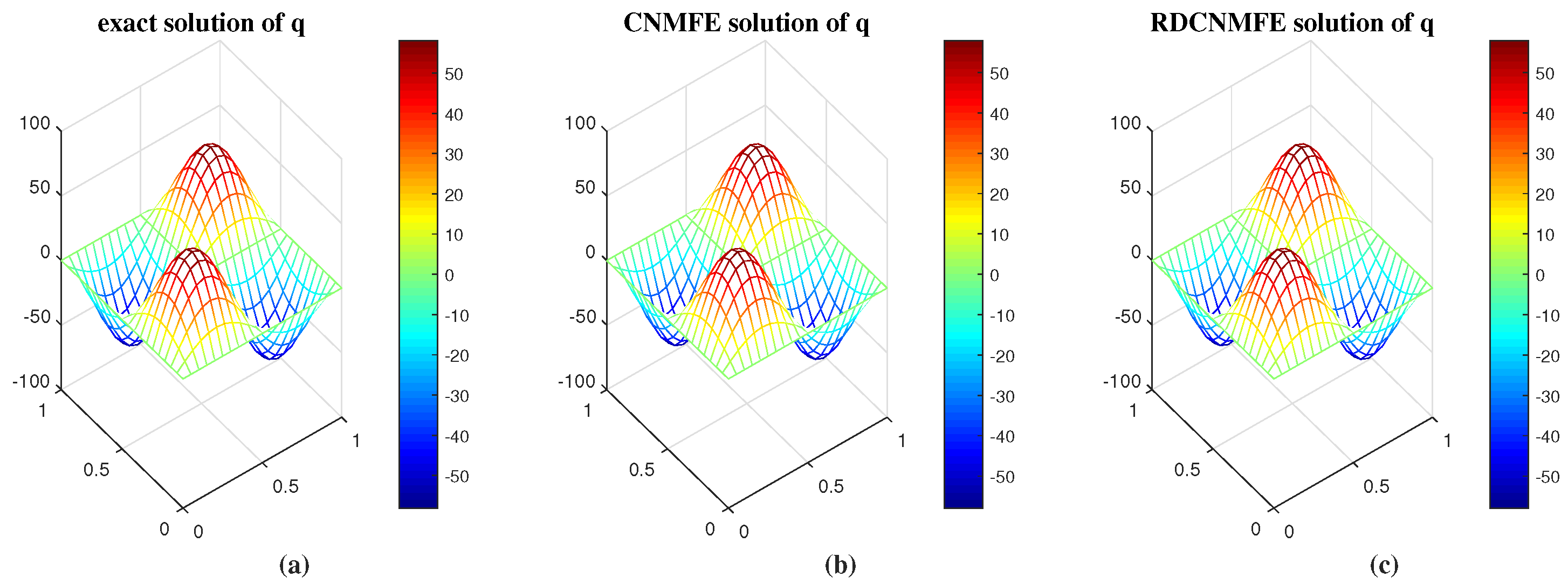
When
, setting
and
, we employ the CNMFE and RDCNMFE methods to obtain the numerical solutions for Equation (18), which has the noted source term (110). Both solutions to
are compared with the exact solutions. It can be seen clearly from Figure 3 and Figure 4 that both solutions closely approximate the exact solutions.
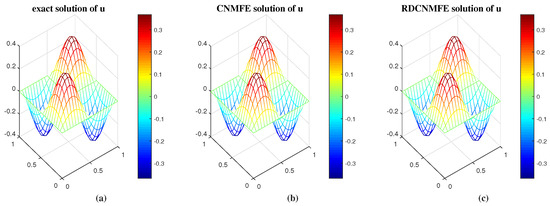
Figure 3.
(a) The exact solution
. (b) The CNMFE solution
. (c) The RDCNMFE solution
.
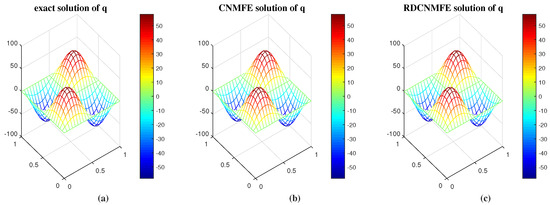
Figure 4.
(a) The exact solution
. (b) The CNMFE solution
. (c) The RDCNMFE solution
.
When
, setting
and
, calculating the CNMFE and reduced-dimension solutions of
. Then we get the
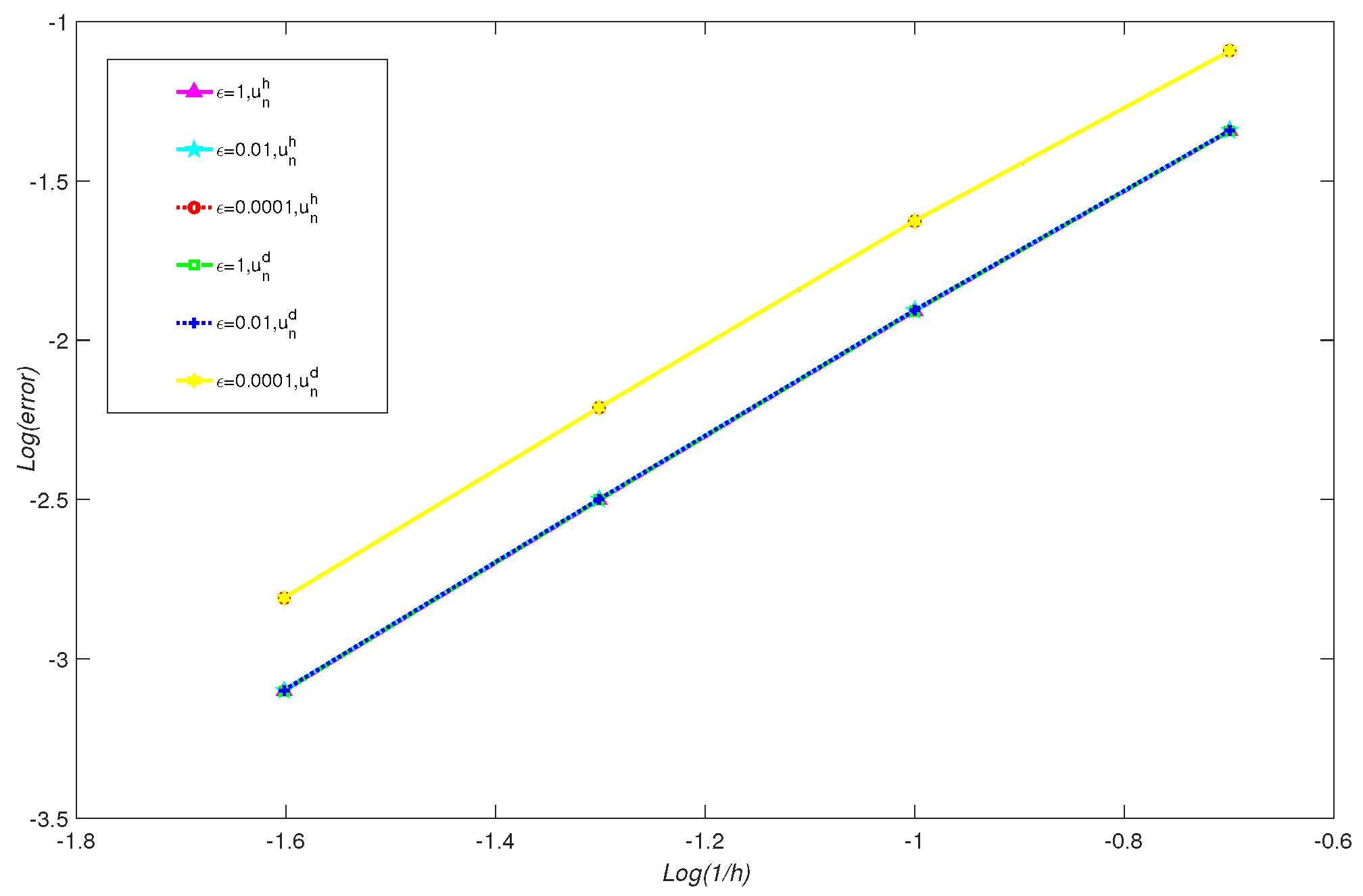
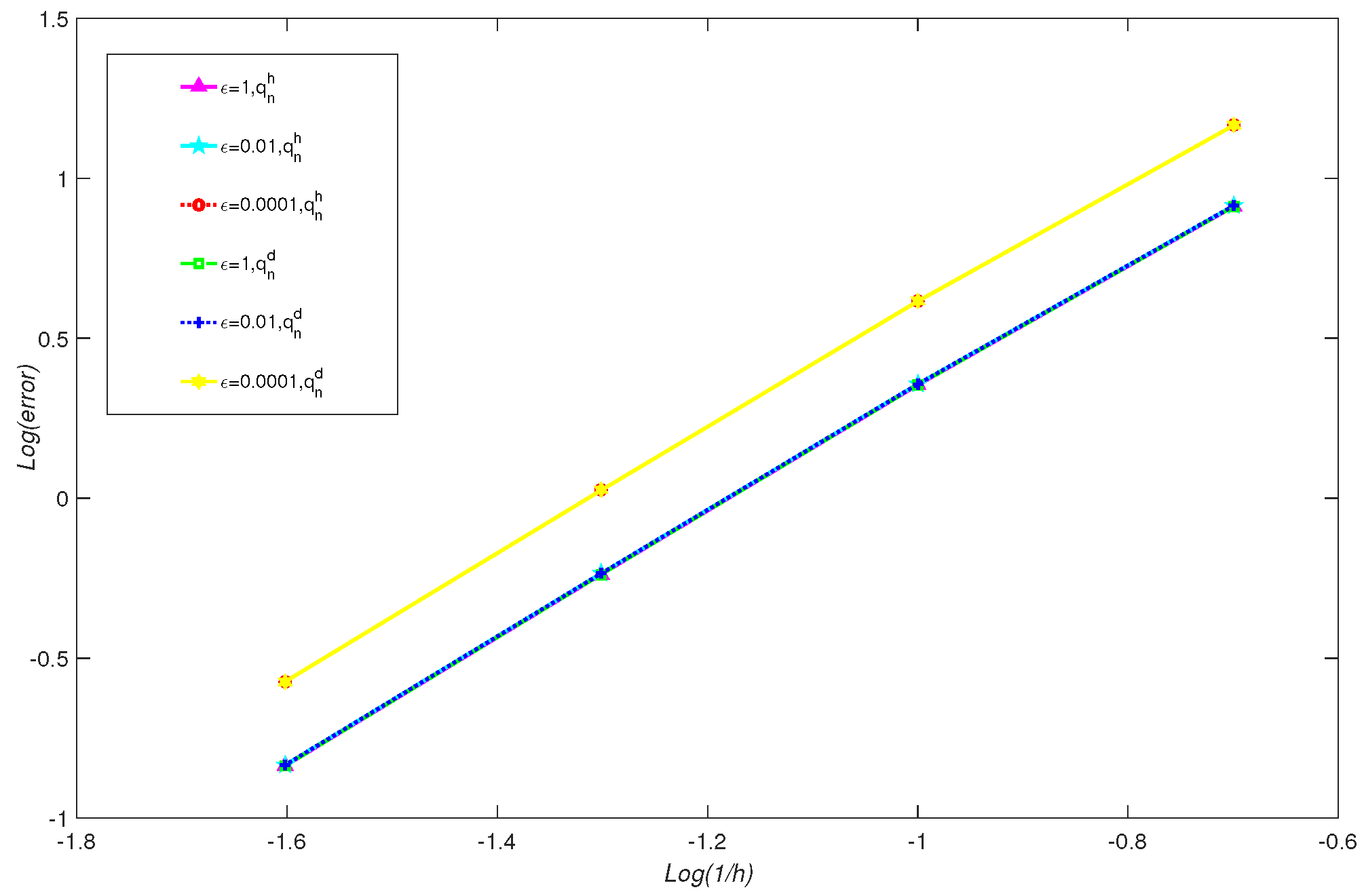
errors and convergence orders of both methods, as shown in Table 4 and Table 5. The comparisons of errors for
at
is depicted in Figure 5 and Figure 6. The figures demonstrate that, when
is set to a very small value, such as
, although the solutions obtained by both methods are convergent, their associated errors tend to increase.
Table 4.
errors and convergence orders between the analytical, CNMFE, and RDCNMFE solutions of u.
Table 5.
errors and convergence orders between the analytical, CNMFE, and RDCNMFE solutions of q.
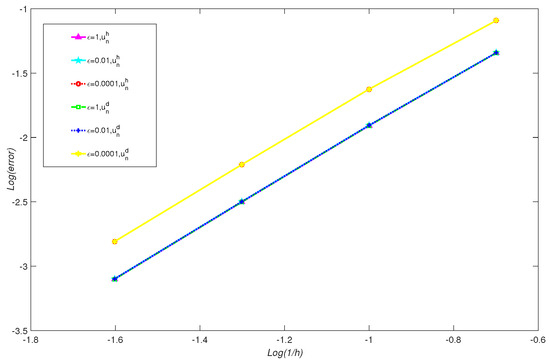
Figure 5.
Comparison of error results of u when
.
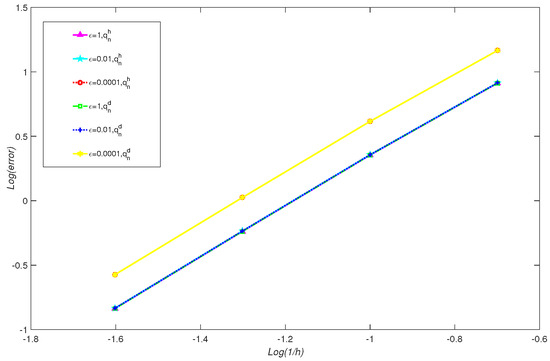
Figure 6.
Comparison of error results of q when
.
The CPU runtime of both methods needs to be compared to further demonstrate the performance of the POD-based reduced-dimension method. When
, with
and
, we calculated the CNMFE and RDCNMFE solutions. Then, we recorded the CPU runtime required using both methods in Table 6. As evidenced in Table 6, when the CNMFE method was used, the CPU runtime increased by about 130 s for every additional
s. However, when the RDCNMFE method was applied, it took just a few seconds for every added
s. The significant reduction in CPU runtime using the reduced-dimension method can be attributed to the difference in degrees of freedom per time step. Specifically, the standard CNMFE method involves
degrees of freedom, compared to just
for the RDCNMFE method.
Table 6.
Comparison of
errors and CPU runtime of CNMFE and RDCNMFE solutions.
4.2. The Time-Fractional Fourth-Order Parabolic Equation
This part focuses on the numerical simulation of a time-fractional fourth-order parabolic equation.
When the
discretization scheme is used, the Caputo derivative
at
can be approximated as:
The expression for the coefficient
is as follows:
Example 3.
We explore the model (111) in
with the analytical solution
. With
and
, the source term is
The analytical solution of q is
.
When
, numerical solutions to the time-fractional Equation (111) under the specified source term (114) are computed using the CNMFE and RDCNMFE schemes under parameter settings
and
. A comparative analysis between the analytical and numerical solutions of
is presented in Figure 7 and Figure 8. The results demonstrate strong agreement, with both methods yielding approximations that align closely with the analytical solutions.
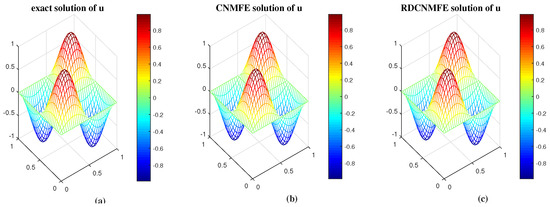
Figure 7.
(a) The exact solution
. (b) The CNMFE solution
. (c) The RDCNMFE solution
.
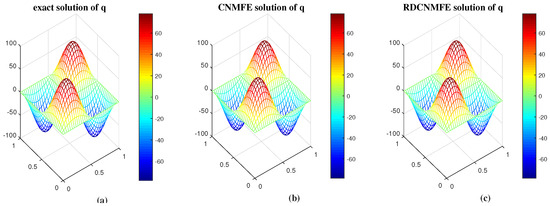
Figure 8.
(a) The exact solution
. (b) The CNMFE solution
. (c) The RDCNMFE solution
.
When
, with
,
, and
ranging from
to
, we numerically solve for the solutions
using both the CNMFE and RDCNMFE methods. The resulting
errors and convergence rates are presented in Table 7 and Table 8. It is evident that the RDCNMFE method delivers accuracy and convergence performance comparable to those of the traditional CNMFE method.
Table 7.
errors and convergence orders between the genuine, CNMFE, and RDCNMFE solutions of u.
Table 8.
errors and convergence orders between the genuine, CNMFE, and RDCNMFE solutions of q.
Furthermore, to demonstrate the computational efficiency of the reduced-dimension method, we recorded the CPU runtime required by both numerical methods. Under fixed parameters
,
,
, and
, numerical experiments were conducted for
, and the runtime comparisons between the CNMFE and RDCNMFE methods are summarized in Table 9. The results reveal that the RDCNMFE method exhibits a significantly slower growth in computational time as the temporal domain T expands, whereas the CNMFE method suffers from a sharp increase in runtime. Notably, at
, the computational time of the conventional method reaches 10 times that of the RDCNMFE method.
Table 9.
With
and
, a comparison of
errors and CPU runtime for CNMFE and RDCNMFE solutions.
From the numerical results obtained from the above-provided examples, it is evident that the RDCNMFE method based on POD serves as an efficient numerical technique for addressing the fourth-order variable coefficient parabolic equations.
5. Conclusions
In this research, our focus was on reducing the dimension of solution coefficient vectors by employing the CNMFE method combined with the POD technique for the nonlinear variable coefficient fourth-order parabolic equation. Firstly, we developed a CNMFE scheme for the equations. We extensively analyzed the uniqueness, stability, and error estimates of the CNMFE solutions. Afterward, the POD bases were derived from the initial
CNMFE solution vectors. We constructed a reduced-dimension matrix model and applied conventional FE analysis techniques in order to study the uniqueness, stability, and convergence of the RDCNMFE solutions. Furthermore, we conducted detailed numerical simulations to compare the efficacy of both methods. The RDCNMFE method exhibited a reduced number of degrees of freedom compared to the conventional CNMFE method. This feature significantly reduces the computational load of the RDCNMFE method, thereby decreasing the runtime. Notably, this study has streamlined the calculations by linearizing the nonlinear terms, thereby eliminating repetitive numerical iterations. Thus, the RDCNMFE method emerges as an innovative and efficient numerical approach for addressing complex nonlinear PDEs.
To further validate the generality of the RDCNMFE method, we solved the numerical solutions of time-fractional fourth-order parabolic equations through numerical experiments, demonstrating the effectiveness of the proposed methods. However, the current work lacks a theoretical analysis for time-fractional fourth-order parabolic equations. The experimental results reveal that the existing method fails to maintain applicability when
. To address this limitation, future research will extend the POD-based reduced-dimension technique to time-fractional equations, encompassing both theoretical analysis and numerical experiments, and developing an improved framework applicable to cases with
. Furthermore, the proposed method exhibits potential for generalization to more complex high-order PDEs, such as spatial-fractional fourth-order PDEs and Schrödinger equations with fourth-order perturbation terms.
Author Contributions
Conceptualization, X.C. and H.L.; methodology, X.C.; numerical simulation, X.C.; formal analysis, X.C.; writing—original draft preparation, X.C.; validation, X.C. and H.L.; writing—review, H.L.; supervision, H.L. All authors have read and agreed to the published version of the manuscript.
Funding
This research was funded by the National Natural Science Foundation of China (12161063) and the Program for Innovative Research Team in Universities of Inner Mongolia Autonomous Region (NMGIRT2207).
Data Availability Statement
Data are contained within the article.
Acknowledgments
The authors would like to thank the reviewers and editors for their invaluable comments, which greatly refined the content of this article.
Conflicts of Interest
The authors declare no conflicts of interest.
Abbreviations
The following abbreviations are used in this manuscript:
| POD | proper orthogonal decomposition |
| CNMFE | Crank–Nicolson mixed finite element |
| RDCNMFE | reduced-dimension Crank–Nicolson mixed finite element |
| PDEs | partial differential equations |
References
- Zhang, T. Finite element analysis for Cahn-Hilliard equation. Math. Numer. Sin. 2006, 28, 281–292. (In Chinese) [Google Scholar]
- Chai, S.; Wang, Y.; Zhao, W.; Zou, Y. A C0 weak Galerkin method for linear Cahn-Hilliard-Cook equation with random initial condition. Appl. Math. Comput. 2022, 414, 126659. [Google Scholar] [CrossRef]
- Danumjaya, P.; Pani, A.K. Mixed finite element methods for a fourth order reaction diffusion equation. Numer. Methods Partial Differ. Equ. 2012, 28, 1227–1251. [Google Scholar] [CrossRef]
- Tian, J.; He, M.; Sun, P. Energy-stable finite element method for a class of nonlinear fourth-order parabolic equations. J. Comput. Appl. Math. 2024, 438, 115576. [Google Scholar] [CrossRef]
- Zhao, X.; Yang, R.; Qi, R.J.; Sun, H. Energy stability and convergence of variable-step L1 scheme for the time fractional Swift-Hohenberg model. Fract. Calc. Appl. Anal. 2024, 27, 82–101. [Google Scholar] [CrossRef]
- Barrett, J.W.; Blowey, J.F.; Garcke, H. Finite element approximation of a fourth order nonlinear degenerate parabolic equation. Numer. Math. 1998, 80, 525–556. [Google Scholar] [CrossRef]
- Du, S.; Cheng, Y.; Li, M. High order spline finite element method for the fourth-order parabolic equations. Appl. Numer. Math. 2023, 184, 496–511. [Google Scholar] [CrossRef]
- Liu, Y.; Fang, Z.; Li, H.; He, S.; Gao, W. A coupling method based on new MFE and FE for fourth-order parabolic equation. J. Appl. Math. Comput. 2013, 43, 249–269. [Google Scholar] [CrossRef]
- Liu, Y.; Li, H.; He, S.; Gao, W.; Fang, Z.C. H1-Galerkin mixed element method and numerical simulation for the fourth-order parabolic partial differential equations. Math. Numer. Sin. 2012, 34, 259–274. (In Chinese) [Google Scholar]
- Shi, D.Y.; Shi, Y.H.; Wang, F.L. Supercloseness and the optimal order error estimates of H1-Galerkin mixed element method for fourth order parabolic equation. Math. Numer. Sin. 2014, 36, 363–380. (In Chinese) [Google Scholar]
- Li, H.; Guo, Y. The space-time mixed finite element method for fourth order parabolic problems. J. Inn. Mong. Univ. (Natural Sci. Ed.) 2006, 37, 19–22. (In Chinese) [Google Scholar]
- He, S.; Li, H. The mixed discontinuous space-time finite element method for the fourth order linear parabolic equation with generalized boundary condition. Math. Numer. Sinica. 2009, 31, 167–178. (In Chinese) [Google Scholar]
- Yin, B.; Liu, Y.; Li, H.; He, S. A two-grid mixed finite element method for a nonlinear fourth-order reaction-diffusion problem with time-fractional derivative. Comput. Math. Appl. 2015, 70, 2474–2492. [Google Scholar]
- Yin, B.; Liu, Y.; Li, H.; He, S.; Wang, J. TGMFE algorithm combined with some time second-order schemes for nonlinear fourth-order reaction diffusion system. Results. Appl. Math. 2019, 4, 100080. [Google Scholar] [CrossRef]
- Chai, S.; Zou, Y.; Zhou, C.; Zhao, W. Weak Galerkin finite element methods for a fourth order parabolic equation. Numer. Methods Partial. Differ. Equ. 2019, 35, 1745–1755. [Google Scholar] [CrossRef]
- Zhao, X.; Liu, F.; Liu, B. Finite difference discretization of a fourth-order parabolic equation describing crystal surface growth. Appl. Anal. 2015, 94, 1–15. [Google Scholar] [CrossRef]
- Mohanty, R.K.; Kaur, D.; Singh, S. A class of two- and three-level implicit methods of order two in time and four in space based on half-step discretization for two-dimensional fourth order quasi-linear parabolic equations. Appl. Math. Comput. 2019, 352, 68–87. [Google Scholar] [CrossRef]
- Kaur, D.; Mohanty, R.K. Highly accurate compact difference scheme for fourth order parabolic equation with Dirichlet and Neumann boundary conditions: Application to good Boussinesq equation. Appl. Math. Comput. 2020, 378, 125202. [Google Scholar] [CrossRef]
- Gao, G.; Huang, Y.; Sun, Z. Pointwise error estimate of the compact difference methods for the fourth-order parabolic equations with the third Neumann boundary conditions. Math. Meth. Appl. Sci. 2023, 47, 634–659. [Google Scholar] [CrossRef]
- Kaur, D.; Mohanty, R.K. High-order half-step compact numerical approximation for fourth-order parabolic PDEs. Numer. Algorithms 2024, 95, 1127–1153. [Google Scholar] [CrossRef]
- Sharma, S.; Sharma, N. A fast computational technique to solve fourth-order parabolic equations: Application to good Boussinesq, Euler-Bernoulli and Benjamin-Ono equations. Int. J. Comput. Math. 2024, 101, 194–216. [Google Scholar] [CrossRef]
- Ishige, K.; Miyake, N.; Okabe, S. Blowup for a Fourth-Order Parabolic Equation with Gradient Nonlinearity. SIAM J. Math. Anal. 2020, 52, 927–953. [Google Scholar] [CrossRef]
- Ding, H.; Zhou, J. Infinite Time Blow-Up of Solutions to a Fourth-Order Nonlinear Parabolic Equation with Logarithmic Nonlinearity Modeling Epitaxial Growth. Mediterr. J. Math. 2021, 18, 1–19. [Google Scholar] [CrossRef]
- Shao, X.; Tang, G. Blow-up phenomena for a class of fourth order parabolic equation. J. Math. Anal. Appl. 2021, 505, 125445. [Google Scholar] [CrossRef]
- Zhao, J.; Guo, B.; Wang, J. Global existence and blow-up of weak solutions for a fourth-order parabolic equation with gradient nonlinearity. Z. Angew. Math. Phys. 2024, 75, 1–12. [Google Scholar] [CrossRef]
- Luo, Z.D. Finite Element and Reduced Dimension Methods for Partial Differential Equations; Springer: Singapore; Beijing, China, 2024. [Google Scholar]
- Luo, Z.D.; Chen, G. Proper Orthogonal Decomposition Methods for Partial Differential Equations; Academic Press of Elsevier: San Diego, CA, USA, 2018. [Google Scholar]
- Shao, W.; Chen, C. A fourth order Runge-Kutta type of exponential time differencing and triangular spectral element method for two dimensional nonlinear Maxwell’s equations. Appl. Numer. Math. 2025, 207, 348–369. [Google Scholar] [CrossRef]
- Zeiser, A. Sparse grid time-discontinuous Galerkin method with streamline diffusion for transport equations. Partial. Differ. Equ. Appl. 2023, 4, 38. [Google Scholar] [CrossRef]
- Jiang, S.; Cheng, Y.; Cheng, Y.; Huang, Y. Generalized multiscale finite element method and balanced truncation for parameter-dependent parabolic problems. Mathematics 2023, 11, 4695. [Google Scholar] [CrossRef]
- Xu, B.; Zhang, X.; Ji, D. A Reduced High-Order Compact Finite Difference Scheme Based on POD Technique for the Two Dimensional Extended Fisher-Kolmogorov Equation. IAENG Int. J. Appl. Math. 2020, 50, 474–483. [Google Scholar]
- Li, Q.; Chen, H.; Wang, H. A proper orthogonal decomposition-compact difference algorithm for plate vibration models. Numer. Algorithms 2023, 94, 1489–1518. [Google Scholar] [CrossRef]
- Zhao, W.; Piao, G.R. A reduced Galerkin finite element formulation based on proper orthogonal decomposition for the generalized KDV-RLW-Rosenau equation. J. Inequal. Appl. 2023, 2023, 104. [Google Scholar] [CrossRef]
- Garcia-Archilla, B.; John, V.; Novo, J. Second order error bounds for POD-ROM methods based on first order divided differences. Appl. Math. Letters 2023, 146, 108836. [Google Scholar] [CrossRef]
- Janes, A.; Singler, R.J. A new proper orthogonal decomposition method with second difference quotients for the wave equation. J. Comput. Appl. Math. 2025, 457, 116279. [Google Scholar] [CrossRef]
- He, S.; Li, H.; Liu, Y. A POD based extrapolation DG time stepping space-time FE method for parabolic problems. J. Math. Anal. Appl. 2024, 539, 128501. [Google Scholar] [CrossRef]
- Lu, J.; Zhang, L.; Guo, X.; Qi, Q. A POD based reduced-order local RBF collocation approach for time-dependent nonlocal diffusion problems. Appl. Math. Letters 2025, 160, 109328. [Google Scholar] [CrossRef]
- Luo, Z.D.; Li, L.; Sun, P. A reduced-order MFE formulation based on POD method for parabolic equations. Acta. Math. Sci. 2013, 33B, 1471–1484. [Google Scholar] [CrossRef]
- Liu, Q.; Teng, F.; Luo, Z.D. A reduced-order extrapolation algorithm based on CNLSMFE formulation and POD technique for two-dimensional Sobolev equations. Appl. Math. Ser. B. 2014, 29, 171–182. [Google Scholar] [CrossRef]
- Luo, Z.D.; Zhou, Y.J.; Yang, X.Z. A reduced finite element formulation based on proper orthogonal decomposition for Burgers equation. Appl. Numer. Math. 2009, 59, 1933–1946. [Google Scholar] [CrossRef]
- Song, J.; Rui, H. A reduced-order characteristic finite element method based on POD for optimal control problem governed by convection-diffusion equation. Comput. Meth. Appl. M 2022, 391, 114538. [Google Scholar] [CrossRef]
- Song, J.; Rui, H. Reduced-order finite element approximation based on POD for the parabolic optimal control problem. Numer. Algorithms 2024, 95, 1189–1211. [Google Scholar] [CrossRef]
- Luo, Z.D. A POD-Based Reduced-Order Stabilized Crank-Nicolson MFE Formulation for the Non-Stationary Parabolized Navier-Stokes Equations. Math. Model. Anal. 2015, 20, 346–368. [Google Scholar] [CrossRef]
- Luo, Z.D. A POD-based reduced-order TSCFE extrapolation iterative format for two-dimensional heat equations. Bound. Value. Probl. 2015, 2015, 1–15. [Google Scholar] [CrossRef]
- Luo, Z.D. The reduced-order extrapolating method about the Crank-Nicolson finite element solution coefficient vectors for parabolic type equation. Mathematics. 2020, 8, 1261. [Google Scholar] [CrossRef]
- Zeng, Y.; Luo, Z.D. The reduced-dimension technique for the unknown solution coefficient vectors in the Crank-Nicolson finite element method for the Sobolev equation. J. Math. Anal. Appl. 2022, 513, 126207. [Google Scholar] [CrossRef]
- Teng, F.; Luo, Z.D. A reduced-order extrapolation technique for solution coefficient vectors in the mixed finite element method for the 2D nonlinear Rosenau equation. J. Math. Anal. Appl. 2020, 485, 123761. [Google Scholar] [CrossRef]
- Luo, Z.D. The dimensionality reduction of Crank-Nicolson mixed finite element solution coefficient vectors for the unsteady Stokes equation. Mathematics 2022, 10, 2273. [Google Scholar] [CrossRef]
- Li, Y.; Teng, F.; Zeng, Y.; Luo, Z. Two-grid dimension reduction method of Crank-Nicolson mixed finite element solution coefficient vectors for the fourth-order extended Fisher-Kolmogorov equation. J. Math. Anal. Appl. 2024, 536, 128168. [Google Scholar] [CrossRef]
- Chang, X.; Li, H. The reduced-dimension method for Crank-Nicolson mixed finite element solution coefficient vectors of the extended Fisher-Kolmogorov equation. Axioms 2024, 13, 710. [Google Scholar] [CrossRef]
- Zeng, Y.; Li, Y.; Zeng, Y.; Cai, Y.; Luo, Z. The dimension reduction method of two-grid Crank-Nicolson mixed finite element solution coefficient vectors for nonlinear fourth-order reaction diffusion equation with temporal fractional derivative. Commun. Nonlinear. Sci. 2024, 133, 107962. [Google Scholar] [CrossRef]
- Adams, R.A. Sobolev Spaces; Academic Press: New York, USA, 1975. [Google Scholar]
- Luo, Z.D. The Founfations and Applications of Mixed Finite Element Methods; Chinese Science Press: Beijing, China, 2006. (In Chinese) [Google Scholar]
- Wang, J.F.; Li, H.; He, S.; Gao, W.; Liu, Y. A new linearized Crank-Nicolson mixed element scheme for the extended Fisher-Kolmogorov equation. Sci. World J. 2013, 2013, 756281. [Google Scholar] [CrossRef]
Disclaimer/Publisher’s Note: The statements, opinions and data contained in all publications are solely those of the individual author(s) and contributor(s) and not of MDPI and/or the editor(s). MDPI and/or the editor(s) disclaim responsibility for any injury to people or property resulting from any ideas, methods, instructions or products referred to in the content. |
© 2025 by the authors. Licensee MDPI, Basel, Switzerland. This article is an open access article distributed under the terms and conditions of the Creative Commons Attribution (CC BY) license (https://creativecommons.org/licenses/by/4.0/).