


Abstract
This study introduces a new metric structure called the Graphical Fuzzy Cone Metric Space (GFCMS) and explores its essential properties in detail. We examine its topological aspects in detail and introduce the notion of Hausdorff distance within this setting—an advancement not previously explored in any graphical structure. Furthermore, a fixed-point result is proven within the framework of GFCMS, accompanied by examples that demonstrate the applicability of the theoretical results. As a significant application, we construct fractals within GFCMS, marking the first instance of fractal generation in a graphical structure. This pioneering work opens new avenues for research in graph theory, fuzzy metric spaces, topology, and fractal geometry, with promising implications for diverse scientific and computational domains.
Keywords:
fractals; graphical fuzzy cone metric space; fixed point theorem; graphical fuzzy metric space MSC:
54H25; 47H10
1. Introduction
Graph theory (GT) has attracted increasing attention because of its wide range of practical applications and importance in both mathematics and the practical sciences. A graph with as the set of vertices and as the set of edges that reflect the connections between these vertices is called an ordered pair. The size of the edge set, , indicates the number of edges, and the order of the vertex set, , determines the order of the graph.
GT can be generically classified into two groups. The first focuses on undirected graphs, which allow for unrestricted movement between connected vertices since connections between them do not have direction. The second category includes directed graphs, where each edge is assigned a particular direction. Whereas edges in undirected graphs are regarded as unordered pairs, edges in directed graphs are represented as ordered pairs.
Leonhard Euler became renowned as the Father of GT in 1736 after solving the famous Konigsberg Bridge Problem. The graphical aspect of this theory has given rise to a variety of applications, such as frameworks for decision-making, the visualization of object relationships, and a flexible method for adjusting and changing current systems. In chemical sciences [1,2], data science [3], and architecture [4], GT has diverse applications. Furthermore, Jachymski [5] developed several FP results by applying the graph structure in FPT. Shukla et al. [6] extended a number of FP discoveries in GMSs and applied the graph structure to MSs. Chen et al. [7] introduced the idea of a graphical convex MS and produced FP results for set-valued G-contraction mappings and related applications.
By introducing fuzzy set theory (FST), Zadeh [8] developed a framework for handling the imprecision and uncertainty that are frequently encountered in day-to-day living. Building on this, FMS was introduced by Kramosil and Michalek [9] using MSs and fuzzy sets. In order to improve the FMS framework, George and Veeramani [10,11] added a Hausdorff structure for these spaces. The concept of graphical fuzzy metric spaces (GFMSs) was first proposed by Saleem et al. [12] and used in the fractional differential equation analysis. This idea was then expanded and refined by Shukla et al. [13] through their investigation of fixed point theory (FPT) in GFMSs.
In their work, Huang and Zhang [14] developed the concept of cone metric spaces (CMSs) by substituting the set of real numbers with an ordered Banach space, and they established various FP results for contractive mappings within this setting. Tarkan Oner et al. [15] introduced the concept of FCMSs, which generalizes CMSs, and established some FP results. Satish Shukla et al. [16] introduced the concept of GCMSs over Banach algebras and established several FP results for specific types of contractive mappings defined on these spaces.
In this study, we introduce the concept of graphical fuzzy cone metric spaces (GFCMSs) and investigate their topological properties in depth. Furthermore, we establish new FP theorems within the framework of complete GFCMSs. The integration of fuzzy, cone, and graph structures into a unified framework is driven by the need to handle uncertainty, partial ordering, and relational dependencies simultaneously in metric-type spaces. Fuzzy metrics account for the vagueness and imprecision inherent in many real-world situations, while cone metrics introduce a vector-valued structure that allows for more refined comparisons, especially in ordered Banach spaces. Incorporating a graph structure enables modeling of asymmetric relationships and directional constraints among elements, which are common in applications such as network theory, optimization, and decision processes. By combining these three components, graphical fuzzy cone metric spaces provide a more flexible and robust setting for analyzing convergence, continuity, and fixed point behavior in complex systems that cannot be effectively studied under classical or single-component metric frameworks.
2. Preliminaries
Definition 1.
Let be a real Banach algebra, meaning that is a real Banach space equipped with a multiplication operation that meets the following requirements (see [17]): ∀, ,
- 1.
- ;
- 2.
- and ;
- 3.
- ;
- 4.
- .
In this paper, we work under the assumption that is a Banach algebra possessing a unit element; that is, there exists an identity element e in satisfying for every . An element is called invertible if there exists s.t. . The inverse of an element is represented by . The quantity denotes the spectral radius of the element in and
Definition 2
(Liu and Xu [18]). Let be a subset of . The set is defined as a cone provided it satisfies the conditions below:
- 1.
- is non-empty, closed, and distinct from the singleton set ;
- 2.
- For any non-negative real numbers and any elements , the linear combination belongs to ;
- 3.
- If and simultaneously , then it must follow that .
A cone is said to be solid if its interior is nonempty, i.e., . We consistently assume that the cone in question is solid. In a Banach algebra , each cone defines a partial order ⪯ on s.t. for all , the relation holds precisely when lies in . Also, we write if and only if int for all .
Remark 1
(Jungck et al. [19]). Let be a cone of , and .
- 1.
- If and , then .
- 2.
- If and , then .
- 3.
- If for every , then .
Remark 2.
For any , ∃ s.t. , and for any , we can find satisfying .
Definition 3
(Dordević et al. [20]). A sequence within the cone is called a c-sequence if, for every with , ∃ s.t. ∀.
Definition 4
([15]). A 3-tuple is defined as a fuzzy cone metric space (FCMS) if the following hold: is a cone within the space , Ω is a set chosen arbitrarily, ∗ represents a continuous t-norm, and is a fuzzy set on the product space that satisfies specific conditions.
- For all and (that is )
- 1.
- ,
- 2.
- ,
- 3.
- ,
- 4.
- ,
- 5.
- is continuous.
We modify certain concepts related to graphs based on the work of Jachymski [5] and Shukla et al. [6].
For a non-empty set , ∆ represents the diagonal of , and A directed graph is denoted by if its collection of vertices is and its set of edges is , which includes no parallel edges and . In this context, we say that is equipped with the graph . The symmetric graph, denoted by , is defined as , where is characterized by and .
Let . A sequence of vertices , taken from , is said to be a path of length from to if it satisfies , , and for every index , the pair belongs to . The vertices and are said to be connected if a path of any length connects to . The graph is considered connected if, for any two vertices in , there is a path that links them.
We define for . Additionally, we introduce a relation P on such that holds if and only if and are connected by a directed path in . We denote if lies along a directed path from to in . A sequence in is said to be -termwise connected if, for every , the relation holds.
Definition 5
([16]). Let Ω be a non-empty set equipped with the graph , and let be a Banach algebra. Assume that a mapping satisfies the following conditions:
- 1.
- ∀;
- 2.
- ;
- 3.
- ∀;
- 4.
- , implies ∀.
In this case, the mapping is referred to as a graphical cone metric on Ω, and the pair is called a GCMS over the Banach algebra .
Next, we define the concept of graphical fuzzy cone metric spaces (GFCMSs).
3. Graphical Fuzzy Cone Metric Spaces
Definition 6.
Let Ω be a nonempty set equipped with the graph , and let be a Banach algebra, ∗ be a continuous t-norm, be a cone in , and be a fuzzy set on . The function is referred to as a graphical fuzzy cone metric provided that the following conditions are satisfied.
- 1.
- ;
- 2.
- ;
- 3.
- ;
- 4.
- , implies ;
- 5.
- is continuous,
for all and . Then, is known as a GFCMS.
If we take , and , then every GFMS becomes a GFCMSs.
Example 1.
Consider , where the norm is Euclidean and multiplication is defined component-wise. Define then is a solid cone in . Let and set to be and . Define a function by
Then, is a GFCMS over Banach algebra .
Example 2.
Consider , where the norm is Euclidean and multiplication is defined component-wise. Define then is a solid cone in . Let and set to be and at time t. Let ∗ be a continuous t-norm defined by . We define a function as follows:
Afterward, we demonstrate that forms a GFCMS over a Banach algebra. The properties 1, 2, and 3 are obvious. For 4, suppose and , i.e., . Then, we must have . This shows that . On the other hand, is not a FCMS, as .
GFCMS differs from GFMS by allowing for cone-valued time parameters ordered via a cone in a Banach algebra, introducing a partial order into the triangle inequality and enabling comparisons within a richer, vector-valued fuzzy framework.
Definition 7.
Consider as a GFCMS. Let be a function, and let represent a subgraph of with the property that contains Δ. In this setting, the mapping is referred to as a -graphical fuzzy cone contraction, provided the following conditions are satisfied:
- (GFCC1)
- implies , i.e., is edge-preserving in
- (GFCC2)
- for some constant κ with s.t.
∀ and with .
Example 3.
Let , and let be equipped with the cone
which is a solid, normal cone in the Banach algebra under coordinate-wise operations. We define the continuous t-norm ∗ by .
We define a graph on Ω such that
Let be the subgraph of defined as follows:
We define the function as follows:
Now, we define the mapping as follows:
We now verify that satisfies both conditions of Definition 7:
- (GFCC1)
- Let , i.e., . Then,
so . Hence, is edge-preserving in .
- (GFCC2)
- Let , i.e., . Then,
Now, we compute
and
Since for all , the inequality
holds for some . It follows that
Hence, satisfies (GFCC2).
Thus, is a -graphical fuzzy cone contraction.
The contraction behavior of the mapping as a graphical fuzzy cone contraction in GFCMS is depicted in Figure 1.
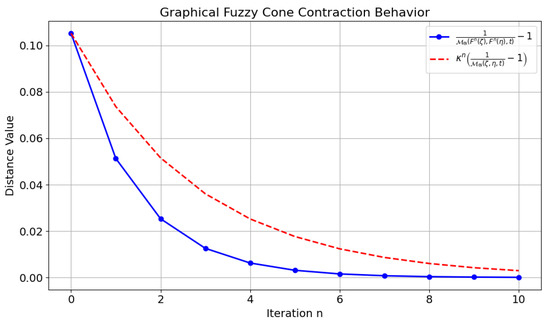
Figure 1.
Iterative graphical fuzzy cone contraction of the mapping in GFCMS.
Definition 8.
Let be a GFCMS. Given , the open ball centered at ζ with radius is described as
Theorem 1.
Let be a GFCMS. We define
Then, τ defines a topology on Ω.
Proof.
It is clear that ; hence, . Suppose . Let . Then, there exist such that and . Since , ∃ s.t. and and so . Hence, . In the same way, it can be demonstrated that the union of any family of sets from also belongs to . □
Theorem 2.
Let be a GFCMS. Then, is a Hausdorff.
Proof.
Let such that . Based on the definition of a fuzzy metric, we have , and let us denote by r. According to Remark 2, for every satisfying , there exists a value such that .
Now, consider the sets and . We have to see
Suppose that . Then, there exists . Therefore, and Thus, . Then, , so This is a contradiction. Hence, . □
Definition 9.
Let be a GFCMS. Then, the graphical fuzzy cone distance between and a set is defined by
, and the distance between is defined by
We shall use to represent the family of all nonempty compact subsets of .
Example 4.
Let , , and let be a solid cone in the Banach algebra (with component-wise operations). Let ∗ be the product t-norm: .
We define the graph on Ω such that: .
We define the graphical fuzzy cone metric as follows:
Now, take , . Since means (based on the graph structure), we compute the following: .
Now, let . Then, .
We already have
so .
Definition 10.
Let be a GFCMS, then the graphical fuzzy cone Hausdorff distance between two elements and of is as follows:
Thus, , equipped with the graphical fuzzy cone Hausdorff distance, forms a GFCMS. This space will be referred to as the graphical fuzzy cone Hausdorff metric space (GFCHMS) and will be denoted by . It should be noted that the graphical fuzzy cone Hausdorff metric space is complete, provided that the GFCMS is complete.
Lemma 1.
Let be a -graphical fuzzy cone contraction (GFCC) on a GFCMS . Then, defined by
is a -GFCC on .
Proof.
Suppose is a -GFCC on a GFCMS . Then, is edge-preserving in , and there exist s.t.
∀ and with . Since is a -graphical fuzzy cone contraction on a GFCMS , maps into itself. We will demonstrate that is a -graphical fuzzy cone contraction on . Clearly, is edge-preserving in . For any and , let us have the following:
Similarly,
Equation (1) implies that
Thus, is a -graphical fuzzy cone contraction on . □
Definition 11.
Let be a GFCMS. A sequence in Ω is said to converge to with respect to if, for every and each , ∃ s.t. holds ∀; that is, for every . A sequence in Ω is termed a Cauchy sequence if, for every and each , ∃ s.t. ∀ indices .
Example 5.
Let , and define the solid cone in . Define the graph on Ω as follows:
Define the graphical fuzzy cone metric as follows:
Now, define the sequence for . Clearly, and as .
To check convergence, let and fix . Choose such that for all :
Then, for , we have the following:
Thus, in the GFCMS.
To show that is Cauchy, fix and choose such that for all ,
Since or (as both approach 1 from below), the ordered pair lies in , so:
Hence, is a Cauchy sequence in the GFCMS.
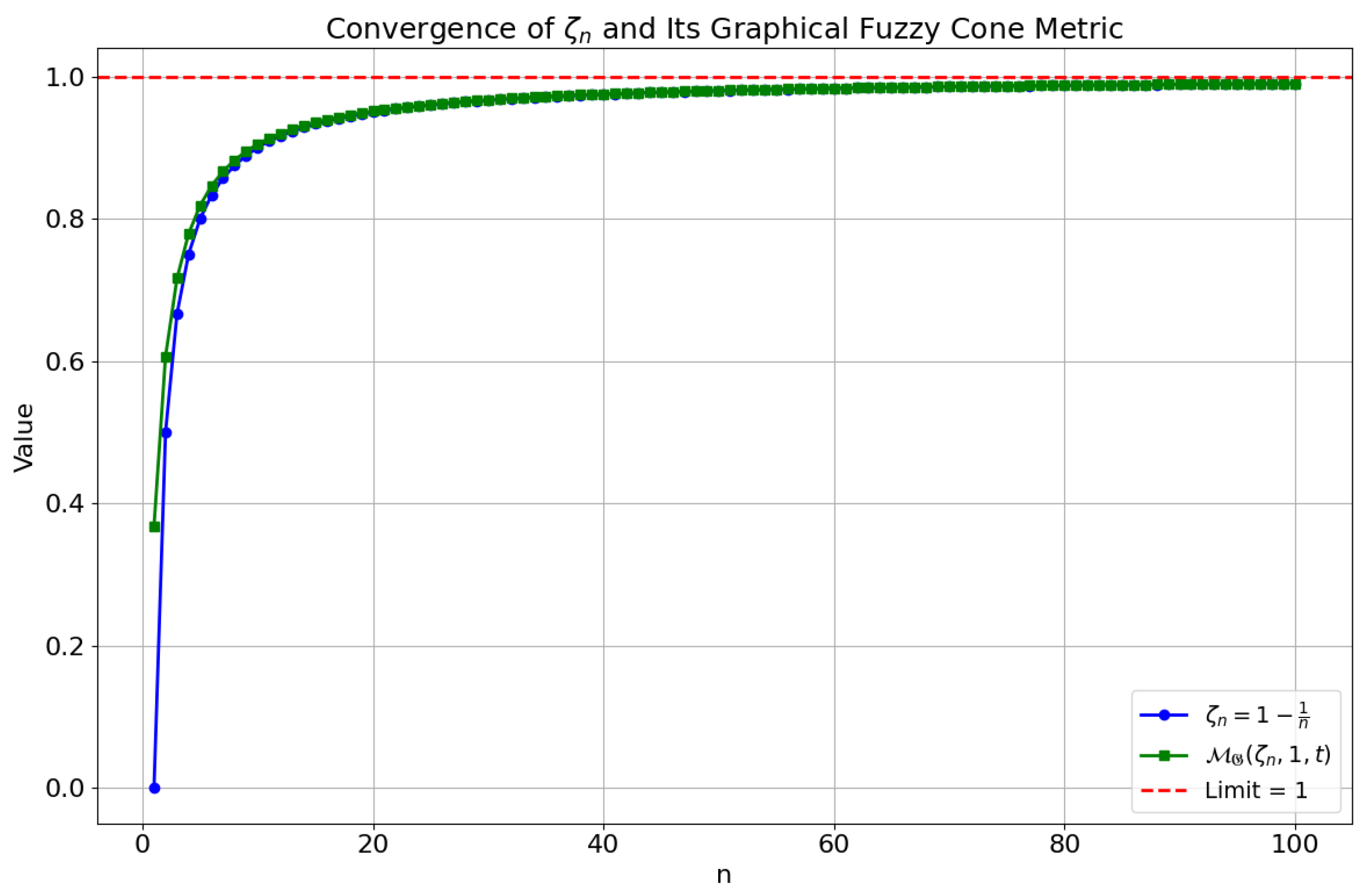
The convergence of the sequence to 1 in the GFCMS is illustrated through the graphical fuzzy cone metric in Figure 2.
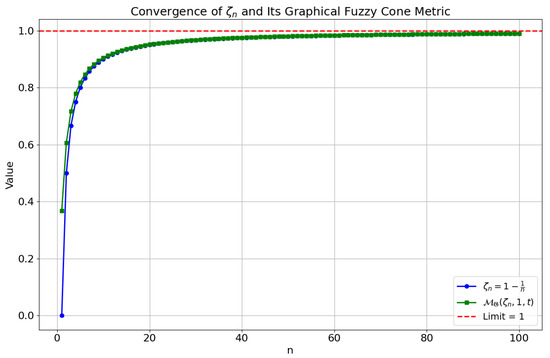
Figure 2.
Behavior of the graphical fuzzy cone metric associated with the convergence of the sequence in the GFCMS.
Definition 12.
Let be a GFCMS. A space is considered complete if all Cauchy sequences in Ω converge to an element within Ω. Let be a subgraph with . We describe as -complete whenever every -termwise connected Cauchy sequence in Ω tends to a point in Ω.
Definition 13.
Let be a GFCMS and let be a subgraph of such that . A sequence in is said to be -convergent to if, for every and , there exists such that and for all . Moreover, if for all , then the sequence is said to be -convergent to .
It is straightforward to verify that sequences that are -convergent are also -convergent; however, the converse is not generally true. Next, we proceed to explore the notion of Cauchy sequences within GFCMSs. In the framework of FMSs, the ideas of Cauchy sequences and completeness have been introduced in two distinct approaches: one following Grabiec (refer to [21]) and the other based on the work of George and Veeramani (refer to [10]). In a similar fashion, we present two categories of Cauchy sequences along with their corresponding forms of completeness.
Clearly, the condition of -completeness is less restrictive compared to the overall completeness of a GFCMS.
In the following section, we present several FP theorems for self-maps on a GFCMS under specific assumptions.
Definition 14.
Let be a GFCMS and be a sequence in . The sequence is referred to as a Cauchy sequence in if, for every , it satisfies either of the following equivalent conditions:
- 1.
- For any natural number p, the limit equals 1 (i.e., -Cauchy).
- 2.
- The limit (i.e., -Cauchy).
Definition 15.
Let be a GFCMS and be a sequence in Ω. The sequence is described as graphical fuzzy cone contractive. Assuming the existence of a constant s.t.
∀, .
Example 6.
Let , , and define the solid cone in the Banach algebra . Let the graph on Ω be defined as follows:
We define the fuzzy cone metric by
Now, we define the sequence for . Then,
Let us compute the quantities:
We have:
Therefore:
Similarly:
Thus:
which holds for some and all n because the exponential function is increasing and .
Hence, the sequence satisfies the graphical fuzzy cone contractive condition.
Definition 16.
Let be a GFCMS, and let be a subgraph of s.t. . The space is referred to as --complete, --complete, or --complete (alternatively, --complete, --complete, or --complete) if every -termwise connected -Cauchy sequence (or -Cauchy sequence) within Ω converges in the sense of or is -convergent or -convergent, respectively.
Theorem 3.
Consider as a --complete GFCMS, where every graphical fuzzy cone contractive sequence is also a -Cauchy sequence. Let be an -GFCC. Consider that the conditions listed below are fulfilled:
- 1.
- ∃ s.t. for some ;
- 2.
- ∀ s.t. ;
- 3.
- if a -Picard sequence , which is -termwise connected, converges to some with respect to , then it also converges to ζ in the sense of .
As a result, one can find an element such that the Picard sequence generated by , starting from an initial point , is -termwise connected and converges in the sense of to both and .
To prove the existence of a fixed point, we construct a Picard sequence starting from a point and show that it is -termwise connected, graphical fuzzy cone contractive, and converges to a common point and under -convergence.
Proof.
Consider a point for which belongs to the q-step neighborhood , where q is a positive integer. Assume that represents the Picard sequence generated by , starting from the initial point . According to the definition, there exists a sequence satisfying , , and for each . As is an -GFCC, based on , we have for . Therefore, is a path from to of length q, and so . Thus, for every , we can build a sequence connecting to , having length q. This demonstrates that for all . Thus, is an -termwise connected sequence. Since for and based on , we have the following:
∀. As the sequence is -termwise connected, it follows that for each , we have the following:
. It follows that is a graphical fuzzy cone contractive sequence and, by assumption, is -Cauchy in . Consequently, is a -termwise connected sequence that is also -Cauchy in . Based on the --completeness of , the sequence -converges to some . Additionally, from Condition (3), it follows that converges to under -convergence. Then, ∃ s.t. ∀ and
Thus, based on , we obtain for each , and using , we get
∀. Since we get
Therefore, the sequence also -converges to . Consequently, the sequence -converges to both and . □
Corollary 1.
Let be a --complete GFCMS and be a GFCC. Consider that the conditions listed below are fulfilled:
- 1.
- ∃ s.t. , for some ;
- 2.
- ∀ s.t. .
There exists an element s.t. the -Picard sequence , initiated at , is -termwise connected and converges to both and with respect to the -convergence.
It is important to note that the previous results guarantee the convergence of a -Picard sequence, but they do not guarantee the existence of a FP for , as demonstrated in the following example.
Example 7.
Consider endowed with the Euclidean norm and the operation of coordinate-wise multiplication. Define then is a solid cone in . Let and be defined by and at a time t. Let ∗ be a continuous t-norm defined by . Define a function by
Then, is a GFCMS over Banach algebra. Suppose a self-map is given:
It is straightforward to observe that is an -graphical fuzzy cone contraction with a constant κ s.t. . For any initial point , we have , meaning that , where . Furthermore, it can be verified that all the hypotheses of Theorem 3 are fulfilled but does not have a FP in Ω.
The previous example demonstrates that even when all the hypotheses of a fixed point theorem are satisfied, a fixed point may still fail to exist if the limit of the Picard sequence is not unique. In particular, the sequence may converge to two different points—one in and another in the image of under . To eliminate such pathological cases and guarantee the existence of fixed points, we now introduce an additional condition known as Property .
Definition 17.
Let be a GFCMS, be a subgraph of , and be a mapping. The five-tuple is said to possess property if a -termwise connected -Picard sequence happens to converge to two different points,
We represent by the collection of all FPs of the mapping . In addition, let us define
Theorem 4.
Let be a --complete GFCMS in which graphical fuzzy cone contractive sequences are -Cauchy. be an -GFCC. Consider that the conditions listed below are fulfilled:
- 1.
- ∃ s.t. for some ;
- 2.
- ∀ s.t. ;
- 3.
- if a -termwise connected -Picard sequence -converges to some , then -converges to ζ.
We can identify a point s.t. the -Picard sequence , starting with the initial value , is -termwise connected and converges to both and with respect to . Furthermore, if the five-tuple satisfies property , then has a FP in Ω.
Proof.
The proof of this theorem follows directly from the argument presented in Theorem 3 and is therefore omitted.□
The following example illustrates that Theorem 3 provides a sufficient condition for the existence of a FP, but it does not ensure the uniqueness of the FP.
Example 8.
Let , and let be the graph with vertex set and
and . Then, is a GFCMS, where is defined as follows:
Then, is a -complete GFCMS. Suppose a self-map is given:
It is straightforward to observe that is a GFCC with a constant κ s.t. . For each , we have and . Additionally, it is clear that for all . It is important to note that property is also fulfilled. Therefore, all the conditions of Theorem 3 are met, and the mapping has two FPs in Ω, specifically, Fix.
Theorem 5.
Let be a --complete GFCMS in which graphical fuzzy cone contractive sequences are -Cauchy. Let be an -GFCC. Provided that the assumptions of Theorem 4 are fulfilled and is connected, has a unique FP.
Proof.
The existence of a FP of can be derived from Theorem 4. Assume that is connected, and let and be two distinct FPs of . Since , , and so . Again, is connected, and we have ; that is, we can identify a sequence , and for Since is an -GFCC, through successive use of , we have for ∀. Therefore, based on , we obtain
for and for all . Therefore, based on Condition (4) of GFCMS, we obtain the following:
Since , we have ; by taking the limit as , the above inequality implies that ∀. This leads to the conclusion that . This contradiction establishes the uniqueness of the FP of . □
Corollary 2.
Let be a -complete GFCMS s.t. ∀. Suppose a self-map is given:
∀ and . Then, has a unique FP.
Proof.
Let the graphs and be defined s.t. and . It is then straightforward to verify that all the conditions of Theorem 5 are met, and consequently, the conclusion holds. □
Although fixed point theorems are well-studied, the present work offers a new and meaningful generalization within the framework of graphical fuzzy cone metric spaces (GFCMS). In particular, Theorem 5 establishes a unique fixed point result for -graphical fuzzy cone contractions by employing both fuzzy metric structures and graph-based connectivity. The incorporation of graph completeness, fuzzy cone metrics, and generalized convergence through Property (S) and -connectivity significantly extends existing results. This allows us to derive fixed point theorems in settings where classical or even fuzzy contractions may fail, thereby highlighting the novelty and broader applicability of our results.
4. Application to Fractals
In this section, we will generate fractals in graphical fuzzy cone metric space using a graphical fuzzy cone iterated function system. This is entirely novel work, as no one has yet generated fractals in a graphical structure. While the process of generating fractals resembles classical iterated function systems, the advancement here lies in extending the framework to fuzzy cone metric spaces equipped with a graph structure. By introducing the concept of a Graphical Fuzzy Cone Iterated Function System (GFCIFS), we move beyond traditional metric-based models and capture a broader class of fractal behaviors. The use of fuzzy cone metrics allows us to incorporate uncertainty and partial ordering, while the graph component models directional relationships and local connectivity among elements. This setting enables the construction of fractals in environments that are not necessarily metrically uniform or linearly connected, thereby offering a more flexible and realistic approach to modeling self-similar structures in abstract spaces.
Definition 18.
Let be a GFCMS and is a finite collection of graphical fuzzy cone contractions (GFCCs). The operator defined by
for all is a graphical fuzzy cone Hutchinson Barnsley operator (GFCHBO).
Definition 19.
Let be a complete GFCMS. If is a finite collection of GFCCs, then is called a graphical fuzzy cone iterated function system (GFCIFS).
Theorem 6.
Let be a GFCMS and be a GFCIFS. If is GFCHBO, then Θ is GFCC on .
Proof.
We will show that is GFCC on for . Let be two GFCCs. Therefore, and will map into itself. Take such that is not equal to zero. Consider the following:
Similarly, this can be proven for any natural number t. Hence, is a GFCC on . □
Theorem 7.
Suppose that is a --complete graphical fuzzy cone Hausdorff metric space in which graphical fuzzy cone contractive sequences are -Cauchy with the property , and is a GFCIFS. Let be GFCHBO. Assume that the following conditions hold:
- (i)
- , provided there exists for some ;
- (ii)
- for all ;
- (iii)
- If a sequence , which is -termwise connected, is Picard convergent in , then ∃ a limit and s.t. or at time t ∀ ;
- (iv)
- is connected.
Then, has a unique FP.
Proof.
Since is GFCHBO, it follows from Theorem 6 that is a graphical fuzzy cone contraction on . Now, if we take , and in Theorem 5, then the proof is similar. □
Example 9.
Let and be a graph defined by and . Let be a subgraph of a graph s.t. and Define then is a solid cone in Ω. Then, is a GFCMS, where is defined as follows:
Then, is -complete GFCMS. Let and
We aim to demonstrate that the mappings and are edge-preserving. Let and be elements of Ω, and assume there exists a path between these two points. This implies the ordering relationships:
Therefore,
Since these inequalities hold, the transformation preserves the adjacency and connectivity of the edges.
By applying the same reasoning, we can similarly conclude that and also preserve edge relations. Thus, all three mappings are edge-preserving mappings.
Let , then
Similarly, we can conclude that also satisfy the second condition of Definition 7. Hence, , and are GFCCs. Consider the GFCIFS with the mapping given as
for all . Based on Theorem 7, we have the following:
As a result, all conditions outlined in Theorem 5 are satisfied. Additionally, the sequence of compact sets converges, and its limit represents the attractor of Θ for any initial set .
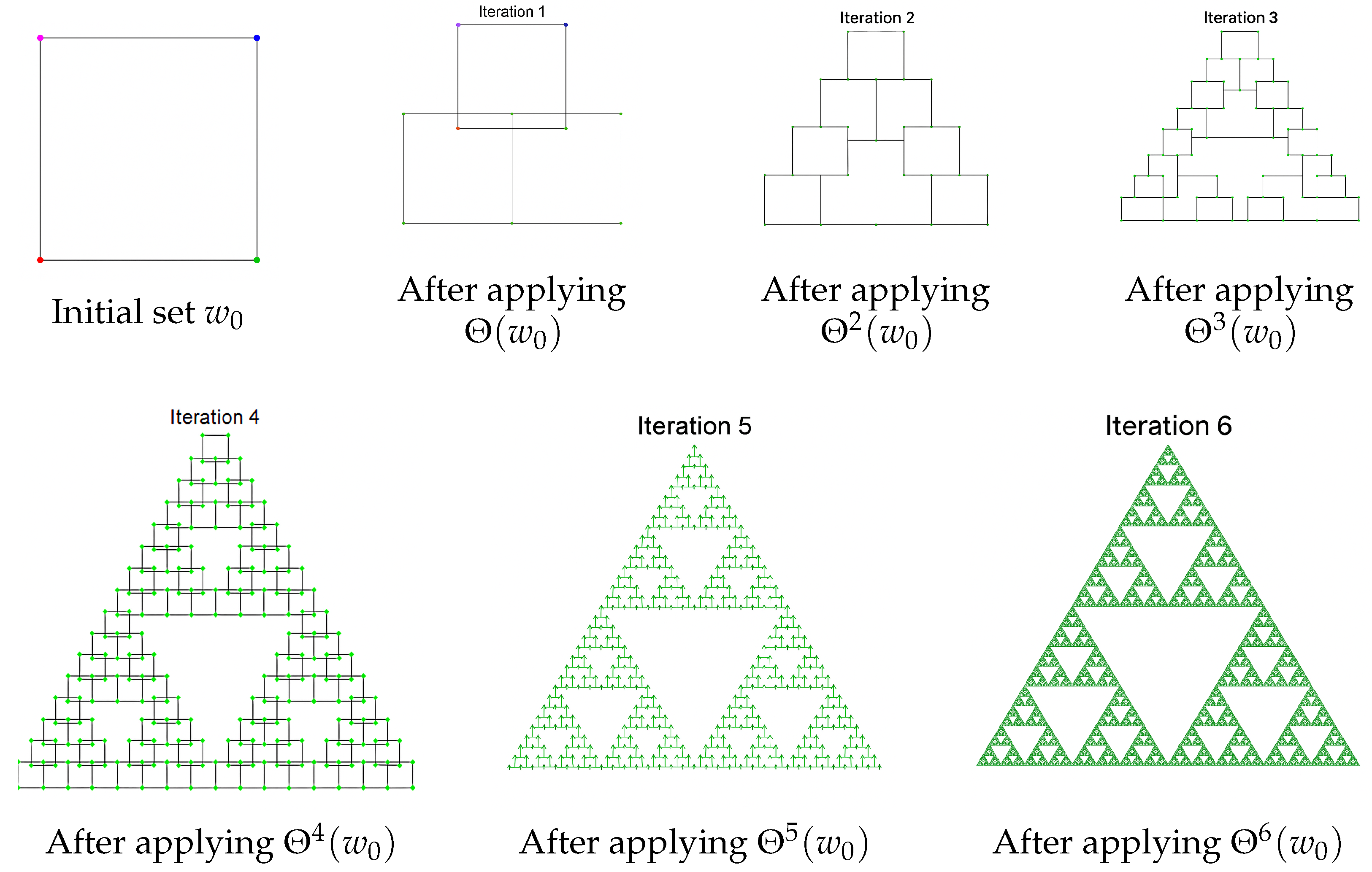
The step-by-step construction of the fractal set under the iteration of is illustrated in Figure 3.
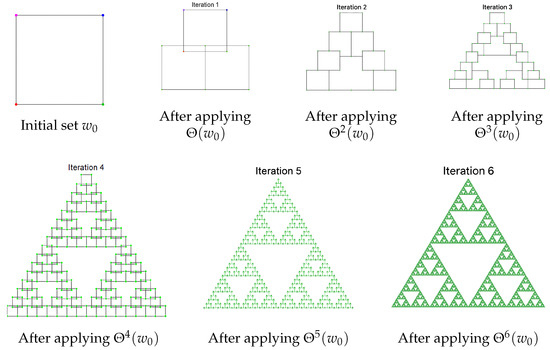
Figure 3.
Iterative construction of a fractal set starting from the initial set under successive applications of the mapping .
We provided a detailed example to demonstrate the process of constructing fractals within a graphical fuzzy cone metric framework. In this example, we used three specific mappings on the space , each of which preserved the structure of a graph that captures partial ordering in both coordinates. The fuzzy cone metric was defined through an exponential function involving the Euclidean distance, allowing us to incorporate uncertainty in a natural way. It was shown that the mappings , , and preserve the edges of the graph, meaning that they are consistent with the directional relationships of the structure. Additionally, these mappings satisfy a contractive condition specific to the graphical fuzzy cone setting, which means that the system forms a well-defined Graphical Fuzzy Cone Iterated Function System (GFCIFS). The associated operator , defined by the union of these mappings, was shown to meet a contractive requirement with respect to the graphical fuzzy Hausdorff metric , which ensures the existence of a unique fixed set, called an attractor. This attractor arises as the limit of an iterative sequence starting from any initial compact set. Unlike classical fractals, this attractor incorporates the influence of both fuzzy behavior and graph-based structure, providing a more general setting for modeling self-similar patterns. This example confirms that our approach can be used to construct and analyze fractals in spaces where uncertainty and directional relationships play a key role.
5. Conclusions
In this study, we introduced the Graphical Fuzzy Cone Metric Space (GFCMS) and thoroughly explored its core properties by investigating its topological characteristics and defining the Hausdorff distance. We discussed fixed-point theorems within GFCMS, supported by illustrative examples. In addition, an application to generate fractals in GFCMS is presented. This work not only expands the current knowledge in graph theory, fuzzy metric spaces, and topology but also paves the way for future research in fractal geometry and its potential applications in various scientific and computational fields.
Author Contributions
Conceptualization, I.K. and F.U.D.; methodology, I.K. and F.U.D.; software, L.-I.C. and D.B.; validation, F.U.D., L.-I.C. and D.B.; formal analysis, F.U.D.; investigation, I.K., F.U.D. and L.-I.C.; resources, F.U.D. and L.-I.C.; data curation, I.K. and L.-I.C.; writing—original draft preparation, I.K.; writing—review and editing, F.U.D. and L.-I.C.; visualization, F.U.D.; supervision, F.U.D.; project administration, L.-I.C.; funding acquisition, L.-I.C. All authors have read and agreed to the published version of the manuscript.
Funding
This research received no external funding.
Data Availability Statement
Data will be available on demand from the corresponding author.
Conflicts of Interest
The authors affirm that they do not have any competing interests.
List of Symbols
| Symbol | Meaning |
| Nonempty set or space under consideration | |
| Graph-based fuzzy cone metric on | |
| ∗ | Continuous t-norm on |
| Directed graph on | |
| Subgraph of satisfying certain conditions | |
| Set of vertices | |
| Edge set of the graph | |
| Fuzzy Cone Metric Space | |
| Graphical Fuzzy Metric Space | |
| Graphical Fuzzy Cone Metric Space | |
| Graphical Fuzzy Cone Contraction | |
| Graphical Fuzzy Cone Iterated Function System | |
| Graphical Fuzzy Cone Hutchinson Barnsley Operator | |
| FP | Fixed Point |
References
- Balaban, A.T. Applications of graph theory in chemistry. J. Chem. Inf. Comput. Sci. 1985, 25, 334–343. [Google Scholar] [CrossRef]
- Ratkiewicz, A.; Truong, T.N. Application of chemical graph theory for automated mechanism generation. J. Chem. Inf. Comput. Sci. 2003, 43, 36–44. [Google Scholar] [CrossRef] [PubMed][Green Version]
- Majeed, A.; Rauf, I. Graph theory: A comprehensive survey about graph theory applications in computer science and social networks. Inventions 2020, 5, 10. [Google Scholar] [CrossRef]
- Vecchio, F.; Miraglia, F.; Rossini, P.M. Connectome: Graph theory application in functional brain network architecture. Clin. Neurophysiol. Pract. 2017, 2, 206–213. [Google Scholar] [CrossRef] [PubMed]
- Jachymski, J. The contraction principle for mappings on a metric space with a graph. Proc. Am. Math. Soc. 2008, 136, 1359–1373. [Google Scholar] [CrossRef]
- Shukla, S.; Radenović, S.; Vetro, C. Graphical metric space: A generalized setting in fixed point theory. Rev. Real Acad. Cienc. Exactas, Fis. Nat. Ser. A Mat. 2017, 111, 641–655. [Google Scholar] [CrossRef]
- Chen, L.; Yang, N.; Zhao, Y.; Ma, Z. Fixed point theorems for set-valued G-contractions in a graphical convex metric space with applications. J. Fixed Point Theory Appl. 2020, 22, 1–23. [Google Scholar] [CrossRef]
- Zadeh, L.A. Fuzzy sets. Inf. Control. 1965, 8, 338–353. [Google Scholar] [CrossRef]
- Kramosil, I.; Michálek, J. Fuzzy metrics and statistical metric spaces. Kybernetika 1975, 11, 336–344. [Google Scholar]
- George, A.; Veeramani, P. On some results in fuzzy metric spaces. Fuzzy Sets Syst. 1994, 64, 395–399. [Google Scholar] [CrossRef]
- George, A.; Veeramani, P. On some results of analysis for fuzzy metric spaces. Fuzzy Sets Syst. 1997, 90, 365–368. [Google Scholar] [CrossRef]
- Saleem, N.; Ishtiaq, U.; Guran, L.; Bota, M.F. On graphical fuzzy metric spaces with application to fractional differential equations. Fractal Fract. 2022, 6, 238. [Google Scholar] [CrossRef]
- Shukla, S.; Rai, S.; Miñana, J.J. On Graphical Fuzzy Metric Spaces and Related Fixed Point Theorems. Fixed Point Theory 2024, 25, 723–746. [Google Scholar] [CrossRef]
- Long-Guang, H.; Xian, Z. Cone metric spaces and fixed point theorems of contractive mappings. J. Math. Anal. Appl. 2007, 332, 1468–1476. [Google Scholar]
- Öner, T.; Kandemir, M.B.; Tanay, B. Fuzzy cone metric spaces. J. Nonlinear Sci. Appl. 2015, 8, 610–616. [Google Scholar] [CrossRef]
- Shukla, S.; Dubey, N.; Shukla, R. Fixed point theorems in graphical cone metric spaces and application to a system of initial value problems. J. Inequalities Appl. 2023, 2023, 91. [Google Scholar] [CrossRef]
- Rudin, W. Functional Analysis, 2nd ed.; International Series in Pure and Applied Mathematics; McGraw-Hill, Inc.: New York, NY, USA, 1991. [Google Scholar]
- Liu, H.; Xu, S. Cone metric spaces with Banach algebras and fixed point theorems of generalized Lipschitz mappings. Fixed Point Theory Appl. 2013, 2013, 320. [Google Scholar] [CrossRef]
- Jungck, G.; Radenovic, S.; Radojevic, S.; Rakocevic, V. Common fixed point theorems for weakly compatible pairs on cone metric spaces. Fixed Point Theory Appl. 2009, 2009, 643840. [Google Scholar] [CrossRef]
- Dordevic, M.; Doric, D.; Kadelburg, Z.; Radenovic, S.; Spasic, D. Fixed point results under c-distance in tvs-cone metric spaces. Fixed Point Theory Appl. 2011, 2011, 29. [Google Scholar] [CrossRef]
- Grabiec, M. Fixed points in fuzzy metric spaces. Fuzzy Sets Syst. 1988, 27, 385–389. [Google Scholar] [CrossRef]
Disclaimer/Publisher’s Note: The statements, opinions and data contained in all publications are solely those of the individual author(s) and contributor(s) and not of MDPI and/or the editor(s). MDPI and/or the editor(s) disclaim responsibility for any injury to people or property resulting from any ideas, methods, instructions or products referred to in the content. |
© 2025 by the authors. Licensee MDPI, Basel, Switzerland. This article is an open access article distributed under the terms and conditions of the Creative Commons Attribution (CC BY) license (https://creativecommons.org/licenses/by/4.0/).