


Abstract
In this work the critical aspects of the process sequence developed for fabrication of hybrid polymer microfluidic systems integrating metal electrode pattern and precisely aligned microfluidic structure are discussed in details. Glass and polycarbonate were considered as primary transparent substrate materials for metal (Au, Pt) electrode deposition and the microchannels were formed in multi-layered SU-8 negative photoresist. Poly(dimethylsiloxane) (PDMS) layer was proposed as cover layer to ensure proper sealing and sample inlet formation.
1. Introduction
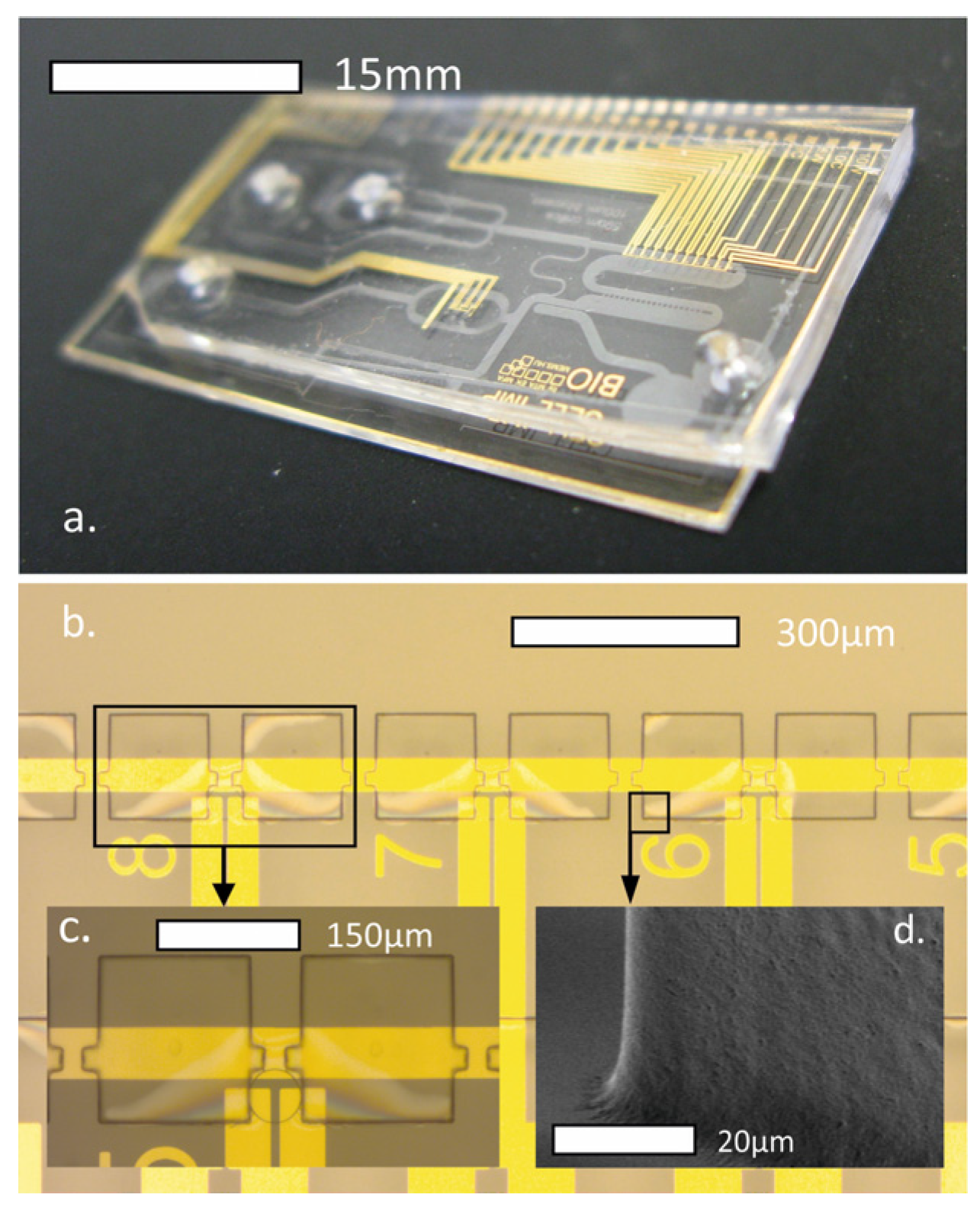
In contrast with the silicon based microsystems polymer or hybrid microfluidic structures offer the possibility of fabrication cheap, disposable analytical cartridges, although high complexity integration of these architecture is quite challenging. In our case the definition and characterization of fundamental technology steps for processing hybrid microfluidic system with integrated microelectrodes was demonstrated (Figure 1).
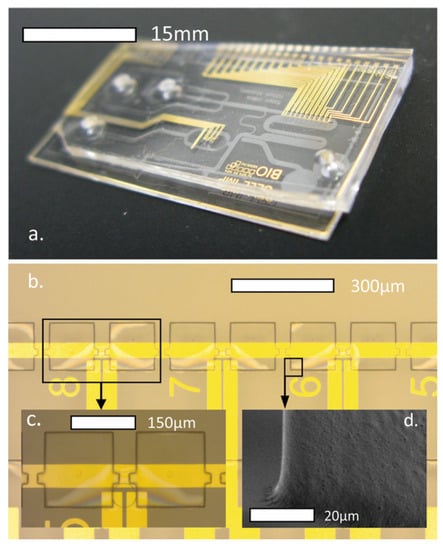
Figure 1.
Metal (Au) electrodes integrated in SU-8 based hybrid microfluidic system (a); For proper alignment, electric insulation and transparency the channels are formed in multi-layered SU-8 (b,c); SEM view presents the interface between the thin insulation and the thick channel forming SU-8 layers (d).
2. Materials and Methods
Primarily gold and platinum metal layers were patterned on glass and polycarbonate substrates. To ensure geometric alignment, electric insulation, optical transparency, chemical and thermal stability and biocompatibility SU-8 epoxy-based negative photoresist was used to form microfluidic channels. To fabricate SU-8 based microstructures on polycarbonate substrate we have modified the lithography process, since the commercial developer (MicroChem) of the SU-8 reacts with the polycarbonate and deteriorates its optical properties. Changing the developer to ethyl-lactate make the development of SU-8 compatible with thermoplastics substrates. For proper sealing PDMS was applied as cover layer.
3. Results
Our aim was to modify both the SU-8 and PDMS surface in a well-controlled way, in order to form covalent bond between the substrates. According to the literature the feasible SU-8/PDMS binding is evolving through the reaction of the epoxy groups on SU-8 and amino groups, however our attempts to reproduce the published recipes failed in most cases. Therefore SU-8 and PDMS surfaces were characterized by surface analytical methods (FTIR, XPS, AFM and contact angle measurements) in between the process steps.
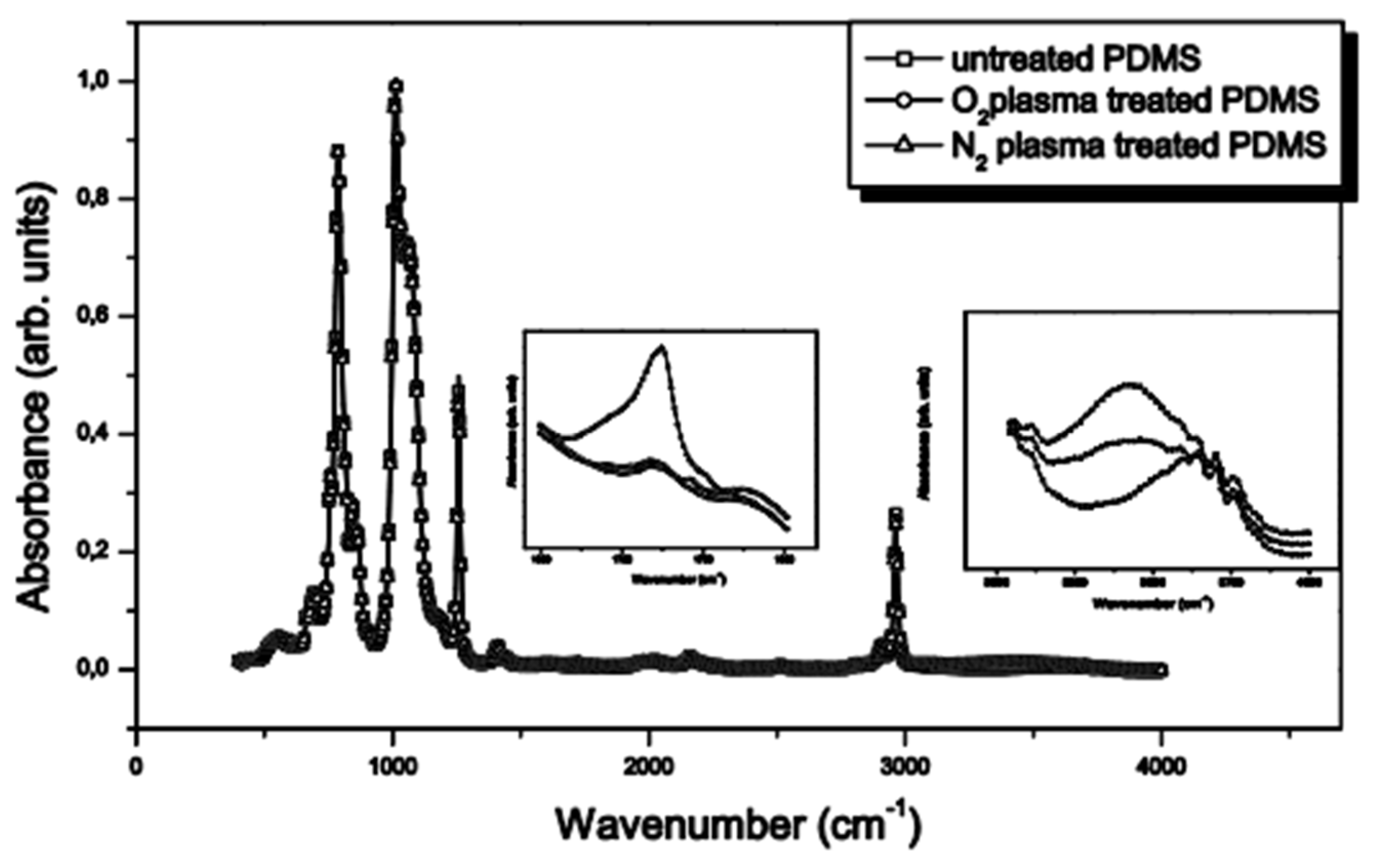
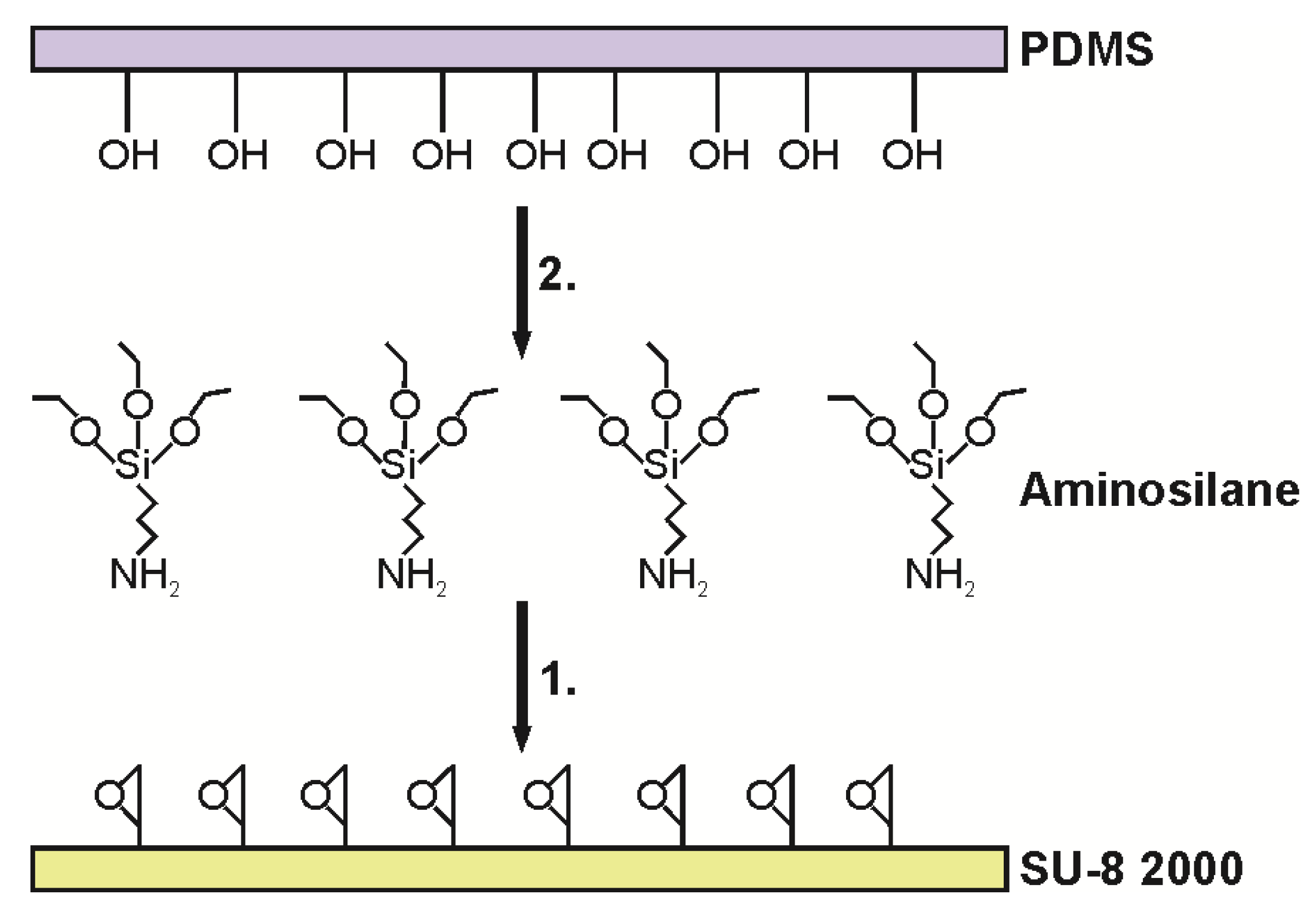
Authors mentioned simple N2 plasma treatment of PDMS to form chemically active amino groups on its surface [1], however IR spectra in Figure 2 demonstrates the absence of nitrogen (amino groups) on the N2 plasma treated PDMS sample surface due to carbonyl groups formed by the fast hydrolysis of the amino groups on air conditions. Accordingly the application of a cross-linker aminosilane molecule layer between the SU-8 and PDMS surfaces is crucial as demonstrated schematically in Figure 3.
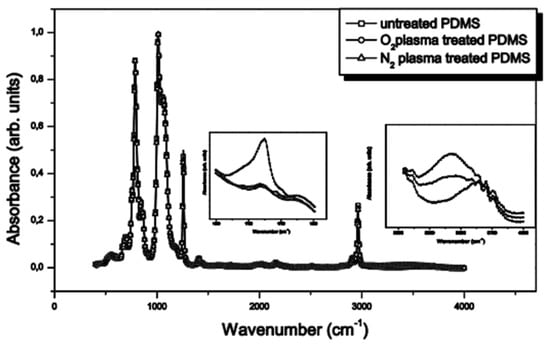
Figure 2.
IR spectra of untreated, O2 plasma and N2 plasma treated PDMS. The left inset is magnification portion of the spectrum around 1730 cm−1, showing characteristic carbonyl band. The right inset: zoom-in on the OH region.
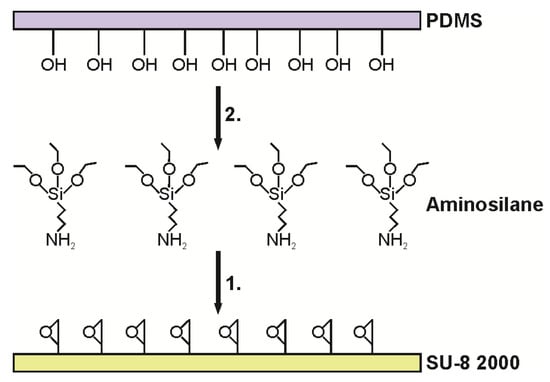
Figure 3.
Schematic molecular level representation of the bonding process between the SU-8 and PDMS surface: 1. Silanization of the SU-8/2. OH groups of hydrolized APTES molecules react with the silanol groups of plasma treated PDMS surface.
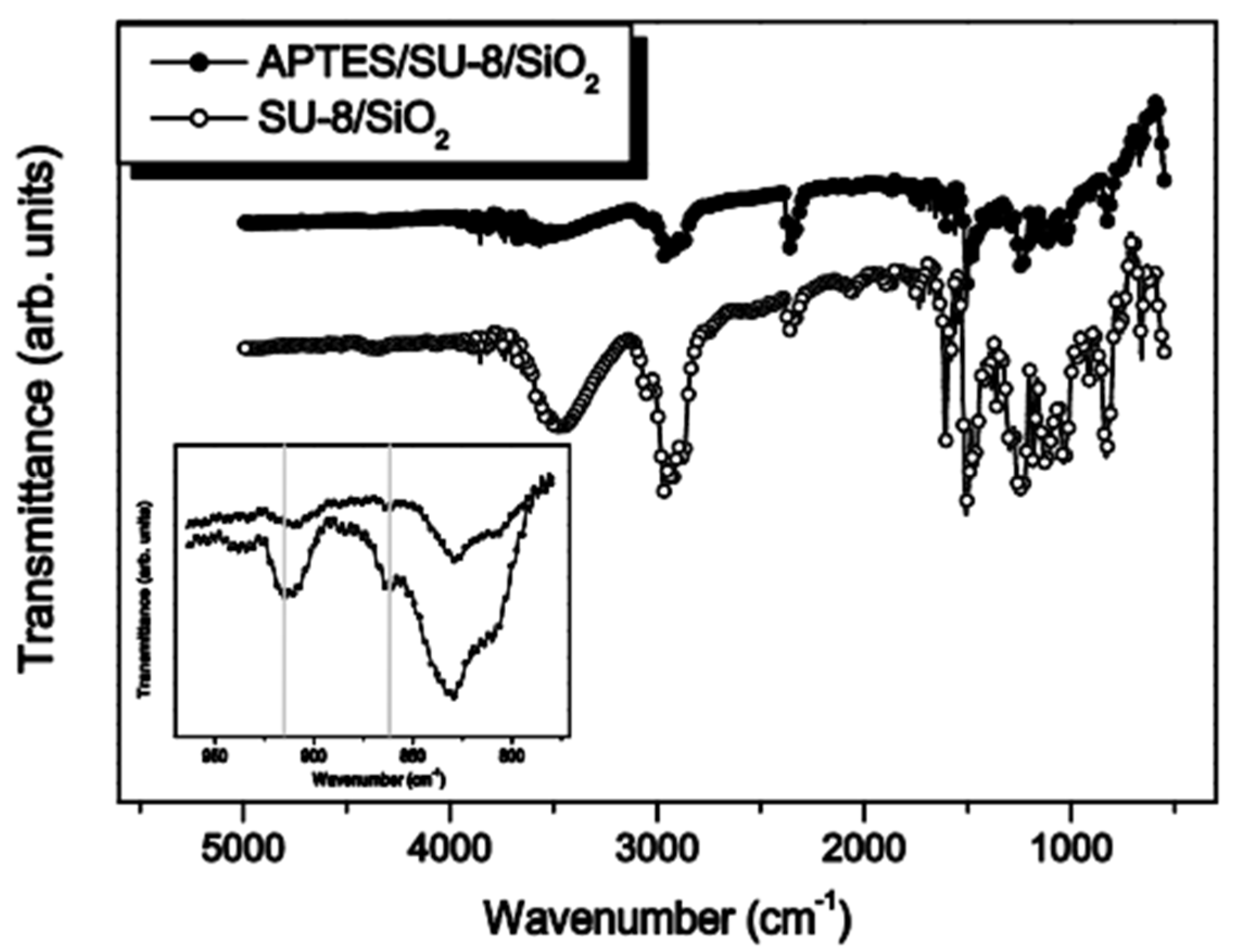
The change of the surface chemistry due to the silanization process of SU-8 (using APTES: (3-Aminopropyl)triethoxysilane) is represented by its IR spectra in Figure 4.
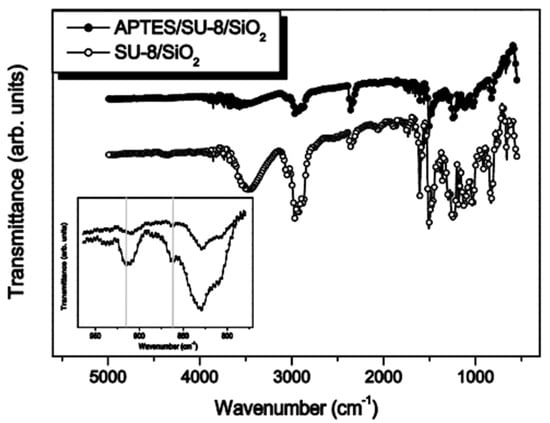
Figure 4.
FT-IR spectra of SU-8 (2025) before and after silanization treatment. The inset shows the expanded spectral region between 960 cm−1 and 780 cm−1, the intensity of epoxy group related vibrational resonances at 867 cm−1, and 917 cm−1 decreased.
4. Conclusions
Several bonding strategies were characterized regarding their adhesion and stability, considering plasma processes (O2, N2) and silanization treatments, as mentioned by diversified literature. Chemical composition of the bonding surfaces was analysed by sensitive analytical methods in molecular level. The applicable materials and processes were defined to achieve reliable formation of complex hybrid polymer microfluidic systems. Accordingly SU-8 series can be bonded to PDMS layer after silanization of its surface and oxygen plasma treatment of PDMS, to form integrated hybrid microfluidic cartridge on transparent substrates for electrical analysis as Figure 1 demonstrated.
Acknowledgments
This work was partially supported by the National Research, Development and Innovation Fund (NKFIA) via the VKSZ_14-1-2015-0004. The authors gratefully acknowledge the high-quality technical work of Gabriella Bíró, Magda Erős and Margit Payer regarding microfabrication processes. The authors also appreciate the important contribution of Judith Mihály and Miklós Veres in implementation surface analytical methods (FTIR).
Conflicts of Interest
The authors declare no conflict of interest. The founding sponsors had no role in the design of the study; in the collection, analyses, or interpretation of data; in the writing of the manuscript, and in the decision to publish the results.
Reference
- Zhang, Z.; Zhao, P.; Xiao, G.; Watts, B.; Xu, C. Sealing SU-8 microfluidic channels using PDMS. Biomicrofluidics 2011, 5, 046503. [Google Scholar] [CrossRef] [PubMed]
Publisher’s Note: MDPI stays neutral with regard to jurisdictional claims in published maps and institutional affiliations. |
© 2017 by the authors. Licensee MDPI, Basel, Switzerland. This article is an open access article distributed under the terms and conditions of the Creative Commons Attribution (CC BY) license (https://creativecommons.org/licenses/by/4.0/).