


Abstract
The present project attempts to investigate students’ Environmental Attitudes based on the Theory of Ecological Attitude. The research methodology involves a literature review and questionnaires. The research is carried out in three countries: Greece, Latvia, and the Netherlands. A certain number of students from each country participated in a survey regarding the purpose of the project. The analysis of the collected data illuminates the intricate interplay between students’ attitudes and two contrasting perspectives: biocentric and human-centered attitudes towards the environment. It begins with an exploration of the prevalence of each attitude type and the correlations between these attitudes and various demographic factors are examined to discern potential patterns and associations. The findings shed light on the nuanced relationship between attitudes and environmental behaviors among students from different countries. The comparative evaluation among the students of the three countries highlighted that the biocentric (pro-environmental) and human-centered (anti-environmental) perceptions may co-exist at the same time. The results indicated that a new theory for environmental ethics has been deemed necessary.
1. Introduction
Human activities contributing to climate change have implications for ecosystems and natural resources, catches, agriculture and animal husbandry, health, nutrition and food, biodiversity, climate, clean water and reserves, clean atmosphere, the economy, and society as a whole [1].
Environmental attitudes, a crucial construct in environmental psychology, are a psychological tendency expressed by evaluating the natural environment with some degree of favor [2].
Young people are the group most heavily involved in educational processes. More importantly, they are a crucial group to be involved in the fight against climate change. They are not only the current members of society but also the future decision-makers, and they will have to deal with the adverse effects of this global issue in the future [3]. It means, if we manage to educate young people about environmental attitudes, that the future of the Earth will be in the hands of people who understand their role in nature preservation. Thus, our entire planet will be run by people who genuinely want the best for nature, and because of that, we will have higher chances of stopping the harm caused by people.
A new theory for environmental ethics is deemed necessary, so we must explore the environmental attitudes of young people in order to be one step closer to improving the knowledge about people’s environmental attitudes [4,5]. Thus, the research problem is to investigate students’ environmental attitudes and their correlation with biocentric and anthropocentric attitudes.
In this research, we use two terms: biocentrism, which refers to a person valuing all living things equally, and anthropocentrism, which refers to a person who believes that humans alone possess intrinsic value. By clearly understanding the true motivation of a person’s actions, we can then resolve the issues even better. This will lead to a better life for all of humanity [6].
Comprehensive understanding of students’ environmental attitudes reveals distinct clusters of attitudes rather than a simple continuum between preservation and utilization. It is hypothesized that students who demonstrate a greater understanding of the implications of climate change and environmental degradation are more likely to show biocentric attitudes, prioritizing the preservation of ecosystems and natural resources over anthropocentric concerns.
2. Methodology
This study utilizes a quantitative-deductive causal approach. The necessity for a fresh perspective on environmental ethics underscores the urgency of delving into the environmental inclinations of younger generations through this study.
2.1. Measures and Instrument
To achieve the aim of the study and examine any possible co-existence between the biocentric (pro-environmental) and human-centered (anti-environmental) perceptions, a questionnaire was developed. The questionnaire was presented in English to students from all three countries (Greece, Latvia, and the Netherlands) who have a vested interest in climate change given its alarming nature and the considerable attention it has garnered in discussions nowadays. The observed countries (the Netherlands, Greece, Latvia) have distinct differences in the demographic factors [7], which implies that there would be differences in the students’ opinions about biocentrism and anthropocentrism. Nonetheless, it is hypothesized that in this world of increasing multiculturalism and individualism [8,9] there is the possibility that the idea of preservation for the three countries is following a simple continuum. The questionnaire items were developed using a five-point Likert scale; the lowest value represented strong disagreement (1) and the highest value represented strong agreement (5). The final version of the questionnaire had seven small sections: The first section (1) contained general information about the participant, such as their ethnicity, age, and field of education. The following five sections (2–6) are five different components that were tested to investigate the Environmental Attitude of the students from the three countries: intent of support, care for resources, enjoyment of nature, altering nature, and dominance over nature.
2.2. The Study Population and Sample
The research collects data on understanding the correlation between students’ attitudes and two specific perspectives: biocentric (pre-environmental) attitudes, emphasizing the intrinsic value of nature, and human-centered (anti-environmental) attitudes, which may prioritize human interests over ecological concerns. The questionnaire was distributed to students from all three universities through various online platforms, such as Discord, Instagram, and Facebook), but also through student associations. We focused on collecting data from three different countries—Greece, Latvia, and the Netherlands—so that we could then distinguish between any differences we identified.
3. Results
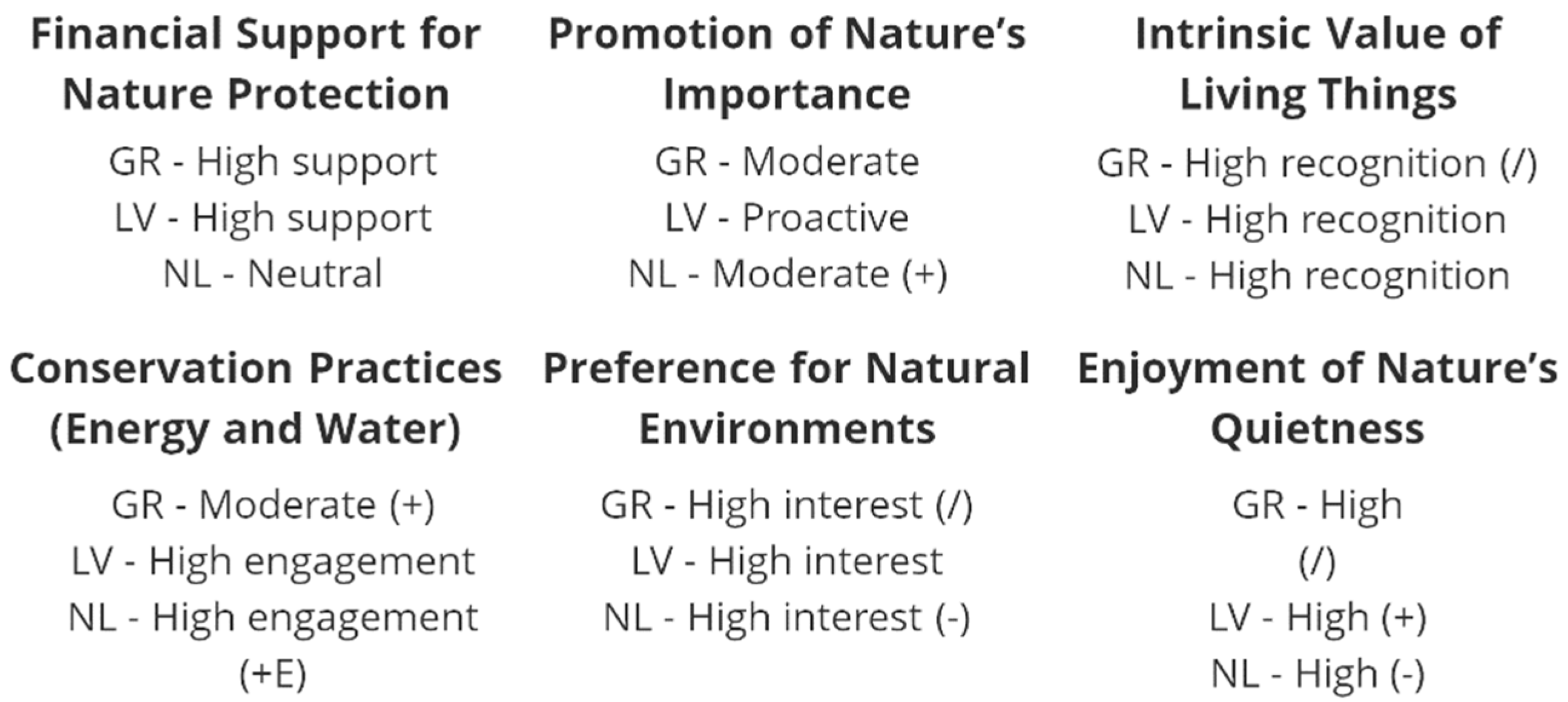
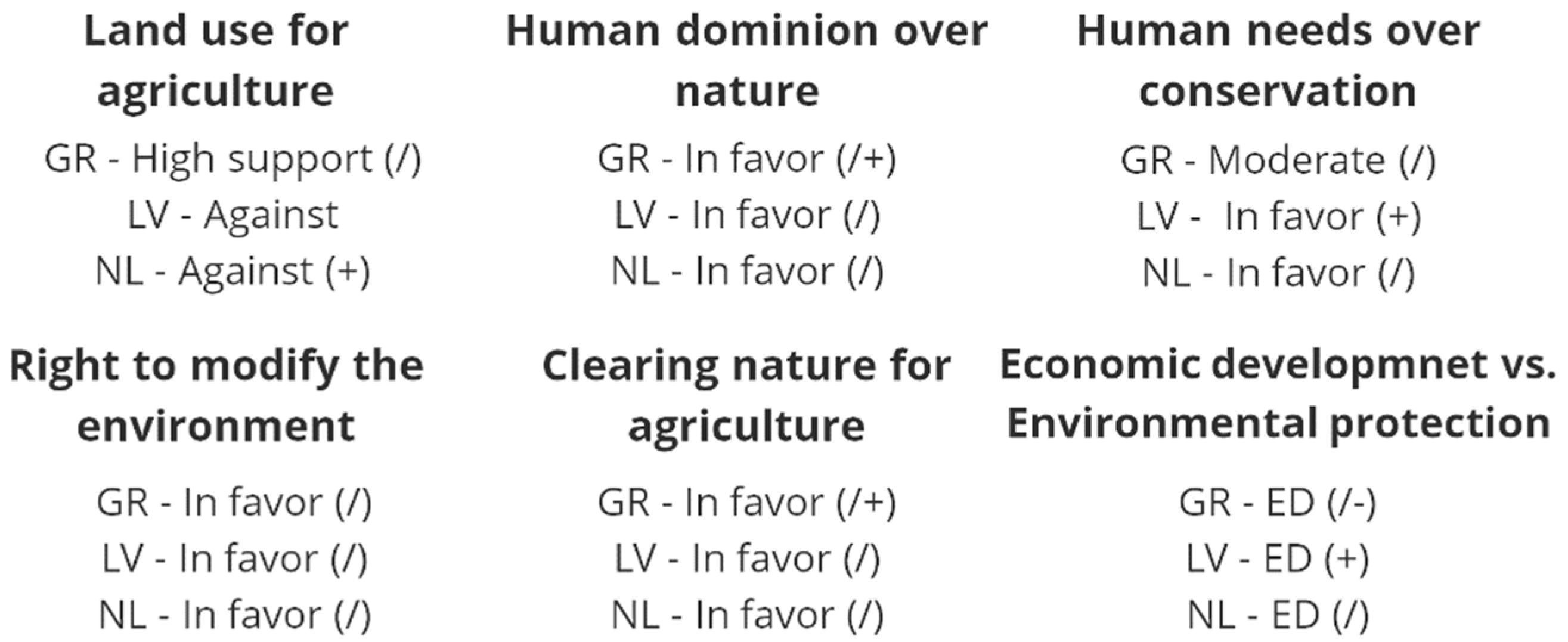
Table 1, Table 2, Table 3 and Table 4 portray sociodemographic characteristics, preservation and utilization constructs, and the component matrix of the responses to the questionnaire.

Table 1.
Sociodemographic characteristics.
Table 2.
Preservation constructs.
Table 3.
Utilization constructs.
Table 4.
Component matrix.
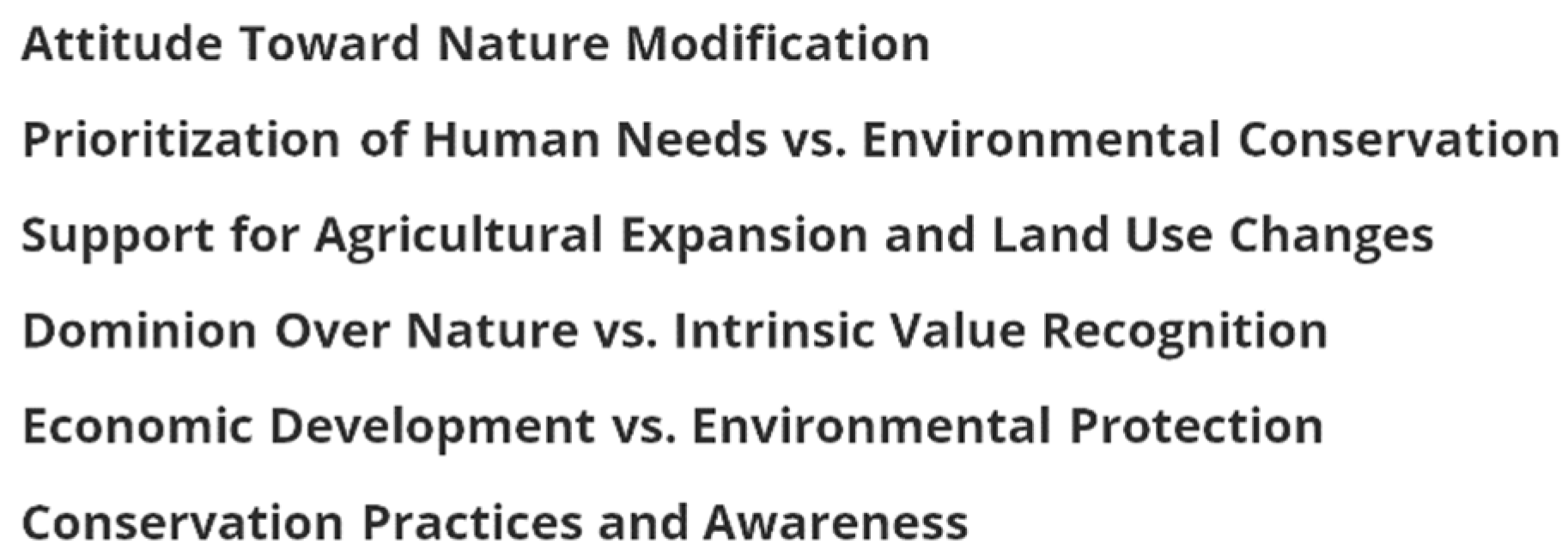
A factorial analysis was performed, where the variables are mainly separated on the first axis (negative and positive coefficients with axis-1).
Figure 1 depicts the correlations between country of origin and preservation.
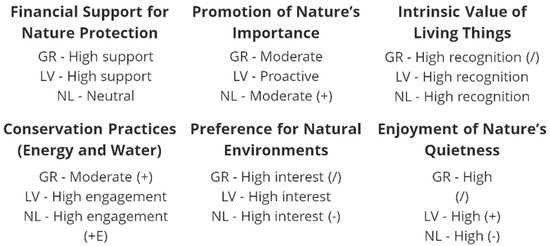
Figure 1.
Correlations between country of origin and preservation.
Figure 2 depicts the correlations between country of origin and utilization.
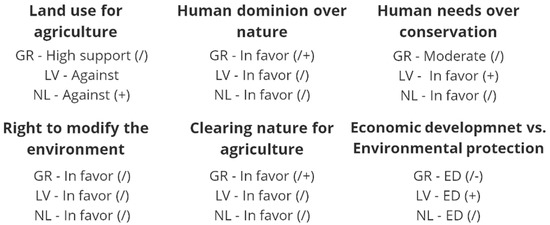
Figure 2.
Correlations between country of origin and utilization.
There are differences in utilization and preservation attitudes among the three countries (Figure 3).
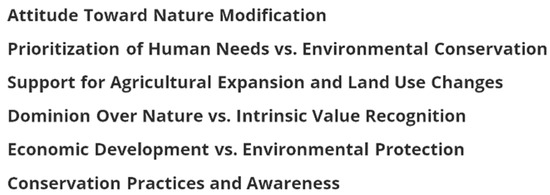
Figure 3.
Differences in utilization and preservation.
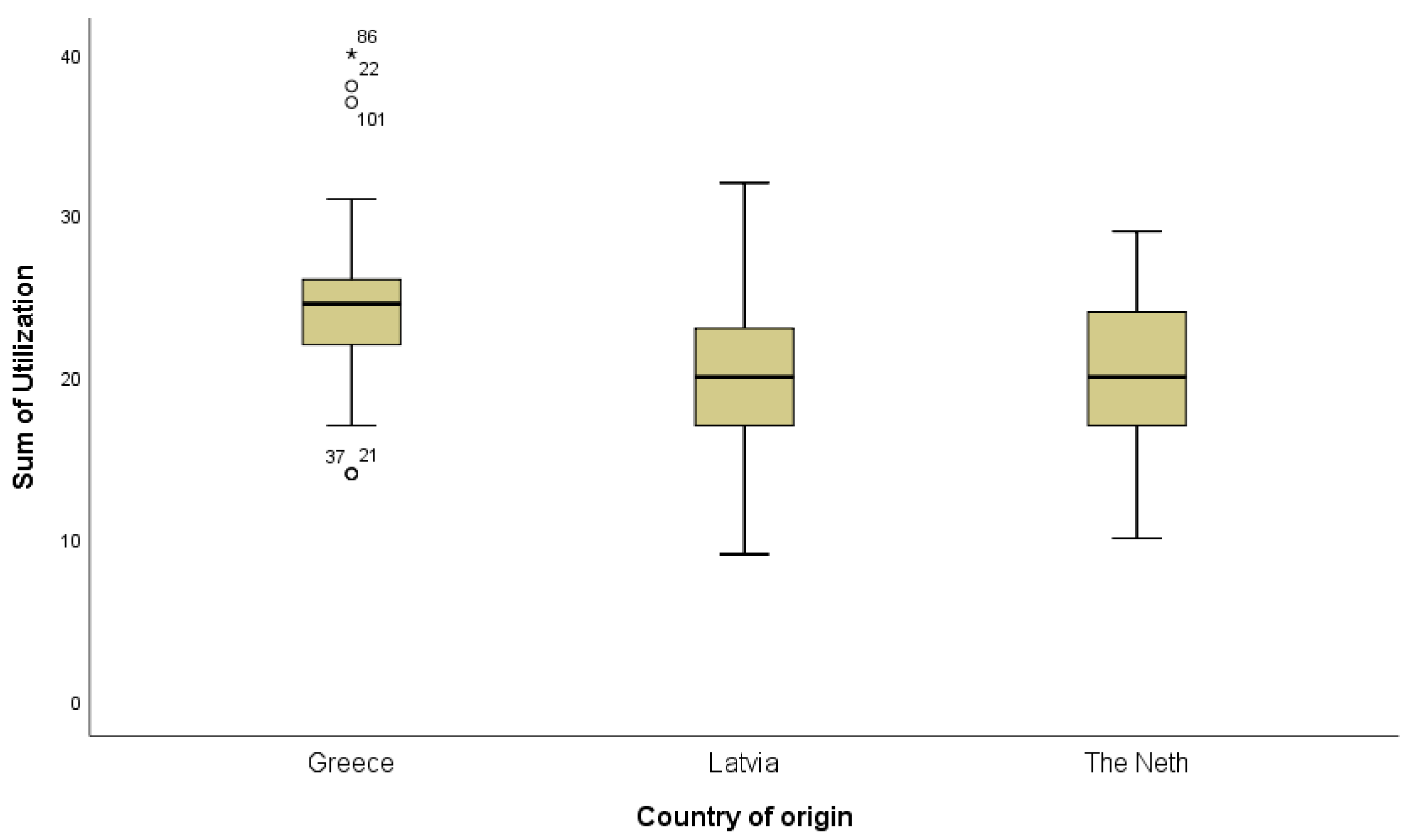
The averages by country as well as the comparison chart (boxplot) are explored, as depicted in Figure 4.
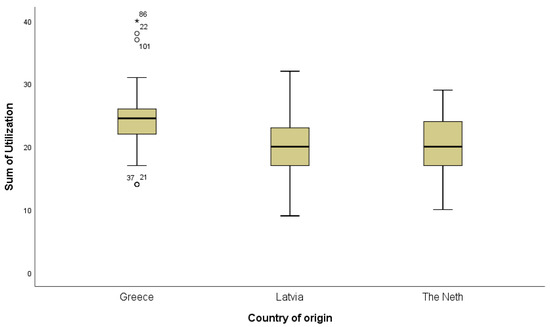
Figure 4.
The boxplot.
4. Conclusions
The analysis of the collected data offers valuable insights into the intricate dynamics of students’ attitudes towards the environment, particularly through the lens of contrasting perspectives: biocentric and human-centered. The findings underscore a prevalent recognition of nature’s significance among respondents, yet a reluctance to provide financial support for environmental initiatives is evident. While there is willingness to engage in actions like waste reduction, opinions diverge on issues such as water usage. The majority express enjoyment of nature and a preference for activities like camping, which suggests a strong affinity for natural settings. However, transportation preferences reveal a split between convenience and environmental concerns. Moreover, there is a discernible shift towards environmental consciousness, with a majority prioritizing environmental protection over economic development. Yet, there remains a difference in views regarding the importance of clean nature for nutrition, agriculture, and ecological products, indicative of the complexity inherent in attitudes towards environmental stewardship among students. These findings show the nature of environmental attitudes and underscore the importance of considering demographic factors and cultural contexts in understanding and promoting sustainable behaviors.
The results presented reflect a complex interplay of attitudes and behaviors towards environmental protection and appreciation of nature. While there is encouraging evidence of a growing recognition of nature’s importance and a willingness to take individual actions to mitigate environmental harm, there are also notable discrepancies and challenges. It is heartening to see a majority of respondents expressing enjoyment and appreciation for nature, as well as a willingness to engage in behaviors like waste reduction and preference for natural experiences like camping. These attitudes suggest a burgeoning environmental consciousness and a desire to prioritize sustainability in daily life.
The significance of nature is unmistakable for the majority of respondents, reflecting a growing awareness of its intrinsic value. However, there is a reluctance among many to provide financial support for environmental protection initiatives, possibly due to various economic or personal constraints.
While utilization and preservation attitudes may appear to be contradictory, it is possible for individuals and societies to hold both simultaneously. A balanced approach that integrates both viewpoints of anthropocentric and biocentric perspectives is essential for fostering environmental sustainability and ensuring the long-term health and resilience of our planet. Future research may expand the aim of the issue to other countries and different cultures, different environmental policies, and different industries, such as tourism and hotel industrial development.
Author Contributions
Conceptualization, S.V. and S.D.A.; methodology, A.M.; software, S.V.; validation, G.F. and S.D.A.; formal analysis, G.F.; investigation, A.M.; resources, S.V.; data curation, S.D.A.; writing—original draft preparation, S.V.; writing—review and editing, G.F.; visualization, A.M.; supervision, S.V.; project administration, S.V. All authors have read and agreed to the published version of the manuscript.
Funding
This research received no external funding.
Institutional Review Board Statement
Not applicable.
Informed Consent Statement
Not applicable.
Data Availability Statement
The data presented in this study are available on request from the corresponding author.
Conflicts of Interest
The authors declare no conflicts of interest.
References
- Ukaogo, P.O.; Ewuzie, U.; Onwuka, C.V. Environmental pollution: Causes, effects, and the remedies. In Microorganisms for Sustainable Environment and Health; Elsevier: Amsterdam, The Netherlands, 2020; pp. 419–429. [Google Scholar]
- Milfont, T.L.; Duckitt, J. The environmental attitudes inventory: A valid and reliable measure to assess the structure of environmental attitudes. J. Environ. Psychol. 2010, 30, 80–94. [Google Scholar] [CrossRef]
- Kirbiš, A. Environmental Attitudes among Youth: How Much Do the Educational Characteristics of Parents and Young People Matter? Sustainability 2023, 15, 11921. [Google Scholar] [CrossRef]
- Taylor, P.W. Respect for Nature: A Theory of Environmental Ethics; Princeton University Press: Princeton, NJ, USA, 2011; Volume 51. [Google Scholar]
- Hourdequin, M. Environmental Ethics: From Theory to Practice; Bloomsbury Publishing: London, UK, 2024. [Google Scholar]
- Sourlas, P. Regulating the Things of Life: The Legislator and Bioethics; University Press of Crete: Heraklion, Crete, 2020; pp. 144–145. [Google Scholar]
- Kaasa, A.; Vadi, M.; Varblane, U. Regional cultural differences within European countries: Evidence from multi-country surveys. Manag. Int. Rev. 2014, 54, 825–852. [Google Scholar] [CrossRef]
- Santos, H.C.; Varnum, M.E.W.; Grossmann, I. Global Increases in Individualism. Psychol. Sci. 2017, 28, 1228–1239. [Google Scholar] [CrossRef] [PubMed]
- Nijman, J. Cultural globalization and the identity of place: The reconstruction of Amsterdam. Ecumene 1999, 6, 146–164. [Google Scholar] [CrossRef]
Disclaimer/Publisher’s Note: The statements, opinions and data contained in all publications are solely those of the individual author(s) and contributor(s) and not of MDPI and/or the editor(s). MDPI and/or the editor(s) disclaim responsibility for any injury to people or property resulting from any ideas, methods, instructions or products referred to in the content. |
© 2025 by the authors. Licensee MDPI, Basel, Switzerland. This article is an open access article distributed under the terms and conditions of the Creative Commons Attribution (CC BY) license (https://creativecommons.org/licenses/by/4.0/).