


Gas sensors are becoming increasingly important for the safety and quality of human life. In the past decades, semiconductor gas sensors employing high-temperature ceramics technology have been intensively investigated, and higher sensitivity as well as selectivity have been achieved. Silicon-based micro-electro-mechanical system (MEMS) hotplates have also been utilized to reduce both the volume size and power consumption of semiconductor gas sensors. Colloidal quantum dots (CQDs) possess a highly sensitive and programmable surface, combined with excellent solution processability, which make them ideal building blocks for next-generation gas sensors compatible with silicon-based or flexible substrates. Through the controllable synthesis with the surface and interface engineering strategy of CQDs, we have demonstrated sensitive and selective semiconductor gas sensors with lower power consumption based on metal sulfides [1,2] and oxides [3,4], respectively. In addition to traditional rigid substrates including ceramics and Si-based MEMS hotplates, soft substrates, being flexible and stretchable, were successfully used for CQD gas sensors, which may open up a powerful new degree of freedom for semiconductor gas sensors being more intelligent and integratable.
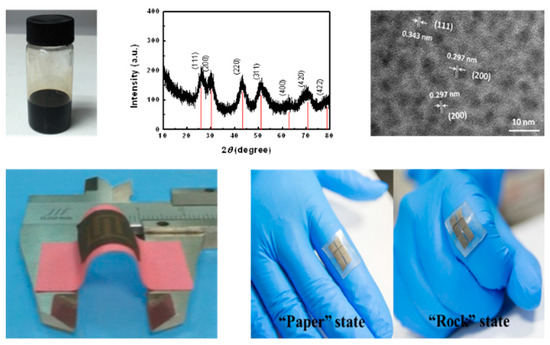
Figure 1.
Colloidal quantum dots for low-power-consumption semiconductor gas sensors. Reproduced with permission from Huan Liu; Physically flexible, rapid-response gas sensor based on colloidal quantum dot solid [1] and Fully stretchable and humidity-resistant quantum dot gas sensors [2]; published by Wiley (2014) and the American Chemical Society (2018), respectively.
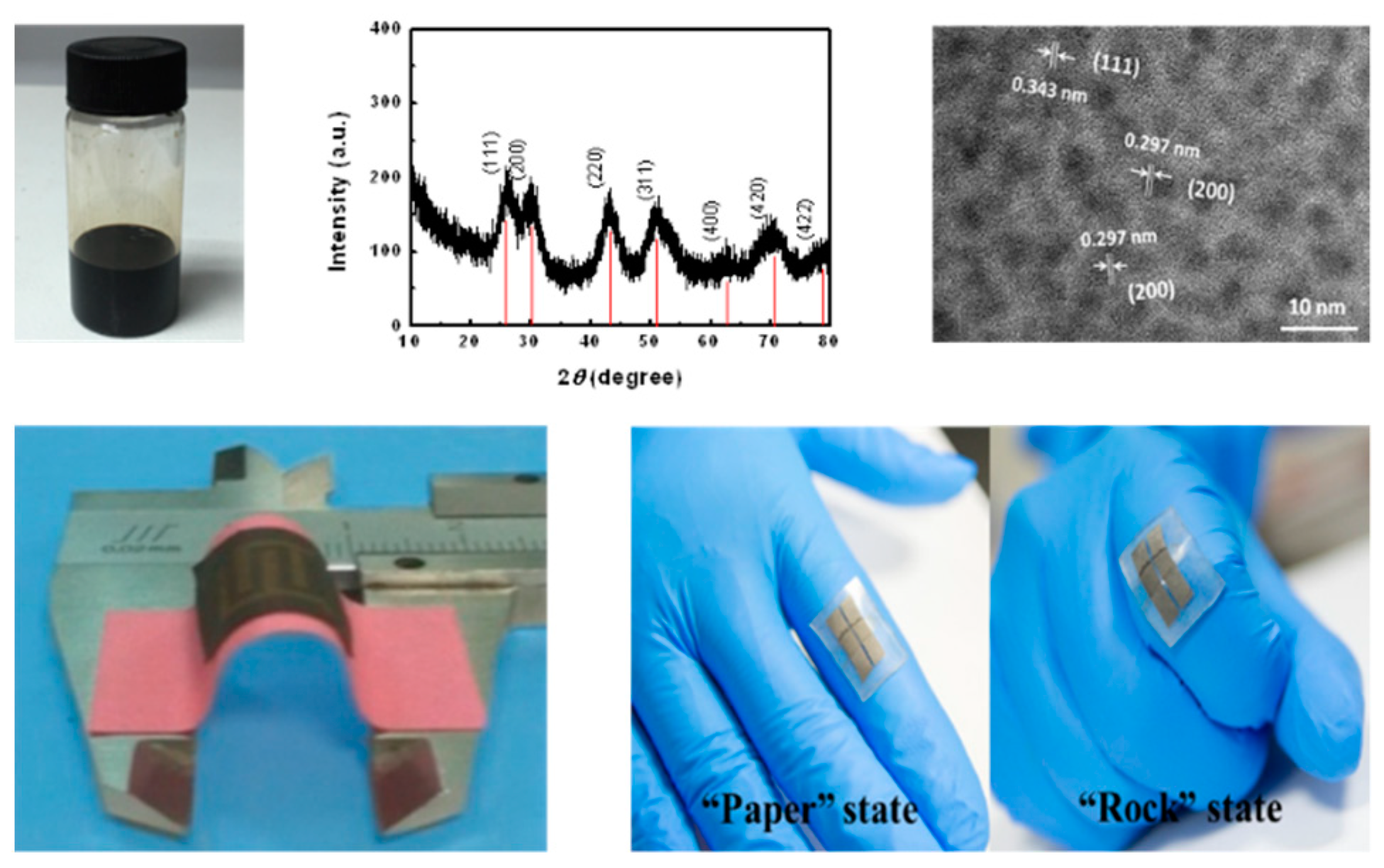
Figure 1.
Colloidal quantum dots for low-power-consumption semiconductor gas sensors. Reproduced with permission from Huan Liu; Physically flexible, rapid-response gas sensor based on colloidal quantum dot solid [1] and Fully stretchable and humidity-resistant quantum dot gas sensors [2]; published by Wiley (2014) and the American Chemical Society (2018), respectively.
References
- Liu, H.; Li, M.; Voznyy, O.; Hu, L.; Fu, Q.Y.; Zhou, D.X.; Xia, Z.; Sargent, E.H.; Tang, J. Physically flexible, rapid-response gas sensor based on colloidal quantum dot solids. Adv. Mater. 2014, 26, 2178. [Google Scholar] [CrossRef] [PubMed]
- Song, Z.L.; Huang, Z.; Liu, J.Y.; Hu, Z.X.; Zhang, J.B.; Zhang, G.Z.; Yi, F.; Jiang, S.L.; Lian, J.B.; Yan, J.; et al. Fully stretchable and humidity-resistant quantum dot gas sensors. ACS Sens. 2018, 3, 1048. [Google Scholar] [CrossRef] [PubMed]
- Liu, H.; Xu, S.M.; Li, M.; Shao, G.; Song, H.B.; Zhang, W.K.; Wei, W.D.; He, M.Z.; Gao, L.; Song, H.S.; et al. Chemiresistive gas sensors employing solution-processed metal oxide quantum dot films. Appl. Phys. Lett. 2014, 105, 163104. [Google Scholar] [CrossRef]
- Song, Z.L.; Wei, Z.R.; Wang, B.C.; Luo, Z.; Xu, S.M.; Zhang, W.K.; Yu, H.X.; Li, M.; Huang, Z.; Zang, J.F.; et al. Sensitive room-temperature H2S gas sensors employing SnO2 quantum wire/reduced graphene oxide nanocomposites. Chem. Mater. 2016, 28, 1205. [Google Scholar] [CrossRef]
© 2019 by the authors. Licensee MDPI, Basel, Switzerland. This article is an open access article distributed under the terms and conditions of the Creative Commons Attribution (CC BY) license (http://creativecommons.org/licenses/by/4.0/).