


Hydroxyapatite is a calcium phosphate-based biomaterial utilized both in the medicine field (bone cement, scaffold, drug-delivery) and in the heritage field (stone conservation) [1]. On the other hand, starch is a natural biodegradable polymerconsisting of two polysaccharides present in the food industry [2,3]. In this research, we examined three main aspects: (i) the thermal synthesis of bovine bone-derived hydroxyapatite, (ii) the powder consolidation for obtaining HA/starch biocomposites, and (iii) the behavior of sacrificialporogen agent at sintering. Thermal processing of ceramic material started with deproteinization of bovine bone at 550 °C for 4 h followed by calcination at 800 °C for 6 h. Hydroxyapatite powder was mixed with 10, 25 vol. % starch and compacted by pressing at different press forces: 1 tf, 3 tf and 5 tf (~1.5 MPa, 3.5 MPa, and 7.5 MPa). The consolidated parts were sintered at 1200 °C for 2 and 8 h. The porous structure resulted after starch removal during sintering. The sintered samples were characterized through SEM, EDS and FT-IR. The porosity was evaluated by using software dedicated to the characterization of SEM images. Chemical composition was evaluated using Energy Dispersive Spectroscopy (EDS) to determine the Ca/P atomic ratio. The results obtained from the FT-IR spectra confirms that starch removal does not affect existing hydroxyapatite compounds. We present conclusive data in Figure 1 relating to the different levels of porosity of final materials with a sintering time of 2 h. To be employable in the medical field, we reported the results obtained at the porosity rate of the cortical and cancellous bone [4]. The additions of starch increase the porosity and, by increasing the pressing force, the size of the pore decreases.Our future research will focus on the optimization of sintering methods through the management of process parameters and the selection of porogen agents for biomedical applications.
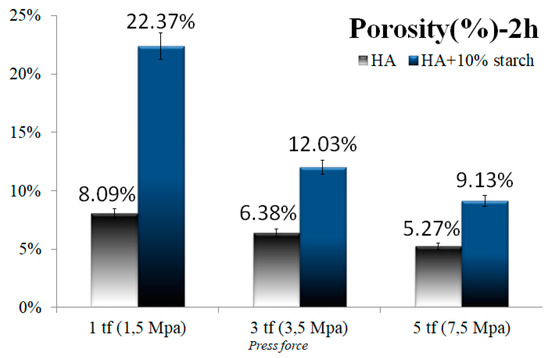
Figure 1.
Determination of porosity at 2 h sintering maintenance.
Acknowledgments
This work was part of Denisa Loredana Copilu’s Bachelor Thesis, “Studies on obtaining porous hydroxyapatite structures using porogen agents of natural origin,” coordinated by Prof. F. Miculescu, Faculty of Materials Science and Engineering, University Politehnica of Bucharest, July/2019.
References
- Ion, R.M.; Carutiu, D.T.; Fierascu, R.C.; Fierascu, I. Chalk stone restoration with hydroxyapatite-based nanoparticles. Sci. Bull. Valahia Univ. Mater. Mech. 2014, 9, 16–19. [Google Scholar]
- Miculescu, F.; Maidaniuc, A.; Voicu, Ș.I.; Thakur, V.K.; Stan, G.E.; Cioca, L.T. Progress in hydroxyapatite–starch based sustainable biomaterials for biomedical bone substitution applications. ACS Sustain. Chem. Eng. 2017, 5, 8491–8512. [Google Scholar] [CrossRef]
- Miculescu, F.; Maidaniuc, A.; Miculescu, M.; Batalu, N.D.; Ciocoiu, R.C.; Voicu, Ș.I.; Stan, G.E.; Tahkur, V.K. Synthesis and Characterization of Jellified Composites from Bovine Bone-Derived Hydroxyapatite and Starch as Precusors for Robocasting. ACS Omega 2018, 3, 1338–1349. [Google Scholar] [CrossRef] [PubMed]
- Renders, G.A.P.; Mulder, L.; van Ruijven, L.J.; van Eijden, T.M.G.J. Porosity of human mandibular condylar bone. J. Anat. 2007, 210, 239–248. [Google Scholar] [CrossRef] [PubMed]
© 2019 by the authors. Licensee MDPI, Basel, Switzerland. This article is an open access article distributed under the terms and conditions of the Creative Commons Attribution (CC BY) license (https://creativecommons.org/licenses/by/4.0/).