


The formation of an oro-antral communication, a not uncommon event in dental practice, may lead to spontaneous resolution or to the formation of a fistula that requires surgical treatment in order to create an absolutely hermetic barrier between the oral environment and the maxillary sinus [1].
The aim of the study was to provide a summary review of the literature on the surgical techniques currently in use for the resolution of oro-antral communications, that are the trapezoidal, rotated vestibular, rotated palatine, buccal fat pad and double-layered flap techniques; then to describe the central theme of the study, that is the technique of mucogingival plastic surgery with the use of a dorsum of tongue flap (Figure 1) if it is not possible to use adjacent tissue to close the communication.
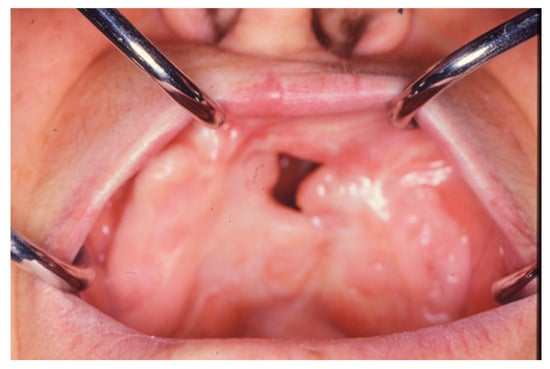
Figure 1.
In this case we decided to use the technique of mucogingival plastic surgery with the use of a dorsum of tongue flap because it wasn’t possible to use adjacent tissue to close the communication.
In fact, when the tissues adjacent to the oro-antral or oro-nasal communication are unsuitable for the closure of a large sized fistula, a muscolar-mucosal flap from the tongue dorsum can be used and rotated upwards.
Once this initial phase is performed, the peduncle of the flap is dissected and the excess will be repositioned to partially reconstruct the area of the dorsum of tongue used. We prepared a case report and we have photographs of the clinical situation after 20 years the surgery was performed (Figure 2).
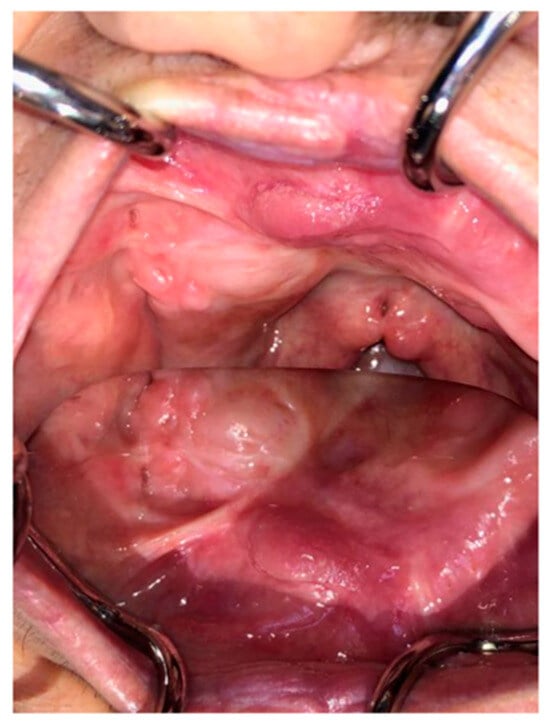
Figure 2.
We see the clinical situation after 20 years the surgery was performed.
With regards to the satisfactory results obtained, we can state that this method is predictable. It’s very important also the early diagnosis that allows the clinician to plan a therapeutic treatment that offers the best guarantees of success [2].
The intent therefore remains to propose a valid protocol that is not a substitute but an alternative to the pre-existing ones, already exhaustively described in literature in the specific case described [3].
Conflicts of Interest
The authors declare no conflict of interest.
References
- Felisati, G.; Chiapasco, M.; Lozza, P.; Saibene, A.M.; Pipolo, C.; Zaniboni, M.; Biglioli, F.; Borloni, R. Sinonasal complications resulting from dental treatment: Outcome-oriented proposal of classification and surgical protocol. Am. J. Rhinol. Allergy 2013, 27, e101–e106. [Google Scholar] [CrossRef] [PubMed]
- Adams, T.; Taud, D.; Rosen, M. Repair of oroantral communications by use of a combined surgical approach: Functional endoscopic surgery and buccal advancement flap/buccal fat pad graft. J. Oral Maxillofac. Surg. 2015, 73, 1452–1456. [Google Scholar] [CrossRef] [PubMed]
- Abuabara, A.; Cortez, L.V.; Passeri, L.A.; de Moraes, M.; Moreira, R.W. Evaluation of different treatments for oroantral/oronasal communications: Experience of 112 cases. Int. J. Oral Maxillofac. Surg. 2006, 35, 155–158. [Google Scholar] [CrossRef] [PubMed]
Publisher’s Note: MDPI stays neutral with regard to jurisdictional claims in published maps and institutional affiliations. |
© 2019 by the authors. Licensee MDPI, Basel, Switzerland. This article is an open access article distributed under the terms and conditions of the Creative Commons Attribution (CC BY) license (https://creativecommons.org/licenses/by/4.0/).