


Abstract
In order to investigate the necessary device improvements for high-temperature CO sensing with SiC metal insulator semiconductor field effect transistor (MISFET)-based chemical gas sensors, devices employing, as the gas-sensitive gate contact, a film of co-deposited Pt/Al2O3 instead of the commonly used catalytic metal-based contacts were fabricated and characterized for CO detection at elevated temperatures and different CO and O2 levels. It can be concluded that the sensing mechanism at elevated temperatures correlates with oxygen removal from the sensor surface rather than the surface CO coverage as observed at lower temperatures. The long-term stability performance was also shown to be improved compared to that of previously studied devices.
1. Introduction
An increasing demand for monitoring and curbing pollutant emissions is a major reason for developing and improving electrical devices as cost-efficient gas sensors. Carbon monoxide (CO) is one example of a substance that is harmful to both the environment and human health and for which a significant amount of what is present in the atmosphere originates from the incomplete combustion of carbon-containing fuels such as natural gas, oil, gasoline and wood. By applying a gate contact material capable of interacting with the gaseous substance of interest to metal insulator semiconductor field effect transistor (MISFET) devices, cost-efficient gas sensors can be realized. The previously used gate contact materials suitable for these FET devices such as Pd, Pt and Ir are, however, stable only for a very limited time at elevated temperatures [1], typically above 350 °C. The chemical inertness and wide band gap of SiC are, on the other hand, intrinsic properties that make this material suitable for electrical devices used in high-temperature and aggressive environments. A suitable gate contact material that can be used in the above-mentioned applications and the corresponding environments and is able to interact efficiently with CO is thereby of importance for the development of SiC MISFET-based CO sensors. The study reported on here instead focuses on co-deposited Pt/Al2O3 as a gate material for the improved CO sensitivity and long-term stability of the MISFET chemical gas sensor at temperatures up to 500 °C.
2. Methods and Materials
In this investigation, SiC-based depletion-type MISFET devices were processed from 4H-SiC wafers, for which the gate metal/oxide material was deposited by the reactive DC magnetron co-sputtering of Pt and Al (IAl = 200 mA, IPt = 450 mA). The deposition was carried out at a total pressure of 25 mTorr with applied Ar and O2 partial pressures of 20 and 5 mTorr, respectively. For the characterization of the fabricated sensor devices, the sensor was then mounted in a gas test chamber and exposed to varying mixtures of CO and O2 in N2 with a total flow of 100 mL/min. The drain current Ids of the MISFET sensor devices was measured and recorded during all the gas exposures using a Keithley 2601 Source Meter, a drain-source voltage (Vds) of 4 V and a gate-source bias (Vgs) of 0 V.
3. Results and Discussion
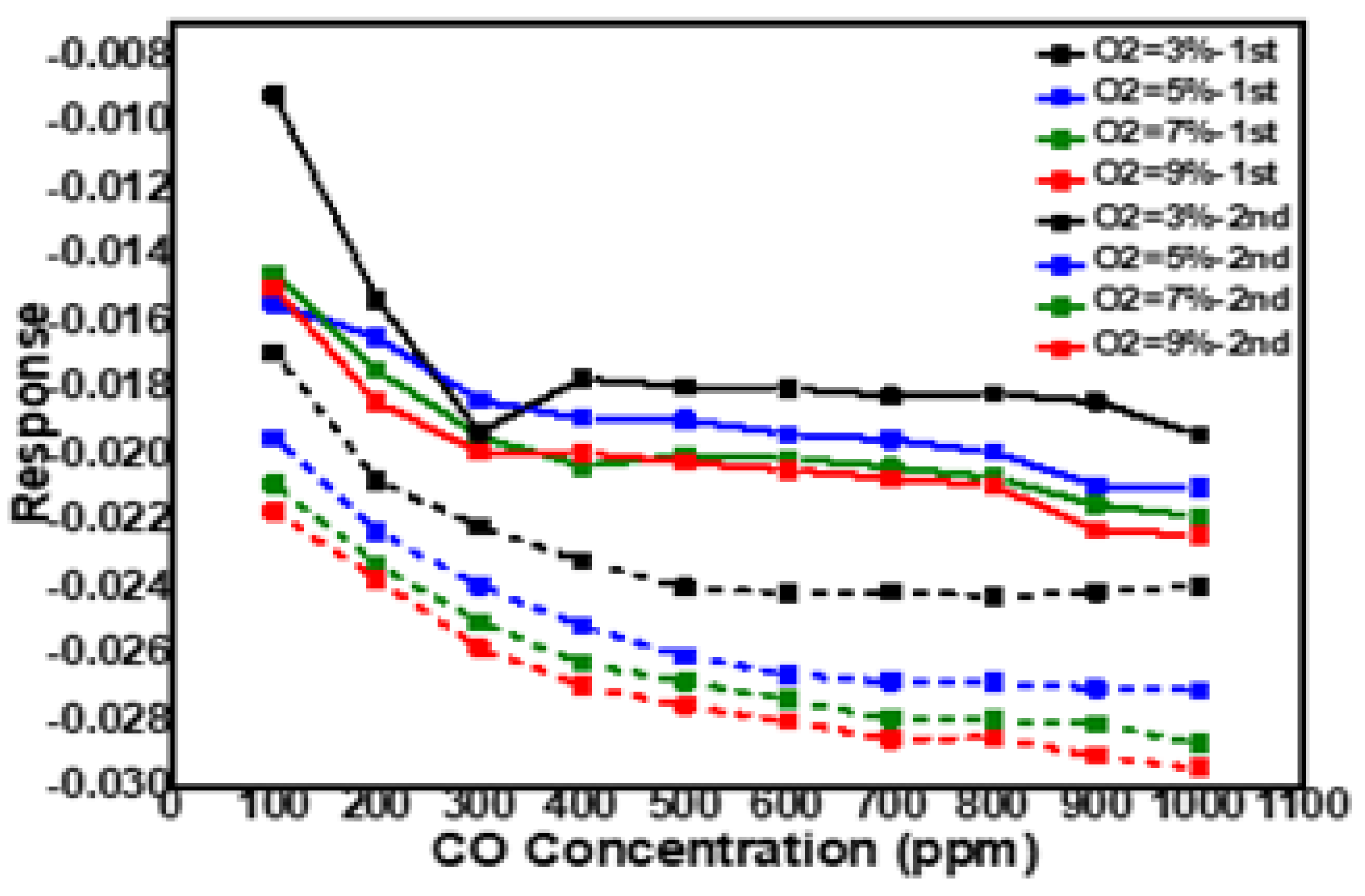
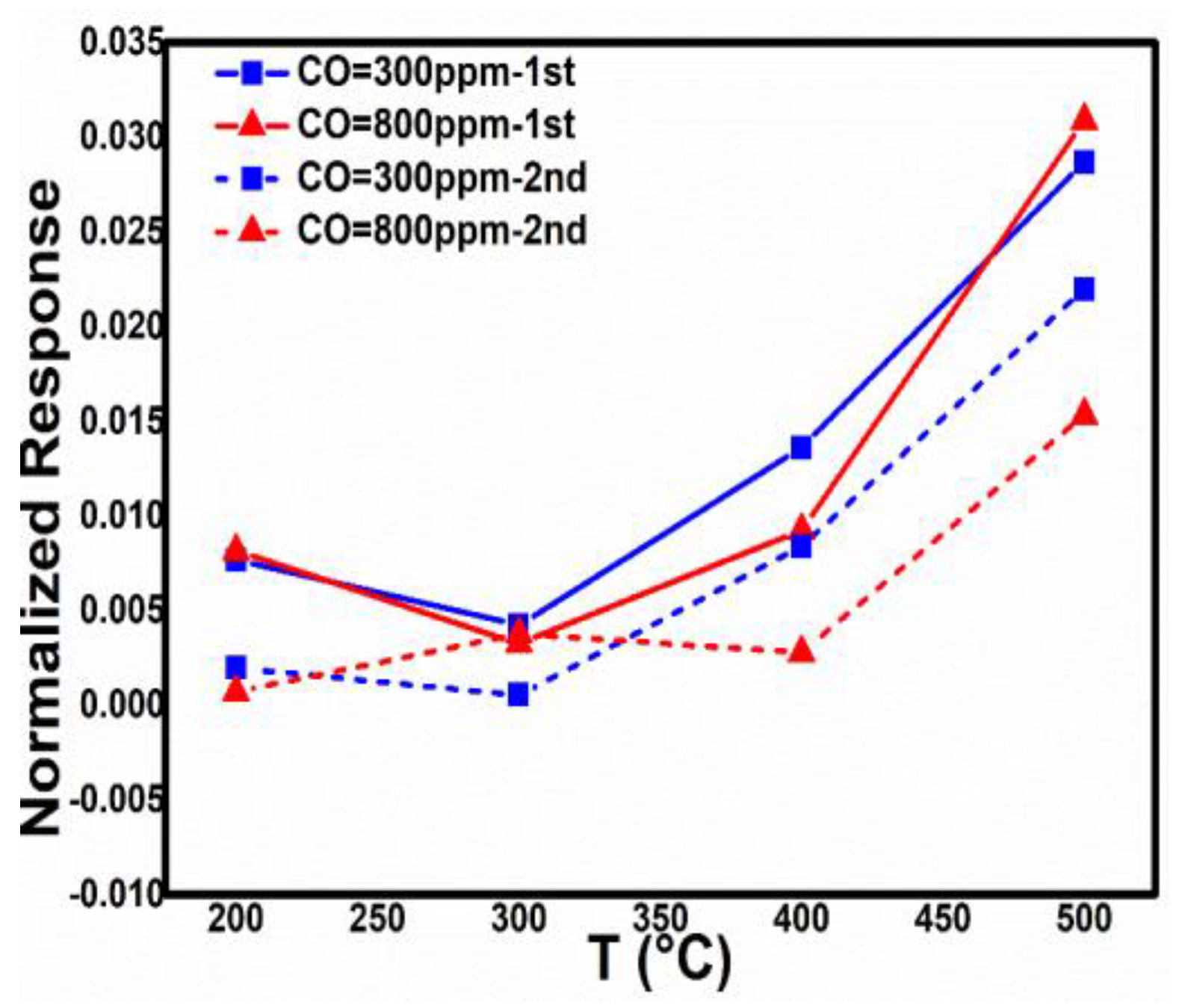
The measured sensor responses to 100–1000 ppm CO during two identical test runs conducted at four different O2 concentrations and a sensor operation temperature of 500 °C were recorded (see Figure 1). The results indicate that for each oxygen level in both the first and second measurements and for all the carbon monoxide concentrations, there is no transition temperature, but the sensor signal slightly decreased with increasing concentrations of carbon monoxide, indicating that the major response mechanism behind the sensor response changes during CO exposure at elevated temperatures (here, 500 °C) and relies on the removal of oxygen from the surface, rather than CO adsorption. This is in contrast to earlier observations at lower temperatures (around 200 °C), for which a strong correlation with the CO oxidation kinetics on a Pt gate has been found. Previous studies [2] have reported a strong dependence of the CO response of Pt-gate MISFET sensors on both temperature and the CO/O2 ratio, the sensor exhibiting a clear CO-surface-coverage dependency correlating well with the surface poisoning phenomenon, as clearly manifested by the binary high-to-low switch in the sensor response upon the ignition of the surface CO oxidation reaction, i.e., when the surface of the Pt gate material changes from being CO covered to more or less oxygen dominated [3]. When looking at the CO responses (CO 300/800 ppm and O2 5%) found for the Pt/Al2O3 gate sensors at different operating temperatures (see Figure 2), such a CO-coverage-dependent response mechanism is not as clearly identified.
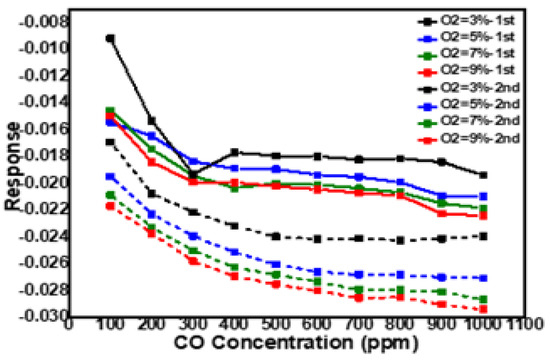
Figure 1.
Response of the Pt/Al2O3 sensor when exposed to CO from 100 to 1000 ppm in 100 ppm steps at 3–9% O2 in N2 at 500 °C. Solid lines indicate first measurements, and dashed lines indicate second measurements.
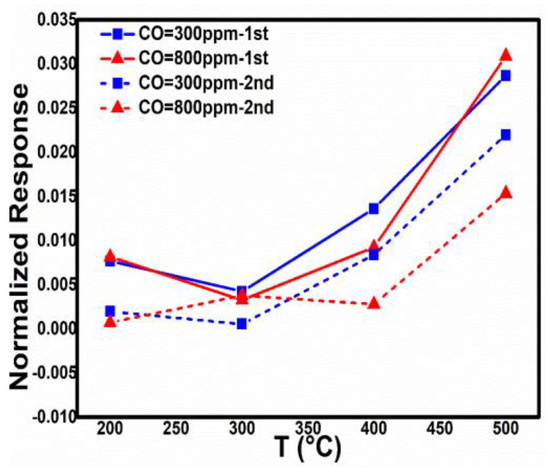
Figure 2.
The increasing trend for the normalized response of Pt/Al2O3-gate SiC metal insulator semiconductor field effect transistor (MISFET) sensors with increasing operating temperature.
Additionally, contrary to what has previously been found for Pt-gate MISFET sensors [3], the CO responses above 300 °C increase with increasing temperature (Figure 2), even if some decrease in the response can be noted over time, which is normal for almost any sensor anyway; the observed response (especially for the somewhat lower CO concentration scale) at the high end of the temperature scale (400–500 °C) is a clear improvement as compared to Pt-gate sensors.
Funding
This research received no external funding.
References
- Spetz, A.L.; Savage, S. Advances in FET chemical gas sensors. In Recent Major Advances in SiC; Choyke, W.J., Matsunami, H., Pensl, G., Eds.; Springer: Berlin, Germany, 2003; pp. 879–906. [Google Scholar]
- Hunter, G.W.; Neudeck, P.G.; Xu, J.; Lukco, D.; Trunek, A.; Artale, M.; Lampard, P.; Androjna, D.; Makel, D.; Ward, B.; et al. Development of SiC-based gas sensors for aerospace applications. Mater. Res. Soc. Symp. Proc. 2004, 815, 287–298. [Google Scholar] [CrossRef]
- Becker, E.; Andersson, M.; Eriksson, M.; Lloyd Spetz, A.; Skoglundh, M. Study of the Sensing Mechanism Towards Carbon Monoxide of Platinum-Based Field Effect Sensors. IEEE Sens. J. 2011, 11, 1527–1534. [Google Scholar] [CrossRef]
Disclaimer/Publisher’s Note: The statements, opinions and data contained in all publications are solely those of the individual author(s) and contributor(s) and not of MDPI and/or the editor(s). MDPI and/or the editor(s) disclaim responsibility for any injury to people or property resulting from any ideas, methods, instructions or products referred to in the content. |
© 2021 by the authors. Licensee MDPI, Basel, Switzerland. This article is an open access article distributed under the terms and conditions of the Creative Commons Attribution (CC BY) license (https://creativecommons.org/licenses/by/4.0/).