


In this study, we aimed to establish the influence of aqueous ferns extracts on the growth in length of the cucumber root. There were tested variants with aqueous extracts obtained from leaves of two species of ferns: Asplenium scolopendrium L. (As) and Dryopteris filix-mas (L.) Schott (Dfm). Some variants with aqueous extracts also contained Ag nanoparticles (As NP, Dfm NP). In this experiment, we used two dilutions (1:10, 1:100) for each type of extract.
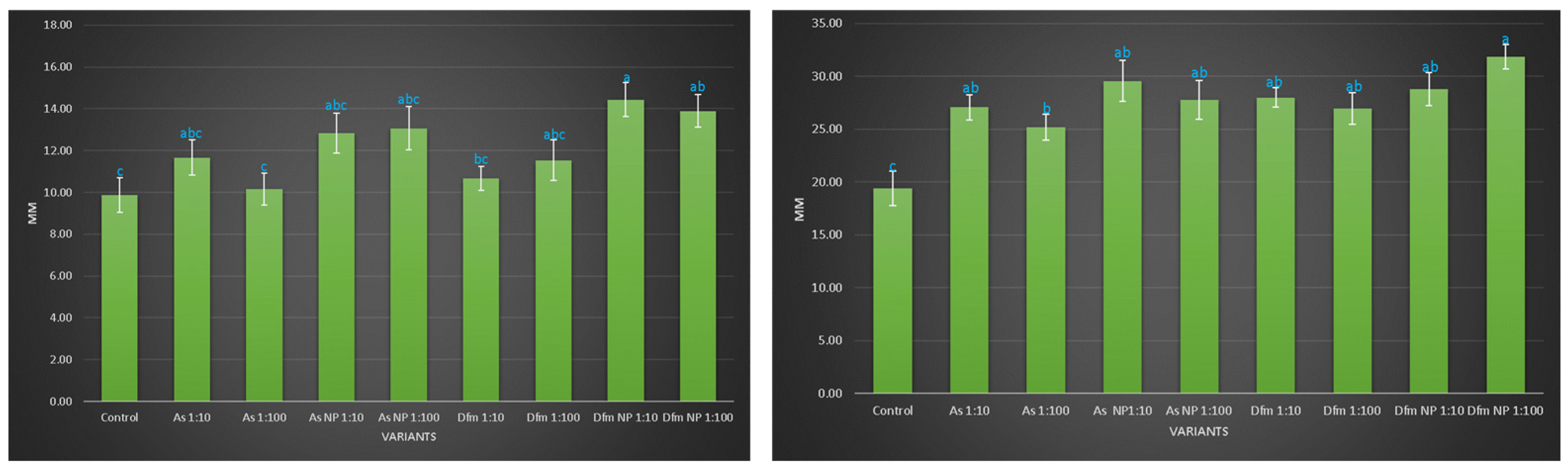
At the first (Figure 1—left) and the second (Figure 1—right) measurements, the highest values of root length were obtained at the variants with AgNPs regardless of dilution. After 5 days of exposure, the highest average root length was 42.73 mm and settled at As NP 1:100 variant (Figure 2—left). Generally, for the variants without nanoparticles, better results were recorded at 1:10 dilution (Figure 2—right) than at 1:100 dilution. AgNPs have a positive effect at low concentrations [1]. Cui et al. (2014) observed that cucumber root elongation was stimulated after exposure to AgNPs at concentrations below 200 mg L−1 [2].
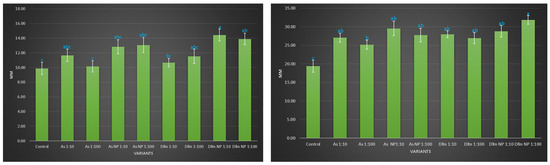
Figure 1.
The influence of extracts on root growth in Cucumis sativus (left—after 3 days of exposure; right—after 4 days of exposure) (a, b, c, d – Duncan’s test results, comparisons made between Control and variants with extract).

Figure 2.
Root growth in C. sativus—As NP 1:100, 5 days of exposure (left); root growth in C. sativus—Dfm 1:10, 5 days of exposure (right).
During the experiment, all extracts stimulated the growth of the root length in C. sativus compared to the control.
Acknowledgments
This work was supported by a grant of the Romanian Ministry of Research and Innovation, CCCDI-UEFISCDI, project number PN-III-P1-1.2-PCCDI-2017-0332/Project 3, contract 6PCCDI/2018, within PNCDI III.
References
- Gupta, D.; Chauhan, P. Toxicity of silver nanoparticles on wheat seedlings. Adv. Sci. Eng. Med. 2018, 10, 823–825. [Google Scholar] [CrossRef]
- Cui, D.; Zhang, P.; Ma, Y.; He, X.; Li, Y.-Y.; Zhao, Y.-C.; Zhang, Z.-Y. Phytotoxicity of silver nanoparticles to cucumber (Cucumis sativus) and wheat (Triticum aestivum). J. Zhejiang Univ.-Sci. A Appl. Phys. Eng. 2014, 15, 662–670. [Google Scholar] [CrossRef]

Publisher’s Note: MDPI stays neutral with regard to jurisdictional claims in published maps and institutional affiliations. |
© 2020 by the authors. Licensee MDPI, Basel, Switzerland. This article is an open access article distributed under the terms and conditions of the Creative Commons Attribution (CC BY) license (https://creativecommons.org/licenses/by/4.0/).