


Abstract
Manganese antimonide Mn2−xMxSb, where M is a 3d transition metal, is a prominent binary material due to its high Curie temperature and magnetocaloric properties accompanying the M-induced first-order phase transition for various compositions. In this work, we employed a modern ab initio approach to analyze the magnetic ground state and electronic structure of Mn2Sb for various types of long-range ordering. In the electronic structure of Mn2Sb, it was found to possess the semi-metallic properties with a gap in the minority spin projection.
1. Introduction
Binary manganese antimonide Mn2−xMxSb doped with transition metal M is a promising material for spintronics due to its unique magnetic properties for various compositions. In addition to external factors (temperature, pressure, electric and magnetic fields) [1,2], the properties of binary compounds depend significantly on their crystal structure and composition [3,4,5]. The aim of this work is to analyze the electronic structure and magnetic properties of Mn2Sb for various types of long-range ordering of Mn magnetic moments.
2. Method
Our calculations of the electronic structure of the Mn2Sb compound were performed in the TB-LMTO-ASA software package [6] based on the method of linearized muffin-tin (MT) orbitals and the approximation of atomic spheres (ASA) with the tight-binding approach (TB). This computational package implements local spin density approximation. The orbital basis included MT orbitals corresponding to the 4s-, 4p-, and 3d states of Mn and the 5s-, 5p-, and Sb states. The following radii of MT spheres were used in the calculations: for Mn1—2.69 a. u.; for Mn2—2.73 a. u.; for Sb—3.46 a. u. The ab initio approach is based on the usage of experimental data on crystal structure only with no further fitting parameters. This theoretical approach allows one to model various types of magnetic ordering, applied pressure effects, magnetic field, and other external factors to improve the magnetic and spectral characteristics of materials.
3. Results
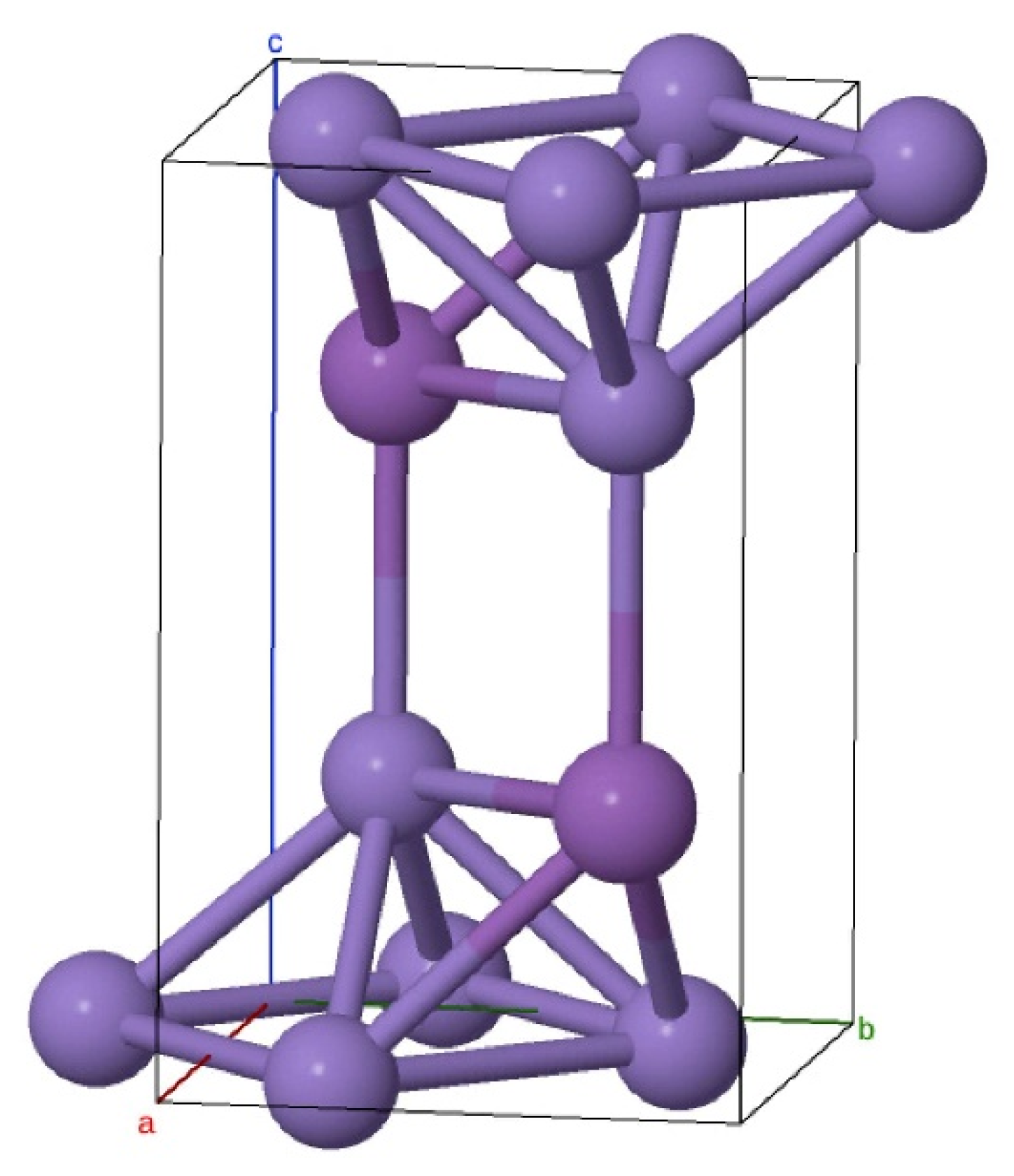
The Mn2Sb compound has a tetragonal structure with the 129th space group (P4/nmm) [7], see Table 1. The Mn atoms are located at two symmetrically independent crystallographic sites: Mn1 (point symmetry: 42 m) and Mn2 (point symmetry: 4 mm). The unit cell contains two crystallographically distinct sites of Mn1 and Mn2, which are respectively surrounded tetrahedrically and octahedrically by the Sb atoms. The ferrimagnetic structure is formed by an antiparallel arrangement of magnetic moments. The crystal structure is shown in Figure 1. The structure is stable over a wide temperature range, with the magnetic structure passing through a series of phase transitions. The magnetic phase transition in Mn2Sb occurs at the Curie temperature TC equal to 550 K [7]. Below this temperature, a ferrimagnetic ordering with unequal magnetic moments of different types of manganese ions is realized in the compound.

Table 1.
Arrangement of Mn2Sb atoms in the crystal lattice [7].
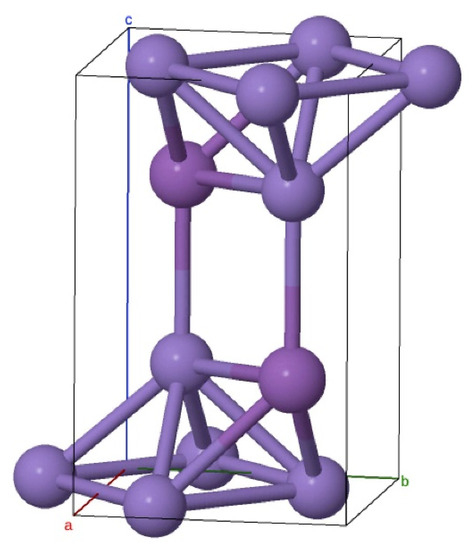
Figure 1.
Crystal structure of the Mn2Sb compound.
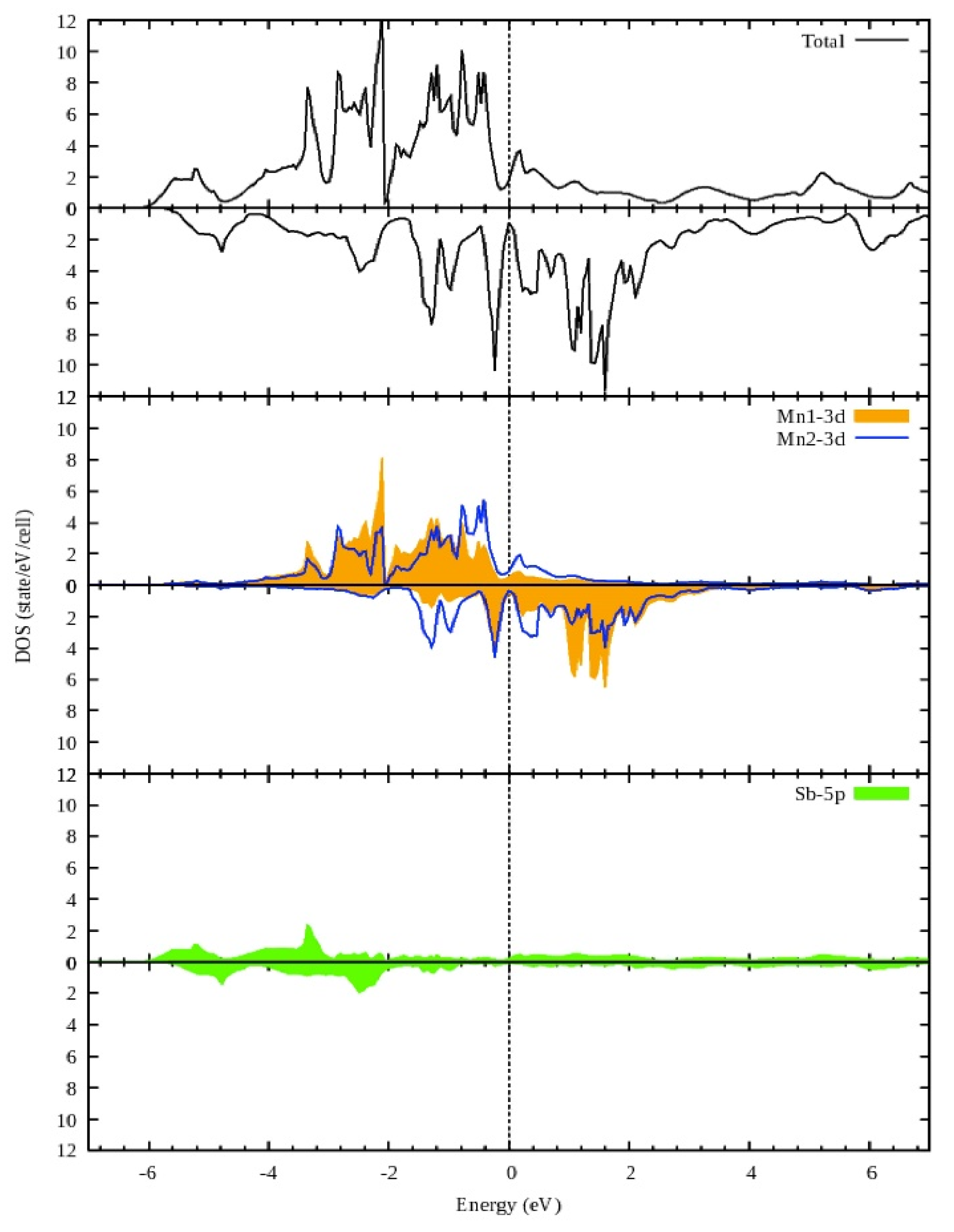
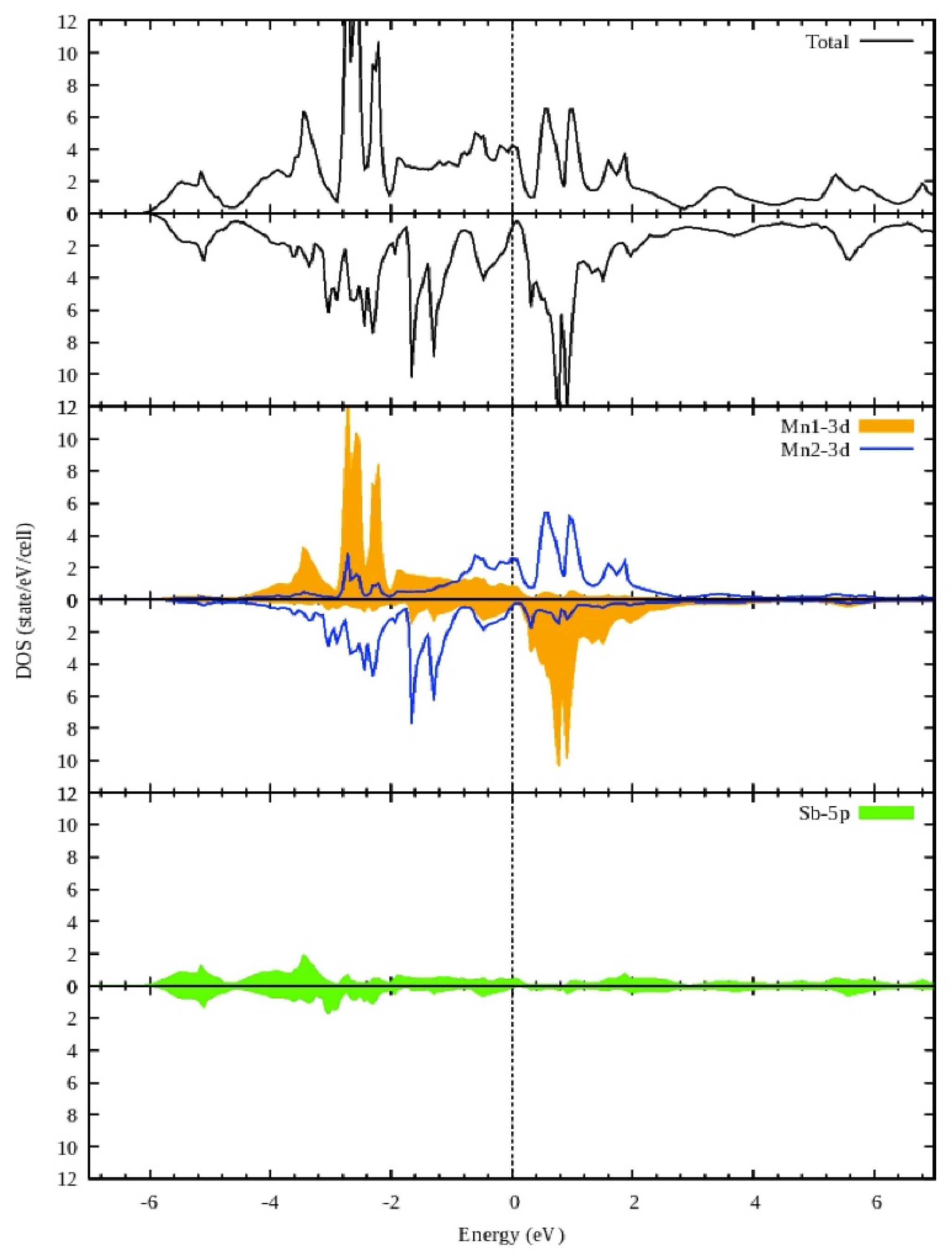
The density of electronic states in Figure 2 and Figure 3 show that in the case of the ferromagnetic and antiferromagnetic arrangements of manganese ions, the Mn2Sb compound has metallic properties and passes a current with only one spin projection—the majority. The figures are plotted relative to the Fermi level (indicated by a vertical dotted line).
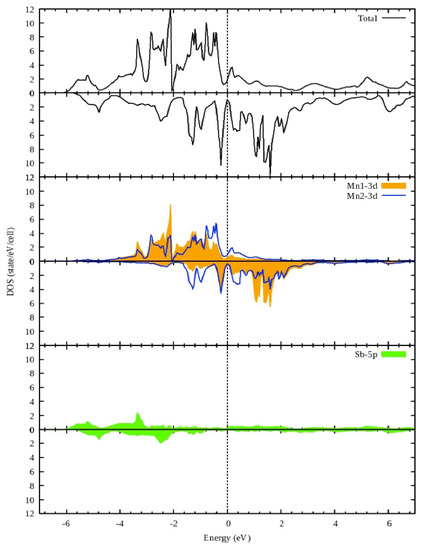
Figure 2.
Energy distribution of the density of electronic states calculated for Mn2Sb in the case of ferromagnetic ordering.
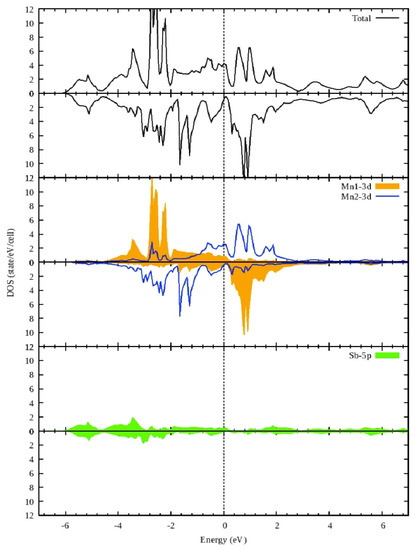
Figure 3.
Energy distribution of the density of electronic states calculated for Mn2Sb in the case of ferrimagnetic ordering.
In the case of calculations with the ferromagnetic ordering of the magnetic moments of the manganese ions, the magnetic moment for Mn1 was found to be 3.22 Bohr magnetons, and for Mn2, was found to be equal to 2 Bohr magnetons; these values are close to the experimental ones: 2.13 and 3.87 Bohr magnetons [7]. In the case of the antiferromagnetic arrangement of the magnetic moments of the manganese ions, the magnetic moment for Mn1 was −3.47 Bohr magnetons, and for Mn2, 2.25 Bohr magnetons, which characterizes the Mn2Sb compound as a ferrimagnet rather than an antiferromagnet, which is in good agreement with the previous results of calculations [7]. The total energy value in the case of ferromagnetic ordering was −35163.246 Ry, and in the case of ferrimagnetic ordering of manganese ions: −35163.274 Ry. It follows that the ferrimagnetic ordering is more energetically preferable for the Mn2Sb compounds.
4. Conclusions
Mn2Sb has a tetragonal-type crystal structure. The unit cell contains two magnetic types of sites Mn1 and Mn2, tetrahedrally and octahedrally surrounded by Sb atoms, respectively. The structure is stable over a wide temperature range, with the magnetic structure passing through a series of phase transitions. As a result of calculations of the electronic structure of the Mn2Sb compound, it was found that this compound is a semi-metal, since it passes a current with only one spin projection. When comparing the total energies, it was found that the ferrimagnetic ordering of the magnetic moments of the manganese ions would be more energetically preferable. The ferrimagnetic structure is formed by an antiparallel arrangement of magnetic moments with different magnitude of the Mn magnetic moments and was found to have the lowest total energy. We obtained the Mn magnetic moments as approximately −3.5 and 2.3 Bohr magnetons in good agreement with experimental data. In the electronic structure of Mn2Sb, it was found to possess semi-metallic properties with a gap in the minority spin projection.
Author Contributions
Conceptualization, methodology, investigation, writing—review and editing, E.D.C. and A.V.L.; project administration, funding acquisition, A.V.L. Both authors have read and agreed to the published version of the manuscript.
Funding
The studies were supported by the Russian Foundation for Basic Research, project grant No. 20-02-00234.
Conflicts of Interest
The authors declare no conflict of interest.
References
- Caron, L.; Miao, X.F.; Klaasse, J.P.; Gama, S.; Brück, E. Tuning the giant inverse magnetocaloric effect in Mn2−xCrxSb compounds. Appl. Phys. Lett. 2013, 103, 112404. [Google Scholar] [CrossRef]
- Ma, S.C.; Hou, D.; Gong, Y.Y.; Wang, L.Y.; Huang, Y.L.; Zhong, Z.C.; Wang, D.H.; Du, Y.W. Giant magnetocaloric and magnetoresistance effects in ferrimagnetic Mn1.9Co0.1Sb alloy. Appl. Phys. Lett. 2014, 104, 022410. [Google Scholar] [CrossRef]
- Ma, S.; Su, Y.; Huang, Y.; Wu, Y.; Zhong, Z. Study of Magnetic Nanoparticle Spectrum for Magnetic Nanothermometry. IEEE Trans. Magn. 2015, 51, 1–6. [Google Scholar]
- Tekgül, A.; Acet, M.; Farle, M.; Ünal, N. Kinetic arrest of the ferrimagnetic state in indium-doped Mn1.82Co0.18Sb. J. Alloys Compd. 2017, 695, 418–425. [Google Scholar] [CrossRef]
- Brown, P.J.; Gandy, A.P.; Kanomata, T.; Ziebeck, K.R.A. Stability of Mn moments and exchange interactions in cobalt substituted Mn2Sb. J. Phys. Condens. Matter 2008, 20, 015220. [Google Scholar] [CrossRef]
- Shorikov, A.O.; Lukoyanov, A.V.; Korotin, M.A.; Anisimov, V.I. Magnetic state and electronic structure of the δ and α phases of metallic Pu and its compounds. Phys. Rev. B 2005, 72, 024458. [Google Scholar] [CrossRef]
- Kanomata, T.; Ido, H. Magnetic transitions in Mn2−xMxSb (M = 3d metals). J. Appl. Phys. 1984, 55, 2039. [Google Scholar] [CrossRef]
Publisher’s Note: MDPI stays neutral with regard to jurisdictional claims in published maps and institutional affiliations. |
© 2020 by the authors. Licensee MDPI, Basel, Switzerland. This article is an open access article distributed under the terms and conditions of the Creative Commons Attribution (CC BY) license (https://creativecommons.org/licenses/by/4.0/).