


Abstract
Speaking is rated as the most fearful task among language learners. Since oral presentation is one of the most vital tasks for second language learners, most learners experience oral presentation apprehension during their learning life, regardless of whether this is encountered face-to-face or through online distance learning (ODL). The study aims to investigate whether there are any significant relationships concerning the state and traits of apprehension regarding oral presentations across genders and faculty. The purposive sampling method was utilized for this study, which consisted of 92 undergraduates taking an oral presentation skills course. The data collected were analyzed using correlation analysis (IBM SPSS Statistics for Windows, IBM Corp. Version 24.0. Armonk, NY, USA). The analysis revealed that gender shows a significant relationship with the state of apprehension; meanwhile, faculty has no relationship with apprehension. For future research, this study provides insights for educators and learners on how to deliver an engaging oral presentation successfully.
1. Introduction
One of the objectives of each university is to produce globally competitive and marketable graduates who can go on to develop the nation, as well as to help graduates obtain good jobs once they graduate. On the other hand, according to previous studies [1,2], fresh Malaysian graduates lack employability skills, including a poor understanding of the English language and weak communication skills. Their poor command of English includes poor speaking and oral presentation skills. This is an alarming issue as it will tarnish the recognition of the education system in Malaysia, as well as impede Malaysia’s vision of becoming a developed economic country [3]. The need to produce a well-rounded graduate is strongly emphasized in the Malaysia Education Blueprint 2012–2025 and the Malaysia Education Blueprint 2015–2025.
Although English is a second language in Malaysia, its use within the country has become more crucial than ever before as society, in general, has started to see its significance in today’s competitive digital age. At the university level, English is offered as a core subject for all undergraduate students. When comparing the four language skills, speaking is the most fearful among English language learners [4] because it requires a greater abundance of vocabulary, challenges regarding enunciation, articulation, and content, as well as a high confidence level [5]. Many English as a second language (ESL) learners find that oral presentations are unsatisfying, intimidating, tough, worrying [6], and represent the most problematic oral communication skill [7]. Bhati [8] found that oral assessment has a higher apprehension level compared to written assessment; therefore, we would like to look further at students’ apprehension in oral assessment during online distance learning (ODL). Furthermore, Chen [9] studied the relationship between ESL students’ speaking-in-class anxiety and their presentation performance and also looked into the factors that caused oral anxiety during presentations and the strategies to regulate L2 students’ speaking anxiety in presentations. The study found that the impact of external factors is greater than the impact of internal factors. Chen also [9] suggested that future research on oral presentations should investigate the relationship of gender on oral presentation apprehension.
Objectives of the Study
The main objective of this study is to investigate whether there are any significant relationships between traits and states of apprehension regarding oral comprehension across genders and faculties during ODL. This research is based on the following research questions:
- Are there any significant relationships between the trait of apprehension and gender regarding oral presentations given over ODL?
- Are there any significant relationships between the state of apprehension and gender regarding oral presentations given over ODL?
- Are there any significant relationships between the trait of apprehension and faculty regarding oral presentations given over ODL?
- Are there any significant relationships between the state of apprehension and faculty regarding oral presentations given over ODL?
2. Literature Review
2.1. Apprehension in Oral Presentation
According to Hotwitz et al. [4], communication apprehension can be defined as “a type of shyness characterized by fear of or anxiety about communicating with people”. They argue that a learner who has difficulty in listening to or learning via spoken messages, or has difficulty in speaking in public or in a group, is experiencing communication apprehension. However, the most widely accepted definition is the one provided by McCroskey [10], who defined communication apprehension as “an individual’s level of fear or anxiety associated with either real or anticipated communication with another person or persons”. Although the definitions may vary, it is noticeable that they all involve ideas of fear, distress, anxiety, shyness, and discomfort when being in touch with others. Meanwhile, Noor Hanim et al. [11] also revealed that fear of giving an oral presentation is caused by traits and states of apprehension in the learners. Students’ apprehension of an oral presentation can be caused by two main factors. Also, according to Santrock [12], apprehension can be divided into traits and states of apprehension. These two factors are widely used in research as factors of apprehension in oral communication.
2.2. Theoretical Framework
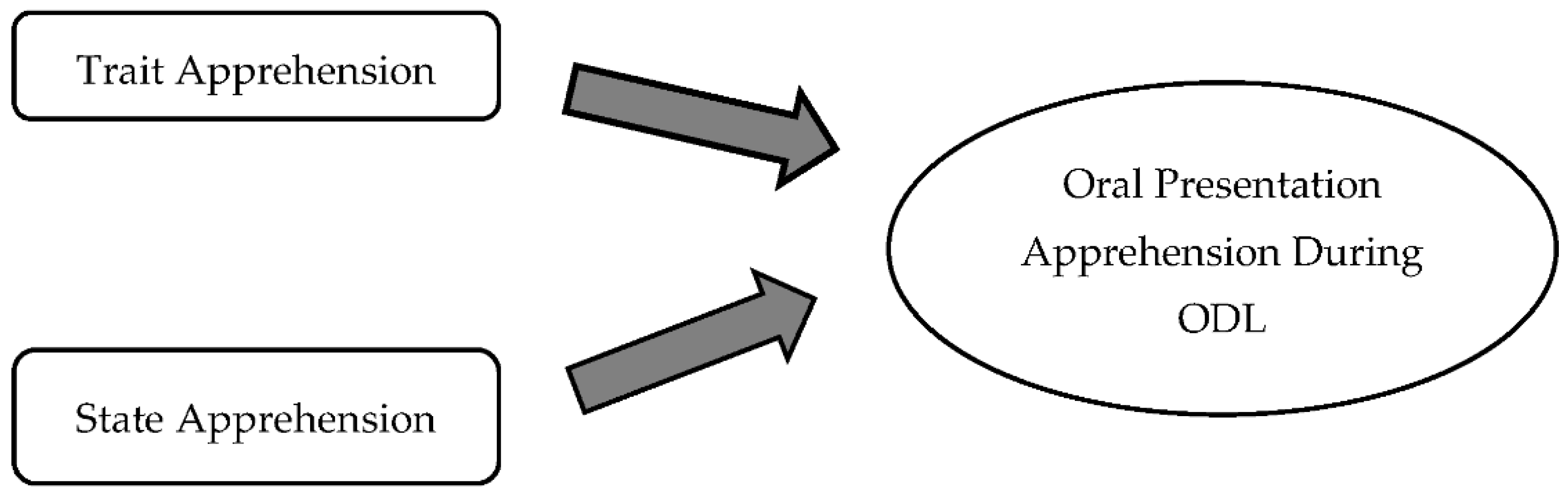
By adapting the questionnaires and theoretical frameworks from Santrock [12] and Noor Hanim et al. [11], Figure 1 reveals the conceptual framework of the study. This study explores the factors of trait and state of apprehension regarding oral presentations given over ODL among students. The trait of apprehension is an internal factor related to personal characteristics, whereas the state of apprehension is an external factor from the environment.
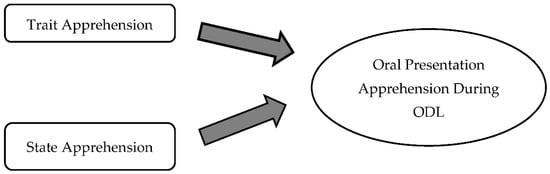
Figure 1.
Theoretical Framework of Study.
The first category of apprehension is trait. This type of anxiety grows in response to a perceived threat. People with this kind of anxiety cannot work well with oral presentations due to their personal traits. A sign of concern about the trait of apprehension is that tensions from this are on-going in their expression. Second, the speakers may be too worried about their lack of preparation, comparing themselves to others or worrying that they may forget their speech. Also, he or she cannot rely on internal abilities and external appearances. Speakers can also be afraid of the audience.
The second type of apprehension is “state”. This type of fear represents an unpleasant emotional experience when faced with a particular situation, request, or object or event. The state of anxiety occurs when a speaker makes a psychological assessment of some type of threat. Speakers are afraid of either their own physical representation, the environment, or even the decision-making process. Students may be afraid of the grades they get in their presentations. They may also be afraid of the size and composition of the audience or even the location and time of the presentation. They may also recognize previous performance as a threat (lower or higher). Second, students may be afraid of the negative ratings they may receive from the presentation. They are worried about the impression the examiners have on them. They are also afraid of the examiners’ opinions. They are afraid to say the wrong thing when presenting themselves.
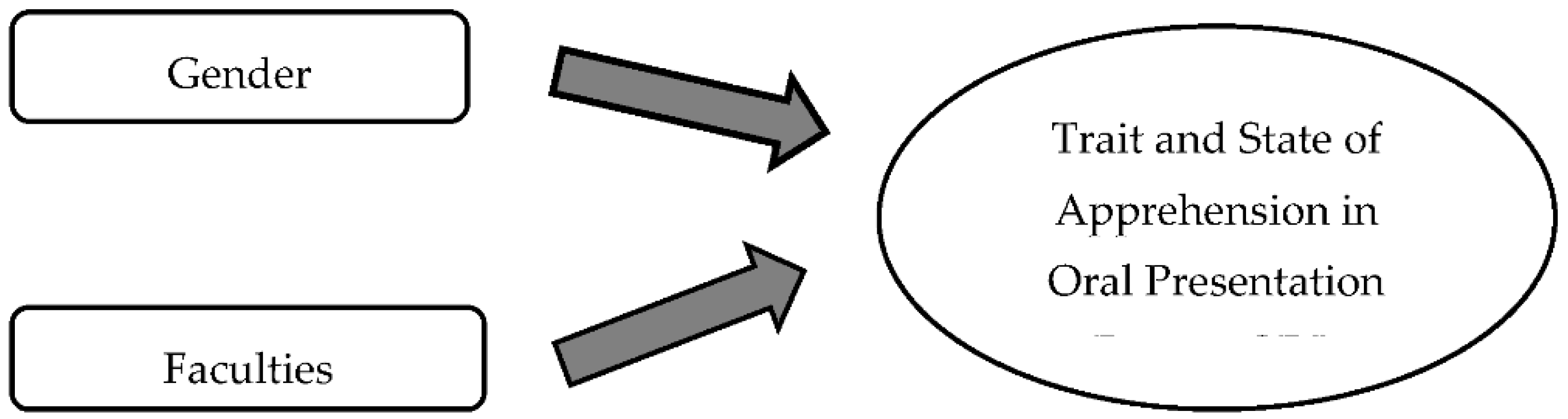
Figure 2 has shown the conceptual framework of the study. This study explores whether there are any significant relationship of trait and state apprehension for oral presentation across genders and faculties. The two main constructs are trait and state apprehension; while the variables are gender and faculties.
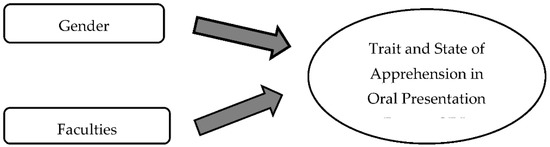
Figure 2.
Conceptual Framework of Study.
3. Results and Discussion
3.1. Correlation Analysis
Pearson correlation was used to describe the strength and direction of the relationship between two variables. In this study, the relationship between the apprehension factors (state and trait) across genders and faculty were investigated using this analysis. A positive correlation indicates that as one variable increases, so does the other variable. A negative correlation indicates that as one variable increases the other decreases. A perfect correlation of 1 or −1 indicates that the value of one variable can be determined exactly by knowing the value of the other variable. On the other hand, a correlation of 0 indicates no relationship between the two variables. The Bivariate correlation procedure was subjected to a two-tailed test of significance using two different levels: highly significant (p < 0.01) and significant (p < 0.05).
Table 1 reveals a summary of the results from the correlation analysis. As shown in the table, there is a negative correlation between the factors of apprehension (state and trait) and gender. The highest correlation is between Trait Apprehension and Gender (r = −0.296/p < 0.01). The lowest correlation is between State Apprehension and Gender (r = −0.269/p < 0.01). Based on Cohen’s interpretation of values (pp. 79–81, [13]), there are three guidelines that are suggested: small (r = 0.01 to 0.29), medium (r = 0.30 to 0.49), and large (r = 0.50 to 1.0). These guidelines apply whether or not there is a negative sign for the r value. Positive and negative r values have the same strength of correlation. Therefore, these correlation values indicate a small correlation between the variables, suggesting quite a weak relationship between State Apprehension and Gender, as well as Trait Apprehension and Gender. However, State and Trait Apprehension do not correlate with Faculty (r = −0.202, r = 0.066/p > 0.05), indicating no relationship.

Table 1.
Correlation Analysis.
3.2. Trait Apprehension across Gender
Research question 1: Are there any significant relationships between the trait of apprehension and gender regarding oral presentations given over ODL?
Table 2 shows the results of the Pearson Correlation: −0.296. This shows the significant relationship between Trait Apprehension and Gender for oral presentations (r = −0.296/p < 0.01). At the same time, the results show a small correlation between the genders, suggesting quite a weak relationship between Trait Apprehension and Gender. In other words, Gender has a slight influence on Trait Apprehension, which represents personal traits, such as feeling nervous during presentation, fear of the audience, distress at their lack of preparation, comparing themselves to others, or worrying that they may forget their speech. He or she also could not rely on his or her own abilities and appearance. This study agrees with a study conducted by the authors of [11], which found that there is a relationship between gender and traits of apprehension regarding oral presentations. On the other hand, this study did not support a previous study [14], in which it was found that gender is not a significant factor in communication apprehension.
Table 2.
Results for the relationship between Trait Apprehension and Gender for oral presentations.
3.3. State Apprehension across Gender
Research Question 2: Are there any significant relationships between the state of apprehension and gender regarding oral presentations given over ODL?
Table 3 shows the results of the Pearson Correlation: −0.269. This shows a significant relationship between Trait Apprehension and Gender regarding oral presentations (r = −0.269/p < 0.01). Similarly, to State Apprehension result, the results also show a small correlation to Gender, showing a weak relationship between State Apprehension and Gender. In other words, gender has a slight influence on Trait Apprehension, which includes external factors like speakers being afraid of either their own physical representation, the environment, or even their decision-making process. Students may be afraid of the grades they receive for their presentations, the size and composition of the audience, or even the location and time of the presentation, as well as the negative ratings they may receive from the presentation. This result agrees with another previous study [11], which found that there is a correlation between gender and the state of apprehension for oral presentations; meanwhile, the results differ from those from [14], which found that gender is not a significant factor in communication apprehension.
Table 3.
Results for the relationship between State Apprehension and Gender for oral presentations.
3.4. Trait Apprehension across Faculties
Research Question 3: Are there any significant relationships between the trait of apprehension and faculty regarding oral presentations given over ODL?
Table 4 shows the result of the Pearson Correlation: −0.066. This shows that there is no significant relationship between Trait Apprehension and Gender regarding oral presentations (r = −0.066/p > 0.05) within the two faculties: the Faculty of Business Management and the Faculty of Hotel Management and Tourism. This study supports the findings in [11], which showed that there is no correlation between faculty and the state of apprehension in oral presentations.
Table 4.
Results for the relationship between State Apprehension and Faculty for oral presentations.
3.5. State Apprehension across Faculties
Research Question 4: Are there any significant relationships between the state of apprehension and faculty regarding oral presentations given over ODL?
Table 5 shows the result of the Pearson Correlation: −0.066. This shows no significant relationship between Trait Apprehension and Gender for oral presentations (r = −0.202/p > 0.05) within the two faculties: the Faculty of Business Management and the Faculty of Hotel Management and Tourism. This result is similar with those found in [11], which found that there is no correlation between faculty and the state of apprehension regarding oral presentations.
Table 5.
Results for the relationship between State Apprehension and Faculty for oral presentations.
4. Conclusions
To summarize, the results of this study reveal that gender has a significant relationship with both traits and states of apprehension regarding oral presentations given over ODL. Even it is a small correlation, the influence of gender on traits and states of apprehension regarding oral presentations is slightly evident. However, the faculties from which the students are from bears no relationship with traits and states of apprehension concerning oral presentations given over ODL. Students, regardless of faculty, exhibited traits and states of apprehension during their presentation.
Author Contributions
Conceptualization, R.S. and R.M.R.; methodology, R.M.R.; software, R.M.R.B.; validation, M.M.Z.; formal analysis, M.M.Z.; investigation, R.M.R. and R.S.; resources, R.M.R. and R.M.R.B.; data curation, R.M.R.B.; writing—original draft preparation, M.M.Z. and R.S.; writing—review and editing, M.M.Z.; visualization, R.M.R.B.; supervision, M.M.Z.; project administration, M.M.Z.; funding acquisition, M.M.Z. and R.M.R.B. All authors have read and agreed to the published version of the manuscript.
Funding
This research received no external funding.
Institutional Review Board Statement
Not applicable.
Informed Consent Statement
Not applicable.
Data Availability Statement
Not applicable.
Acknowledgments
We would like to express our gratitude to those who have been involved in and supported this study directly and indirectly, especially the 92 students involved in the study, as well as the Writing and Publication Unit (PJI) UiTM Cawangan Terengganu, under the project “Inspiring June 2022”, which inspired this study.
Conflicts of Interest
The authors declare no conflict of interest.
References
- Zahiid, S.J. Poor English Eroding Malaysian Graduates’ Self-Belief. Malaymail Online. Available online: http://www.themalaymailonline.com/malaysia/article/pmpoor-englisheroding-malaysian-graduates-self-be (accessed on 10 January 2020).
- Hossain, M.I.; Yagamaran, K.S.A.; Afrin, T.; Limon, N.; Nasiruzzaman, M.; Karim, A.M. Factors influencing unemployment among fresh graduates: A case study in Klang Valley, Malaysia. Int. J. Acad. Res. Bus. Soc. Sci. 2018, 8, 1494–1507. [Google Scholar] [CrossRef]
- Shamsuddin, A.; Isa, K.H.M.; Aziz, M.N.; Mahfol, N.Z.N.M.; Alagari, T. Graduate unemployment: The awareness and perception of graduates towards Government’s initiatives. Int. J. Bus. Econ. Law 2013, 3, 15–24. [Google Scholar]
- Horwitz, E.K. Even teachers get the blues: Recognizing and alleviating language teachers’ feeling of foreign language anxiety. Foreign Lang. Ann. 1996, 29, 365–372. [Google Scholar] [CrossRef]
- Rahmat, N.H. Cycle of Fear in Learning: The Case for Three Language Skills. Am. J. Soc. Sci. Humanit. 2019, 4, 151–162. [Google Scholar] [CrossRef]
- King, J. Preparing EFL learners for oral presentations. Internet TESL J. 2002, 4, 401–418. [Google Scholar]
- Soomro, M.A.; Siming, I.A.; Shah, S.H.R.; Rajper, M.A.; Naz, S.; Channa, M.A. An investigation of anxiety factors during English oral presentation skills of engineering undergraduates in Pakistan. Int. J. Engl. Linguist. 2009, 9, 203–210. [Google Scholar] [CrossRef]
- Bhati, S.S. The Effectiveness of oral presentation assessment in a finance subject: An empirical examination. J. Univ. Teach. Learn. Pract. 2012, 9, 6. [Google Scholar] [CrossRef]
- Chen, Y. ESL Students’ Language Anxiety In In-Class Oral Presentations. Master’s Dissertation, Marshall University, Huntington, WV, USA, 2015. Available online: http://mds.marshall.edu/cgi/viewcontent.cgi?article=1967&context=etd (accessed on 10 January 2020).
- McCroskey, J.C. Oral communication apprehension: A summary of recent theory and research. Hum. Commun. Res. 1977, 4, 78–96. [Google Scholar] [CrossRef]
- Rahmat, N.H.; Othman, N.A.; Hasan, H.R.; Arepin, M. An Analysis of ESL Oral Presentation Using Trait and State Apprehension. European J. of Engl. Lang. Teaching. 2018, 4, 65–77. [Google Scholar]
- Santrock, J.W. Educational Psychology; McGraw-Hill: Boston, MA, USA, 2009. [Google Scholar]
- Cohen, J. Statistical Power Analysis for the Behavioral Sciences, 2nd ed; Lawrence Erlbaum Associates, Publishers: Hillsdale, NJ, USA, 1988. [Google Scholar]
- Oladipo, S.E.; Agbajeola, R.O.; Adenaike, F.A. Assessing communication apprehension among in-service teachers in a university of education. Res. Humanit. Soc. Sci. 2012, 2, 27–31. [Google Scholar]
Publisher’s Note: MDPI stays neutral with regard to jurisdictional claims in published maps and institutional affiliations. |
© 2022 by the authors. Licensee MDPI, Basel, Switzerland. This article is an open access article distributed under the terms and conditions of the Creative Commons Attribution (CC BY) license (https://creativecommons.org/licenses/by/4.0/).