


Abstract
This study encompasses two implementations of evaluation of the daily exposure to hand-arm vibration of employees. The first one focuses on maintenance technicians and operating agents in wastewater treatment plants and as network technicians on the water distribution network. The second one focuses on technicians in the after-sales service of a company supplying a wide range of percussive and vibrating portable tools for professionals and the general public. In both cases, we established a precise inventory of the tools used by the employees, and computed the duration of use per day of each tool. We used the INRS tools N43 “Calculette Vibrations Mains Bras” and N59 “OSEV—Vibrations transmises aux membres supérieurs” to determine the daily exposure A(8). These results were explained to the employees, with practical advice for prevention, collectively during meetings and individually during sensitization workshops.
1. Introduction
We present the first implementation of the assessment of hand-arm vibration exposure of maintenance and operations technicians working in wastewater treatment plants and network technicians working in the water distribution network; all of these workers use daily percussive and vibrating portable tools. The results of the evaluation of their daily exposure were delivered during a sensitization workshop.
We then present a second implementation that concerns the exposure to hand-arm vibration of technicians in the after-sales service of a company supplying a wide range of portable percussive and vibrating tools for professionals and the general public, who diagnose, repair, test and return the equipment received from customers. The results were presented at a meeting with the quality department, the employees concerned and members of the Economic and Social Council (CSE).
2. Method
In both implementations, we establish a precise inventory of the tools used by the employees, completed with the duration of use per day of each tool by questioning the employees and the team leaders.
We use a “Hand Arm Vibration Calculator” [1] to compute the duration of exposure to reach the action value (2.5 m/s2) and the duration of exposure to reach the limit value (5 m/s2), using the vibration coefficient (or vibration level) given by the supplier in its technical data sheet and the estimated duration of exposure per day. We elaborated a table to deliver all the results; an extraction is shown in Table 1.

Table 1.
Results for a vibrative tool and a percussive tool extracted from the table.
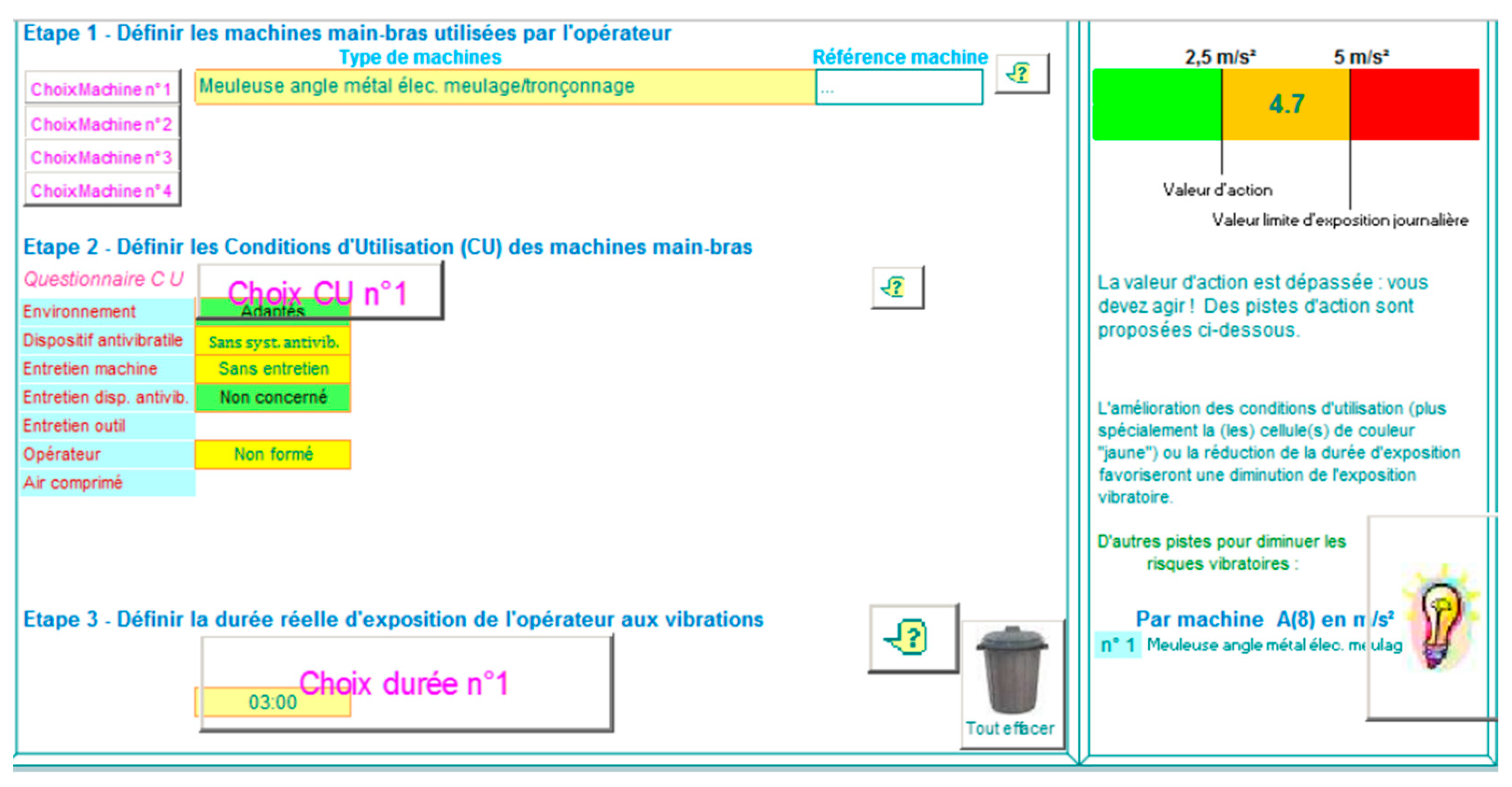
We computed the daily exposure A(8) from the information provided by the employees utilizing the devices, including their estimated duration of exposure per day, using a simplified tool for evaluation of exposure of vibration transmitted to the upper limbs [2].
The results of the hand-arm OSEV tool were placed in a report intended for the quality manager of the company. As an example, Figure 1 displays the results for the angle grinder tool.
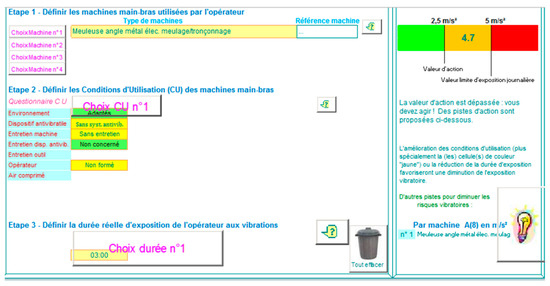
Figure 1.
Result of the hand-arm OSEV tool for an angle grinder tool (meuleuse d’angle).
3. Results
For technicians working in wastewater treatment plants and network technicians working in the water distribution network, we assessed the eight most used tools with the OSEV tool. For seven of them, the daily exposure A(8) was between the action value (2.5 m/s2) and limit value (5 m/s2).
For technicians in the after-sales service of a company supplying a wide range of portable percussive and vibrating tools, we inventoried 262 portable tools in the table and filled it with the results of the “Hand Arm Vibration Calculator” for each of these tools. For 200 out of 262 (76.3%), the daily exposure A(8) was below the action value (2.5 m/s2). For 46 of them (17.6%), the daily exposure A(8) was between the action value (2.5 m/s2) and limit value (5 m/s2). For 16 of them (6.1%), the daily exposure A(8) was above the limit value (5 m/s2).
We could highlight the tools with exceedances of action values and limit values and give prevention advice to users to lower their exposure level, collectively during meetings and individually during an awareness workshop. Recommendations were based on flyer “Syndrome des vibrations La main et le bras en danger” [3] (10/2016) and document “Bien choisir son outil portatif pour mieux travailler” [4] (03/2017).
Author Contributions
All authors contributed equally. All authors have read and agreed to the published version of the manuscript.
Funding
This research received no external funding.
Institutional Review Board Statement
Not applicable.
Informed Consent Statement
Not applicable.
Data Availability Statement
The data presented in this study are available on request from the corresponding author.
Conflicts of Interest
The authors declare no conflict of interest.
References
- INRS Tool N43 Hand Arm Vibration Calculator. Available online: https://www.inrs.fr/risques/vibration-membres-superieurs/evaluation-risque.html (accessed on 3 April 2023).
- INRS Tool N59 OSEV—Vibrations Transmitted to the Upper Limbs. Available online: https://www.inrs.fr/media.html?refINRS=outil59 (accessed on 3 April 2023).
- INRS Flyer ED 6204 Syndrome des Vibrations La Main et le Bras en Danger. Available online: https://www.inrs.fr/media.html?refINRS=ED%206204 (accessed on 3 April 2023).
- CRAMIF Brochure DTE 271 Bien Choisir Son Outil Portatif Pour Mieux Travailler. Available online: https://www.cramif.fr/actualites/bien-choisir-son-outil-portatif-pour-mieux-travailler (accessed on 3 April 2023).
Disclaimer/Publisher’s Note: The statements, opinions and data contained in all publications are solely those of the individual author(s) and contributor(s) and not of MDPI and/or the editor(s). MDPI and/or the editor(s) disclaim responsibility for any injury to people or property resulting from any ideas, methods, instructions or products referred to in the content. |
© 2023 by the authors. Licensee MDPI, Basel, Switzerland. This article is an open access article distributed under the terms and conditions of the Creative Commons Attribution (CC BY) license (https://creativecommons.org/licenses/by/4.0/).