


Abstract
The two most common oral diseases, caries and periodontal disease, are very abundant among the population of industrialized countries, having a major impact on the well-being of the population and medical service providers. Millions of people around the world suffer from toothache due to tooth decay and this often leads to permanent tooth loss. The aim of the current study is to present the development and characterization of a composite material containing a glass ionomer cement and phytosynthesized metallic nanoparticles, intended for dental applications.
1. Introduction
Dental-related issues greatly influence the quality of life, both in the costs related to dental treatments, as well as in the discomfort experienced by most of the patients, and, last but not least, in the issues related to self-conscious emotions. One of the main problems associated with dental treatments is the durability of the materials used for dental restoration [1]. Considering those aspects, we have evaluated the potential to develop alternative dental restoration materials, using a nanotechnology approach, in order to provide enhanced antimicrobial and mechanical properties.
2. Materials and Methods
Two approaches were evaluated for the development of innovative materials: the incorporation of synthesized green into glass ionomer cements [2,3], the deposition of green nanoparticles and natural compound in an apatitic material carrier, respectively, followed by their incorporation into the glass-ionomer cements. The developed materials were characterized in terms of crystallographic structure using X-ray diffraction, antimicrobial potential, as well as physic-mechanical properties (according ISO 9917-1:2003) [4,5].
3. Results
In order to determine the antimicrobial effect, the phytosynthesized nanoparticles and the developed materials were tested on standard strains (ATCC) as well as clinical strains (CL), with sources of isolation from the sphere of the oral cavity, involved in dental pathologies (Figure 1): Pseudomonas aeruginosa ATTC 27853, Pseudomonas aeruginosa CL, Candida albicans ATCC 10231, Candida albicans CL, Enterococcus faecalis ATCC 25212, Lactococcus lactis CL (isolated from dental plaque).
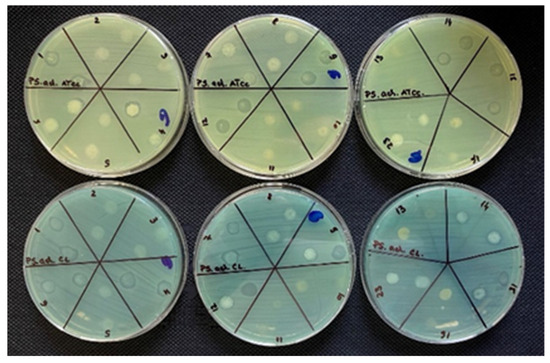
Figure 1.
Antimicrobial potential of the developed materials.
4. Conclusions
The results support the conclusion that addition of metallic nanoparticles with an antimicrobial effect does not negatively affect the physical/mechanical properties of the glass ionomer cement. The final materials have superior compression strength compared to the blank sample, while also exhibiting superior antimicrobial properties.
Author Contributions
Conceptualization, R.C.F., I.F., L.M.D. and A.M.B.; methodology, R.C.F., I.F., L.M.D., I.E.C. and A.M.B.; formal analysis, A.M.B., R.I.M., T.F., I.S.H. and I.E.C.; investigation, A.M.B., R.I.M., L.M.D., I.S.H. and T.F.; writing—original draft preparation, A.M.B. and R.C.F.; writing—review and editing, I.F. and R.C.F.; supervision, R.C.F.; project administration, R.C.F. All authors have read and agreed to the published version of the manuscript.
Funding
This work was supported by the Ministry of Research, Innovation and Digitization, CCCDI—UEFISCDI, project number PN-III-P4-PCE-2021-0292, contract 92PCE/2022, within PNCDI III. The support provided by the Ministry of Research, Innovation and Digitization through Program 1—Development of the national research and development system, Subprogram 1.2—Institutional performance—Projects to finance excellence in RDI, Contract no. 15PFE/2021 is also gratefully acknowledged.
Institutional Review Board Statement
Not applicable.
Informed Consent Statement
Not applicable.
Data Availability Statement
The supporting data are available from the corresponding author.
Conflicts of Interest
The authors declare no conflict of interest.
References
- Fierascu, R.C. Incorporation of Nanomaterials in Glass Ionomer Cements—Recent Developments and Future Perspectives: A Narrative Review. Nanomaterials 2022, 12, 3827. [Google Scholar] [CrossRef] [PubMed]
- Fierascu, I.C.; Fierascu, I.; Baroi, A.M.; Ungureanu, C.; Ortan, A.; Avramescu, S.M.; Somoghi, R.; Fierascu, R.C.; Dinu-Parvu, C.E. Phytosynthesis of Biological Active Silver Nanoparticles Using Echinacea purpurea L. Extracts. Materials 2022, 15, 7327. [Google Scholar] [CrossRef] [PubMed]
- Fierascu, I.C.; Fierascu, I.; Baroi, A.M.; Ungureanu, C.; Spinu, S.; Avramescu, S.M.; Somoghi, R.; Fierascu, R.C.; Dinu-Parvu, C.E. Phytosynthesis of Silver Nanoparticles Using Leonurus cardiaca L. Extracts. Materials 2023, 16, 3472. [Google Scholar] [CrossRef] [PubMed]
- Fierascu, R.C.; Matei (Brazdis), R.I.; Baroi, A.M.; Fistos, T.; Fierascu, I.; Ditu, L.M. Composite Material Based on Glass Ionomer Cement and Phytosynthesized Metallic Nanoparticles with Improved Antimicrobial Properties and Procedure for Obtaining. It. Patent A00104, 6 March 2023. [Google Scholar]
- Fierascu, R.C.; Matei (Brazdis), R.I.; Baroi, A.M.; Fistos, T.; Fierascu, I.; Chican, I.E.; Ditu, L.M. Composite Material for Dental Restoration with Strength to Improved Compression and Antimicrobial Properties and Method of Producing. It. Patent A00425, 3 August 2023. [Google Scholar]
Disclaimer/Publisher’s Note: The statements, opinions and data contained in all publications are solely those of the individual author(s) and contributor(s) and not of MDPI and/or the editor(s). MDPI and/or the editor(s) disclaim responsibility for any injury to people or property resulting from any ideas, methods, instructions or products referred to in the content. |
© 2023 by the authors. Licensee MDPI, Basel, Switzerland. This article is an open access article distributed under the terms and conditions of the Creative Commons Attribution (CC BY) license (https://creativecommons.org/licenses/by/4.0/).