


Abstract
In this study, a novel electrochemical sensor was developed for the quantitative determination of riboflavin. The tungsten disulfide (WS2) layer was deposited on carbon nanotubes (CNTs) by atomic layer deposition (ALD), forming a CNTs-WS2 core–shell heterostructure. This material was used to modify the commercial screen-printed carbon electrode in order to enhance its electrocatalytic activity toward the detection of vitamin B2. Cyclic voltammetry was performed as a preliminary test in the presence of riboflavin. In addition to this, an extensive electrochemical study was performed using differential pulse voltammetry, demonstrating that modified the CNTs-WS2/SPCE sensor display superior electrochemical performance compared with bare SPCE. The sensor exhibits a linear response in the concentration range from 0 µM to 45 µM, with remarkably enhanced sensitivity (9 μAμM−1cm−2) compared with the bare electrode, with a limit of detection (LOD) of 1.24 µM. This enhancement is attributed to the conformal growth of the WS2 flakes on the CNTs and the high surface area offered by these flakes.
1. Introduction
Transition metals dichalcogenides (TMDs) have been investigated as sensing layers in electrochemical sensors to detect various analytes such as biomolecules [1], gases [2], and heavy metal ions [3]. Among the compounds of this family, tungsten disulfide (WS2) presents a layered structure that makes it attractive for various applications. WS2 has been investigated as a sensing material in electrochemical sensors due to its unique properties. Carbon nanotubes (CNTs) have also been used in electrochemical sensors due to their excellent electrical conductivity, high surface area, and biocompatibility [4]; CNTs can be combined with WS2 to develop CNTs-WS2 heterostructures with improved electrochemical performances.
In this respect, here, we investigate the CNTs-WS2 heterostructure for the detection of riboflavin (vitamin B2), a water-soluble vitamin essential for human health. It is involved in many metabolic processes in the body, including the metabolism of carbohydrates, fats, and proteins. Riboflavin is important for maintaining healthy skin, hair, and nails, and is also needed for the production of red blood cells [5]. The improved sensor performances of the CNTs-WS2 heterostructure are related to the synergy between the WS2 layer, which provides the active sites for target analyte adsorption, and the CNTs, which provide excellent electron transport properties.
2. Materials and Methods
Carbon nanotubes (CNTs) were functionalized as follows: 10 mg of dried powder (80 °C overnight) was dispersed in 2 mL ethanol by ultrasonication (30 min) and drop-cast on an Al foil for ALD-WS2 deposition. WS2 films were deposited in the ALD system at 300 °C, using BTBMW (maintained at 80 °C) and H2S as precursors.
3. Discussion
The good electroanalytical performance of the developed CNTs-WS2/SPCE sensor is summarized in Figure 1a, showing the large current variation during the differential pulse voltammetry (DPV) analysis of a solution containing different concentrations of RF, from 0 to 45 µM. Figure 1b shows the corresponding calibration curve, plotting the peak current as a function of the analyte concentration. The sensitivity of 9 μAμM−1cm−2 was computed from a linear fit of the data (red line) and resulted in a limit of detection of 1.24 µM.
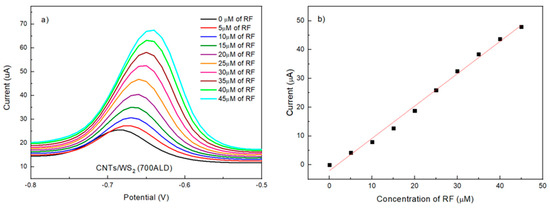
Figure 1.
(a) DPV of CNTs-WS2/SPCE in 0.1 M PBS in the presence of different RF concentrations, (b) calibration curve corresponding to the DPV test. (The red line corresponds to the linear fit of the calibration curve).
Author Contributions
Investigation, data curation, writing—review and editing R.Z.; data curation, writing—review M.H.R. Supervision N.P. Supervision, writing—review and editing, G.N. All authors have read and agreed to the published version of the manuscript.
Funding
This research received no external funding.
Institutional Review Board Statement
Not applicable.
Informed Consent Statement
Not applicable.
Data Availability Statement
Dataset available on request from the authors.
Conflicts of Interest
The authors declare no conflicts of interest.
References
- Zang, Y.; Nie, J.; He, B.; Yin, W.; Zheng, J.; Hou, C.; Huo, D.; Yang, M.; Liu, F.; Sun, Q.; et al. Fabrication of S-MoSe2/NSG/Au/MIPs imprinted composites for electrochemical detection of dopamine based on synergistic effect. Microchem. J. 2020, 156, 104845. [Google Scholar] [CrossRef]
- Neri, G. Thin 2D: The new dimensionality in gas sensing. Chemosensors 2017, 5, 21. [Google Scholar] [CrossRef]
- Cai, J.; Xia, Y.; Gang, R.; He, S.; Komarneni, S. Activation of MoS2 via tungsten doping for efficient photocatalytic oxidation of gaseous mercury. Appl. Catal. B Environ. 2022, 314, 121486. [Google Scholar] [CrossRef]
- Hu, C.; Hu, S. Carbon Nanotube-Based Electrochemical Sensors: Principles and Applications in Biomedical Systems. J. Sens. 2009, 2009, 187615. [Google Scholar] [CrossRef]
- Powers, H.J. Riboflavin (vitamin B-2) and health. Am. J. Clin. Nutr. 2003, 77, 1352–1360. [Google Scholar] [CrossRef] [PubMed]
Disclaimer/Publisher’s Note: The statements, opinions and data contained in all publications are solely those of the individual author(s) and contributor(s) and not of MDPI and/or the editor(s). MDPI and/or the editor(s) disclaim responsibility for any injury to people or property resulting from any ideas, methods, instructions or products referred to in the content. |
© 2024 by the authors. Licensee MDPI, Basel, Switzerland. This article is an open access article distributed under the terms and conditions of the Creative Commons Attribution (CC BY) license (https://creativecommons.org/licenses/by/4.0/).