


Abstract
Hydroxybenzaldehydes are submitted to a one pot O-alkylation/Wittig olefination in dimethyl sulfoxide (DMSO) to give alkyl alkoxycinnamates. The reaction is carried out facilely and gives the products in high yield.
1. Introduction
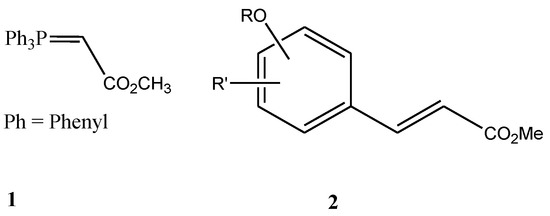
In our endeavor to develop one-pot transformations involving Wittig olefination reactions with stabilized phosphoranes leading to substituted cinnamates [1,2] and cinnamic acids [3], we have recently turned to running etherification and Wittig olefination reactions with (carbomethoxymethylene)triphenylphosphorane (1a) (Figure 1) in one pot. The following contribution describes the scope of such procedures and gives experimental details.
Figure 1.
Carbalkoxymethylenetriphenylphosphoranes as stabilized Wittig reagents (1) and target compounds alkoxycinnamates (2).
2. Materials and Methods
2.1. General Remarks
Melting points were measured on a Stuart SMP 10 melting point apparatus and are uncorrected. Infrared spectra were measured with a Thermo/Nicolet Nexus 470 FT-IR ESP spectrometer and a Perkin Elmer Spectrum Two spectrometer. 1H and 13C NMR spectra were recorded with a Varian 400 NMR spectrometer (1H at 395.7 MHz, 13C at 100.5 MHz). The assignments of the carbon signals were aided by DEPT 90 and DEPT 135 experiments (DEPT = Distortionless Enhancement by Polarisation Transfer). The chemical shifts are relative to TMS (solvent CDCl3, unless otherwise noted. Column chromatography, where necessary, was performed on recycled silica gel (S, 0.063 mm–0.1 mm, Riedel de Haen and Merck grade 9385).
2.2. Starting Materials
Triphenylphosphine (3, Aldrich, Germany), iodomethane (7, Sigma-Aldrich, Germany), iodoethane (7b, BDH, UK), 1-iodopropane (7c, Alfa Products, USA), 1-iodobutane (7d, Merck-Schuchardt, Germany), 4-bromobenzyl bromide (7e, Aldrich, Germany), methyl bromoacetate (4, Aldrich, Germany), 3-hydroxy-4-methoxybenzaldehyde (11, Aldrich, Germany), 4-hydroxybenzaldehyde (6, BDH, UK), 2-hydroxybenzaldehyde (9, salicylaldehyde, Merck-Schuchardt, Germany), potassium hydroxide (KOH, Merck, Germany), chloroform (CHCl3-Sigma Aldrich, Germany), dichloromethane (CH2Cl2, Sigma-Aldrich, Germany) were acquired commercially. (Carbomethoxymethylene)triphenylphosphorane (1) was prepared by the reaction of methyl bromoacetate (4) with triphenylphosphine (3, CHCl3, precipitated upon addition of diethyl ether) with the subsequent reaction of carbomethoxymethyltriphenylphosphonium bromide (5) in a biphasic system of aq. Na2CO3 and CH2Cl2 (Scheme 1) [4].
Scheme 1.
Preparation of stabilized phosphorane 1 as starting material.
2.3. General Procedures
2.3.1. Preparation of methyl 4-bromobenzyloxycinnamate (8e)
Potassium hydroxide (KOH, 0.84 g, 15 mmol) was ground in a mortar under pentane to give a fine powder. This was added to dimethyl sulfoxide (DMSO, 10 mL), stirred for 10 min. After that, 4-hydroxybenzaldehyde (6, 1.22 g, 10 mmol) was added. The reaction mixture was stirred at rt. Then, 4-bromobenzyl bromide (7e, 3.0 g, 12.0 mmol) was added to the mixture (exothermic reaction). After 10 min, (carbomethoxymethylene)triphenylphosphorane (Ph3P=CHCO2Me, 1, 5.15 g, 14.9 mmol) was added. The reaction was heated at 80 °C for 1 h, thereafter stirred at rt for another 5 h. The resulting mixture was poured into cold water (75 mL) and extracted with CHCl3 (3 × 50 mL). The organic phase was separated and dried over anhydrous MgSO4. The residue was subjected to column chromatography on silica gel (CH2Cl2) to give 8e as a colorless solid (3.33 g, 96%); IR υ (KBr, cm−1): 2948, 2918, 2862, 1721, 1641, 1604, 1510, 1285, 1251, 1175, 1009, 983, 821, 551, 530, 497; δH (400 MHz, CDCl3) 3.79 (3H, s, OCH3), 5.03 (2H, s, OCH2), 6.94 (2H, d, 3J = 8.8 Hz), 6.31 (1H, d, 3J = 16.0 Hz), 7.29 (2H, d, 3J = 8.8 Hz), 7.46 (2H, d, 3J = 8.0 Hz), 7.51 (2H, d, 3J = 8.0 Hz), 7.64 (1H, d, 3J = 16.0 Hz); δC (100.5 MHz, CDCl3) 51.6 (OCH3), 69.2 (OCH2), 115.2 (2CH), 115.6 (CH), 122.1 (Cquat), 127.5 (Cquat), 129.1 (2C, CH), 129.8 (2C, CH), 131.8 (2C, CH), 135.5 (Cquat), 144.4 (CH), 160.2 (Cquat), 167.7 (Cquat, CO).
2.3.2. Preparation of methyl 3-ethoxy-4-methoxycinnamate (12b)
Potassium hydroxide (KOH, 0.84 g, 15 mmol) was ground in a mortar under pentane to give a fine powder. This was added to dimethyl sulfoxide (DMSO, 10 mL). After that, 3-hydroxy-4-methoxybenzaldehyde (11, 1.52 g, 10 mmol) was added, and the solution was stirred for 10 min at rt. Then, iodoethane (2.45 g, 1.4 mol) was added dropwise. The resulting mixture was stirred at rt. for 10 min, whereby the color of the solution turned yellow. The reaction produced heat. (Carbomethoxymethylene)triphenylphosphorane (1, 5.15 g, 15.4 mmol) was added to the mixture. The reaction was heated at 80 °C for 1 h, thereafter stirred at rt for another 5 h. The resulting mixture was poured into cold water (75 mL) and extracted with CHCl3 (3 × 50 mL). The organic phase was separated and dried over anhydrous MgSO4. The residue was subjected to column chromatography on silica gel to give methyl 3-ethoxy-4-methoxycinnamate (12b, trans/cis: > 95:5) as a pale yellow solid (2.11 g, 90%); IR υ (KBr, cm−1): 3448, 3028, 2978, 2836, 2609, 2503, 2285, 2050, 1948, 1891, 1813, 1696, 1627, 1592, 1516, 1350, 1226, 1031, 984, 799, 699, 538; δH (400 MHz, CDCl3) 1.47 (3H, t, 3J = 7.2 Hz), 4.11 (2H, q, 3J = 7.2 Hz), 3.78 (3H, s, OCH3), 3.89 (3H, s, OCH3), 6.28 (1H, d, 3J = 16.0 Hz), 6.85 (1H, d, 3J = 8.0 Hz), 7.04 (1H, d, 4J = 2.0 Hz), 7.09 (1H, dd, 3J = 8.0 Hz, 4J = 2.0 Hz), 7.61 (1H, d, 3J = 16.0 Hz); δC (100.5 MHz, CDCl3) 14.7 (CH3), 51.6 (OCH3), 56.0 (OCH3), 64.3 (OCH2), 110.9 (CH), 111.1 (CH), 115.3 (CH), 122.5 (CH), 127.2 (Cquat), 144.9 (CH), 148.4 (Cquat), 151.4 (Cquat), 167.7 (Cquat, CO).
2.3.3. Preparation of methyl 3-(4-bromobenzyloxy)-4-methoxycinnamate (12e)
Potassium hydroxide (KOH, 0.84 g, 15 mmol) was ground under pentane to give a fine powder. This was added to dimethyl sulfoxide (DMSO, 10 mL) and stirred for 10 min. After that, 3-hydroxy-4-methoxybenzaldehyde (11, 1.52 g, 10 mmol) was added. The reaction mixture was stirred at rt. Then, 4-bromobenzyl bromide (7e, 3.0 g, 12 mmol), was added to the mixture (exothermic reaction). After 10 min, (carbomethoxymethylene)triphenylphosphorane (Ph3P=CHCO2Me, 1, 5.15 g, 15.4 mmol) was added. The reaction was heated at 80 °C for 1 h, thereafter stirred at rt for another 5 h. The resulting mixture was poured into cold water (75 mL) and extracted with CHCl3 (3 × 50 mL). The organic phase was separated and dried over anhydrous MgSO4. The residue was subjected to column chromatography on silica gel to give methyl 3-(4-bromobenzyloxy)-4-methoxycinnamate (trans/cis: > 95:5) as a pale yellow solid (12e, 3.53 g, 93.4%). IR υ (KBr, cm−1): 3016, 2934, 2838, 1727, 1634, 1600, 1514, 1434, 1305, 1268, 1158, 1141, 101, 846, 808, 767, 610, 481; δH (400 MHz, CDCl3) 3.78 (3H, s, OCH3), 3.90 (3H, s, OCH3), 6.88 (1H, d, 3J = 8.4 Hz), 5.10 (2H, s, OCH2), 6.23 (1H, d, 3J = 16.0 Hz), 7.03 (1H, d, 4J = 1.6 Hz), 7.12 (1H, dd, 3J = 8.4 Hz, 4J = 1.6 Hz), 7.32 (2H, d, 3J = 8.4 Hz), 7.50 (2H, d, 3J = 8.4 Hz), 7.57 (1H, d, 3J = 16.0 Hz); δC (100.5 MHz, CDCl3) 51.6 (OCH3), 56.1 (OCH3), 70.3 (OCH2), 111.5 (CH), 112.6 (CH), 115.6 (CH), 122.0 (Cquat), 123.1 (CH), 127.2 (Cquat), 129.0 (2C, CH), 131.8 (2C, 2 CH), 135.7 (Cquat), 144.6 (CH), 148.0 (Cquat), 151.7 (Cquat), 167.6 (Cquat, CO).
3. Results and Discussion
Among other things, cinnamates are used as UV-B sunscreens and are present in over 90% of the commercial sunscreen products [5,6]. Cinnamates can be prepared by esterification of cinnamic acid and by Claisen reaction of benzaldehyde with alkyl acetates in the presence of Na. The Wittig reaction of benzaldehydes with the stabilized carbalkoxymethylenetriphenylphosphoranes have also been used in the synthesis of cinnamates. Carbalkoxymethylenetriphenylphosphoranes such as 1, as stabilized phosphoranes, are reactive enough to undergo Wittig olefination reactions with both aldehydes and ketones, but are not sensitive towards water (and oxygen/air) and tolerate a number of solvent systems that include THF, DMSO, DME, and CHCl3, aqueous systems [2], aqueous/organic solvent mixtures and even solventless conditions [1]. On the other hand, one of the best reaction systems for the alkylation of phenols by Williamson ether synthesis is the utilization of KOH in DMSO as initially forwarded by Johnstone and Rose [7]. Particularly with methyl halides, the alkylation of phenolates sometimes leads to ring alkyation, especially in ortho position of the phenolic function, but also in para position, however, the system KOH/DMSO, RX is known for its high O-alkylation versus C-alkylation selectivity [8].
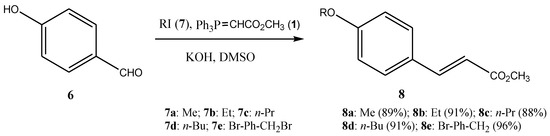
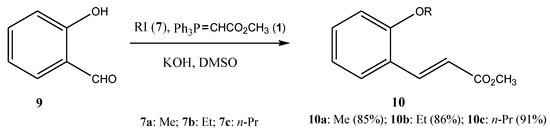
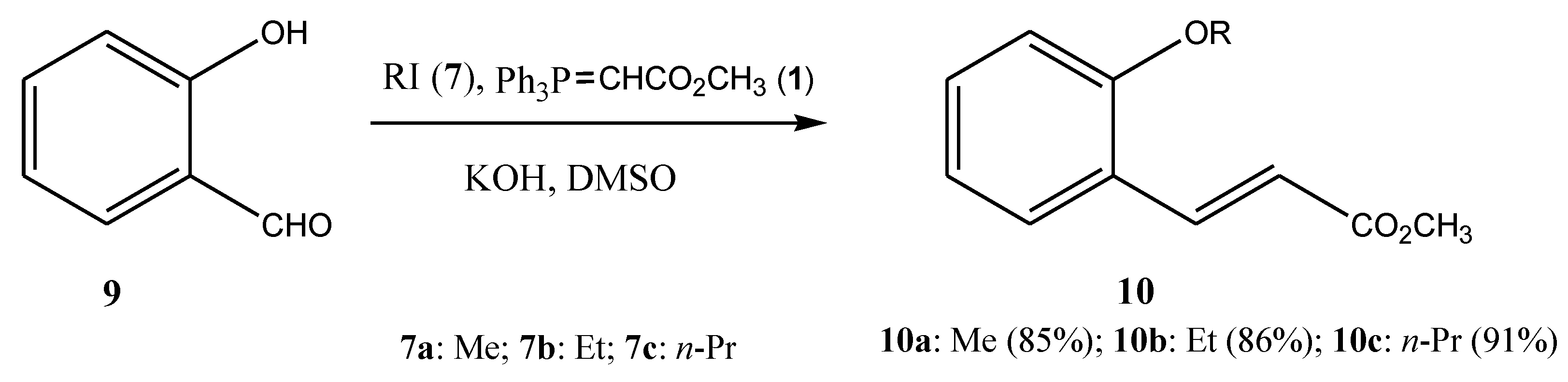
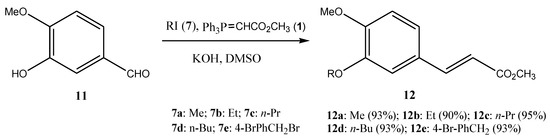
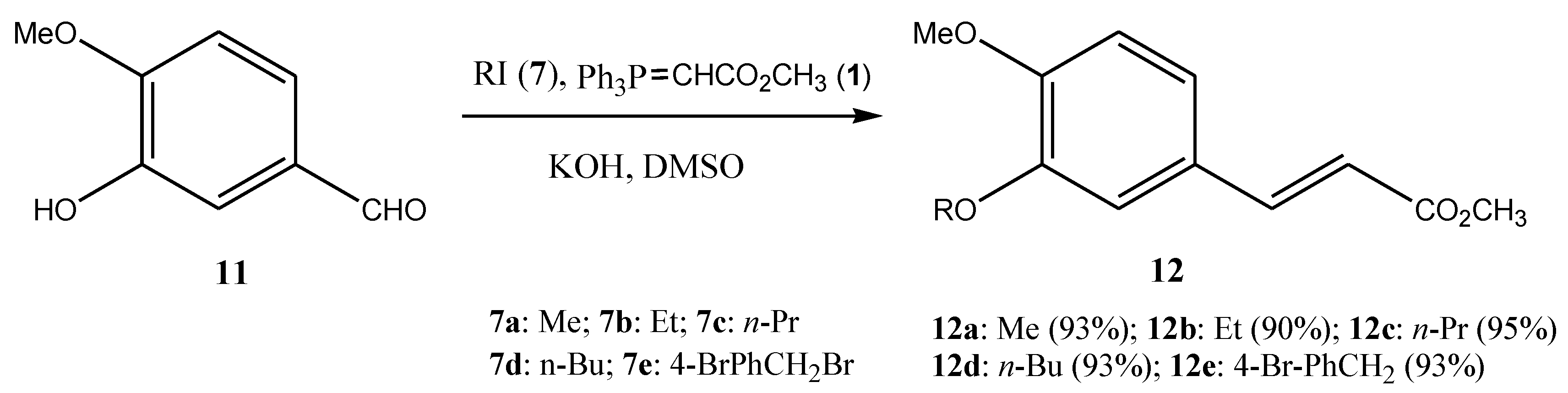
When hydroxybenzaldehydes 6/9/11 are reacted with alkyl iodides/bromides in the presence of KOH as base in DMSO as a solvent with the subsequent addition of phosphorane 1, the alkoxycinnamates 8/10/12 are formed in high yields (Scheme 2, Scheme 3 and Scheme 4). The work-up is a simple aqueous extraction followed by a chromatographic separation of the reaction mixture, where the cinnamates can easily be purified from the accompanying triphenylphosphine oxide. Only, in the case of the preparation of the methylated products can small amounts of side products stemming from C-alkylation of the aromatic system be found. The Wittig-olefination is deemed to be a reaction of poor atom-economy as triphenylphosphine oxide is lost to the material yield of the product. This “deficiency” could be overcome by recycling of the triphenylphosphine oxide [9,10,11]. Studies on how such a recycling step can be incorporated in the above process are currently underway.
Scheme 2.
One pot Wittig olefination—etherification of 4-hydroxybenzaldehyde (6).
Scheme 3.
One pot Wittig olefination—etherification of 2-hydroxybenzaldehyde (9).
Scheme 4.
One pot Wittig olefination—etherification of 3-hydroxy-4-methoxybenzaldehyde (11).
4. Conclusions
The reaction of hydroxybenzaldehydes with alkyl iodides/bromides in DMSO, in the presence of KOH as base, leads after addition of (carbomethoxymethylene)triphenylphosphorane to O-alkylated cinnamates in high yield.
Author Contributions
Conceptualization, supervision, synthetic investigation, writing—original draft preparation, T.T.; synthetic investigation, A.H.; analytical work, V.P. All authors have read and agreed to the published version of the manuscript.
Institutional Review Board Statement
Not applicable.
Informed Consent Statement
Not applicable.
Data Availability Statement
Upon request.
Conflicts of Interest
The authors declare no conflict of interest.
References
- Thiemann, T.; Watanabe, M.; Tanaka, Y.; Mataka, S. One-Pot Wittig-olefination/Suzuki-reaction—The Compatibility of conjugated phosphoranes in Pd(0) catalysed C-C-bond forming reactions. New J. Chem. 2006, 30, 359–369. [Google Scholar] [CrossRef] [Scilit]
- Yamamoto, K.; Watanabe, W.; Ideta, K.; Mataka, S.; Thiemann, T. Combined Suzuki coupling—Wittig olefination reaction in aqueous medium. Z. Nat. B 2005, 60, 1299–1307. [Google Scholar] [CrossRef] [Scilit]
- Thiemann, T.; Elshorbagy, M.; Ahmadani, S.; Al Jasem, Y.; Al Azani, M.; Al-Sulaibi, M.; Al Hindawi, B. Facile, direct reaction of benzaldehydes to 3-phenyl-prop-2-enoic acids and 3-arylprop-2-ynoic acids in aqueous medium. Int. J. Org. Chem. 2016, 6, 126–141. [Google Scholar] [CrossRef]
- Thiemann, T. Solventless Wittig reactions with fluorinated benzaldehydes. J. Chem. Res. 2007, 31, 336–341. [Google Scholar] [CrossRef] [Scilit]
- Cantrell, A.; McGarvey, D.J.; Truscott, T.G. Photochemical and photophysical properties of sunscreens. In Sun Protection in Man; Giacomoni, P.U., Ed.; Elsevier Science, B.V: Amsterdam, The Netherlands, 2001; Volume 26, pp. 495–519. [Google Scholar]
- Nunes, A.R.; Vieira, I.G.P.; Queiroz, D.B.; Leal, A.L.A.B.; Morais, S.M.; Muniz, D.F.; Calixto-Junior, J.T.; Coutinho, H.D.M. Use of flavonoids and cinnamates, the main photoprotectors with natural origin. Adv. Pharmacol. Pharm. Sci. 2018, 2018, 5341487. [Google Scholar] [CrossRef] [Scilit] [PubMed]
- Johnstone, R.A.W.; Rose, M.E. A rapid, simple, and mild procedure for alkylation of phenols, alcohols, amides and acids. Tetrahedron 1979, 35, 2169–2173. [Google Scholar] [CrossRef] [Scilit]
- Abdel-Magid, A.F. Potassium hydroxide-dimethyl sulfoxide. In e-EROS Encyclopedia of Reagents for Organic Synthesis; John Wiley & Sons, Ltd.: Chichester, UK, 2001; pp. 1–2. [Google Scholar]
- Horner, L.; Hoffman, H.; Beck, P. Phosphororganische Verbindungen, XVI. Wege zur Darstellung primärer, sekundärer und tertiärer Phosphine. Chem. Ber. 1958, 91, 1583–1588. [Google Scholar] [CrossRef] [Scilit]
- Keglevich, V.; Fekete, M.; Chulununbaatar, T.; Dobó, A.; Harmat, V.; Töke, L. One-pot transformation of cyclic phosphine oxides to phosphine–boranes by dimethyl sulfide-borane. J. Chem. Soc. Perkin Trans. 1 2000, 24, 4451–4455. [Google Scholar] [CrossRef] [Scilit]
- Al Jasem, Y.; El-Esawi, R.; Thiemann, T. Wittig- and Horner-Wadsworth-Emmons-olefination reactions with stabilised and semi-stabilised phosphoranes and phosphonates under non-classical conditions. J. Chem. Res. 2014, 38, 453–463. [Google Scholar] [CrossRef] [Scilit]


Publisher’s Note: MDPI stays neutral with regard to jurisdictional claims in published maps and institutional affiliations. |
© 2020 by the authors. Licensee MDPI, Basel, Switzerland. This article is an open access article distributed under the terms and conditions of the Creative Commons Attribution (CC BY) license (https://creativecommons.org/licenses/by/4.0/).