


Abstract
To determine the road performance and optimum dosing of solid-waste-based gelling agents in road subgrade, we conducted unconfined compressive strength testing for clay, sandy soil, weathered sand, and crushed stone mixed with different proportions of solid-waste gelling agents and compared the results with the road performance of cement-stabilized crushed stone materials. The results show that the optimum admixture of cementitious materials for clay and clay is 8–10%. The optimum admixture of cementitious materials for weathered sand is 5–7%. The optimum admixture of cementitious materials for stabilized gravel is 5.5%. The late strength growth of stabilized gravel with solid-waste-based cementitious agents is significantly better than that of cement-stabilized gravel.
1. Introduction
Deelwal et al. [1] found that the maximum dry density of red mud was less than 1.75 g/cm3, which is the minimum requirement for use in road substrates for India’s national highways, state highways, and major regional arterials and other heavily trafficked roads [2]. The liquid limit and plasticity index were much higher than the minimum requirements of the Indian standard. Sahoo et al. [3] and Deelwal et al. [1] obtained CBR (California bearing ratio) values for red mud and submerged CBR values of 4.2 and 4%, respectively, under submerged conditions, which are 20–30% lower than those required by Indian standards for pavement subgrade road construction. Although higher than the minimum requirement of 2.5% for Irish standards and 3% for major road design in Queensland, Australia, they are 10% lower than those required by statewide urban road design specifications [4]. Li et al. conducted a detailed experimental study on the distribution and mechanical performance indexes of coal gangue in cold regions such as the three northeastern provinces and found problems and testing indexes when using coal gangue as road base fill material in construction in cold regions [5,6,7]. Liu [8,9,10] studied the change law of test values of the compaction test and unconfined compressive strength of saline soils stabilized by a soil conglomerate in different salt content rates and different maintenance age conditions. Yue [11] adopted monomer ethylene glycol, monovinyl polyethylene glycol ether, acrylic acid, and hydroxypropyl acrylate in a polymerization reaction at room temperature to produce solid-waste-based cementitious materials, polycarboxylic acid water reducing agent.
2. Raw Materials
2.1. Earth and Rock Materials and Solid-Waste-Based Cementitious Agents
For inorganic bonded solid-waste-based cementitious stabilization (sub-base), the type of soil, the nature of the solid-waste-based cementitious agent, and the construction process affect the performance of the stabilized sub-base. Four types of typical soil and rock materials, namely clay, sand, weathered sand, and gravel, were used in Shandong, and the chemical composition of the selected materials was analyzed. The corresponding solid-waste-based gelling agents (in different ratios) were configured for testing.
The gelling material is solid-waste-based gelling from Beijing Donghao Technology Co. (Beijing, China).The main ingredients are sintered red mud micronized powder, fly ash, calcined gangue micronized powder, and a compound exciter consisting of sodium silicate, triterpene saponin, polymeric aluminium sulphate, magnesium fluorosilicate, and sodium hydroxide. The characteristics of each type of raw material are shown in Table 1, Table 2 amd Table 3.

Table 1.
Performance indicators for solid-waste-based gelling agents.
Table 2.
Engineering properties of clay, sandy soil, and weathered sand raw materials.
Table 3.
Composition of crushed stone particle gradation.
2.2. Cement-Stabilized Aggregates
To compare the difference in performance effects between solid-waste-based-gelling-agent-stabilized aggregates and cement-stabilized aggregates, aggregates with the same gradation were selected for testing. The proportions of each grade of aggregate and the synthetic gradation are shown in Table 4 and Table 5, respectively. The cement used is P.C-32.5, a type commonly used in substrates. The feedstock properties are shown in Table 6.
Table 4.
Stabilized gravel mix ratio.
Table 5.
Synthetic gradation.
Table 6.
Physical properties of cement.
3. Tests and Results
According to the Test Procedure for Inorganic Binding Material Stabilization for Highway Engineering (JTGE51-2009), four typical materials—clay, sand, weathered sand, and gravel—were mixed with different proportions of the solid-waste-based cementing agent. The standard specimens were prepared according to the maximum dry density and optimum moisture content obtained from compaction tests. They were tested for unconfined compressive strength with 7 days of standard conditions to determine the optimum amount of solid-waste-based cementing agent.
3.1. Compaction Tests
Table 7 presents the results of compaction tests on different types of soils stabilized by different doses of solid-waste-based gelling agents and cement.
Table 7.
Results of compaction tests.
The optimum water content does not change much with the increase in the cementitious material, and the maximum dry density increases slightly with the increase in the cementitious material admixture. This is because the density of the cementitious material is greater than that of the clay, sandy soil, and weathered sand. Comparing the results of optimum water content and maximum dry density of cement-stabilized gravel and cement-stabilized gravel, it is found that there is little difference between the results of the two at 6% admixture.
3.2. Lateral Limitless Compressive Strength Test
For the asphalt pavement sub-base, the unconfined compressive strength index is one of the most important indicators of road performance, indicating the strength value that the specimen can withstand when placed under unconfined lateral conditions. The unconfined compressive strength of clay, sand, weathered sand, and macadam stabilized by the solid-waste base binder for 7 days and the unconfined compressive strength of cement-stabilized macadam base for 7 days were tested. The results are shown in Table 8 and analyzed concerning the amount of solid-waste-based cementitious binder incorporated (Figure 1).
Table 8.
Results of 7 d unconfined compressive strength tests for different materials with different amounts of cementitious materials.
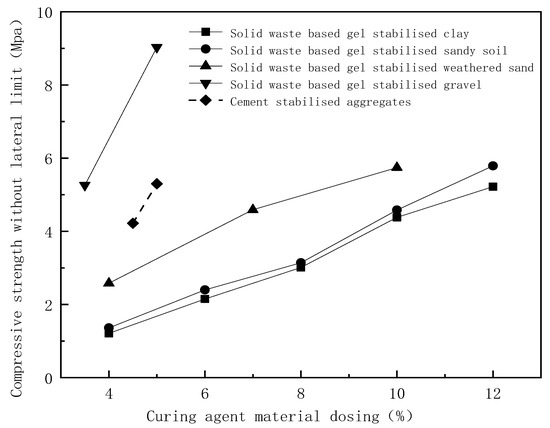
Figure 1.
Correlation between the unconfined compressive strength of four types of road materials stabilized by curing agents and the amount of admixture.
For the same raw material, the unconfined compressive strength tended to increase significantly with the increase in the amount and the strength values of the aggregates stabilized with the solid-waste-based gelling agent. This indicates that the amount of solid-waste-based gelling agent plays a decisive role in the unconfined compressive strength.
For the same raw material, the unconfined compressive strength tended to increase significantly with the increase in the amount of solid-waste-based gelling agent. This indicates that the amount of solid-waste-based gelling agent plays a decisive role in the unconfined compressive strength.
2.5–3.0 MPa of the grassroots level for 7 d standard maintenance is appropriate to determine the best mixture of materials as a sub-base in solid-waste-based cementitious materials (Table 9).
Table 9.
Optimal dosing of solid-waste-based gelling agents in several typical mixed materials.
The variation of the unconfined compressive strength with the curing age was investigated for different material specimens with the optimum solid-waste-based gelling agent admixture. The results are shown in Figure 2.
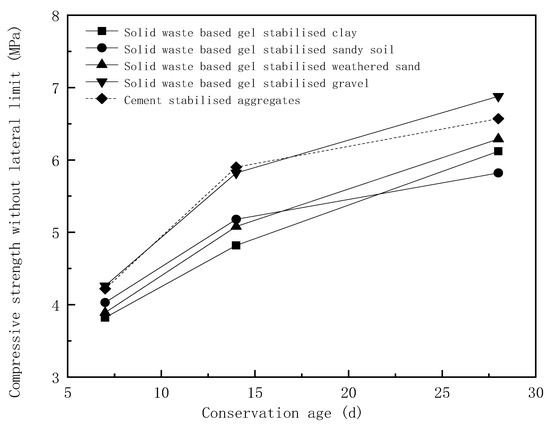
Figure 2.
Variation of unconfined compressive strength with the age of curing for various types of stabilized materials.
The unconfined compressive strength of the four types of stabilized materials increased significantly with the increase in the curing age. The strength of the sandy soil materials stabilized with the solid-waste-based gelling agent increased relatively slowly, while that of weathered sand and clay increased in a similar trend. For the stabilized aggregates, the late strength growth (14–28 days) of the solid-waste-based-gelling-agent-stabilized aggregates was significantly better than that of the cement-stabilized aggregates.
4. Conclusions
The optimum water content is not related to the amount of cementitious material admixture, and the maximum dry density increases slightly with the increase in cementitious material admixture. At the admixture of 6%, the optimum water content and maximum dry density of crushed stone and cement-stabilized crushed stone with the solid-waste-based cementitious stabilized are almost the same. The optimum admixture of cementitious material for clay and clay is 8 to 10%. The optimum admixture of cementitious material for weathered sand is 5 to 7%. The optimum admixture of cementitious material for stabilized gravel is 5.5%. The unconfined compressive strength of each type of stabilized material increases linearly with the increase in solid-waste-based cementing admixture. Under the condition of a certain admixture of cementing material, the unconfined compressive strength of each type of stabilized material increases with the increase in the curing age.
Author Contributions
Methodology, T.G.; test, Y.Q.; data curation, Y.Q.; writing-original draft preparation, Y.Q.; writing-review and editing, T.G.; All authors have read and agreed to the published version of the manuscript.
Funding
This research received no external funding.
Institutional Review Board Statement
Not applicable.
Informed Consent Statement
Not applicable.
Data Availability Statement
Not applicable.
Conflicts of Interest
The authors declare no conflict of interest.
References
- Wang, K.; Wang, H.; Li, S. Hydrochloric acid leaching of red mud for aluminium recovery. Nonferrous Met. 2012, 7, 16–18. (In Chinese) [Google Scholar]
- Chen, D. Recovery of titanium dioxide from red mud. Ind. Environ. 1994, 3, 42–45. (In Chinese) [Google Scholar]
- Agatzini-Leonardou, S.; Oustadakis, P.; Tsakiridis, P.; Markopoulos, C. Titanium leaching from red mud by diluted sulfuric acid at atmospheric pressure. J. Hazard. Mater. 2008, 157, 579–586. (In Chinese) [Google Scholar] [CrossRef] [PubMed]
- Zhang, J. Preliminary study on the recovery of titanium dioxide from red mud. China Resour. Compr. Util. 2003, 1, 28–30. (In Chinese) [Google Scholar]
- Niu, W. Technical points of highway coal gangue filling roadbed. Heilongjiang Sci. Technol. Inf. 2013, 14, 241. (In Chinese) [Google Scholar]
- Jan, X. Application of coal gangue backfill for highway roadbed. TranspoWorld 2013, 291, 187–188. (In Chinese) [Google Scholar]
- Cui, H.; Zhu, C.; Yang, S.; Hu, S. Study on the strength characteristics of new improved soil containing red mud curing agent for cold zone road base. J. Hebei Inst. Archit. Civ. Eng. 2021, 39, 18–26. (In Chinese) [Google Scholar]
- Xiao, Z.; Dai, A.; Zhang, Q.; Sui, N. Research on the construction technology of cold regenerated base layer of asphalt pavement. J. Highw. Transp. Res. Dev. (Appl. Technol. Ed.) 2020, 16, 91–92+96. (In Chinese) [Google Scholar]
- Liu, J.; Wei, B.; Yang, S. Experimental study on the unconfined compressive strength of saline soils modified with soil condensate. J. Hebei Inst. Archit. Civ. Eng. 2021, 39, 29–33. (In Chinese) [Google Scholar]
- Liu, J.; Zhang, G.; Zhang, N. Experimental study on salt swelling characteristics of saline soils improved by curing agents under freeze-thaw cycles. J. Hebei Inst. Archit. Civ. Eng. 2020, 38, 60–63. (In Chinese) [Google Scholar]
- Yue, G.; Xie, R.; Guo, W.; Peng, L.; Tang, Y.; Yu, P.; Mo, L. Preparation and properties of polycarboxylate superplasticizer for solid waste-based cementitious materials. New Build. Mater. 2022, 49, 120–123+128. (In Chinese) [Google Scholar]
Disclaimer/Publisher’s Note: The statements, opinions and data contained in all publications are solely those of the individual author(s) and contributor(s) and not of MDPI and/or the editor(s). MDPI and/or the editor(s) disclaim responsibility for any injury to people or property resulting from any ideas, methods, instructions or products referred to in the content. |
© 2023 by the authors. Licensee MDPI, Basel, Switzerland. This article is an open access article distributed under the terms and conditions of the Creative Commons Attribution (CC BY) license (https://creativecommons.org/licenses/by/4.0/).