


Abstract
The provision of affordable housing has become a major concern for policymakers and urban planners, especially in developing nations of the world. One of the key challenges in this domain is the identification of suitable locations for the development of affordable housing. Appropriate locations of affordable housing will improve the housing satisfaction of residents by increasing the social and economic benefits for low-income residents, providing better accessibility to opportunities and services, and reducing the poverty concentration. A bidirectional relationship exists among affordable adequate housing and health, and has been recognised as an essential sustainable development component. Therefore, this research aims to identify the factors that govern the spatial location choice of affordable housing. The determinants were derived via an exploratory study of relevant literature studies encompassing different geographical contexts, socio-economic backgrounds, and technological and economic advancement levels. A total of 61 parameters were identified, each of which lies in one of the following six categories: neighbourhood characteristics, urban characteristics, social factors, economic parameters, demographic factors, and housing quality. The findings indicate that the location choice of users varies with regard to the context of an urban area. Broadly speaking, most of the prior studies have considered accessibility, transport-related factors, and housing prices as important attributes in determining the optimal location for siting affordable housing. However, parameters such as socio-economic criteria, accessibility to various facilities, and employment opportunities have greater significance in developing nations. Contrasting results are observed in the case of several developed nations, wherein factors such as safety, environmental aspects, and dwelling type were emphasised over elements of accessibility. The identified parameters can be considered by the policymakers to evaluate optimal locations for siting affordable housing projects, thereby ensuring that low-income residents reside in neighbourhoods that promote social and economic sustainability.
1. Introduction
As the global population continues to burgeon and urbanisation accelerates, the challenge of ensuring adequate and affordable housing for all has become imperative, especially in developing nations. One of the key challenges in this domain is the identification of suitable locations for the development of affordable housing. Appropriate locations of affordable housing will improve the housing satisfaction of residents by increasing the social and economic benefits for low-income residents, providing better accessibility to opportunities and services, reducing poverty concentration, and positively impacting health conditions [1,2]. The housing location choice not only defines the interaction between the built environment and the households but also influences their lifestyle and travel patterns [3]. To gain insights into housing demand and spatial allocation issues, it is imperative to delve into users’ housing preferences, as it is a fundamental factor in addressing the mismatch between housing supply and household needs. It has been acknowledged by experts and researchers that the placement of affordable housing at optimal sites is critical in determining its viability and effectiveness [4]. Therefore, this research aims to identify the factors that govern the spatial location choice of affordable housing. By examining a diverse array of factors, both individual and contextual, we aim to contribute to a more comprehensive understanding of the dynamics governing these choices. In doing so, we hope to offer insights that can inform policy development, urban planning strategies, and affordable housing provision practices to create more equitable and sustainable urban environments.
2. Methodology
This research employs an exploratory literature review of peer-reviewed journal articles and conference proceedings. It focuses on investigating specific keywords, namely residential location choice, affordable housing, location suitability, and parameters, across various electronic databases such as Google Scholar, Scopus, ScienceDirect, and SpringerLink. A manual assessment of the titles and abstracts of articles was carried out to decide their inclusion in the study. Altogether, 48 research papers from peer-reviewed journals and 3 conference proceedings articles were identified as relevant to the aim of this research. Through these sources, 61 parameters associated with the housing location choice of the residents were gathered. Among these, 45% were carried out in developing countries, notably China, Malaysia, and India, while the remaining were from high-income and technologically advanced nations, including the United States of America and the United Kingdom.
3. Results and Discussions
3.1. Parameters Identified via Literature Review
The housing choice of a household is described as the selection of a dwelling unit or its spatial setting from a range of alternatives with various characteristics based on considerations involving their needs, preferences, and available resources along with existing housing market constraints [5,6]. However, there exists a notable absence of a standardised method for categorising the attributes utilised for defining residential location choices. Addressing this drawback, a structured classification of parameters influencing the location choices of households is developed in this study, comprising the following six distinct categories, namely neighbourhood characteristics, urban characteristics, social factors, economic parameters, demographic factors, and housing quality (Table 1).
- Neighbourhood Characteristics: The notion of neighbourhood may be characterised as a collection of spatially related features, including a diverse array of attributes, such as infrastructure, accessibility and proximity to various facilities, environmental conditions, and transportation network traits or connectivity [7,8].
- Urban Characteristics: The term urban characteristic is a location-related attribute that is defined by the geometries and dimensions of physical objects. It involves the function of population size and density, the spatial extent of the built area, the variations in land prices across the area, and a mix of different land uses [9].
- Social Factors: Social characteristics comprise a wide range of societal and cultural attributes (such as ethnic groups and social status), demographic, and interpersonal attributes that shape the identity, behavior, and relationships of individuals within a group or community [10].
- Economic Parameters: Apart from social factors, economic aspects have gained greater prominence in influencing urban land use patterns. Economic value has been a critical factor in the allocation of land resources, influencing the overall affordability of a housing project [11,12]. Price of land and construction and labour market attributes are some specific economic parameters that are mostly included in studies of residential location choice set.
- Demographic Factors: Demography deals with the study of human populations and facilitates in determining the response of various demographic groups to housing location choice factors [4]. Variables such as ethnic diversity and the household size average at the zonal level are often associated with spatial alternatives of location choices.
- Housing Quality: Though housing quality encompasses multidimensional indicators, the factors representing the distinctive physical characteristics of a dwelling unit, along with other measures of building services such as water supply, waste management, and drainage systems, have been incorporated into studies assessing the location choice of households.

Table 1.
List of parameters identified from literature review, source-compiled by authors.
Table 1.
List of parameters identified from literature review, source-compiled by authors.
| S. No. | Category | S. No. | Sub-Category | Related Indicators | Selected References |
|---|---|---|---|---|---|
| 1 | Neighbourhood Characteristics | 1.1 | Neighbourhood Attributes | Aesthetic views, poverty incidence, level of education, crime rate, neighbourhood satisfaction | [3,13,14,15] |
| 1.2 | Accessibility and Proximity to Various Facilities | Accessibility and proximity to transit stops, accessibility and proximity to educational facilities (elementary and primary schools), accessibility and proximity to public safety (fire rescue and police stations), accessibility and proximity to healthcare facilities, accessibility and proximity to recreational spaces, accessibility and proximity to retail | [2,3,15,16,17] | ||
| 1.3 | Infrastructural Coverage | Coverage of physical infrastructure facilities like water supply, waste management, drainage systems andcoverage of social infrastructure such as the availability of schools, hospitals, recreational spaces | [1,14,16] | ||
| 1.4 | Environmental Aspect | Frequency of flooding, level of air pollution, noise pollution, land surface temperature, vegetation cover | [3,13,14,15] | ||
| 1.5 | Connectivity | Availability of public transportation in close proximity, duration of travel, transportation cost, public transportation routes | [1,13,14] | ||
| 2 | Urban Characteristics | 2.1 | Land Use Variables | Percentage of educational, cultural, commercial, public and semi-public, open spaces and networking opportunities | [17,18] |
| 2.2 | City Level Variables | Total built-area, residential population density, spatial variation in housing affordability | [16,17] | ||
| 3 | Economic Parameters | 3.1 | Land and Construction Cost | Land cost, housing costs, construction cost, maintenance costs, construction techniques and building materials, transportation cost | [1,16] |
| 3.2 | Labour Market | Employment availability, unemployment rate | [1,13,18] | ||
| 4 | Social Factors | 4.1 | Social Factors | Family size, age group, housing ownership, employment status, working members, household income, cost-to-income ratio, education level | [2,13,17] |
| 4.2 | Social Sustainability | Safety, minimising social segregation, enhancing the local community lifestyle, health and well-being, promoting a positive cultural influence | [1,3] | ||
| 5 | Demographic Factors | 5.1 | Zonal Demographic Variables | No. of families, ethnic composition of the population in each zone, average household size in each zone | [3,18] |
| 6 | Housing Quality | 6.1 | Dwelling Unit Structure | Building typology, unit area, total units (in numbers), number of bedrooms, number of bathrooms, presence of parking area, building façade | [2,17,18] |
| 6.2 | Services | Availability of drainage system andwater facilities, sufficient ventilation, proper waste management systems, landscaping | [15,16] |
3.2. Comparative Analysis of Parameters in Developing and Developed Countries
The parameters related to measures of accessibility and proximity to various facilities were incorporated into the largest share of the articles reviewed (59%), highlighting its importance in influencing choice behavior. Apart from this, transportation-related factors, connectivity, and the distribution of employment zones are prioritized in the housing location decisions particularly by lower-income communities [19,20]. High-density areas tend to attract residents due to the presence of abundant job opportunities and well-established infrastructure [17]. Social factors such as education and income level, economic sector of employment, and housing ownership type influence housing choices [2]. After a comparison of the results, it can be stated that the parameters related to connectivity are found to be less important in developed nations as they have better public transport infrastructure coverage. Dwelling type and other dwelling unit features, building services, and environmental factors hold higher weights in most developed countries, notably the USA. Distinct preferences towards housing typology are observed depending on the household type, such as single-family or joint family, and family size. The findings also suggest that clustering tendencies are evident in relation to ethnic composition and housing costs, mostly among high-income economies [18]. In the context of the infrastructural level, evidence suggests that inner city locations are preferred over suburbs in developing nations due to the presence of different infrastructure services and better access to employment in informal sectors [15]. The subcategory of attributes that were encompassed in the reviewed research papers is represented in Figure 1.
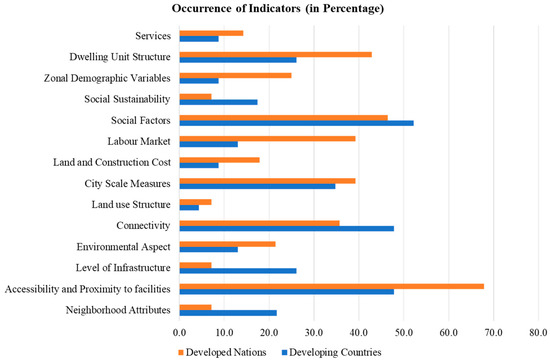
Figure 1.
Occurrence of parameters in percentage in the literature reviewed (source: generated by authors).
4. Conclusions
In this study, multiple attributes associated with the location choice of residents in the context of affordable housing have been examined through a review of relevant literature. Location choice can be envisioned as the decision-making process of households linked to probabilities of selection from a range of parameters correlated with a specific location that influences their everyday activities. The findings indicate that the location choice of users varies concerning the context of an urban area. The result of this study can be implied in housing development policy, land use, and transportation planning. The identified factors may be prioritized and considered by policymakers to evaluate optimal locations for siting affordable housing projects as these align with the actual demand and preferences of end users, thereby addressing the housing needs of the residents. It will also ensure that low-income residents reside in neighbourhoods that promote social and economic sustainability.
Author Contributions
Conceptualization, R.C.S.; methodology, N.A.; software, N.A.; formal analysis, N.A.; investigation, N.A.; resources, N.A.; data curation, Afshan, N.; writing—original draft preparation, N.A.; writing—review and editing, N.A. and R.C.S.; visualization, N.A.; supervision, R.C.S. All authors have read and agreed to the published version of the manuscript.
Funding
This research received no external funding.
Institutional Review Board Statement
Not applicable.
Informed Consent Statement
Not applicable.
Data Availability Statement
Not applicable.
Conflicts of Interest
The authors declare no conflict of interest.
References
- Sharghi, A.; Nourtaghani, A.; Ramzanpour, M.; Gorji, R.B. Low-income housing location based on affordable criteria Using AHP Model and GIS Technique (Case Study: Babolsar City). Environ. Dev. Sustain. 2022, 24, 10337–10377. [Google Scholar] [CrossRef]
- Olanrewaju, A.; Wong, H.C. Evaluation of the requirements of first time buyers in the purchase of affordable housing in Malaysia. J. Hous. Built Environ. 2020, 35, 309–333. [Google Scholar] [CrossRef]
- Ayoola, A.B.; Oyetunji, A.K.; Amaechi, C.V.; Olukolajo, M.A.; Ullah, S.; Kemiki, O.A. Determining Residential Location Choice along the Coastline in Victoria Island, Nigeria Using a Factor Analytical Approach. Buildings 2023, 13, 1513. [Google Scholar] [CrossRef]
- Sener, I.N.; Pendyala, R.M.; Bhat, C.R. Accommodating spatial correlation across choice alter-natives in discrete choice models: An application to modeling residential location choice behavior. J. Transp. Geogr. 2011, 19, 294–303. [Google Scholar] [CrossRef]
- Brown, T.; King, P. The power to choose: Effective choice and housing policy. Eur. J. Hous. Policy 2005, 5, 59–97. [Google Scholar] [CrossRef]
- Mulder, C.H.; Hooimeijer, P. Residential relocations in the life course. In Population Issues: An Interdisciplinary Focus; Van Wissen, L.J.G., Dykstra, P.A., Eds.; NIDI: Den Haag, The Netherlands, 1999; pp. 159–186. [Google Scholar]
- Galster, G. On the nature of neighbourhood. Urban Stud. 2001, 38, 2111–2124. [Google Scholar] [CrossRef]
- Cao, X.; Handy, S.L.; Mokhtarian, P.L. The influences of the built environment and residential self-selection on pedestrian behavior: Evidence from Austin, TX. Transportation 2006, 33, 1–20. [Google Scholar] [CrossRef]
- Weeks, J.R. Defining urban areas. Remote Sens. Urban Suburb. Areas 2010, 10, 33–45. [Google Scholar]
- Seo, D.; Kwon, Y. In-migration and housing choice in Ho Chi Minh City: Toward sustainable housing development in Vietnam. Sustainability 2017, 9, 1738. [Google Scholar] [CrossRef]
- Deng, X.; Huang, J.; Rozelle, S.; Uchida, E. Economic growth and the expansion of urban land in China. Urban Stud. 2010, 47, 813–843. [Google Scholar] [CrossRef]
- Zheng, W.; Shen, G.; Wang, H.; Lombardi, P. Critical issues in spatial distribution of public housing estates and their implications on urban renewal in Hong Kong. Smart Sustain. Built Environ. 2015, 4, 172–187. [Google Scholar] [CrossRef]
- Jaramillo, A.; Rohe, W.M.; Webb, M.D. Neighborhood opportunity and satisfaction among housing choice voucher recipients: A subjective well-being perspective. Hous. Policy Debate 2020, 30, 703–717. [Google Scholar] [CrossRef]
- Dawood, S.R.S. Sustainability, quality of life and challenges in an emerging city region of George Town, Malaysia. J. Sustain. Dev. 2019, 12, 35. [Google Scholar] [CrossRef][Green Version]
- Mulliner, E.; Smallbone, K.; Maliene, V. An assessment of sustainable housing affordability using a multiple criteria decision making method. Omega 2013, 41, 270–279. [Google Scholar] [CrossRef]
- Ghumare, P.N.; Chauhan, K.A.; Yadav, S.M. Exploring preferences for affordable housing criteria importance among EWS in India. Int. J. Hous. Mark. Anal. 2021, 14, 759–778. [Google Scholar] [CrossRef]
- Frenkel, A.; Bendit, E.; Kaplan, S. Residential location choice of knowledge-workers: The role of amenities, workplace and lifestyle. Cities 2013, 35, 33–41. [Google Scholar] [CrossRef]
- Rezaei, A.; Patterson, Z. Preference stability in household location choice: Using cross-sectional data from three censuses. Res. Transp. Econ. 2018, 67, 44–53. [Google Scholar] [CrossRef]
- Boschmann, E.E. Job access, location decision, and the working poor: A qualitative study in the Columbus, Ohio metropolitan area. Geoforum 2011, 42, 671–682. [Google Scholar] [CrossRef]
- Glaeser, E.L.; Resseger, M.G. The complementarity between cities and skills. J. Reg. Sci. 2010, 50, 221–244. [Google Scholar] [CrossRef]
Disclaimer/Publisher’s Note: The statements, opinions and data contained in all publications are solely those of the individual author(s) and contributor(s) and not of MDPI and/or the editor(s). MDPI and/or the editor(s) disclaim responsibility for any injury to people or property resulting from any ideas, methods, instructions or products referred to in the content. |
© 2023 by the authors. Licensee MDPI, Basel, Switzerland. This article is an open access article distributed under the terms and conditions of the Creative Commons Attribution (CC BY) license (https://creativecommons.org/licenses/by/4.0/).