


Abstract
A focus of this study was to investigate water quality in the central settlement area of Sukhbaatar province, which is characterized by semi-arid climate. In total, 47 water samples were collected from 13 soums in 2021, and major ions and trace elements were analyzed to evaluate the suitability of groundwater for drinking purposes. The dominant hydro-chemical facies of groundwater were the Na-HCO3 type, which represents 46.8% of the total analyzed samples. The water supply wells of Baruun-Urt soum, Asgat, Khalzan, and Erdenetsagaan soums do not meet the requirements of drinking water standards due to the content of magnesium, fluoride, and uranium ions. Additionally, the fluoride ion content in most wells exceeds the drinking water standard, while the fluoride content of Dariganga soum water was less than the drinking water standard; however, the Munkhkhaan soum was suitable.
1. Introduction
One of the main factors affecting the development of any country is clean and fresh water. Groundwater quality issues are crucial for sustainable water resources management in many countries worldwide, especially in arid and semi-arid regions. In the region, drinking water supply mainly depends on the groundwater, with no surface water resources due to natural moisture supply conditions. There is a natural pattern of poor water quality due to poor groundwater recharge in the region. Chemical elements in drinking water could possibly affect human health [1].
The main objective of this work was to study the drinking water quality of the soum centers in the Sukhbaatar province.
2. Materials and Methods
The Sukhbaatar province has a total area of 82.3 thousand km2 and is included in the steppe zone. In terms of climate, it is dry, with cool summers and cold winters, while the average temperature in July is +21.3 °C, and the average temperature in January is −19.9 °C [2].
We collected 43 groundwater (GW) and 4 spring water samples from soum centers in June (summer) 2021 (Figure 1). All sampling sites were used for drinking water supply. Electrical conductivity (EC), Total Dissolved Solid (TDS), pH, ORP, and water temperature were measured on-site using Multiparameter Hanna HI98195. The sampling site locations were verified using a portable GPS meter (GPSMAP 76S; Garmin Ltd.). All water samples were sealed in 1000 mL (anion and cation) and 100 mL (heavy metal) polyethylene bottles for chemical analysis. We measured Ca2+, Mg2+, Na+, K+, HCO3−, and Cl− via titration. NH4+, NO2−, NO3−, SO42−, F, and Fe were analyzed using a T-60 U spectrophotometer. The heavy metals were analyzed via ICP.
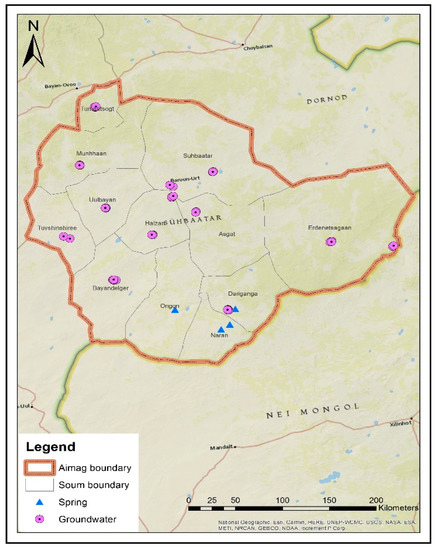
Figure 1.
Study area.
As a quality check on the analysis, the charge balance error (CBE ± 10%) was calculated using the following equation, and the calculated error did not exceed ±10%. The data were compared to the Mongolian standard (MNS0900:2018) [3].
3. Results and Discussion
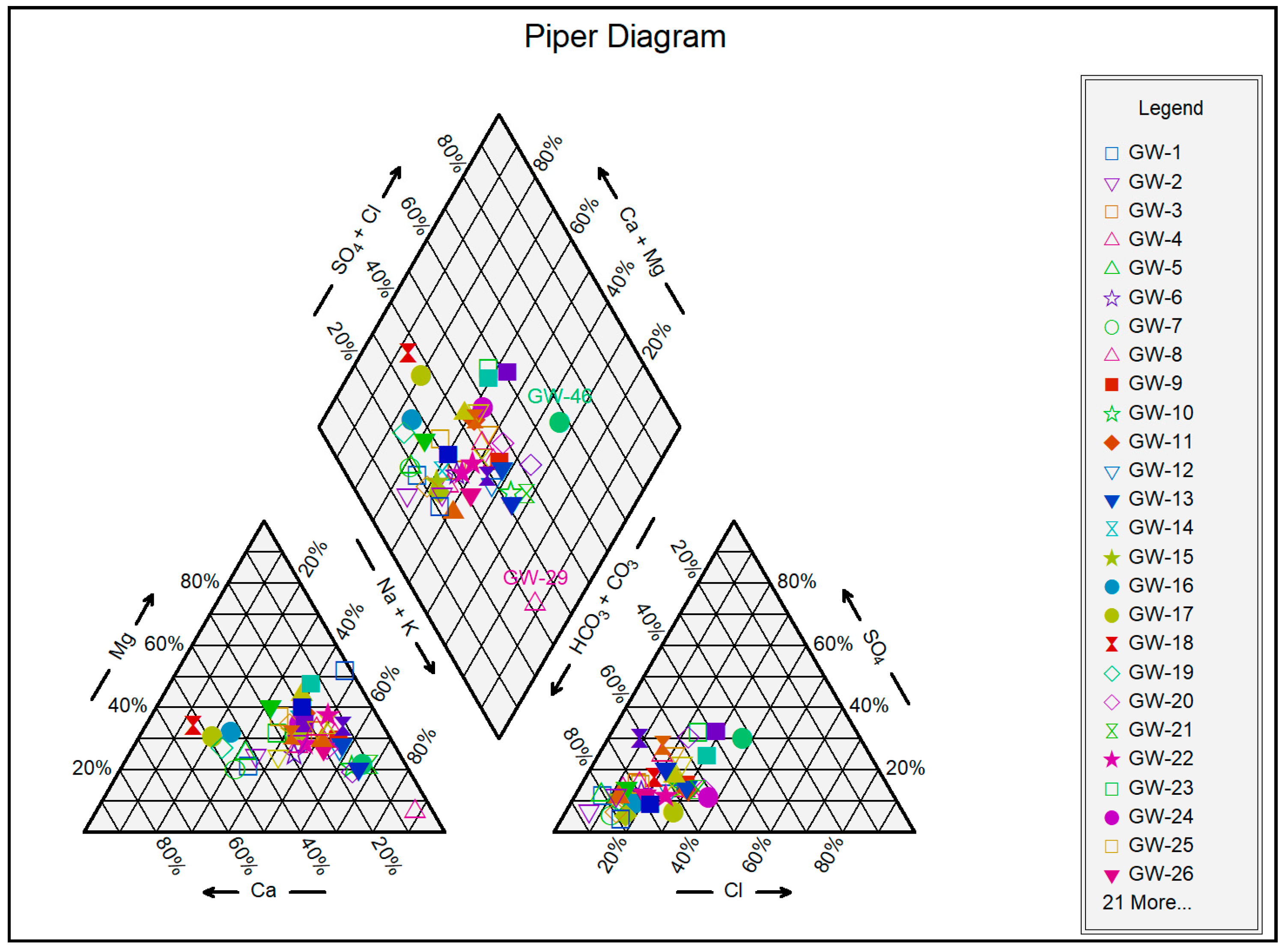
Figure 2 shows the classification of the hydro-chemical characteristics of water samples based on the main ion concentrations. The dominant hydro-chemical facies of groundwater were the Na-HCO3 type, which represents 46.8% of the total analyzed samples, while Ca-HCO3 and HCO3-mixed types each represent 17%, the HCO3-Na-Mg type and HCO3-Mg-Na type each represent 8.5%, and the mixed-Na-Mg type represents 2.1% of the total samples (Figure 2). The water supply wells of Baruun-Urt soum and Asgat, Khalzan, and Erdenetsagaan soums do not meet the requirements of drinking water standards due to their content of magnesium, fluorine, and uranium ions. Additionally, the fluoride ion content in most wells exceeds the drinking water standard, while the fluoride content of Dariganga soum water was less than the drinking water standard; however, Munkhkhaan soum was suitable. Almost 60% of the water samples exceeds the standard by magnesium.
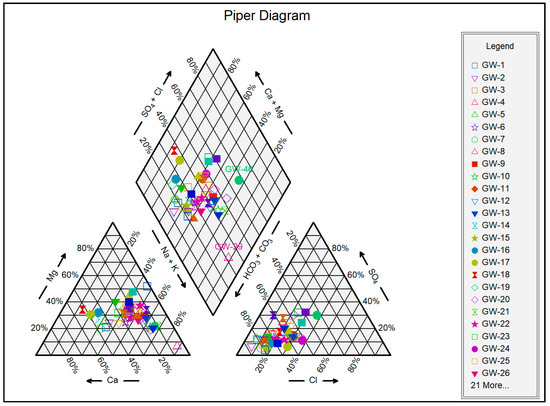
Figure 2.
Piper diagram of the collected water samples in the study area.
In total, 21 or 44.7% of all samples do not meet drinking water standards due to uranium content, and 11 or 23.4% of all samples have nitrate pollution. These findings suggest that appropriate actions have to be taken to improve groundwater quality and the protection of public health in the Sukhbaatar province.
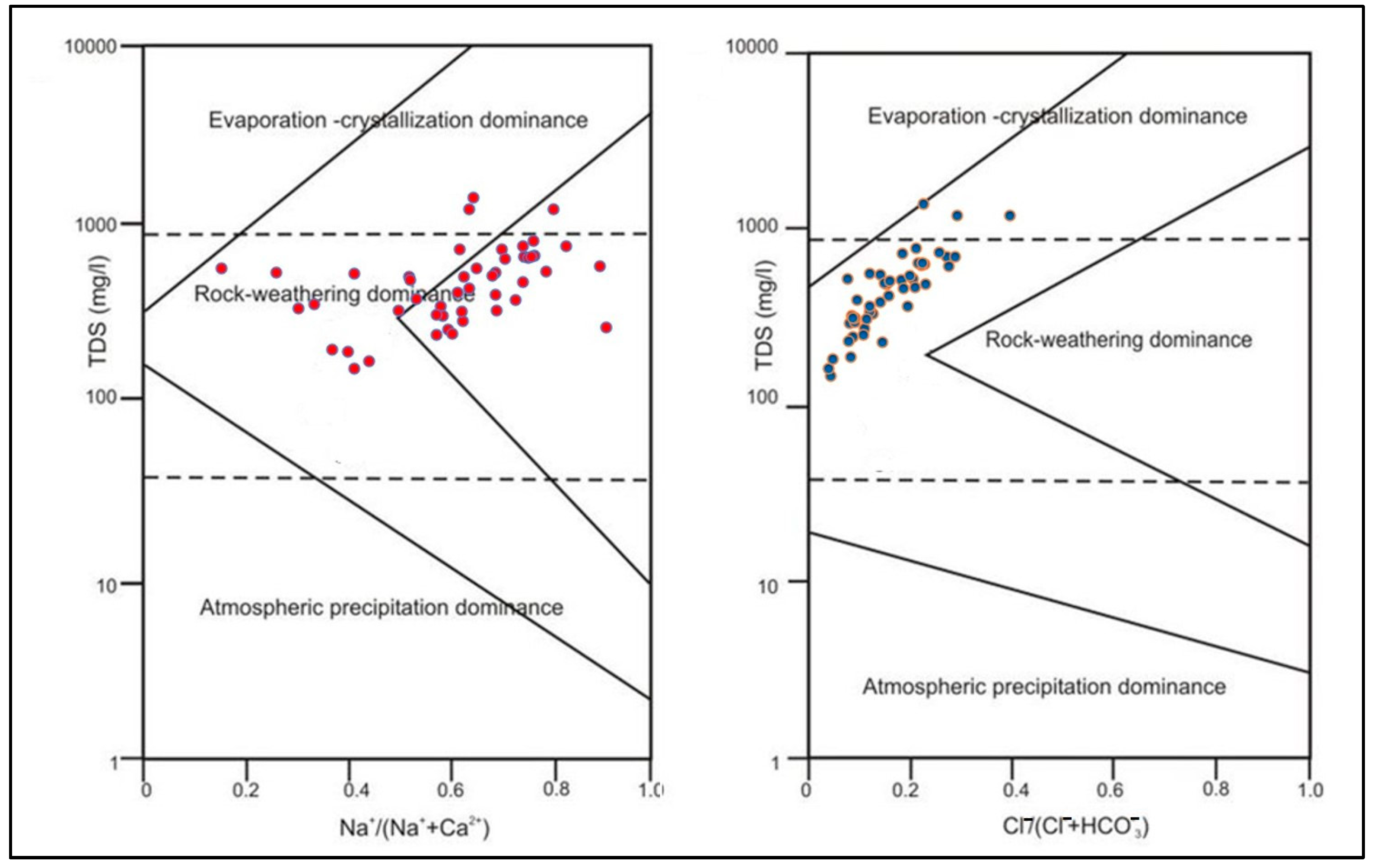
A Gibbs diagram was used for the geochemical evolution of groundwater, as well as evaluating evaporation, weathering, and precipitation in arid and semi-arid regions [4]. We can see in Figure 3 that most of the samples are plotted in the field of the rock dominance area, indicating that the main geochemical process is rock–water interaction in the study area.
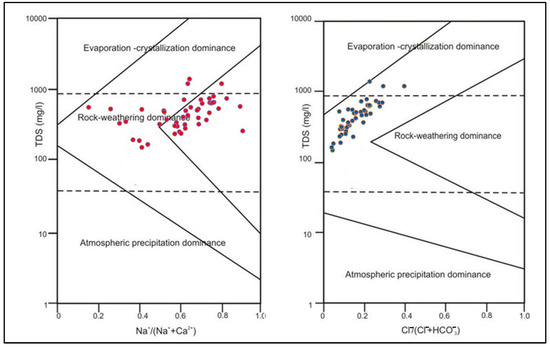
Figure 3.
Gibbs diagram of water samples in the study area.
4. Conclusions
In total, 47 water samples were collected from 13 soums to study the suitability of groundwater for drinking purposes. The major conclusions are:
- The Na-HCO3 type represents 46.8% of the total samples;
- In total, the drinking water in 11 soums does not meet drinking water standards regarding fluoride ion out of 13 soums, with Dariganga soum water being less than the standard, and Munkhkhaan soum being suitable;
- Magnesium, fluoride, uranium, and nitrate were among the elements found higher than the standard, and the worst water soum was Baruun-Urt.
Author Contributions
O.B. wrote the paper and E.T. carried out data preparation. The field study was performed by all (O.B., E.T., O.-E.B., R.B. and G.-E.E.). All authors have read and agreed to the published version of the manuscript.
Funding
This research was funded by Governor of Sukhbaatar province.
Institutional Review Board Statement
Not applicable.
Informed Consent Statement
Not applicable.
Data Availability Statement
Not applicable.
Acknowledgments
The authors acknowledge the financial support received by the Governor of Sukhbaatar province.
Conflicts of Interest
The authors declare no conflict of interest.
References
- Addisie, M.B. Assessment of Drinking Water Quality and Determinants of Household Potable Water Consumption in Simada District, Ethiopia; Cornell University: Ithaca, NY, USA, 2012. [Google Scholar]
- Sukhbaatar, C.; Batdelger, B.; Togtokh, E.; Enkhbold, E.; Boldsaikhan, O.; Badrakh, R. Drinking Water Quality Survey, Conclusions and Recommendations in the Soum Centers of Sukhbaatar Province; Mongolian State University of Education Publishing: Ulaanbaatar, Mongolia, 2021. [Google Scholar]
- MNS 900:2018; Environment. Health Protection. Safety. Drinking Water. Hygienically Requirements, Assessment of the Quality and Safety. Mongolian Standard: Ulaanbaatar, Mongolia, 2018.
- Gibbs, R.J. Mechanisms Controlling World Water Chemistry. Science 1970, 170, 1088–1090. [Google Scholar] [CrossRef] [PubMed]
Disclaimer/Publisher’s Note: The statements, opinions and data contained in all publications are solely those of the individual author(s) and contributor(s) and not of MDPI and/or the editor(s). MDPI and/or the editor(s) disclaim responsibility for any injury to people or property resulting from any ideas, methods, instructions or products referred to in the content. |
© 2023 by the authors. Licensee MDPI, Basel, Switzerland. This article is an open access article distributed under the terms and conditions of the Creative Commons Attribution (CC BY) license (https://creativecommons.org/licenses/by/4.0/).