Skip Content
You are currently on the new version of our website. Access the old version .

AI

AI is an international, peer-reviewed, open access journal on artificial intelligence (AI), including broad aspects of cognition and reasoning, perception and planning, machine learning, intelligent robotics, and applications of AI, published monthly online by MDPI.

Quartile Ranking JCR - Q1 (Computer Science, Interdisciplinary Applications)

All Articles (726)

Distributed production systems have to increasingly balance economic goals such as energy efficiency and productivity with critical technical requirements such as flexibility, real-time capability, and reliability. This paper presents a novel approach for distributed optimization by means of Evolutionary State-based Potential Games with dynamic grid structures. More in detail, we leverage the combination of Potential Games which provide rigorous convergence guarantees with population-based optimization to improve the efficiency of the learning process. Specifically, we address challenges of previous approaches including inefficient best response strategies, insufficient coverage of the state–action space and the lack of knowledge transfer among agents. The developed strategies are evaluated on a industrial system of laboratory scale. The results highlight advances in evolutionary state-based knowledge transfer and an improved coverage resulting in efficient control policies. By leveraging dynamic grid structures, Evolutionary State-based Potential Games enable the maximization of weighted production targets while simultaneously eliminating process losses resulting in improvements in the considered metrics compared to state-of-the-art methods.

6 February 2026
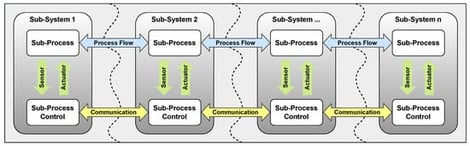
Consideration of distributed production systems for process measurement and control systems in a decentralized arrangement, divided into sub-systems, sub-processes and sub-applications.

Edge-Ready Romanian Language Models: Training, Quantization, and Deployment

  • T. A. Diac,
  • P. F. de Viana and
  • A. Nicolin-Żaczek
  • + 3 authors

We present RoBaseLM-S (125 M) and RoBaseLM-M (260 M), two compact Romanian decoder-only language models trained from scratch on a 4.3 B-token curated corpus. Architecturally, they follow a modern LLaMA-style recipe with pre-norm RMSNorm, rotary position embeddings, SwiGLU feed-forward blocks, grouped-query attention, and 4 k-token context windows. We release both full-precision (FP16) and post-training 5-bit (Q5_K_M) checkpoints in GGUF format for lightweight local inference. The 5-bit variants fit under 500 MB and generate text in real time on a Jetson Nano 4 GB, enabling fully offline Romanian text generation on consumer-grade edge hardware. We evaluate the models intrinsically (multi-domain perplexity across news, literary prose, poetry, and heterogeneous web text) and extrinsically (LaRoSeDa sentiment classification and RO-STS sentence similarity). Relative to Romanian GPT-2–style baselines at similar parameter scales, RoBaseLM-S and RoBaseLM-M reduce perplexity substantially, e.g., from 30.7 to 15.9 on our held-out news split. The 5-bit post-training quantized checkpoints remain within FP16 performance across all reported tasks. To our knowledge, these are the first Romanian small language models explicitly optimized for long-context inference, post-training quantization, and low-power on-device deployment.

6 February 2026

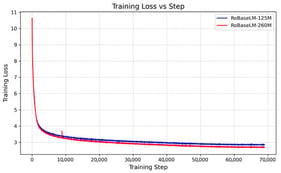
Training loss vs. training step for RoBaseLM-125 M and RoBaseLM-260 M. Curves reflect smoothed step-wise loss with evaluation-induced spikes visible but transient.

Anticoagulant pharmacology is a cognitively demanding domain in undergraduate medical education, with persistent challenges in learner engagement, retention, and safe clinical application. Cinematic Clinical Narratives (CCNs) offer a theory-informed multimedia approach designed to support learning through narrative structure, visual mnemonics, and affective engagement. We conducted a multi-site quasi-experimental study within a six-week Cancer, Hormones, and Blood course across a distributed medical education program. First-year medical students received either a traditional case-based lecture or an animated CCN (Twilight: Breaking Clots) during a one-hour anticoagulant pharmacology session. Learning outcomes were assessed using pre- and posttests, learner engagement was measured with the Situational Interest Survey for Multimedia (SIS-M), and exploratory eye tracking with second-year medical students was used to assess visual attention to embedded mnemonics. Both instructional groups demonstrated significant learning gains, with fold-change analyses indicating greater relative improvement among students exposed to the CCN. The animated CCN elicited significantly higher triggered situational interest compared with non-animated cases (p = 0.019), while also being preferred by the majority of participants. Qualitative analysis revealed that learners perceived CCNs as particularly effective for initial encoding and memorization, while non-animated cases supported subsequent clinical application. Eye-tracking data demonstrated high visual uptake and sustained attention to key mnemonic elements. Together, these findings support expert-designed, genAI-assisted CCNs as a validated and complementary instructional approach in medical education.

5 February 2026

Movie poster for the CCN.

An Adaptive Attention DropBlock Framework for Real-Time Cross-Domain Defect Classification

  • Shailaja Pasupuleti,
  • Ramalakshmi Krishnamoorthy and
  • Hemalatha Gunasekaran

The categorization of real-time defects in heterogeneous domains is a long-standing challenge in the field of industrial visual inspection systems, primarily due to significant visual variations and the lack of labelled information in real-world inspection settings. This work presents the Adaptive Attention DropBlock (AADB) framework, a lightweight deep learning framework that was developed to promote cross-domain defect detection using attention-guided regularization. The proposed architecture integrates the Convolutional Block Attention Module (CBAM) and an organized DropBlock-based regularization scheme, creating a unified and robust framework. Although CBAM-based approaches improve localization of defect-related areas and traditional DropBlock provides a generic spatial regularization, neither of them alone is specifically designed to reduce domain overfitting. To address this limitation, AADB combines attention-directed feature refinement with a progressive, transfer-aware dropout policy that promotes the learning of domain-invariant representations. The proposed model is built on a MobileNetV2 base and trained through a two-phase transfer learning regime, where the first phase consists of pretraining on a source domain and the second phase consists of adaptation to a visually dissimilar target domain with constrained supervision. The overall analysis of a metal surface defect dataset (source domain) and an aircraft surface defect dataset (target domain) shows that AADB outperforms CBAM-only, DropBlock-only, and conventional MobileNetV2 models, with an overall accuracy of 91.06%, a macro-F1 of 0.912, and a Cohen’s k of 0.866. Improved feature separability and localization of error are further described by qualitative analyses using Principal Component Analysis (PCA) and Grad-CAM. Overall, the framework provides a practical, interpretable, and edge-deployable solution to the classification of cross-domain defects in the industrial inspection setting.

3 February 2026

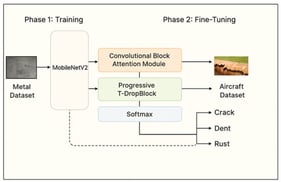
Proposed two-phase transfer learning framework based on MobileNetV2 backbone integrating CBAM and TDropBlock modules.

News & Conferences

Issues

Open for Submission

Editor's Choice

Reprints of Collections

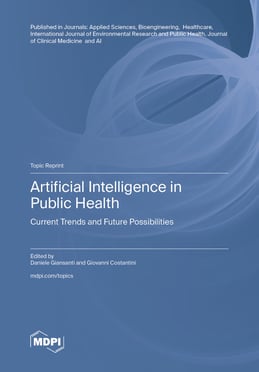
Artificial Intelligence in Public Health
Reprint

Artificial Intelligence in Public Health

Current Trends and Future Possibilities
Editors: Daniele Giansanti, Giovanni Costantini
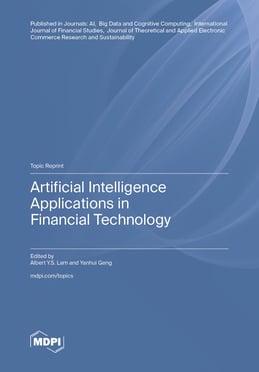
Artificial Intelligence Applications in Financial Technology
Reprint

Artificial Intelligence Applications in Financial Technology

Editors: Albert Y.S. Lam, Yanhui Geng

Get Alerted

Add your email address to receive forthcoming issues of this journal.

XFacebookLinkedIn
AI - ISSN 2673-2688