



applsci-logo

Journal Browser

Journal Browser

Advances in Artificial Intelligence and Big Data in Smart Environments

A special issue of Applied Sciences (ISSN 2076-3417). This special issue belongs to the section "Computing and Artificial Intelligence".

Deadline for manuscript submissions: 30 April 2026 | Viewed by 2079
Special Issue Editors


E-Mail Website
Guest Editor
Department of Business Administration, Faculty of Economic Sciences, Petroleum-Gas University of Ploiesti, 39 Bucharest Avenue, 100680 Ploiesti, Romania
Interests: artificial intelligence; machine learning; Internet of Things; economics
Special Issues, Collections and Topics in MDPI journals

E-Mail Website
Guest Editor
Department of Automatic Control, Computers, and Electronics, Faculty of Mechanical and Electrical Engineering, Petroleum-Gas University of Ploiesti, 39 Bucharest Avenue, 100680 Ploiesti, Romania
Interests: artificial intelligence; machine learning; deep learning; Internet of Things; digital twin; sensors; databases
Special Issues, Collections and Topics in MDPI journals

E-Mail Website
Guest Editor
Institute for Language and Speech Processing, Athena Research Centre, Kimmeria University Campus, 67100 Xanthi, Greece
Interests: privacy-enhancing technologies (PETs); information security; distributed ledger technologies (DLTs); personal data management; cryptographic protocols; health informatics; information retrieval; social networks analysis; ubiquitous computing
Special Issues, Collections and Topics in MDPI journals

Special Issue Information

Dear Colleagues,

In this special issue, we invite researchers, academics, PhD students, and practitioners to contribute original work in the field of Artificial Intelligence and Big Data as it relates to smart environments. The subject is a general one that interconnects with multiple fields of activity, leaving this horizon of contributions and technological advancement open. In this special issue, we aim to bring together new theoretical elements and practical applications that contribute to the development of the smart environments field through the integration of new technologies targeting the sectors of Artificial Intelligence and Big Data.

Topics of interest include, but are not limited to, the following:

  • Artificial Intelligence in smart engineering;
  • Machine learning and autonomous systems;
  • Smart and sustainable agriculture;
  • Large-scale data analysis (Big Data);
  • Internet of Things (IoT) in smart infrastructures;
  • Smart energy and energy management;
  • Data-driven decision-making and predictive algorithms;
  • Smart cities and urban mobility;
  • Intelligent systems for healthcare and education;
  • Security and privacy in Smart Environments;
  • Privacy and security in Big Data and Artificial Intelligence. 

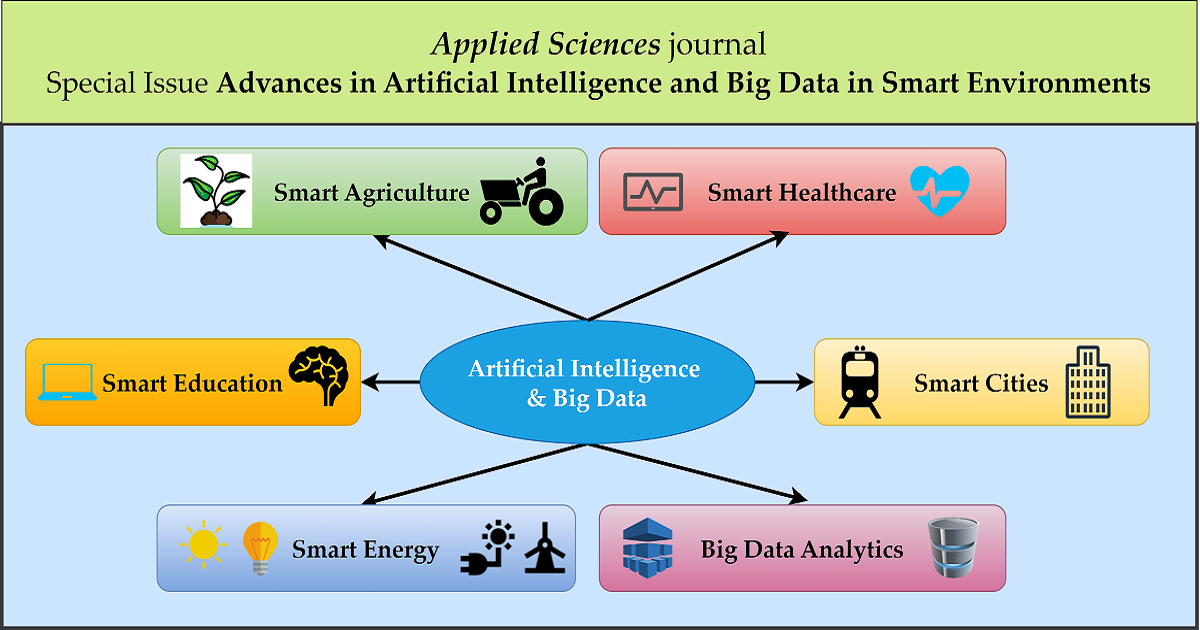
In the opinion of the editors, the future lies in the collaboration of experts from various fields, so that Artificial Intelligence components can be integrated into as many applications as possible. Since the performance of Artificial Intelligence algorithms is closely tied to the volume and quality of data, analyzing the concept of Big Data in relation to AI components is of particular interest. For these reasons, this Special Issue brings together the concepts of Big Data, Artificial Intelligence, and Smart Environment under a common research umbrella. The issue targets fields such as environment, energy, agriculture, education, health, and infrastructure, but it is not limited to them.

Prof. Dr. Adrian Stancu
Dr. Cosmina-Mihaela Rosca
Dr. George Drosatos
Guest Editors

Manuscript Submission Information

Manuscripts should be submitted online at www.mdpi.com by registering and logging in to this website. Once you are registered, click here to go to the submission form. Manuscripts can be submitted until the deadline. All submissions that pass pre-check are peer-reviewed. Accepted papers will be published continuously in the journal (as soon as accepted) and will be listed together on the special issue website. Research articles, review articles as well as short communications are invited. For planned papers, a title and short abstract (about 250 words) can be sent to the Editorial Office for assessment.

Submitted manuscripts should not have been published previously, nor be under consideration for publication elsewhere (except conference proceedings papers). All manuscripts are thoroughly refereed through a single-blind peer-review process. A guide for authors and other relevant information for submission of manuscripts is available on the Instructions for Authors page. Applied Sciences is an international peer-reviewed open access semimonthly journal published by MDPI.

Please visit the Instructions for Authors page before submitting a manuscript. The Article Processing Charge (APC) for publication in this open access journal is 2400 CHF (Swiss Francs). Submitted papers should be well formatted and use good English. Authors may use MDPI's English editing service prior to publication or during author revisions.

Keywords

  • artificial intelligence
  • smart engineering
  • machine learning
  • smart agriculture
  • big data analysis
  • smart environments
  • internet of things
  • smart energy
  • data-driven decision making
  • smart cities
  • intelligent systems
  • smart healthcare system
  • smart education

Benefits of Publishing in a Special Issue

  • Ease of navigation: Grouping papers by topic helps scholars navigate broad scope journals more efficiently.
  • Greater discoverability: Special Issues support the reach and impact of scientific research. Articles in Special Issues are more discoverable and cited more frequently.
  • Expansion of research network: Special Issues facilitate connections among authors, fostering scientific collaborations.
  • External promotion: Articles in Special Issues are often promoted through the journal's social media, increasing their visibility.
  • Reprint: MDPI Books provides the opportunity to republish successful Special Issues in book format, both online and in print.

Further information on MDPI's Special Issue policies can be found here.

Published Papers (2 papers)

Order results
Result details
Select all
Export citation of selected articles as:

Research

Jump to: Review

33 pages, 3089 KB  
Article
A Machine Learning-Based Data-Driven Model for Predicting Wastewater Quality Parameters in the Industrial Domain
by Madalina Carbureanu and Catalina Gabriela Gheorghe
Appl. Sci. 2026, 16(2), 694; https://doi.org/10.3390/app16020694 - 9 Jan 2026
Cited by 1 | Viewed by 719
Abstract
This study proposes HGBRCond, a machine learning model for conductivity prediction in controlled biodegradation processes. Eight regression algorithms were evaluated using experimental data (n = 424) from a micro-pilot treatment system. HGBRCond, based on Histogram-Gradient Boosting Regression (best performing ML model), achieved [...] Read more.
This study proposes HGBRCond, a machine learning model for conductivity prediction in controlled biodegradation processes. Eight regression algorithms were evaluated using experimental data (n = 424) from a micro-pilot treatment system. HGBRCond, based on Histogram-Gradient Boosting Regression (best performing ML model), achieved optimal performance (R2 = 0.877 ± 0.011, RMSE = 10.235 ± 0.54 µS/cm) through 10-fold cross-validation. Unlike standard HGBR and previous conductivity models that lack comprehensive validation frameworks, HGBRCond integrates rigorous statistical validation (cross-validation, sensitivity analysis, confidence intervals) with multi-level interpretability (Morris screening, SHAP analysis, feature importance), achieving a 6.8% performance improvement over standard gradient boosting approaches while addressing mechanistic interpretability gaps present in prior work. However, limitations constrain direct potential industrial applicability: limited dataset (n = 424), narrow conductivity range (285–360 µS/cm), strong dissolved oxygen dependence, sensitivity across two critical parameters, constant flowrate, and validation restricted to controlled conditions. These constraints require model recalibration for potential industrial application. Future work will focus on model validation across extended operational ranges using industrial samples and full-scale testing to establish applicability beyond controlled experimental settings. Full article
Show Figures

Figure 1

Review

Jump to: Research

32 pages, 1979 KB  
Review
Automation and Sustainability—The Impact of AI on Energy Consumption and Other Key Features of Industry 4.0/5.0 Technologies
by Izabela Rojek, Ewa Dostatni, Jakub Kopowski, Jakub Lewandowski and Dariusz Mikołajewski
Appl. Sci. 2026, 16(5), 2550; https://doi.org/10.3390/app16052550 - 6 Mar 2026
Viewed by 954
Abstract
Automation and sustainability are closely intertwined in the evolution of Industry 4.0 and 5.0, where artificial intelligence (AI) plays a key role in transforming energy consumption and production efficiency. For Industry 4.0, AI-based automation has optimized production, logistics, and resource management, reducing waste [...] Read more.
Automation and sustainability are closely intertwined in the evolution of Industry 4.0 and 5.0, where artificial intelligence (AI) plays a key role in transforming energy consumption and production efficiency. For Industry 4.0, AI-based automation has optimized production, logistics, and resource management, reducing waste and improving throughput through predictive analytics and intelligent control systems. These systems have enabled energy-efficient production lines by automatically adjusting processes to minimize downtime and energy consumption. However, the increasing use of AI and digital infrastructure has also led to an increase in demand for computing energy, raising concerns about data center efficiency and carbon footprint, leading to the division between Green AI and Red AI. Industry 5.0 expands this paradigm, focusing on human–machine collaboration and sustainable design, where AI supports personalization, circular economy practices, and the integration of renewable energy. Generative AI and digital twins (DTs) enable real-time energy modeling, helping companies simulate outcomes and choose the most sustainable paths. Automation also enables predictive maintenance, extending machine life and reducing material waste. At the same time, AI is contributing to the development of decentralized energy systems, such as smart grids and microgrids, which increase resilience and reduce emissions. A key challenge is balancing the energy efficiency benefits of automation with the sustainability of the AI infrastructure itself, which requires innovation in energy-efficient computing and green algorithms. From this perspective, AI-based automation represents both a solution and a challenge: it accelerates the achievement of sustainable development goals while requiring responsible technological management to ensure long-term ecological sustainability. Full article
Show Figures

Figure 1

Back to TopTop