

Cultivating Teachers for STEAM Education

A special issue of Education Sciences (ISSN 2227-7102). This special issue belongs to the section "STEM Education".

Deadline for manuscript submissions: closed (31 December 2025) | Viewed by 13442
Special Issue Editors


E-Mail Website
Guest Editor
School of Inclusive Teacher Education, Bowling Green State University, Bowling Green, OH, USA
Interests: STEM education; STEAM education; teacher preparation

E-Mail Website
Guest Editor
School of Inclusive Teacher Education, Bowling Green State University, Bowling Green, OH, USA
Interests: teacher professional development; coaching and mentoring; teacher preparation; STEM education

E-Mail Website
Guest Editor
School of Inclusive Teacher Education, Bowling Green State University, Bowling Green, OH, USA
Interests: preservice science teacher education; transdisciplinary learning; STEAM education

Special Issue Information

Dear Colleagues,

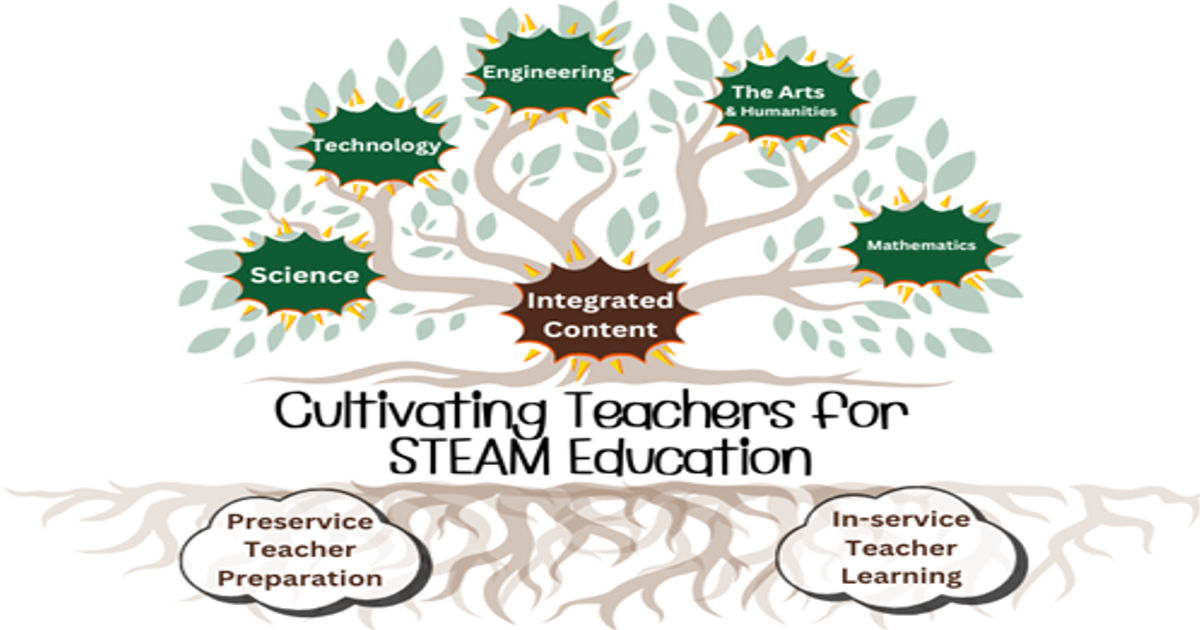
We use the term “STEAM Education” to refer to both discipline specific (e.g., science education, mathematics education, technology education, etc.) and integrated approaches to supporting teachers who teach STEAM topics. Supporting the development of teachers for teaching STEAM is  necessary and complex (Nadelson et al., 2013). STEAM education can refer to the collective siloes of science, technology, engineering, the arts, and mathematics, and also to an integrated approach to teaching. STEAM can also include computational thinking, computer science, and humanities. As approaches and programs are diverse, teachers must be supported and provided professional learning opportunities (Brand, 2020; Chai et al., 2019; Williams et al., 2019). Teacher education programs have also headed the call to prepare STEAM teachers within teacher preparation programs, certificates, foci of graduate programs including masters and doctoral work. Gaps still exist in how teachers are supported in becoming STEAM teachers, both siloed and integrated, in both teacher education (e.g., Nesmith and Cooper, 2020) and in in-service professional learning (Brand, 2020; Chai et al., 2019; Williams et al., 2019).

Thus, the purpose of this Special Issue is to highlight work in STEAM teacher education, including preservice teacher preparation and in-service teacher learning in both discipline-specific and integrated STEAM education. This Special Issue provides the opportunity to present original empirical research, conceptual pieces, evaluation of innovations in STEAM teacher learning, and research-to-practice articles. Potential paper themes include (but are not limited to) the following:

  • Coaching and mentoring of STEAM teachers – sustained support/ job embedded professional learning
  • The role of professional learning in dismantling oppressive practices in STEAM education
  • Transformative STEAM programs as a result of professional learning programs
  • Professional development projects
  • Undergraduate and/ or graduate preparation of STEAM teachers
  • STEAM certificate or endorsement programs
  • Alternative routes to STEAM teacher preparation
  • Preparation and support of special education educators in STEAM

Dr. Thomas Roberts
Dr. Stefanie Livers
Dr. Holly Plank
Guest Editors

Reference

Nadelson, L. S., Callahan, J., Pyke, P., Hay, A., Dance, M., & Pfiester, J. (2013). Teacher STEM perception and preparation: Inquiry-based STEM professional development for elementary teachers. The Journal of Educational Research, 106(2), 157-168.

Brand, B. R. (2020). Integrating science and engineering practices: outcomes from a collaborative professional development. International Journal of STEM Education, 7, 1-13.

Chai, C. S., Jong, M., Yin, H. B., Chen, M., & Zhou, W. (2019). Validating and modelling teachers’ technological pedagogical content knowledge for integrative science, technology, engineering and Mathemat-ics education. Journal of Educational Technology & Society, 22(3), 61-73.

Williams, T., Singer, J., Krikorian, J., Rakes, C., & Ross, J. (2019). Measuring pedagogy and the integration of engineering design in STEM classrooms. Journal of Science Education and Technology, 28, 179-194.

Nesmith, S. M., & Cooper, S. (2020). Elementary STEM learning. In Handbook of research on STEM education (pp. 101-114). Routledge.

Manuscript Submission Information

Manuscripts should be submitted online at www.mdpi.com by registering and logging in to this website. Once you are registered, click here to go to the submission form. Manuscripts can be submitted until the deadline. All submissions that pass pre-check are peer-reviewed. Accepted papers will be published continuously in the journal (as soon as accepted) and will be listed together on the special issue website. Research articles, review articles as well as short communications are invited. For planned papers, a title and short abstract (about 250 words) can be sent to the Editorial Office for assessment.

Submitted manuscripts should not have been published previously, nor be under consideration for publication elsewhere (except conference proceedings papers). All manuscripts are thoroughly refereed through a double-blind peer-review process. A guide for authors and other relevant information for submission of manuscripts is available on the Instructions for Authors page. Education Sciences is an international peer-reviewed open access monthly journal published by MDPI.

Please visit the Instructions for Authors page before submitting a manuscript. The Article Processing Charge (APC) for publication in this open access journal is 1800 CHF (Swiss Francs). Submitted papers should be well formatted and use good English. Authors may use MDPI's English editing service prior to publication or during author revisions.

Keywords

  • STEAM teacher education
  • STEAM professional development
  • mathematics teacher education
  • science teacher education
  • engineering education
  • technology education
  • transdisciplinary learning
  • integrated content
  • computational thinking

Benefits of Publishing in a Special Issue

  • Ease of navigation: Grouping papers by topic helps scholars navigate broad scope journals more efficiently.
  • Greater discoverability: Special Issues support the reach and impact of scientific research. Articles in Special Issues are more discoverable and cited more frequently.
  • Expansion of research network: Special Issues facilitate connections among authors, fostering scientific collaborations.
  • External promotion: Articles in Special Issues are often promoted through the journal's social media, increasing their visibility.
  • Reprint: MDPI Books provides the opportunity to republish successful Special Issues in book format, both online and in print.

Further information on MDPI's Special Issue policies can be found here.

Published Papers (8 papers)

Order results
Result details
Select all
Export citation of selected articles as:

Research

17 pages, 852 KB  
Article
Supporting Teachers’ Understanding of Integrated STEM Through the Evaluation of a Teaching–Learning Sequence
by Víctor Martínez-Martínez, Jairo Ortiz-Revilla and Ileana M. Greca
Educ. Sci. 2026, 16(3), 368; https://doi.org/10.3390/educsci16030368 - 27 Feb 2026
Viewed by 335
Abstract
The effective transfer of research-based instructional innovations into classroom practice requires assessment tools that allow teachers to critically examine the quality and applicability of STEM learning designs. This study employs the RubeSTEM rubric to analyze a STEM teaching–learning sequence on fire ecology, focusing [...] Read more.
The effective transfer of research-based instructional innovations into classroom practice requires assessment tools that allow teachers to critically examine the quality and applicability of STEM learning designs. This study employs the RubeSTEM rubric to analyze a STEM teaching–learning sequence on fire ecology, focusing on how preservice and in-service teachers evaluate disciplinary integration, structural coherence, and classroom feasibility. By involving teachers at different stages of professional experience, the study examines patterns in teachers’ evaluative judgments and explores differences according to teaching experience and specialization. The findings indicate a high level of perceived disciplinary integration, particularly in the dimensions of argumentation and authenticity, highlighting strengths in the design of the sequence. At the same time, limitations were identified in relation to engineering design and the evaluation of the learning process, pointing to areas for improvement in STEM instructional planning. Statistically significant differences in evaluations were found according to teaching experience, especially in the assessment of the theoretical dimension, with higher ratings from teachers with intermediate experience. Overall, the results illustrate how a structured evaluation rubric can be used to examine the quality of integrated STEM teaching–learning sequences from a teacher perspective, providing empirical evidence on design coherence, disciplinary integration, and classroom applicability. Full article
(This article belongs to the Special Issue Cultivating Teachers for STEAM Education)
Show Figures

Figure 1

25 pages, 811 KB  
Article
Preservice Elementary Teachers’ Perceptions of Integrated STEM After Participating in an Integrated STEAM Course
by Holly M. Plank, Stefanie D. Livers and Thomas Roberts
Educ. Sci. 2026, 16(2), 214; https://doi.org/10.3390/educsci16020214 - 1 Feb 2026
Viewed by 438
Abstract
(1) Background: Although integrated STEM education is an important policy focus, teacher preparation to implement high-quality integrated STEM and STEAM learning experiences in an equitable manner is not widespread. Teacher beliefs significantly impact how they teach; therefore, this study explores preservice teachers’ self-reported [...] Read more.
(1) Background: Although integrated STEM education is an important policy focus, teacher preparation to implement high-quality integrated STEM and STEAM learning experiences in an equitable manner is not widespread. Teacher beliefs significantly impact how they teach; therefore, this study explores preservice teachers’ self-reported perceptions of teaching integrated STEM after participating in an integrated STEAM course. (2) Methods: We employed qualitative methods to explore 47 preservice elementary teachers’ perceptions about teaching integrated STEM based on their lived experiences in an integrated STEAM course. Guided by our conceptual framework, we used deductive methods to better understand preservice elementary teachers’ perceptions. We also used open coding to understand their lived experiences in the course. Pattern coding was used in the second cycle to identify themes. (3) Findings: Three primary themes emerged, including understanding integrated STEM frameworks through a transdisciplinary and critical lens; perceiving STEAM is engaging because it is relevant; and developing self-efficacy for future STEAM integration without infrastructure. (4) Conclusions: Although preservice elementary teachers had positive experiences in the course and believe integrated STEM and STEAM to be important, more work is needed to develop their understanding of equitable integrated STEM and STEAM instruction. Full article
(This article belongs to the Special Issue Cultivating Teachers for STEAM Education)
Show Figures

Figure 1

18 pages, 267 KB  
Article
A Review of U.S. Education Policy on Integrating Science and Mathematics Teaching and Learning
by Liza Bondurant, Lacey Fitts, Jessica Ivy, Dana Pomykal Franz and Anna Wan
Educ. Sci. 2025, 15(12), 1687; https://doi.org/10.3390/educsci15121687 - 15 Dec 2025
Viewed by 1455
Abstract
Current calls to integrate science and mathematics in PK-16 education build on decades of prior initiatives, yet the United States still lacks consensus on what integration entails and consistent policies to support it. This study systematically reviews current U.S. policies to identify guidance [...] Read more.
Current calls to integrate science and mathematics in PK-16 education build on decades of prior initiatives, yet the United States still lacks consensus on what integration entails and consistent policies to support it. This study systematically reviews current U.S. policies to identify guidance on the preparation of teachers to integrate science and mathematics. Given that teacher preparation is inherently connected to PK-12 policy, we also review PK-12 policy guidance focused on dual or integrated teacher endorsements, school designations, and PK-12 science and mathematics learning standards. Drawing on an established framework that defines meaningful integration as authentic problem solving supported by the use of multiple STEM disciplines, we examine the degree to which current policies enable such practice. Our findings reveal recommendations for integrating science and mathematics, yet policies overwhelmingly reinforce a siloed approach. We argue that misalignment between teacher preparation policy and PK-12 policy creates a circular problem: teachers cannot be expected to implement integrated science and mathematics instruction without adequate preparation, yet preparation programs have little incentive to design coursework for an instructional approach not systematically supported in PK-12 settings. Clarifying and aligning these policies is therefore essential for advancing coherent, scalable integration across the PK-16 system. Full article
(This article belongs to the Special Issue Cultivating Teachers for STEAM Education)
22 pages, 1215 KB  
Article
Building Primary Teachers’ Capacity for Integrated STEM Education: A Case Study of Programmatic Features and Structures
by Dani Rimbach-Jones, Frances Kay Harper and Clara Lee Brown
Educ. Sci. 2025, 15(12), 1657; https://doi.org/10.3390/educsci15121657 - 9 Dec 2025
Viewed by 856
Abstract
A global push for teaching science, technology, engineering and mathematics (STEM) as a multidisciplinary endeavor is becoming increasingly prevalent in primary education. To understand how teachers are prepared to meet this need, we examined the programmatic design of seven teacher education programs, identified [...] Read more.
A global push for teaching science, technology, engineering and mathematics (STEM) as a multidisciplinary endeavor is becoming increasingly prevalent in primary education. To understand how teachers are prepared to meet this need, we examined the programmatic design of seven teacher education programs, identified from among seventeen Robert Noyce Teacher Scholarship projects that focused on integrated STEM teacher education at the primary level. Specifically, we asked how the programmatic features and structures of the teacher education programs presented opportunities for prospective and practicing teachers to build capacity for integrated STEM teaching. Using case study methodology and qualitative content analysis, this study explored how primary teacher education programs framed integrated STEM across and within courses. The findings suggest that current initiatives aimed at meeting critical needs in STEM education do not sufficiently foster a focus on integrated STEM components in teacher education, especially at the primary level. The findings highlight a need for more intentional development of integrated STEM programs targeting primary teachers and provide guidance for the development or redesign of programs that better meet the demand. Specifically, integrated STEM can be woven into programs through a varying number of courses, which are introduced either later or from the beginning of programs. Full article
(This article belongs to the Special Issue Cultivating Teachers for STEAM Education)
Show Figures

Figure 1

24 pages, 821 KB  
Article
Investigating the Connection Between Spatial Reasoning Skills and Reggio Emilia-Inspired Kindergarten Mathematics Activities
by Robyn K. Pinilla, Pratimaben J. Mehta and Enrique Pineda Sanchez
Educ. Sci. 2025, 15(10), 1375; https://doi.org/10.3390/educsci15101375 - 15 Oct 2025
Viewed by 1578
Abstract
Spatial reasoning (SR) skills are inherent to our daily interactions with the world and essential to young children’s learning in science, technology, engineering, arts, and mathematics (STEAM) domains. Most simply, SR skills allow humans to mentally represent and transform objects and their relations. [...] Read more.
Spatial reasoning (SR) skills are inherent to our daily interactions with the world and essential to young children’s learning in science, technology, engineering, arts, and mathematics (STEAM) domains. Most simply, SR skills allow humans to mentally represent and transform objects and their relations. While the connection between SR skills and mathematics achievement is strong, the skills are infrequently emphasized in curriculum or instruction in the early grades of traditional elementary schools. The Regio-Emilia Inspired Approach (RE-IA) offers a schooling model that promotes teachers, or guides, to engage children in authentic learning opportunities and co-construct an emergent curriculum suited to their learning goals, which offers opportunities to learn and practice SR skills through interactive engagements. In this study, we sought to understand and identify specific ways of designing and implementing mathematics activities that support children in receiving opportunities to learn SR skills, whether they are explicit within learning objectives or implicit in learning actions students take. We examined lessons that offer opportunities to integrate SR within a kindergarten mathematics project targeting data analysis concepts. Findings revealed RE-IA as one pedagogical approach to including SR in early childhood education, which could help educators provide engaging environments and joyful mathematics learning experiences for young children. Implications for practice and directions for future research aimed more broadly at transdisciplinary STEAM and in other school models are discussed. Full article
(This article belongs to the Special Issue Cultivating Teachers for STEAM Education)
Show Figures

Figure 1

20 pages, 1474 KB  
Article
“We Believe in STEAM Education, but We Need Support”: In-Service Teachers’ Voices on the Realities of STEAM Implementation
by Natalia Spyropoulou, Konstantinos Mathiopoulos and Achilles Kameas
Educ. Sci. 2025, 15(10), 1300; https://doi.org/10.3390/educsci15101300 - 1 Oct 2025
Cited by 2 | Viewed by 3191
Abstract
The integration of STEAM education is widely recognized as a pathway to foster creativity, problem-solving, and collaboration, yet its implementation remains fragmented due to systemic and organizational barriers. This study examines educators’ perspectives on STEAM by focusing on three key questions: their attitudes [...] Read more.
The integration of STEAM education is widely recognized as a pathway to foster creativity, problem-solving, and collaboration, yet its implementation remains fragmented due to systemic and organizational barriers. This study examines educators’ perspectives on STEAM by focusing on three key questions: their attitudes toward STEAM, the challenges and needs they report, and how these vary by professional development experience, disciplinary background, and teaching experience. Drawing on a large-scale survey of in-service educators, the analysis shows that teachers hold strongly positive attitudes across dimensions of application, higher-order thinking, motivation, and collaboration. However, these attitudes are accompanied by substantial needs, particularly in curriculum guidance, instructional time, resource availability, and assessment frameworks. Professional development was found to strengthen educators’ enthusiasm but did not reduce broader systemic challenges, while disciplinary background and years of experience shaped specific needs and perceptions. The findings highlight that teacher motivation is a necessary but insufficient condition for meaningful STEAM implementation. Addressing the gap between vision and practice requires a multi-level approach that integrates competence-based professional development with structural reforms in curriculum, leadership, and institutional culture. Full article
(This article belongs to the Special Issue Cultivating Teachers for STEAM Education)
Show Figures

Figure 1

18 pages, 1251 KB  
Article
From Classroom to Community: Evaluating Data Science Practices in Education and Social Justice Projects
by Marc T. Sager, Jeanna R. Wieselmann and Anthony J. Petrosino
Educ. Sci. 2025, 15(7), 878; https://doi.org/10.3390/educsci15070878 - 9 Jul 2025
Cited by 4 | Viewed by 1864
Abstract
Critical data literacy (CDL) has emerged as a crucial component in data science education, transcending traditional disciplinary boundaries. Promoting CDL requires collaborative approaches to enhance learners’ skills in data science, going beyond mere quantitative reasoning to encompass a comprehensive understanding of data workflows [...] Read more.
Critical data literacy (CDL) has emerged as a crucial component in data science education, transcending traditional disciplinary boundaries. Promoting CDL requires collaborative approaches to enhance learners’ skills in data science, going beyond mere quantitative reasoning to encompass a comprehensive understanding of data workflows and tools. Despite the growing literature on CDL, there is still a need to explore how students use data science practices for supporting the learning of CDL throughout a summer-long data science program. Drawing on situative perspectives of learning, we utilize a descriptive case study to address our research question: How do data science practices taught in a classroom setting differ from those enacted in real-world social justice projects? Key findings reveal that while the course focused on abstract principles and basic technical skills, the Food Justice Project provided students with a more applied understanding of data tools, ethics, and exploration. Through the project, students demonstrated a deeper engagement with CDL, addressing real-world issues through detailed data analysis and ethical considerations. This manuscript adds to the literature within data science education and has the potential to bridge the gap between theoretical knowledge and practical application, preparing students to address real-world data science challenges through their coursework. Full article
(This article belongs to the Special Issue Cultivating Teachers for STEAM Education)
Show Figures

Figure 1

23 pages, 494 KB  
Article
Exploring Croatian In-Service Primary Teachers’ Professional Attitudes Toward Science Using the Dimensions of Attitude Toward Science (DAS)
by Nataša Erceg and Tatjana Ivošević
Educ. Sci. 2025, 15(6), 692; https://doi.org/10.3390/educsci15060692 - 3 Jun 2025
Cited by 1 | Viewed by 1303
Abstract
Teachers holding positive professional attitudes towards science is a key prerequisite for high-quality teaching and consequently for the sustainability of ongoing science education reform, which is being implemented in Croatia for the first time. Therefore, this cross-sectional study examined the attitudes, views, and [...] Read more.
Teachers holding positive professional attitudes towards science is a key prerequisite for high-quality teaching and consequently for the sustainability of ongoing science education reform, which is being implemented in Croatia for the first time. Therefore, this cross-sectional study examined the attitudes, views, and self-reported behaviour of primary school teachers in the context of science teaching. The sample included 950 teachers during the 2024/2025 school year. Data were collected using the DAS questionnaire and analyzed using descriptive and inferential statistical methods. Most teachers expressed positive professional attitudes toward science teaching and held, broadly defined, a contemporary view of science. However, the frequency of implementing science-specific teaching activities remained relatively low. Correlational analyses revealed a moderate positive association between attitudes and behaviour (r = 0.396, p < 0.001), and a weak but statistically significant association between attitudes and views of science (ρ = 0.081, p = 0.012). The results indicate the need for systematic support in teacher education and professional development, particularly in strengthening teachers’ competencies required for conducting science-related activities. This study contributes to a deeper understanding of teachers’ professional orientations within the context of Croatia’s current educational reform and provides a foundation for aligning national practice with European evidence-based educational policies. Full article
(This article belongs to the Special Issue Cultivating Teachers for STEAM Education)
Show Figures

Figure 1

Back to TopTop