Skip Content
You are currently on the new version of our website. Access the old version .

Fire

Fire is an international, peer-reviewed, open access journal about the science, policy, and technology of fires and how they interact with communities and the environment, published monthly online by MDPI. 

Quartile Ranking JCR - Q1 (Forestry)

All Articles (2,017)

Wildfire suppression is often represented in fire spread simulators as static barriers that completely stop fire propagation and are placed at the start of the simulation. Recent works have begun to simulate barriers introduced at different time frames, but these normally act as static barriers. In reality, many water-based suppression tactics (aerial and ground) only slow the fire spread by temporarily increasing fuel moisture and cooling the fuel bed. To address this limitation, we present a new simulation feature: the Dynamic Water Barrier. Unlike static barriers, this representation captures the temporal transient effect of water application, since it is modeled using a simplified water load and evaporation dynamics to estimate changes in live fuel moisture content (LFMC). Implemented using the Fire Area Simulator (FARSITE), the Dynamic Water Barrier reduces the rate of spread and fireline intensity, delaying but not fully preventing fire propagation, providing a transient influence of water-based suppression. The approach was tested on one North American (NA) and one Portuguese fire, where suppression missions were available. The dynamic barriers led to reductions in Relative Area Difference, reaching 0.234 for the Portuguese fire and 0.006 for the NA fire, outperforming the scenario of no combat and having a comparable performance with the full static barrier (RAD 0.108 and 0.024, respectively), while limiting the creation of unburned areas behind the firefront. Although the validation is limited, these findings illustrate the potential to improve tactical decision support and dynamic suppression planning in wildfire management, requiring further studies of other fires and controlled fire suppression missions.

6 February 2026
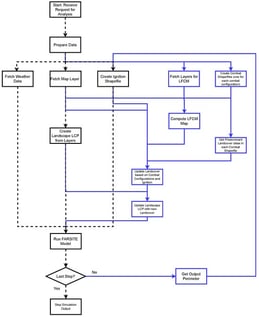
Algorithm flowchart. Black: base workflow. Blue: extra steps taken to include Dynamic Water Barriers.

In a context of increasing wildfire risk and highly fragmented forest ownership, this work investigates two relatively recent monetary policy instruments in Catalonia that require grouped applications: a subsidy for fuel reduction, which prioritises collective applications in wildfire-strategic areas, and a climate credit system that promotes territorially coordinated, multifunctional forest management that, i.a., decreases wildfire risk through fuel management. Through in-depth interviews with beneficiaries and consultations with key informants, we analysed whether these measures have triggered adjacent forest management, and how they have interacted with joint action rules to facilitate concerted interventions. The qualitative content analysis indicates that these measures represent a significant step towards landscape-level management and that pre-existing forest owners’ associations play a crucial role in capturing the available funds. The eligibility of coordination costs is also appreciated for covering the transaction costs of catalysing landowners. Yet, areas with weaker social capital may become disadvantaged if there is no external support for their organisation. These findings contribute to the emerging field of policy tools for effective landscape-level interventions.

6 February 2026

Conceptual framework for joint action, with its elements (boxes), their related working rules in [], the identified joint forest management challenges (normal), and key related variables (italics). Adapted from [21].
  • Technical Note
  • Open Access

Wildland firefighting involves prolonged, high-intensity physical work performed under hot, variable, and operationally demanding conditions, placing firefighters at substantial risk of heat-related illness. This paper synthesizes current evidence on the mechanisms, contributing factors, and management of heat stress in wildland firefighting, with a specific focus on physiologically and operationally relevant considerations aligned with NIOSH, NFPA, and USFS guidelines. Heat stress is conceptualized as a cumulative process resulting from the interaction of metabolic heat production, environmental heat load, protective clothing, and individual susceptibility. Key environmental contributors include high ambient temperatures, humidity, and solar and fire-related radiant heat, while occupational demands such as sustained heavy work, extended shift durations, limited recovery, and the thermal burden of personal protective equipment further exacerbate risk. Individual factors—including fitness, hydration status, acclimatization, fatigue, and underlying health conditions—modify heat tolerance and vulnerability. This review highlights evidence-based exposure management strategies tailored to wildland fire operations, including work–rest cycles, heat acclimatization protocols, and practical cooling interventions, and addresses the operational constraints that shape their implementation. This paper further emphasizes the role of standardized training programs in prevention, early symptom recognition, and rapid response. Together, these integrated approaches provide a focused framework for reducing heat-related morbidity and enhancing wildland firefighter safety.

2 February 2026

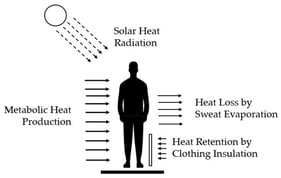
Firefighter heat exchange during exposure to increased metabolic heat and solar IR radiation. Body heat dissipation occurs primarily through sweat evaporation since protective clothing limits air flow over the skin and, therefore, limits heat loss through convection.

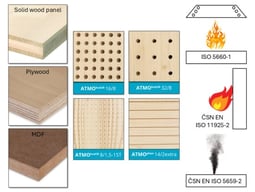
This work deals with the impact of surface acoustic treatment (holes and grooves) and primary material (plywood, MDF, solid wood panel) of acoustic panels on their fire characteristics. Fire characteristics were determined based on the cone calorimeter method, single-flame source test, and smoke generation assessment. In general, birch plywood demonstrated the highest values for heat release rate (HRR), maximum average rate of heat emission (MARHE), and effective heat of combustion (EHC), indicating its higher flammability compared to the other tested materials. MDF generally exhibited the lowest values for heat release rate (HRR) and maximum average rate of heat emission (MARHE); yet, under certain perforated configurations, it generated the highest amount of smoke. Solid wood panels exhibited the lowest heat release rate (HRR) but developed the largest charred areas during the single-flame source test. Among the surface treatments, the 16/8 mm treatment resulted in the highest values of effective heat of combustion (EHC) and maximum average rate of heat emission (MARHE), while the 8/1.5–15T treatment exhibited the most rapid increase in heat release rate (HRR), attributed to the swift degradation of its thin surface layer and high void fraction. The presence of holes and grooves increased smoke production, which was most evident in MDF and plywood panels. The results demonstrate that acoustic surface geometry significantly modifies the fire behavior of wood-based panels and should be considered alongside material selection when evaluating fire safety in interior applications.

2 February 2026

Reference primary material panels without acoustic surface treatment. (a) Spruce solid wood panel, (b) birch plywood, (c) MDF veneered with an ash veneer.

News & Conferences

Issues

Open for Submission

Editor's Choice

Reprints of Collections

Simulation, Experiment and Modeling of Coal Fires
Reprint

Simulation, Experiment and Modeling of Coal Fires

Editors: Wei Liu, Zeyang Song, Caiping Wang, Bobo Shi

Get Alerted

Add your email address to receive forthcoming issues of this journal.

XFacebookLinkedIn
Fire - ISSN 2571-6255