Skip Content
You are currently on the new version of our website. Access the old version .

Neurology International

Neurology International is an international, peer-reviewed, open access journal which provides an advanced forum for studies related to all aspects of neurology and neuroscience, published monthly online by MDPI (since Volume 12, Issue 3 - 2020).
The Panhellenic Federation of Alzheimer's Disease and Related Disorders (PFADRD) is affiliated with Neurology International and its members receive discounts on the article processing charges.
Indexed in PubMed | Quartile Ranking JCR - Q2 (Clinical Neurology)

All Articles (871)

  • Case Report
  • Open Access

Background: Central cord syndrome (CCS) is the most common incomplete spinal cord injury, producing more severe motor deficits in the upper than lower extremities and impairing sensory and autonomic function. Although transcutaneous spinal cord stimulation (tSCS) has shown benefits in motor and sensory recovery after spinal cord injury, studies have not explicitly documented whether CCS subjects were included. The aim of this study was to assess the effects of tSCS over 12 weeks on motor and sensory outcomes in a subject with CCS. Methods: A 20-year-old male with a C7 injury was evaluated at baseline and after 12 weeks with the American Spinal Cord Injury Impairment scale, Modified Ashworth Scale, Penn and Spasm Frequency Scale, 3-Meter Walk Test and 6-Minute Walk Test, 9-Hole Peg Test, Box and Block Test, hand dynamometry, and lower-limb EMG. tSCS was applied between T9 and L1 at 30 Hz. Results: At 12 weeks, upper-limb motor and sensory scores improved, while spasm frequency and hand spasticity were reduced. Manual dexterity improved bilaterally in the 9-Hole Peg and Box and Block Tests, with a 2 kg gain in right-hand grip strength. In the 6-Minute Walk Test, the distance covered increased from 224.4 m to 295.2 m, and a 1.36 s reduction in 3-Meter walking time was achieved. Conclusions: tSCS improved motor and sensory function and reduced spasticity and spasms. These findings suggest that tSCS may serve as an effective complementary intervention for motor and sensory rehabilitation in individuals with mild cervical injuries, including CCS.

10 February 2026
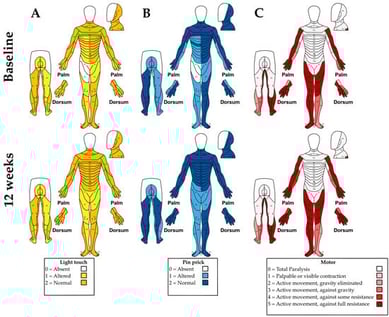
AIS evaluation at baseline (upper panels) and 12 weeks (lower panels). Sensory scores: (A) light touch and (B) pinprick; (C) motor scores.

Background/Objectives: Postoperative intracerebral hematomas (POHs) are a common complication following brain tumor surgery and are typically associated with unfavorable outcomes. While extensive hemorrhages have been studied extensively, smaller, Non-Space-Occupying hemorrhages are frequently detected, yet their clinical relevance and associated risk factors remain insufficiently understood. This study aimed to identify predictive factors for the occurrence of Non-Space-Occupying postoperative cerebral hemorrhages in patients undergoing brain tumor resection. Methods: A total of 1481 patients without a history of anticoagulant or antiplatelet therapy underwent brain tumor surgery at our neurosurgical institute over a ten-year period. Non-Space-Occupying postoperative hemorrhages were diagnosed in 84 patients using cranial computed tomography (cCT) or magnetic resonance imaging (cMRI) performed after the tumor resection. Demographic data, pre-existing comorbidities, and tumor characteristics were collected and analyzed. Results: Non-Space-Occupying POHs occurred in 5.6% of patients. The most frequent tumor type associated with POHs was glioblastoma multiforme (N = 33; 39.3%), followed by metastatic lesions (N = 9; 10.7%) and benign primary intracranial neoplasms (N = 31; 38%). None of the affected patients exhibited new neurological deficits or signs of increased intracranial pressure. A multivariate analysis identified the tumor size as an independent risk factor for Non-Space-Occupying POHs (p = 0.002), with patient age emerging as the strongest predictor (p = 0.001). Conclusions: Non-Space-Occupying POHs after a brain tumor resection are significantly associated with the tumor size, an advanced patient age, and the presence of pre-existing liver disease. The recognition of these risk factors may facilitate targeted perioperative monitoring and guide postoperative management strategies.

9 February 2026

Background/Objectives: Protein Z (PZ) and the protein Z-dependent protease inhibitor (ZPI) are vitamin K-dependent regulators of coagulation that inhibit activated factor Xa. Their relevance in ischemic stroke (IS) remains insufficiently characterized, with inconsistent evidence regarding their association with stroke severity and outcomes. This study aimed to evaluate the concentrations and dynamics of PZ and ZPI in the acute phase of IS in patients treated with intravenous thrombolysis or conservative therapy and to assess their potential prognostic significance. Methods: Eighty-four patients with acute IS were enrolled and divided into two groups: group I treated with intravenous thrombolysis (rt-PA) and group II managed conservatively. PZ and ZPI concentrations were measured using ELISA on admission (day 1) and on day 7. Associations with factor X activity, the modified Rankin Scale (mRS), and the National Institutes of Health Stroke Scale (NIHSS) were analyzed using nonparametric tests and Spearman correlations (p < 0.05). Results: PZ concentrations were significantly higher in thrombolysis-treated patients than in conservatively managed patients both on day 1 (median: 2810.05 vs. 2178.50 ng/mL; p = 0.024) and day 7 (2982.90 vs. 2286.50 ng/mL; p = 0.026). A slight negative correlation between PZ and mRS on day 7 was observed in the conservative group (r = −0.360; p = 0.043). In thrombolysis-treated patients with dyslipidemia, PZ increased from day 1 to day 7, whereas it decreased in those without dyslipidemia. No significant correlations were found between PZ, ZPI, or factor X and NIHSS or ASTRAL scores. Conclusions: Higher PZ concentrations in the acute phase of IS—particularly in rt-PA-treated patients—may reflect differences related to the timing of the acute ischemic process and reperfusion status, suggesting potential utility as markers of stroke severity or outcome.

6 February 2026

  • Systematic Review
  • Open Access

Effectiveness of Pulsed Electromagnetic Field Therapy on Neuropathic Pain: A Systematic Review and Meta-Analysis

  • Jesus Antonio Lara-Reyes,
  • Cristofer Zarate-Calderon and
  • Fausto Rojas-Durán
  • + 2 authors

Background: Neuropathic pain represents a substantial global burden with limited effective therapeutic options. Pulsed Electromagnetic Field (PEMF) therapy has emerged as a potential non-invasive adjuvant, though clinical evidence remains inconsistent. This systematic review and meta-analysis evaluated PEMF efficacy and safety, specifically analyzing the influence of etiology and stimulation parameters. Methods: Following PRISMA 2020 guidelines (PROSPERO: CRD420251184151), five databases (Cochrane, PubMed, Scopus, Web of Science, and LILACS) were searched for Randomized Controlled Trials (RCTs) comparing PEMF versus sham. Risk of bias was assessed via Cochrane RoB 2, and heterogeneity was explored through detailed subgroup analyses. Results: Thirteen RCTs met the inclusion criteria (N = 688). While global analysis indicated a statistically significant pain reduction (SMD: −1.01; p = 0.03), it exhibited extreme statistical heterogeneity (I2 = 92.8%) and instability. After adjusting for missing studies using the Trim-and-Fill method, global significance disappeared. However, subgroup analysis resolved this inconsistency, revealing a massive, clinically meaningful effect in Spinal/Radicular pain (SMD: −2.35; 95% CI: −4.42 to −0.29), whereas Peripheral Neuropathy showed no significant reduction (SMD: −0.38; 95% CI: −0.86 to 0.10). Conclusions: The PEMF evidence base for neuropathic pain is currently highly fragmented. Extreme heterogeneity and publication bias render “one-size-fits-all” efficacy estimates invalid and potentially misleading. Instead, our data reveals a critical etiological divergence: PEMF appears highly effective for spinal/radicular pathology, likely due to the mechanical nature of the lesion, but demonstrates limited efficacy for diffuse peripheral neuropathy. Future research must abandon generic protocols in favor of etiology-specific trials, prioritizing high-frequency parameters and rigorous bias control.

6 February 2026

News & Conferences

Issues

Open for Submission

Editor's Choice

Get Alerted

Add your email address to receive forthcoming issues of this journal.

XFacebookLinkedIn
Neurol. Int. - ISSN 2035-8377