
Skip to Content
You are currently on the new version of our website. Access the old version .
  • 6.9
    Impact Factor
  • 12.5
    CiteScore
  • 17 days
    Submission to First Decision
  • 4 days
    Acceptance to Publication

Pharmaceutics

Pharmaceutics is a peer-reviewed, open access journal on the science and technology of pharmaceutics and biopharmaceutics, published monthly online by MDPI. The Spanish Society of Pharmaceutics and Pharmaceutical Technology (SEFIG), Pharmaceutical Solid State Research Cluster (PSSRC), Academy of Pharmaceutical Sciences (APS) and Korean Society of Pharmaceutical Sciences and Technology (KSPST) are affiliated with Pharmaceutics and their members receive a discount on the article processing charges.

Get Alerted

Add your email address to receive forthcoming issues of this journal.

All Articles (15,121)

  • Article
  • Open Access

Background/Objectives: Janus kinase inhibitors (JAKis) are effective treatments for moderate-to-severe atopic dermatitis (AD), although longitudinal real-world data on their laboratory safety profile remain limited and there is scarce information regarding whether laboratory changes differ according to JAKi use. So, the main objective of this study was to evaluate longitudinal laboratory changes in patients with AD treated with JAKis in routine clinical practice and to evaluate these changes across different types of JAKis. Methods: We conducted a retrospective observational study including patients with moderate-to-severe AD who initiated treatment with abrocitinib, upadacitinib, or baricitinib. Demographic, clinical, laboratory, and patient-reported outcome data were collected at baseline and after 4, 12–16, 24–32, and 48–52 weeks. Longitudinal changes were analyzed using REML mixed-effects models with categorical visit and a patient-specific random intercept, using logarithmic transformations for skewed laboratory parameters. Results: Forty-three patients were included. EASI decreased from 21.18 ± 8.82 at baseline to 6.06 ± 8.27 at week 4 and 7.85 ± 8.63 at weeks 48–52, while pruritus NRS decreased from 7.15 ± 2.48 to 2.23 ± 2.78 and 4.34 ± 3.28, respectively (p < 0.001). At weeks 24–32, total cholesterol (+29.26), LDL cholesterol (+16.09), HDL cholesterol (+6.57), and MCV (+2.12) increased significantly, whereas CRP (−2.87), leukocyte (−1.07), and neutrophil counts (−1.07) decreased significantly. Mean creatinine changes were small. No significant longitudinal changes were observed in AST, ALT, triglycerides or hemoglobin. Few between-treatment differences were identified. No MACE, VTE or changes in lipid-lowering treatment were documented during recorded follow-up. Conclusions: JAKis provided substantial clinical benefit with a favorable longitudinal laboratory safety profile. Laboratory abnormalities were generally mild and consistent with the known safety profile of this class.

Pharmaceutics

13 November 2026

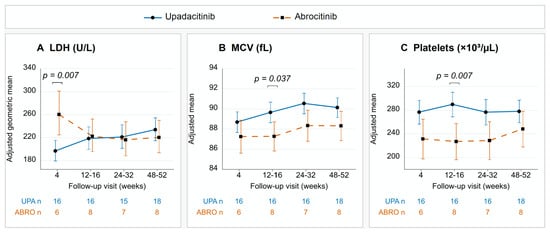
Exploratory comparison of baseline-adjusted laboratory values between upadacitinib and abrocitinib. (A) Lactate dehydrogenase (LDH), (B) mean corpuscular volume (MCV), and (C) platelet counts.
  • Review
  • Open Access

Highways to the Brain: Nanoformulations for the Treatment of Central Nervous System Pathologies

  • Eugenia Romano,
  • Chantalle Moulton and
  • Ennio Tasciotti
  • + 5 authors

Central nervous system (CNS) disorders remain difficult to treat because many pharmacologically active molecules do not achieve adequate exposure in the brain. The blood–brain barrier (BBB), blood-cerebrospinal fluid (CSF) barrier, efflux transporters, extracellular matrix, and local clearance mechanisms impose different constraints according to the target compartment and administration route. Nanocarriers can protect unstable payloads, alter pharmacokinetics, and support receptor-mediated or local delivery, but the same properties that promote transport can also increase immune recognition, tissue retention, and neurotoxicity. This review critically examines how nanoparticles (NPs) size, surface charge, composition, degradability, ligand density, and release kinetics should be matched to intravenous, intranasal, intrathecal, intracranial, and oral administration. Rather than treating these routes as interchangeable, we compare the barriers encountered by each route, the payloads for which it is best suited, and the experimental conditions that limit interpretation of reported brain uptake. Particular attention is given to the weak correspondence between many rodent efficacy studies and human delivery constraints, including protein-corona formation after systemic dosing, species differences in BBB and nasal anatomy, limited parenchymal penetration from cerebrospinal fluid, and the procedural risks of direct administration. The resulting route-specific framework is intended to support application-driven formulation design and more informative preclinical evaluation of CNS nanomedicines.

Pharmaceutics

13 November 2026

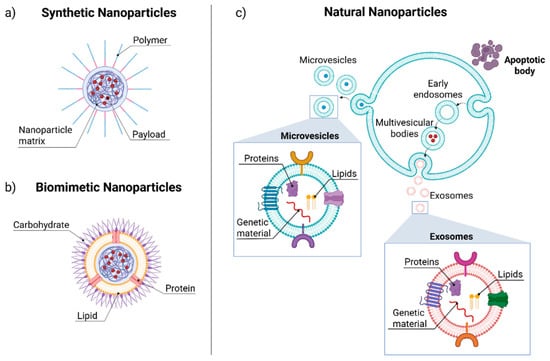
Schematic representation of major NP classes for CNS drug delivery. (a) Synthetic NPs are composed of polymeric, lipid-based or inorganic matrices designed to encapsulate and release therapeutic payloads in a controlled manner. (b) Biomimetic NPs integrate biological components such as lipids, proteins or carbohydrates to replicate natural membrane properties, enhancing targeting and immune evasion. (c) Natural NPs (EVs) include exosomes and microvesicles derived from endosomal or plasma membrane pathways. EVs carry proteins, lipids and genetic material, and exhibit intrinsic biocompatibility and BBB-crossing capability. Image created in BioRender. Cremonesi, G. (2026) https://BioRender.com/7hha3ph accessed on 1 November 2026.
  • Article
  • Open Access

Background/Objectives: As a fungus-sourced sterol endoperoxide, ergosterol peroxide possesses extensive antitumor properties. However, unfavorable aqueous solubility, rapid in vivo clearance, and poor accumulation within tumor sites constitute major obstacles restricting its progression toward clinical application. Methods: Herein, we constructed a novel phospholipid nanoformulation by supramolecular self-assembly of ergosterol peroxide with soybean phosphatidylcholine via a thin-film dispersion method. Results: The optimized ergosterol peroxide–soybean phosphatidylcholine nanoformulation exhibited a uniform spherical morphology (~98 nm), excellent colloidal stability in serum-containing medium, and pH-responsive drug release behavior. In vitro, the ergosterol peroxide–soybean phosphatidylcholine nanoformulation demonstrated significantly enhanced cellular uptake in HeLa cervical cancer cells compared with free ergosterol peroxide, achieving markedly superior antiproliferative and pro-apoptotic efficacy through amplified reactive oxygen species generation. Furthermore, the ergosterol peroxide–soybean phosphatidylcholine nanoformulation effectively induced immunogenic-cell-death-associated damage-associated molecular patterns. In TC-1 tumor-bearing mice, intravenous administration of the ergosterol peroxide–soybean phosphatidylcholine nanoformulation exhibited potent dose-dependent antitumor efficacy, with biodistribution analysis confirming enhanced intratumoral ergosterol peroxide accumulation via the enhanced permeability and retention effect. Of particular note, ergosterol peroxide–soybean phosphatidylcholine nanoformulation treatment led to a substantial increase in the abundance of splenic B cells, NK cells, CD4+ helper T-cells and CD8+ cytotoxic T-cells; hematology testing together with histopathological examination further demonstrated only marginal systemic toxicity after treatment. Conclusions: Collectively, this soybean phosphatidylcholine-based nanoplatform provides a feasible and promising pharmaceutical strategy for overcoming the inherent delivery limitations of ergosterol peroxide, offering a potential candidate for cervical cancer treatment.

Pharmaceutics

12 November 2026

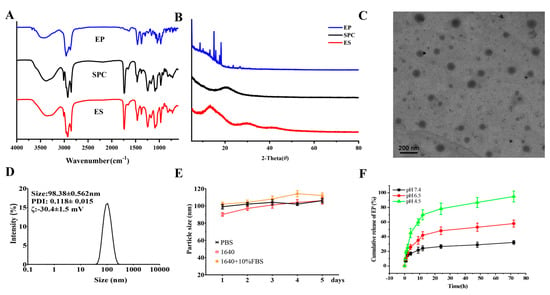
Characterization of the ES NFs. (A) FTIR spectra of EP, SPC and ES NFs. (B) XRD spectra of EP, SPC and ES NFs. (C) Representative micrographs of ES NFs captured by TEM. Scale bar = 200 nm. (D) Hydrodynamic size-distribution profile of ES NFs acquired via dynamic light scattering (DLS). (E) Particle-size stability of ES NFs following incubation in various solvents for 5 days. (F) In vitro EP release profiles from ES NFs under pH conditions of 4.5, 6.5 and 7.4. All data are presented as mean ± SD. TEM: transmission electron microscope; XRD: X-ray diffraction; FTIR: Fourier transform infrared; SPC: soybean phosphatidylcholine; EP: ergosterol peroxide; ES: EP-SPC nanoformulation.
  • Article
  • Open Access

Background/Objectives: This study aimed to develop a novel polymeric micelle formulation using poloxamer 184 with ethanol and various terpenes to improve the skin penetration of resveratrol. Methods: The terpenes used in this study were monoterpenes, namely, d-limonene, citral, and cineole. Polymeric micelles were prepared by direct dissolution method. The prepared polymeric micelles were composed of 1% terpenes, 25% poloxamer 184, 5% ethanol, and 69% water. Resveratrol was successfully loaded into the polymeric micelles at a concentration of 0.24 mg/mL. The obtained polymeric micelles were characterized for their size, surface charge, and size distribution. The skin penetration pathway of the micelles was investigated using dual fluorescently labeled particles and observed via confocal laser scanning microscopy. Results: The average particle size of the prepared polymeric micelles ranged from 29.02 ± 2.28 to 57.16 ± 8.32 nm, exhibiting a neutral surface charge and an acceptable size distribution. The in vitro skin penetration study revealed that polymeric micelles with ethanol and d-limonene significantly increased the skin penetration of resveratrol compared with the resveratrol ethanolic solution as control. These polymeric micelles penetrated the skin primarily via the intercellular and transcellular pathways, whereas the transfollicular pathway served as a minor route. The particles also penetrated the skin through the intercluster pathway. Conclusions: The polymeric micelles with d-limonene effectively enhanced dermal delivery of resveratrol by facilitating its penetration through the skin via intercellular and transcellular pathway as major penetration pathway.

Pharmaceutics

12 November 2026

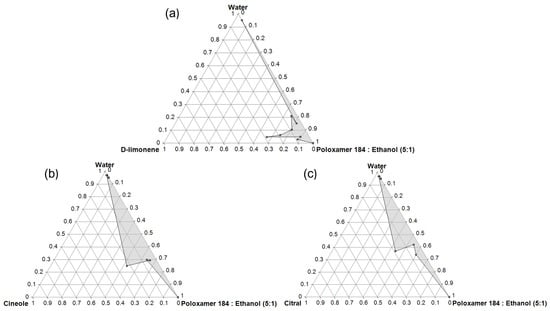
Pseudoternary phase diagram of poloxamer 184 as a surfactant, ethanol as co-surfactant, and water as an aqueous phase with different terpenes as the oil phase (a) d-limonene, (b) cineole, and (c) citral. The ratio of poloxamer 184 to ethanol was 5:1 w/w. The gray area represents the transparent mixtures.

Featured Articles of Last Quarter

Highly Accessed Articles

News & Conferences

Latest Issues

Open for Submission

Journal Sections

XFacebookLinkedIn
Pharmaceutics - ISSN 1999-4923