



Mechanisms Behind Black Holes and Relativistic Jets

A special issue of Universe (ISSN 2218-1997). This special issue belongs to the section "Compact Objects".

Deadline for manuscript submissions: 19 June 2026 | Viewed by 2325
Special Issue Editor


E-Mail Website
Guest Editor
Institute of Space Science—INFLPR Subsidiary, 077125 Magurele, Romania
Interests: black holes; relativistic jets; plasma instabilities; gravitational waves; cosmic rays
Special Issues, Collections and Topics in MDPI journals

Special Issue Information

Dear Colleagues,

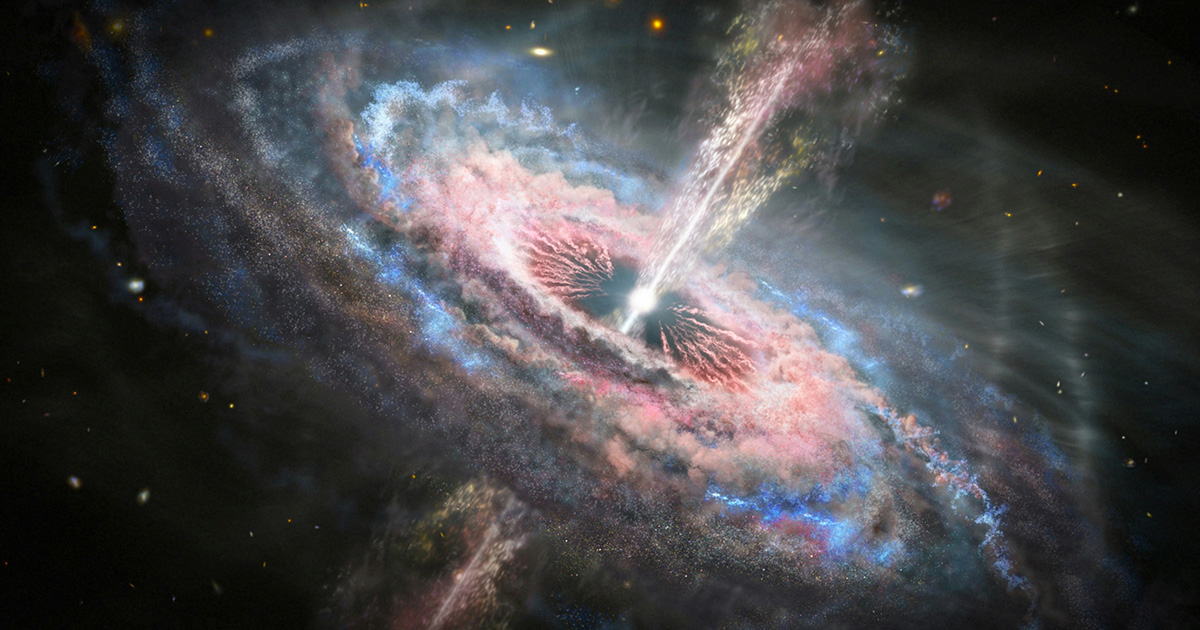
Black holes are perhaps the most fascinating objects in the Universe. They can power thin beams of plasma, called jets, that extend into space, propagating with velocities close to the speed of light. Such relativistic jets are associated with supermassive black holes at the center of active galaxies, gamma-ray bursts, and some X-ray binaries. They can also be the result of compact object (black hole/neutron star) mergers with prompt black hole formation.

To discover what the mechanisms at work are around such black holes—from the accretion processes to the formation of jets—and how relativistic jets propagate through intergalactic or interstellar medium, how they are collimated, and how the observed radiation is produced, theoretical models and numerical simulations have been developed. The results obtained can thus be compared with observational data.

For this Special Issue, we welcome scientific contributions on mechanisms that are relevant for improving our understanding of black holes and relativistic jets.

Dr. Ioana Dutan
Guest Editor

Manuscript Submission Information

Manuscripts should be submitted online at www.mdpi.com by registering and logging in to this website. Once you are registered, click here to go to the submission form. Manuscripts can be submitted until the deadline. All submissions that pass pre-check are peer-reviewed. Accepted papers will be published continuously in the journal (as soon as accepted) and will be listed together on the special issue website. Research articles, review articles as well as short communications are invited. For planned papers, a title and short abstract (about 250 words) can be sent to the Editorial Office for assessment.

Submitted manuscripts should not have been published previously, nor be under consideration for publication elsewhere (except conference proceedings papers). All manuscripts are thoroughly refereed through a single-blind peer-review process. A guide for authors and other relevant information for submission of manuscripts is available on the Instructions for Authors page. Universe is an international peer-reviewed open access monthly journal published by MDPI.

Please visit the Instructions for Authors page before submitting a manuscript. Submitted papers should be well formatted and use good English. Authors may use MDPI's English editing service prior to publication or during author revisions.

Keywords

  • black holes
  • relativistic jets
  • active galactic nuclei
  • gamma-ray bursts
  • numerical simulations

Benefits of Publishing in a Special Issue

  • Ease of navigation: Grouping papers by topic helps scholars navigate broad scope journals more efficiently.
  • Greater discoverability: Special Issues support the reach and impact of scientific research. Articles in Special Issues are more discoverable and cited more frequently.
  • Expansion of research network: Special Issues facilitate connections among authors, fostering scientific collaborations.
  • External promotion: Articles in Special Issues are often promoted through the journal's social media, increasing their visibility.
  • Reprint: MDPI Books provides the opportunity to republish successful Special Issues in book format, both online and in print.

Further information on MDPI's Special Issue policies can be found here.

Published Papers (2 papers)

Order results
Result details
Select all
Export citation of selected articles as:

Research

Jump to: Review

21 pages, 19705 KB  
Article
Magnetohydrodynamic Simulations of Transonic Accretion Flows
by Raj Kishor Joshi, Antonios Tsokaros, Sanjit Debnath, Indranil Chattopadhyay and Ramiz Aktar
Universe 2026, 12(3), 77; https://doi.org/10.3390/universe12030077 - 10 Mar 2026
Viewed by 563
Abstract
Theoretical studies of transonic accretion onto black holes reveal a wide range of possible solutions, broadly classified into smooth flows and flows featuring shocks. Accretion solutions that involve the formation of shocks are particularly intriguing, as they are expected to naturally produce observable [...] Read more.
Theoretical studies of transonic accretion onto black holes reveal a wide range of possible solutions, broadly classified into smooth flows and flows featuring shocks. Accretion solutions that involve the formation of shocks are particularly intriguing, as they are expected to naturally produce observable variability features. However, despite their theoretical significance, time-dependent studies exploring the stability and evolution of such shocked solutions remain relatively scarce. To address this gap, we perform simulations of transonic accretion flows around a black hole in an ideal magnetohydrodynamic framework. Our simulations are initialized using boundary conditions derived from semi-analytical hydrodynamical models, allowing us to explore the stability of these flows under varying magnetic field strengths. Our results indicate that mildly magnetized flows in a uniform vertical magnetic field alter the accretion dynamics through magnetic pressure, with the resulting force imbalance driving oscillations in the shock front. Variations in the emitted luminosity arising from shock oscillations appear as quasi-periodic oscillations (QPOs), a characteristic feature commonly observed in accreting black holes. We find that the QPO frequency is determined by the radial position of the shock front: oscillations occurring closer to the black hole produce frequencies of tens of hertz, whereas shocks located farther out yield sub-hertz frequencies. Full article
(This article belongs to the Special Issue Mechanisms Behind Black Holes and Relativistic Jets)
Show Figures

Figure 1

Review

Jump to: Research

45 pages, 5693 KB  
Review
Future Perspectives on Black Hole Jet Mechanisms: Insights from Next-Generation Observatories and Theoretical Developments
by Andre L. B. Ribeiro and Nathalia M. N. da Rocha
Universe 2026, 12(1), 24; https://doi.org/10.3390/universe12010024 - 15 Jan 2026
Viewed by 1175
Abstract
Black hole jets represent one of the most extreme manifestations of astrophysical processes, linking accretion physics, relativistic magnetohydrodynamics, and large-scale feedback in galaxies and clusters. Despite decades of observational and theoretical work, the mechanisms governing jet launching, collimation, and energy dissipation remain open [...] Read more.
Black hole jets represent one of the most extreme manifestations of astrophysical processes, linking accretion physics, relativistic magnetohydrodynamics, and large-scale feedback in galaxies and clusters. Despite decades of observational and theoretical work, the mechanisms governing jet launching, collimation, and energy dissipation remain open questions. In this article, we discuss how upcoming facilities such as the Event Horizon Telescope (EHT), the Cherenkov Telescope Array (CTA), the Vera C. Rubin Observatory (LSST), and the Whole Earth Blazar Telescope (WEBT) will provide unprecedented constraints on jet dynamics, variability, and multi-wavelength signatures. Furthermore, we highlight theoretical challenges, including the role of magnetically arrested disks (MADs), plasma microphysics, and general relativistic magnetohydrodynamic (GRMHD) simulations in shaping our understanding of jet formation. By combining high-resolution imaging, time-domain surveys, and advanced simulations, the next decade promises transformative progress in unveiling the physics of black hole jets. Full article
(This article belongs to the Special Issue Mechanisms Behind Black Holes and Relativistic Jets)
Show Figures

Figure 1

Back to TopTop