
Topic Menu
► Topic MenuTopic Editors



Natural Coumarin and Metal Complexes: Pharmacological Properties and Potential Applications
Topic Information
Dear Colleagues,
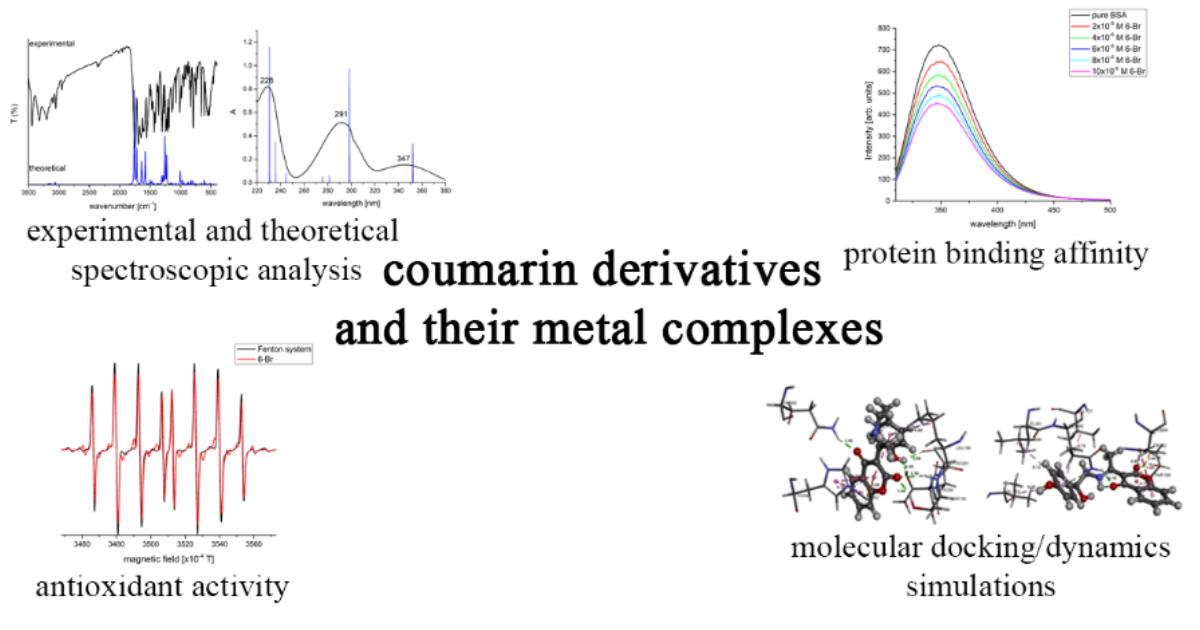
Coumarin derivatives, a class of compounds derived from natural sources, hold significant importance in modern science due to their diverse range of biological activities and potential applications. These derivatives exhibit various pharmacological properties, including anticoagulant, anti-inflammatory, antimicrobial, and anticancer effects. Moreover, their structural versatility makes them valuable in drug design and development. Investigating coumarin derivatives offers a promising avenue for the discovery of new therapeutic agents with enhanced efficacy and reduced side effects. Their exploration contributes extensively to the advancement of medicinal chemistry, offering novel compounds that could potentially address unmet medical needs and improve human health. This topic welcomes original and review articles to be published in the selected MDPI journals concerning the synthesis and structural analysis of newly obtained and known coumarin derivatives and their transition metal complexes. Biological activities, such as cytotoxicity, antioxidant and protein/DNA binding affinities, should be included, if applicable. In addition, articles containing quantum-chemical analysis and molecular docking/dynamics simulations to support available spectral and reactivity features are highly encouraged. Notably, understanding the effects of substituents on structural characteristics, reactivity, and biological activity remains a key emphasis.
Dr. Dušan Dimić
Dr. Edina Avdović
Dr. Dejan Milenković
Topic Editors
Keywords
- coumarin derivatives
- density functional theory
- protein binding
- cytotoxicity
- antioxidant activity
- molecular dynamics
- human serum albumin
- natural bond orbital theory
Participating Journals
| Journal Name | Impact Factor | CiteScore | Launched Year | First Decision (median) | APC |
|---|---|---|---|---|---|

Chemistry
|
2.4 | 4.4 | 2019 | 15 Days | CHF 1800 |

Inorganics
|
3.0 | 5.3 | 2013 | 14.9 Days | CHF 2200 |

International Journal of Molecular Sciences
|
4.9 | 10.0 | 2000 | 17.8 Days | CHF 2900 |

Pharmaceuticals
|
4.8 | 9.0 | 2004 | 16 Days | CHF 2900 |

Preprints.org is a multidisciplinary platform offering a preprint service designed to facilitate the early sharing of your research. It supports and empowers your research journey from the very beginning.
MDPI Topics is collaborating with Preprints.org and has established a direct connection between MDPI journals and the platform. Authors are encouraged to take advantage of this opportunity by posting their preprints at Preprints.org prior to publication:
- Share your research immediately: disseminate your ideas prior to publication and establish priority for your work.
- Safeguard your intellectual contribution: Protect your ideas with a time-stamped preprint that serves as proof of your research timeline.
- Boost visibility and impact: Increase the reach and influence of your research by making it accessible to a global audience.
- Gain early feedback: Receive valuable input and insights from peers before submitting to a journal.
- Ensure broad indexing: Web of Science (Preprint Citation Index), Google Scholar, Crossref, SHARE, PrePubMed, Scilit and Europe PMC.
