


On Laws of Thought—A Quantum-like Machine Learning Approach

Abstract
1. Introduction
2. Quantum-like Machine Learning Algorithm
- Logic tree: to determine the action to be taken and calculate the theoretical value of the closing price.
- Value tree: to calculate the absolute value of the difference in closing prices between two trading points of the Dow Jones index.
- (1)
- Generate the results to match the observed outcomes;
- (2)
- Predict the next outcome.
- (1)
- Randomly generate 300 logic or value trees;
- (2)
- Historical data is learned to obtain the fitness of each tree;
- (3)
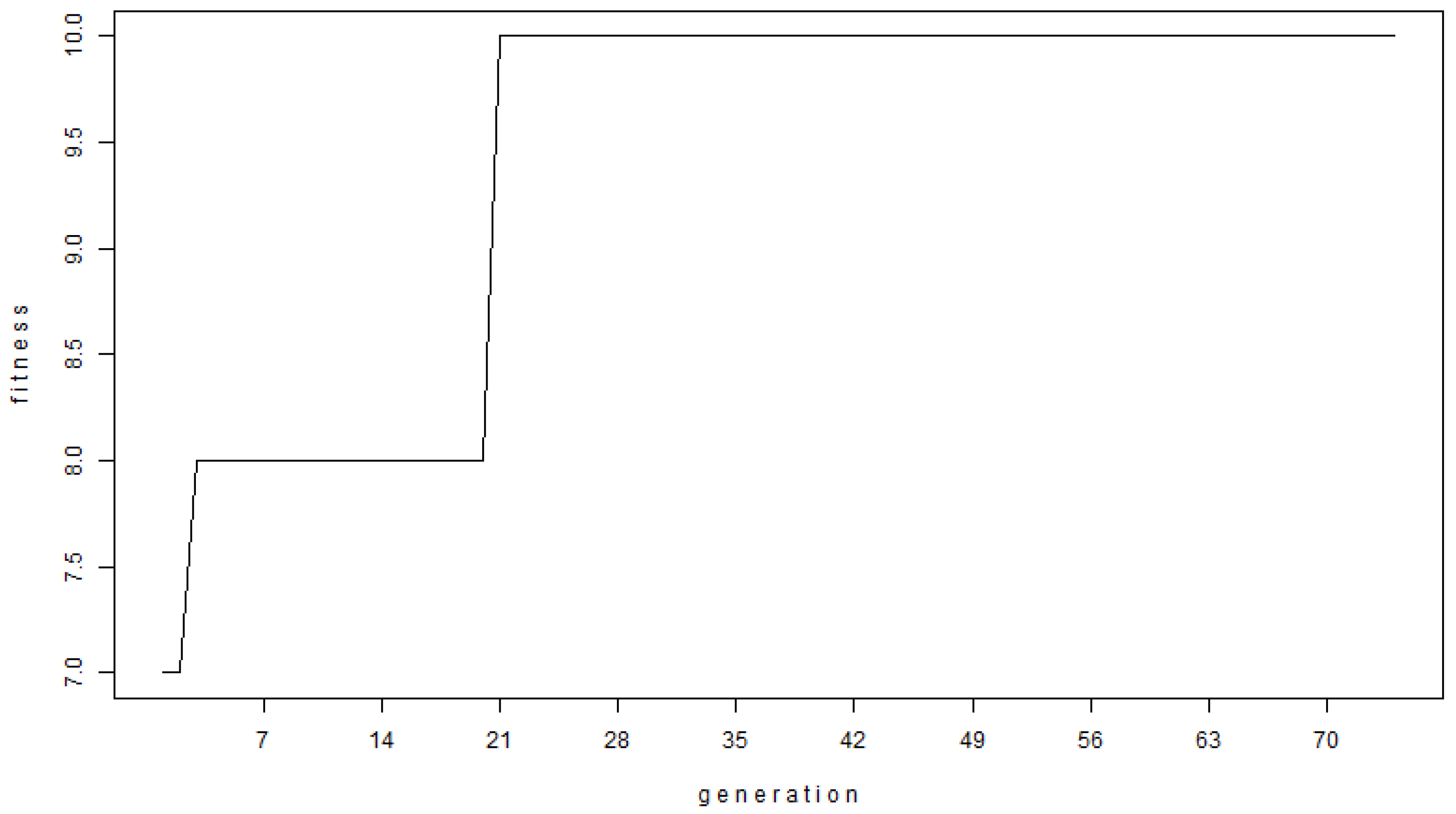
- The satisfactory logic or value tree is obtained through the Darwinian principle of survival of the fittest (crossover, mutation and selection) after about 80 generations of evolution.
| Algorithm 1. GP Algorithm |
|
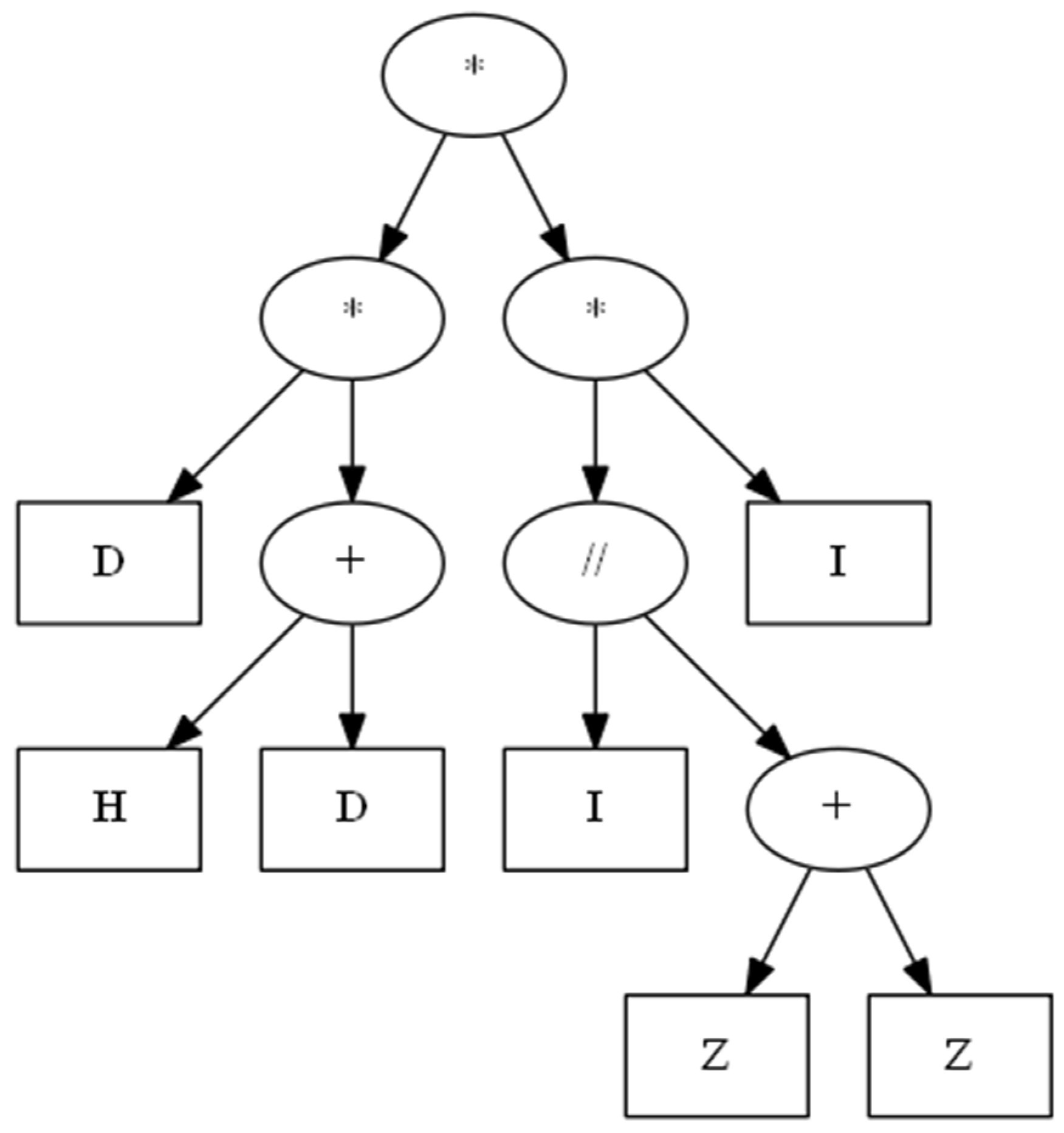
2.1. Value Tree
- (1)
- Operation set ;
- (2)
- Dataset
2.2. Logic Tree
- (1)
- Operation set ;
- (2)
- Dataset
- (1)
- If the Dow Jones index is up ():
- If the “machine economist” bets the Dow Jones index is up to buy (), it profits ;
- If the “machine economist” bets the Dow Jones index is down to sell (), it deficits .
- (2)
- If the Dow Jones Index is down ():
- If the “machine economist” bets the Dow Jones index is down to sell ( = 1), it profits ;
- If the “machine economist” bets the Dow Jones index is up to buy (), it deficits .
3. Results
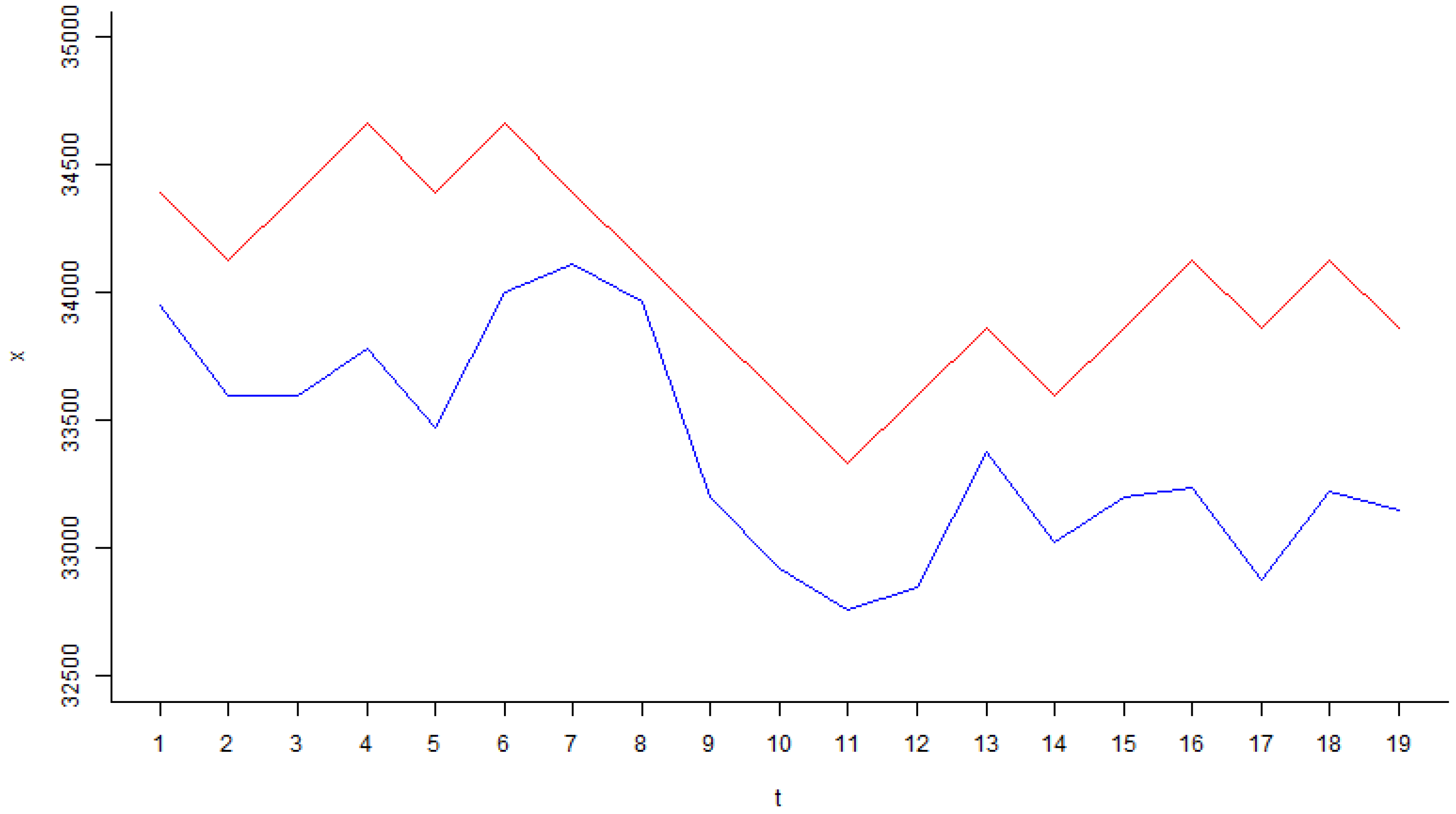
3.1. Dow Jones Index’s Value Tree
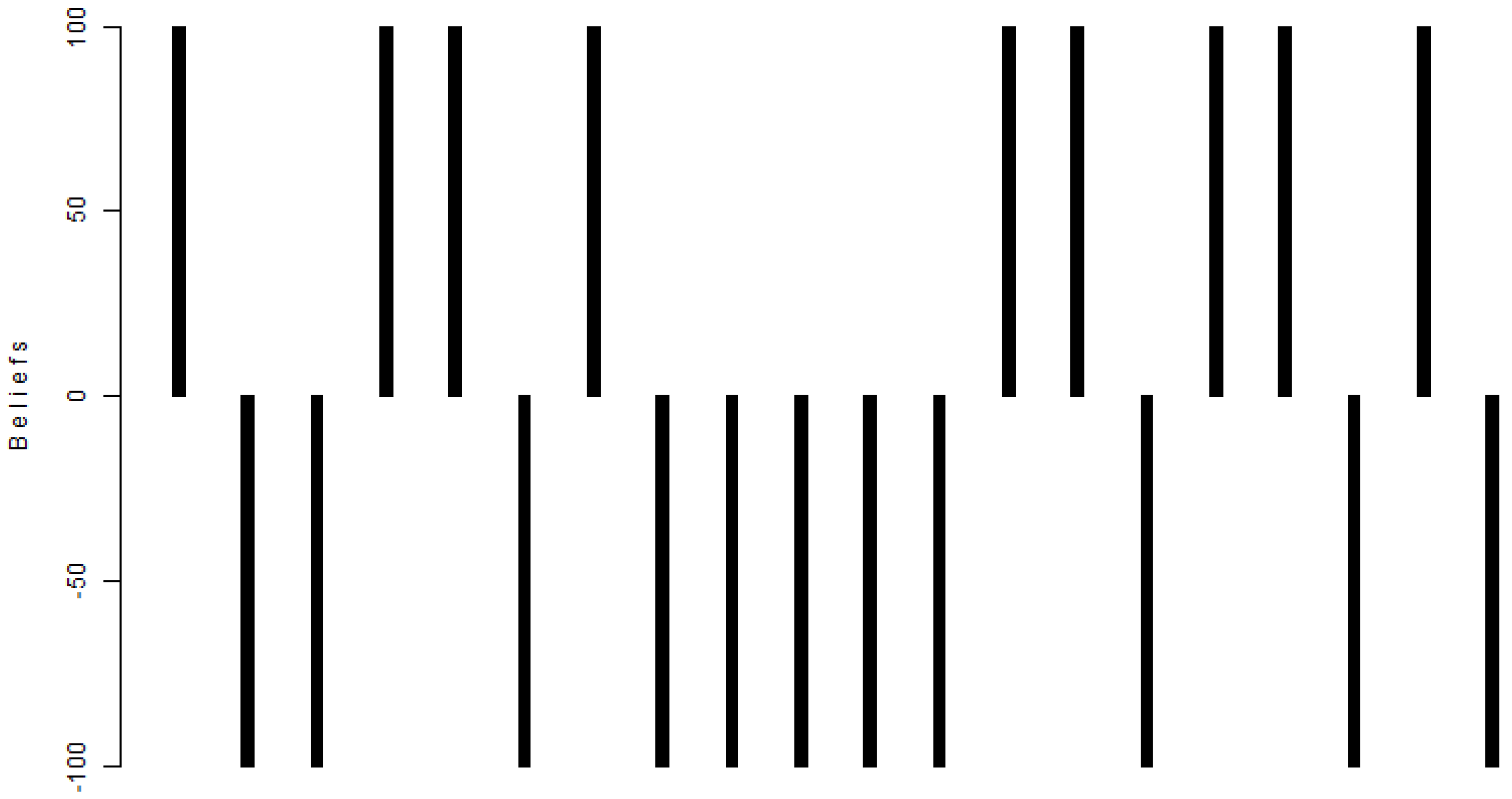
3.2. Dow Jones Index’s Logic Tree
4. Discussion
Author Contributions
Funding
Institutional Review Board Statement
Data Availability Statement
Acknowledgments
Conflicts of Interest
References
- Von Neumann, J.; Morgenstern, O. Theory of Games and Economic Behavior; Princeton University Press: Princeton, NJ, USA, 1944. [Google Scholar]
- Savage, L.J. The Foundation of Statistics; Dover Publication Inc.: New York, NY, USA, 1954. [Google Scholar]
- Binmore, K. Rational Decisions; Princeton University Press: Princeton, NJ, USA, 2009. [Google Scholar]
- Kahneman, D.; Tversky, A. Prospect theory: An analysis of decision under risk. Econemetrica 1979, 47, 263–292. [Google Scholar] [CrossRef]
- Simon, H.A. Reason in Human Affairs; Stanford University Press: Stanford, CA, USA, 1983. [Google Scholar]
- Ashtiani, M.; Azgomi, M.A. A survey of quantum-like approaches to decision making and cognition. Math. Soc. Sci. 2015, 75, 49–80. [Google Scholar] [CrossRef]
- Busemeyer, J.R.; Bruza, P.D. Quantum Models of Cognition and Decision; Cambridge University Press: Cambridge, UK, 2012. [Google Scholar]
- Haven, E.; Khrennikov, A. Quantum Social Science; Cambridge University Press: Cambridge, UK, 2013. [Google Scholar]
- Aerts, D.; Aerts, S. Applications of quantum statistics in psychological studies of decision processes. Found. Sci. 1995, 1, 85–97. [Google Scholar] [CrossRef]
- Aerts, D. Quantum structure in cognition. J. Math. Psychol. 2009, 53, 314–348. [Google Scholar] [CrossRef]
- Busemeyer, J.; Franco, R. What is the evidence for quantum like interference effects in human judgments and decision behavior? NeuroQuantology 2010, 8, S48–S62. [Google Scholar] [CrossRef]
- Busemeyer, J.R.; Franco, R.; Pothos, E.M. Quantum probability explanations for probability judgment errors. Psychol. Rev. 2010, 118, 193. [Google Scholar] [CrossRef] [PubMed]
- Wang, Z.; Busemeyer, J.R. A quantum question order model supported by empirical tests of an a priori and precise prediction. Top. Cogn. Sci. 2013, 5, 689–710. [Google Scholar]
- Khrennikov, A.; Basieva, I.; Dzhafarov, E.N.; Busemeyer, J.R. Quantum models for psychological measurements: An unsolved problem. PLoS ONE 2014, 9, e110909. [Google Scholar] [CrossRef] [PubMed]
- Asano, M.; Basieva, I.; Khrennikov, A.; Ohya, M.; Tanaka, Y. A quantum-like model of selection behavior. J. Math. Psych. 2017, 78, 2–12. [Google Scholar] [CrossRef]
- Basieva, I.; Khrennikova, P.; Pothos, E.M.; Asano, M.; Khrennikov, A. Quantum-like model of subjective expected utility. J. Math. Econ. 2018, 78, 150–162. [Google Scholar] [CrossRef]
- Ozawa, M.; Khrennikov, A. Application of theory of quantum instruments to psychology: Combination of question order effect with response replicability effect. Entropy 2019, 22, 37. [Google Scholar] [CrossRef] [PubMed]
- Ozawa, M.; Khrennikov, A. Modeling combination of question order effect, response replicability effect, and QQ-equality with quantum instruments. J. Math. Psychol. 2021, 100, 102491. [Google Scholar] [CrossRef]
- Yukalov, V.I.; Sornette, D. Physics of risk and uncertainty in quantum decision making. Eur. Phys. J. B 2009, 71, 533–548. [Google Scholar] [CrossRef]
- Yukalov, V.I.; Sornette, D. Quantum probabilities as behavioral probabilities. Entropy 2017, 19, 112. [Google Scholar] [CrossRef]
- Yukalov, V.I. Evolutionary Processes in Quantum Decision Theory. Entropy 2020, 22, 681. [Google Scholar] [CrossRef] [PubMed]
- Xin, L.; Xin, H. Decision-making under uncertainty—A quantum value operator approach. Int. J. Theor. Phys. 2023, 62, 48. [Google Scholar] [CrossRef]
- Holland, J. Adaptation in Natural and Artificial System; University of Michigan Press: Ann Arbor, MI, USA, 1975. [Google Scholar]
- Goldberg, D.E. Genetic Algorithms—In Search, Optimization and Machine Learning; Addison-Wesley Publishing Company, Inc.: New York, NY, USA, 1989. [Google Scholar]
- Koza, J.R. Genetic Programming, on the Programming of Computers by Means of Natural Selection; MIT Press: Cambridge, MA, USA, 1992. [Google Scholar]
- Koza, J.R. Genetic Programming II, Automatic Discovery of Reusable Programs; MIT Press: Cambridge, MA, USA, 1994. [Google Scholar]
- Von Neumann, J. Mathematical Foundations of Quantum Theory; Princeton University Press: Princeton, NJ, USA, 1932. [Google Scholar]
- Dirac, P.A.M. The Principles of Quantum Mechanics; Oxford University Press: Oxford, UK, 1958. [Google Scholar]
- Nielsen, M.A.; Chuang, I.L. Quantum Computation and Quantum Information; Cambridge University Press: Cambridge, UK, 2000. [Google Scholar]
- Benenti, G.; Casati, G.; Strini, G. Principles of Quantum Computation and Information I; World Scientific Publishing: Singapore, 2004. [Google Scholar]



| State | |||
|---|---|---|---|
| Action | |||
| −1 | 34,395.01 |
| 0 | 34,429.88 |
| 1 | 33,947.1 |
| 1 | 33,596.34 |
| 0 | 33,597.92 |
| 0 | 33,781.48 |
| 1 | 33,476.46 |
| 0 | 34,005.04 |
| 0 | 34,108.64 |
| 1 | 33,966.35 |
| 1 | 33,202.22 |
| 1 | 32,920.46 |
| 1 | 32,757.54 |
| 0 | 32,849.74 |
| 0 | 33,376.48 |
| 1 | 33,027.49 |
| 0 | 33,203.93 |
| 0 | 33,241.56 |
| 1 | 32,875.71 |
| 0 | 33,220.8 |
| 1 | 33,147.25 |
Disclaimer/Publisher’s Note: The statements, opinions and data contained in all publications are solely those of the individual author(s) and contributor(s) and not of MDPI and/or the editor(s). MDPI and/or the editor(s) disclaim responsibility for any injury to people or property resulting from any ideas, methods, instructions or products referred to in the content. |
© 2023 by the authors. Licensee MDPI, Basel, Switzerland. This article is an open access article distributed under the terms and conditions of the Creative Commons Attribution (CC BY) license (https://creativecommons.org/licenses/by/4.0/).
Share and Cite
Xin, L.; Xin, K.; Xin, H. On Laws of Thought—A Quantum-like Machine Learning Approach. Entropy 2023, 25, 1213. https://doi.org/10.3390/e25081213
Xin L, Xin K, Xin H. On Laws of Thought—A Quantum-like Machine Learning Approach. Entropy. 2023; 25(8):1213. https://doi.org/10.3390/e25081213
Chicago/Turabian StyleXin, Lizhi, Kevin Xin, and Houwen Xin. 2023. "On Laws of Thought—A Quantum-like Machine Learning Approach" Entropy 25, no. 8: 1213. https://doi.org/10.3390/e25081213
APA StyleXin, L., Xin, K., & Xin, H. (2023). On Laws of Thought—A Quantum-like Machine Learning Approach. Entropy, 25(8), 1213. https://doi.org/10.3390/e25081213