


Abstract
We consider a secure integrated sensing and communication (ISAC) scenario, where a signal is transmitted through a state-dependent wiretap channel with one legitimate receiver with which the transmitter communicates and one honest-but-curious target that the transmitter wants to sense. The secure ISAC channel is modeled as two state-dependent fast-fading channels with correlated Rayleigh fading coefficients and independent additive Gaussian noise components. Delayed channel outputs are fed back to the transmitter to improve the communication performance and to estimate the channel state sequence. We establish and illustrate an achievable secrecy-distortion region for degraded secure ISAC channels under correlated Rayleigh fading, for which we show that the signal-to-interference-plus-noise is not a sufficient statistic. We also evaluate the inner bound for a large set of parameters to derive practical design insights. The presented results include parameter ranges for which the secrecy capacity of a classical wiretap channel setup is surpassed and for which the channel capacity is approached. Thus, we illustrate for correlated Rayleigh fading cases that our secure ISAC methods can (i) eliminate the need for the legitimate receiver to have a statistical advantage over the eavesdropper and (ii) provide communication security with minimal rate penalty.
1. Introduction
Integrating the digital and physical world, envisioned for future communication systems, requires a network to react to changes in real-time through sensing and communication [1]. An example is a millimeter wave (mmWave) integrated sensing and communication (ISAC) system that aims to sense a target by estimating relevant channel parameters to fine-tune the communication scheme [2,3]. There are multiple recent information-theoretic studies of ISAC that extend previous results, such as [4,5]. Focusing on vehicular radar applications for mmWave systems, an information-theoretic model is proposed in [6] for ISAC. In this model, encoded messages are sent over a state-dependent channel with generalized feedback such that the state is only known at the receiver and the feedback is used to improve communication and to estimate the channel state. The rate-distortion region is characterized for independent and identically distributed (i.i.d.) channel states and memoryless ISAC channels with strictly causal channel output feedback. Subsequent works have considered multiple access channels [7], broadcast channels [6], transmitter actions [8], covert communications [9,10], and low-latency scenarios [11,12,13].
As a single modality is used to both communicate with a legitimate receiver and detect a target, the sensing signal may carry sensitive information about the message communicated, which may then be leaked to a target. Since the signal power at the sensed target impacts both the secrecy and sensing performance, there exists a tradeoff between the two [2,14,15,16,17,18]. This tradeoff is characterized in [14] for degraded and reversely-degraded ISAC channels, when the transmitter aims to reliably communicate with the legitimate receiver by using the ISAC channel, estimate the channel state by using the channel output feedback, and keep the message hidden from the target that acts as an eavesdropper. The results in [14] show that it is possible to surpass the secrecy capacity by using the channel output feedback for secure ISAC applications, which strongly contrasts with and significantly improves on classical physical layer security methods.
In this work, we establish an achievable rate region for stochastically degraded secure ISAC channels under bivariate Rayleigh fading by using a Gaussian channel input. Since closed form expressions for this rate region remain elusive, we derive integral expressions from the involved differential entropies, which are amenable to simplified and stable numerical evaluations. Based on the evaluation results, fundamental insights are presented, including, in particular, parameter ranges for which secure-ISAC rates greater than the secrecy capacity can be achieved and for which the channel capacity is approached. Moreover, we provide accurate approximations, which allow easy-to-compute numerical evaluations.
1.1. Main Contributions
A summary of the main contributions of this work is as follows:
- We establish an inner bound on the rate region for stochastically degraded secure ISAC channels under bivariate Rayleigh fading by employing a Gaussian input. Our formulation shows how channel-output feedback can be leveraged to significantly improve the secrecy rate, enabling the system to surpass classical secrecy capacity results.
- We derive integral expressions stemming from the involved differential entropies in the achievable rate region. These expressions are amenable to numerically stable and simplified evaluations, facilitating practical performance analysis.
- For some integral expressions in the achievable rate region, we provide closed form solutions in special cases, such as high SNR regime and uncorrelated fading, which significantly simplifies the numerical evaluations.
- We provide fundamental insights into sensing-assisted secure communication systems, including parameter regimes where the achievable secure-ISAC rates can exceed the secrecy capacity and where approaching the channel capacity (i.e., the maximum possible rate without a secrecy constraint) can be possible. We further present accurate approximations that enable straightforward numerical evaluations and guide system design.
1.2. Paper Organization
In Section 2, we define the system model and metrics used. In Section 3, we provide the secrecy-distortion regions for correlated fading additive Gaussian noise (AGN) ISAC channels. In Section 4, we evaluate the provided secrecy-distortion regions for Gaussian inputs, which constitutes an achievable rate region. In Section 5, we illustrate the achievable rate regions by numerical calculations and provide the fundamental insights gained from them. In Section 6, we conclude the paper.
1.3. Notation
Uppercase letters denote random variables, while their corresponding lowercase letters represent specific realizations. For a continuous random variable X, the probability density function (pdf) is denoted as and the cumulative distribution function (cdf) is given by . Calligraphic letters, such as , indicate sets, with the cardinality of a set given by . represents a sequence . We represent as covariance and as variance, respectively.
denotes the zeroth-order modified Bessel function of the first kind ([19], 10.25.2, 10.32.1).
represents the exponential integral function ([19], 6.2.5). denotes Euler’s constant ([19], 5.2.3). Moreover,
denotes the imaginary error function ([19], 7.2.1), and represents the generalized hypergeometric function ([19], 16.2.1).
2. System Model and Problem Definition
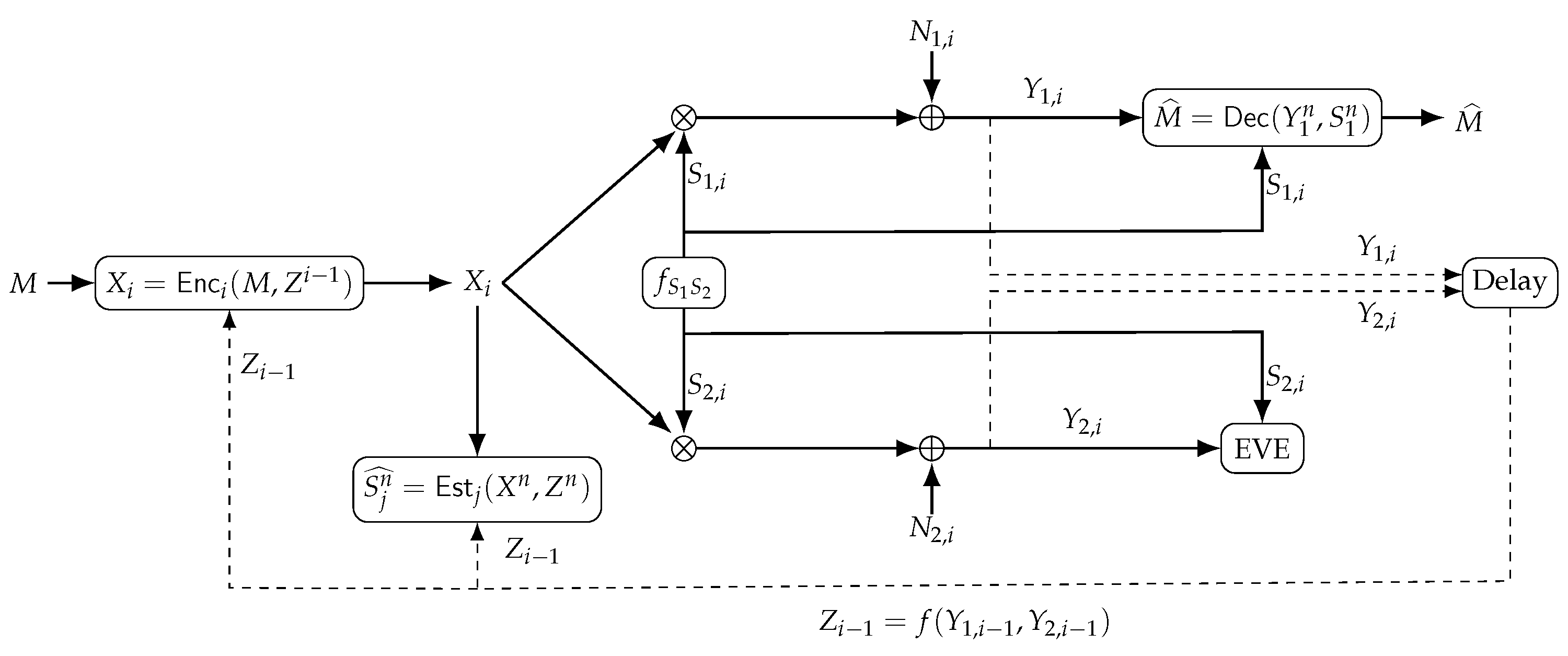
We consider the secure ISAC model depicted in Figure 1, comprising one legitimate receiver, one state estimator, and an eavesdropper (Eve). The transmitter wants to transmit a uniformly distributed message M from the finite message set through a fast fading additive Gaussian noise (AGN) secure ISAC channel, in which i.i.d. fading channel coefficients are causally estimated by the receiver and eavesdropper, respectively. The fading coefficients with non-negative real-valued alphabet are correlated according to a known joint pdf , but their realizations are not known by the transmitter. For discussions about how to extend the results to include complex fading channel coefficients and noise components, see ([20], Section V-A).
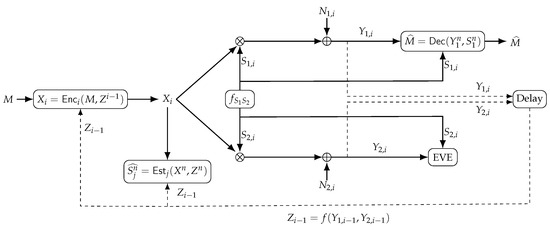
Figure 1.
Secure ISAC model for and , for which the message M should be kept secret from the eavesdropper. We impose an average transmit power constraint on the channel input symbols and assume independent AGN components and . We principally consider perfect channel output feedback with unit symbol time delay, i.e., such that the function is the identity function.
Given M, the transmitter generates the channel inputs by using encoding functions such that for all , where is the delayed channel output feedback. We impose an average power constraint on the subsequent transmitted symbols, i.e., we have
for all messages M, where denotes expectation. The channel output for the legitimate receiver at time i is
where are i.i.d. Gaussian distributed with zero mean, variance , and independent of . The legitimate receiver observes the sequences and estimates the transmitted message as , where is a decoding function. Similarly, the channel output for the eavesdropper at time i is
where are i.i.d. Gaussian distributed with zero mean, variance , and independent of . The transmitted message M should be kept secret from the eavesdropper that observes . Finally, the state estimator observes both the channel output feedback
and the codeword symbol to estimate the fading channel coefficients as for , where is an estimation function with range .
For simplicity, we assume the deterministic processing function is the identity function, so the channel output feedback is perfect, i.e., we have noiseless channel output feedback . This simplification allows us to obtain fundamental insights into the optimal coding schemes and helps tackle the noisy feedback scenario, which is generally challenging; see, e.g., achievability results for wiretap channels with generalized output feedback in [21]. Note that the achievability proofs for wiretap channels generally require a local randomness source at the encoder, which is true also for the results given below. The randomness can be provided, e.g., by using hardware-intrinsic security primitives [22]. We next define the secrecy-distortion region for the secure correlated fast-fading ISAC problem.
Definition 1.
A secrecy-distortion tuple is achievable for the secure correlated fast-fading ISAC problem if for any , there exist , one encoder-decoder pair, and two state estimators such that
where are averaged per-letter distortion metrics.
The secrecy-distortion region is the closure of the set of all achievable tuples for the secure correlated fast-fading ISAC problem under perfect channel output feedback.
Since the transmitted message is independent of the channel state, the secrecy condition in (6) is equivalent to the inequality . Furthermore, there are ISAC models, such as in [23], that consider a practical application, in which only a part of the channel parameters are relevant for the transmitter. By not imposing the estimation of the exact channel state at the transmitter via adapting (7), one can extend our results for such practical settings.
4. Achievable Rates for Gaussian Input
Given (8), the main goal is to find the maximum of its right-hand side with respect to the distribution of the random variable X. However, this is a difficult optimization problem, so we instead provide an achievable rate for a Gaussian input X. Subsequently, we evaluate (8a)–(8c) for X being a zero-mean Gaussian random variable with positive variance P, where X is independent of .
4.1. Evaluation of Equation (8a)
Proposition 2.
Under the assumptions above, we have
where we have
with
Proof of Proposition 2.
Fix and for some . Then is jointly Gaussian with zero mean and covariance matrix
since X, , and are independent Gaussian random variables with positive variances P, , and . We have
Using (21), we can write
where the random variable S is given by
with . Since S is a ratio of random variables, the pdf of S has the following integral representation ([26], Equation 6.60):
where is the joint pdf of given by
for , where and are as specified in (19).
In the case of uncorrelated fading or for high SNR , the representation given in Proposition 2 has the following closed form.
Corollary 2.
Proof.
Proof of part (i): The density (28) follows by (17) for . Plugging (28) into (16) and using the substitution , we obtain the equivalent integral
The antiderivative of the integrand in (33) for is given by
which can be obtained by using, e. g., Mathematica. The antiderivative can be directly verified by calculating the derivative of (34) and collecting the terms to re-obtain the integrand of (33). Evaluating (34) for the integration limits of (33), we obtain
Substracting (35) from (36) yields the first part of (29).
Similarly, for the antiderivative of the integrand in (33) for , we obtain
Evaluating (37) for the integration limits of (33), we obtain
Substracting (38) from (39) yields the second part of (29).
Proof of part (ii): The densities (30) and (31) are directly obtained from (17) for and . Plugging (31) into (16) and using the substitution , we obtain the equivalent integral
The antiderivative of the integrand in (40) is given by
where we have , and which can be directly verified by calculating the derivative of (41) and collecting the terms to re-obtain the integrand of (40). Evaluating (41) for the integration limits of (40), we obtain
where we use L’Hôpital’s rule to calculate the limit . Substracting (42) from (43) yields (32). □
4.2. Evaluation of Equation (8b)
First, we rewrite (8b) as
Using the marginal pdf of , we obtain
using the substitution and the integral relations
and
The evaluation of requires the following calculations. Let . Then, the joint pdf of is given for by the convolution integral
for and . Furthermore, we have
Due to symmetry, we obtain
As we can evaluate the convolution integral in (48) numerically, we rely on numerical calculations also for (49) and (50).
An upper bound of , for which the numerical evaluation is much easier, is the following.
Proposition 3.
Proof of Proposition 3.
Fix for some . Then, the differential entropy is bounded by
as a result of the differential entropy maximizing property of the Gaussian distribution with a given covariance matrix. Since , and are independent, we have
Inserting the definitions of and , we obtain
where and are as defined in (52), (53), and . Due to the monotonicity of the integral and symmetry properties, we have
To evaluate the integral, we use the substitution , the correspondence ([28], 2.6.23.4) (please note that in ([28], 2.6.23.4), the sign before is incorrect), and the identities and ([19], 13.6.7). Applying the expression in (45) yields the bound for given in Proposition 3. □
The representation in Proposition 2 as a one-dimensional integral is particularly convenient for numerical evaluations and is used in Section 5.
4.3. Evaluation of Equation (8c)
Proposition 4.
Under the assumptions above, we have
Proof of Proposition 4.
Fix for some . Then, is a Gaussian random variable with zero mean and variance since X and are independent Gaussian random variables with positive variances P and . For the differential entropy , we obtain
Thus, we can write
where . With the marginal pdf of and basic density transformation, we obtain the pdf for of the random variable such that we have
The integral is solved using the substitution and integration by parts. Collecting the terms yields (60). □
5. Numerical Results and Discussions
We next evaluate the results of Section 4 numerically for interesting parameter regimes. To simplify notation, we denote the sum of (8a) and (8b) by and the sum of (8a) and the upper bound (51) of (8b) by , respectively. Furthermore, we denote (8c) by . With this notation, we have for the achievable rate in Section 4
Based on the representation in (16)–(18) as a one-dimensional integral, we numerically evaluate (8a). Similarly, the upper bound in (51) is numerically evaluated, and the same applies to (8c) using (60). However, the numerical evaluation of (8b) is more involved. First, we numerically calculate the convolution integral in (48) on a sufficiently-dense grid for the variables and . Then, we numerically calculate the differential entropy using (49) based on an interpolated version of the density . Repeating these calculations for a sufficiently dense set of values x, we numerically calculate using (50) and an interpolated version of the function Combining with (45), we finally obtain (8b).
We consider a stochastically degraded secure ISAC channel, i. e., we assume that the chosen parameter values satisfy the inequality (15). Moreover, we assume that , which is the interesting regime where the corresponding wiretap channel does not allow secure communication. The parameter sets satisfying these conditions for which we subsequently discuss the numerical results below are given in Table 1.

Table 1.
Parameter sets for numerical calculations.
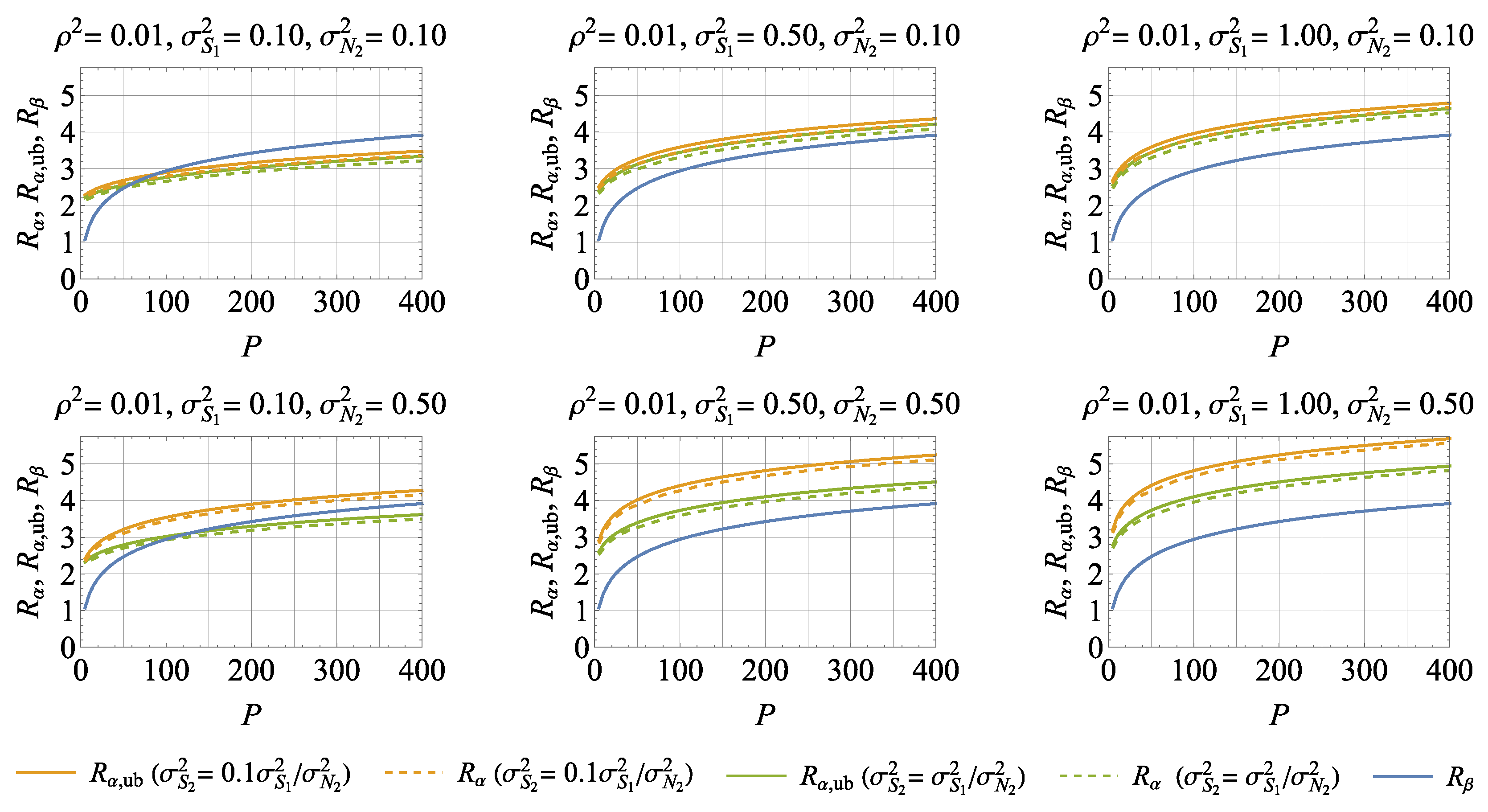
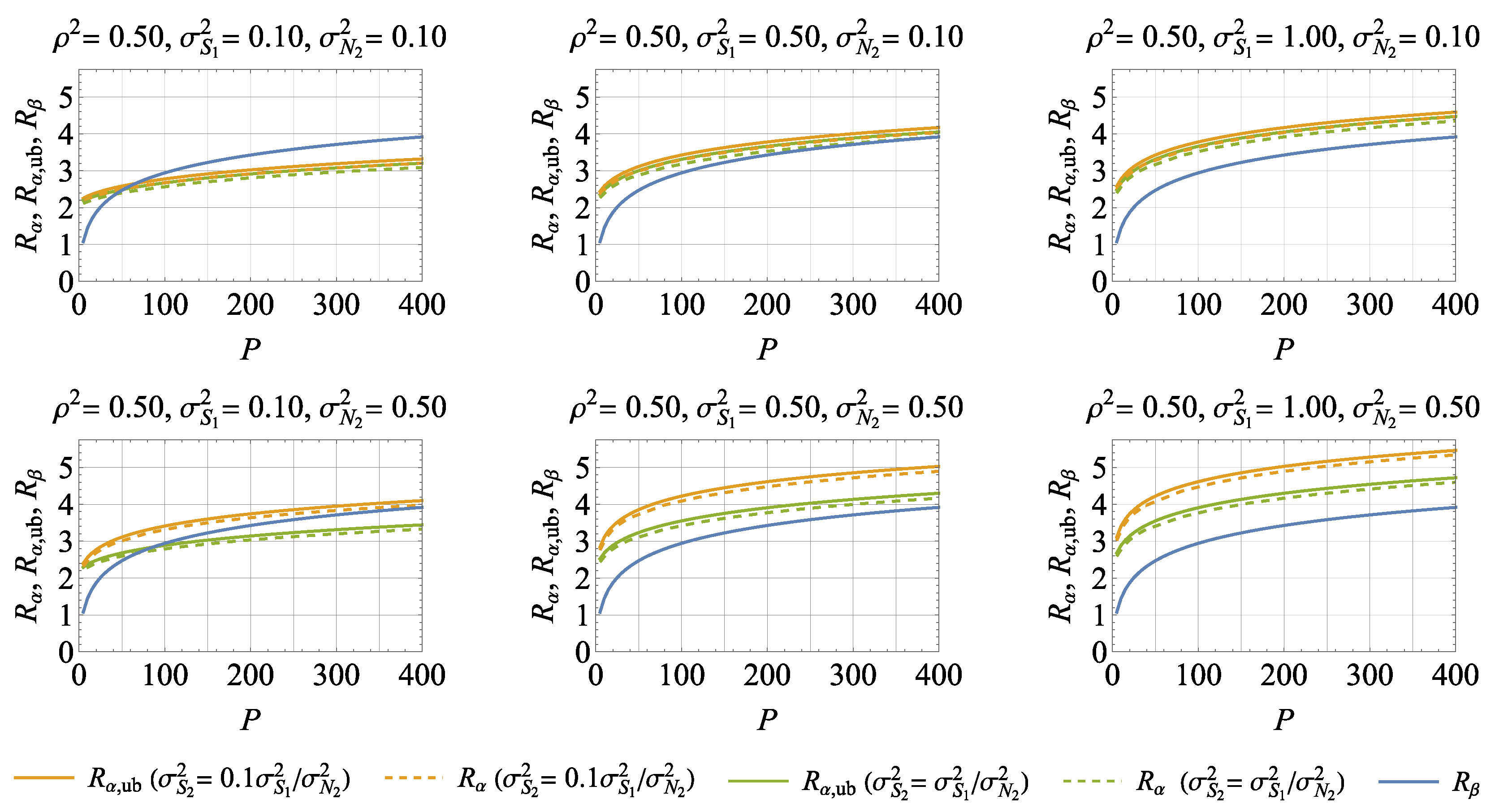
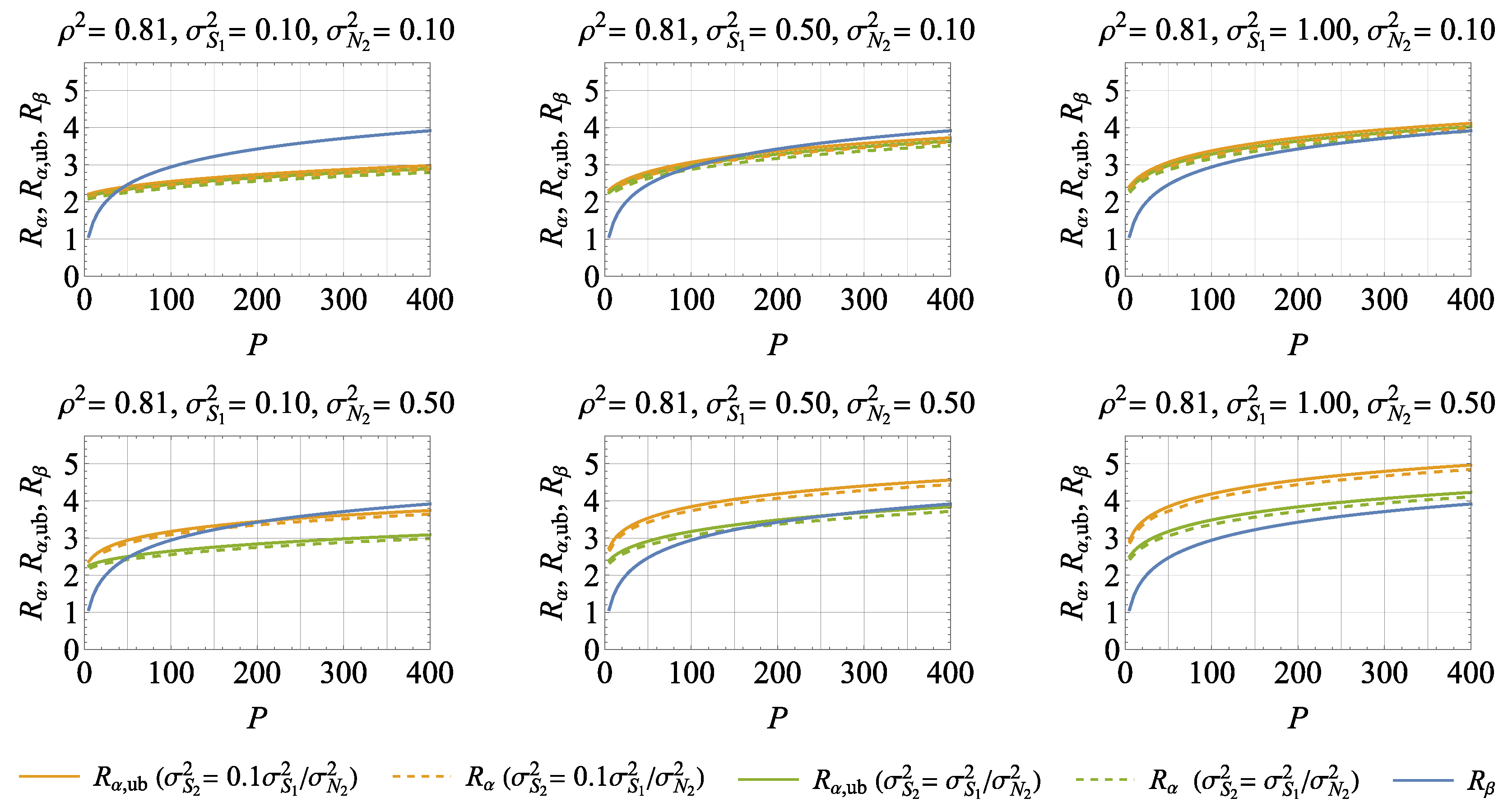
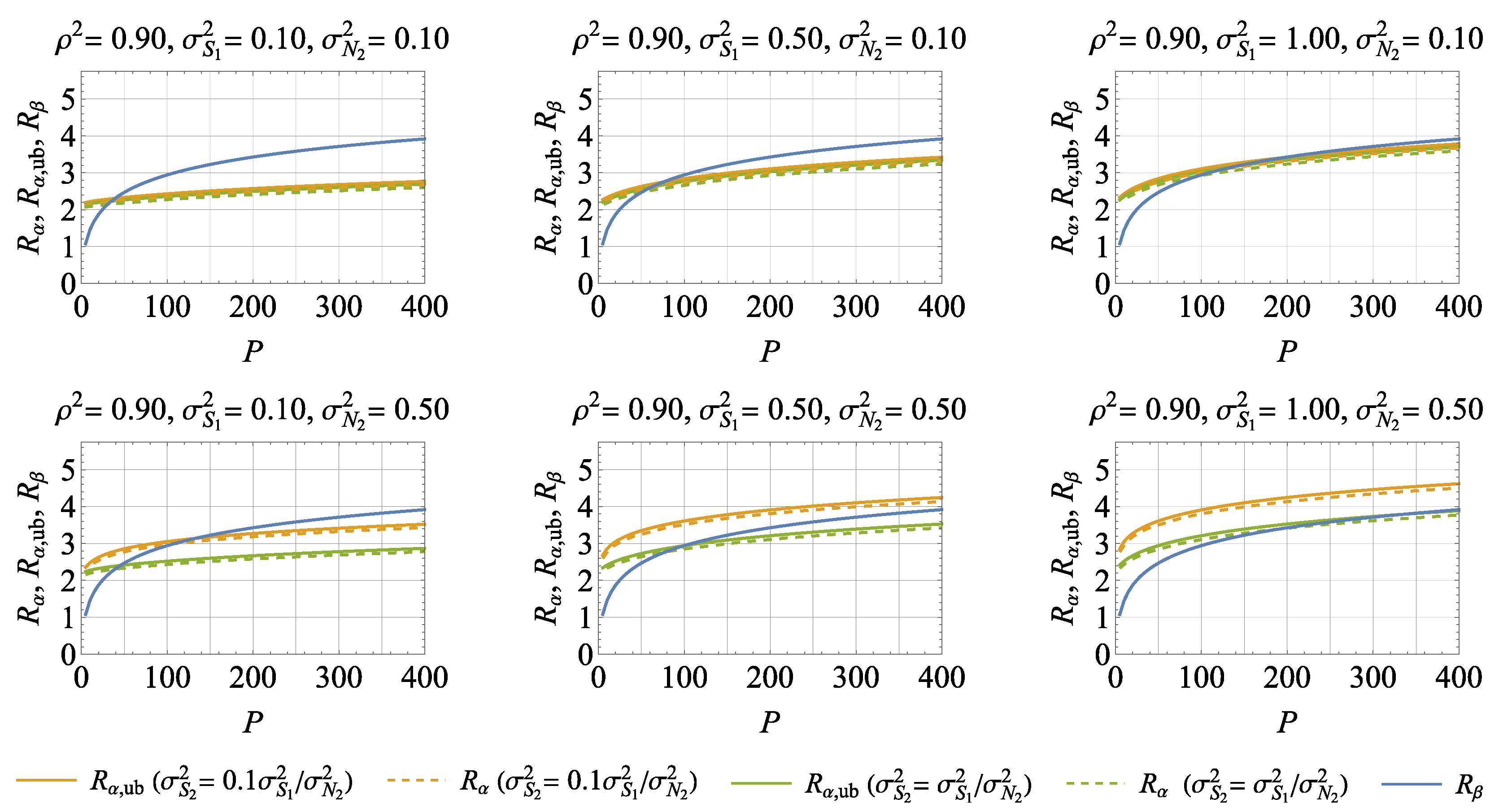
We compute the results for , , and as a function of the transmit power P for different values of the power correlation coefficient . The corresponding curves are shown in Figure 2, Figure 3, Figure 4 and Figure 5. For the matrix of subfigures in each figure, the parameter is modified from left to right and the parameter from top to bottom, respectively, whereas is fixed. The parameter is modified within a subfigure.
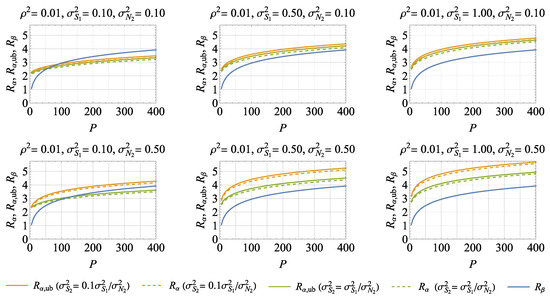
Figure 2.
for power correlation coefficient .
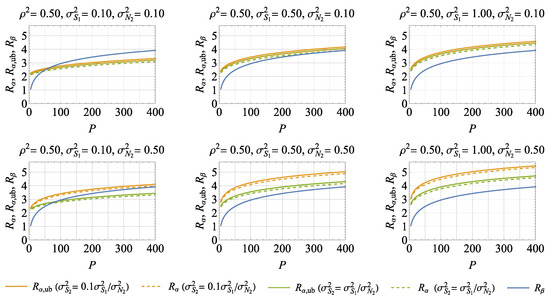
Figure 3.
for power correlation coefficient .
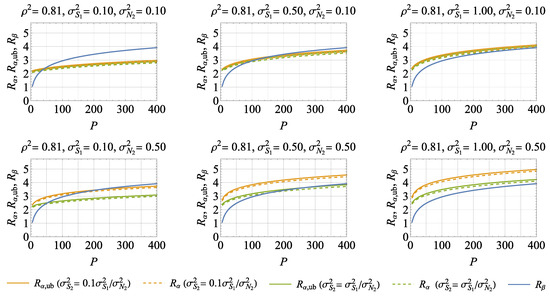
Figure 4.
for power correlation coefficient .
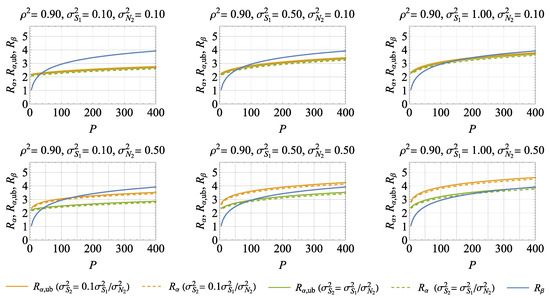
Figure 5.
for power correlation coefficient .
We next list our conclusions for a degraded secure ISAC channel with correlated Rayleigh fading for the parameter ranges given above, drawn from the computations mentioned above. From (60), we observe that is only a function of the transmit power P such that the curves of are the same in all diagrams. From (16)–(18), we observe that (8a) as a summand of and is a function of , P, and the parameter ratios and . Similarly, the upper bound (51) as a summand of is a function of , P, , and and it does not depend on and . The numerical results also indicate that (8b) as a summand of does not depend on and .
The results show that and curves behave highly similar with a small constant gap. Thus, for most of the parameter constellations, the much-easier-to-calculate , instead of , can be used to interpret the results.
Furthermore, we observe the following monotonicities: increases for increasing parameters or and for decreasing parameters or . Moreover, we observe that increasing the power correlation from 0 to 0.50 has only a minor effect, whereas the impact of increasing from 0.50 to 0.81 is much stronger. This trend continues when further increases from 0.81 to 0.90.
The interesting regime where the channel capacity is approached is when determines the right-hand side of (8). The range for the power P where determines (8) increases with increasing or and decreasing or . For low correlation , this range stretches over all considered power values for almost all parameter constellations, whereas for highly correlated fading coefficients it shrinks to low power values. Thus, in the low power regime, channel capacity is approached irrespective of the values of the remaining parameters.
6. Conclusions
We considered a new secure ISAC model for a state-dependent wiretap channel under correlated Rayleigh fading with channel output feedback. We derived and evaluated an achievable secrecy-distortion region and demonstrated conditions where the secrecy capacity can be surpassed, unlike classical physical layer security methods, which provides fundamental insights essential for designing optimal secure ISAC systems for future communication systems. We remark that extensions of our model to consider active attacks, as in, e.g., [29], and evaluations for more practical ISAC channel models, as in, e.g., [30], are also important for secure ISAC research.
Author Contributions
Conceptualization, M.M., R.F.S., M.B., A.Y. and O.G.; methodology, M.M., R.F.S. and O.G.; mathematical analysis, M.M., R.F.S., M.B. and O.G.; validation, M.M. and O.G.; writing—original draft preparation, M.M., R.F.S. and O.G.; writing—review and editing, M.B., A.Y. and O.G.; project management, M.B., A.Y. and O.G. All authors have read and agreed to this version of the manuscript.
Funding
This work has been supported by the German Federal Ministry of Education and Research (BMBF) through the research hub 6G-life under grant 16KISK001K, the German Research Foundation (DFG) as part of Germany’s Excellence Strategy—EXC 2050/1—Project ID 390696704—Cluster of Excellence CeTI, the U.S. National Science Foundation (NSF) under grant CCF 1955401 and grant CCF 2148400 as part of the Resilient and Intelligent NextG Systems (RINGS) Program, the U.S. Department of Transportation under grant 69A3552348327 for the CARMEN+ University Transportation Center, the ZENITH Research and Leadership Career Development Fund, and the ELLIIT funding endowed by the Swedish government.
Conflicts of Interest
The authors declare no conflicts of interest.
References
- Wild, T.; Braun, V.; Viswanathan, H. Joint Design of Communication and Sensing for Beyond 5G and 6G Systems. IEEE Access 2021, 9, 30845–30857. [Google Scholar] [CrossRef]
- Wei, Z.; Liu, F.; Masouros, C.; Su, N.; Petropulu, A.P. Towards Multi-Functional 6G Wireless Networks: Integrating Sensing, Communication and Security. IEEE Commun. Mag. 2022, 60, 65–71. [Google Scholar] [CrossRef]
- Fettweis, G.; Schlüter, M.; Thomä, R.; Boche, H.; Schotten, H.; Barreto, A.; Mueller, A.; Bilgic, A.; Hildebrand, C.; Schupke, D.; et al. Joint Communications & Sensing—Common Radio-Communications and Sensor Technology. VDE Positionspapier 2021. [Google Scholar]
- Zhang, W.; Vedantam, S.; Mitra, U. Joint Transmission and State Estimation: A Constrained Channel Coding Approach. IEEE Trans. Inf. Theory 2011, 57, 7084–7095. [Google Scholar] [CrossRef]
- Wymeersch, H.; Shrestha, D.; de Lima, C.M.; Yajnanarayana, V.; Richerzhagen, B.; Keskin, M.F.; Schindhelm, K.; Ramirez, A.; Wolfgang, A.; de Guzman, M.F.; et al. Integration of Communication and Sensing in 6G: A Joint Industrial and Academic Perspective. In Proceedings of the IEEE Annual International Symposium on Personal, Indoor and Mobile Radio Communications, Helsinki, Finland, 13–16 September 2021; pp. 1–7. [Google Scholar]
- Ahmadipour, M.; Kobayashi, M.; Wigger, M.; Caire, G. An Information-Theoretic Approach to Joint Sensing and Communication. IEEE Trans. Inf. Theory 2024, 70, 1124–1146. [Google Scholar] [CrossRef]
- Kobayashi, M.; Hamad, H.; Kramer, G.; Caire, G. Joint State Sensing and Communication over Memoryless Multiple Access Channels. In Proceedings of the IEEE International Symposium on Information Theory, Paris, France, 7–12 July 2019; pp. 270–274. [Google Scholar]
- Welling, T.; Günlü, O.; Yener, A. Transmitter Actions for Secure Integrated Sensing and Communication. In Proceedings of the IEEE International Symposium on Information Theory, Athens, Greece, 7–12 July 2024; pp. 2580–2585. [Google Scholar]
- Wang, S.Y.; Chang, M.C.; Bloch, M.R. Covert Joint Communication and Sensing under Variational Distance Constraint. In Proceedings of the Annual Conference on Information Sciences and Systems, Princeton, NJ, USA, 13–15 March 2024; pp. 1–6. [Google Scholar]
- Wang, X.; Fei, Z.; Liu, P.; Zhang, J.A.; Wu, Q.; Wu, N. Sensing-Aided Covert Communications: Turning Interference Into Allies. IEEE Trans. Wirel. Commun. 2024, 23, 10726–10739. [Google Scholar] [CrossRef]
- Welling, T.; Günlü, O.; Yener, A. Low-latency Secure Integrated Sensing and Communication with Transmitter Actions. In Proceedings of the IEEE International Workshop on Signal Processing Advances in Wireless Communications, Lucca, Italy, 10–13 September 2024; pp. 351–355. [Google Scholar]
- Günlü, O.; Bloch, M.; Schaefer, R.F.; Yener, A. Nonasymptotic Performance Limits of Low-Latency Secure Integrated Sensing and Communication Systems. In Proceedings of the IEEE International Conference on Acoustics, Speech and Signal Processing, Seoul, Republic of Korea, 14–19 April 2024; pp. 12971–12975. [Google Scholar]
- Nikbakht, H.; Wigger, M.; Shamai, S.; Poor, H.V. Integrated Sensing and Communication in the Finite Blocklength Regime. In Proceedings of the IEEE International Symposium on Information Theory, Athens, Greece, 7–12 July 2024; pp. 2790–2795. [Google Scholar]
- Günlü, O.; Bloch, M.; Schaefer, R.F.; Yener, A. Secure Integrated Sensing and Communication. IEEE J. Sel. Inf. Theory 2023, 4, 40–53. [Google Scholar] [CrossRef]
- Günlü, O.; Bloch, M.; Schaefer, R.F.; Yener, A. Secure Integrated Sensing and Communication for Binary Input Additive White Gaussian Noise Channels. In Proceedings of the IEEE International Symposium on Joint Communications & Sensing, Seefeld, Austria, 5–7 March 2023; pp. 1–6. [Google Scholar]
- Ahmadipour, M.; Wigger, M.; Shamai, S. Integrated Communication and Receiver Sensing with Security Constraints on Message and State. In Proceedings of the IEEE International Symposium on Information Theory, Taipei, Taiwan, 25–30 June 2023; pp. 2738–2743. [Google Scholar]
- Dong, F.; Liu, F.; Lu, S.; Xiong, Y. Secure ISAC Transmission With Random Signaling. In Proceedings of the IEEE GLOBECOM Workshops, Kuala Lumpur, Malaysia, 4–8 December 2023; pp. 407–412. [Google Scholar]
- Su, N.; Liu, F.; Masouros, C. Sensing-Assisted Eavesdropper Estimation: An ISAC Breakthrough in Physical Layer Security. IEEE Trans. Wirel. Commun. 2024, 23, 3162–3174. [Google Scholar] [CrossRef]
- Olver, F.W.J.; Lozier, D.W.; Boisvert, R.F.; Clark, C.W. (Eds.) NIST Handbook of Mathematical Functions; Cambridge University Press: Cambridge, UK, 2010. [Google Scholar]
- Tse, D.; Yates, R. Fading Broadcast Channels with State Information at the Receivers. IEEE Trans. Inf. Theory 2012, 58, 3453–3471. [Google Scholar] [CrossRef]
- Bassi, G.; Piantanida, P.; Shamai, S. The Wiretap Channel With Generalized Feedback: Secure Communication and Key Generation. IEEE Trans. Inf. Theory 2019, 65, 2213–2233. [Google Scholar] [CrossRef]
- Günlü, O.; Schaefer, R.F. An Optimality Summary: Secret Key Agreement With Physical Unclonable Functions. Entropy 2021, 23, 16. [Google Scholar] [CrossRef] [PubMed]
- Liu, Y.; Li, M.; Liu, A.; Ong, L.; Yener, A. Fundamental Limits of Multiple-Access Integrated Sensing and Communication Systems. arXiv 2023, arXiv:2205.05328. [Google Scholar]
- Gamal, A.E.; Kim, Y.H. Network Information Theory; Cambridge University Press: Cambridge, UK, 2011. [Google Scholar]
- Lin, P.H.; Jorswieck, E. On the Fast Fading Gaussian Wiretap Channel with Statistical Channel State Information at the Transmitter. IEEE Trans. Inf. Forensics Secur. 2016, 11, 46–58. [Google Scholar] [CrossRef]
- Papoulis, A.; Pillai, S.U. Probability, Random Variables, and Stochastic Processes, 4th ed.; McGraw-Hill: Boston, MA, USA, 2002. [Google Scholar]
- Prudnikov, A.P.; Brychov, Y.A.; Marichev, O.I. Integrals and Series, Volume 2: Special Functions; Gordon and Breach Science: New York, NY, USA, 1986. [Google Scholar]
- Prudnikov, A.P.; Brychov, Y.A.; Marichev, O.I. Integrals and Series, Volume 1: Elementary Functions; Gordon and Breach: New York, NY, USA, 1986. [Google Scholar]
- Ge, Y.; Ching, P.C. Energy Efficiency for Proactive Eavesdropping in Cooperative Cognitive Radio Networks. IEEE Int. Things J. 2022, 9, 13443–13457. [Google Scholar] [CrossRef]
- Xiong, B.; Zhang, Z.; Ge, Y.; Wang, H.; Jiang, H.; Wu, L.; Zhang, Z. Channel Modeling for Heterogeneous Vehicular ISAC System with Shared Clusters. In Proceedings of the IEEE Vehicular Technology Conference, Hong Kong, 10–13 October 2023; pp. 1–6. [Google Scholar]
Disclaimer/Publisher’s Note: The statements, opinions and data contained in all publications are solely those of the individual author(s) and contributor(s) and not of MDPI and/or the editor(s). MDPI and/or the editor(s) disclaim responsibility for any injury to people or property resulting from any ideas, methods, instructions or products referred to in the content. |
© 2025 by the authors. Licensee MDPI, Basel, Switzerland. This article is an open access article distributed under the terms and conditions of the Creative Commons Attribution (CC BY) license (https://creativecommons.org/licenses/by/4.0/).