


Abstract
Six Amaranthus species (A. cruentus, A. hybridus, A. hypochondriacus, A. muricatus, A. tuberculatus, and A. viridis) were collected in Italy (wild habitats) from crops and roadsides. Amaranth seed oil was extracted to obtain fractions rich in squalene. Squalene, free fatty acid, tocopherol, and sterol composition and content were investigated in detail. An analysis of variance and principal components was performed. The oil content in the seed ranged from 5.17% (A. muricatus) to 12.20% (A. tuberculatus). The quantity of squalene in the oil varied from 3.43% (A. muricatus) to 6.09% (A. hypochondriacus). The primary sterols were beta-sitosterol, brassicasterol, campesterol, and stigmasterol. The main tocopherols in all the samples were alfa-tocopherol, beta-tocopherol, and delta-tocopherol. Our results exhibited that the smallest seeds (A. tuberculatus) have the highest percentages of oil and squalene, whereas the largest seeds size (A. muricatus) show the lowest percentages. There is also evidence that the samples growing at lower altitudes show the highest concentration of fatty acids. According to our results, the six wild Amaranthus species exhibited similar characteristics to commercial species. This study confirms that the site of the collection has an impact on the oil and squalene content of the Amaranthus species.
Keywords:
Amaranthus; fatty acids; Italy; seeds; squalene; statistical analysis; tocopherols; sterols 1. Introduction
The genus Amaranthus L. (Amaranthaceae Juss.) comprises 65–70 species, of which approximately half are native to the Americas [1]. Some taxa are used as ornamentals, food, and medicines, and they are able to spread due to cultivation, negatively impacting agricultural and natural ecosystems [1,2,3]. Taxonomically, this genus is complex due to its high phenotypic variability, which has resulted in the current nomenclatural disorders and misapplication of several names [4,5,6,7,8,9]. Amaranthus species have the C4 photosynthetic pathway, which allows them to proliferate at high temperatures and light levels, tolerate drought, and aggressively compete with warm-season plants for light, moisture, and nutritive substances. All these characteristics make Amaranth a valuable plant, particularly in parts of the world with scarce water resources [10]. The interest in Amaranth seeds, both for their use in the food field (human and animal nutrition) and their application in the industrial field, is increasing, mainly because its seeds are a source of minerals and vegetable oil rich in essential fatty acids, vitamins, and unsaponifiable substances, particularly squalene [11]. Squalene is a biochemical antecedent of sterols and occurs naturally as a triterpenoid. It has a significant role in medicine, cosmetics, and therapeutic applications. Recently, it has also had a significant role in drug design as an antioxidant and anticarcinogen [12]. Additionally, it is also used to reduce cholesterol levels among human beings. It also shows promise as an excellent oxidation-resistant lubricant in the industrial sector [13].
In the past, the primary source of squalene was whale and shark liver, containing 40–80% squalene by weight. Due to marine animal protection concerns, researchers have turned their attention to exploring and identifying alternative affordable and sustainable sources of squalene, such as plants [14,15]. Among the different sources of squalene (yeast, olive oil, rice, corn, soy, peanuts, etc.) identified so far [13], Amaranth seeds are the most important and reliable source for their high squalene concentration (6–8%) compared to other sources [16,17]. The importance and value of squalene in cosmetics, pharmaceuticals, and the food industry allow advances in up-to-date technologies to purify squalene in higher concentrations from diverse resources [18]. Recently, new innovative and diverse eco-friendly technologies (thermal and non-thermal) have been developed and successfully applied in food technology. Next to conventional technologies for extracting essential and valuable bioactive compounds from plants, researchers have used high hydrostatic pressure (HHP), microwave (MW), ultrasound (US), infrared (IR), pulsed electric fields (PEF), and supercritical fluids [13].
Accelerated solvent extraction (ASE) is a helpful extraction technique that gives an excellent yield of extracted materials, involving the use of different organic solvents with varying polarity at elevated temperatures and pressure. This technique is time-saving and reduces solvent use [12,18,19]. Furthermore, it was discovered in a different study that ASE had the highest squalene yield, followed by Soxhlet and supercritical fluid extraction [18]. To extend the investigations of Amaranth seeds and broaden knowledge from a geographical point of view, it was decided to study Amaranthus species that grow spontaneously in Italy in different environments. Environmental factors such as climate, altitude, and soil pH should affect the chemical composition and squalene content [20]. In detail, the present paper aims to evaluate the chemical composition of seed oil extracted from six Amaranthus species collected in situ using the ASE apparatus. In particular, the squalene content, free fatty acid content, tocopherol, and sterol composition and content were investigated. This research aimed to understand the value of seed oils of wild species belonging to the genus Amaranthus, providing guidelines for future studies on food chemistry and industrial applications. Furthermore, the collected Amaranth seeds will be made accessible via GenBank to preserve the plant’s genetic materials. Preserved seeds may be used in the future in experimental fields.
2. Materials and Methods
2.1. Plant Material
The research was based on our field investigations carried out in Italy in 2021. Six Amaranth species (Amaranthus cruentus L., A. hybridus L., A. hypochondriacs L., A. muricatus (Gillies ex Moq.) Hieron., A. tuberculatus (Moq.) J.D. Sauer., and A. viridis L.) were collected from wild fields in Italy (Table 1 and Figure S1). The species selected were determined primarily by the absence of data regarding seed oil and squalene in literature, and secondly by the rare or common status of the species in the Italian territory. For the common species A. hybridus and A. hypochondriacus, two and three collections, respectively, were made in NC, Italy, where these species are spread throughout the agricultural landscape.
The collected material was identified using the recent monograph on Italian Amaranthus by [1]. Around 40–50 individuals per site were collected in the fruiting stage. Synflorescences were later air-dried in the shade, and their fruits were subsequently separated and placed in closed containers. The voucher specimens were deposited at the Herbarium of the University of Molise IS (code according to [21] (Table 1). The seeds were deposited at the gene bank of the University of Molise. Three morphological characteristics were examined for each seed using a stereoscope (Leica MZ12): seed coat color, and the mean value of the length and width of the seeds.

Table 1.
List of the collected specimens. Bioclimate is based on [22].
Table 1.
List of the collected specimens. Bioclimate is based on [22].
| Amaranthus Species | Voucher Specimen | Italian Region (Code) | Coordinates | Altitude m (a.s.l.) | Date of Collection | Substrate | Bioclimate | Habitat |
|---|---|---|---|---|---|---|---|---|
| A. cruentus | 12,002 | Veneto (VEN) | 45°17′49.2″ N 11°53′31.2″ E | 5 | 21 October 2021 | Clastic, soil with fertilizers | Temperate sub-continental | Cereals and vines crops |
| A. hybridus | 12,005 | Friuli Venezia Giulia (FVG) | 46°03′14.4″ N 13°04′18.8″ E | 144 | 8 August 2021 | Clastic, soil with fertilizers | Temperate sub-continental | Crop in full sun |
| A. hybridus | 12,006 | Piedmont (PIE) | 45°05′29.0″ N 7°22′53.3″ E | 348 | 12 September 2021 | Sandy, silty soil with coarse pebble component deriving from river flooding | Temperate semi-continental | Abandoned garden in the alluvial plain |
| A. hybridus | 12,007 | Veneto (VEN) | 46°06′39.2″ N 12°08′20.4″ E | 380 | 17 September 2021 | Calcareous matrix | Temperate semi-continental | Corn crop |
| A. hypochondriacus | 12,008 | Veneto (VEN) | 46°07′60.0″ N 12°15′32.5″ E | 440 | 22 September 2021 | Calcareous matrix | Temperate semi-continental | Corn crop |
| A. hypochondriacus | 12,009 | Lazio (LAZ) | 41°49′44.4″ N 13°08′24.0″ E | 625 | 15 October 2021 | Soil rich in nitrogen | Temperate oceanic | Roadside |
| A. muricatus | 12,004 | Molise (MOL) | 42°00′14.4″ N 14°59′45.6″ E | 14 | 17 July 2021 | Calcareous matrix | Mediterranean oceanic | Stony wall of the Svevo castle |
| A. tuberculatus | 12,001 | Marche (MAR) | 43°48′39.0″ N 13°02′21.0″ E | 5 | 23 September 2021 | Terrigenous matrix | Transitional semi-continental | Gravelly riverbed, in full sun |
| A. viridis | 12,003 | Campania (CAM) | 40°51′07.2″ N 14°16′22.8″ E | 12 | 21 July 2021 | Soil rich in nitrogen | Mediterranean oceanic | Roadside |
2.2. Oil Extraction and Oil Content Determination
The Amaranthus seeds were cleaned and oven-dried (2 h in a vacuum oven at 45 °C). Afterward, seeds were packed in airtight containers with cotton and silica gel and stored in a cold room until use. The cleaned and oven-dried seeds (50 g) were then powdered using a Fritsch Pulverisette 6 planetary mono mill (400 rpm for 4–8 min, depending on the species), excepting Amaranthus viridis L., which took 15 min to grind. The process of extraction was performed using an ASE350 apparatus (Dionex). A 22 mL extraction cell was filled with a mixture of 8–13 g milled seeds and 1.1 g of celite powder. The extraction solvent being used was n-hexane (100%), and three extraction cycles were performed during the process. The optimized conditions used for extraction included a temperature of 70 °C and static time of 10 min. As the extraction was completed, the excess solvent was evaporated using a rotary evaporator (Büchi). The pre-set temperature for the water bath was 60 °C, and the vacuum was set at 370 mbar. After evaporation, the mixture was left overnight in the refrigerator in a fume hood to allow any residual solvent (n-hexane) to be removed. Finally, the mass of oil was recorded.
2.3. Determination of Squalene, Free Fatty Acid, Tocopherol, and Sterol Content
The squalene, free fatty acids, tocopherol, and sterol content in the oil was determined by gas chromatography (Trace 1300 Thermo Scientific Interscience, Louvain-la-Neuve, Belgium) using a capillary MXT-5 column (30 m × 0.53 mm, film thickness 0.25 µm, Restek, Interscience, Louvain-la-Neuve, Belgium) equipped with an SSL injector (inlet temperature 350 °C) and with a flame ionization detector (GC-FID) (380 °C, constant flow, hydrogen 35 mL/min, air 350 mL/min, nitrogen 40 mL/min) under a temperature gradient (50 °C for 1 min, ramp to 180 °C at 10 °C/min; ramp to 230 °C at 3 °C/min; ramp to 380 °C at 15 °C/min; 380 °C for 10 min). A constant helium flow of 1.5 mL/min was applied as a carrier gas. Samples for GC analysis were prepared by mixing 0.1 g of a 10 m% oil solution in n-heptane with 0.1 g of 0.1 m% tetradecane solution in n-heptane (internal standard solution) and diluting up to 1 g with n-heptane. A calibration was performed using squalene, fatty acid, tocopherol, and sterol standards (Acros Organics) to perform a quantitative analysis. Analysis results were evaluated using Chromeleon 6 software [23].
2.4. Statistical Analysis
All the experiments in this study were conducted in triplicate, and the data were reported as the mean ± standard deviation (SD). Principal component analysis (PCA) was performed using PAST 4.11 [24]. The data were subjected to statistical analysis using XLSTAT software version 2021.5.1 [25]. Analysis of variance (ANOVA) and Tukey’s HSD multiple comparison tests were used to identify significant differences among the different samples at p ≤ 0.05. Data are available within the article and in Supplementary Materials.
3. Results and Discussion
3.1. Seed Features
The sizes of the nine Amaranthus samples investigated exhibited mean values ranging from the minimum values in the length of 0.399 mm and width of 0.385 mm (A. tuberculatus MAR) to the maximum values in the length of 0.642 mm and width of 0.589 mm (A. muricatus MOL) (Table 2). In detail, A. cruentus VEN and A. tuberculatus MAR were statistically different (p < 0.001) from each other and from all the other samples. It should be noted that A. hypocondriacus and A. hybridus, collected in different stands, showed similar values in order of magnitude. The seed color was quite consistent for the Amaranth samples collected in different regions: A. hybridus seeds were black while A. hypocondriacus seeds were dark brown (Table 2). The seed color was also black for A. cruentus, A. muricatus, and A. virdis, and dark brown for A. tuberculatus (Table 2).
Table 2.
Compositional characteristics of seeds of the six Amaranthus species collected from Italian wild habitats: SDO, seed color; SL, average seed length (mm); SW, average seed width (mm); OYS, average oil yield in seeds (%); CSO, average concentration squalene in oil (%); CSS, average concentration squalene in seeds (%); FAS, average free fatty acids in seed oil (%); SSO, average sterols in seed oil (ppm); TSO, average tocopherols in seed oil (ppm). Different letters (a–e) indicate significant differences according to Tukey’s HSD test (p < 0.05). **, *** represent significant at p < 0.01, 0.001, respectively. n.s.: not significant.
3.2. Oil Content
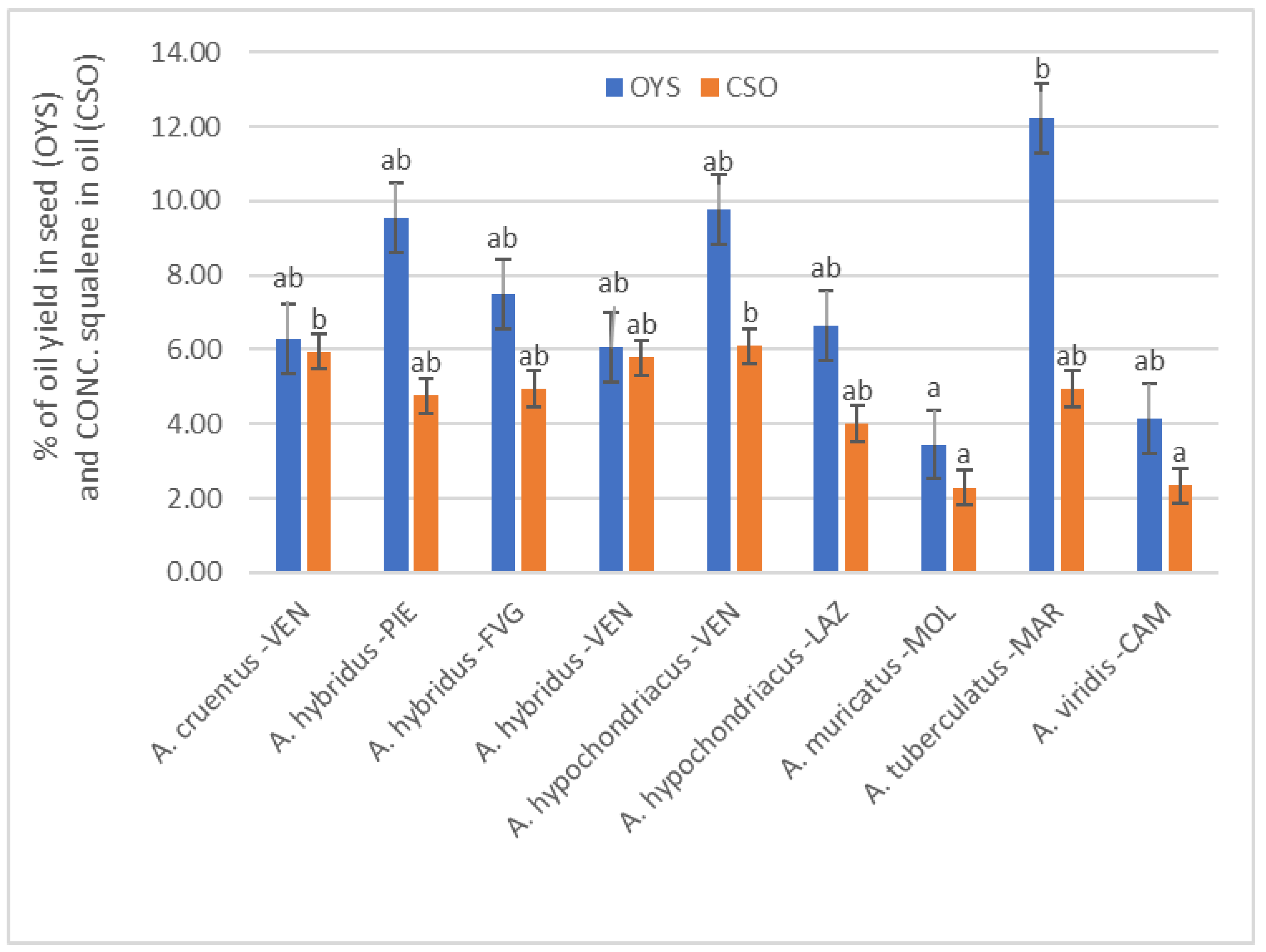
In accordance with our findings, the oil content in the seeds (OYS) of the six Amaranthus species ranges from 5.17% for A. muricatus to 12.20% for A. tuberculatus (Table 2 and Figure 1), and these two species are significantly different from each other. In detail, A. hybridus gathered from three different regions in northern Italy (PIE, FVG, VEN; see Table 1 for regional codes) shows overall high values of oil content, with no statistically significant differences in the three stands: 9.53%, 7.47%, and 6.05% values, respectively. A. hypochondriacus collected from two different regions reveals divergent values of 9.77% in the Veneto region (north Italy) and 6.64% in the Lazio region (central Italy), but these values are not statistically significant. Lastly, the oil content of A. cruentus is 6.29%, whereas it is 6.24% for A. viridis (Table 2 and Figure 1). According to our research, smaller-sized seeds (A. tuberculatus MAR) contain the highest percentage of oil, whereas larger seeds (A. muricatus MOL) contain the lowest percentage of oil OYS and squalene CSO. The OYS percentages obtained in this work support those previously reported: they show that the OYS in A. cruentus ranges from 1.09% to 8.20%, and from 3.03% to 8.70% in A. hypochondriacus ranges [26,27,28].
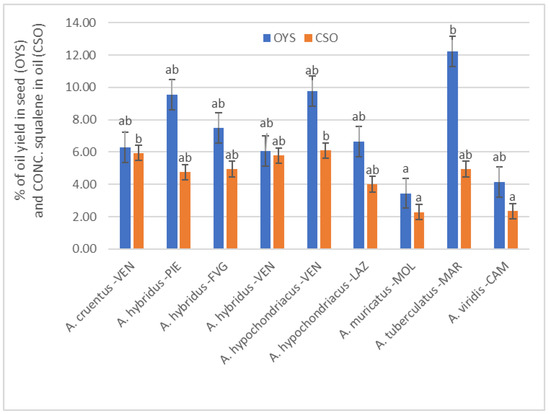
Figure 1.
Percentage of oil yield in seed (OYS) and concentration of squalene in oil (CSO) for the six species of Amaranthus collected. Different letters (a–d) indicate significant differences according to Tukey’s HSD test (p < 0.05).
3.3. Squalene Content
The investigation of the six Amaranthus species reveals considerable variations in the squalene content (CSO) depending on the samples (Table 2 and Figure 1). As a whole, the range of CSO varies from 3.43% for A. muricatus to 6.09% for A. hypochondriacus VEN (Table 1 and Table 2, and Figure 1). In detail, the species that grow at low altitudes and in a Mediterranean bioclimate (A. muricatus, A. viridis) show the significantly lowest CSO values (3.43%, 3.51%). On the other hand, A. hypochondriacus VEN and A. cruentus VEN, which grow in a temperate bioclimate, show the significantly highest CSO values (6.09% and 5.94%) (Table 1 and Table 2, and Figure 1). The CSO values for A. hybridus are very similar (PIE: 4.75%, FVG: 4.94%, VEN: 5.78%).
The results obtained for wild species are consistent with previously published results on squalene content in cultivated Amaranth species (Table 3). Regarding A. cruentus, A. hypocondriacus, and A. hybridus, our research results confirm the range of the values and align with the highest values found in the literature [14,26,27,28,29,30,31,32,33]. For A. muricatus, A. tuberculatus, and A. viridis, our research found values comparable to those reported in [14], and also contribute to the limited knowledge of CSO for these three species.
Table 3.
Comparison between squalene content in oil CSO from this study and from the major references data.
3.4. Free Fatty Acid, Sterol, and Tocopherol Content
Our results show a strongly varying amount of free fatty acids (FAS) found in Amaranthus oil for all the samples. The free fatty acid range is from 0.39% for A. hybridus FVG to 8.93% for A. viridis CAM (Table 2). A. cruentus, A. muricatus, A. tuberculatus, and A. viridis, collected at low altitudes (5 m, 14 m, 5 m, 12 m a.s.l.), show high levels of free fatty acids (1.73%, 1.17%, 2.42%, 8.93%), and only the value of A. viridis is significantly different from all the others (Table 2). Instead, the species growing at medium and high altitudes (144 m, 348 m, 380 m, 440 m, and 625 m a.s.l.), namely A. hybridus FVG, A. hybridus PIE, A. hybridus VEN, A. hypochondriacus VEN, and A. hypochondriacus LAZ, show free fatty acids levels lower than 1 (0.39%, 0.66%, 0.65%, 0.84%, and 0.65% respectively). The free fatty acid composition shows the nutritional value and stability of fats and oils. Our findings support the earlier studies that suggested Amaranth oil is a reliable source of free fatty acids [14,27,28,31,34,35,36,37].
Our research indicates that beta-sitosterol, brassicasterol, campesterol, and stigmasterol are the major sterols (SSO) present in Amaranthus oil (Table S1). Additionally, beta-sitosterol is the principal sterol present in all the Amaranth samples. The total sterols (SSO) range is between 83 ppm for A. tuberculatus and 857 ppm for A. hypochondriacus LAZ (Table 2). According to our study, the ranges of major sterols are 47–738 ppm for beta-sitosterol, 12–43 ppm for brassicasterol, 2–9 ppm for campesterol, and 8–130 ppm for stigmasterol (Table S1). Our results are similar to those of prior publications [38,39]. It is interesting to note that, among the Amaranth samples, the total sterol content (SSO) of A. hypochondriacus (LAZ) and A. hybridus (FVG and VEN) (Table 2) is higher than that of other plants studied, such as olive, peanut, palm, coconut, walnut, cashew, and almond [39,40].
Based on our studies, the range for total tocopherols (TSO) is from 70 ppm for the A. hybridus PIE region to 536 ppm for A. muricatus (Table 2). The ranges for the three main tocopherols are 6–14 ppm for alfa-tocopherol, 11–158 ppm for beta-tocopherol, and 39–289 ppm for delta-tocopherol (Table S2). These ranges are comparable to other results stated in the literature [38,41,42].
3.5. Multivariate Analysis
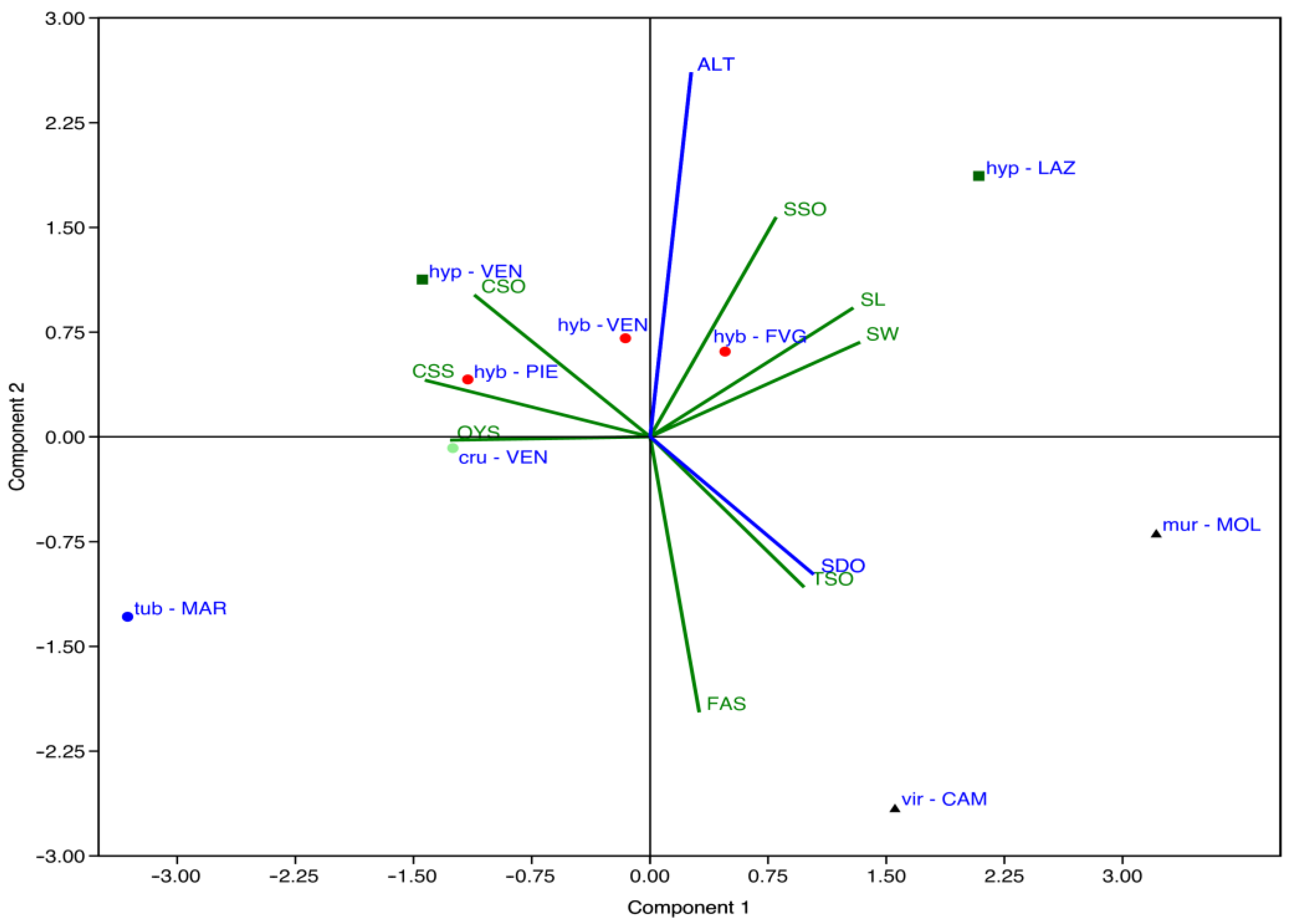
In the principal component analysis (Figure 2), the cumulative percentage of the first two axes (Components 1 and 2) is 75.464%, with the first one (PC1) contributing 52.039% to the total variance and the second (PC2) contributing 23.425%. A positive correlation between seed length (SL), seed width (SW), sterols in seed oil (SSO), and tocopherols in seed oil (TSO) was found along PC1. Conversely, the correlation is negative between the oil yield in seed (OYS), the concentration of squalene in seed oil (CSO), and the concentration of squalene in seed (CSS). PC2 shows a positive correlation with altitude (ALT) and a negative correlation with fatty acids (FAS).
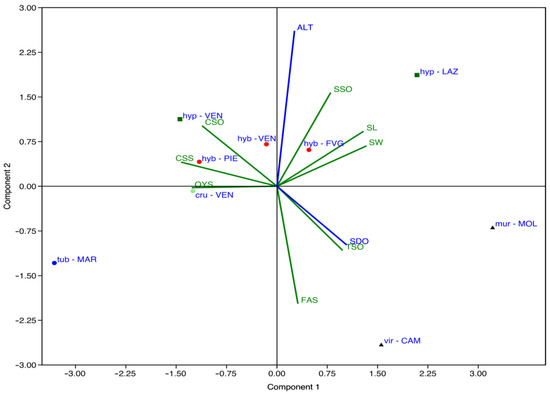
Figure 2.
Scatterplot of the first two principal components from the PCA was carried out with 10 variables and 9 samples. Blue line: ALT (altitude); SDO (seed color); green line: OYS (oil yield in seed); CSO (conc. squalene in oil); CSS (conc. squalene in seed); TSO (tocopherols in seed oil); SSO (sterols in seed oil); FAS (free fatty acids in seed oil); SL (seed length); SW (seed width).
PCA confirms the results obtained from the previous analysis: large seeds exhibit a higher tocopherol (TSO) and sterol (SSO) content, whereas small seeds exhibit a higher amount of oil yield in seed (OYS), concentration of squalene in seed oil (CSO), and concentration of squalene in seed (CSS). A. hybridus and A. hypocondriacus collected from altitudes from 144 to 625 m have low values of fatty acids (FAS); conversely, the species A. muricatus, A. tuberculatus, and A. viridis collected at low altitudes (5–14 m) exhibit the opposite behavior.
4. Conclusions
This study provides, for the first time, data on the squalene, free fatty acid, tocopherol, and sterol content and composition of six Amaranthus species that grow in wild habitats. These species exhibited similar characteristics to the commercial species, with both showing medium–high values for oil and squalene content. This study confirms that the collection site influences the oil and squalene content of the Amaranthus species. The growing interest in the seed of the genus Amaranthus all over the world, such as in nutraceutical, industrial, and medical fields, makes it necessary to expand the spectrum of the Amaranth species to be cultivated as a good source of squalene and other components.
Supplementary Materials
The following supporting information can be downloaded at https://www.mdpi.com/article/10.3390/d15020237/s1, Figure S1: regions where the Amaranthus species were collected in Italy: CAM Campania, FVG Friuli-Venezia Giulia, LAZ Lazio, MAR Marche, MOL Molise, PIE Piedmont, VEN Veneto. Other regions: AOS Val d’Aosta, LOM Lombardia, TRA Trentino-Alto Adige, LIG Liguria, EMR Emilia-Romagna, SMR Republic of San Marino, TOS Toscana, UMB Umbria, SCV Vatican City, State ABR Abruzzo, PUG Puglia, BAS Basilicata, CAL Calabria, SAR Sardegna, SIC Sicilia; Table S1: Sterol (beta-sitosterol, brassicasterol, campesterol, stigmasterol) composition of Amaranth seed oil collected from Italian wild habitats; AVG: average value, SD: standard deviation; Table S2: Tocopherol (alfa-tocopherol, beta-tocopherol, delta-tocopherol) composition of Amaranth seed oil collected from Italian wild habitats; AVG: average value, SD: standard deviation.
Author Contributions
Conceptualization, A.N.H. and P.F.; methodology, A.N.H., J.G., M.M. and A.V; software, A.N.H. and P.D.M.; validation, P.F. and A.N.H.; formal analysis, A.N.H. and J.G.; investigation, A.N.H. and P.F.; resources, A.N.H., J.G., M.M. and A.V.; data curation, P.F. and J.G.; writing—original draft preparation, A.N.H.; writing, A.N.H., J.G., M.M., A.V., D.I. and P.D.M.; review and editing, P.F., D.I. and J.G.; supervision, P.F. All authors have read and agreed to the published version of the manuscript.
Funding
This research received no external funding.
Data Availability Statement
Data are contained within the article and Supplementary Materials.
Acknowledgments
Thanks to Daniela Bouvet, Fabrizio Martini, Carlo Argenti, Nicole Hoffman, and Rizzieri Masin for sending the plant material. Special thanks to Hannah Krupa for being with me during plant collection and drying the samples.
Conflicts of Interest
No potential conflict of interest were provided by the authors.
References
- Iamonico, D. Taxonomic revision of the genus Amaranthus (Amaranthaceae) in Italy. Phytotaxa 2015, 199, 1–84. [Google Scholar] [CrossRef]
- Das, S. Amaranthus: A Promising Crop of the Future; Springer Nature: Singapore, 2016; pp. 13–48. [Google Scholar] [CrossRef]
- Iamonico, D. II Genere Amaranthus L. in Italia: Stato attuale delle conoscenze. Ann. Missouri Bot. Gard 2010, 273, 149–154. [Google Scholar] [CrossRef]
- Bayón, N.D. Revisión Taxonómica de las Especies Monoicas de Amaranthus (Amaranthaceae): Amaranthus subg. Amaranthus Amaranthus subg. Albersia1. Ann. Mo. Bot. Gard. 2015, 101, 261–383. [Google Scholar] [CrossRef]
- Iamonico, D. Nomenclatural survey of the genus Amaranthus (Amaranthaceae). 4. Detailed questions arising around the name Amaranthus gracilis. Bot Serb 2016, 40, 61–68. [Google Scholar] [CrossRef]
- Iamonico, D. Nomenclature survey of the genus Amaranthus (Amaranthaceae). 5. Moquin-Tandon’s names. Phytotaxa 2016, 273, 81–114. [Google Scholar] [CrossRef]
- Iamonico, D. A nomenclatural survey of the genus Amaranthus (Amaranthaceae) 7: Names published by Willdenow. Willdenowia 2020, 50, 147–155. [Google Scholar] [CrossRef]
- Iamonico, D.; El Mokni, R. Amaranthus palmeri (Amaranthaceae) in Tunisia, a second record for the continental African flora and nomenclatural notes on A. sonoriensis nom. nov. pro A. palmeri var. glomeratus. Bothalia 2017, 47, 4. [Google Scholar] [CrossRef]
- Iamonico, D.; Palmer, J. Nomenclature survey of the genus Amaranthus (Amaranthaceae). 6. Names linked to the Australian flora. Aust. Syst. Bot. 2020, 33, 169–173. [Google Scholar] [CrossRef]
- Nogoy, K.M.; Yu, J.; Song, Y.G.; LI, S.; Chung, J.W.; Choi, S.H. Evaluation of the nutrient composition, in vitro fermentation characteristics, and in situ degradability of Amaranthus caudatus, Amaranthus cruentus, and Amaranthus hypochondriacus in Cattle Animals. Basel 2021, 11, 18. [Google Scholar] [CrossRef]
- Sayed-Ahmad, B.; Urrutigoïty, M.; Hijazi, A.; Saad, Z.; Cerny, M.; Evon, P.; Talou, T.; Merah, O. Amaranth oilseed composition and cosmetic applications. Separations 2022, 9, 181. [Google Scholar] [CrossRef]
- Sheng, Y.Y.; Xiang, J.; Wang, K.R.; Li, Z.Y.; Li, K.; Lu, J.L.; Ye, J.H.; Liang, Y.R.; Zheng, X.Q. Extraction of squalene from tea leaves (Camellia sinensis) and its variations with leaf maturity and tea cultivar. Front. Nutr. 2022, 9, 37. [Google Scholar] [CrossRef]
- Wejnerowska, G.; Heinrich, P.; Gaca, J. Separation of squalene and oil from Amaranthus seeds by supercritical carbon dioxide. Sep. Purif. Technol. 2013, 110, 39–43. [Google Scholar] [CrossRef]
- He, H.-P.; Corke, H. Oil and squalene in Amaranthus grain and leaf. Agric. Food Chem. 2003, 51, 7913–7920. [Google Scholar] [CrossRef]
- Sun, H.; Wiesenborn, D.; Tostenson, K.; Gillespie, J.; Rayas-Duarte, P. Fractionation of squalene from amaranth seed oil. JAOCS 1997, 74, 413–418. [Google Scholar] [CrossRef]
- Aderibigbe, O.R.; Ezekiel, O.O.; Owolade, S.O.; Korese, J.K.; Sturm, B.; Hensel, O. Exploring the potentials of underutilized grain amaranth (Amaranthus spp.) along the value chain for food and nutrition security: A review. Crit. Rev. Food Sci. Nutr. 2022, 62, 656–669. [Google Scholar] [CrossRef]
- Taia, W.K.; Shehata, A.A.; Elshamy, E.M.; Ibrahim, M.M. Biosystematic studies for some Egyptian Amaranthus L. taxa and their significance in their identification. Taeckholmia 2020, 40, 85–99. [Google Scholar] [CrossRef]
- Krulj, J.; Brlek, T.; Pezo, L.; Brkljača, J.; Popović, S.; Zeković, Z.; Bodroža Solarov, M. Extraction methods of Amaranthus sp. grain oil isolation. J. Sci. Food Agric. 2016, 96, 3552–3558. [Google Scholar] [CrossRef]
- Sun, H.; Ge, X.; Lv, Y.; Wang, A. Application of accelerated solvent extraction in the analysis of organic contaminants, bioactive and nutritional compounds in food and feed. J. Chromatogr. 2012, 1237, 1–23. [Google Scholar] [CrossRef]
- Thomas, W.E.; Burke, I.C.; Spears, J.F.; Wilcut, J.W. Influence of environmental factors on slender amaranth (Amaranthus viridis) germination. Weed Sci. 2006, 54, 316–320. [Google Scholar] [CrossRef]
- Di Marzio, P.; Fortini, P. (Eds.) Il Museo Erbario dell’Università del Molise; Università degli Studi del Molise: Campobasso, Italy, 2015; p. 38. ISBN 9788896394151. Available online: https://hdl.handle.net/11695/47228 (accessed on 22 November 2022).
- Blasi, C.; Capotorti, G.; Copiz, R.; Guida, D.; Mollo, B.; Smiraglia, D.; Zavattero, L. Terrestrial Ecoregions of Italy; Map and Explanatory Notes; Global Map s.r.l., S.EL.C.A.: Firenze, Italy, 2018; p. 36. Available online: https://hdl.handle.net/11386/4746968 (accessed on 22 November 2022).
- Szabóová, M.; Záhorský, M.; Gažo, J.; Geuens, J.; Vermoesen, A.; D’Hondt, E.; Hricová, A. Differences in seed weight, amino acid, fatty acid, oil, and squalene content in γ-irradiation-developed and commercial amaranth varieties (Amaranthus spp.). Plants 2020, 9, 1412. [Google Scholar] [CrossRef]
- Addinsoft, A. Addinsoft XLSTAT Statistical and Data Analysis Solution; Long Island: New York, NY, USA, 2023. [Google Scholar]
- Hammer, Ø.; Harper, D.A.T.; Ryan, P.D. PAST: Paleontological Statistics Software Package for Education and Data Analysis. Palaeontol. Electron. 2001, 4, 9. [Google Scholar]
- Bozorov, S.S.; Berdiev, N.S.; Ishimov, U.J.; Olimjonov, S.S.; Ziyavitdinov, J.F.; Asrorov, A.M.; Salikhov, S.I. Chemical composition and biological activity of seed oil of amaranth varieties. Nova Biotechnol. Chim. 2018, 12, 66–73. [Google Scholar] [CrossRef]
- Hlinková, A.; Bednarova, A.; Havrlentová, M.; Šupová, J.; Čičová, I. Evaluation of fatty acid composition among selected amaranth grains grown in two consecutive years. Biologia 2013, 68, 641–650. [Google Scholar] [CrossRef]
- He, H.P.; Cai, Y.; Sun, M.; Corke, H. Extraction and purification of squalene from Amaranthus grain. J. Agric. Food Chem. 2002, 50, 368–372. [Google Scholar] [CrossRef]
- Berganza, B.E.; Moran, A.W.; Rodríguez, G.M.; Coto, N.M.; Santamaría, M.; Bressani, R. Effect of variety and location on the total fat, fatty acids and squalene content of amaranth. Plant Foods Hum. Nutr. 2003, 58, 1–6. [Google Scholar] [CrossRef]
- Gamel, T.H.; Mesallam, A.S.; Damir, A.A.; Shekib, L.A.; Linssen, J.P. Characterization of amaranth seed oils. J. Food Lipids 2007, 14, 323–334. [Google Scholar] [CrossRef]
- El Gendy, A.N.G.; Tavarini, S.; Conte, G.; Pistelli, L.; Hendawy, S.F.; Omer, E.A.; Angelini, L.G. Yield and qualitative characterisation of seeds of Amaranthus hypochondriacus L. and Amaranthus cruentus L. grown in central Italy. IJA 2018, 13, 63–73. [Google Scholar] [CrossRef]
- León-Camacho, M.; García-González, D.L.; Aparicio, R. A detailed and comprehensive study of amaranth (Amaranthus cruentus L.) oil fatty profile. Eur. Food Res. Technol. 2001, 213, 349–355. [Google Scholar] [CrossRef]
- Lyon, C.K.; Becker, R. Extraction and refining of oil from amaranth seed. JAOCS 1987, 64, 233–236. [Google Scholar] [CrossRef]
- Martirosyan, D.M.; Miroshnichenko, L.A.; Kulakova, S.N.; Pogojeva, A.V.; Zoloedov, V.I. Amaranth oil application for coronary heart disease and hypertension. Lipids Health Dis. 2007, 6, 44–45. [Google Scholar] [CrossRef]
- Ayorinde, F.O.; Ologunde, M.O.; Nana, E.Y.; Bernard, B.N.; Afolabi, O.A.; Oke, O.L.; Shepard, R.L. Determination of fatty acid composition of Amaranthus species. JAOCS 1989, 66, 1812–1814. [Google Scholar] [CrossRef]
- Prakash, D.; Pal, M. Seed protein, fat and fatty acid profile of Amaranthus species. J. Sci. Food Agric. 1992, 58, 145–147. [Google Scholar] [CrossRef]
- Srivastava, S.; Sreerama, Y.N.; Dharmaraj, U. Effect of processing on squalene content of grain amaranth fractions. J. Cereal Sci. 2021, 100, 103218. [Google Scholar] [CrossRef]
- Nasirpour-Tabrizi, P.; Azadmard-Damirchi, S.; Hesari, J.; Piravi-Vanak, Z. Amaranth seed oil composition. In Nutritional Value of Amaranth; Intech Open: London, UK, 2020. [Google Scholar] [CrossRef]
- Marcone, M.F.; Kakuda, Y.; Yada, R.Y. Amaranth as a rich dietary source of β-sitosterol and other phytosterols. Plant Foods Hum. Nutr. 2003, 58, 207–211. [Google Scholar] [CrossRef]
- Phillips, K.M.; Ruggio, D.M.; Toivo, J.I.; Swank, M.A.; Simpkins, A.H. Free and esterified sterol composition of edible oils and fats. J. Food Compos. Anal. 2002, 15, 123–142. [Google Scholar] [CrossRef]
- Kraujalis, P.; Venskutonis, P.R. Supercritical carbon dioxide extraction of squalene and tocopherols from amaranth and assessment of extracts antioxidant activity. J. Supercrit. Fluids 2013, 80, 78–85. [Google Scholar] [CrossRef]
- Santiago, P.; Tenbergen, K.; Vélez-Jiménez, E.; Cardador-Martínez, M.A. Functional attributes of amaranth. Int. J. Food Sci. Nutr. 2014, 2, 1010. [Google Scholar]
Disclaimer/Publisher’s Note: The statements, opinions and data contained in all publications are solely those of the individual author(s) and contributor(s) and not of MDPI and/or the editor(s). MDPI and/or the editor(s) disclaim responsibility for any injury to people or property resulting from any ideas, methods, instructions or products referred to in the content. |
© 2023 by the authors. Licensee MDPI, Basel, Switzerland. This article is an open access article distributed under the terms and conditions of the Creative Commons Attribution (CC BY) license (https://creativecommons.org/licenses/by/4.0/).