

Skip Content
You are currently on the new version of our website. Access the old version .

Marine Drugs, Volume 18, Issue 3

2020 March - 47 articles

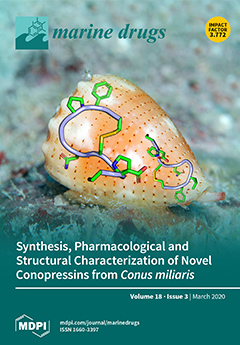
Cover Story: Cone snails produce a fast-acting venom, largely dominated by disulfide-rich conotoxins targeting ion channels. Although disulfide-poor conopeptides are usually minor components, their ability to target key membrane receptors such as GPCRs make them highly valuable as drug lead compounds. From the venom gland transcriptome of Conus miliaris, we report here on the discovery and characterization of two conopressins, which are nonapeptide ligands of the vasopressin/oxytocin receptor family. These novel sequence variants show unusual features, including a charge inversion at the critical position 8. Interestingly, Conopressin-M2 acted as a full agonist at the ZFV2 receptor with low micromolar affinity. Together with the NMR structures of amidated conopressins-M1, -M2, and -G, this study provides novel structure–activity relationship information that may help in the design of more selective ligands. View this paper
  • Issues are regarded as officially published after their release is announced to the table of contents alert mailing list .
  • You may sign up for email alerts to receive table of contents of newly released issues.
  • PDF is the official format for papers published in both, html and pdf forms. To view the papers in pdf format, click on the "PDF Full-text" link, and use the free Adobe Reader to open them.

Articles (47)

  • Communication
  • Open Access
4 Citations
2,999 Views
10 Pages

Design, Synthesis and Biological Evaluation of Jahanyne Analogs as Cell Cycle Arrest Inducers

  • Baijun Ye,
  • Jianmiao Gong,
  • Qiuying Li,
  • Shiqi Bao,
  • Xuemei Zhang,
  • Jing Chen,
  • Qing Meng,
  • Bolin Chen,
  • Peng Jiang and
  • Yue Chen
  • + 1 author

23 March 2020

Jahanyne, a lipopeptide with a unique terminal alkynyl and OEP (2-(1-oxo-ethyl)-pyrrolidine) moiety, exhibits anticancer activity. We synthesized jahanyne and analogs modified at the OEP moiety, employing an α-fluoromethyl ketone (FMK) strategy...

  • Article
  • Open Access
7 Citations
3,966 Views
17 Pages

23 March 2020

A potent marine toxin, tetrodotoxin (TTX), found in a great variety of marine and some terrestrial species, leaves intriguing questions about its origin and distribution in marine ecosystems. TTX-producing bacteria were found in the cultivable microf...

  • Article
  • Open Access
43 Citations
6,403 Views
15 Pages

Marine Microalgae, Spirulina maxima-Derived Modified Pectin and Modified Pectin Nanoparticles Modulate the Gut Microbiota and Trigger Immune Responses in Mice

  • H.P.S.U. Chandrarathna,
  • T.D. Liyanage,
  • S.L. Edirisinghe,
  • S.H.S. Dananjaya,
  • E.H.T. Thulshan,
  • Chamilani Nikapitiya,
  • Chulhong Oh,
  • Do-Hyung Kang and
  • Mahanama De Zoysa

21 March 2020

This study evaluated the modulation of gut microbiota, immune responses, and gut morphometry in C57BL/6 mice, upon oral administration of S. maxima-derived modified pectin (SmP, 7.5 mg/mL) and pectin nanoparticles (SmPNPs; 7.5 mg/mL). Metagenomics an...

  • Article
  • Open Access
203 Citations
14,680 Views
15 Pages

20 March 2020

This study aims to determine the influence of (1) ultrasound-assisted extraction (UAE), (2) microwave-assisted extraction (MAE) and (3) a combination of ultrasound–microwave-assisted extraction (UMAE) on the yields of fucose-sulphated polysacch...

  • Article
  • Open Access
17 Citations
4,013 Views
10 Pages

20 March 2020

The chemical examination of the marine soft coral Lemnalia sp., collected at the Xisha islands in the South China Sea, resulted in the isolation of four new nardosinane-type sesquiterpenoids, namely clavukoellians G–J (14), and one new a...

  • Review
  • Open Access
41 Citations
7,866 Views
28 Pages

Marine Toxins Targeting Kv1 Channels: Pharmacological Tools and Therapeutic Scaffolds

  • Rocio K. Finol-Urdaneta,
  • Aleksandra Belovanovic,
  • Milica Micic-Vicovac,
  • Gemma K. Kinsella,
  • Jeffrey R. McArthur and
  • Ahmed Al-Sabi

20 March 2020

Toxins from marine animals provide molecular tools for the study of many ion channels, including mammalian voltage-gated potassium channels of the Kv1 family. Selectivity profiling and molecular investigation of these toxins have contributed to the d...

  • Article
  • Open Access
23 Citations
5,575 Views
13 Pages

20 March 2020

Red alga dulse possesses a unique xylan, which is composed of a linear β-(1→3)/β-(1→4)-xylosyl linkage. We previously prepared characteristic xylooligosaccharide (DX3, (β-(1→3)-xylosyl-xylobiose)) from dulse. In this stu...

  • Article
  • Open Access
43 Citations
6,041 Views
14 Pages

Antimalarial Peptide and Polyketide Natural Products from the Fijian Marine Cyanobacterium Moorea producens

  • Anne Marie Sweeney-Jones,
  • Kerstin Gagaring,
  • Jenya Antonova-Koch,
  • Hongyi Zhou,
  • Nazia Mojib,
  • Katy Soapi,
  • Jeffrey Skolnick,
  • Case W. McNamara and
  • Julia Kubanek

18 March 2020

A new cyclic peptide, kakeromamide B (1), and previously described cytotoxic cyanobacterial natural products ulongamide A (2), lyngbyabellin A (3), 18E-lyngbyaloside C (4), and lyngbyaloside (5) were identified from an antimalarial extract of the Fij...

  • Review
  • Open Access
263 Citations
17,659 Views
29 Pages

Advanced Technologies for the Extraction of Marine Brown Algal Polysaccharides

  • Ana Dobrinčić,
  • Sandra Balbino,
  • Zoran Zorić,
  • Sandra Pedisić,
  • Danijela Bursać Kovačević,
  • Ivona Elez Garofulić and
  • Verica Dragović-Uzelac

18 March 2020

Over the years, brown algae bioactive polysaccharides laminarin, alginate and fucoidan have been isolated and used in functional foods, cosmeceutical and pharmaceutical industries. The extraction process of these polysaccharides includes several comp...

  • Review
  • Open Access
85 Citations
10,296 Views
22 Pages

18 March 2020

Fucoidans are multifunctional marine macromolecules that are subjected to numerous and various downstream processes during their production. These processes were considered the most important abiotic factors affecting fucoidan chemical skeletons, qua...

  • Article
  • Open Access
27 Citations
6,506 Views
18 Pages

Autotrophic and Heterotrophic Growth Conditions Modify Biomolecole Production in the Microalga Galdieria sulphuraria (Cyanidiophyceae, Rhodophyta)

  • Roberto Barone,
  • Lorenzo De Napoli,
  • Luciano Mayol,
  • Marina Paolucci,
  • Maria Grazia Volpe,
  • Luigi D’Elia,
  • Antonino Pollio,
  • Marco Guida,
  • Edvige Gambino and
  • Matteo Lorito
  • + 4 authors

18 March 2020

Algae have multiple similarities with fungi, with both belonging to the Thallophyte, a polyphyletic group of non-mobile organisms grouped together on the basis of similar characteristics, but not sharing a common ancestor. The main difference between...

  • Communication
  • Open Access
69 Citations
5,834 Views
11 Pages

Lysophosphatidylcholines and Chlorophyll-Derived Molecules from the Diatom Cylindrotheca closterium with Anti-Inflammatory Activity

  • Chiara Lauritano,
  • Kirsti Helland,
  • Gennaro Riccio,
  • Jeanette H. Andersen,
  • Adrianna Ianora and
  • Espen H. Hansen

17 March 2020

Microalgae have been shown to be excellent producers of lipids, pigments, carbohydrates, and a plethora of secondary metabolites with possible applications in the pharmacological, nutraceutical, and cosmeceutical sectors. Recently, various microalgal...

  • Article
  • Open Access
18 Citations
3,654 Views
17 Pages

16 March 2020

Chitosan is an active biopolymer, and the combination of it with other active groups can be a valuable method to improve the potential application of the resultant derivatives in food, cosmetics, packaging materials, and other industries. In this pap...

  • Article
  • Open Access
23 Citations
4,213 Views
9 Pages

Terpenoids from the Deep-Sea-Derived Fungus Penicillium thomii YPGA3 and Their Bioactivities

  • Zhongbin Cheng,
  • Wan Liu,
  • Runzhu Fan,
  • Shouye Han,
  • Yuanli Li,
  • Xiaoyun Cui,
  • Jia Zhang,
  • Yinan Wu,
  • Xin Lv and
  • Qin Li
  • + 4 authors

16 March 2020

A chemical study of the ethyl acetate (EtOAc) extract from the deep-sea-derived fungus Penicillium thomii YPGA3 led to the isolation of a new austalide meroterpenoid (1) and seven known analogues (28), two new labdane-type diterpenoids (9 and...

  • Communication
  • Open Access
46 Citations
4,473 Views
10 Pages

16 March 2020

Soil-borne pathogens, including phytopathogenic fungi and root-knot nematodes, could synergistically invade vegetable roots and result in serious economic losses. The genus of Trichoderma has been proven to be a promising reservoir of biocontrol agen...

  • Article
  • Open Access
35 Citations
4,367 Views
12 Pages

13 March 2020

Four new thiodiketopiperazine alkaloids, namely, 5’-hydroxy-6’-ene-epicoccin G (1), 7-methoxy-7’-hydroxyepicoccin G (2), 8’-acetoxyepicoccin D (3), and 7’-demethoxyrostratin C (4), as well as a pair of new enantiomeric d...

  • Article
  • Open Access
4 Citations
3,427 Views
11 Pages

Establishment of Novel High-Standard Chemiluminescent Assay for NTPase in Two Protozoans and Its High-Throughput Screening

  • Masamitsu Harada,
  • Jun Nagai,
  • Riho Kurata,
  • Kenji Shimizu,
  • Xiaofeng Cui,
  • Takayuki Isagawa,
  • Hiroaki Semba,
  • Jun Ishihara,
  • Yasuhiro Yoshida and
  • Tomo Yonezawa
  • + 2 authors

13 March 2020

Toxoplasma gondii is a major protozoan parasite and infects human and many other warm-blooded animals. The infection leads to Toxoplasmosis, a serious issue in AIDS patients, organ transplant recipients and pregnant women. Neospora caninum, another t...

  • Article
  • Open Access
23 Citations
4,127 Views
17 Pages

Antioxidant, Hypolipidemic and Hepatic Protective Activities of Polysaccharides from Phascolosoma esculenta

  • Yaqing Wu,
  • Hongying Jiang,
  • Jyuan-Siou Lin,
  • Jia Liu,
  • Chang-Jer Wu and
  • Ruian Xu

12 March 2020

The aims of this study were to investigate the antioxidant, hypolipidemic and hepatic protective effects of Phascolosoma esculenta polysaccharides (PEP). PEP was prepared from Phascolosoma esculenta by enzyme hydrolysis and its characterization was a...

  • Feature Paper
  • Article
  • Open Access
11 Citations
4,433 Views
30 Pages

Types and Distribution of Bioactive Polyunsaturated Aldehydes in a Gradient from Mesotrophic to Oligotrophic Waters in the Alborán Sea (Western Mediterranean)

  • Ana Bartual,
  • María Hernanz-Torrijos,
  • Iria Sala,
  • María J. Ortega,
  • Cristina González-García,
  • Marina Bolado-Penagos,
  • Angel López-Urrutia,
  • Leonardo Romero-Martínez,
  • Luís M. Lubián and
  • Carlos M. García
  • + 2 authors

12 March 2020

Polyunsaturated aldehydes (PUAs) are bioactive molecules suggested as chemical defenses and infochemicals. In marine coastal habitats, diatoms reach high PUA production levels during bloom episodes. Two fractions of PUA can usually be analyzed: pPUA...

  • Article
  • Open Access
23 Citations
4,481 Views
14 Pages

Immunoadjuvant Activity of Fucoidans from the Brown Alga Fucus evanescens

  • Tatyana A. Kuznetsova,
  • Tatyana P. Smolina,
  • Ilona D. Makarenkova,
  • Lydmila A. Ivanushko,
  • Elena V. Persiyanova,
  • Svetlana P. Ermakova,
  • Artem S. Silchenko,
  • Tatyana S. Zaporozhets,
  • Natalya N. Besednova and
  • Sergey P. Kryzhanovsky
  • + 1 author

11 March 2020

The study presents the results of a comparative evaluation of the effect of structural modifications of fucoidans from the brown alga Fucus evanescens (native, highly purified product of fucoidan enzymatic hydrolysis, a new regular 1→3;1→4-...

  • Article
  • Open Access
110 Citations
6,752 Views
19 Pages

11 March 2020

Bioactive peptides from fish collagens with antioxidant properties have become a topic of great interest for health, food, and processing/preservation industries. To explore the high-value utilized way of scales produced during the fish processing, c...

  • Article
  • Open Access
42 Citations
4,736 Views
13 Pages

Effect of a Laminarin Rich Macroalgal Extract on the Caecal and Colonic Microbiota in the Post-Weaned Pig

  • Stafford Vigors,
  • John V O’Doherty,
  • Ruth Rattigan,
  • Mary J McDonnell,
  • Gaurav Rajauria and
  • Torres Sweeney

11 March 2020

Dietary supplementation with 300 ppm of a laminarin rich macroalgal extract reduces post-weaning intestinal dysfunction in pigs. A comprehensive analysis of the impact of laminarin on the intestinal microbiome during this period is essential to infor...

  • Article
  • Open Access
123 Citations
6,407 Views
21 Pages

10 March 2020

In the work, defatted muscle proteins of monkfish (Lophius litulon) were separately hydrolyzed by pepsin, trypsin, and in vitro gastrointestinal (GI) digestion methods, and antioxidant peptides were isolated from proteins hydrolysate of monkfish musc...

  • Article
  • Open Access
28 Citations
6,046 Views
13 Pages

Improvement of Psoriasis by Alteration of the Gut Environment by Oral Administration of Fucoidan from Cladosiphon Okamuranus

  • Masanobu Takahashi,
  • Kento Takahashi,
  • Sunao Abe,
  • Kosuke Yamada,
  • Manami Suzuki,
  • Mai Masahisa,
  • Mari Endo,
  • Keiko Abe,
  • Ryo Inoue and
  • Hiroko Hoshi

10 March 2020

Psoriasis is a chronic autoimmune inflammatory disease for which there is no cure; it results in skin lesions and has a strong negative impact on patients’ quality of life. Fucoidan from Cladosiphon okamuranus is a dietary seaweed fiber with im...

  • Article
  • Open Access
52 Citations
5,493 Views
18 Pages

Laminarin-Derived from Brown Algae Suppresses the Growth of Ovarian Cancer Cells via Mitochondrial Dysfunction and ER Stress

  • Hyocheol Bae,
  • Gwonhwa Song,
  • Jin-Young Lee,
  • Taeyeon Hong,
  • Moon-Jeong Chang and
  • Whasun Lim

9 March 2020

Ovarian cancer (OC) is difficult to diagnose at an early stage and leads to the high mortality rate reported in the United States. Standard treatment for OC includes maximal cytoreductive surgery followed by platinum-based chemotherapy. However, rela...

  • Article
  • Open Access
13 Citations
4,295 Views
14 Pages

Synthesis, Pharmacological and Structural Characterization of Novel Conopressins from Conus miliaris

  • Julien Giribaldi,
  • Lotten Ragnarsson,
  • Tom Pujante,
  • Christine Enjalbal,
  • David Wilson,
  • Norelle L. Daly,
  • Richard J. Lewis and
  • Sebastien Dutertre

6 March 2020

Cone snails produce a fast-acting and often paralyzing venom, largely dominated by disulfide-rich conotoxins targeting ion channels. Although disulfide-poor conopeptides are usually minor components of cone snail venoms, their ability to target key m...

  • Article
  • Open Access
32 Citations
5,668 Views
17 Pages

The Nutritional and Pharmacological Potential of New Australian Thraustochytrids Isolated from Mangrove Sediments

  • Thi Linh Nham Tran,
  • Ana F. Miranda,
  • Adarsha Gupta,
  • Munish Puri,
  • Andrew S. Ball,
  • Benu Adhikari and
  • Aidyn Mouradov

6 March 2020

Mangrove sediments represent unique microbial ecosystems that act as a buffer zone, biogeochemically recycling marine waste into nutrient-rich depositions for marine and terrestrial species. Marine unicellular protists, thraustochytrids, colonizing m...

  • Article
  • Open Access
16 Citations
5,146 Views
14 Pages

A Phenotarget Approach for Identifying an Alkaloid Interacting with the Tuberculosis Protein Rv1466

  • Yan Xie,
  • Yunjiang Feng,
  • Angela Di Capua,
  • Tin Mak,
  • Garry W. Buchko,
  • Peter J. Myler,
  • Miaomiao Liu and
  • Ronald J. Quinn

5 March 2020

In recent years, there has been a revival of interest in phenotypic-based drug discovery (PDD) due to target-based drug discovery (TDD) falling below expectations. Both PDD and TDD have their unique advantages and should be used as complementary meth...

  • Article
  • Open Access
28 Citations
5,532 Views
15 Pages

4 March 2020

High-fat and high-sucrose diet (HFHSD)-induced obesity leads to oxidative stress and chronic inflammatory status. However, little is known about the beneficial effects of total lipids extracted from Spirulina. Hence, in the present study, Spirulina l...

  • Review
  • Open Access
95 Citations
10,213 Views
17 Pages

2 March 2020

Alkaloids are nitrogenous compounds with various biological activities. Alkaloids with anti-inflammatory activity are commonly found in terrestrial plants, but there are few records of the identification and characterization of the activity of these...

  • Article
  • Open Access
4 Citations
3,170 Views
15 Pages

29 February 2020

A convenient and sensitive triple-wavelength overlapping resonance Rayleigh scattering (TWO-RRS) method for the detection of chito-oligosaccharides (COS) was proposed based on enhancing the rigid surface of porous reticular spatial structure of gelat...

  • Feature Paper
  • Review
  • Open Access
37 Citations
8,037 Views
40 Pages

28 February 2020

Marine macroalgae occurring in the south eastern region of Victoria, Australia, consisting of Port Phillip Bay and the heads entering the bay, is the focus of this review. This area is home to approximately 200 different species of macroalgae, repres...

  • Communication
  • Open Access
24 Citations
5,288 Views
11 Pages

Micro RNA Expression after Ingestion of Fucoidan; A Clinical Study

  • Nuri Gueven,
  • Kevin J. Spring,
  • Sandra Holmes,
  • Kiran Ahuja,
  • Raj Eri,
  • Ah Young Park and
  • J Helen Fitton

28 February 2020

Fucoidans are a class of fucose-rich sulfated polysaccharides derived from brown macroalgae that exert a range of biological activities in vitro and in vivo. To generate an unbiased assessment of pathways and processes affected by fucoidan, a placebo...

  • Review
  • Open Access
226 Citations
13,529 Views
26 Pages

Advances in Research on the Bioactivity of Alginate Oligosaccharides

  • Maochen Xing,
  • Qi Cao,
  • Yu Wang,
  • Han Xiao,
  • Jiarui Zhao,
  • Qing Zhang,
  • Aiguo Ji and
  • Shuliang Song

28 February 2020

Alginate is a natural polysaccharide present in various marine brown seaweeds. Alginate oligosaccharide (AOS) is a degradation product of alginate, which has received increasing attention due to its low molecular weight and promising biological activ...

  • Review
  • Open Access
60 Citations
10,373 Views
26 Pages

Antibiotics Development and the Potentials of Marine-Derived Compounds to Stem the Tide of Multidrug-Resistant Pathogenic Bacteria, Fungi, and Protozoa

  • Justus Amuche Nweze,
  • Florence N. Mbaoji,
  • Gang Huang,
  • Yanming Li,
  • Liyan Yang,
  • Yunkai Zhang,
  • Shushi Huang,
  • Lixia Pan and
  • Dengfeng Yang

28 February 2020

As the search for new antibiotics continues, the resistance to known antimicrobial compounds continues to increase. Many researchers around the world, in response to antibiotics resistance, have continued to search for new antimicrobial compounds in...

  • Article
  • Open Access
20 Citations
4,623 Views
12 Pages

Anti-Inflammatory Activity of Glycolipids and a Polyunsaturated Fatty Acid Methyl Ester Isolated from the Marine Dinoflagellate Karenia mikimotoi

  • Alain S. Leutou,
  • Jennifer R. McCall,
  • Robert York,
  • Rajeshwar R. Govindapur and
  • Andrea J. Bourdelais

27 February 2020

A new monogalactosyldiacylglycerol (MGDG), a known monogalactosylmonoacylglycerol (MGMG) and a known polyunsaturated fatty acid methyl ester (PUFAME) were isolated from the marine dinoflagellate Karenia mikimotoi. The planar structure of the glycolip...

  • Article
  • Open Access
22 Citations
3,627 Views
10 Pages

27 February 2020

Nephrotic syndrome (NS) is a clinical syndrome with a variety of causes, mainly characterized by heavy proteinuria, hypoalbuminemia, and edema. At present, identification of effective and less toxic therapeutic interventions for nephrotic syndrome re...

  • Article
  • Open Access
23 Citations
5,470 Views
16 Pages

27 February 2020

Radiation-induced fibrosis (RIF) occurs after radiation therapy in normal tissues due to excessive production and deposition of extracellular matrix proteins and collagen, possibly resulting in organ function impairment. This study investigates the e...

  • Article
  • Open Access
28 Citations
4,244 Views
14 Pages

Two Highly Similar Chitinases from Marine Vibrio Species have Different Enzymatic Properties

  • Xinxin He,
  • Min Yu,
  • Yanhong Wu,
  • Lingman Ran,
  • Weizhi Liu and
  • Xiao-Hua Zhang

27 February 2020

Chitinase, as one of the most important extracellular enzymes in the marine environment, has great ecological and applied values. In this study, two chitinases (Chi1557 and Chi4668) with 97.33% amino acid sequences identity were individually found in...

  • Article
  • Open Access
47 Citations
6,395 Views
23 Pages

27 February 2020

Macroalgae are potentially excellent sources of bioactive secondary metabolites useful for the development of new functional ingredients. This study was conducted to determine the antimicrobial efficacy of the hot water crude extracts (HWCEs) of thre...

  • Article
  • Open Access
9 Citations
2,820 Views
16 Pages

27 February 2020

Prostaglandin A2-AcMe (1) and Prostaglandin A2 (2) were isolated from the octocoral Plexaura homomalla and three semisynthetic derivatives (35) were then obtained using a reduction protocol. All compounds were identified through one- and two-d...

  • Article
  • Open Access
39 Citations
4,710 Views
10 Pages

New Thiodiketopiperazine and 3,4-Dihydroisocoumarin Derivatives from the Marine-Derived Fungus Aspergillus terreus

  • Jing-Shuai Wu,
  • Xiao-Hui Shi,
  • Guang-Shan Yao,
  • Chang-Lun Shao,
  • Xiu-Mei Fu,
  • Xiu-Li Zhang,
  • Hua-Shi Guan and
  • Chang-Yun Wang

26 February 2020

Aspergillus terreus has been reported to produce many secondary metabolites that exhibit potential bioactivities, such as antibiotic, hypoglycemic, and lipid-lowering activities. In the present study, two new thiodiketopiperazines, emestrins L (1) an...

  • Article
  • Open Access
16 Citations
3,542 Views
11 Pages

26 February 2020

In the present study, histone from immature testis of Atlantic salmon was extracted and identified, and its antibacterial activity after enzymolysis was investigated. Histone extracted from Atlantic salmon (Salmo salar) testis using the acid extracti...

  • Article
  • Open Access
11 Citations
3,172 Views
13 Pages

Highly Substituted Phenol Derivatives with Nitric Oxide Inhibitory Activities from the Deep-Sea-Derived Fungus Trichobotrys effuse FS524

  • Shanchong Chen,
  • Zhaoming Liu,
  • Yuchan Chen,
  • Haibo Tan,
  • Saini Li,
  • Hongxin Liu,
  • Weimin Zhang and
  • Shuang Zhu

26 February 2020

Chemical investigation on EtOAc extract of the deep-sea-derived fungus Trichobotrys effuse FS524 resulted in the isolation of six new highly substituted phenol derivatives, trieffusols A–F (16), along with ten known relative analogs (7&n...

  • Article
  • Open Access
10 Citations
3,538 Views
14 Pages

Structural and Functional Characterization of Conotoxins from Conus achatinus Targeting NMDAR

  • Xiujie Liu,
  • Ge Yao,
  • Kang Wang,
  • Yanli Liu,
  • Xiukun Wan and
  • Hui Jiang

26 February 2020

Conotoxin-Ac1 and its variant conotoxin-Ac1-O6P, were isolated from the venom duct of Conus achatinus, a fish-hunting cone snail species collected in the Sea of Hainan, China. Conotoxin-Ac1 is linear peptide that contain 15 amino acids. In the presen...

  • Article
  • Open Access
20 Citations
6,101 Views
17 Pages

Whole Genome Sequence of Dermacoccus abyssi MT1.1 Isolated from the Challenger Deep of the Mariana Trench Reveals Phenazine Biosynthesis Locus and Environmental Adaptation Factors

  • Wael M. Abdel-Mageed,
  • Bertalan Juhasz,
  • Burhan Lehri,
  • Ali S. Alqahtani,
  • Imen Nouioui,
  • Dawrin Pech-Puch,
  • Jioji N. Tabudravu,
  • Michael Goodfellow,
  • Jaime Rodríguez and
  • Andrey V. Karlyshev
  • + 1 author

25 February 2020

Dermacoccus abyssi strain MT1.1T is a piezotolerant actinobacterium that was isolated from Mariana Trench sediment collected at a depth of 10898 m. The organism was found to produce ten dermacozines (A‒J) that belonged to a new phenazine family and w...

Get Alerted

Add your email address to receive forthcoming issues of this journal.

XFacebookLinkedIn
Mar. Drugs - ISSN 1660-3397