
Skip Content
You are currently on the new version of our website. Access the old version .

Marine Drugs, Volume 20, Issue 8

2022 August - 75 articles

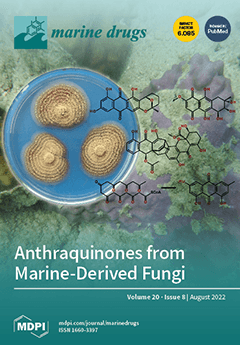
Cover Story: Anthraquinones are an important group of fungal secondary metabolites which are biosynthesized via the acetate-malonate pathway. Marine-derived fungi from different ecological niches are shown to be important sources of anthraquinones and their derivatives. This class of compounds exhibits a myriad of biological and pharmacological activities such as antibacterial, antifungal, antiviral, antioxidant, anti‐inflammatory, anti‐fouling, cytotoxicity, as well as inhibition of various enzymes. This review discusses the biosynthesis, structures and sources of 296 anthraquinonoids reported in the literature from 2000 to 2021. In addition, a classification of marine-derived anthraquinones and their derivatives into subclasses, according to their scaffolds, and relevant biological/pharmacological activities of some isolated anthraquinones are highlighted. View this paper
  • Issues are regarded as officially published after their release is announced to the table of contents alert mailing list .
  • You may sign up for email alerts to receive table of contents of newly released issues.
  • PDF is the official format for papers published in both, html and pdf forms. To view the papers in pdf format, click on the "PDF Full-text" link, and use the free Adobe Reader to open them.

Articles (75)

  • Review
  • Open Access
33 Citations
8,204 Views
17 Pages

Potential Beneficial Effects of Sargassum spp. in Skin Aging

  • Min-Kyeong Lee,
  • Heeyeon Ryu,
  • Ji Yun Lee,
  • Hyeon Hak Jeong,
  • Jiwon Baek,
  • Ji Yun Van,
  • Myeong-Jin Kim,
  • Won-Kyo Jung and
  • Bonggi Lee

22 August 2022

Seaweeds are receiving much attention as a rich source of bioactive compounds with cosmeceutical potential. Recent studies have revealed that Sargassum spp., a genus of brown algae in the family Sargassaceae, has multiple functions in preventing and...

  • Review
  • Open Access
12 Citations
3,462 Views
12 Pages

An Insight into the Role of Marine Biopolymer Alginate in Endodontics: A Review

  • Galvin Sim Siang Lin,
  • Chia Yee Cher,
  • Yong Hong Goh,
  • Daryl Zhun Kit Chan,
  • Mohmed Isaqali Karobari,
  • Josephine Chang Hui Lai and
  • Tahir Yusuf Noorani

22 August 2022

Alginate is a natural marine biopolymer that has been widely used in biomedical applications, but research on its use as an endodontic material is still sparse in the literature. This pioneer review aims to summarize the emerging roles of alginate an...

  • Article
  • Open Access
9 Citations
3,181 Views
9 Pages

Halo- and Thiocarbazomycins from Coral- and Coral Reef Sands-Derived Actinomycetes

  • Qiaoling Wu,
  • Hongjie Zhu,
  • Changli Sun,
  • Le Zhou,
  • Huimin Wang,
  • Songbiao Shi,
  • Xinpeng Tian and
  • Jianhua Ju

21 August 2022

Four actinomycete strains isolated from the coral Acropora austera and coral sand samples from the South China Sea, were found to produce a series of halogenated compounds baring similar ultraviolet absorption based on the analysis of HPLC and LC-MS....

  • Article
  • Open Access
14 Citations
3,573 Views
15 Pages

Synaptamide Modulates Astroglial Activity in Mild Traumatic Brain Injury

  • Arina Ponomarenko,
  • Anna Tyrtyshnaia,
  • Darya Ivashkevich,
  • Ekaterina Ermolenko,
  • Inessa Dyuizen and
  • Igor Manzhulo

21 August 2022

At present, the study of the neurotropic activity of polyunsaturated fatty acid ethanolamides (N-acylethanolamines) is becoming increasingly important. N-docosahexaenoylethanolamine (synaptamide, DHEA) is a highly active metabolite of docosahexaenoic...

  • Review
  • Open Access
178 Citations
12,462 Views
36 Pages

Progress in Research of Chitosan Chemical Modification Technologies and Their Applications

  • Qizhou Chen,
  • Yi Qi,
  • Yuwei Jiang,
  • Weiyan Quan,
  • Hui Luo,
  • Kefeng Wu,
  • Sidong Li and
  • Qianqian Ouyang

21 August 2022

Chitosan, which is derived from chitin, is the only known natural alkaline cationic polymer. Chitosan is a biological material that can significantly improve the living standard of the country. It has excellent properties such as good biodegradabilit...

  • Article
  • Open Access
15 Citations
4,184 Views
20 Pages

Carrageenophyte Kappaphycus malesianus Inhibits Microglia-Mediated Neuroinflammation via Suppression of AKT/NF-κB and ERK Signaling Pathways

  • Nicole Jean-Yean Lai,
  • Ee-Ling Ngu,
  • Jun-Rui Pang,
  • Kah-Hui Wong,
  • Chrismawan Ardianto,
  • Long Chiau Ming,
  • Siew-Huah Lim,
  • Shweta Gangasa Walvekar,
  • Ayaz Anwar and
  • Yoon-Yen Yow

20 August 2022

Neuroinflammation is an inflammatory response in any part of the central nervous system triggered by the activation of microglia and astrocytes to produce proinflammatory cytokines in the brain. However, overproduction of proinflammatory cytokines fu...

  • Review
  • Open Access
28 Citations
5,797 Views
35 Pages

20 August 2022

Mangrove ecosystems are widely distributed in the intertidal zone of tropical and subtropical estuaries or coasts, containing abundant biological communities, for example, mangrove plants and diverse groups of microorganisms, featuring various bioact...

  • Article
  • Open Access
6 Citations
3,466 Views
20 Pages

Structural and Biochemical Analysis Reveals Catalytic Mechanism of Fucoidan Lyase from Flavobacterium sp. SA-0082

  • Juanjuan Wang,
  • Zebin Liu,
  • Xiaowei Pan,
  • Ning Wang,
  • Legong Li,
  • Yuguang Du,
  • Jianjun Li and
  • Mei Li

20 August 2022

Fucoidans represent a type of polyanionic fucose-containing sulfated polysaccharides (FCSPs) that are cleaved by fucoidan-degrading enzymes, producing low-molecular-weight fucoidans with multiple biological activities suitable for pharmacological use...

  • Article
  • Open Access
10 Citations
4,039 Views
19 Pages

Discovery of Ircinianin Lactones B and C—Two New Cyclic Sesterterpenes from the Marine Sponge Ircinia wistarii

  • Thomas Majer,
  • Keshab Bhattarai,
  • Jan Straetener,
  • Justus Pohlmann,
  • Patrick Cahill,
  • Markus O. Zimmermann,
  • Marc P. Hübner,
  • Marcel Kaiser,
  • Johan Svenson and
  • Harald Gross
  • + 3 authors

19 August 2022

Two new ircinianin-type sesterterpenoids, ircinianin lactone B and ircinianin lactone C (7 and 8), together with five known entities from the ircinianin compound family (1, 36) were isolated from the marine sponge Ircinia wistarii. Ircinianin...

  • Review
  • Open Access
7 Citations
5,122 Views
20 Pages

Conotoxin Patenting Trends in Academia and Industry

  • Noemi Sanchez-Campos,
  • Johanna Bernaldez-Sarabia and
  • Alexei F. Licea-Navarro

19 August 2022

Sea snails of the genus Conus produce toxins that have been the subjects of numerous studies, projects, publications, and patents over the years. Since Conus toxins were discovered in the 1960s, their biological activity has been thought to have high...

  • Article
  • Open Access
7 Citations
3,037 Views
19 Pages

19 August 2022

Enantioseparation of the newly synthesized series of novel quinoline-2(1H)-one epoxide structures rac-6ac and rac-8ac, named marinoepoxides, is described. Marinoepoxide rac-6a, the key intermediate in the total synthesis of natural prod...

  • Article
  • Open Access
21 Citations
3,228 Views
9 Pages

18 August 2022

Five new aromatic polyketides, including a unique benzofuran derivative, talarominine A (1), and four chromone analogs talamins A–D (25), along with one known related metabolite, 5-hydroxy-7-methoxy-2,3-dimethylchromone (6), were isolate...

  • Review
  • Open Access
115 Citations
14,664 Views
40 Pages

Marine Natural Products in Clinical Use

  • Neshatul Haque,
  • Sana Parveen,
  • Tingting Tang,
  • Jiaen Wei and
  • Zunnan Huang

18 August 2022

Marine natural products are potent and promising sources of drugs among other natural products of plant, animal, and microbial origin. To date, 20 drugs from marine sources are in clinical use. Most approved marine compounds are antineoplastic, but s...

  • Article
  • Open Access
4 Citations
3,444 Views
15 Pages

18 August 2022

Collagen hydrogels have been extensively applied in biomedical applications. However, their mechanical properties are insufficient for such applications. Our previous study showed improved mechanical properties when collagen was blended with alginate...

  • Review
  • Open Access
54 Citations
6,444 Views
30 Pages

Marine-Bioinspired Nanoparticles as Potential Drugs for Multiple Biological Roles

  • Geum-Jae Jeong,
  • Sohail Khan,
  • Nazia Tabassum,
  • Fazlurrahman Khan and
  • Young-Mog Kim

18 August 2022

The increased interest in nanomedicine and its applicability for a wide range of biological functions demands the search for raw materials to create nanomaterials. Recent trends have focused on the use of green chemistry to synthesize metal and metal...

  • Article
  • Open Access
18 Citations
3,168 Views
14 Pages

Immunosuppressive Cytochalasins from the Mangrove Endophytic Fungus Phomopsis asparagi DHS-48

  • Zhao Feng,
  • Xuexia Zhang,
  • Jingwan Wu,
  • Chengwen Wei,
  • Ting Feng,
  • Dongdong Zhou,
  • Zhenchang Wen and
  • Jing Xu

18 August 2022

Three new cytochalasins, phomoparagins A-C (13), along with five known analogs (48), were isolated from Phomopsis asparagi DHS-48, a mangrove-derived endophytic fungus. Their structures, including their absolute configurations, were elu...

  • Review
  • Open Access
46 Citations
6,952 Views
31 Pages

Archaea Carotenoids: Natural Pigments with Unexplored Innovative Potential

  • Antoine Grivard,
  • Isabelle Goubet,
  • Luiz Miranda de Souza Duarte Filho,
  • Valérie Thiéry,
  • Sylvie Chevalier,
  • Raimundo Gonçalves de Oliveira-Junior,
  • Noureddine El Aouad,
  • Jackson Roberto Guedes da Silva Almeida,
  • Przemysław Sitarek and
  • Laurent Picot
  • + 3 authors

17 August 2022

For more than 40 years, marine microorganisms have raised great interest because of their major ecological function and their numerous applications for biotechnology and pharmacology. Particularly, Archaea represent a resource of great potential for...

  • Article
  • Open Access
5 Citations
3,880 Views
12 Pages

Identification of PKS-NRPS Hybrid Metabolites in Marine-Derived Penicillium oxalicum

  • Hongcheng Li,
  • Wei Zhang,
  • Xuan Zhang,
  • Shen Tang,
  • Ping Men,
  • Mengyi Xiong,
  • Zhimin Li,
  • Yongyu Zhang,
  • Xuenian Huang and
  • Xuefeng Lu

16 August 2022

Filamentous fungi are abundant resources of bioactive natural products. Here, 151 marine-derived fungi were collected from the north Yellow Sea and identified by an internal transcribed spacer (ITS) sequence. The crude extracts of all strains were ev...

  • Review
  • Open Access
62 Citations
10,040 Views
25 Pages

Mucoadhesive Marine Polysaccharides

  • Irina M. Yermak,
  • Viktoriya N. Davydova and
  • Aleksandra V. Volod’ko

15 August 2022

Mucoadhesive polymers are of growing interest in the field of drug delivery due to their ability to interact with the body’s mucosa and increase the effectiveness of the drug. Excellent mucoadhesive performance is typically observed for polymer...

  • Review
  • Open Access
84 Citations
10,396 Views
22 Pages

15 August 2022

Sea cucumbers are considered a luxury food item and used locally in traditional medication due to their impressive nutritional profile and curative effects. Sea cucumbers contain a wide range of bioactive compounds, namely phenolics, polysaccharides,...

  • Article
  • Open Access
27 Citations
3,862 Views
18 Pages

15 August 2022

In order to discover a broad-specificity and high stability chitinase, a marine fungus, Aspergillus fumigatus df347, was identified in the sediments of mangrove wetlands in Qinzhou Bay, China. The chitinase gene (AfChi28) from A. fumigatus df347 was...

  • Article
  • Open Access
9 Citations
4,502 Views
13 Pages

Mixotrophic Cultivation Optimization of Microalga Euglena pisciformis AEW501 for Paramylon Production

  • Panpan Fan,
  • Yanhua Li,
  • Rui Deng,
  • Feixia Zhu,
  • Fengfeng Cheng,
  • Gaofei Song,
  • Wujuan Mi and
  • Yonghong Bi

14 August 2022

Euglena, a flagellated unicellular protist, has recently received widespread attention for various high-value metabolites, especially paramylon, which was only found in Euglenophyta. The limited species and low biomass of Euglena has impeded paramylo...

  • Article
  • Open Access
14 Citations
3,703 Views
18 Pages

14 August 2022

The extensive use of conventional antibiotics has led to the growing emergence of many resistant strains of pathogenic bacteria. Evidence suggests that cationic antimicrobial peptides (AMPs) have the greatest potential to serve as traditional antibio...

  • Article
  • Open Access
18 Citations
3,282 Views
19 Pages

Novel β-Hairpin Peptide from Marine Polychaeta with a High Efficacy against Gram-Negative Pathogens

  • Victoria N. Safronova,
  • Ilia A. Bolosov,
  • Roman N. Kruglikov,
  • Olga V. Korobova,
  • Eugenia S. Pereskokova,
  • Alexander I. Borzilov,
  • Pavel V. Panteleev and
  • Tatiana V. Ovchinnikova

13 August 2022

In recent years, new antibiotics targeting multidrug resistant Gram-negative bacteria have become urgently needed. Therefore, antimicrobial peptides are considered to be a novel perspective class of antibacterial agents. In this study, a panel of nov...

  • Article
  • Open Access
20 Citations
5,659 Views
13 Pages

In Vitro Antioxidant and Antiaging Activities of Collagen and Its Hydrolysate from Mackerel Scad Skin (Decapterus macarellus)

  • Elisa Herawati,
  • Yochidamai Akhsanitaqwim,
  • Pipin Agnesia,
  • Shanti Listyawati,
  • Artini Pangastuti and
  • Adi Ratriyanto

13 August 2022

The skin of mackerel scad fish (Decapterus macarellus) is a new source for pepsin-soluble collagen and its hydrolysate, both of which have never been explored. This study aims to characterize and determine the in vitro antioxidant, antiglycation, and...

  • Article
  • Open Access
20 Citations
3,339 Views
22 Pages

Novel Labdane Diterpenes-Based Synthetic Derivatives: Identification of a Bifunctional Vasodilator That Inhibits CaV1.2 and Stimulates KCa1.1 Channels

  • Gabriele Carullo,
  • Simona Saponara,
  • Amer Ahmed,
  • Beatrice Gorelli,
  • Sarah Mazzotta,
  • Alfonso Trezza,
  • Beatrice Gianibbi,
  • Giuseppe Campiani,
  • Fabio Fusi and
  • Francesca Aiello

13 August 2022

Sesquiterpenes such as leucodin and the labdane-type diterpene manool are natural compounds endowed with remarkably in vitro vasorelaxant and in vivo hypotensive activities. Given their structural similarity with the sesquiterpene lactone (+)-sclareo...

  • Article
  • Open Access
18 Citations
3,059 Views
10 Pages

13 August 2022

Four new compounds including three andrastin-type meroterpenoids hemiacetalmeroterpenoids A-C (13), and a drimane sesquiterpenoid astellolide Q (15), together with eleven known compounds (414) were isolated from the cultures of the mari...

  • Article
  • Open Access
11 Citations
3,771 Views
17 Pages

An Alkaloid from a Highly Invasive Seaweed Increases the Voracity and Reproductive Output of a Model Fish Species

  • Valentina Schiano,
  • Adele Cutignano,
  • Daniela Maiello,
  • Marianna Carbone,
  • Maria Letizia Ciavatta,
  • Gianluca Polese,
  • Federica Fioretto,
  • Chiara Attanasio,
  • Antonio Palladino and
  • Ernesto Mollo
  • + 6 authors

12 August 2022

The invasive macroalga Caulerpa cylindracea has spread widely in the Mediterranean Sea, becoming a favorite food item for native fish for reasons yet unknown. By using a combination of behavioral, morphological, and molecular approaches, herein we pr...

  • Review
  • Open Access
67 Citations
7,391 Views
21 Pages

Exopolysaccharides from Marine Microbes: Source, Structure and Application

  • Mingxing Qi,
  • Caijuan Zheng,
  • Wenhui Wu,
  • Guangli Yu and
  • Peipei Wang

12 August 2022

The unique living environment of marine microorganisms endows them with the potential to produce novel chemical compounds with various biological activities. Among them, the exopolysaccharides produced by marine microbes are an important factor for t...

  • Article
  • Open Access
6 Citations
3,090 Views
13 Pages

Fluorescently Labeled α-Conotoxin TxID, a New Probe for α3β4 Neuronal Nicotinic Acetylcholine Receptors

  • Meiling Huang,
  • Xiaopeng Zhu,
  • Yishuai Yang,
  • Yao Tan,
  • Sulan Luo and
  • Dongting Zhangsun

12 August 2022

Neuronal nicotinic acetylcholine receptors (nAChRs) are important ion channel membrane proteins that are widely distributed in the central nervous system (CNS) and peripheral nervous system (PNS). As an important member, α3β4 nAChRs are re...

  • Article
  • Open Access
6 Citations
4,220 Views
15 Pages

11 August 2022

The exploitation of new economically valuable microalgae as a sustainable source of minor high-value products can effectively promote the full utilization of microalgae. The efficient preparation of minor products from microalgae remains the challeng...

  • Article
  • Open Access
3 Citations
3,054 Views
12 Pages

10 August 2022

Sphingomyelin is a cell membrane sphingolipid that is upregulated in synovial sarcoma (SS). Jaspine B has been shown to inhibit sphingomyelin synthase, which synthesizes sphingomyelin from ceramide, a critical signal transducer; however, jaspine B&rs...

  • Article
  • Open Access
18 Citations
3,321 Views
19 Pages

Mechanisms of Sodium-Acetate-Induced DHA Accumulation in a DHA-Producing Microalga, Crypthecodinium sp. SUN

  • Yiming Li,
  • Weina Tian,
  • Zhongxiang Fu,
  • Wenqi Ye,
  • Xinwei Zhang,
  • Zhao Zhang and
  • Dongzhe Sun

9 August 2022

Docosahexaenoic acid (DHA) is an omega-3 polyunsaturated fatty acid (PUFA) that is critical for the intelligence and visual development of infants. Crypthecodinium is the first microalga approved by the Food and Drug Administration for DHA production...

  • Article
  • Open Access
13 Citations
4,280 Views
12 Pages

Antifouling Marine Coatings with a Potentially Safer and Sustainable Synthetic Polyphenolic Derivative

  • Ana R. Neves,
  • Luciana C. Gomes,
  • Sara I. Faria,
  • João Sousa,
  • Raquel Ruivo,
  • Inês Páscoa,
  • Madalena Pinto,
  • Emília Sousa,
  • Miguel M. Santos and
  • Filipe Mergulhão
  • + 2 authors

5 August 2022

The development of harmless substances to replace biocide-based coatings used to prevent or manage marine biofouling and its unwanted consequences is urgent. The formation of biofilms on submerged marine surfaces is one of the first steps in the mari...

  • Article
  • Open Access
13 Citations
3,181 Views
15 Pages

5 August 2022

Alginate lyases with unique biochemical properties have irreplaceable value in food and biotechnology industries. Herein, the first new hybrid action mode Thalassotalea algicola-derived alginate lyase gene (TAPL7A) with both psychrophilic and cold-to...

  • Article
  • Open Access
1 Citations
2,884 Views
19 Pages

Structural and Functional Characterization of Orcokinin B-like Neuropeptides in the Cuttlefish (Sepia officinalis)

  • Maxime Endress,
  • Céline Zatylny-Gaudin,
  • Jérôme Leprince,
  • Benjamin Lefranc,
  • Erwan Corre,
  • Gildas Le Corguillé,
  • Benoît Bernay,
  • Alexandre Leduc,
  • Jimmy Rangama and
  • Joël Henry
  • + 3 authors

4 August 2022

The cuttlefish (Sepia officinalis) is a Cephalopod mollusk that lives in the English Channel and breeds in coastal spawning grounds in spring. A previous work showed that the control of egg-laying is monitored by different types of regulators, among...

  • Article
  • Open Access
4 Citations
3,231 Views
21 Pages

3 August 2022

Cathepsins are lysosomal cysteine proteases belonging to the papain family and play crucial roles in intracellular protein degradation/turnover, hormone maturation, antigen processing, and immune responses. In the present study, 18 cathepsins were sy...

  • Article
  • Open Access
4 Citations
3,695 Views
19 Pages

New Three-Finger Protein from Starfish Asteria rubens Shares Structure and Pharmacology with Human Brain Neuromodulator Lynx2

  • Alexander S. Paramonov,
  • Mikhail A. Shulepko,
  • Alexey M. Makhonin,
  • Maxim L. Bychkov,
  • Dmitrii S. Kulbatskii,
  • Andrey M. Chernikov,
  • Mikhail Yu. Myshkin,
  • Sergey V. Shabelnikov,
  • Zakhar O. Shenkarev and
  • Ekaterina N. Lyukmanova
  • + 1 author

3 August 2022

Three-finger proteins (TFPs) are small proteins with characteristic three-finger β-structural fold stabilized by the system of conserved disulfide bonds. These proteins have been found in organisms from different taxonomic groups and perform var...

  • Article
  • Open Access
6 Citations
3,248 Views
9 Pages

In Vitro Toxicity Evaluation of Carrageenan on Cells and Tissues of the Oral Cavity

  • Babatunde Y. Alli,
  • Akshaya Upadhyay,
  • Yuli Zhang,
  • Belinda Nicolau and
  • Simon D. Tran

3 August 2022

Carrageenan is a highly potent anti-human papillomavirus (HPV) agent with the potential for formulation as a mouthwash against oral HPV infection. However, its toxic effect on tissues of the oral cavity is currently unknown. This study aims to evalua...

  • Review
  • Open Access
25 Citations
6,877 Views
31 Pages

Marine Arthropods as a Source of Antimicrobial Peptides

  • Juan Pablo Saucedo-Vázquez,
  • Fernando Gushque,
  • Nelson Santiago Vispo,
  • Jenny Rodriguez,
  • Marco Esteban Gudiño-Gomezjurado,
  • Fernando Albericio,
  • Markus P. Tellkamp and
  • Frank Alexis

2 August 2022

Peptide therapeutics play a key role in the development of new medical treatments. The traditional focus on endogenous peptides has shifted from first discovering other natural sources of these molecules, to later synthesizing those with unique bioac...

  • Article
  • Open Access
23 Citations
6,134 Views
27 Pages

2 August 2022

Seaweed polysaccharides in the diet may influence both inflammation and the gut microbiome. Here we describe two clinical studies with an Ulva sp. 84-derived sulfated polysaccharide—“xylorhamnoglucuronan” (SXRG84)—on metabolic...

  • Article
  • Open Access
8 Citations
3,135 Views
19 Pages

Scale-Up to Pilot of a Non-Axenic Culture of Thraustochytrids Using Digestate from Methanization as Nitrogen Source

  • Denis de la Broise,
  • Mariana Ventura,
  • Luc Chauchat,
  • Maurean Guerreiro,
  • Teo Michez,
  • Thibaud Vinet,
  • Nicolas Gautron,
  • Fabienne Le Grand,
  • Antoine Bideau and
  • Philippe Soudant
  • + 3 authors

2 August 2022

The production of non-fish based docosahexaenoic acid (DHA) for feed and food has become a critical need in our global context of over-fishing. The industrial-scale production of DHA–rich Thraustochytrids could be an alternative, if costs turne...

  • Article
  • Open Access
8 Citations
3,074 Views
9 Pages

Spongenolactones A–C, Bioactive 5,5,6,6,5-Pentacyclic Spongian Diterpenes from the Red Sea Sponge Spongia sp.

  • Chi-Jen Tai,
  • Atallah F. Ahmed,
  • Chih-Hua Chao,
  • Chia-Hung Yen,
  • Tsong-Long Hwang,
  • Fang-Rong Chang,
  • Yusheng M. Huang and
  • Jyh-Horng Sheu

1 August 2022

Three new 5,5,6,6,5-pentacyclic spongian diterpenes, spongenolactones A–C (13), were isolated from a Red Sea sponge Spongia sp. The structures of the new metabolites were elucidated by extensive spectroscopic analysis and the absolute co...

  • Article
  • Open Access
3 Citations
2,917 Views
10 Pages

Single-Disulfide Conopeptide Czon1107, an Allosteric Antagonist of the Human α3β4 Nicotinic Acetylcholine Receptor

  • Yuan Ma,
  • Qiushi Cao,
  • Mengke Yang,
  • Yue Gao,
  • Shuiping Fu,
  • Wenhao Du,
  • David J. Adams,
  • Tao Jiang,
  • Han-Shen Tae and
  • Rilei Yu

31 July 2022

Conopeptides are peptides in the venom of marine cone snails that are used for capturing prey or as a defense against predators. A new cysteine-poor conopeptide, Czon1107, has exhibited non-competitive inhibition with an undefined allosteric mechanis...

  • Review
  • Open Access
31 Citations
6,655 Views
15 Pages

Carotenoids Biosynthesis, Accumulation, and Applications of a Model Microalga Euglenagracilis

  • Rao Yao,
  • Wen Fu,
  • Ming Du,
  • Zi-Xi Chen,
  • An-Ping Lei and
  • Jiang-Xin Wang

31 July 2022

The carotenoids, including lycopene, lutein, astaxanthin, and zeaxanthin belong to the isoprenoids, whose basic structure is made up of eight isoprene units, resulting in a C40 backbone, though some of them are only trace components in Euglena. They...

  • Article
  • Open Access
8 Citations
2,958 Views
14 Pages

A Novel Marine Pyran-Isoindolone Compound Enhances Fibrin Lysis Mediated by Single-Chain Urokinase-Type Plasminogen Activator

  • Chunli Gao,
  • Simin Tang,
  • Haixing Zhang,
  • Huishu Zhang,
  • Tian Zhang,
  • Bin Bao,
  • Yuping Zhu and
  • Wenhui Wu

30 July 2022

Fungi fibrinolytic compound 1 (FGFC1) is a rare pyran-isoindolone derivative with fibrinolytic activity. The aim of this study was to further determine the effect of FGFC1 on fibrin clots lysis in vitro. We constructed a fibrinolytic system containin...

  • Review
  • Open Access
20 Citations
12,434 Views
37 Pages

Antibody-Drug Conjugates Containing Payloads from Marine Origin

  • Iván Cheng-Sánchez,
  • Federico Moya-Utrera,
  • Cristina Porras-Alcalá,
  • Juan M. López-Romero and
  • Francisco Sarabia

30 July 2022

Antibody-drug conjugates (ADCs) are an important class of therapeutics for the treatment of cancer. Structurally, an ADC comprises an antibody, which serves as the delivery system, a payload drug that is a potent cytotoxin that kills cancer cells, an...

  • Article
  • Open Access
5 Citations
3,471 Views
27 Pages

Potential for the Production of Carotenoids of Interest in the Polar Diatom Fragilariopsis cylindrus

  • Sébastien Guérin,
  • Laura Raguénès,
  • Dany Croteau,
  • Marcel Babin and
  • Johann Lavaud

29 July 2022

Carotenoid xanthophyll pigments are receiving growing interest in various industrial fields due to their broad and diverse bioactive and health beneficial properties. Fucoxanthin (Fx) and the inter-convertible couple diadinoxanthin–diatoxanthin...

  • Review
  • Open Access
18 Citations
6,424 Views
24 Pages

29 July 2022

Sleep deficiency is now considered an emerging global epidemic associated with many serious health problems, and a major cause of financial and social burdens. Sleep and mental health are closely connected, further exacerbating the negative impact of...

of 2

Get Alerted

Add your email address to receive forthcoming issues of this journal.

XFacebookLinkedIn
Mar. Drugs - ISSN 1660-3397