You are currently viewing a new version of our website. To view the old version click .
Energies
  • Article
  • Open Access

4 December 2020

Link Quality Estimation from Burstiness Distribution Metric in Industrial Wireless Sensor Networks


and
IT Convergence Department, University of Ulsan, Daehak-ro 93, Nam-gu Ulsan 44610, Korea
*
Author to whom correspondence should be addressed.
This article belongs to the Section A1: Smart Grids and Microgrids

Abstract

Although mature industrial wireless sensor network applications increasingly require low-power operations, deterministic communications, and end-to-end reliability, it is very difficult to achieve these goals because of link burstiness and interference. In this paper, we propose a novel link quality estimation mechanism named the burstiness distribution metric, which uses the distribution of burstiness in the links to deal with variations in wireless link quality. First, we estimated the quality of the link at the receiver node by counting the number of consecutive packets lost in each link. Based on that, we created a burstiness distribution list and estimated the number of transmissions. Our simulation in the Cooja simulator from Contiki-NG showed that our proposal can be used in scheduling as an input metric to calculate the number of transmissions in order to achieve a reliability target in industrial wireless sensor networks.

1. Introduction

Currently, industrial wireless sensor networks deploy many applications in fields such as environment monitoring, smart factories, healthcare, radiation checks, leakage detection, and process control. In these types of applications, many problems have to be considered, such as solving delays in data delivery, prolonging network lifetime [1,2], safety, and security [3,4,5]. However, the reliability of data transmission is the most important factor in designing a protocol for industrial wireless sensor networks. Many studies have tried to increase the reliability of data transmission by improving the physical layer [6], the MAC protocol [7], and the routing protocol [8,9,10,11]. However, the previous studies did not consider the effect of link quality; they assumed the link quality is always stable. In real applications, the link quality is not stable, and it can vary depending on the environment and time. Therefore, for industrial wireless sensor networks, it is necessary to study link quality measurements that have low computational complexity and that require low-energy consumption.
The link quality estimator can be divided into two groups: hardware-based estimator and software-based estimator. Some studies that used hardware-based metrics such as Noda et al. [12] proposed a new channel measurement based on the channel availability over time. This significantly quantified the utilization of the spectrum. However, in the presence of multipath fading, it may have problems estimating the channel quality. Audéoud and Heusse [13] studied the correlation between the Received Signal Strength Indicator (RSSI), Link Quality Indicator (LQI), and Packet Delivery Ratio (PDR). RSSI is a weak indication, loosely correlated with PDR. The work was therefore based on the use of LQI since it gives more valuable information. However, the LQI may overestimate the quality of the channel in impulsive noise scenarios, since the LQI does not account for the packet losses. Eskola and Heikkilä [14] proposed a method to classify wireless channel disturbances related to line-of-sight changes and radio interference. However, the proposed method did not give any metrics that apply to protocols for improving network performance. Gomes et al. [15] proposed a Link Quality Estimator (LQE) node, dedicated to real-time link quality estimation using the obtained information and RSSI from received packets. They used RSSI and LQI values to infer the Packet Reception Rate (PRR) of the given links. Unfortunately, RSSI and PDR have proven to be only loosely correlated in many situations. The hardware-based estimators do not require computation resources because they use built-in hardware metrics. However, they do not have precise measurements, as found and recorded in previous studies.
The PRR and the Required Number of Packets (RNP) are some examples of software-based estimators based on the upper layer calculated information. RNP is calculated based on the transmitted packets from senders and is more reactive when compared with PRR. Thus, as long as the traffic is created by the sender, RNP can assess the quality of the link. However, if packets are successfully received after being retransmitted many times, RNP can underestimate the quality of the link. Some RNP-based estimators are Window Mean with Exponentially Weighted Moving Average (WMEWMA), Expected Transmission Count (ETX), and Four-Bit (FB). WMEWMA uses the EWMA filter as the key estimation technique; the PRR is calculated and then smoothed to the previously calculated PRR, which gives a more reliable yet sufficiently agile approximation compared to the PRR [16]. The average-based LQEs show poor reactivity. In order to overcome that, the authors [17] proposed the Kalman Filter-based Link Quality Estimator (KLE). ETX [18] considers link asymmetry by calculating the PRR of the backward link and the forward link. However, Koksal and Balakrishnan [19] found that in congested networks, passive monitoring ETX overloaded, since a large number of nodes did not receive packets to calculate ETX. FB [20] link estimation is designed with four bits of information. FB integrates RNP and WMEWMA with an EWMA filter to approximate the number of retransmissions. The authors in [21] performed a simulation to compare five LQEs: PRR, RNP, WMEWMA, ETX, and FB in smart-grid environments. The simulation result showed that ETX and FB showed better performance since ETX and FB considered the link asymmetry. However, ETX and FB did not consider burstiness in the links during their measurements.
In this study, we examined the effect of the link quality on designing a MAC protocol for industrial wireless sensor networks. Then, we proposed a link quality estimation mechanism that is based on counting the number of consecutively lost packets on each link at the receiving end, as calculated by the receiver node. The number of consecutively lost packets then gave the distribution of burstiness for each link in the networks. In our proposal, link quality measurement was executed during network formation; however, its result could be utilized during network working. Furthermore, based on the new link quality estimator, we proposed a metric called the burstiness distribution metric, which is used for estimating the number of transmissions in order to obtain target PRR that can be used to find the shortest transmission path in routing protocol. The metric can also be used for designing a MAC protocol for the industrial wireless sensor network or applying soft-sensor techniques [22,23] to give real-time estimation for the link quality measurement.
The rest of the paper is organized as follows. In Section 2, we described the system model and gave a link burstiness research overview. The proposed LQE is described in Section 3. In Section 4, we showed the performance evaluation from our method, and the conclusions are given in Section 5.

2. System Model

2.1. System and Network Model

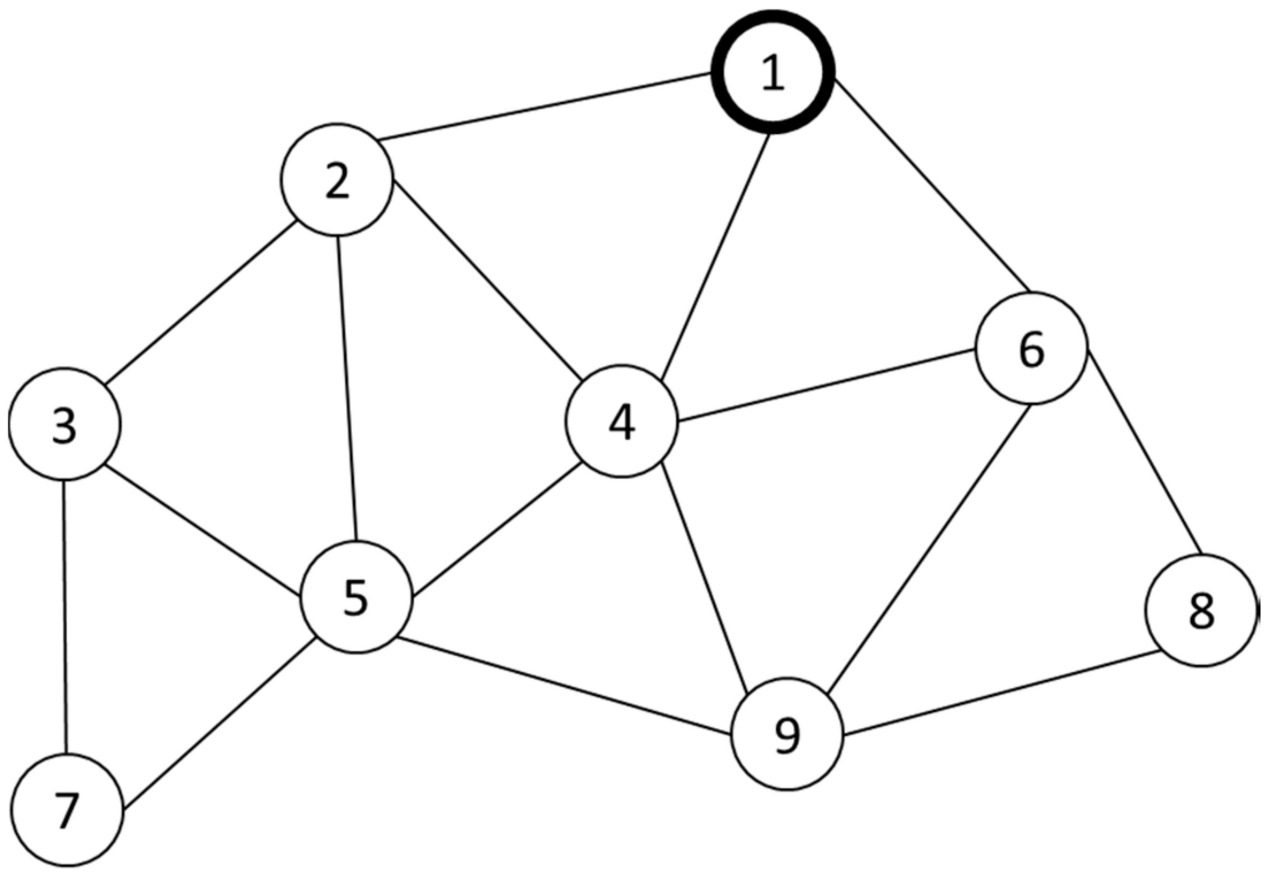
In this study, we focused on convergecast multi-hop networks that consist of one coordinator (sink) node and some sensor nodes in a tree topology. All nodes are deployed randomly during network formation and they have identification numbers. The communication between two nodes is called a tree-link if they have a parent–child relationship and exchange data through this link. The data of the sensor are generated by sensor nodes and transmitted periodically through the tree-link to the sink.

2.2. Link Burstiness Research Overview

Physical property in wireless communications exhibits consecutive packet losses in a burst called a link burstiness. The authors in [24,25] proposed mechanisms to solve the link burstiness problem. Srinivasan et al. [24] proposed a new metric, denoted as β, showing that providing an inter-packet delay of 500 ms can avoid link burstiness. Even in the industrial fields, a 500 ms delay is a disadvantage for the network; one should not have to wait for an extended period of time to prevent packet failure when a link burst occurs. Munir et al. [25] proposed a maximum burst length metric (denoted Bmax), estimated by long experiment data. The authors connected the scheduling algorithm and the routing algorithm called the least-burst-route to reduce the total number of burst lengths on the route. However, the algorithm to calculate Bmax was based on a long experiment data-trace before constructing the network. After processing the data-trace by computing the Bmax value, they applied it to the sensor network. They did not calculate the metric during network construction. That makes this algorithm hard to apply to an ad hoc network.

4. Evaluation

By using the Cooja simulator, the Bdist metric was compared with schemes such as ETX and PRR. The key parameters are presented in Table 2.
Table 2. Summary of the simulation set-up parameters.
The link quality of the channel for each link indicates the percentage of successful packets at the receiver, compared with the number of packets from senders. For example, a channel link quality at 70% indicates that the receiver will successfully receive 70 packets if sent 100 packets. The number of probes to measure the link quality and the number of data packets to evaluate the measured link quality metric are both 1000.

4.1. Relationship between the Number of Retransmissions and Network Performance

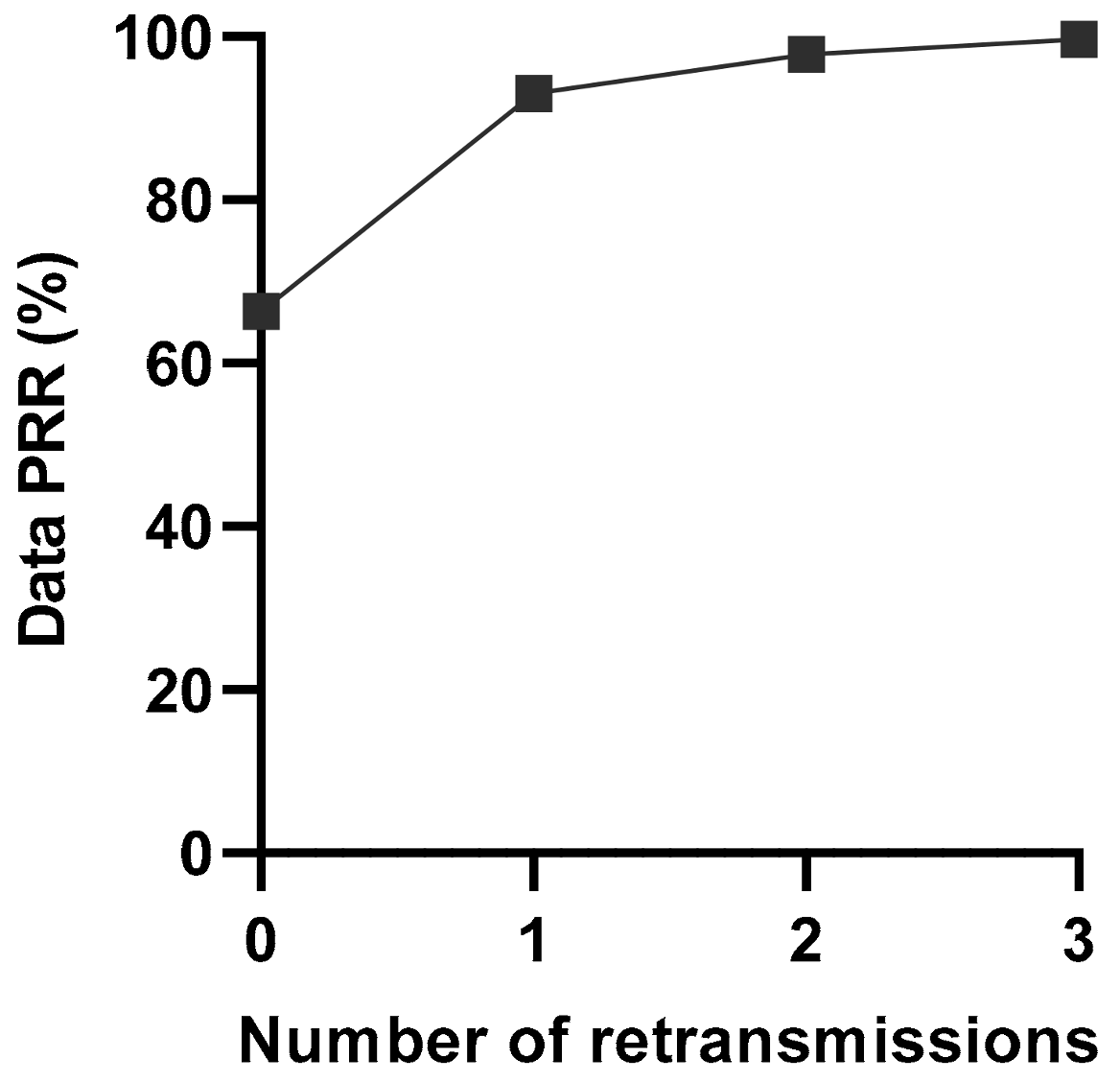
To evaluate the effect of the number of retransmissions on the performance of the network, a simple network with one sink (gateway) and nine sensor nodes was considered. The link quality of the channel was fixed, while the number of retransmissions varied from 0 to 3, and we examined the packet reception rate at the sink with each value for the number of retransmissions.
The results in Figure 5 show that since the sensor nodes were not allowed retransmissions, the PRR at the sink achieved a low PRR: 66.3%. When the sensor nodes were allowed retransmissions, the PRR improved since the number of retransmissions increased. It is shown that when the link quality is not very good, the number of retransmissions will decide the network performance. Therefore, to estimate the number of transmissions is very important.
Figure 5. Relationship between the number of retransmissions and the packet reception rate.

4.2. Effect of the Hop Count on Network Performance

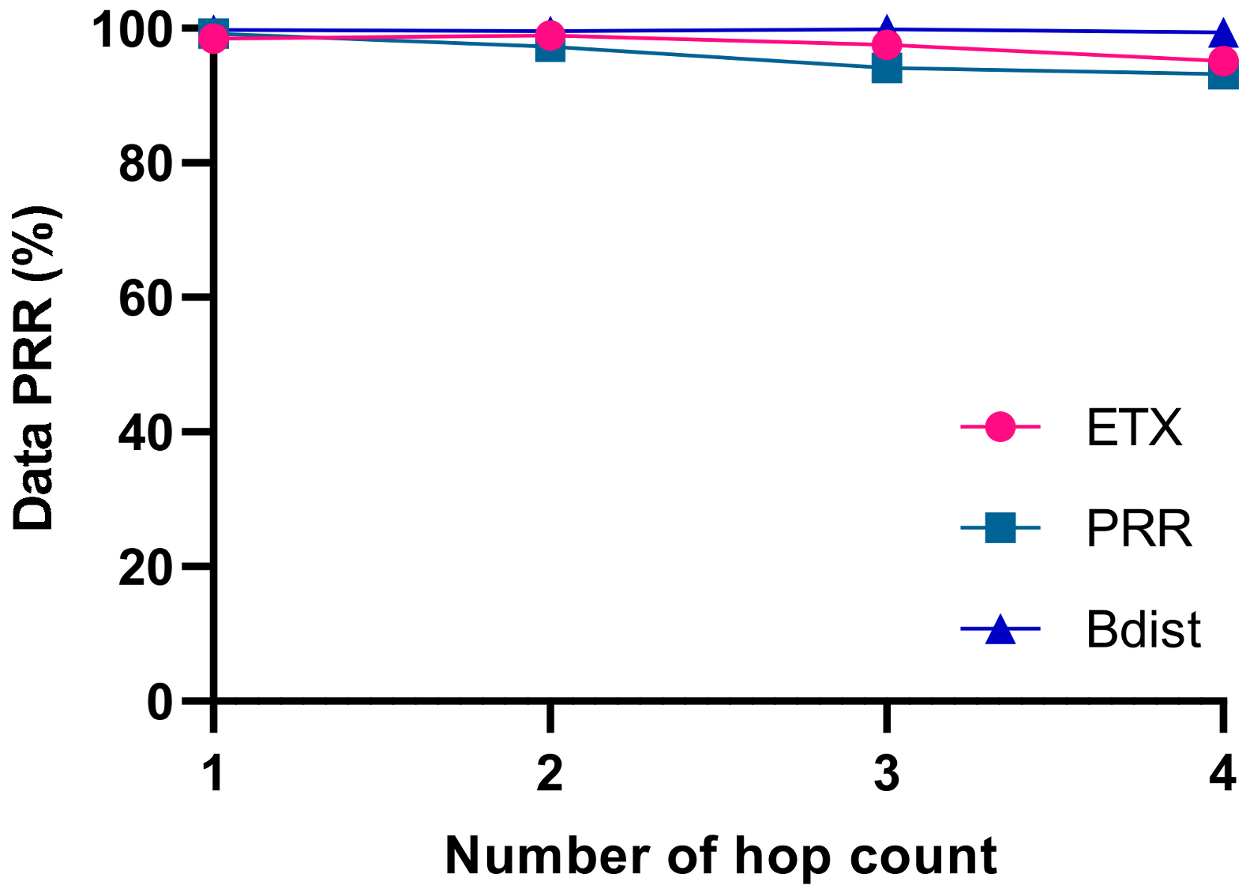
We evaluated the effect of the hop count on PRR. A simple linear network with the hop count varying from 1 to 4 was considered. We compared our proposed approach with schemes like ETX and PRR. Each scheme estimates the number of transmissions by itself. We examined the packet reception rate at the sink for each value of the hop count.
The results are presented in Figure 6, where it is indicated that our proposed method achieved a very high PRR, even at the highest hop count. That is because our proposed method provided a good estimation of the number of transmissions by using the target PRR to estimate link quality. Under other schemes, the PRR decreased since the hop count increased. This is because with the two other schemes, the estimate of the number of transmissions was not very good.
Figure 6. Effect of the hop count on network performance.

4.3. Evaluating the Network with other Estimation Schemes

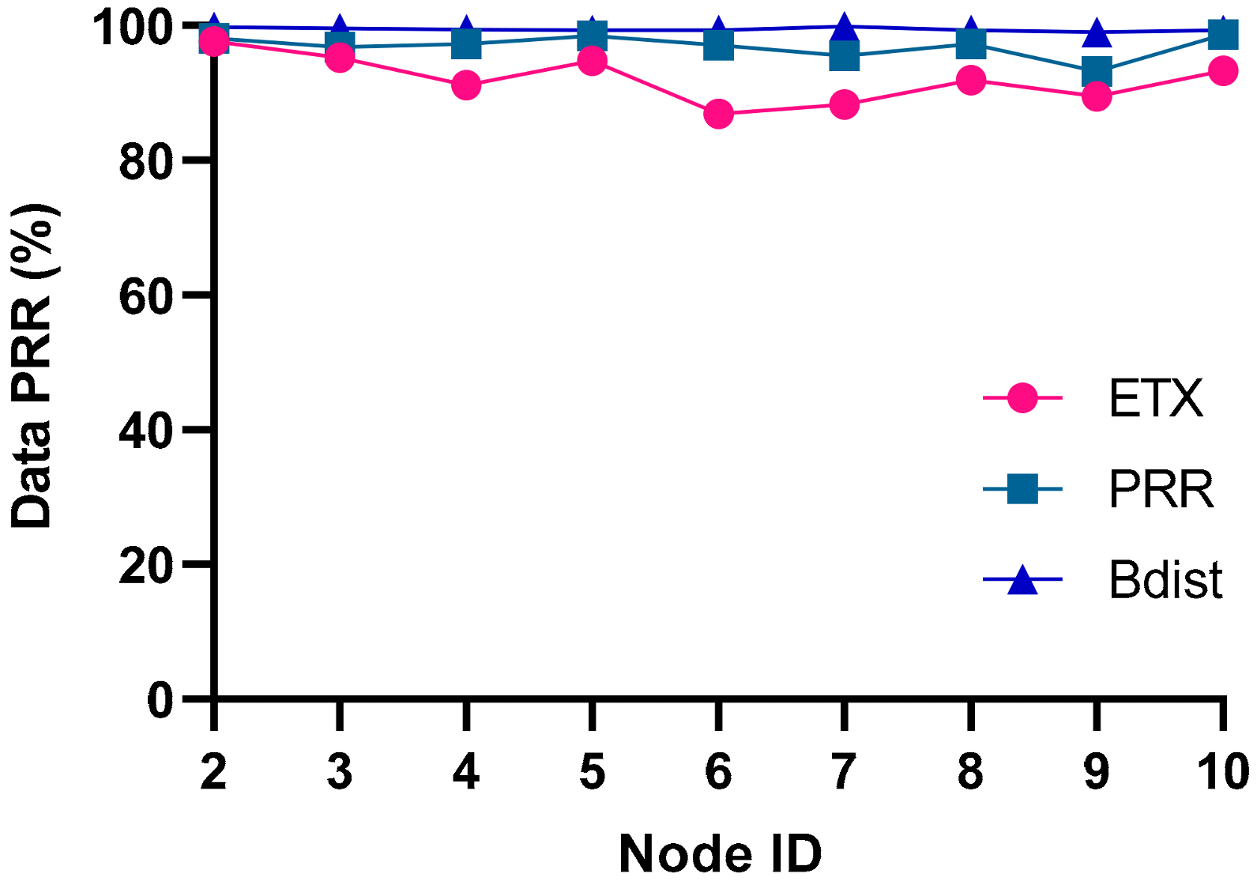
In this examination, nine sensor nodes were deployed randomly, and the link quality between every two nodes was set randomly from 70% to 90%. Each sensor node generated 1000 packets periodically. The Time Slotted Channel Hopping (TSCH) MAC protocol was used with the Path Collision-aware Least Laxity First (PCLLF) [26] scheduling algorithm to guarantee that no collisions occurred in the network. We collected the packet reception rate of each sensor node at the sink.
The resulting PRR data for each sensor node at the sink are presented in Figure 7, where the PRR of the proposed scheme almost achieved the target PRR with the estimated number of transmissions for each sensor node. It shows that the algorithm for calculating the number of transmissions worked well. Furthermore, the other schemes achieved a much lower PRR since the estimation of the number of transmissions by ETX and PRR was not very good. This is because ETX and PRR did not consider the burstiness that happens in the links.
Figure 7. The data PRR of sensor nodes under several estimation schemes.

4.4. Evaluating Networks of Several Types

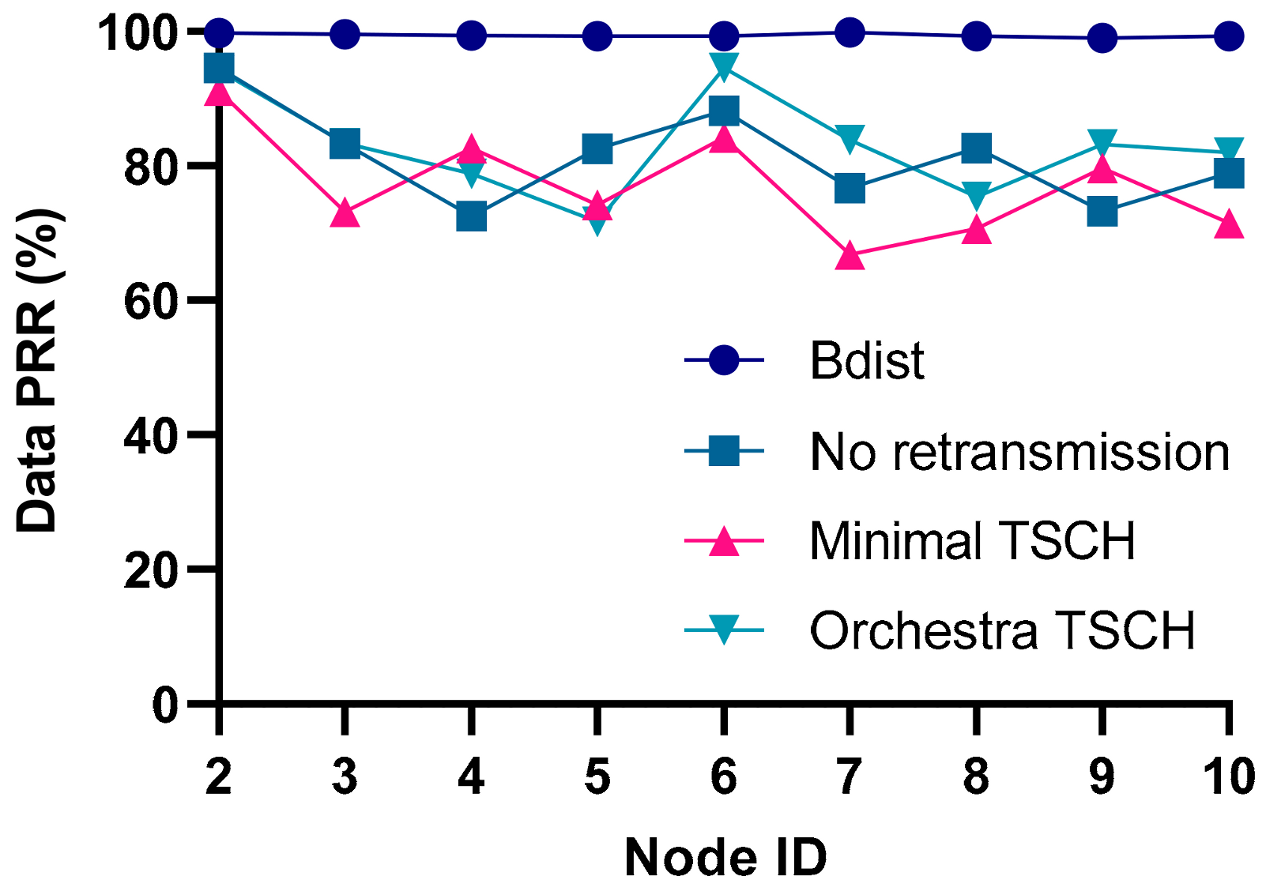
In this examination, we ran nine sensor nodes deployed with a link quality between two nodes set randomly between 70% and 90%. We compared network schemes using minimal scheduling, orchestra scheduling, and PCLLF scheduling, with Bdist as the metric value and PCLLF with no retransmission configuration. Each sensor node generated 1000 packets and transmitted using the time slot assigned by the scheduling algorithm. We collected the data packet reception rate at the sink node.
Figure 8 shows the data PRR of each sensor node at the sink. From Figure 8, the network performance of the proposed Bdist metric had the highest reliability compared with the other network schemes. Almost all sensor nodes achieved the target PRR by using the number of transmissions calculated with our method. Other network schemes showed lower performance since they did not consider the retransmissions.
Figure 8. The PRR data of sensor nodes under several network schemes.

5. Conclusions

In this study, we proposed an LQE to apply to industrial wireless sensor networks with high reliability. Based on the burstiness property of wireless links, we estimated the number of transmissions required to reach the PRR target by using the burstiness distribution list proposed in Section 3. We proved by simulation in Cooja that our approach estimated the number of transmissions that can reach the target PRR, as we expected. Based on the simulation in which we compared our approach with some RNP-based methods (ETX and PRR), our proposal can be used as the input metric to calculate the number of transmissions in scheduling for industrial wireless sensor networks. We conclude that our approach is highly suitable for industrial wireless sensor networks that require high reliability for data transmissions. In future work, we will evaluate our approach in regards to the real devices for monitoring and controlling systems in industrial environments.
Probe packets distribution makes increasing the overhead of the network. However, it can be helpful in guaranteeing the reliability of data transmission when the link quality is not very good. Especially in real applications, we cannot guarantee that the link quality can be stable every time. Every link in the network may have a very different link quality. Therefore, estimating the link quality to guarantee the reliability of data transmission is more important than energy consumption in the industry application.

Author Contributions

Conceptualization, N.H.N. and M.K.K.; methodology, N.H.N.; software, N.H.N.; validation, N.H.N. and M.K.K.; formal analysis, N.H.N.; investigation, N.H.N.; resources, M.K.K.; data curation, N.H.N.; writing—original draft preparation, N.H.N.; writing—review and editing, N.H.N. and M.K.K.; visualization, N.H.N.; supervision, M.K.K.; project administration, M.K.K.; funding acquisition, M.K.K. All authors have read and agreed to the published version of the manuscript.

Funding

This work (Grants No. S2665996) was supported by project for Cooperative R&D between Industry, Academy, and Research Institute funded Korea Ministry of SMEs and Startups in 2020.

Conflicts of Interest

The authors declare no conflict of interest.

References

  1. Shah, R.C.; Roy, S.; Jain, S.; Brunette, W. Data MULEs: Modeling and analysis of a three-tier architecture for sparse sensor networks. Ad Hoc Netw. 2003, 1, 215–233. [Google Scholar] [CrossRef]
  2. He, X.; Fu, X.; Yang, Y. Energy-Efficient Trajectory Planning Algorithm Based on Multi-Objective PSO for the Mobile Sink in Wireless Sensor Networks. IEEE Access 2019, 7, 176204–176217. [Google Scholar] [CrossRef]
  3. Fu, X.; Yao, H.; Yang, Y. Cascading failures in wireless sensor networks with load redistribution of links and nodes. Ad Hoc Netw. 2019, 93, 101900. [Google Scholar] [CrossRef]
  4. Fu, X.; Yang, Y.; Postolache, O. Invulnerability of Clustering Wireless Sensor Networks Against Cascading Failures. IEEE Syst. J. 2019, 13, 1431–1442. [Google Scholar] [CrossRef]
  5. Mittal, M.; Iwendi, C.; Khan, S.; Rehman Javed, A. Analysis of security and energy efficiency for shortest route discovery in low-energy adaptive clustering hierarchy protocol using Levenberg-Marquardt neural network and gated recurrent unit for intrusion detection system. Trans. Emerg. Telecommun. Technol. 2020, e3997. [Google Scholar] [CrossRef]
  6. Nguyen, T.T.; Oh, H. A Receiver for Resource-Constrained Wireless Sensor Devices to Remove the Effect of Multipath Fading. IEEE Trans. Ind. Electron. 2018, 65, 6009–6016. [Google Scholar] [CrossRef]
  7. Nguyen, T.T.; Oh, H. SCSMA: A Smart CSMA/CA Using Blind Learning for Wireless Sensor Networks. IEEE Trans. Ind. Electron. 2019, 67, 10981–10988. [Google Scholar] [CrossRef]
  8. Winter, T.; Thubert, P.; Brandt, A.; Hui, J.W.; Kelsey, R.; Levis, P.; Pister, K.; Struik, R.; Vasseur, J.-P.; Alexander, R.K. RPL: IPv6 Routing Protocol for Low-Power and Lossy Networks. RFC 2012, 6550, 1–157. [Google Scholar]
  9. Mittal, M.; Iwendi, C. A survey on energy-aware wireless sensor routing protocols. EAI Endorsed Trans. Energy Web 2019, 6. [Google Scholar] [CrossRef]
  10. Clausen, T.; Yi, J.; Herberg, U. Lightweight on-demand ad hoc distance-vector routing-next generation (LOADng): Protocol, extension, and applicability. Comput. Netw. 2017, 126, 125–140. [Google Scholar] [CrossRef]
  11. Nguyen, T.T.; Oh, H. Constructing an optimally balanced tree to maximize data throughput with multiple channels. Wirel. Netw. 2018, 24, 993–1005. [Google Scholar] [CrossRef]
  12. Noda, C.; Prabh, S.; Alves, M.; Boano, C.A.; Voigt, T. Quantifying the channel quality for interference-aware wireless sensor networks. ACM SIGBED Rev. 2011, 8, 43–48. [Google Scholar] [CrossRef]
  13. Audéoud, H.-J.; Heusse, M. Quick and efficient link quality estimation in wireless sensors networks. In Proceedings of the 2018 14th Annual Conference on Wireless On-demand Network Systems and Services (WONS), Isola, France, 6–8 February 2018; pp. 87–90. [Google Scholar]
  14. Eskola, M.; Heikkilä, T. Classification of radio channel disturbances for industrial wireless sensor networks. Ad Hoc Netw. 2016, 42, 19–33. [Google Scholar] [CrossRef]
  15. Gomes, R.D.; Queiroz, D.V.; Lima Filho, A.C.; Fonseca, I.E.; Alencar, M.S. Real-time link quality estimation for industrial wireless sensor networks using dedicated nodes. Ad Hoc Netw. 2017, 59, 116–133. [Google Scholar]
  16. Kirubasri, G.; Maheswari, N.U. A study on hardware and software link quality metrics for wireless multimedia sensor networks. Int. J. Adv. Netw. Appl. 2016, 8, 3103. [Google Scholar]
  17. Woo, A.; Culler, D.E. Evaluation of Efficient Link Reliability Estimators for Low-Power Wireless Networks; Computer Science Division, University of California: Oakland, CA, USA, 2003. [Google Scholar]
  18. De Couto, D.S.J.; Aguayo, D.; Bicket, J.; Morris, R. A high-throughput path metric for multi-hop wireless routing. In Proceedings of the 9th Annual International Conference on Mobile Computing and Networking, San Diego, CA, USA, 14–19 September 2003; pp. 134–146. [Google Scholar]
  19. Koksal, C.E.; Balakrishnan, H. Quality-aware routing metrics for time-varying wireless mesh networks. IEEE J. Sel. Areas Commun. 2006, 24, 1984–1994. [Google Scholar]
  20. Fonseca, R.; Gnawali, O.; Jamieson, K.; Levis, P. Four-bit wireless link estimation. In Proceedings of the HotNets, Atlanta, GA, USA, 14–15 November 2007. [Google Scholar]
  21. Gungor, V.C.; Korkmaz, M.K. Wireless link-quality estimation in smart grid environments. Int. J. Distrib. Sens. Netw. 2012, 8, 214068. [Google Scholar] [CrossRef]
  22. Kaneko, H.; Funatsu, K. Application of online support vector regression for soft sensors. AIChE J. 2014, 60, 600–612. [Google Scholar] [CrossRef]
  23. Fortuna, L.; Giannone, P.; Graziani, S.; Xibilia, M.G. Virtual Instruments Based on Stacked Neural Networks to Improve Product Quality Monitoring in a Refinery. IEEE Trans. Instrum. Meas. 2007, 56, 95–101. [Google Scholar] [CrossRef]
  24. Srinivasan, K.; Kazandjieva, M.A.; Agarwal, S.; Levis, P. The β-factor: Measuring wireless link burstiness. In Proceedings of the 6th ACM Conference on Embedded Network Sensor Systems, Raleigh, NC, USA, 5–7 November 2008; pp. 29–42. [Google Scholar]
  25. Munir, S.; Lin, S.; Hoque, E.; Nirjon, S.M.S.; Stankovic, J.A.; Whitehouse, K. Addressing burstiness for reliable communication and latency bound generation in wireless sensor networks. In Proceedings of the 9th ACM/IEEE International Conference on Information Processing in Sensor Networks, Stockholm, Sweden, 12–16 April 2010; pp. 303–314. [Google Scholar]
  26. Darbandi, A.; Kim, M.K. Path collision-aware real-time link scheduling for TSCH wireless networks. KSII Trans. Internet Inf. Syst. 2019, 13, 4429–4445. [Google Scholar]
Publisher’s Note: MDPI stays neutral with regard to jurisdictional claims in published maps and institutional affiliations.

Article Metrics

Citations

Article Access Statistics

Multiple requests from the same IP address are counted as one view.