


Energy Communities and Electric Mobility as a Win–Win Solution in Built Environment



Abstract
1. Introduction
2. Energy Communities and Electric Mobility Review
2.1. Energy Communities
2.1.1. Economic Impacts of ECs
2.1.2. Energy Communities in Portugal
2.2. Electric Mobility
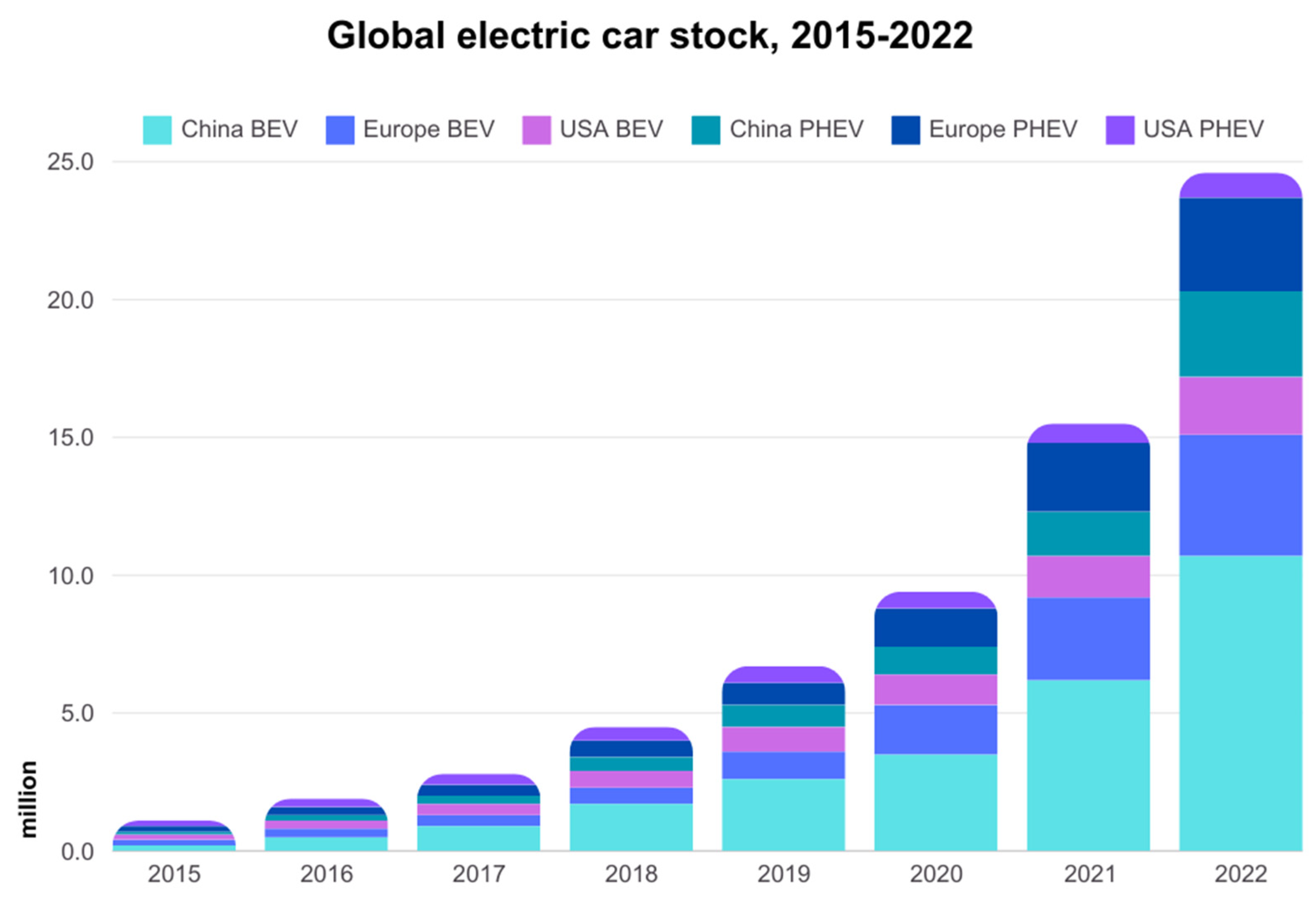
2.2.1. Market Trends
2.2.2. V2X Technology
2.3. Integration of Electric Mobility in Energy Communities
2.4. Research Gaps
3. Methodology
3.1. Energy and Electricity in Portugal
3.2. Equipment
3.2.1. PV
- The estimation of the total energy consumption, the energy consumption per household and user;
- The estimation of power demands and domestic load profiles;
- The comparison of the domestic load profile with the PV production profile;
- The estimation of the percentage of self-consumption to achieve;
- The estimation of the Wp (watt-peak) necessary from the PVs;
- The number of required PVs.
3.2.2. Inverter
3.2.3. Battery
3.2.4. EV Charger
3.3. Proposed Approach
- Every member of the community needs to pay an initial investment that will cover the different components of the energy community (PV modules, inverters, batteries, EV chargers, management, and communication systems) as well as their installation. This cost is divided equally between the members.
- Every year, the members of the community contribute similarly to the operation and maintenance costs of the community.
- The members of the community do not have to pay to use the energy produced by the photovoltaic system.
- Although the energy produced is not equally divided between every member, meaning that the energy is distributed according to necessity, it will be assumed that every member has a similar energy consumption.
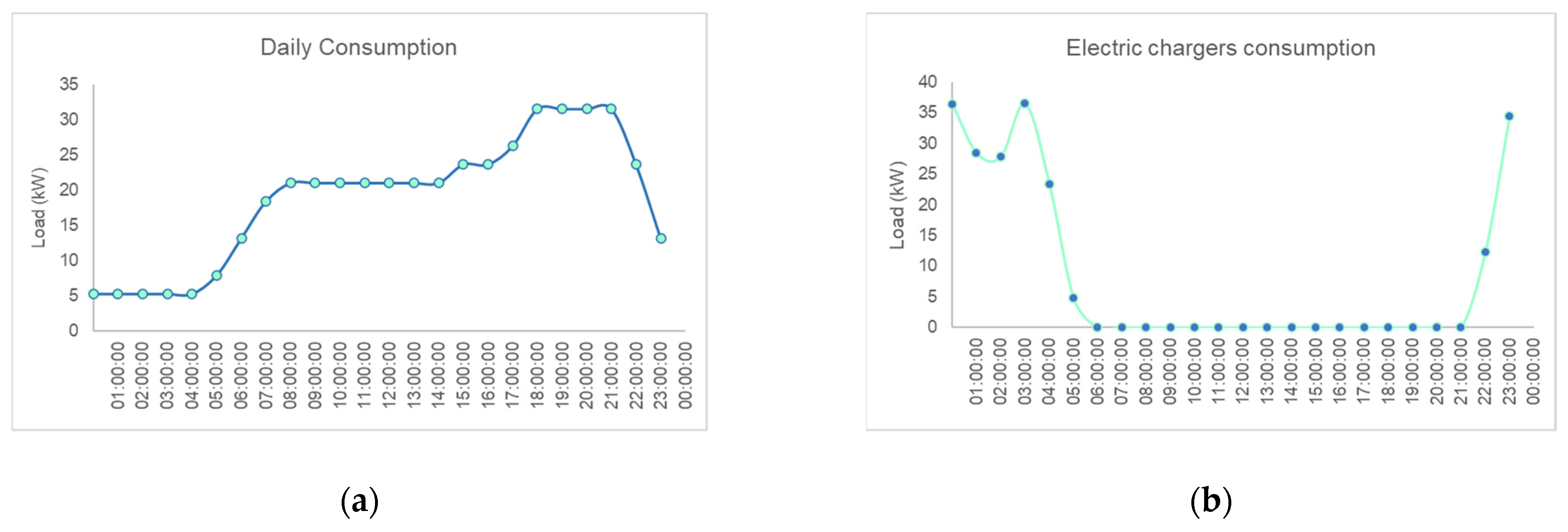
- It will be considered that the vehicles will only start charging after 10 p.m.
- It is assumed that the vehicles are not all charging simultaneously since it will cause a very high energy demand. That way, the cars will charge between 10 p.m. and 7 a.m. This is possible because wallboxes have smart charging features.
- It is possible to have batteries only for the EV chargers, considering that the vehicles start charging when solar production is lower or even nonexistent.
- The remaining energy is not sold back to the grid.
- Bi-hour or simple time cycle;
- High population density area or low population density area;
- With and without electric mobility.
3.4. Methods in the Simulation
4. High- and Low-Density Cases
4.1. High-Density Case
4.2. Low-Density Case
4.3. Comparing Estimation Results: Homer Grid and Preliminary Study
5. Potential and Limitations
5.1. Economic Analysis
- The lower the NPC, the better.
- The lower the LCOE, the better.
- The higher the IRR, the better.
- The lower the payback time, the better.
- The higher the utility bill savings, the better.
5.2. Emissions Analysis
5.3. Is high- and Low Density a Win–Win?
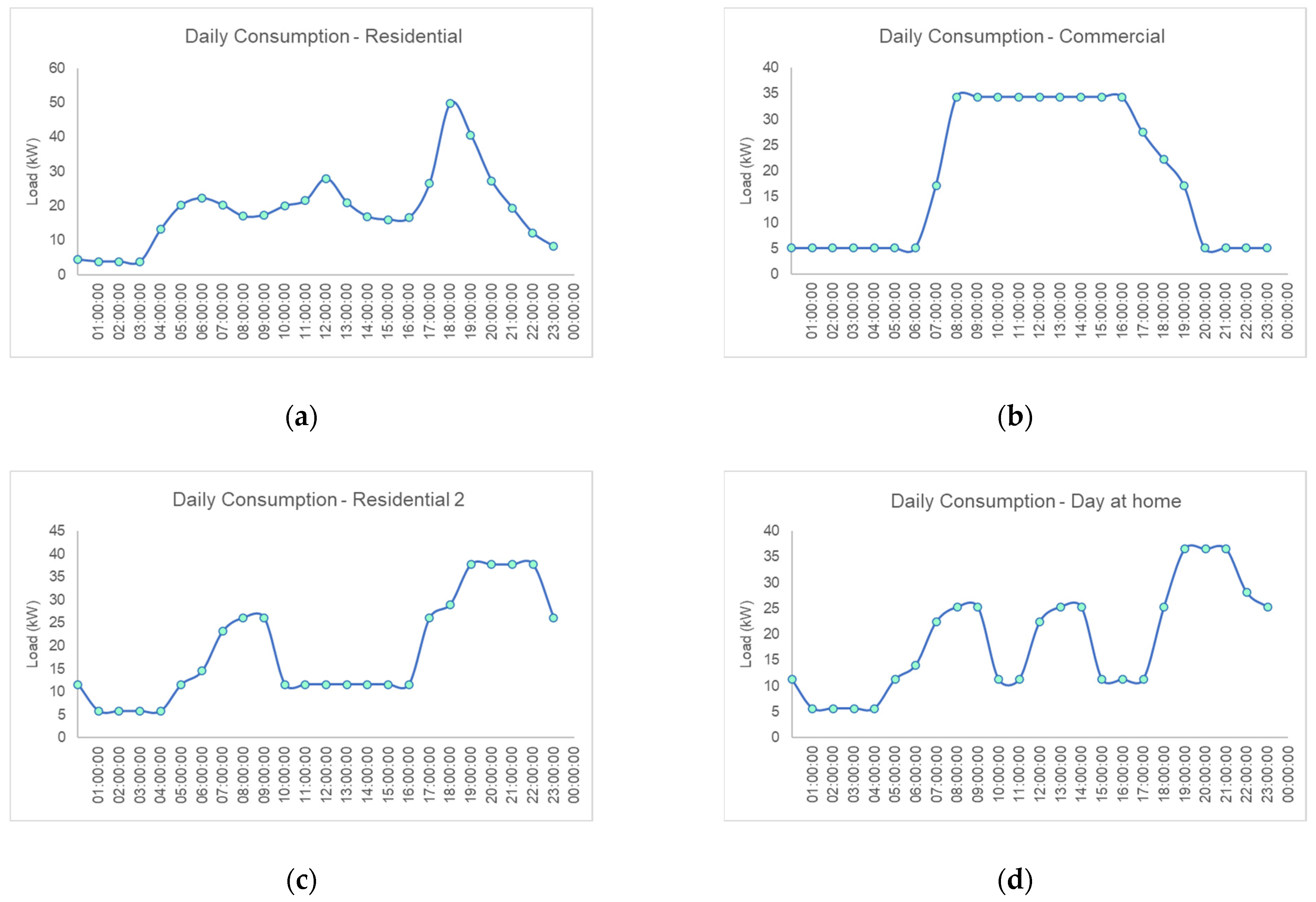
5.4. Alternative Consumption Patterns
5.5. Other Types of Integration
5.6. Limitations in the Research
- Firstly, a weakness that was noticed is that it is impossible to include the costs associated with EV chargers, in this case, of the wallboxes in the simulations.
- Another thing that could be very helpful is seeing how CO2 changes during the day and, therefore, relating those emissions to the presence of vehicles charging.
- For the hourly tariff, it was considered that between 10 p.m. and 7 a.m., the electricity price was 0.11 €/kWh, and between 7 a.m. and 10 p.m. the price was 0.17 €/kWh. It was not considered having vehicles charging, for example, between 7 p.m. and 6 a.m. This scenario could have been helpful in understanding when the best hours to charge the car are from the moment it arrives in the afternoon to the moment it leaves in the morning.
- Lastly, unlike what was planned in Section 3, the software cannot include management and communication systems; therefore, its costs were not considered.
5.7. Other Limitations
6. Conclusions and Further Developments
6.1. Conclusions
6.2. Further Developments
Author Contributions
Funding
Data Availability Statement
Conflicts of Interest
References
- European Commission; Directorate-General for Energy. For Clean Energy for All Europeans; Publications Office: Brussels, Belgium, 2019. [Google Scholar]
- Roberts, J. What Are Energy Communities Under the EU’s Clean Energy Package? In Renewable Energy Communities and the Low Carbon Energy Transition in Europe; Springer International Publishing: Cham, Switzerland, 2021; pp. 23–48. [Google Scholar]
- Diário da República. Portuguese Decree-Law 90/2014 2014. Available online: https://diariodarepublica.pt/dr/detalhe/decreto-lei/90-2014-25676885 (accessed on 12 June 2024).
- Mobi.E. Website Legislação Nacional e Europeia. Available online: https://www.mobie.pt/mobilidade/legisla%C3%A7%C3%A3o/nacional-e-europeia (accessed on 29 October 2023).
- Coopérnico. COMSOLVE: COMunidade de Energia SOLar Com Integração de Veículos Elétricos. Available online: https://www.coopernico.org/artigo/303 (accessed on 6 May 2024).
- Official Journal of the European Union. Directive (EU) 2019/944; European Parliament and Council: Brussels, Belgium, 2019. [Google Scholar]
- Official Journal of the European Union. Directive (EU) 2018/2001; European Parliament and Council: Brussels, Belgium, 2018. [Google Scholar]
- Boulanger, S.O.M.; Massari, M.; Longo, D.; Turillazzi, B.; Nucci, C.A. Designing Collaborative Energy Communities: A European Overview. Energies 2021, 14, 8226. [Google Scholar] [CrossRef]
- Caramizaru, A.; Uihlein, A. Energy Communities: An Overview of Energy and Social Innovation; Publications Office of the European Union: Luxembourg, 2020. [Google Scholar]
- Hunkin, S.; Krell, K. Empowering Citizens for Energy Communities—A Policy Brief from the Policy Learning Platform on Low-Carbon Economy. Available online: https://www.interregeurope.eu/sites/default/files/good_practices/PolicyBrief_RECommunities_final.pdf (accessed on 27 May 2024).
- Li, N.; Okur, Ö. Economic Analysis of Energy Communities: Investment Options and Cost Allocation. Appl. Energy 2023, 336, 120706. [Google Scholar] [CrossRef]
- Carreras, F.; Steinmaurer, G. Influence of Data Reduction Methods on Economic Evaluation of Energy-Communities. Environ. Clim. Technol. 2022, 26, 1310–1322. [Google Scholar] [CrossRef]
- Diário da República. Portuguese Decreto-Lei n.o 162/2019. Available online: https://files.dre.pt/1s/2019/10/20600/0004500062.pdf (accessed on 12 June 2024).
- Frieden, D.; Tuerk, A.; Neumann, C.; d’Herbemont, S.; Roberts, J. Collective Self-Consumption and Energy Communities: Trends and Challenges in the Transposition of the EU Framework; COMPILE: Graz, Austria, 2020. [Google Scholar]
- European Parlement. Electric Road Vehicles in the European Union—Trends, Impacts and Policies; European Parlement: Brussels, Belgium, 2019. [Google Scholar]
- Ruggieri, R.; Ruggeri, M.; Vinci, G.; Poponi, S. Electric Mobility in a Smart City: European Overview. Energies 2021, 14, 315. [Google Scholar] [CrossRef]
- IEA Global EV Outlook 2023. Available online: https://www.iea.org/reports/global-ev-outlook-2023 (accessed on 13 September 2023).
- Barreto, R.; Faria, P.; Vale, Z. Electric Mobility: An Overview of the Main Aspects Related to the Smart Grid. Electronics 2022, 11, 1311. [Google Scholar] [CrossRef]
- Savona Campus Website La Smart Polygeneration Microgrid (SPM). Available online: https://campus-savona.unige.it/en/progetti/Energia2020/SPM (accessed on 26 September 2023).
- Piazza, G.; Bracco, S.; Delfino, F.; Di Somma, M.; Graditi, G. Impact of Electric Mobility on the Design of Renewable Energy Collective Self-Consumers. Sustain. Energy Grids Netw. 2023, 33, 100963. [Google Scholar] [CrossRef]
- Piazza, G.; Bracco, S.; Delfino, F.; Siri, S. Optimal Design of Electric Mobility Services for a Local Energy Community. Sustain. Energy Grids Netw. 2021, 26, 100440. [Google Scholar] [CrossRef]
- Bracco, S.; Delfino, F.; Piazza, G. E-Mobility & Microgrid Laboratory at the Savona Campus of Genova University. In Proceedings of the 2020 AEIT International Annual Conference (AEIT), Catania, Italy, 23–25 September 2020; pp. 1–6. [Google Scholar]
- Piazza, G.; Bracco, S.; Siri, S.; Delfino, F. Integration of Electric Mobility Services within an Existing Polygeneration Microgrid. In Proceedings of the 2019 IEEE International Conference on Environment and Electrical Engineering and 2019 IEEE Industrial and Commercial Power Systems Europe (EEEIC/I&CPS Europe), Genova, Italy, 11–14 June 2019; pp. 1–6. [Google Scholar]
- Straub, F.; Streppel, S.; Göhlich, D. Methodology for Estimating the Spatial and Temporal Power Demand of Private Electric Vehicles for an Entire Urban Region Using Open Data. Energies 2021, 14, 2081. [Google Scholar] [CrossRef]
- Negeri, E.; Baken, N. Smart Integration of Electric Vehicles in a Energy Community. In Proceedings of the 1st International Conference on Smart Grids and Green IT Systems, Porto, Portugal, 18–21 April 2012; pp. 25–32. [Google Scholar]
- Wang, J.; You, S.; Zong, Y.; Traholt, C. Energylab Nordhavn: An Integrated Community Energy System towards Green Heating and e-Mobility. In Proceedings of the 2017 IEEE Transportation Electrification Conference and Expo, Asia-Pacific (ITEC Asia-Pacific), Harbin, China, 7–10 August 2017; pp. 1–6. [Google Scholar]
- Kobashi, T.; Jittrapirom, P.; Yoshida, T.; Hirano, Y.; Yamagata, Y. SolarEV City Concept: Building the next Urban Power and Mobility Systems. Environ. Res. Lett. 2021, 16, 024042. [Google Scholar] [CrossRef]
- Wen, M.; Xiang, W.; Sun, J. Research on Charging and Parking Price Model of Electric Vehicle for Urban Residential District. In Proceedings of the 2021 13th International Conference on Measuring Technology and Mechatronics Automation (ICMTMA), Beihai, China, 16–17 January 2021; pp. 504–508. [Google Scholar]
- Faia, R.; Soares, J.; Vale, Z.; Corchado, J.M. An Optimization Model for Energy Community Costs Minimization Considering a Local Electricity Market between Prosumers and Electric Vehicles. Electronics 2021, 10, 129. [Google Scholar] [CrossRef]
- Moura, P.; Sriram, U.; Mohammadi, J. Sharing Mobile and Stationary Energy Storage Resources in Transactive Energy Communities. In Proceedings of the 2021 IEEE Madrid PowerTech, Madrid, Spain, 28 June–2 July 2021; pp. 1–6. [Google Scholar]
- Ramsebner, J.; Hiesl, A.; Haas, R.; Auer, H.; Ajanovic, A.; Mayrhofer, G.; Reinhardt, A.; Wimmer, A.; Ferchhumer, E.; Mitterndorfer, B.; et al. Smart Charging Infrastructure for Battery Electric Vehicles in Multi Apartment Buildings. Smart Energy 2023, 9, 100093. [Google Scholar] [CrossRef]
- Eckhoff, S.; Wagner, H.; Werth, O.; Gerlach, J.; Breitner, M.H.; Engel, B. Electric Mobility Integration in Energy Communities: Trending Topics and Future Research Directions. In Proceedings of the 5th E-Mobility Power System Integration Symposium (EMOB 2021), Berlin, Germany, 27 September 2021; Volume 2021, pp. 196–204. [Google Scholar]
- Bertolini, M.; Morosinotto, G. Business Models for Energy Community in the Aggregator Perspective: State of the Art and Research Gaps. Energies 2023, 16, 4487. [Google Scholar] [CrossRef]
- Krug, M.; Di Nucci, M.R.; Schwarz, L.; Alonso, I.; Azevedo, I.; Bastiani, M.; Dyląg, A.; Laes, E.; Hinsch, A.; Klāvs, G.; et al. Implementing European Union Provisions and Enabling Frameworks for Renewable Energy Communities in Nine Countries: Progress, Delays, and Gaps. Sustainability 2023, 15, 8861. [Google Scholar] [CrossRef]
- Onat, N.C.; Kucukvar, M. A Systematic Review on Sustainability Assessment of Electric Vehicles: Knowledge Gaps and Future Perspectives. Environ. Impact. Assess. Rev. 2022, 97, 106867. [Google Scholar] [CrossRef]
- INE. Energy Survey. Inquérito Ao Consumo de Energia No Sector Doméstico—2020; INE: Cary, NC, USA, 2021. [Google Scholar]
- Odyssee-Mure. Heating Consumption per m2 and per Dwelling. Available online: https://www.odyssee-mure.eu/publications/efficiency-by-sector/households/heating-consumption-per-m2.html (accessed on 9 November 2023).
- Selectra. Como Calcular o Preço KWh Da Eletricidade e Gás Natural Em Portugal. Available online: https://selectra.pt/energia/precos/kwh (accessed on 9 November 2023).
- LojaLuz Preço KWh Eletricidade e Gás Das Fornecedoras|Novembro 2023. Available online: https://lojaluz.com/faq/preco-kwh (accessed on 9 November 2023).
- LojaLuz Preço Do KWh Da EDP: Eletricidade, Gás, Termos Fixo e de Consumo|Novembro 2023. 2023. Available online: https://lojaluz.com/fornecedores/edp/tarifas/preco-kwh (accessed on 12 June 2024).
- Gentile, G.; Fidalgo, J.N.; Coppo, M. Renewable Energy Communities: Design and Management from the Household Perspective. Master’s Thesis, Universidade do Porto, Porto, Portugal, 2022. [Google Scholar]
- Castro, R. Electricity Production from Renewables; Springer International Publishing: Cham, Switzerland, 2022; ISBN 978-3-030-82415-0. [Google Scholar]
- Solar Electric Webpage Inverter Basics and Selecting the Right Model. Available online: https://www.solar-electric.com/learning-center/inverter-basics-selection.html/ (accessed on 21 October 2023).
- Helioscope. Helioscope Website. Available online: https://helioscope.aurorasolar.com/ (accessed on 14 May 2024).
- Homer Software. HOMER Grid 1.11.1. Available online: https://homerenergy.com/products/grid/ (accessed on 21 October 2023).
- Utility Dive. EV Batteries Can Be Repurposed as Grid Storage to Reduce Battery Supply Chain Impacts. Available online: https://www.utilitydive.com/news/ev-batteries-repurpose-recycle-grid-storage-microgrid-nrdc/686200/ (accessed on 3 May 2024).

| Equipment | Chosen Type | Price |
|---|---|---|
| PV | Polycrystalline silicon | 734 €/kW |
| Battery | Lithium-ion | 729.3 €/kWh |
| Inverter | Hybrid | 289.13 €/kW |
| EV charger | Wallbox | 1000 €/unit |
| Eprod/Econs | Pp (kW) | Ea (kWh/Year) |
|---|---|---|
| 0.1 | 37.628 | 55,300.26 |
| 0.2 | 75.257 | 110,600.52 |
| 0.3 | 112.885 | 165,900.78 |
| 0.4 | 150.513 | 221,201.04 |
| 0.5 | 188.142 | 276,501.30 |
| 0.6 | 225.770 | 331,801.56 |
| 0.7 | 263.399 | 387,101.82 |
| 0.8 | 301.027 | 442,402.08 |
| 0.9 | 338.655 | 497,702.34 |
| 1 | 376.285 | 553,302.60 |
| Simple Tariff + Mobility | Hourly Tariff + Mobility | Simple Tariff − Mobility | Hourly Tariff − Mobility | |
|---|---|---|---|---|
| PV (kW) | 153 | 123 | 148 | 125 |
| Inverter (kW) | 84.8 | 75.5 | 84.9 | 77.6 |
| NPC (€) | 855,309 | 1,010,328 | 850,170 | 802,795 |
| LCOE (€/kWh) | 0.124 | 0.128 | 0.114 | 0.110 |
| IRR (%) | 21% | 16% | 22% | 16% |
| Payback time (year) | 4.5 | 5.8 | 4.4 | 5.3 |
| Savings (€) | 26,473 | 18,410 | 26,040 | 18,590 |
| Eprod/Econs | Pp (kW) | Ea (kWh/Year) |
|---|---|---|
| 0.1 | 10.63 | 15,626.29 |
| 0.2 | 21.26 | 31,252.58 |
| 0.3 | 31.90 | 46,878.86 |
| 0.4 | 42.53 | 62,505.15 |
| 0.5 | 53.16 | 78,131.44 |
| 0.6 | 63.80 | 93,757.73 |
| 0.7 | 74.43 | 109,384.02 |
| 0.8 | 85.06 | 125,010.30 |
| 0.9 | 95.69 | 140,636.59 |
| 1 | 106.33 | 156,262.88 |
| Simple Tariff + Mobility | Hourly Tariff + Mobility | Simple Tariff − Mobility | Hourly Tariff − Mobility | |
|---|---|---|---|---|
| PV (kW) | 42.2 | 79.6 | 42.2 | 79.6 |
| Inverter (kW) | 24.1 | 55.3 | 24.1 | 55.3 |
| NPC (€) | 241,818 | 180,172 | 241,818 | 180,204 |
| LCOE (€/kWh) | 0.122 | 0.0773 | 0.115 | 0.0665 |
| IRR (%) | 21% | 30% | 21% | 30% |
| Payback time (year) | 4.4 | 3.2 | 4.5 | 3.2 |
| Savings (€) | 7402 | 18,935 | 7402 | 18,931 |
| Low-Density Case | High-Density Case | |||||
|---|---|---|---|---|---|---|
| Homer Grid + Mobility | Homer Grid − Mobility | Preliminary Study | Homer Grid + Mobility | Homer Grid − Mobility | Preliminary Study | |
| PV (kW) | 42.2 | 42.2 | 42.53 | 153 | 148 | 150.513 |
| Energy produced (kWh) | 68,786 | 68,786 | 62,856 | 248,773 | 240,456 | 221,335 |
| Inverter (kW) | 24.1 | 24.1 | 32.9 | 84.8 | 84.9 | 115.85 |
| DC/AC ratio | 1.75 | 1.75 | 1.3 | 1.80 | 1.74 | 1.3 |
| Renewable prod/cons | 0.30 | 0.42 | 0.4 | 0.28 | 0.42 | 0.4 |
| Carbon Dioxide | |||||
|---|---|---|---|---|---|
| Initial (kg/Year) | Best Option (kg/Year) | Reduction (%) | Energy Produced by PV (%) | ||
| High Density | ST + Mobility | 546,574 | 412,277 | 24.57 | 26.9 |
| HT + Mobility | 555,739 | 442,832 | 20.32 | 22.0 | |
| ST − Mobility | 349,480 | 217,650 | 37.72 | 39.6 | |
| HT − Mobility | 349,480 | 234,648 | 32.86 | 34.6 | |
| Low Density | ST + Mobility | 142,664 | 105,110 | 26.32 | 28.5 |
| HT + Mobility | 142,664 | 66,820 | 53.16 | 44.9 | |
| ST − Mobility | 98,759 | 61,205 | 38.03 | 39.9 | |
| HT − Mobility | 98,759 | 22,914 | 76.80 | 59.1 | |
| With/Without Mobility | ||||
| Ex (Community) | Ex (Residential) | Ex (Commercial) | Ex (Residential 2) | Ex (Day at Home) |
| 117.40 | 133.71 | 33.53 | 180.68 | 144.66 |
| Without Mobility | ||||
| GP (Community) | GP (Residential) | GP (Commercial) | GP (Residential 2) | GP (Day at home) |
| 238.62 | 254.93 | 154.74 | 301.89 | 265.87 |
| With Mobility | ||||
| GP (Community) | GP (Residential) | GP (Commercial) | GP (Residential 2) | GP (Day at home) |
| 442.58 | 458.88 | 358.70 | 505.85 | 469.83 |
| Ex (Community) | Ex (Residential) | Ex (Commercial) | Ex (Residential 2) | Ex (Day at Home) |
| 15.50 | 23.12 | 0 | 22.04 | 21.04 |
| GP (Community) | GP (Residential) | GP (Commercial) | GP (Residential 2) | GP (Day at Home) |
| 340.67 | 348.30 | 325.17 | 347.21 | 346.21 |
| Architecture | Cost | Project Economics | ||||||
|---|---|---|---|---|---|---|---|---|
| PV (kW) | Battery (kWh) | Converter (kW) | NPC (€) | LCOE (€/kWh) | Operating Cost (€/Year) | CAPEX (€) | IRR (%) | Payback Time (Years) |
| 123 | N/A | 86.7 | 153,727 | 0.0659 | 5694 | 80,118 | 30 | 3.2 |
Disclaimer/Publisher’s Note: The statements, opinions and data contained in all publications are solely those of the individual author(s) and contributor(s) and not of MDPI and/or the editor(s). MDPI and/or the editor(s) disclaim responsibility for any injury to people or property resulting from any ideas, methods, instructions or products referred to in the content. |
© 2024 by the authors. Licensee MDPI, Basel, Switzerland. This article is an open access article distributed under the terms and conditions of the Creative Commons Attribution (CC BY) license (https://creativecommons.org/licenses/by/4.0/).
Share and Cite
Martins, J.C.; Pinheiro, M.D. Energy Communities and Electric Mobility as a Win–Win Solution in Built Environment. Energies 2024, 17, 3011. https://doi.org/10.3390/en17123011
Martins JC, Pinheiro MD. Energy Communities and Electric Mobility as a Win–Win Solution in Built Environment. Energies. 2024; 17(12):3011. https://doi.org/10.3390/en17123011
Chicago/Turabian StyleMartins, Joana Calado, and Manuel Duarte Pinheiro. 2024. "Energy Communities and Electric Mobility as a Win–Win Solution in Built Environment" Energies 17, no. 12: 3011. https://doi.org/10.3390/en17123011
APA StyleMartins, J. C., & Pinheiro, M. D. (2024). Energy Communities and Electric Mobility as a Win–Win Solution in Built Environment. Energies, 17(12), 3011. https://doi.org/10.3390/en17123011

