


Skip Content
You are currently on the new version of our website. Access the old version .

Viruses, Volume 9, Issue 7

2017 July - 36 articles

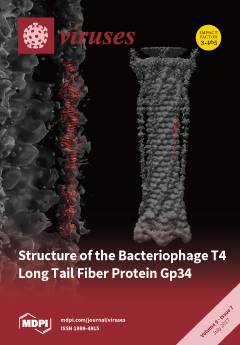
Cover Story: Long tail fibers of phage T4 are formed by proteins gp34, gp35, gp36, and gp37, with gp34 located at the phage-proximal end. A partial structure of gp34 revealed an extended triple β-helix domain punctuated by three β-prism domains. Between the N-terminal and the β-helix, three mixed α-β domains are located. More copies of this mixed α-β domain are present in the unsolved part of gp34 and in other T4 fiber proteins. View this paper
  • Issues are regarded as officially published after their release is announced to the table of contents alert mailing list .
  • You may sign up for email alerts to receive table of contents of newly released issues.
  • PDF is the official format for papers published in both, html and pdf forms. To view the papers in pdf format, click on the "PDF Full-text" link, and use the free Adobe Reader to open them.

Articles (36)

  • Review
  • Open Access
97 Citations
13,579 Views
12 Pages

24 July 2017

Human herpesvirus-6A (HHV-6A) and human herpesvirus-6B (HHV-6B) are two closely related viruses that infect T-cells. Both HHV-6A and HHV-6B possess telomere-like repeats at the terminal regions of their genomes that facilitate latency by integration...

  • Review
  • Open Access
31 Citations
8,355 Views
11 Pages

Applicability of Metal Nanoparticles in the Detection and Monitoring of Hepatitis B Virus Infection

  • Maxim Shevtsov,
  • Lili Zhao,
  • Ulrike Protzer and
  • Maarten A. A. van de Klundert

21 July 2017

Chronic infection with the hepatitis B virus (HBV) can lead to liver failure and can cause liver cirrhosis and hepatocellular carcinoma (HCC). Reliable means for detecting and monitoring HBV infection are essential to identify patients in need of the...

  • Article
  • Open Access
6 Citations
5,691 Views
16 Pages

Perturbation of Human T-Cell Leukemia Virus Type 1 Particle Morphology by Differential Gag Co-Packaging

  • José O. Maldonado,
  • Isaac Angert,
  • Sheng Cao,
  • Serkan Berk,
  • Wei Zhang,
  • Joachim D. Mueller and
  • Louis M. Mansky

19 July 2017

Human T-cell leukemia virus type 1 (HTLV-1) is an important cancer-causing human retrovirus that has infected approximately 15 million individuals worldwide. Many aspects of HTLV-1 replication, including virus particle structure and assembly, are poo...

  • Article
  • Open Access
12 Citations
7,918 Views
13 Pages

DNA-Interacting Characteristics of the Archaeal Rudiviral Protein SIRV2_Gp1

  • Eveline Peeters,
  • Maarten Boon,
  • Clare Rollie,
  • Ronnie G. Willaert,
  • Marleen Voet,
  • Malcolm F. White,
  • David Prangishvili,
  • Rob Lavigne and
  • Tessa E.F. Quax

18 July 2017

Whereas the infection cycles of many bacterial and eukaryotic viruses have been characterized in detail, those of archaeal viruses remain largely unexplored. Recently, studies on a few model archaeal viruses such as SIRV2 (Sulfolobus islandicus rod-s...

  • Article
  • Open Access
44 Citations
11,733 Views
15 Pages

Novel Fri1-like Viruses Infecting Acinetobacter baumannii—vB_AbaP_AS11 and vB_AbaP_AS12—Characterization, Comparative Genomic Analysis, and Host-Recognition Strategy.

  • Anastasia V. Popova,
  • Daria G. Lavysh,
  • Evgeniy I. Klimuk,
  • Mikhail V. Edelstein,
  • Alexander G. Bogun,
  • Mikhail M. Shneider,
  • Artemiy E. Goncharov,
  • Sergey V. Leonov and
  • Konstantin V. Severinov

17 July 2017

Acinetobacter baumannii is a gram-negative, non-fermenting aerobic bacterium which is often associated with hospital-acquired infections and known for its ability to develop resistance to antibiotics, form biofilms, and survive for long periods in ho...

  • Article
  • Open Access
14 Citations
7,457 Views
9 Pages

Synchronous Langat Virus Infection of Haemaphysalis longicornis Using Anal Pore Microinjection

  • Melbourne Rio Talactac,
  • Kentaro Yoshii,
  • Emmanuel Pacia Hernandez,
  • Kodai Kusakisako,
  • Remil Linggatong Galay,
  • Kozo Fujisaki,
  • Masami Mochizuki and
  • Tetsuya Tanaka

17 July 2017

The tick-borne encephalitis virus (TBEV) serocomplex of flaviviruses consists of arboviruses that cause important diseases in animals and humans. The transmission of this group of viruses is commonly associated with tick species such as Ixodes spp.,...

  • Communication
  • Open Access
61 Citations
15,313 Views
11 Pages

14 July 2017

Infection of the cutaneous skin with human papillomaviruses (HPV) of genus betapapillomavirus (βHPV) is associated with the development of premalignant actinic keratoses and squamous cell carcinoma. Due to the higher viral loads of βHPVs in actinic k...

  • Review
  • Open Access
66 Citations
12,904 Views
28 Pages

Vertebrate Reservoirs of Arboviruses: Myth, Synonym of Amplifier, or Reality?

  • Goro Kuno,
  • John S. Mackenzie,
  • Sandra Junglen,
  • Zdeněk Hubálek,
  • Alexander Plyusnin and
  • Duane J. Gubler

13 July 2017

The rapid succession of the pandemic of arbovirus diseases, such as dengue, West Nile fever, chikungunya, and Zika fever, has intensified research on these and other arbovirus diseases worldwide. Investigating the unique mode of vector-borne transmis...

  • Review
  • Open Access
76 Citations
11,229 Views
17 Pages

13 July 2017

Modern vaccinology has increasingly focused on non-living vaccines, which are more stable than live-attenuated vaccines but often show limited immunogenicity. Immunostimulatory substances, known as adjuvants, are traditionally used to increase the ma...

  • Review
  • Open Access
21 Citations
6,832 Views
14 Pages

12 July 2017

Human herpesvirus 6A and 6B, alongside some other herpesviruses, have the striking capacity to integrate into telomeres, the terminal repeated regions of chromosomes. The chromosomally integrated forms, ciHHV-6A and ciHHV-6B, are proposed to be a sta...

  • Feature Paper
  • Review
  • Open Access
33 Citations
20,486 Views
14 Pages

The Interaction between Nidovirales and Autophagy Components

  • Yingying Cong,
  • Pauline Verlhac and
  • Fulvio Reggiori

11 July 2017

Autophagy is a conserved intracellular catabolic pathway that allows cells to maintain homeostasis through the degradation of deleterious components via specialized double-membrane vesicles called autophagosomes. During the past decades, it has been...

  • Article
  • Open Access
33 Citations
6,307 Views
11 Pages

11 July 2017

Sterility mosaic disease (SMD) of pigeonpea is a serious constraint for cultivation of pigeonpea in India and other South Asian countries. SMD of pigeonpea is associated with two distinct emaraviruses, Pigeonpea sterility mosaic virus 1 (PPSMV-1) and...

  • Article
  • Open Access
13 Citations
10,880 Views
24 Pages

PCR-DGGE Analysis: Unravelling Complex Mixtures of Badnavirus Sequences Present in Yam Germplasm

  • Aliyu A. Turaki,
  • Moritz Bömer,
  • Gonçalo Silva,
  • P. Lava Kumar and
  • Susan E. Seal

11 July 2017

Badnaviruses (family Caulimoviridae, genus Badnavirus) have emerged as serious pathogens especially affecting the cultivation of tropical crops. Badnavirus sequences can be integrated in host genomes, complicating the detection of episomal infections...

  • Article
  • Open Access
63 Citations
8,222 Views
15 Pages

Almond Skin Extracts Abrogate HSV-1 Replication by Blocking Virus Binding to the Cell

  • Carlo Bisignano,
  • Giuseppina Mandalari,
  • Antonella Smeriglio,
  • Domenico Trombetta,
  • Maria Musarra Pizzo,
  • Rosamaria Pennisi and
  • Maria Teresa Sciortino

10 July 2017

The aim of the present research was to determine the effect of almond skin extracts on herpes simplex virus 1 (HSV-1) replication. Drug-resistant strains of HSV frequently develop following therapeutic treatment. Therefore, the discovery of novel ant...

  • Article
  • Open Access
17 Citations
5,587 Views
12 Pages

Development of Polioencephalomyelitis in Cesarean-Derived Colostrum-Deprived Pigs Following Experimental Inoculation with Either Teschovirus A Serotype 2 or Serotype 11

  • Franco Matias Ferreyra,
  • Bailey Arruda,
  • Gregory Stevenson,
  • Kent Schwartz,
  • Darin Madson,
  • Kyoung-Jin Yoon,
  • Jianqiang Zhang,
  • Pablo Piñeyro,
  • Qi Chen and
  • Paulo Arruda

8 July 2017

Teschovirus encephalomyelitis is a sporadic disease associated with Teschovirus A (PTV) serotype 1 and, less frequently, other serotypes. In recent years, the number of cases submitted to the Iowa State University Veterinary Diagnostic Laboratory wit...

  • Review
  • Open Access
52 Citations
10,223 Views
21 Pages

Interplay between Autophagy, Exosomes and HIV-1 Associated Neurological Disorders: New Insights for Diagnosis and Therapeutic Applications

  • Chet Raj Ojha,
  • Jessica Lapierre,
  • Myosotys Rodriguez,
  • Seth M. Dever,
  • Mohammad Asad Zadeh,
  • Catherine DeMarino,
  • Michelle L. Pleet,
  • Fatah Kashanchi and
  • Nazira El-Hage

6 July 2017

The autophagy–lysosomal pathway mediates a degradative process critical in the maintenance of cellular homeostasis as well as the preservation of proper organelle function by selective removal of damaged proteins and organelles. In some situations, c...

  • Article
  • Open Access
72 Citations
8,699 Views
13 Pages

Porcine Epidemic Diarrhea in Europe: In-Detail Analyses of Disease Dynamics and Molecular Epidemiology

  • Dennis Hanke,
  • Anne Pohlmann,
  • Carola Sauter-Louis,
  • Dirk Höper,
  • Julia Stadler,
  • Mathias Ritzmann,
  • Adi Steinrigl,
  • Bernd-Andreas Schwarz,
  • Valerij Akimkin and
  • Martin Beer
  • + 2 authors

6 July 2017

Porcine epidemic diarrhea (PED) is an acute and highly contagious enteric disease of swine caused by the eponymous virus (PEDV) which belongs to the genus Alphacoronavirus within the Coronaviridae virus family. Following the disastrous outbreaks in A...

  • Review
  • Open Access
34 Citations
12,325 Views
15 Pages

Complex Virus–Host Interactions Involved in the Regulation of Classical Swine Fever Virus Replication: A Minireview

  • Su Li,
  • Jinghan Wang,
  • Qian Yang,
  • Muhammad Naveed Anwar,
  • Shaoxiong Yu and
  • Hua-Ji Qiu

5 July 2017

Classical swine fever (CSF), caused by classical swine fever virus (CSFV), is one of the most devastating epizootic diseases of pigs in many countries. Viruses are small intracellular parasites and thus rely on the cellular factors for replication. F...

  • Article
  • Open Access
21 Citations
6,334 Views
17 Pages

SOX2 as a New Regulator of HPV16 Transcription

  • Imelda Martínez-Ramírez,
  • Víctor Del-Castillo-Falconi,
  • Irma B. Mitre-Aguilar,
  • Alfredo Amador-Molina,
  • Adela Carrillo-García,
  • Elizabeth Langley,
  • Alejandro Zentella-Dehesa,
  • Ernesto Soto-Reyes,
  • Alejandro García-Carrancá and
  • Marcela Lizano
  • + 1 author

5 July 2017

Persistent infections with high-risk human papillomavirus (HPV) constitute the main risk factor for cervical cancer development. HPV16 is the most frequent type associated to squamous cell carcinomas (SCC), followed by HPV18. The long control region...

  • Feature Paper
  • Review
  • Open Access
16 Citations
8,752 Views
11 Pages

Virus/Host Cell Crosstalk in Hypoxic HPV-Positive Cancer Cells

  • Karin Hoppe-Seyler,
  • Julia Mändl,
  • Svenja Adrian,
  • Bianca J. Kuhn and
  • Felix Hoppe-Seyler

5 July 2017

Oncogenic types of human papillomaviruses (HPVs) are major human carcinogens. The expression of the viral E6/E7 oncogenes plays a key role for HPV-linked oncogenesis. It recently has been found that low oxygen concentrations (“hypoxia”), as present i...

  • Review
  • Open Access
28 Citations
7,863 Views
13 Pages

Telomeres and Telomerase: Role in Marek’s Disease Virus Pathogenesis, Integration and Tumorigenesis

  • Ahmed Kheimar,
  • Renato L. Previdelli,
  • Darren J. Wight and
  • Benedikt B. Kaufer

4 July 2017

Telomeres protect the ends of vertebrate chromosomes from deterioration and consist of tandem nucleotide repeats (TTAGGG)n that are associated with a number of proteins. Shortening of the telomeres occurs during genome replication, thereby limiting t...

  • Article
  • Open Access
31 Citations
8,890 Views
15 Pages

2BC Non-Structural Protein of Enterovirus A71 Interacts with SNARE Proteins to Trigger Autolysosome Formation

  • Jeffrey K. F. Lai,
  • I-Ching Sam,
  • Pauline Verlhac,
  • Joël Baguet,
  • Eeva-Liisa Eskelinen,
  • Mathias Faure and
  • Yoke Fun Chan

4 July 2017

Viruses have evolved unique strategies to evade or subvert autophagy machinery. Enterovirus A71 (EV-A71) induces autophagy during infection in vitro and in vivo. In this study, we report that EV-A71 triggers autolysosome formation during infection in...

  • Feature Paper
  • Review
  • Open Access
32 Citations
21,527 Views
19 Pages

4 July 2017

The human Hepatitis Delta Virus (HDV) is unique among all viral pathogens. Encoding only one protein (Hepatitis Delta Antigen; HDAg) within its viroid-like self-complementary RNA, HDV constitutes the smallest known virus in the animal kingdom. To dis...

  • Review
  • Open Access
108 Citations
13,465 Views
15 Pages

Update on Senecavirus Infection in Pigs

  • Raquel A. Leme,
  • Alice F. Alfieri and
  • Amauri A. Alfieri

3 July 2017

Senecavirus A (SVA) is a positive-sense single-stranded RNA virus that belongs to the Senecavirus genus within the Picornaviridae family. The virus has been silently circulating in pig herds of the USA since 1988. However, cases of senecavirus-associ...

  • Article
  • Open Access
28 Citations
9,545 Views
12 Pages

Crystal Structure of the Carboxy-Terminal Region of the Bacteriophage T4 Proximal Long Tail Fiber Protein Gp34

  • Meritxell Granell,
  • Mikiyoshi Namura,
  • Sara Alvira,
  • Shuji Kanamaru and
  • Mark J. Van Raaij

30 June 2017

Long tail fibers of bacteriophage T4 are formed by proteins gp34, gp35, gp36, and gp37, with gp34 located at the phage-proximal end and gp37 at the phage-distal, receptor-binding end. We have solved the structure of the carboxy-terminal region of gp3...

  • Article
  • Open Access
34 Citations
9,154 Views
18 Pages

Effective Suckling C57BL/6, Kunming, and BALB/c Mouse Models with Remarkable Neurological Manifestation for Zika Virus Infection

  • Jianhai Yu,
  • Xuling Liu,
  • Changwen Ke,
  • Qinghua Wu,
  • Weizhi Lu,
  • Zhiran Qin,
  • Xiaoen He,
  • Yujing Liu,
  • Jieli Deng and
  • Wei Zhao
  • + 8 authors

29 June 2017

Since 2015, 84 countries and territories reported evidence of vector-borne Zika Virus (ZIKV) transmission. The World Health Organization (WHO) declared that ZIKV and associated consequences especially the neurological autoimmune disorder Guillain–Bar...

  • Article
  • Open Access
24 Citations
7,327 Views
19 Pages

Systemic Propagation of a Fluorescent Infectious Clone of a Polerovirus Following Inoculation by Agrobacteria and Aphids

  • Sylvaine Boissinot,
  • Elodie Pichon,
  • Céline Sorin,
  • Céline Piccini,
  • Danièle Scheidecker,
  • Véronique Ziegler-Graff and
  • Véronique Brault

29 June 2017

A fluorescent viral clone of the polerovirus Turnip yellows virus (TuYV) was engineered by introducing the Enhanced Green Fluorescent Protein (EGFP) sequence into the non-structural domain sequence of the readthrough protein, a minor capsid protein....

  • Feature Paper
  • Article
  • Open Access
24 Citations
6,313 Views
15 Pages

29 June 2017

Rotavirus (RV), a member of the Reoviridae family, causes infection in children and infants, with high morbidity and mortality. To be viable, the virus particle must package a set of eleven RNA segments. In order to understand the packaging mechanism...

  • Review
  • Open Access
64 Citations
17,278 Views
37 Pages

27 June 2017

Human Endogenous Retroviruses (HERVs) are ancient infection relics constituting ~8% of our DNA. While HERVs’ genomic characterization is still ongoing, impressive amounts of data have been obtained regarding their general expression across tissues. A...

  • Article
  • Open Access
14 Citations
4,858 Views
16 Pages

Susceptibility and Lethality of Western Equine Encephalitis Virus in Balb/c Mice When Infected by the Aerosol Route

  • Amanda L. Phelps,
  • Lyn M. O’Brien,
  • Lin S. Eastaugh,
  • Carwyn Davies,
  • Mark S. Lever,
  • Jane Ennis,
  • Larry Zeitlin,
  • Alejandro Nunez and
  • David O. Ulaeto

27 June 2017

Western equine encephalitis virus (WEEV) naturally cycles between mosquitos and birds or rodents, with a case fatality rate of up to 15% in humans during epizootic outbreaks. There are no medical countermeasures to treat WEEV infection, and accidenta...

  • Review
  • Open Access
19 Citations
5,781 Views
12 Pages

27 June 2017

Epstein–Barr virus (EBV)-encoded latent membrane protein 1 (LMP1) is expressed in germinal-center-derived, mononuclear Hodgkin (H) and multinuclear, diagnostic Reed–Sternberg (RS) cells in classical EBV-positive Hodgkin’s lymphoma (cHL). LMP1 express...

  • Review
  • Open Access
26 Citations
7,490 Views
14 Pages

26 June 2017

Unlike other human herpesviruses, human herpesvirus 6A and 6B (HHV-6A/B) infection can lead to integration of the viral genome in human chromosomes. When integration occurs in germinal cells, the integrated HHV-6A/B genome can be transmitted to 50% o...

  • Article
  • Open Access
13 Citations
6,213 Views
19 Pages

26 June 2017

The genus Sinorhizobium/Ensifer mostly groups nitrogen-fixing bacteria that create root or stem nodules on leguminous plants and transform atmospheric nitrogen into ammonia, which improves the productivity of the plants. Although these biotechnologic...

  • Article
  • Open Access
64 Citations
8,013 Views
10 Pages

Garlic Organosulfur Compounds Reduce Inflammation and Oxidative Stress during Dengue Virus Infection

  • Alex Hall,
  • Andrea Troupin,
  • Berlin Londono-Renteria and
  • Tonya M. Colpitts

23 June 2017

Dengue virus (DENV) is a mosquito-borne flavivirus that causes significant global human disease and mortality. One approach to develop treatments for DENV infection and the prevention of severe disease is through investigation of natural medicines. I...

Get Alerted

Add your email address to receive forthcoming issues of this journal.

XFacebookLinkedIn
Viruses - ISSN 1999-4915