


Abstract
In this systematic review we explore the forces that encourage or hinder the adoption of wastewater treatment and/or management technology. Our literature search uncovered 37 sources that discuss these issues. Retrieved sources were then subjected to qualitative synthesis. We adopted a systems-theory perspective in analyzing the qualitative data and provide insights into the interaction between the political environment and societal and organizational systems. Our findings indicate that sustainable change can best be achieved through understanding the interaction between systems and their actual capability to meet the needs of related systems. Societal-level systems emerge as having the possibility to influence the political environment as well as organizations.
1. Introduction
The textile industry is water-consumption intensive. Specifically, it is estimated that approximately 93 trillion liters of water is consumed yearly for the needs of the global textile industry [1]. Intense water resource usage contributes to social and environmental issues, one of them being resource overconsumption leading to resource scarcity [2]. To reduce water usage, textile industries could adopt innovative wastewater treatment technologies [3], for example, closed-loop systems [4]. Such systems enable sustainability issues caused by the textile industry to be addressed. Namely, they allow freshwater uptake to be minimized because they rely on recycled water and significantly reduce contamination of the environment because they nearly eliminate water discharge from the system.
Despite the environmental benefits of the closed-loop wastewater treatment systems textile companies might not necessarily readily accept and adopt them. This is because of a variety of factors and mixture of these factors plays a role in this process. First, depending on the governmental initiatives such as adoption policies and financial measures, could facilitate or hinder willingness to adopt closed-loop technologies [5]. Second, social pressure of local communities or consumers affects the extent to which organizational performance practices are socially responsible [6]. Third, organizational factors such as perceived usefulness of technology and perceived ease of use might affect intentions to adopt the system [7]. Fourth, the costliness of the technology might also determine the willingness to adopt it [8]. Fifth, depending on whether other organizations in the same field have already adopted such technologies can influence the adoption decision in a competing organization [9].
In this systematic review we adopt a systems-theory approach [10] toward the interaction of the political, societal, and organizational components of sustainable wastewater treatment technology adoption [11]. We view the political system as a supersystem in which both communities and organizations operate and interact, receiving inputs from the political supersystem and providing feedback to it. As is common in the systems-theory approach and we consider various outcomes, not as a result from one singular system or agent, but as a result of the interaction of various systems and subsystems within them [12], thus we view the adoption of novel and sustainable wastewater treatment and disposal technologies as a result of communities, organizations, and the political environments adapting to one another through continuous interaction [13].
This approach enables a holistic understanding of the interplay between various forces affecting each stakeholder in the pursuit of sustainable wastewater treatment technology adoption, not focusing separately on regulation, policy, incentives, social action, economic viability, or other factors [14]. Each of these forces act in an open and interacting environment, where neither can be fully effective if the whole system does not change in the same direction. In essence, to achieve sustainable and effective change, an equilibrium position needs to be reached within interacting systems, where all systems both produce desired outputs and are able to receive desired inputs [15]. In other words, simply legislating change would not have a desired effect if the regulated system were incapable of producing the outputs required from it, nor would social pressure have any effect if the required infrastructure was simply not present [13]. Thus, a systems-theory approach is capable of illustrating of how all interacting parts of a system rely on each other and how through mutual change and adaptation they achieve homeostasis and effective functioning.
A multitude of factors might explain acceptance and adoption of technologies which can also can depend on the specifics of the technology itself; there might be complex interactions among various drivers of technology acceptance and a multitude of criteria may need to be met in order for change to occur [16]. Therefore, we conducted a systematic review to find out which factors are particularly relevant in explaining the adoption of locally novel wastewater treatment systems and what type of interaction between political, social, and organizational systems is likely to lead to positive, sustainable results in this regard.
2. Method
Here we describe all decisions we made in searching for sources and the procedures of carrying out the search and filtering out eligible sources.
2.1. Eligibility Criteria
Studies that met the following criteria were included in the review: (a) the study explored the topic of wastewater; (b) the study dealt with acceptance of sustainable wastewater treatment or disposal technology on any level (political, societal, or organizational); (c) the study could be theoretical or empirical; and (d) the study was written in English.
2.2. Search Strategy and Data Sources
One of the authors of the present study carried out the initial literature search using this search string: (accept* OR adopt*) AND (technolog*) AND (environment* OR sustainab*) AND (wastewater OR waste-water) NOT (education OR healthcare). The timeframe was set from 2010 onwards, the search was carried out on 7 January 2021. The search yielded 1766 results (duplicates were removed by the search engine). The number of articles in each specific database is presented in parentheses:
- Academic Search Complete (1126);
- GreenFILE (468);
- Business Source Complete (146);
- MasterFILE Premier (21);
- SocINDEX with Full Text (5).
2.3. Article Selection
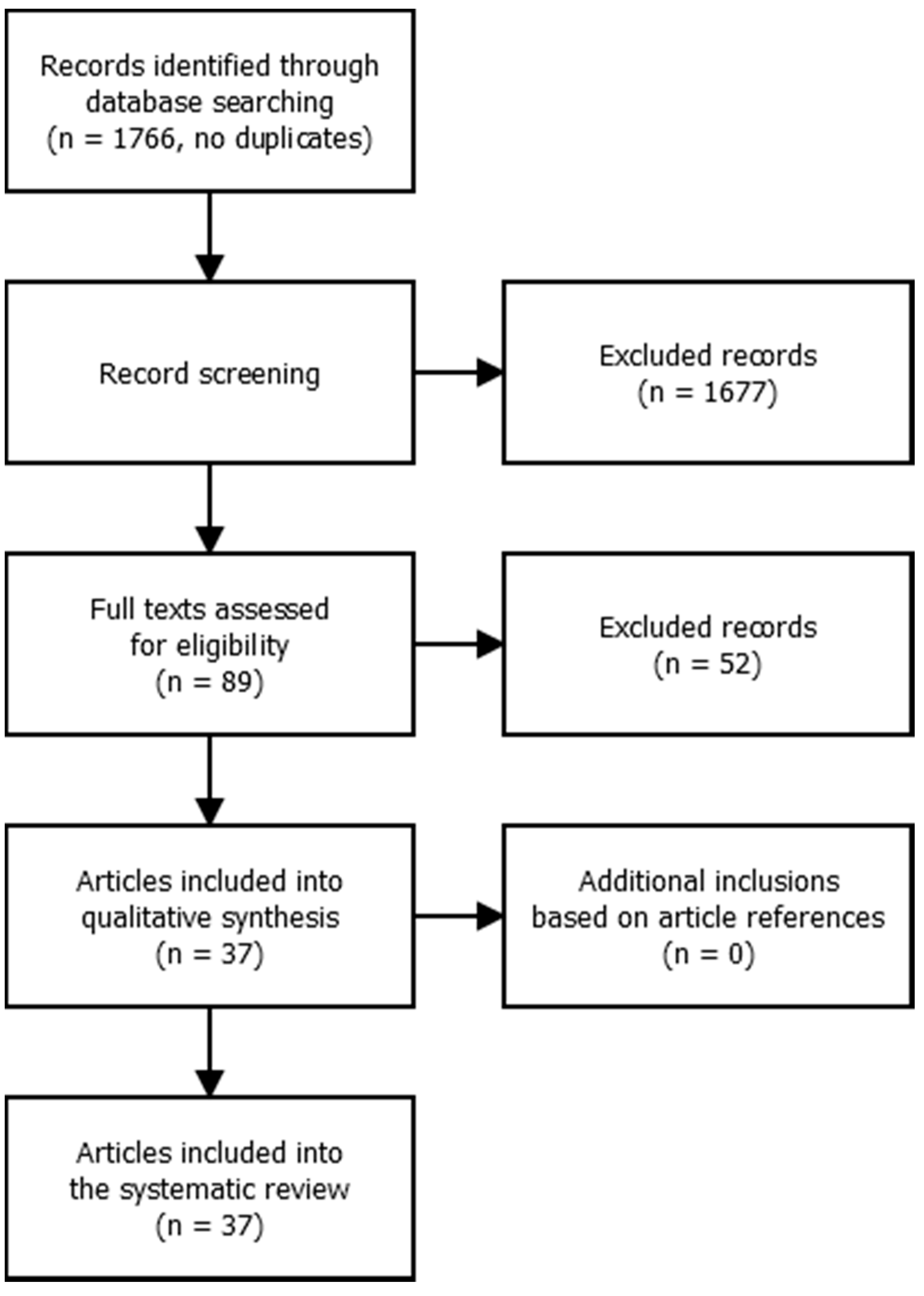
One rater screened the 1766 sources for potential inclusion in the review and a total of 89 articles were identified as potentially eligible. Two raters separately evaluated each of the identified articles for eligibility and a total of 37 articles were included in the review after this step. Initial rater agreement was 82%, with a Cohen’s κ of 0.65, which is considered as indicative of good interrater agreement [17]. After a group discussion of the sources all disagreements were resolved. See Table 1 for all included studies and see Figure 1 for a step-by-step description of the article inclusion process.

Table 1.
Summary of analyzed articles.
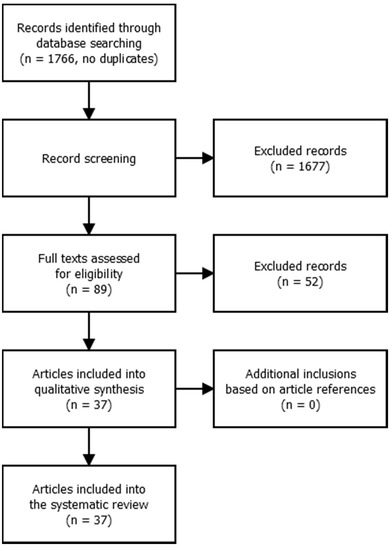
Figure 1.
The process of article inclusion in the systematic review following the PRISMA methodology.
3. Results
The 37 studies included into the systematic review underwent qualitative analysis and synthesis and the main points of each source were briefly summarized alongside the relevant system levels discussed in each source (see Table 1). Overall, many of the included sources were relevant to all system levels—political, societal, and organizational, touching upon how the adoption of locally novel sustainable wastewater treatment and/or management technologies relies on the joint cooperation of all involved stakeholders.
The findings of the systematic review were further condensed into the main points of hindering technology adoption at each system level, providing a concise list of areas that need to be addressed in order to drive the acceptance of the wastewater treatment and/or management technologies (Table 2). Each system level has its own barriers that it needs to overcome, but tackling these barriers is not a localized action, it requires interaction between all systems participating in the process of change.
Table 2.
A systems-theory approach to wastewater treatment technology adoption.
4. Discussion
As evidenced by the data presented in Table 1 and the obstacles identified in Table 2, there is an interdependence among all three system levels where one system cannot act in enabling adoption of new technology if it does not receive the needed inputs from the other systems. For example, the political system could propose novel regulations regarding wastewater treatment if it perceives a societal pressure to do so, yet communities cannot exert such pressure if they lack the knowledge and understanding needed regarding various solutions—an input that could reasonably come from the organizational level. This web of interdependence in moving forward with innovations illustrates the need for a more integrated dialogue between all stakeholders, so that businesses and organizations can provide the necessary information for both communities and lawmakers on what is infrastructurally possible and economically viable, helping communities develop an informed opinion regarding the matter and voice their opinion in such a way that it results in appropriate legal regulations and enabling.
When analyzing the way open systems interact, we must consider the concept of equifinality—the ability for a system to achieve desired results through a multitude of paths [10,12]. For wastewater treatment technology adoption this means that organizations can be persuaded to adopt novel practices and technologies through legal means and regulation, voluntarily, or based on the perceived pressure from the consumer, meaning that there is no universal one-best-way of achieving sustainable technology adoption and the process will be different under different interacting systems and the level of their openness [10].
Open systems interact by exchanging inputs and outputs, thus sustaining themselves in a state of equilibrium if the needs of the interacting systems are met. Any type of change in one system introduces disturbances in all related systems, thus there is a need for a balanced approach where none if the interacting systems requires more than other systems can provide. Regulation and social pressure might be a strong input for organizations providing services and goods, but if organizations are unable to accommodate the requirements posed to them—if there is a mismatch between their real outputs and the outputs expected by related systems—this results in neither system operating optimally. It follows that legal requirements and regulations, as well as societal pressure and expectations, should not exceed what is currently possible to achieve by organizations in terms of sustainable outcomes. Effective change, in this regard, needs to be gradual and evolutionary, building on existing capacities and introducing gradual changes that all stakeholders have agreed upon.
In order to achieve realistic and sustainable change, all interacting systems need to understand their interdependence and work together, through an informed and practical bottom-up perspective. This requires not only understanding what is possible technologically and financially, but understanding one’s own goals and clearly communicating them to other stakeholders. If we take the interaction between the political environment, communities, and organizations as a singular organism, we cannot expect that one part of the whole can be improved at the expense of others.
5. Conclusions
The main barriers to novel (both locally and overall) wastewater treatment technology adoption are the lack of willingness to share the R&D cost the development of such technology by governments, the lack of a clear direction in which the industry should go, and the lack of clear and reasonable regulations regarding wastewater treatment.
Communities can be a strong force in promoting positive change in wastewater treatment technology adoption, however this requires their willingness to act, having relevant knowledge regarding possible technological solutions, and favorable attitudes toward such technology. Communities have the possibility to both affect change through collective action if they vocalize their needs to governing bodies and exert financial pressure on organizations by choosing to vote with their money and purchasing goods and services from those organizations that meet their expectations.
Author Contributions
Conceptualization, M.S.P.; A.B., and L.J.; methodology, M.S.P.; writing—original draft, M.S.P.; writing—review and editing, M.S.P., A.B. and L.J.; formal analysis, M.S.P. and L.J. All authors have read and agreed to the published version of the manuscript.
Funding
The current research is part of the Waste2Fresh project. The Waste2Fresh project has received funding from the European Union’s Horizon 2020 research and innovation program under GA No. 958491.
Institutional Review Board Statement
Not applicable.
Informed Consent Statement
Not applicable.
Data Availability Statement
The manuscript has no data associated with it other than that presented in Table 1.
Conflicts of Interest
The authors declare no conflict of interest.
References
- Ellen_MacArthur_Foundation. A New Textiles Economy: Redesigning Fashion’s Future. Available online: https://www.ellenmacarthurfoundation.org/publications/a-new-textiles-economy-redesigning-fashions-future (accessed on 7 July 2020).
- Šajn, N. Environmental Impact of the Textile and Clothing Industry; EPRS, European Parliamentary Research Service: Brussels, Belgium, 2019. [Google Scholar]
- Rather, L.J.; Jameel, S.; Dar, O.A.; Ganie, S.A.; Bhat, K.A.; Mohammad, F. Advances in the sustainable technologies for water conservation in textile industries. In Water in Textiles and Fashion; Elsevier: Amsterdam, The Netherlands, 2019; pp. 175–194. [Google Scholar]
- Rulkens, W.H. Sustainable development in industry by closing water loops: Technological aspects and expected future developments. In Chemistry for the Protection of the Environment 4; Springer: Boston, MA, USA, 2005; pp. 223–253. [Google Scholar]
- Cipolletta, G.; Ozbayram, E.G.; Eusebi, A.L.; Akyol, Ç.; Malamis, S.; Mino, E.; Fatone, F. Policy and legislative barriers to close water-related loops in innovative small water and wastewater systems in Europe: A critical analysis. J. Clean. Prod. 2021, 288, 125604. [Google Scholar] [CrossRef]
- Baron, D.P.; Agus Harjoto, M.; Jo, H. The Economics and Politics of Corporate Social Performance. Bus. Polit. 2011, 13, 1–46. [Google Scholar] [CrossRef] [Green Version]
- Davis, F.D. Perceived Usefulness, Perceived Ease of Use, and User Acceptance of Information Technology. MIS Q. 1989, 13, 319. [Google Scholar] [CrossRef] [Green Version]
- Tom Dieck, M.C.; Jung, T. A theoretical model of mobile augmented reality acceptance in urban heritage tourism. Curr. Issues Tour. 2018, 21, 154–174. [Google Scholar] [CrossRef]
- Copeland, A.M.; Shapiro, A.H. The Impact of Competition on Technology Adoption: An Apples-to-PCs Analysis. SSRN Electron. J. 2010. [Google Scholar] [CrossRef] [Green Version]
- Von Bertalanffy, L. The History and Status of General Systems Theory. Acad. Manag. J. 1972, 15, 407–426. [Google Scholar]
- Fu, Y.; Kok, R.A.W.; Dankbaar, B.; Ligthart, P.E.M.; van Riel, A.C.R. Factors affecting sustainable process technology adoption: A systematic literature review. J. Clean. Prod. 2018, 205, 226–251. [Google Scholar] [CrossRef]
- Van Assche, K.; Verschraegen, G.; Valentinov, V.; Gruezmacher, M. The social, the ecological, and the adaptive. Von Bertalanffy’s general systems theory and the adaptive governance of social-ecological systems. Syst. Res. Behav. Sci. 2019, 36, 308–321. [Google Scholar] [CrossRef]
- Veugelers, R. Which policy instruments to induce clean innovating? Res. Policy 2012, 41, 1770–1778. [Google Scholar] [CrossRef]
- Cecere, G.; Corrocher, N.; Gossart, C.; Ozman, M. Lock-in and path dependence: An evolutionary approach to eco-innovations. J. Evol. Econ. 2014, 24, 1037–1065. [Google Scholar] [CrossRef]
- Rousseau, D. General Systems Theory: Its Present and Potential. Syst. Res. Behav. Sci. 2015, 32, 522–533. [Google Scholar] [CrossRef]
- Keshminder, J.; Río, P. The missing links? The indirect impacts of drivers on eco-innovation. Corp. Soc. Responsib. Environ. Manag. 2019, 26, 1100–1118. [Google Scholar] [CrossRef]
- Landis, J.R.; Koch, G.G. The Measurement of Observer Agreement for Categorical Data. Biometrics 1977, 33, 159. [Google Scholar] [CrossRef] [Green Version]
- Harris-Lovett, S.R.; Binz, C.; Sedlak, D.L.; Kiparsky, M.; Truffer, B. Beyond User Acceptance: A Legitimacy Framework for Potable Water Reuse in California. Environ. Sci. Technol. 2015, 49, 7552–7561. [Google Scholar] [CrossRef] [Green Version]
- Thiam, D.R.; Dinar, A.; Ntuli, H. Promotion of Residential Water Conservation Measures in South Africa: The Role of Water-Saving Equipment; Springer: Tokyo, Japan, 2021; Volume 23, ISBN 0123456789. [Google Scholar]
- Akhoundi, A.; Nazif, S. Sustainability assessment of wastewater reuse alternatives using the evidential reasoning approach. J. Clean. Prod. 2018, 195, 1350–1376. [Google Scholar] [CrossRef]
- Verstraete, W.; Vlaeminck, S.E. ZeroWasteWater: Short-cycling of wastewater resources for sustainable cities of the future. Int. J. Sustain. Dev. World Ecol. 2011, 18, 253–264. [Google Scholar] [CrossRef] [Green Version]
- Sherman, L.; Cantor, A.; Milman, A.; Kiparsky, M. Examining the complex relationship between innovation and regulation through a survey of wastewater utility managers. J. Environ. Manag. 2020, 260, 110025. [Google Scholar] [CrossRef] [PubMed]
- Sun, H.; Zhang, H.; Zou, X.; Li, R.; Liu, Y. Water reclamation and reuse. Water Environ. Res. 2019, 91, 1080–1090. [Google Scholar] [CrossRef] [Green Version]
- Lyu, S.; Chen, W.; Zhang, W.; Fan, Y.; Jiao, W. Wastewater reclamation and reuse in China: Opportunities and challenges. J. Environ. Sci. 2016, 39, 86–96. [Google Scholar] [CrossRef]
- Kenney, S. Purifying water: Responding to public opposition to the implementation of direct potable reuse in California. UCLA J. Environ. Law Policy 2019, 37, 85. [Google Scholar] [CrossRef]
- Simha, P.; Lalander, C.; Ramanathan, A.; Vijayalakshmi, C.; McConville, J.R.; Vinnerås, B.; Ganesapillai, M. What do consumers think about recycling human urine as fertiliser? Perceptions and attitudes of a university community in South India. Water Res. 2018, 143, 527–538. [Google Scholar] [CrossRef] [PubMed]
- Brunner, N.; Starkl, M. Financial and economic determinants of collective action: The case of wastewater management. Environ. Impact Assess. Rev. 2012, 32, 140–150. [Google Scholar] [CrossRef]
- Sutherland, C.; Reynaert, E.; Dhlamini, S.; Magwaza, F.; Lienert, J.; Riechmann, M.E.; Buthelezi, S.; Khumalo, D.; Morgenroth, E.; Udert, K.M.; et al. Socio-technical analysis of a sanitation innovation in a peri-urban household in Durban, South Africa. Sci. Total Environ. 2021, 755. [Google Scholar] [CrossRef]
- Prouty, C.; Mohebbi, S.; Zhang, Q. Extreme weather events and wastewater infrastructure: A system dynamics model of a multi-level, socio-technical transition. Sci. Total Environ. 2020, 714, 136685. [Google Scholar] [CrossRef] [PubMed]
- Verdhen, A. Drinking Water Supply and Sanitation: A Typical Syndrome in Sub-Urban Rural Areas: Require Scientific and Technological Intervention. Glob. J. Enterp. Inf. Syst. 2015, 7, 7. [Google Scholar] [CrossRef]
- Jiménez-Benítez, A.; Ferrer, F.J.; Greses, S.; Ruiz-Martínez, A.; Fatone, F.; Eusebi, A.L.; Mondéjar, N.; Ferrer, J.; Seco, A. AnMBR, reclaimed water and fertigation: Two case studies in Italy and Spain to assess economic and technological feasibility and CO2 emissions within the EU Innovation Deal initiative. J. Clean. Prod. 2020, 270, 122398. [Google Scholar] [CrossRef]
- Quezada, G.; Walton, A.; Sharma, A. Risks and tensions in water industry innovation: Understanding adoption of decentralised water systems from a socio-technical transitions perspective. J. Clean. Prod. 2016, 113, 263–273. [Google Scholar] [CrossRef]
- Zurita, F.; Roy, E.D.; White, J.R. Municipal wastewater treatment in Mexico: Current status and opportunities for employing ecological treatment systems. Environ. Technol. 2012, 33, 1151–1158. [Google Scholar] [CrossRef]
- Kandiah, V.; Binder, A.R.; Berglund, E.Z. An Empirical Agent-Based Model to Simulate the Adoption of Water Reuse Using the Social Amplification of Risk Framework. Risk Anal. 2017, 37, 2005–2022. [Google Scholar] [CrossRef] [PubMed]
- Ellis, S.F.; Savchenko, O.M.; Messer, K.D. What’s in a name? Branding reclaimed water. Environ. Res. 2019, 172, 384–393. [Google Scholar] [CrossRef] [Green Version]
- Sánchez, I.M.R.; Ruiz, J.M.M.; López, J.L.C.; Pérez, J.A.S. Effect of environmental regulation on the profitability of sustainable water use in the agro-food industry. Desalination 2011, 279, 252–257. [Google Scholar] [CrossRef]
- Huang, W.L.; Welch, E.W.; Corley, E.A. Public sector voluntary initiatives: The adoption of the environmental management system by public waste water treatment facilities in the United States. J. Environ. Plan. Manag. 2014, 57, 1531–1551. [Google Scholar] [CrossRef]
- Eggen, R.I.L.; Hollender, J.; Joss, A.; Schärer, M.; Stamm, C. Reducing the discharge of micropollutants in the aquatic environment: The benefits of upgrading wastewater treatment plants. Environ. Sci. Technol. 2014, 48, 7683–7689. [Google Scholar] [CrossRef] [PubMed]
- Parker, D.S. Introduction of New Process Technology into the Wastewater Treatment Sector. Water Environ. Res. 2011, 83, 483–497. [Google Scholar] [CrossRef] [Green Version]
- Guerrini, A.; Romano, G.; Mancuso, F.; Carosi, L. Identifying the performance drivers of wastewater treatment plants through conditional order-m efficiency analysis. Util. Policy 2016, 42, 20–31. [Google Scholar] [CrossRef] [Green Version]
- Garcia, X.; Barceló, D.; Comas, J.; Corominas, L.; Hadjimichael, A.; Page, T.J.; Acuña, V. Placing ecosystem services at the heart of urban water systems management. Sci. Total Environ. 2016, 563–564, 1078–1085. [Google Scholar] [CrossRef]
- Zhang, L.; Dong, H.; Geng, Y.; Francisco, M.J. China’s provincial grey water footprint characteristic and driving forces. Sci. Total Environ. 2019, 677, 427–435. [Google Scholar] [CrossRef]
- Hou, Y.; Velthof, G.L.; Case, S.D.C.; Oelofse, M.; Grignani, C.; Balsari, P.; Zavattaro, L.; Gioelli, F.; Bernal, M.P.; Fangueiro, D.; et al. Stakeholder perceptions of manure treatment technologies in Denmark, Italy, the Netherlands and Spain. J. Clean. Prod. 2018, 172, 1620–1630. [Google Scholar] [CrossRef]
- Barquet, K.; Järnberg, L.; Rosemarin, A.; Macura, B. Identifying barriers and opportunities for a circular phosphorus economy in the Baltic Sea region. Water Res. 2020, 171, 115433. [Google Scholar] [CrossRef] [PubMed]
- Popp, D.; Hafner, T.; Johnstone, N. Environmental policy vs. public pressure: Innovation and diffusion of alternative bleaching technologies in the pulp industry. Res. Policy 2011, 40, 1253–1268. [Google Scholar] [CrossRef]
- Ormerod, K.J. Illuminating elimination: Public perception and the production of potable water reuse. Wiley Interdiscip. Rev. Water 2016, 3, 537–547. [Google Scholar] [CrossRef] [Green Version]
- Paranychianakis, N.V.; Salgot, M.; Snyder, S.A.; Angelakis, A.N. Water reuse in EU states: Necessity for uniform criteria to mitigate human and environmental risks. Crit. Rev. Environ. Sci. Technol. 2015, 45, 1409–1468. [Google Scholar] [CrossRef]
- Carr, G.; Potter, R.B. Towards effective water reuse: Drivers, challenges and strategies shaping the organisational management of reclaimed water in Jordan. Geogr. J. 2013, 179, 61–73. [Google Scholar] [CrossRef]
- Farrelly, M.A.; Brown, R.R. Making the implicit, explicit: Time for renegotiating the urban water supply hydrosocial contract? Urban Water J. 2014, 11, 392–404. [Google Scholar] [CrossRef]
- Yu, Z.L.T.; Rahardianto, A.; DeShazo, J.R.; Stenstrom, M.K.; Cohen, Y. Critical Review: Regulatory Incentives and Impediments for Onsite Graywater Reuse in the United States. Water Environ. Res. 2013, 85, 650–662. [Google Scholar] [CrossRef]
- McClelland, C.J.; Linden, K.; Drewes, J.E.; Khan, S.J.; Raucher, R.; Smith, J. Determining key factors and challenges that affect the future of water reuse. J. Water Supply Res. Technol. AQUA 2012, 61, 518–528. [Google Scholar] [CrossRef]
- Terryn, I.C.; Lazar, G. Driving forces affecting the adoption of eco-innovation: A survey on vacuum sewer systems. Environ. Eng. Manag. J. 2016, 15, 589–598. [Google Scholar]
- Fam, D.M.; Mitchell, C.A. Sustainable innovation in wastewater management: Lessons for nutrient recovery and reuse. Local Environ. 2013, 18, 769–780. [Google Scholar] [CrossRef]
- Domènech, L.; Saurí, D. Socio-technical transitions in water scarcity contexts: Public acceptance of greywater reuse technologies in the Metropolitan Area of Barcelona. Resour. Conserv. Recycl. 2010, 55, 53–62. [Google Scholar] [CrossRef]
Publisher’s Note: MDPI stays neutral with regard to jurisdictional claims in published maps and institutional affiliations. |
© 2021 by the authors. Licensee MDPI, Basel, Switzerland. This article is an open access article distributed under the terms and conditions of the Creative Commons Attribution (CC BY) license (https://creativecommons.org/licenses/by/4.0/).