


Abstract
With the growing demand for electricity, the inability of governments to provide the necessary resources to invest in the electricity industry and the rising price of fossil fuels, the tendency is to study and pay attention to economic issues in power systems studies. In this paper a new modified version of gray wolf optimization (MGWO) is proposed to solve the unit commitment (UC) problem in a power system in case of uncertainty. Market price variation is the main source of uncertainty in the UC program. Therefore, a model based on normal probability density function (PDF) is present for reducing the market price uncertainty effect in the model. Simulations are done for a standard 10 thermal units power system, and the results of the optimization by the proposed MGWO are compared with the previous version of the GWO algorithm and particle swarm optimization (PSO) algorithm results. The simulation results confirm the superiority of the proposed MGWO algorithm over the two algorithms PSO and GWO.
1. Introduction
These days, factors involving rise in energy consumption, common use of fossil fuels as input sources and the related environmental issues make fossil energy sources a more challenging subject [1]. The use of distributed generation sources in the power system has valuable benefits and costs for the system. Additionally, introducing the distributed generation resources to the market poses a serious challenge for owners of these resources [2]. The first reason to be mentioned is the uncertainty of the projected electricity output of distributed generation sources [3]. Reducing the power system operation costs is one of the most important issue in power system studies. Due to the development of interconnected power systems and their enlargement, the unit commitment (UC) program has undergone extensive changes [4]. The UC program is not as easily solved as in the past. On the other hand, with the increase in the number of renewable power generation units in recent decades, which have helped to solve the problem of electricity shortage, the UC problem has become more complex [5]. Therefore, the UC program should be done more accurately and with more criteria in mind. Several methods are used for solving the UC program.
The traditional methods used for solving UC program include linear programming (LP) [6], nonlinear programming (NLP) [7] and dynamic programming methods [8]. In Reference [9], a UC in the power system provides a combination of on/off power generation units and continuous power sharing. The problem is solved in both cases by linear programming and mixed integer linear programming (MILP). The optimization model based on economic MILP was proposed in [10] to plan the power generation of units. Additionally, a demand response program has been used to solve the variable problem with the time required load, to improve the load factor and to improve peak shaving. The program has been implemented by considering GAMS software and considering investment, replacement, operation and maintenance costs. The weakness of traditional methods is trapping in local optimal points and sometimes their lack of convergence.
In recent years, since the introduction of new innovative algorithms, they have been used extensively to solve UC problem in the power system. In Reference [11], the whale algorithm, along with using a series of possible indicators and success indicators of the participation program in the performance function, are used to reduce the power system operation cost. In Reference [12], a UC based on fuzzy logic is proposed to smooth the load profile of the network in the presence of distributed generation sources. In this model, the fluctuations of the load profile and peak load are reduced. The proposed method has shown better results compared to traditional UC methods. In Reference [13], a multi-objective method is proposed for solving UC problem to minimize operating costs and emission. In Reference [14], a decentralized method based on a multi-operating system is proposed to plan the participation of units and distributed generation resources in the power system. All consumers, distributed generation units and main network are considered as agents. In Reference [15], a (UC) in the power system is proposed by considering the load response program and storage maker with renewable resources in order to reduce the peak and reduce costs. Customers are encouraged to participate in planning using the demand response program.
The rest of this paper is organized as follows. In Section 2, the problem formulation is given. In this part, the objective function and unit commitment constraints are presented. The proposed GWO algorithm is briefly introduced in Section 3. In Section 4, the under-study power system is presented then the simulation results are analyzed. Finally, this article concludes in Section 5.
2. Problem Formulation
The unit commitment issue is usually described using a goal function and a series of constraints in the power system. The objective function is the issue of operating costs and pollution, which must be minimized using optimization methods.
2.1. Objective Function, Maximizing Profits
The UC program is also used to reduce operation costs or increase profitability. In this paper, increasing the profitability is selected as the objective function. Profitability will be maximized when the revenue increases and costs decrease. The objective function is calculated by Equation (1).
where PDem(t) is electrical demand and λ(t) is the electrical energy price per kilowatt at time t. FCi is the fuel cost, Pi(t) is the electrical power generation at time t and SUC is the stochastic unit commitment power; additionally, αi(t) and βi(t) are cost coefficients. In Equation (1), which shows the amount of profit, the first expression is representing the income from production capacity of units, and the second expression is representing the costs. In Equation (2), the amount of revenue is equal to the amount of power generated by the units in the market price. In Equation (3), the first phrase indicates the cost of generated power by the units and the second phrase indicates the cost of turning on the unit [16].
where, ai, bi and ci are fuel cost coefficients.
2.2. Constraints of Thermal Units
A heating unit can only withstand gradual changes in temperature, which means that a period of several hours is required for the unit to be placed in the orbit. In addition, these units can only produce power within a certain range. Therefore, there are several limitations in the operation of heating units, which are described below.
2.3. Power Balance
Production units must be able to meet the expected demand load. As the unit commitment planning is done for the future operations, load forecasting is based on calculations and the production capacity of the units must provide the predicted load [17].
2.4. Lower and Upper Band for Power in Units
According to the technical specifications of generators, their output power is between the maximum and minimum limits. This constraint is one of the characteristics of every generator and arises from the structure of the generator and is expressed using the following equation [17]:
where and are the lower and upper band for unit generation capacity, respectively.
2.5. Slope Limits for Each Unit
The rate of increase and decrease of production capacity of units is limited [17].
where RUPi and DRNi are the maximum incremental and decremental rates, respectively.
2.6. Minimum off and on Time for Each Unit
Since the heating unit can only withstand gradual changes in temperature, it should not be turned off immediately when a unit is operating. Additionally, when a thermal unit is out of circuit, it needs a minimum of time to be able to re-enter the circuit [18].
where, MUP is the minimum up time and MDN is the minimum down time.
3. Modified Gray Wolf Algorithm
The gray wolf algorithm is a particle-based metaheuristic algorithm. Gray wolves live in groups with an average size of 5 or 12. The group leader is called the alpha and it is mainly responsible for deciding on hunting, sleeping and waking times. The next level in the gray wolf hierarchy is the beta wolf. The beta helps the alpha wolf in making decisions. The beta wolf commands the lower wolves. The lowest level for the gray wolf is the omega. The main phase of gray wolf hunting is divided into three parts: search, running and approaching the hunt. For creating a mathematical model of the hunting, the following equations are proposed [19]:
where Xp shows the position of the gray wolf vector, t is the number of the iteration A and C are vectors coefficients, which are calculated as follows:
where the α is a linear component reduction from 2 to 0 and r1 and r2 are two random numbers. Hunting is usually led by the alpha and the beta wolf also occasionally hunts. The following equations have been suggested in this regard [19]:
When the random value of A is between [−1,1], the next position of the search agent will be in any position between the current position and the hunting position. Gray wolves move away in search of prey and close in on hunting prey. Another component of GWO that detects and identifies is C. The vector C contains random values [0, 2]. This component provides different weights for prey to randomly show the effect of prey on distance detection as significant (C > 1) or insignificant (C < 1). This helps GWO show more random behavior throughout the optimization and avoid local optimization. It should be noted that here, C decreases linearly with respect to A. During the iteration of alpha wolves and beta wolves, it estimates the probable position of the prey. Each selected solution updates its distance from the bait. Parameter a is reduced from 2 to 0 to emphasize identification and operation, respectively. Selected solutions tend to diverge from prey at |A| >1 and tend to converge at prey at |A| <1. Finally, the GWO algorithm ends with the satisfaction of a final criterion. Mutants are done for the omega wolves in a modified version of the GWO algorithm. The mutant for omega wolves is done by Equation (18).
where, Mf is the mutant rate, r is random and Maxval and Minval are the maximum and minimum limits, respectively. How to perform the optimization to solve the UC problem is given in Table 1.

Table 1.
Solve the UC problem using MGWO.
4. Case Study
In this paper, the short-term planning of the units’ commitment was conducted for of 24 h and 1 h intervals. The system of 10 machines with 10 thermal units was used for the studies. The amount of cargo and the predicted price are shown in Table 2. The specifications of the heating units are also given in Reference [20].
Table 2.
Load specifications and market price.
Short-term planning of unit commitment is one of the most necessary plans for units’ commitment. In order to evaluate the efficiency of the proposed MGWO algorithm, the gray wolf optimization (GWO) and particle swarm optimization (PSO) algorithms were used for optimization. The parameters of the algorithms are given in Table 3.
Table 3.
Optimization algorithms parameters.
In this type of planning, the constraints of the minimum on and off time, the minimum and maximum production of units, etc. should be considered. However, its generalization to medium- and long-term planning of units’ participation is shortcoming. This is because those conditions do not consider the forced departure of units, maintenance costs, etc. Data about market price and unit information are extracted from Reference [20].
4.1. Uncertainty
Uncertainty occurs when the output is random and uncontrollable for us. Furthermore, its mathematical concept is the difference between real and the predicted values. According to the previous studies, uncertainty is related to environmental, economic, political and other factors. Uncertainty in planning the units’ commitment is due to uncertainty in the market price.
4.2. Price Modeling
As mentioned before, random planning tries to model the random behavior of market prices.
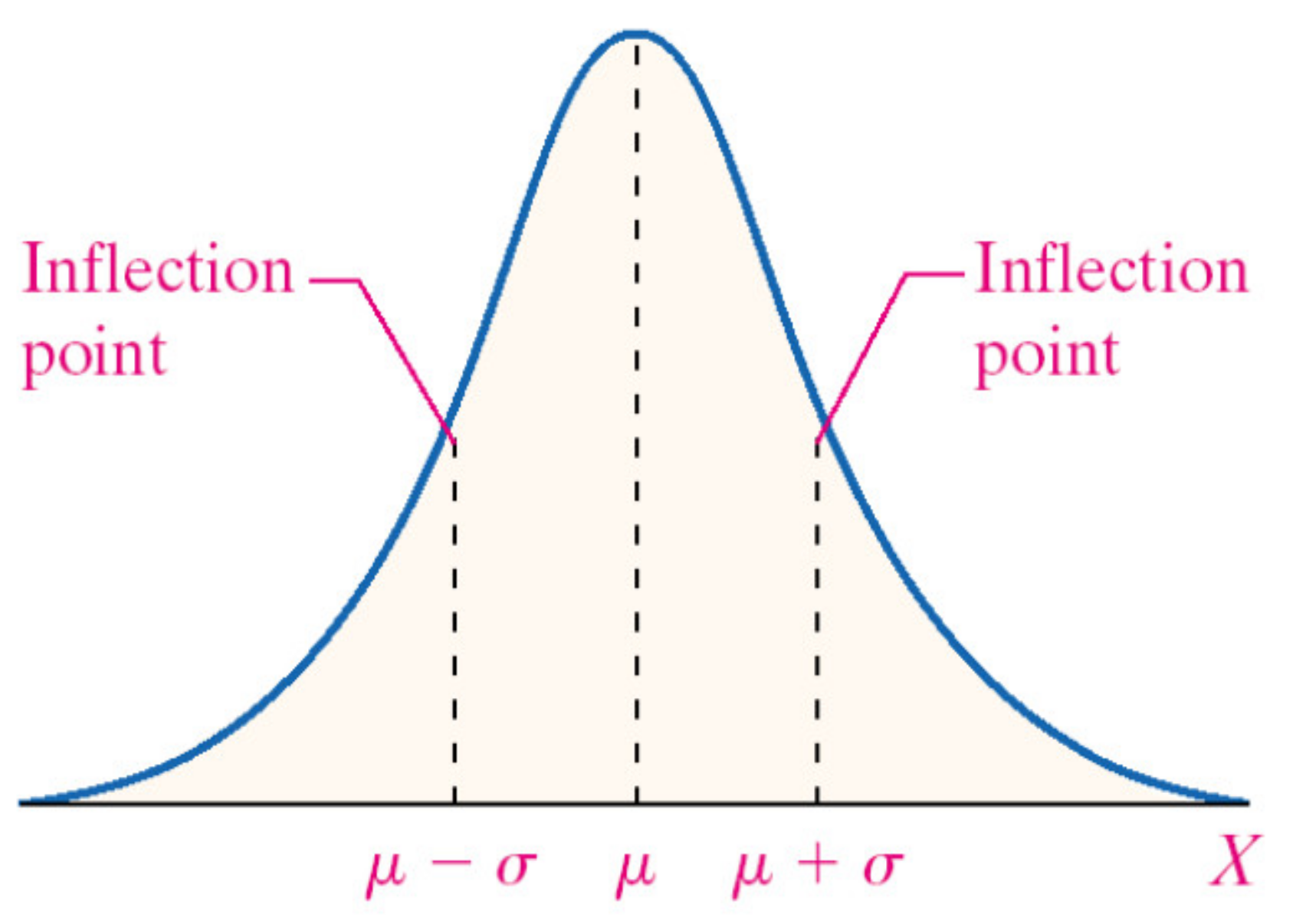
In studies, price uncertainty is usually considered as a price prediction error [21]. To model price uncertainty, a normal distribution function of is usually used, for which the mean value is and the standard deviation value is . The normal distribution function can be approximated using several discrete intervals, each interval being represented by its midpoint. For example, five intervals can be referred to as shown in the Figure 1. In this study, a standard deviation of 5 is considered for modeling price uncertainty. The price values and probabilities of each scenario are shown in the Table 4 and Table 5. The normal probability density function is shown as follows [21]:
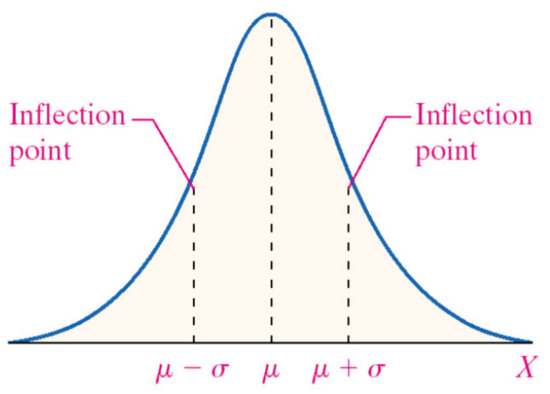
Figure 1.
Normal probability density function base on [21].
Table 4.
Price values in scenarios in dollars.
Table 5.
Probability values of each scenario.
Solving the problem while considering the uncertainty is based on a set of scenarios, which are defined by sampling the possible distributions; the problem is then solved for each of these scenarios. The final answer to the problem will be the average weight obtained from these scenarios. The purpose of this paper is short-term random planning of units’ commitment in a 24 h planning horizon. The sample system studied in this paper includes 10 thermal units. The values and probability values of each scenario are shown in the Table 4 and Table 5.
Planning is evaluated in the form of two cases of without and with considering the uncertainty in the market price.
4.3. Planning without Considering the Uncertainty in the Market Price
In this case, unit commitment planning is done for a system of 10 units. Unit commitment planning is done for various purposes, including unit commitment planning with security constraints and unit commitment planning based on price. In this case, we plan the participation of units with the aim of minimizing.
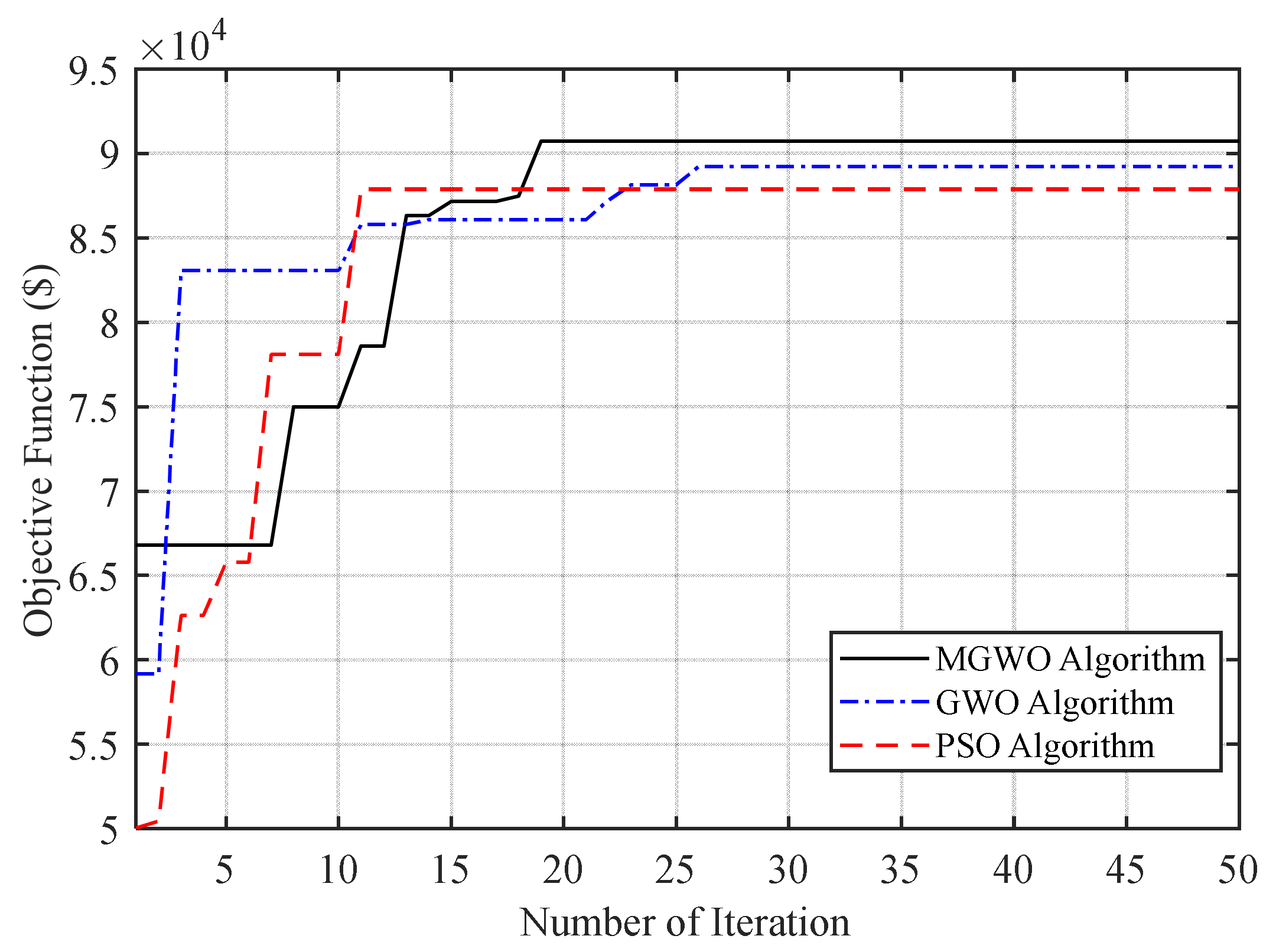
Table 6 shows the storage values in this case. As can be seen from Table 6, the units that produced less power played a greater role in providing system storage. The final value of the objective function in this case is about $90,718. The convergence curves of the algorithms are shown in Figure 2.
Table 6.
Output power of units without uncertainty.
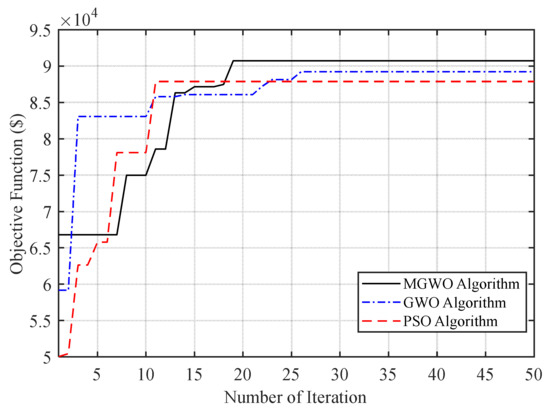
Figure 2.
Convergence curves of the algorithms.
Also, Table 7 shows storage values in the case of uncertainty. The profitability of the UC program after optimization by the PSO algorithm is equal to $87,882, and in case of optimization by the GWO algorithm it is about $89,224. The profitability of the UC using the proposed MGWO is more than the two other algorithms.
Table 7.
Storage values in the case of uncertainty.
4.4. Planning by Considering the Parameter of Uncertainty in the Market Price
In this case, the unit commitment planning was implemented by considering the uncertainty on the market price, which is in the form of five scenarios. The outputs shown are related to scenario number 5.
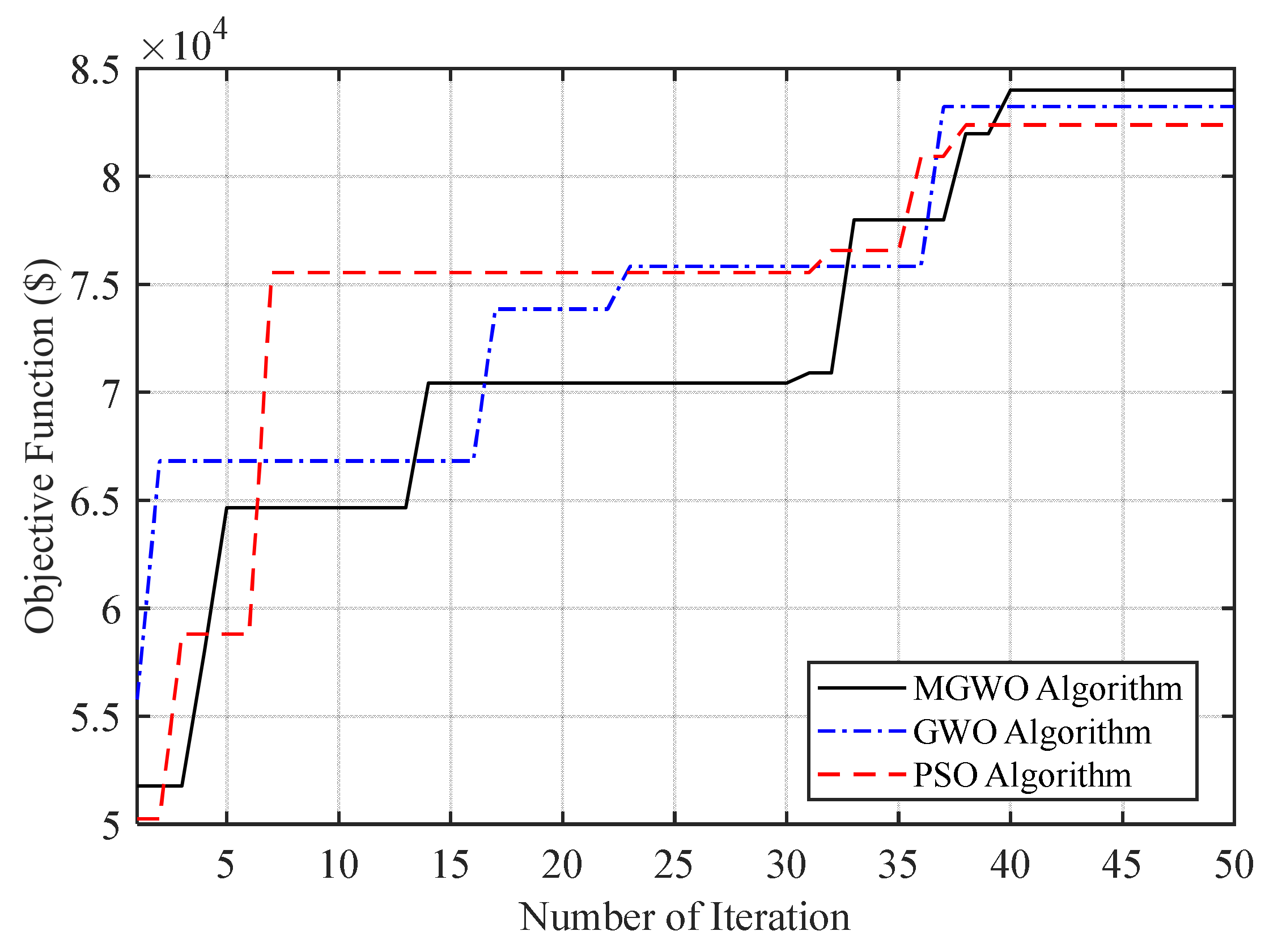
As can be seen from Table 8, units 1 and 2, which are among the cheapest units, produced their maximum power at almost all hours. The final profitability in the case of uncertainty was $84,364. Similar to the previous section, the PSO algorithm and GWO algorithm are used for optimization. The convergence curves of the optimization algorithms are shown in Figure 3.
Table 8.
Output power of units, considering the uncertainty.
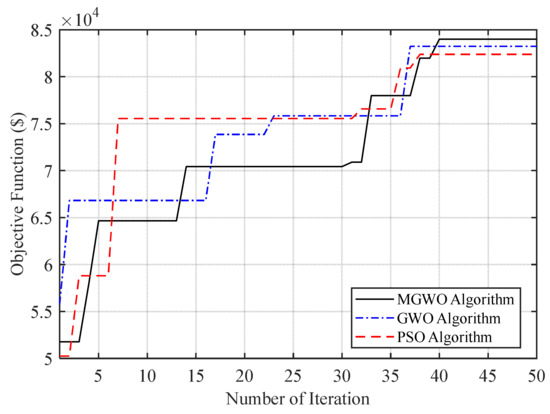
Figure 3.
Convergence curves of the algorithms.
The UC program profitability in case of doing optimization by the PSO algorithm is $82,383 and after optimization by the GWO algorithm is about $83,237. The proposed MGWO profitability is more than the PSO and GWO algorithms.
5. Conclusions
The main purpose of this paper is to present an effective model for optimizing the scheduling of unit commitment in the smart grid environment by considering the uncertainty for random parameters. The main innovation of this article is to implement the issue of unit commitment randomly, taking into account the uncertainty on the market price. Additionally, a modified version of the gray wolf optimization algorithm is proposed for solving unit commitment program. To solve the unit commitment planning issue while considering the uncertainties, a set of scenarios was generated by sampling this probability distribution function and the problem was solved for each of these scenarios; finally, the final answer is a weighted average of the results of these scenarios. Comparison of the optimization results with the proposed MGWO algorithm and its comparison with the results of the gray wolf optimization and particle swarm optimization algorithms confirms the performance of the proposed method.
Author Contributions
The authors contributed equally to this work. All authors have read and agreed to the published version of the manuscript.
Funding
Not applicable.
Institutional Review Board Statement
Not applicable.
Informed Consent Statement
Not applicable.
Data Availability Statement
Not applicable.
Conflicts of Interest
The authors declare no conflict of interests.
References
- Poncelet, K.; Delarue, E.; D’haeseleer, W. Unit commitment constraints in long-term planning models: Relevance, pitfalls and the role of assumptions on flexibility. Appl. Energy 2020, 258, 113843. [Google Scholar] [CrossRef]
- Shokouhandeh, H.; Jazaeri, M.; Sedighizadeh, M. On-time stabilization of single-machine power system connected to infinite bus by using optimized fuzzy-PID controller. In Proceedings of the 2014 22nd Iranian Conference on Electrical Engineering (ICEE), Tehran, Iran, 20–22 May 2014; pp. 768–773. [Google Scholar]
- Shokouhandeh, H.; Jazaeri, M. Robust design of fuzzy-based power system stabiliser considering uncertainties of loading conditions and transmission line parameters. IET Gener. Transm. Distrib. 2019, 13, 4287–4300. [Google Scholar] [CrossRef]
- Cheng, Q.; Ming, B.; Liu, P.; Huang, K.; Gong, Y.; Li, X.; Zheng, Y. Solving hydro unit commitment problems with multiple hydraulic heads based on a two-layer nested optimization method. Renew. Energy 2021, 172, 317–326. [Google Scholar] [CrossRef]
- Zhang, Z.; Du, E.; Teng, F.; Zhang, N.; Kang, C. Modeling frequency dynamics in unit commitment with a high share of renewable energy. IEEE Trans. Power Syst. 2020, 35, 4383–4395. [Google Scholar] [CrossRef]
- Esmaeily, A.; Ahmadi, A.; Raeisi, F.; Ahmadi, M.R.; Nezhad, A.E.; Janghorbani, M. Evaluating the effectiveness of mixed-integer linear programming for day-ahead hydro-thermal self-scheduling considering price uncertainty and forced outage rate. Energy 2017, 122, 182–193. [Google Scholar] [CrossRef]
- Wang, J.; Guo, M.; Liu, Y. Hydropower unit commitment with nonlinearity decoupled from mixed integer nonlinear problem. Energy 2018, 150, 839–846. [Google Scholar] [CrossRef]
- Zou, J.; Ahmed, S.; Sun, X.A. Multistage stochastic unit commitment using stochastic dual dynamic integer programming. IEEE Trans. Power Syst. 2018, 34, 1814–1823. [Google Scholar] [CrossRef]
- Fu, B.; Ouyang, C.; Li, C.; Wang, J.; Gul, E. An improved mixed integer linear programming approach based on symmetry diminishing for unit commitment of hybrid power system. Energies 2019, 12, 833. [Google Scholar] [CrossRef] [Green Version]
- Feng, Z.K.; Niu, W.J.; Wang, W.C.; Zhou, J.Z.; Cheng, C.T. A mixed integer linear programming model for unit commitment of thermal plants with peak shaving operation aspect in regional power grid lack of flexible hydropower energy. Energy 2019, 175, 618–629. [Google Scholar] [CrossRef]
- Reddy, K.S.; Panwar, L.; Panigrahi, B.K.; Kumar, R. Binary whale optimization algorithm: A new metaheuristic approach for profit-based unit commitment problems in competitive electricity markets. Eng. Optim. 2019, 51, 369–389. [Google Scholar] [CrossRef]
- Navin, N.K.; Sharma, R. A fuzzy reinforcement learning approach to thermal unit commitment problem. Neural Comput. Appl. 2019, 31, 737–750. [Google Scholar] [CrossRef]
- Panossian, N.V.; McLarty, D.; Taylor, M.E. Artificial Neural Network for Unit Commitment on Networks with Significant Energy Storage. In Proceedings of the 2019 IEEE Green Technologies Conference (GreenTech), Lafayette, LA, USA, 3–6 April 2019; pp. 1–5. [Google Scholar]
- Koltsaklis, N.E.; Dagoumas, A.S. Incorporating unit commitment aspects to the European electricity markets algorithm: An optimization model for the joint clearing of energy and reserve markets. Appl. Energy 2018, 231, 235–258. [Google Scholar] [CrossRef]
- Bakirtzis, E.A.; Simoglou, C.K.; Biskas, P.N.; Bakirtzis, A.G. Storage management by rolling stochastic unit commitment for high renewable energy penetration. Electr. Power Syst. Res. 2018, 158, 240–249. [Google Scholar] [CrossRef]
- Zhu, X.; Zhao, S.; Yang, Z.; Zhang, N.; Xu, X. A parallel meta-heuristic method for solving large scale unit commitment considering the integration of new energy sectors. Energy 2021, 121829. [Google Scholar] [CrossRef]
- Shokouhandeh, H.; Jazaeri, M. An enhanced and auto-tuned power system stabilizer based on optimized interval type-2 fuzzy PID scheme. Int. Trans. Electr. Energy Syst. 2018, 28, e2469. [Google Scholar] [CrossRef]
- Nikolaidis, P.; Chatzis, S. Gaussian process-based Bayesian optimization for data-driven unit commitment. Int. J. Electr. Power Energy Syst. 2021, 130, 106930. [Google Scholar] [CrossRef]
- Rezaei, H.; Bozorg-Haddad, O.; Chu, X. Grey wolf optimization (GWO) algorithm. In Advanced Optimization by Nature-Inspired Algorithms; Springer: Singapore, 2018; Volume 1, pp. 81–91. [Google Scholar]
- Xu, Y.; Dong, Z.Y.; Zhang, R.; Xue, Y.; Hill, D.J. A decomposition-based practical approach to transient stability-constrained unit commitment. IEEE Trans. Power Syst. 2014, 30, 1455–1464. [Google Scholar] [CrossRef]
- Ghorbani, S.; Unland, R.; Shokouhandeh, H.; Kowalczyk, R. An innovative stochastic multi-agent-based energy management approach for microgrids considering uncertainties. Inventions 2019, 4, 37. [Google Scholar] [CrossRef] [Green Version]
Publisher’s Note: MDPI stays neutral with regard to jurisdictional claims in published maps and institutional affiliations. |
© 2021 by the authors. Licensee MDPI, Basel, Switzerland. This article is an open access article distributed under the terms and conditions of the Creative Commons Attribution (CC BY) license (https://creativecommons.org/licenses/by/4.0/).